“Mom,” my daughter said, in a voice I hadn’t heard since she was nine
and broke my mother’s cut-glass bowl. “Please don’t hang up.”
Those weren’t the four words that changed everything. Those came
eleven seconds later, after the bank manager laid his pen on his desk
very softly, as if the sound might scare something away. I counted
the seconds on the wall clock above his diploma.
“It was my idea,” Karen said.
I was sitting in a leather chair in the manager’s office at the First
Miami Valley Bank branch on Kemp Road in Dayton, Ohio. The phone
was on speaker on the desk in front of me. A young teller stood in the
doorway with her hand over her mouth.
My name is Eleanor Lane. I’m eighty years old, and I’ve banked at that
branch since March 2nd, 1971. That was the day my husband, Harold,
and I opened a joint savings account with forty dollars and promised
the teller we’d never bounce a check.
We never did.
Harold taught shop class at Fairmont High School for thirty-four years.
He died six years ago of a stroke, out in the garden, with a tomato in his
hand. He left me our house on Alder Street, which we paid off in 1994,
a small teacher’s pension, and a $140,000 life insurance policy through the school district.
I put the insurance money in a savings account. I added a little to it every
month and never touched it. That was our rule. The principal was for emergencies and for our grandsons.
At the end of last October, the balance was $87,412.18. I know that number
the way I know my own phone number. I’ve written our balance in a green
ledger every first Monday of the month, at the kitchen table, in pencil, for fifty-three years.
On Thursday, October 19th, I found out that a woman wearing my coat
had walked into my bank and taken sixty-one thousand dollars of it.
The teller in the doorway was Brittany. She’s twenty-six, a cheerful girl
with braces and a gift for remembering names. She’d waited on me for
six years. Over three weeks, she counted out three withdrawals to a woman she thought was me.
On the last visit, the Monday before, Brittany had smiled and asked, “Having a nice week, Mrs. Lane?”
And the woman said, “Lovely, dear.”
“I’m so sorry,” Brittany whispered now. “She knew your birthday. She knew
your mother’s maiden name. She knew about your cat.”
“Pickles,” I said.
“She said Pickles had been sick.”
“He was.”
I’d told Karen. Three weeks earlier, on the phone.
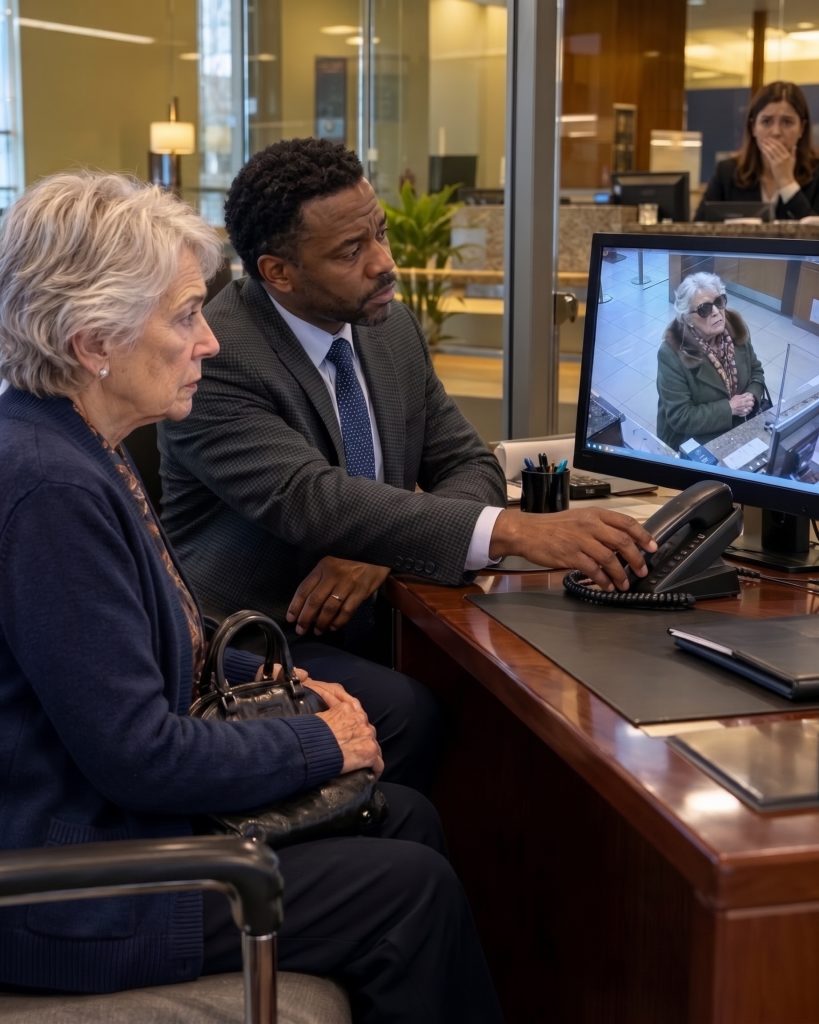
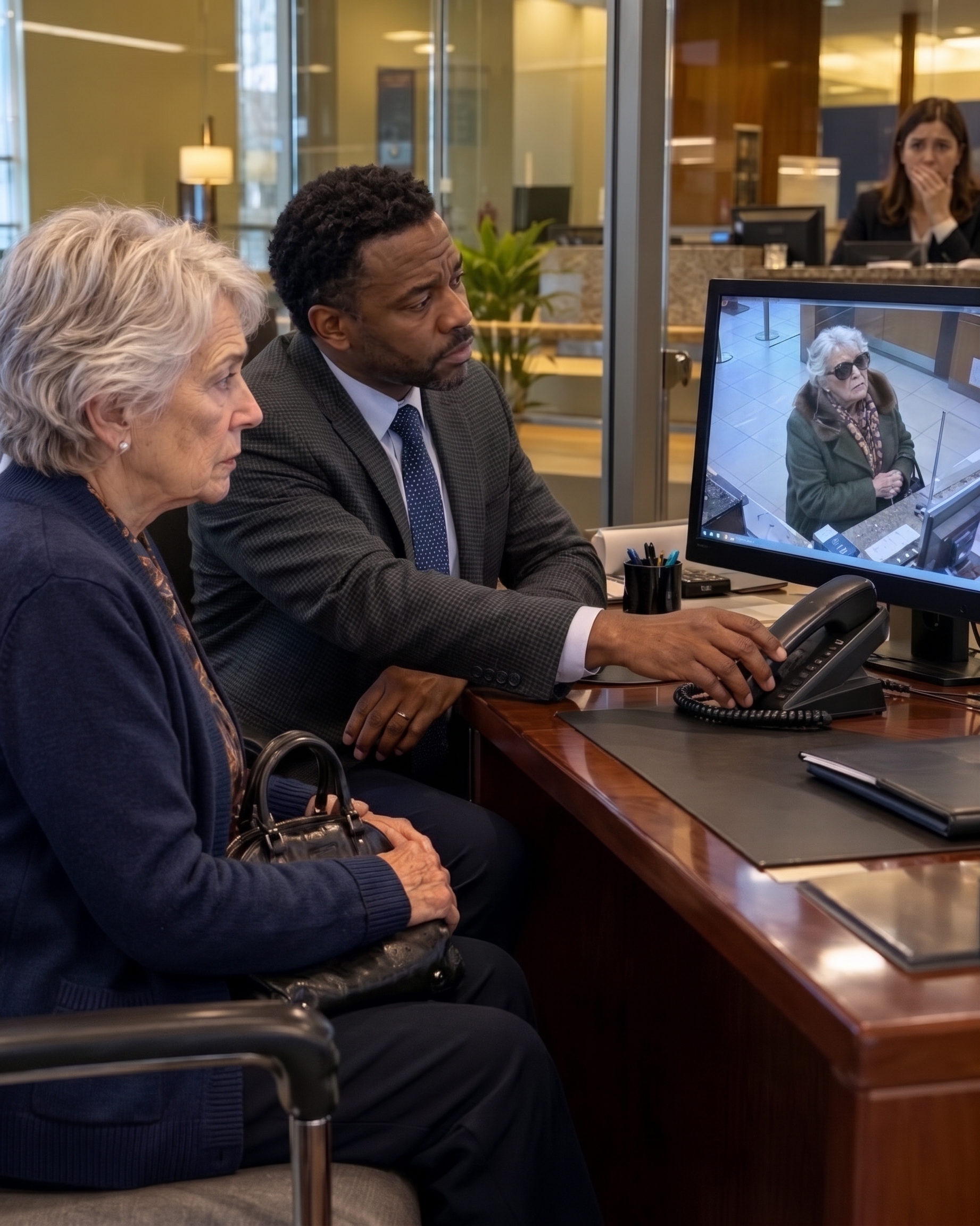
The bank manager, Mr. Okafor, was a gray, careful man of about fifty-five with reading glasses pushed up on his forehead. He’d been the one to call me that morning. A routine fraud review had flagged three large in-person withdrawals from an account that hadn’t had a withdrawal over three hundred dollars in six years. He asked me to come in, and he showed me a printout of the withdrawal slips: $20,000, $21,000, and $20,000, each signed with my name in a hand that wasn’t mine.
He also showed me a still photo from the lobby camera. It was a small gray-haired woman in my green wool coat with the big brass buttons, the one I’d lost at Easter.
I didn’t recognize her face in the grainy image. But I recognized the coat, and I remembered where I’d last seen it.
So I called my daughter from Mr. Okafor’s desk phone and asked her one question: “Karen, where is my green coat?”
The silence on the other end told me everything before she said a word.
Now Karen’s breathing filled the room through the speaker, thin and fast.
“Karen,” I said. “Say it again.”
“It was my idea. Brian, he didn’t even want to.”
“Brian.”
“My husband.”
“I know who Brian is.”
“Mom, I can explain.”
“Then do it,” I said. “Slowly. Mr. Okafor is writing it down.”
I heard her stop breathing.
I should tell you about my daughter.
Karen is fifty-four. She was born in the spring of 1970, the year Harold and I had given up hoping. She was a bright, fierce, funny child with a gap in her front teeth and an endless supply of questions. She wanted to be a veterinarian. She worked at a feed store in high school and won a scholarship to Ohio State.
Then she dropped out in her second year to marry Brian Whitaker, a tall, handsome salesman with a smile like a car showroom. Harold never trusted him.
“He talks too smooth,” Harold used to say. “A man that smooth has got something he’s trying to slide past you.”
Brian sold cars, then boats, then something called “wellness franchising,” which went under in eleven months. They had two boys. Tyler is twenty-three now. Ben was turning seventeen the following week. He’s my favorite, though I’d never say so out loud.
It was Ben’s birthday I’d gone to the bank for that morning. I wanted three hundred dollars for a card with a drawing of a fish on it. He loves to fish. Harold taught him.
Over the years, I’d lent Karen money five times. There was $4,000 in 2009, $11,500 in 2014, and $18,000 in 2019 for “a new roof.” I never asked for a note or for anything in writing. A mother doesn’t.
I never asked what the roof looked like either.
“It started in the spring,” Karen said. Her voice was small and cracked. “Brian opened a gym in Dayton. He took out a loan against the house for two hundred and ten thousand dollars. He didn’t tell me until it was already in default.”
“I see.”
“The bank was going to foreclose in October. We had thirty days.”
“And you didn’t tell me.”
“I was ashamed.”
“Of what?”
“That I’d let it happen. That you’d… that Daddy would have been so…” She broke off. “I couldn’t.”
I opened my eyes. Across the desk, Mr. Okafor was writing steadily on a yellow legal pad. A cuckoo clock, a gift from a retiring teller, ticked beside the filing cabinet.
“So you decided to take it,” I said.
“No! I mean, it wasn’t like that. We were going to put it back.”
“With what?”
“Brian had a deal. A friend. He said it would be a month, two at the most.”
“Karen.” My voice was perfectly level. “How did you get into my account?”
There was a very long silence.
“Brian had your ID.”
“Where did he get it?”
“From your purse. At Easter.”
I thought about that Easter. It was a bright, chilly day. There was a ham, a lamb cake, and the boys hunting eggs in the yard. I hung my green coat on a hook in Karen’s front hall and went home wearing my sweater. I spent six months looking for that coat. I thought I’d left it at church. I even had to order a new driver’s license from the Ohio BMV for $25, because I thought my wallet had been stolen out of my purse at the grocery store.
“And the coat?” I asked.
“Diane wore it,” Karen whispered.
Mr. Okafor put down his pen.
“Diane,” I said, “is Brian’s mother.”
“Yes.”
“She’s seventy-eight years old.”
“Yes.”
“She was in my kitchen at Christmas.”
“I know.”
“She helped me peel potatoes.”
Karen began to cry. It wasn’t the loud, performing cry of her teenage years. It was a low, ragged, gasping sound, like someone being pulled up out of a well.
“I didn’t want her to do it,” she said. “I told Brian we couldn’t. I said she’d be recognized. But he said nobody looks at old ladies. He said the tellers would see the coat and the gray hair and not think twice.”
“He was right,” Brittany said from the doorway, in a stricken whisper.
“He said it was only a loan. From Daddy’s money, which would have come to me anyway.”
“Would it?” I asked.
“Mom.”
“I’d like to know.”
“Yes! Of course! It’s for Ben and Tyler. It’s our family’s money. And I thought, what’s the difference? Now or later?”
I looked at the clock. It was ten past eleven. A thin gold light came through the blinds and lay across the carpet like a ruler.
“The difference, Karen,” I said, “is that I’m alive.”
I didn’t say anything for a while, and neither did she. The line hissed softly. Out in the lobby, a child shrieked happily, and somebody laughed.
I think I’d been bracing for this for years. I’d known its shape without seeing it, the way you know there’s a stair in the dark. Every time Karen said, “Mom, can I borrow,” I heard something underneath the words, like a tide going out. And every time I said yes, because the alternative was saying no and finding out what came after.
“Mr. Okafor,” I said. “What can be done about the money?”
He cleared his throat. He had the air of a man choosing his words the way you’d choose your steps on ice.
“It depends, Mrs. Lane. Federal rules protect customers from unauthorized electronic transfers. But these were in-person withdrawals, at the counter, with a valid ID and correct answers to your security questions. Whether the bank is liable is…” He glanced at Brittany, who flinched. “Arguable. We’ll open a formal fraud claim today, and our legal department will review it. But I don’t want to promise you anything I can’t deliver.”
“I understand.”
“However,” he said, “we have the security footage. We have the forged withdrawal slips. And we now have a confession, on a recorded line, to a scheme involving the identity theft of an elderly customer.”
“That’s a crime.”
“It’s several,” he said gently. “In Ohio, exploiting an elderly person financially is a felony. So is forgery. So is identity fraud. The bank is required to report suspected elder financial abuse to Adult Protective Services and to law enforcement. I’ll be filing that report this afternoon.”
“Would she go to prison?”
“That’s for a prosecutor to decide.”
“Would Diane?”
He hesitated. “Mrs. Lane, I’d like you to think carefully about what you want.”
So I thought about it. I sat in that leather chair in a bank I’d used for fifty-three years, with the speaker light blinking beside me, and I thought about what I wanted.
I wanted my husband. I wanted to wake up and have it be 1982, with Karen twelve years old in a Girl Scout sash, selling cookies door to door with her hair in braids. I wanted not to know.
I realized that not knowing was exactly what I’d been giving my daughter her whole life.
“Karen,” I said. “Are you at home?”
“Yes.”
“Is Brian there?”
“He’s at work.”
“Is Diane?”
A pause. “She’s in the guest room.”
“Good.” I stood up. “I’m coming over. With a police officer and a lawyer. In one hour.”
“Mom, please…”
“And I’d like you to have the money.”
She gasped.
“All of it. Whatever’s left. Whatever you can find in that house. I want it on the kitchen table when I get there.”
“Mom, it’s… most of it’s gone.”
“How much is left?”
“About eleven thousand.”
I closed my eyes. “Where did the other fifty go?”
“The bank,” she sobbed. “Brian paid the arrears on the loan so they’d stop the foreclosure. And the… the kitchen. I’m so sorry. It was Diane’s idea. She said if we were going to do it, we might as well. She said we deserved it.”
“The kitchen.”
“It’s a Wolf range. And quartz countertops.”
I put my hand over my mouth, and God help me, I started to laugh.
I’d like to tell you it was bitterness, but it wasn’t. It was the strange, helpless laughter of a woman being told, at eighty, that her husband’s life insurance had turned into a stove.
“Mom?” Karen said in a thin, frightened voice.
“I’m all right.” I wiped my eyes. “I’m quite all right. I’ll see you in an hour.”
I hung up.
Mr. Okafor sat very still. Brittany came into the room and stood beside him, white-faced, with her hands twisted together.
“Mrs. Lane,” she said, “I’m so sorry. I should have known. There were signs. She wore a hearing aid. You don’t wear one.”
“I don’t.”
“And her hands were so spotted. And she didn’t have the ring.”
I looked at my left hand at the thin gold band, worn smooth. It belonged to Harold’s grandmother.
“You couldn’t have known,” I said.
“I should have asked another security question.”
“You did. She knew the answers.”
“I could have called you. I could have…”
“Brittany.” I took her hand. It was cold and small, with bitten nails. “Look at me.”
She looked.
“You did your job,” I said. “You were kind to an old woman in a coat. That isn’t a crime.”
She burst into tears. I held her there in the manager’s office, among the diplomas and the cuckoo clock, while Mr. Okafor studied his desk blotter with great concentration.
Before I left, he did several things. He froze my savings account and opened a new one with a new account number. He added a note to my file requiring my physical signature to be compared against my signature card for any withdrawal over $500. He set up a verbal password that only I would know, and it wasn’t my mother’s maiden name or my cat’s. He printed copies of the three forged withdrawal slips and the lobby camera stills and put them in a manila folder for me.
Then he made two phone calls. The first was to the Centerville Police Department. The second was to Philip Reyes, the attorney who’d drawn up Harold’s will thirty years ago.
The officer who met us at Karen’s house was a tall, tired woman named Officer Alvarez, with a long gray braid and a notebook. Philip Reyes met me at the curb. He was seventy, in a rumpled brown suit, and had handled probate and estate law in Dayton for forty years.
He took my arm. “Eleanor, are you sure you want to be in the room?”
“I want to look at her.”
“Which her?”
“Both.”
Karen’s house is a gray colonial in Centerville with white shutters, a flagpole, and, I now knew, a brand-new kitchen. It’s a handsome place. I helped her paint the nursery there twenty-three years ago.
She opened the door. She’d put on makeup, and it was smeared. She wore a gray sweatshirt and leggings, her hair in a loose knot, and her eyes were swollen almost shut. For a moment, she looked exactly like the little girl I used to walk to school.
“Mom.”
“Karen.”
“Come in.”
The kitchen was beautiful. I want to be honest about that. It was one of the loveliest rooms I’d ever seen: white cabinets to the ceiling, a marble-look island the size of a canoe, a stainless steel range with six burners and a griddle, a pot rack, and a farmhouse sink under a window that looked out at the maple tree in the backyard.
On the island, in a neat row, lay what she’d found: a bank envelope, a shoebox, a handful of rubber-banded twenties, a jewelry box, and Brian’s watch.
“It’s eleven thousand, four hundred dollars,” she said. “I counted it twice.”
I picked up the envelope and looked at it for a long moment.
Then a voice spoke behind me.
“Eleanor.”
Diane stood in the doorway to the hall.
She’s seventy-eight and my height, five-foot-two, with short gray hair cut in a bob and a face I’d have known anywhere. We’d sat beside each other at church every Sunday for fifteen years. She brought me chicken soup the week Harold died. She wore a navy cardigan and a string of pearls, and she held a cup of tea in both hands.
She looked at me, and I looked at her. For a long moment, neither of us spoke.
“I suppose,” Diane said quietly, “you’d like an explanation.”
“I’ve had one. From Karen.”
“Not mine.”
“No.”
She set down the cup. Her hands trembled, thin and spotted, with swollen knuckles.
“I’d like to say it was Brian’s idea,” she said. “It wasn’t. Not entirely.”
Karen made a small sound. “Diane. Don’t.”
“I’m seventy-eight years old, Karen. I’d like to say it once.”
She stood in that gleaming kitchen in her navy cardigan and told it.
“My husband, Frank, died in 2011,” Diane said. “I never told you how. He’d gambled. Not in a casino. In the stock market, on margin, with money we didn’t have. He lost everything. Then he took his own life.” Her voice was flat and level. “I found him in the garage.”
I put a hand to my chest.
“I was left with a second mortgage on a house I couldn’t afford, two grown sons, and a pension of nine hundred dollars a month. Brian was the one who held me up. He was my boy. He sent me a check every month for two hundred dollars. For years.”
Her eyes were bright and hard.
“Then his gym failed. He came to me in April and said, ‘Mama, I’m going to lose the house.’ I said, ‘What can I do?’ And he said, ‘There’s Eleanor.’”
I stood very still.
“I said no. I said, ‘No, Brian. She’s my friend.’ And he said, ‘Mama, she’s got eighty thousand dollars sitting in a savings account doing nothing. She’s eighty years old. She’ll be gone in five years. It’s all going to Karen anyway.’”
“That’s a monstrous thing to say,” Philip Reyes said mildly.
“It is,” Diane said. “I know.”
“Did you object?”
“I did.”
“And?”
“And he said, ‘Mama, I’m your son. You’d let me lose everything?’” Her voice broke.
I looked at her: a tiny, upright, shaking old woman in a kitchen she never earned.
“And you said yes,” I said.
“I said yes,” said Diane Whitaker.
Nobody moved. Officer Alvarez had stopped writing. Philip was looking at the floor. Karen stood against the counter with her arms wrapped around herself, crying without a sound.
“I’m not asking you to forgive me,” Diane said. “I wouldn’t. I put on your coat, Eleanor. I walked into that bank three times in your coat. I looked that sweet girl in the eye and said, ‘Lovely, dear.’” Her face twisted. “I’ve been sick for six days. I haven’t eaten.”
“I can see that.”
“I knew it was wrong the minute I walked in the first time. I wanted to turn around. But I’d already told Brian I’d do it.”
“You could have said no.”
“Yes.”
“You could have told me.”
“Yes.”
“Why didn’t you?”
She looked at me.
“Because I thought if I told you, you’d stop being my friend,” she said. “And I thought I’d rather be your thief than be alone.”
I’ll tell you what I did next, because it’s the part I’ve never been able to explain.
I crossed the kitchen, past the island and the six-burner range and the shining copper pots, and stopped in front of her. She flinched. I took her hands.
They were thin and cold and shaking, and I held them in mine. For a long moment we stood there, two old women in matching cardigans, with a lifetime of Sunday mornings between us.
“Diane,” I said. “I’m so angry.”
“I know.”
“I’m angrier than I’ve ever been in my life.”
“I know.”
“I’d like to say terrible things to you.”
“Say them.”
“I’m not going to.”
She looked at me.
“Because I think you’ve already said them to yourself,” I said. “For six days. And I don’t think I could improve on them.”
Her face crumpled. She bent over slowly, like a tree going down, rested her forehead against our joined hands, and wept.
I stood there holding her in my daughter’s kitchen, under a pot rack I’d paid for, and looked over her gray head at Karen.
My daughter was staring at us with her mouth open. She looked like someone watching the sky rearrange itself.
It took four days to untangle the worst of it.
Philip Reyes drew up a plain two-page agreement that afternoon on a yellow legal pad at Karen’s kitchen island, in his slanting, old-fashioned handwriting. It said that Karen Whitaker and Brian Whitaker acknowledged receiving $61,000 from the account of Eleanor Lane through misrepresentation and forgery. It said they would repay it in full, with interest at four percent, over ten years, at $618 a month. And it said I could have a lien recorded against their house in Centerville for whatever was still unpaid.
The house had a first mortgage of $198,000 and, after Brian paid the arrears with my money, a second mortgage of about $186,000 left on the gym loan. Philip shook his head when Karen told him.
“Your lien would be third in line, Eleanor,” he said. “Behind both banks. If they ever sell, the banks get paid first. But it still means they can’t sell or refinance without dealing with you.”
“And if they stop paying?”
“Then we go to court, and you could ask a judge to order the house sold.”
I looked at my daughter at the table with her face in her hands.
“I won’t do that.”
“You don’t have to,” Philip said. “But the right will be there.”
“I’d like it noted,” I said, “that it’s there to protect her. Not me.”
He gave a faint smile. “I’ll add a clause.”
The next week, Karen and Brian signed a formal promissory note and a mortgage in my favor at Philip’s office downtown, in front of a notary. Brian came in a borrowed sport coat and wouldn’t look at me. Philip recorded the mortgage with the Montgomery County Recorder’s Office the same afternoon. The filing fee was $34.
Brian deposited the $11,400 from the kitchen island directly into my new account at First Miami Valley. Mr. Okafor counted it himself.
Officer Alvarez took statements from all three of them. She sat at that kitchen island for two hours writing. When she finished, she closed her notebook and said in a low, level voice:
“Mrs. Lane, I’d like to tell you something that isn’t going in my report.”
“Please.”
“I’ve worked financial crimes for eleven years. Most elderly victims never press charges. They’re ashamed. They think it makes them look foolish.” She met my eyes. “It doesn’t.”
“I know.”
“If you choose to prosecute, I’ll back you all the way. If you choose not to, I’ll respect that. But I’d strongly suggest you let me send a written report to the Montgomery County Prosecutor’s Office. It doesn’t have to lead to charges. It’s for the record.”
“Why?”
“Because it matters later, if it ever happens again.”
“To me?”
“To anybody.” She tapped her notebook. “I think Diane Whitaker might have done something like this before.”
I stared at her.
“Not stolen from a person, maybe. But a woman her age, with a story like hers, living on nine hundred a month? I’d ask around. Your church, for instance.”
My heart lurched.
“The Christmas before last,” Officer Alvarez said, “I took a call from Fairmont Methodist. Somebody reported the roof fund came up short. Eleven thousand dollars. They decided it was a counting error and never followed up.”
I closed my eyes. I remembered a treasurer’s report, a shrug, “accounting discrepancy,” and a woman in the second pew with her head bowed.
Oh, Diane, I thought.
I didn’t decide to go to church that Sunday. I’d planned to stay home with Pickles and the crossword. But at ten o’clock, I found myself putting on my good gray suit and a hat, and driving to the white clapboard building on Third Street where I’d sat every Sunday for fifty years.
Diane wasn’t there. Her pew, second from the front on the left, was empty. A hymnal sat in the rack where she’d left it.
After the service, in the fellowship hall, over weak coffee and shortbread, a woman came up beside me. It was Gloria Pruitt, the church treasurer, a round, rumpled woman of sixty with reading glasses on a beaded chain and a habit of looking at the floor.
“Eleanor,” she said. “Could we talk? It’s about the roof fund.”
“I’d heard.”
“It wasn’t a counting error.”
“I thought not.”
“I found the discrepancy in March. Eleven thousand, four hundred dollars. I checked it three times. And then I saw who’d handled the last deposit.” Her voice cracked. “I didn’t say anything. She’s been a member for thirty years. She’s a widow. I thought maybe she borrowed it and meant to put it back.”
“Did she?”
“Not a penny.”
I put down my coffee cup.
“Gloria,” I said, “I’d like to see the records.”
It took a week. I sat at a folding table in the church office with a pot of tea and a green ledger of my own, and I went through twelve years of the treasurer’s books. Before I married Harold, I’d been a bookkeeper at a hardware store on Main Street for nine years. Harold used to say I could find a missing penny in a snowstorm.
I found it, and it wasn’t just the roof fund. The Christmas offering in 2019 was $2,300 short. A memorial gift in 2021 was short by $4,100. The food pantry fund was missing $900. Over twelve years, in small, regular amounts nobody would think to question, a woman of modest means and perfect manners had taken $27,640 from the congregation of Fairmont Methodist Church.
I laid the ledger on the table. Across from me, Gloria was white to the lips.
“I’m so sorry,” she whispered. “I’m the treasurer. I should have caught it.”
“You trusted her.”
“That’s no excuse.”
“It’s a reason.”
I looked at the column of small, shameful numbers in my own neat handwriting. I thought of a man in a garage, and a woman who found him, and a pension of nine hundred dollars a month, and a son who sent two hundred.
I’d rather be your thief than be alone.
I went to see Diane the following Thursday at her small brick bungalow on Maple Street. I didn’t call first. I stood on her porch in my gray coat with the ledger in my arms and rang the bell.
There was a long silence, then a shuffling step, a chain, and a click.
She stood in the doorway in a faded housecoat. She looked ten years older. She’d lost weight, and her hair was uncombed. She didn’t say anything. She just stepped back to let me in.
The house was small and tidy and very quiet. A clock ticked on the mantel. A crocheted blanket lay over the arm of the sofa. On the coffee table were an open Bible and a plate of toast she hadn’t touched.
I sat in the armchair. She sat on the sofa very straight, with her hands in her lap.
I laid the ledger on the coffee table between us.
“I’ve been to the church,” I said.
She closed her eyes.
“I found the roof fund. And the Christmas offering, and the memorial gift, and the food pantry.” I opened the book. “Twenty-seven thousand, six hundred and forty dollars. Over twelve years.”
“Yes.”
“Why?”
She looked at the crocheted blanket for a long time.
“I needed to be needed,” she said finally. “That’s all. I know it sounds like nonsense. But after Frank, the silence. I’d sit in that kitchen at night, and nobody called. And I’d think, if I had money, if I could give Brian something, he’d come. He’d sit at my table and say, ‘Thanks, Mama.’”
“So you took it from the church.”
“And gave it to my son.”
“And he came.”
“For a while.” She gave a bitter little smile. “Then he needed more.”
We sat there a long time. The clock ticked. A mourning dove cooed on the porch rail.
“Diane,” I said finally, “I’m going to tell you what I’d like.”
She raised her head.
“I’d like you to tell them. The church. Gloria. The pastor. All of it, in your own words.”
Her face went white. “I can’t. Eleanor, they’ll throw me out. I’ve been a member for thirty years. I’d have nobody.”
“You’d have me,” I said.
She stared at me.
I hadn’t known I’d say it until I did. It came out of me simply, the way a sneeze does.
“I’m not saying it’s forgiven,” I said. “I haven’t gotten there. I may never. But I’d like to be there when you tell them.”
“Why?”
“Because I think you’ve been alone with it long enough.”
She told them on a Sunday in November.
I sat beside her in the second pew on the left and held her hand. It was cold and dry and shook like a leaf. When the pastor, a gentle young man named Reverend Okonkwo, invited the congregation to share joys and concerns, Diane stood up.
She stepped into the aisle in her navy cardigan and pearls, with her chin up and her eyes fixed on the cross above the altar.
“I have something to say,” she said.
The sanctuary went quiet.
She told it plainly. She said the numbers and the years. She said, “I took it, and I gave it to my son, and I lied.” She said, “I’m so ashamed. I don’t expect to be forgiven.”
Nobody spoke. Somewhere in the back, a baby gave a thin, startled cry and was hushed.
When she finished, she sat down. Her whole body was shaking. I put my arm around her.
The silence went on and on.
Then, from the front pew, a voice said very softly, “Diane.”
It was Gloria Pruitt. She’d stood up and turned around, holding her glasses, with tears running down her face.
“I knew,” she said.
Someone gasped.
“I found it in March. I didn’t say anything. I’m the treasurer, and I let it go because I couldn’t stand to confront you.” She pressed her fist to her mouth. “I’m so sorry.”
Diane stared at her.
Then, to my astonishment, an old man in the back stood up. It was Ray Hollister, a retired mailman, and he said in a cracked voice, “I took twenty dollars from the collection plate in 1974.”
A ripple of startled laughter went through the room.
“I put it back,” he said. “Eventually. I think.” He sat down, bright red.
That broke something open. A woman stood up, then a man, then a sixteen-year-old girl, each saying something small and true: a library fine never paid, a lie told to a mother, a sympathy card never mailed. It went on for twenty minutes, a long, shaky, astonishing confession, and I sat in the second pew with my arm around Diane Whitaker and felt the whole old building breathe.
The church council voted the following week. They didn’t expel her. They asked her to repay the money on a schedule of fifty dollars a month, which by my math would take forty-six years. Reverend Okonkwo announced that figure with a perfectly straight face, and everyone understood it as a deliberate kindness. They asked her to step down from the altar guild. They asked her to attend a year of counseling through a county program for older adults.
And to everyone’s surprise, they asked her to keep coming to coffee hour.
The council also made a change Gloria insisted on. From then on, two unrelated people would count every collection, and every deposit slip would be signed by both of them.
That first Sunday, Diane sat beside me in the fellowship hall with a cup of weak tea in both hands, white and trembling. People came up one by one and nodded and murmured. Nobody said much. A woman handed her a plate of shortbread.
“It’s very strange,” Diane whispered. “Nobody’s been unkind.”
“They might be later.”
“I know.” She laughed shakily. “But for now.”
I patted her hand. “For now is all there is.”
Brian was a different story.
The Montgomery County Prosecutor’s Office reviewed Officer Alvarez’s report, the bank’s footage, the forged withdrawal slips, and the recording of Karen’s confession. In December, a detective came to my house and sat at my kitchen table with a cup of coffee.
“Mrs. Lane, the prosecutor wants to know whether you’re willing to testify if this goes forward.”
“Against whom?”
“Primarily Brian Whitaker. The evidence shows he took your ID, filled out the withdrawal slips, coached his mother on your personal information, and drove her to the bank all three times. He was waiting in the parking lot.”
“And Karen?”
“Your daughter didn’t go to the bank. She gave Brian information about you, and she knew what was happening. The prosecutor is inclined to treat her as a cooperating witness, given her confession and the repayment agreement. Same with Diane, considering her age, her statement, and her cooperation.”
I thought about it for a long time.
“I’m willing,” I said.
Brian took a plea in the spring. He pleaded guilty to theft from a person in a protected class, a felony in Ohio, and to forgery. The judge sentenced him to three years of community control, which is what Ohio calls probation, with 200 hours of community service, mandatory financial counseling, and an order of restitution for the full $61,000, to be paid through the repayment agreement Philip had already drawn up. The judge also issued an order barring him from having any contact with me except through attorneys.
It turned out the gym loan wasn’t the only thing Brian had hidden from Karen. During the investigation, a detective found that a man named Gary Pruett had sold Brian a “turnkey fitness franchise” for $45,000 in cash. The franchise didn’t exist. Brian agreed to testify against him, and Gary Pruett was later charged with fraud in three counties.
Brian and Karen separated that summer. I think it was the first thing she’d ever done without asking anyone.
Karen took the longest to come back to me.
I’d expected a flood of apologies. What I got that winter was silence. She stopped calling. On the first of every month, a check for $618 arrived in an envelope with no note. I deposited each one at the bank, where Brittany, who’d been promoted to assistant manager, counted it with a small, solemn nod.
Then, on a gray Sunday in February, Karen showed up at my door. She stood on the porch in a thin coat with her hands in her pockets and no makeup. She looked about twelve.
“Mom. May I come in?”
“Of course.”
She sat at my kitchen table, and I made tea, because that’s what I do with my hands. She held the cup without drinking and looked at the green ledger on the shelf.
“I’ve been in therapy,” she said finally. “Since November. A woman named Dr. Abara, in Kettering. She asked me why I let Brian do it. I said I didn’t know. And she asked, ‘What would you have lost if you’d said no?’”
I waited.
“And I said, ‘Him.’” Her voice cracked. “I said, ‘I’d have lost him.’ I’ve been afraid for thirty years that he’d leave. He’s not a bad man, Mom. He’s weak. And I’ve propped him up and propped him up, and I thought if I ever stopped, everything would…”
“Fall down.”
“Yes.”
“It does, you know,” I said gently. “Eventually.”
She laughed, a short, wet sound. “I wasn’t looking for a reason to stop. I was looking for permission. To say, ‘No, Brian. I’m not doing this.’”
I set down my cup.
“Karen,” I said, “you’ve had that permission for fifty-four years. It was never mine to give you. It’s always been yours.”
She put her head down on my kitchen table, among the toast crumbs, and sobbed.
I laid my hand on her back the way I used to when she was small and feverish, and felt her shaking. Outside, the winter light lay thin and gray across the yard. Pickles jumped up onto the windowsill.
“I’m so sorry, Mom,” she said. “I did a terrible thing. I want to make it right.”
“You’re paying me back.”
“That isn’t it.”
“Then what is?”
She raised her head. Her face was swollen and blotchy and completely honest.
“I’d like to know you,” she said. “Properly. I’ve been your daughter for fifty-four years, and I don’t think I’ve ever once asked what you wanted.”
I looked at her, and I thought of a girl with a gap in her teeth, a woman in a green coat, and a ledger in a drawer, written in pencil.
“I wanted to be asked,” I said.
“I’m asking.”
“I’d like to go fishing.”
She blinked. “What?”
“With Ben. Your father used to take him every summer to the lake at Caesar Creek. Harold’s gone, and I can’t drive that far anymore. I’d like somebody to take us.”
She stared at me. “That’s it?”
“That’s all of it.”
She started to laugh, and then to cry, and then both at once. “I can do that,” she said. “Mom, I can do that.”
We went in April.
It was a bright, cool morning with mist on the water and the redbuds in bloom. Karen drove. I sat in the passenger seat with a thermos of coffee and a bag of Harold’s old fishing lures. In the back seat, Ben, seventeen and long-legged, with his grandfather’s jaw, sat with a tackle box on his knees, grinning.
We parked at the end of a gravel road beside a gray wooden dock. Karen carried the folding chairs. I walked slowly with a cane I’d recently started using. Ben held my elbow.
The three of us sat at the end of the dock with our lines in the water. Nobody talked. A heron lifted out of the reeds. The sun climbed. The water lay flat and brown and still.
After an hour, Ben said in a low voice, “Grandma? I know what happened. Mom told me. About the bank.” He looked out at the water. “I’m sorry.”
“It’s not yours to be sorry for.”
“I know.” His voice was thick. “But I wanted to say it.”
I put my hand on his knee. “Your grandfather would be proud of you.”
“Why?”
“Because you’re here.”
He laughed, a short, damp sound, and wiped his nose on his sleeve. On my other side, Karen bowed her head.
A while later, Ben’s line twitched. He reeled in a small, silver, indignant bluegill and held it up, flashing in the morning light.
“It’s tiny,” he said.
“Put it back,” I said.
He did. It flicked its tail and vanished.
I thought about Harold in the garden with a tomato in his hand, and about my green ledger, and I thought: there.
Here’s what happened to the rest of them.
Karen kept the house in the separation. She sold Brian’s watch and the Wolf range on consignment and put the $7,200 toward the second mortgage. She took a job as a receptionist at a veterinary clinic in Centerville for fifteen dollars an hour. She called and told me it was the first honest paycheck she’d earned in twenty years.
In the fall, she enrolled in the veterinary technology program at Sinclair Community College, taking classes at night.
“I’m fifty-four,” she said on the phone. “I’ll be fifty-seven when I finish.”
“You’ll be fifty-seven anyway,” I told her.
She laughed.
The $61,000 comes back to me at $618 a month. By my math, it will take ten years, and I’ll be ninety. I’ve told everyone I intend to be here.
The bank’s legal department finished its review in January. Mr. Okafor called me into his office to tell me personally. Because their teller hadn’t compared the forged signatures against my signature card on file, as their own procedures required for withdrawals over $10,000, First Miami Valley agreed to reimburse me $15,000 as a goodwill settlement. I signed a release, and Philip read every word of it first.
I used part of the money to set up a small account at the bank for Ben, for college or for a fishing boat, whichever he decides he needs more.
Diane still lives in her brick bungalow on Maple Street. She goes to counseling on Wednesdays, and to my private amusement, she’s started volunteering at the church food pantry. She arrives at eight, leaves at noon, and sorts cans. The other volunteers tell me she’s the most careful counter they’ve ever had.
“She counts everything twice,” Gloria says.
“I’m not surprised,” I say.
She sends the church a check for fifty dollars on the first of every month. She also sends one to me, though she doesn’t owe me anything. Brian’s restitution covers my money. Her note always says the same thing: “For the coat.”
I cash them and put every one into the food pantry fund.
We sit together on Sundays, second pew on the left. She holds my hand during the hymns.
I went to the bank last week.
It was a Thursday in October, a mild, bright morning, and the maples along Kemp Road were turning red and gold. I parked in my usual spot and walked in on my cane, in a wool coat with a velvet collar that Karen bought me for Christmas. It’s gray. I haven’t owned a green coat since.
“Mrs. Lane!” Brittany came around the counter. “Good morning! What can I do for you?”
“I’d like to withdraw three hundred dollars.”
She smiled. “For Ben’s birthday?”
“For Ben’s birthday.” I handed her my ID. “He’s eighteen.”
She counted it out in twenties with great ceremony, then compared my signature on the slip to my signature card, carefully, line by line, as she does every time now. My signature is small, upright, and firm, the way it’s been for fifty-three years.
I tucked the bills into a card with a drawing of a fish on the front.
“Will there be anything else?” Brittany asked.
I thought about it.
“Yes,” I said. “I’d like to ask you a security question.”
She raised her eyebrows.
“What’s my cat’s name?”
She laughed, bright and a little wet. “Pickles.”
“And what’s his favorite food?”
“Tuna.”
“And what was my husband’s name?”
Her smile softened.
“Harold,” she said. “It’s Harold, Mrs. Lane.”
I tucked the card into my purse and picked up my cane.
“Thank you, dear,” I said. “I’ll see you on the first Monday.”
When I got home, I sat down at the kitchen table, opened my green ledger, and wrote the balance in pencil, the way I’ve done every first Monday for fifty-three years. It was smaller than it used to be, but it was mine.
Then I closed the ledger, put the kettle on, and called my daughter. She answered on the first ring.
THE END..!