My name is Riley. I’m thirty-two years old, and I work in contract
administration for a commercial construction company. My job,
in plain language, is turning other people’s vague promises into
binding language they cannot wiggle out of later. I know exactly
how words work. I know which ones protect you. I know which
ones quietly ruin your life three years down the road when nobody sees it coming.
That matters, because everything that happened at the cabin came
down to exactly that. Words. Whose name was on what. What an
irrevocable trust actually means. And why I had been careful
enough to make sure those words were in place long before my
sister’s husband pulled an unfamiliar truck into my parents’
driveway with the hatch open wide.
My father was diagnosed with early-onset Parkinson’s when I
was nineteen. He was fifty-one years old. His hands had started
trembling at work, small shakes he explained away as fatigue, as
too much coffee, as nothing worth mentioning. By the time he
saw a neurologist, the diagnosis was already clear enough that there was no softening it.
My mother became his caregiver almost overnight. She reorganized her
entire life around his medications, his specialist appointments, his bad
days, and his pride, which was considerable and which she protected
without ever making him feel managed. For thirteen years she carried
that without complaint. She learned every dosage change, every
new symptom, every early warning sign that something had shifted.
She laughed at his jokes even on the mornings when his hands shook
so badly he could barely hold a coffee mug. She made his condition
feel like something they were navigating together rather than something happening to him.
The one thing my parents never did was ask for help.
Not once. Not from me, not from extended family, not from anyone.
They were of the generation and the temperament that believed
asking meant burden, and burden meant failure, and so they simply
didn’t ask. They absorbed everything quietly and kept moving.
So I decided I would do something anyway.
I started saving from my first paycheck. Nothing dramatic, nothing
that required sacrifice that hurt. Just steady and quiet and intentional,
the way you save when you’re building toward something that matters
more than anything else. I didn’t have a plan yet. I just knew I was going
to need money for something important, and I wanted to be ready when I figured out what it was.
Two years ago, I found the property.
A little over an acre on a still, dark lake about ninety minutes outside the city. The listing described it as a small structure with potential, which in real estate language means start over from the ground up. But the land itself was exactly right. Hemlocks around the perimeter. Water so calm it reflected the sky like a mirror. Total silence except for wind moving through the trees.
I stood there on a gray November morning with mud on my boots, and I thought one clear thought: my father could sit here for hours and finally feel peace.
So I bought it.
Then I did what I am best at. I wrote the scope of work myself. I hired a contractor I had worked with and trusted for six years. I pulled every permit personally. I oversaw every stage of the build. I designed the entire place not for the way a cabin looks in a magazine, but for the way my parents actually lived.
Single story. Fully accessible. Wide doorways. Grab bars built into the design in a way that looked intentional rather than institutional, because my father’s dignity was not a secondary consideration. Kitchen counters at the right height for his harder days. A wraparound porch so he could always find sunlight without navigating a single stair. A bedroom on the main level that would still work for them ten years from now, fifteen years from now, however far into the future this disease took them.
I thought of everything I could think of.
What I did not do was tell my sister.
Vanessa is four years older than me. She is not cruel in any simple or obvious way. She is something quieter and more draining than that. She has a way of entering other people’s important moments and gradually repositioning herself closer to the center of them, not through aggression but through a kind of persistent emotional gravity. By the time you notice it happening, she is already there, and it feels churlish to point it out.
When my father first got sick, Vanessa was present and genuinely helpful for about six weeks. She made casseroles. She cried with my mother in the kitchen. She managed the family group chat like it was a communications operation. She was there in the way that made everyone feel like she was going to be there for the long haul.
Then she got a new job. Then she met Craig. Then her life took a hard turn toward itself and never really curved back.
Craig is a specific kind of person. He walks into any room and immediately begins calculating what value he can extract from it. He has the energy of a spreadsheet that has learned to smile. Hyper-observant, always scanning, always measuring, always clocking what other people have before deciding how useful they might be to him. In six years of watching him at family events, I have never once seen him do something generous that did not eventually circle back to benefit Craig.
I did not want those two anywhere near this project while it was happening. I did not want Vanessa crying over the finished cabin as though she had been part of building it. I did not want Craig walking the floor plan before the gift was given, running numbers in his head. I did not want any version of the moment that allowed either of them to retroactively insert themselves into the story and casually claim a share of the credit over time.
So I built it in silence.
Weekend after weekend. Loan payment by loan payment. Every decision made alone and with full intention.
Total cost: three hundred and ten thousand dollars. The land. The construction. The furniture, chosen for accessibility and comfort rather than style. The dock, where my father could sit in a chair and watch the water for as long as he wanted. I prepaid the property taxes for fifteen years. I stocked the pantry and set up both bedrooms and had the porch furniture arranged before I brought them out for the first time.
Then I transferred the deed into an irrevocable trust with my parents as the only lifetime beneficiaries.
That part was deliberate. That part was my contract-administration brain overriding my sentimental one, because I knew that a gift of this size, in a family with a Craig in it, needed language around it that could not be undone by pressure or persuasion or a weekend when my parents felt guilty and wanted to help someone they loved. An irrevocable trust means the grantor cannot take it back. It also means no one else can take it forward without the beneficiaries’ full legal consent. I put those words in place because I knew the day might come when I would need them to hold.
For their fortieth anniversary, I told my parents I was taking them to dinner.
Instead I drove them ninety minutes out of the city under an October sunset, down a gravel road they had never seen, through a break in the hemlock trees, and up to a porch light that came into view like something out of a dream neither of them had let themselves have.
My father did not speak. He sat in the passenger seat for nearly a full minute after I stopped the car, just looking at it through the windshield. My mother covered her mouth with both hands and whispered, the way you say something when you are afraid saying it too loudly will make it disappear: is this real?
I looked at them both and said, yeah, it’s yours.
My father cried. My mother swayed where she stood like the weight of it hit her all at once in her legs. It was the most complete and uncomplicated joy I have ever felt in my life.
I thought it was the most important moment the cabin would ever hold.
I was wrong about that.
Five months later, my phone buzzed at eleven in the morning on a Tuesday. A text from my father’s number, three words: please come now.
My father does not text like that. He is a man of context and full sentences and the careful preamble of someone who grew up writing letters. Three words with no explanation meant something had happened that he could not put into a longer message.
I was on the highway within four minutes.
The drive felt longer than ninety minutes. I ran through possibilities the way you do when your brain is trying to prepare for something it doesn’t have enough information to prepare for. Medical emergency. A fall. Something with the house. I called my mother twice. No answer either time, which told me she was occupied with something that had both hands.
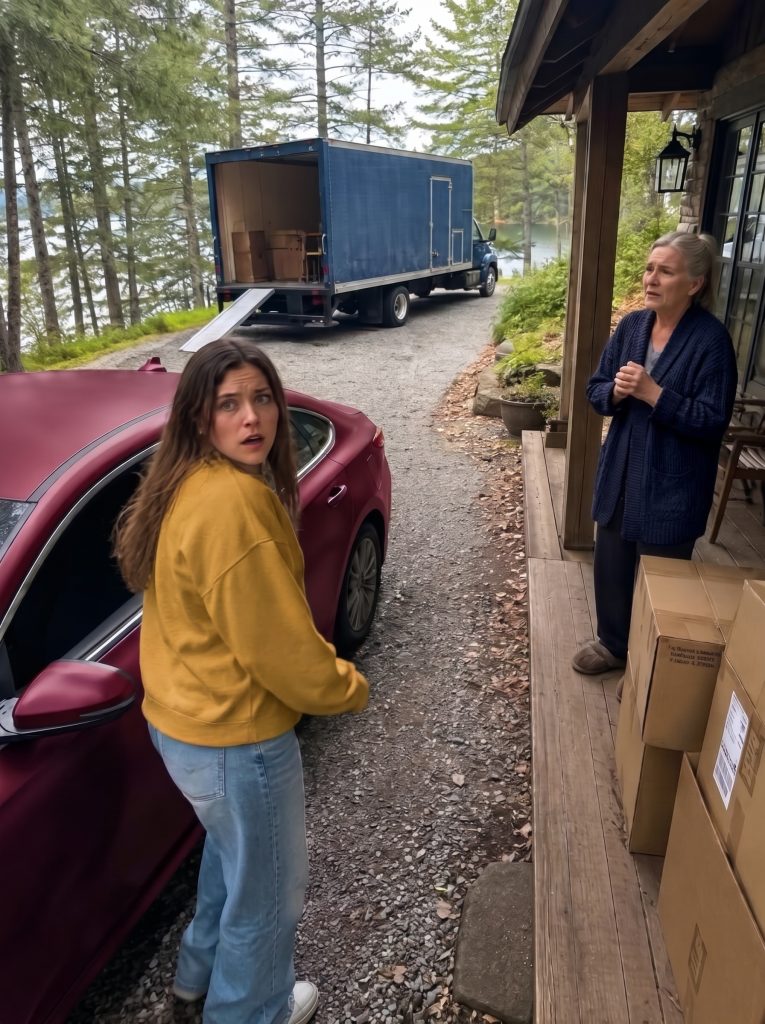
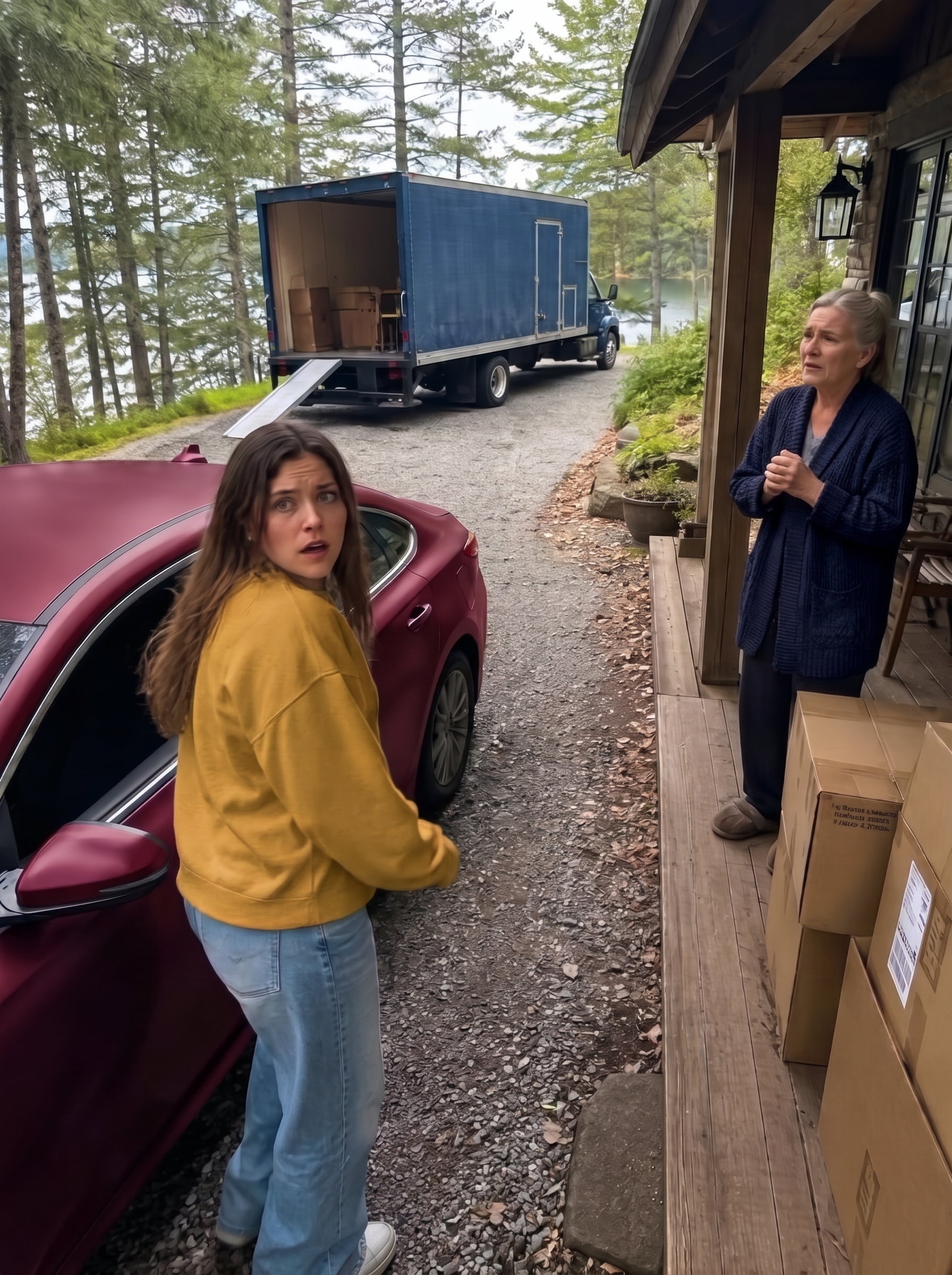
When I turned onto the gravel road and came through the trees, I saw my sister’s car in the driveway. I saw my mother standing on the porch in her bathrobe at two in the afternoon. And I saw a truck I didn’t recognize parked near the side door with the rear hatch open wide, the kind of open that means either loading or unloading, and in that moment I was not sure which was worse.
My mother’s face when she saw me come up the porch steps told me everything about how the last several hours had gone. Not panic. Not anger. The specific expression of a woman who has been managing a difficult situation alone for longer than she should have had to, and who is deeply relieved that someone else has finally arrived to help her carry it.
She didn’t say anything. She just touched my arm and gestured me inside.
The cabin felt different. The air had the quality of a room where an argument has recently happened or is still happening at a lower volume. My father was in his chair by the window, the one we had positioned to catch the morning light over the water. He looked tired in the particular way that means emotional exhaustion rather than physical, the weariness that comes from having to hold a position you should not have been required to hold.
Vanessa was standing near the kitchen island. She had the look she gets when she knows she has done something she cannot fully defend, which is a specific expression, chin slightly forward, eyes searching for the version of the situation that allows her to present herself as having meant well. Craig was not in the room, which was its own kind of information. The open truck hatch was his work. His absence meant he had either gone out to it or positioned himself somewhere he could monitor without being directly in the frame.
“Riley,” Vanessa said, and her voice had the particular mixture of relief and defensiveness that means she was glad I had arrived while also having already prepared her case.
“Tell me what’s happening,” I said.
She looked at my father. He gave her a small nod that I read correctly: go ahead and tell her, because I am not going to tell it for you.
Craig’s company had collapsed. She laid it out in the careful language of someone presenting a business case rather than an admission. The business had been struggling for over a year. The formal closure had come four months ago. They had been managing on savings and on Vanessa’s income but the savings were mostly gone and her income was not enough to cover their mortgage and their expenses both. They had not told anyone because Craig didn’t want it known and Vanessa went along with that.
“And so Craig decided,” she said, not quite finishing the sentence.
“That they could move in here,” I said.
The words sat in the room for a moment.
“Just for a while,” she said. “Just until we stabilize. The cabin is sitting empty most of the week. Mom and Dad aren’t here full-time. It seemed practical.”
I looked at my mother, still in her bathrobe. I looked at my father, whose hands were resting in his lap with the careful stillness he adopted when he was working hard at appearing calm. I thought about the truck hatch and what had been planned for it. I thought about the word practical and what it meant coming from Craig’s mouth through my sister’s.
“Where is he?” I said.
“Outside,” Vanessa said.
“Did anyone ask Mom and Dad before this plan was made?”
Silence.
My mother spoke then, quietly and with the diplomacy she has practiced for decades. “We didn’t want to trouble you, Riley. We know how much you’ve already done. And Vanessa is family. We were trying to figure out how to—”
“Mom,” I said gently. “Did anyone ask you what you wanted? Yes or no.”
She looked at her hands. “Craig called Thursday and said they needed somewhere temporary. He said it made sense. He said you’d understand.”
He had not called me.
He had called my parents, who are in their sixties, one of whom has a progressive neurological disease, and he had framed the situation as practical and reasonable and temporary, knowing they would not say no because they do not say no to their children, and knowing that by the time I found out the truck would already be in the driveway and boxes would already be inside.
Craig came in from the side door carrying a duffel bag and a box of kitchen items. He set them down when he saw my face.
“Riley,” he said. The smile he attempted did not connect with the rest of his expression. “I was hoping to talk to you about this.”
“You should have called me before you called them,” I said.
“We’re family,” he said. “This is a family situation. There’s plenty of room here—”
“Craig.” I kept my voice even. “I need you to stop moving things into this house.”
He looked at Vanessa. Vanessa looked at the floor.
“This is your parents’ place,” he said. “Not yours. They can decide who stays here.”
That was the moment I had built the trust for.
I went to my bag and took out my phone and pulled up the trust documents I had saved as a PDF eighteen months ago on the day the paperwork was finalized. I had them because I am who I am, because I live in a world of binding language, because I had stood in a notary’s office and understood that the day might come when I would need to show someone exactly what the words said.
I placed the phone on the kitchen island where both Vanessa and Craig could see it.
“This is the property trust,” I said. “The cabin is held in an irrevocable trust. My parents are the sole lifetime beneficiaries. That means they have the right to live here, to use it, and to enjoy it for the rest of their lives. It does not mean they can grant residency to other parties without triggering a formal legal review of the trust terms. It also means I cannot take it back, and it means no one can pressure them into arrangements that compromise their use and enjoyment of the property.”
Craig’s expression did the thing I had watched it do at family dinners when a situation stopped going his way. A brief stillness, like a recalculation happening somewhere behind his eyes. Then a reassembly into something smoother.
“We’re not trying to compromise anything,” he said. “We just need a few months—”
“You need a few months,” I said. “My parents need their home to remain their home. Those are different needs.”
“Vanessa and I are going through a hard time.”
“I understand that. And I’m sorry for it. But the way to address that is not to move into a space my parents depend on without asking me, without asking an attorney, and without giving my father and mother any actual choice in the matter.”
“They said yes,” Craig said.
I looked at my parents. My mother’s eyes were careful. My father’s hands had stilled in his lap.
“Mom,” I said. “Did you want them here? Not what seemed kind, not what felt like the right thing to do for Vanessa. What did you actually want?”
The quiet that followed was long enough to be an answer by itself.
“I wanted to help,” my mother said finally. “But I was also scared about what it would mean for your father. The routine here matters. The quiet matters.” She paused. “I didn’t know how to say no.”
Vanessa made a sound, something between a breath and the beginning of a sentence she didn’t complete.
“She didn’t know how to say no,” I said to Craig, “because you didn’t give her a real opportunity to. You presented a plan as settled and called it a conversation.”
Craig started to respond and I held up one hand. Not unkindly, but with enough firmness that he stopped.
“Here is what’s going to happen,” I said. “You’re going to take everything you brought inside back out to the truck. You’re not going to leave any of your belongings here today. And then we’re going to have a real conversation, the four of us, not six, about what actual help looks like for you and Vanessa, and what my parents actually need from their family right now.”
Craig looked at Vanessa.
Vanessa looked at the floor and then at me and then at something past my left shoulder.
“This is cruel,” she said. “We’re in a crisis.”
“I know,” I said. “I’m not dismissing that. But your crisis doesn’t get solved by creating one for them.”
She started crying. It was the kind of crying I have seen from her before, real in its origins but also strategic in its deployment, the tears arriving at the moment when argument is no longer working. I felt for her. I did. Whatever Craig had done or failed to do with his business, whatever decisions had led them here, Vanessa was genuinely frightened and genuinely lost, and she was my sister, and none of that was simple.
But I also looked at my father in his chair, hands folded too carefully, and my mother in her bathrobe at two in the afternoon, and I understood what quiet damage looks like when it is already in progress.
Craig took his things back to the truck. He did it without further argument, which told me the document on my phone had done what I needed it to do. Binding language. Words that could not be walked back. He was still calculating, I could see it in the set of his shoulders, but the calculation had changed. There was nothing here to extract.
Vanessa sat at the kitchen table while he carried things out. She and I did not talk much. I made coffee because my hands needed something to do, and I set a cup in front of her without asking, and she held it with both hands the way people do when they are cold even when they are not cold.
After Craig had finished and was waiting outside, I sat down across from her.
“I’m not trying to hurt you,” I said.
“I know,” she said, though she didn’t sound entirely sure.
“Craig put you in a position where you had to go along with something that wasn’t right, and then he let you be the one to explain it.”
She looked at the coffee cup. Something shifted in her face.
“He said it was just practical,” she said quietly. “He kept saying they weren’t using it most of the week. He said Riley will understand, it’s temporary, family helps family. He made it sound like the normal thing to do.”
“He made it sound like that because he needed it to sound like that.”
She was quiet.
“Do you have somewhere you can go? Not here, but somewhere real?”
She nodded slowly. Her college friend in the city had an extra room. She had been avoiding asking because it felt like more admission of failure, but the room was there.
“That’s a better option than this,” I said. “Not because I don’t care about you, but because this place needs to be what it was built to be. And because you living here under Craig’s terms would put you sideways with Mom and Dad in ways you don’t want to live with later.”
She looked up.
“He said you’d try to control everything,” she said. “He said you built the cabin to have leverage over the family.”
I let that sit for a moment.
“Does that sound like me?” I said. “Or does it sound like him?”
She pressed her lips together. Didn’t answer. But she heard it.
Before she left, she hugged my mother for a long time on the porch. My mother held her like mothers hold their children when they are frightened, regardless of age, regardless of fault, regardless of what has happened in the hours before. That part was not complicated. That part was just love.
Craig did not say goodbye to me. He got in the truck and started the engine while Vanessa was still on the porch. When she came down the steps and got in the passenger seat, he pulled out without looking back.
I watched them until the truck disappeared through the trees.
My mother came to stand beside me on the porch. My father had moved to his chair near the window where the afternoon light came across the water. From where I stood I could see his profile, the slight stillness of his hands, the way he was looking at the lake with the particular attention he brought to things he found genuinely beautiful.
“I’m sorry,” my mother said. “We should have called you immediately.”
“You called me,” I said. “That’s what matters.”
“Your father sent that text about thirty seconds after Vanessa told us Craig wanted to move furniture in. Before any of us had said another word.”
I looked at my father’s silhouette in the window.
“He trusts you,” my mother said.
“I know,” I said. “I’m trying to deserve it.”
She took my hand and held it the way she has held my hand since I was small enough for it to disappear inside hers. The lake was flat and still in the late afternoon. The hemlock trees were dark at the edges of the property. A bird moved across the water far from shore.
We stood there for a while without talking, which is its own kind of conversation.
Eventually my father called from inside that he was thinking about making tea, and my mother went in to help him, and I followed, and we spent the rest of the evening the way the cabin was built to be spent: the three of us at the kitchen table with the light on over the water and nowhere else to be.
I stayed the night in the second bedroom. I lay awake for a while listening to the hemlocks and the quiet that had settled back into the house now that the truck was gone. I thought about Craig’s face when he saw the trust documents. I thought about the word practical and all the things it is used to justify. I thought about my father’s three-word text and the thirty seconds it took him to send it.
Before I fell asleep, I thought about the morning I had stood on this land for the first time in November with mud on my boots, and the thought I had then. My father could sit here for hours and finally feel peace.
He had been sitting by that window looking at the water when I walked out to the porch with my mother. His hands were resting in his lap and his shoulders were settled and his face was quiet in the way I had hoped for when I signed the purchase agreement.
The cabin was doing what I built it to do.
And the trust was doing what I wrote it to do.
Sometimes the most important thing you can put into the world is binding language. Words that say what you mean and mean what you say and hold their shape when people push against them.
I had known that for a long time. I just hadn’t known yet how much it would matter here, in this particular family, on this particular afternoon.
Now I knew.
The Aftermath of the Porch
The silence that settled into the house after the red tail-lights of Craig’s truck vanished down the dirt track was not an oppressive silence. It was the heavy, settling quiet of a room after a storm has passed—the sound of windows no longer rattling, of roof timbers no longer groaning against the strain of high winds.
Inside the kitchen, the steam from the kettle my father had put on began to whistle, a low, polite shriek that broke the spell. My mother moved toward the stove with the slow, deliberate care that had become her signature since her diagnosis began reshaping her world three years ago. Her movements were careful, measured by an internal clock that required twice as much concentration as it used to, but they were precise.
“Let me do that, Mom,” I said, stepping past her to lift the kettle off the burner.
“I can manage a kettle, Riley,” she said, though there was no heat in the protest. She leaned back against the counter, her hands resting flat on the butcher block. “Though I wouldn’t mind if you sliced that lemon we bought yesterday.”
My father sat at the small pine table by the window, his back to the darkening glass. The lake outside was turning the color of hammered pewter as the sun dipped behind the western ridge of hemlocks. He hadn’t turned on the overhead light yet, preferring the amber glow of the small brass desk lamp that threw long shadows across his knuckles.
“He thought he had us cornered,” my father said. His voice was lower than it used to be, raspy around the edges from years of woodworking dust and too many decades of unfiltered cigarettes before he quit, but it held the steady, unshakeable timber of a man who had spent forty years running a regional civil engineering firm where accuracy was the only currency that mattered.
“He didn’t think he had you cornered, Dad,” I said, setting the steaming mugs down on ceramic coasters. “He thought you wouldn’t look up. There’s a difference.”
My father picked up his mug, wrapping both hands around the ceramic to draw the heat into his skin. “People like Craig always confuse kindness with compliance. They think if you don’t shout, you agree. They think if you don’t slam a door, you’ve left it open for them to walk right through.”
We sat together in the kitchen for a long time, the three of us, drinking tea that tasted of lemon and bruised mint. We didn’t talk about Vanessa right away. We didn’t need to. Her departure had left a hollow space in the room, but it was a clean hollow, free of the frantic, performative panic that Craig had brought with him like a foul-weather front.
Instead, my mother talked about the garden she wanted to put in by the south porch next spring—a small square of raised beds where she could grow garlic and leaf lettuce without having to bend too far down. My father listened, nodding occasionally, his eyes tracking the steam curling up from his cup.
“You’re staying through Monday, aren’t you?” my mother asked, looking at me over the rim of her glasses.
“I can,” I said. “I have my laptop. I can take the morning calls from the guest room desk.”
“Good,” she said simply. “We need to talk about the well pump anyway. It’s been making that clicking sound again when the pressure drops below forty PSI.”
That was how my family handled crises: by retreating into the architecture of the ordinary. A well pump clicking at forty PSI was something you could fix. A failing business, a marriage unraveling under the weight of bad debts, and a son-in-law who treated other people’s retirement sanctuaries as a storage locker for his life choices—those were things you couldn’t fix with a wrench and a roll of Teflon tape.
Unless, of course, you had the right documents.
The Anatomy of a Trust
People outside the legal profession—and even many within it—often think of trusts as cold, sterile instruments designed exclusively for the ultra-wealthy to hide assets from tax collectors or shield fortunes behind corporate veils. They picture Swiss bank accounts, mahogany-paneled boardrooms, and lawyers wearing expensive silk ties who speak in a dialect of Latin and conditional clauses.
They don’t picture an eighteen-month-old PDF stored in the cloud under a folder labeled Cabin_Legal_Final_2024.
They don’t picture a gray Tuesday afternoon in a fluorescent-lit notary’s office in Burlington, where the carpet smelled faintly of industrial carpet cleaner and cheap pine air freshener, and where I sat across from an eighty-year-old notary named Mrs. Gable who clicked her ballpoint pen rhythmically against her teeth while checking my driver’s license against three separate state-issued IDs.
I had built that trust brick by legal brick, clause by clause, over the course of four months following my father’s diagnosis.
When the neurologist had first used words like progressive, degenerative, and management rather than cure, my brother and sister had reacted in the ways they were structurally predisposed to react. Vanessa had cried on the phone for twenty minutes, cataloging every memory she had of our childhood as though my father were already gone, before pivoting abruptly to ask if my parents were going to be able to afford the co-pays on the new medication. Craig had sent a group text suggesting that maybe they should sell the suburban house immediately, cash out the equity, and move into a managed care facility three counties away where things would be “easier to monitor.”
Neither of them had asked what my parents wanted. Neither of them had sat at the kitchen table with my father while he stared out the window at his workshop, wondering quietly who would oil the lathe when his hands stopped listening to his brain.
So I did what I do. I went to work.
I hired an estate attorney named Vance Miller—a man who looked like an owl who had spent too many decades reading municipal zoning codes—and we spent six weeks constructing an irrevocable living trust designed for one specific, narrow, unyielding purpose: to put a steel wall between my parents’ remaining years and the financial chaos that seemed to follow Craig around like a persistent raincloud.
The cabin wasn’t just a vacation home. We had bought the land together three years after my mother’s first cancer scare went into remission, pooling the money from the sale of my grandfather’s timber lot with my own savings from five years of corporate restructuring consulting. My name was on the deed originally, but Vance and I dismantled that ownership structure and rebuilt it from the ground up.
The Grantor doth hereby transfer, convey, and set over…
In plain English: The property belonged to the trust. Not to me. Not to Craig. Not to Vanessa. Not even, in the absolute technicality of property law, to my parents.
What my parents held—and what the trust protected with the force of state statute—was a Life Estate. A lifetime beneficiary interest that could neither be revoked by my death, nor seized by my creditors, nor signed away by my mother in a moment of emotional exhaustion, nor commandeered by Craig in a desperate bid to save his failing commercial landscaping supply company.
When Craig had looked at my phone screen in the kitchen, he hadn’t just been reading words on a digital display. He had been reading the perimeter fence. He was a man who lived his entire life looking for gates left unlocked, and for the first time in his adult existence, he had run full tilt into a concrete retaining wall.
The Anatomy of Craig
To understand why Craig moved boxes into my parents’ hallway without calling me first, you have to understand how Craig viewed the world.
Craig was a man who believed that the universe operated on a sliding scale of audacity. If you asked for permission, people felt authorized to say no. If you informed them of a fait accompli, they felt social pressure to accommodate you to avoid an awkward scene. It was a strategy born of mediocre intelligence combined with high-volume confidence—a combination that often allowed him to skate through life just ahead of the financial wreckage he left in his wake.
I had watched him do it for twelve years of marriage to my sister.
First, it was the landscaping business he started with thirty thousand dollars of my parents’ retirement savings—money they had given him because Vanessa was pregnant with their first child and crying in the kitchen about how hard life was. He promised to pay it back within two years with twelve percent interest. We never saw a dime of the interest, and the principal was eventually written off as a family loss, absorbed quietly into my mother’s ledger of things you don’t mention at Thanksgiving.
Then came the commercial warehouse lease he signed in a declining industrial park just outside Worcester, convinced that drop-shipping bulk mulch to municipal contractors was going to make him a regional player. When the municipality went with a cheaper vendor out of state, Craig didn’t downsize or liquidate inventory. He doubled down, took out high-interest bridge loans against his equipment, and started missing mortgage payments on the split-level ranch they had bought with a zero-down USDA loan in 2018.
By the time he showed up at the cabin with a U-Haul trailer and a box of mismatched kitchen utensils, his credit rating was floating somewhere near the Mariana Trench, his business accounts had been frozen by a local credit union, and the bank had posted a notice of foreclosure on their front door three days prior.
He hadn’t come to the cabin for a weekend retreat. He had come to squat.
And he had chosen my parents’ place not because he loved the hemlocks or respected my father’s woodcarving bench, but because my parents were old, soft-hearted, and geographically isolated enough that he could run out the clock while figuring out his next extraction.
When I sat across from Vanessa at the kitchen table while Craig waited by the truck, I saw the exact moment the fog of twelve years began to lift just enough for her to catch a glimpse of the landscape she was standing in.
“Does he have a lawyer?” I asked her, stirring my coffee with a battered silver spoon that had been in our family since my grandmother’s kitchen in Maine.
Vanessa shook her head. Her hair was pulled back in a loose, untidy knot that was slipping down the back of her neck, and there were dark, purple-gray smudges beneath her eyes that no amount of concealer could mask. “He says lawyers are just bloodsuckers who charge three hundred dollars an hour to tell you what you already know.”
“What do you know, Vanessa?”
She looked up at me then, her eyes sharp with a sudden, defensive flare. “I know we’re broke, Riley. I know our accounts are locked. I know the girls had to change schools three weeks into the semester because we couldn’t make the tuition check clear for the parochial academy, and I know that every time I ask Craig what the plan is, he tells me he’s working an angle.”
“An angle,” I repeated.
“Yeah. An angle.” She let out a dry, humorless laugh that sounded like dry leaves scraping across concrete. “Usually involving someone else’s cousin or some guy he met at a hardware store supply counter who’s got a warehouse full of surplus roofing shingles.”
“You don’t have to stay with him, you know.”
The words hung in the air between us, heavy and uninvited. They were the kind of words you can’t take back once they’ve left your mouth—the kind of family intervention that usually triggers a defensive wall ten feet high.
Vanessa didn’t explode. She just looked down at her coffee mug again, watching the small whirlpool she was making with her spoon.
“Where would I go, Riley?” she whispered. “On what? With what? I haven’t had my own checking account since 2019. He convinced me it was easier to run everything through the corporate ledger for tax purposes. I’m a ghost on paper.”
That was when I realized why Craig had been so panicked by the trust document on my phone. It wasn’t just that he couldn’t move into the cabin. It was that the trust represented something he didn’t possess and couldn’t hack: sovereignty. It was an asset that stood completely outside his sphere of influence—a piece of the world that belonged to my parents, protected by legal iron, that he couldn’t leverage, couldn’t mortgage, and couldn’t talk his way into owning.
The Drive Back and the State of Things
The next morning, the mist hung low over the lake, thick enough to obscure the opposite shore entirely. The pine needles on the trail down to the water were slick with overnight dew, smelling of damp earth and resin.
I walked down alone around six-thirty, before my parents were up, carrying a heavy ceramic mug of black coffee that cooled too quickly in the sharp autumn air. My boots made a muffled, rhythmic crunch against the pine duff.
When I reached the wooden dock—the one my father and I had built four summers ago, bolting pressure-treated cedar planks into concrete footings while he barked orders about square corners and plumb lines—I stopped and leaned against the railing.
This was what I was protecting.
Not just the physical lumber and the square footage under the asphalt-shingle roof, but the specific quality of time my father had left. In a world where everything seemed engineered to rush people toward obsolescence—where corporate reorganizations discarded fifty-year-old engineers like old software and where family dynamics were treated like negotiation assets in a bankruptcy proceeding—this cabin was an island of absolute stillness.
My phone vibrated in my jacket pocket. It was a text from an unknown number—local area code, somewhere down near Worcester.
Can we talk? Not Craig. Just me.
I stared at the screen for thirty seconds while the mist drifted across the dark water. The ripples from a diving loon expanded outward in widening rings until they hit the wooden pilings beneath my boots and dissolved into nothing.
I’m at the cabin, I texted back. If you want to talk, come alone.
It took her two hours to make the drive. When her dented Honda Civic crunched up the gravel driveway at eight-forty-five, I was sitting on the front porch with my laptop open, pretending to review a quarterly forecast for a client in Chicago while actually watching the blue jays quarrel over suet in the cedar tree by the well-head.
Vanessa got out of the car alone. Craig wasn’t in the passenger seat.
She was wearing an oversized wool coat that had belonged to our grandmother—a heavy, boxy thing with tortoiseshell buttons that swallowed her shoulders. She walked up the wooden steps slowly, her sneakers making a soft scraping sound against the treated boards.
“He went to see a guy about a truck,” she said by way of greeting, standing awkwardly near the screen door.
“Do you want some coffee?” I asked, closing the laptop lid.
“Yeah. Black, please.”
I went inside, poured a fresh cup from the thermal carafe, and brought it out to her. She took it with both hands, the steam rising between us like a pale curtain.
“He’s not going to change, Riley,” she said, staring out at the lake. Her voice was flat, devoid of the theatrical panic she had deployed yesterday. This was the quiet despair that comes after the panic has burned itself out.
“I know.”
“He thinks you’re the enemy.”
“I figured.”
“He spent three hours in the car yesterday telling me how you’ve always looked down on us—how you think because you have a corner office in the city and a title with ‘Director’ in it that the rest of us are just peasants in your kingdom.” She took a small sip of the coffee. “He really believes it, too. That’s the funny part. He genuinely thinks you built this place just to lord it over the family.”
I leaned back against the porch railing, looking at the grey grain of the old pine boards. “Did you believe him?”
She was quiet for a long time. A motorboat started up somewhere far across the foggy lake, its engine a low, buzzing drone that didn’t quite pierce the quiet of our clearing.
“I used to,” she said softly. “When we were younger. When you got the scholarship and went off to college and didn’t come back for Thanksgiving because you were studying for finals. I thought you thought you were better than us.” She turned her head to look at me, her eyes clear and sharp in the morning light. “Then I spent twelve years watching Craig manage our lives into a ditch, and I realized something.”
“What’s that?”
“You didn’t leave because you thought you were better. You left because you saw the math.”
The Math of Survival
The math of survival in our family had always been simple, brutal, and unspoken: Someone always pays for the person who won’t look at the ledger.
My father had spent his entire life looking at the ledger. Every bridge he designed, every culvert he calculated for municipal drainage, every payroll he met during the 2008 recession when construction ground to a halt for eighteen months—it was all math. He taught me how to balance a checkbook when I was nine years old using a ledger book with green and white grid lines and a mechanical pencil with a red eraser that smelled like rubber and dust.
Never spend money you haven’t earned, he used to say while running the side of his hand across the graphite lines to make sure nothing smeared. And never trust a man who tells you he’s got an angle that bypasses the math.
Craig’s entire existence was an argument against the math. He believed that if you yelled loud enough, blinked hard enough, or called enough people “family,” the numbers would eventually feel sorry for you and reset themselves to zero.
When Vanessa and I sat on that porch while the mist burned off the hemlocks, we talked about what came next. Not in grand, cinematic terms—not with dramatic ultimatums or tearful declarations of independence—but in the quiet, unglamorous language of logistics.
“The friend in the city,” I said. “Does she still have that room?”
“She does,” Vanessa said, staring down into her coffee cup. “She’s a paralegal at a firm downtown. She works seventy hours a week and sleeps with her cat. She told me last month that if I ever needed to crash while I figured my life out, the door was unlocked.”
“Then go there.”
“And the girls?”
“Bring them with you for now. Enroll them in the district school near her apartment. It’s a good district—better than the one you’re in now anyway.”
“And Craig?”
I looked out at the lake, where the sun was finally punching through the grey haze, turning the water into a sheet of polished copper.
“Craig is a grown man,” I said. “He has a truck. He has a mind for angles. Let him find his own angle this time without you holding the ladder.”
She didn’t answer immediately. She finished her coffee, set the mug down on the porch floor with a dull thud, and pulled her grandmother’s wool coat a little tighter around her throat.
“He’s going to sue you,” she said, almost casually.
“On what grounds?” I asked. “With what lawyer? On what retainer?”
She gave a short, dry chuckle. “Right. I forgot. You have the trust documents.”
“It’s not just the documents, Vanessa. It’s the fact that he has no legal standing. He’s not a beneficiary, he’s not a trustee, and he’s not on the deed. If he sets foot on this property again without my parents’ explicit invitation—an invitation they give while of sound mind and recorded on video—I can have the sheriff escort him off the land before he reaches the back porch.”
She stood up, shaking out her legs as if trying to wake up muscles that had been cramped too long. “You’re terrifying when you’re organized, Riley.”
“No,” I said, standing up to walk her to her car. “I’m just tired of cleaning up messes that could have been avoided if someone had read the fine print before signing their name.”
The Last Evening of Peace
By Sunday evening, the house had returned to its natural rhythm.
My mother was sitting in her usual armchair by the woodstove, knitting a grey wool scarf that was already four feet long and showed no signs of stopping. My father was at his workbench in the corner of the living room, using a small curved chisel to shape a decoy duck out of a block of seasoned white pine. The rhythmic tap-tap-tap of the mallet against the wooden handle filled the room like the ticking of a grandfather clock—steady, patient, and completely unhurried.
I sat at the kitchen island with my laptop open, reviewing the final draft of a municipal logistics audit I was due to submit to my firm on Tuesday morning. The numbers columns scrolled down the screen in neat, orderly rows—debits on the left, credits on the right, variances highlighted in soft amber when they drifted more than two percent off the baseline projection.
Everything balanced. Everything reconciled.
My father paused his chiseling, wiped a thin curl of white pine sawdust off his knuckles with a rag, and looked across the room at me.
“You’re heading back tomorrow morning?” he asked.
“Early,” I said. “I have a ten o’clock with the city transit authority.”
“Drive careful through the notch,” he said. “They’ve been doing road work near the county line, and the gravel gets loose when the morning frost hits.”
“I will.”
“And Riley?”
I looked up from the screen.
“Thanks for the paperwork,” he said simply.
He didn’t elaborate. He didn’t need to. My father was a man of economical speech, a man who believed that when the right thing was done, talking about it too much only cheapened the transaction. He went back to his decoy duck, the small, rhythmic mallet strikes resuming their steady cadence against the pine.
My mother looked up from her knitting, catching my eye across the room. She gave me a small, quiet smile—the kind that mothers give when they know something you aren’t ready to say out loud yet, a look that said We know what you did, and we are glad you did it.
Later that night, long after the house had gone dark and the only sound was the wind rustling the dry oak leaves against the gutters outside my bedroom window, I lay awake staring at the ceiling beams.
I thought about Craig driving down the highway in his dented truck, looking for his next angle. I thought about Vanessa in the city, packing two suitcases and her daughters’ backpacks while her friend’s cat watched from the top of a bookshelf. I thought about my parents sleeping down the hall—safe, warm, and undisturbed in a house that belonged to their lives rather than someone else’s crisis.
Some people spend their entire lives waiting for someone to save them from the wreckage of their own bad decisions. Others build walls out of binding language and clear boundaries, and they stand on the porch with a cup of coffee while the storm breaks harmlessly against the stones.
I rolled over, pulled the heavy wool blanket up to my chin, and listened to the hemlocks whispering in the dark.
The cabin was doing what I built it to do.
And I was right where I belonged.
Epilogue — The Autumn Ledger
Six months later, the spring thaw came through the valley with the kind of sudden, violent energy that only northern New England can muster. The snowpacks on the upper ridges melted into muddy torrents that rushed down the gullies, swelling the creeks until they foamed white against the culverts and turned the lake the color of strong tea mixed with milk.
I drove up alone on a Friday afternoon in late April.
The dirt road was still rutted from the winter frost-heaves, my tires kicking up wet gravel and shale as the car climbed the ridge through the beech and maple woods. When I turned into the driveway, the first thing I noticed was the garden beds.
My mother had four wooden raised boxes built along the south side of the porch, freshly filled with dark, steaming compost from the local dairy farm down the road. She was out there in a faded blue flannel shirt and mud-spattered knee boots, kneeling on a foam pad with a small hand trowel, burying seed potatoes into the damp earth with slow, methodical care.
My father was sitting on the bench by the well-head, holding a mug of coffee and watching her work with the quiet, absorbed intensity of a man watching a master craftsman at a lathe.
When he saw my car pull up, he raised a hand in a slow, casual salute.
I parked by the woodpile, cut the engine, and sat for a moment in the silence of the clearing. The air smelled of wet earth, rotting leaves, and woodsmoke from the chimney—the distinct, unmistakable scent of spring in the highlands.
I got out of the car, walked over to my father, and sat down on the bench beside him.
“How’s the pump?” I asked.
“Holding at forty-five PSI,” he said, not taking his eyes off my mother’s trowel. “Put in a new pressure switch last month. Brass contacts this time. The cheap ones they’re making now burn out after eighteen months.”
“Good.”
My mother looked up from her planting box, wiping a smudge of dark loam off her forehead with the back of her wrist. “Riley! You’re just in time. The garlic we planted last fall is coming up through the mulch.”
She looked healthy. Not miraculous—the neurological tremor in her left hand was still there, a faint, rhythmic flutter when she reached for a seed packet—but her color was good, her eyes were clear, and there was a strength in her shoulders that hadn’t been there the day Craig parked his U-Haul trailer in our driveway.
Vanessa and the girls were living in a three-bedroom apartment on the third floor of a brick walk-up in Somerville. Vanessa had started working part-time as an administrative assistant for a civil engineering firm downtown—a firm, as it happened, that occasionally sub-contracted out to my father’s old business associates. She hadn’t spoken to Craig in four months, and the divorce papers had been filed quietly, without drama, without U-Hauls, and without anyone trying to squat in someone else’s life.
Craig was somewhere in Rhode Island, presumably looking for another warehouse full of surplus roofing shingles.
I stood up, stretched my arms against the spring air, and walked down the pine-needle path to the edge of the water. The lake was bright and blue under a high, washed sky, dotted with the V-shaped wake of a pair of loons paddling slowly toward the reed beds on the far shore.
I pulled my phone out of my pocket, unlocked it with my thumb, and tapped the folder icon.
Cabin_Legal_Final_2024.pdf
I didn’t open the document. I didn’t need to. I already knew every word by heart—every clause, every contingency, every ironclad sentence designed to hold the world at bay when the world got too loud and too messy and too demanding of things it hadn’t earned.
Some people spend their lives believing that family means never saying no.
My family had learned a different lesson. We learned that the kindest thing you can do for the people you love is to build a wall strong enough that nobody can ever talk them out of their own peace.
I stood there by the water for a long time, watching the ripples dissolve against the cedar pilings, listening to my father’s hammer tap against a piece of pine up on the porch, and feeling the quiet settle deep into my bones where it belonged.
The ledger was balanced. The accounts were square.
And the cabin was holding.
THE END..!