Five years ago, my sister told my parents I had dropped out of medical school.
She said it softly. That was always Monica’s particular gift.
She could ruin a person without ever raising her voice, without
ever sounding anything other than worried. One phone call,
one careful tremble placed in exactly the right place, one small
story wrapped so thoroughly in the language of concern that
my parents had no reason to look for the seams. She told them
I had failed out, lied about it, and disappeared into my own shame.
They believed her because she was standing in front of them and
I was not. Because she had always been the one who called on
birthdays without being reminded. Because love, when it is lazy, will
always choose the version of a story that requires the least investigation.
My father blocked my number first. My mother followed two days later,
which told me they had discussed it, weighed it, and reached
a conclusion together. The first letter I mailed came back with
RETURN TO SENDER stamped across the front in that particular
shade of bureaucratic black that looks like finality. The second came
back bent at the corner, as if someone had carried it a little while before
deciding. The third came back unopened, and I sat on the edge of my bed in
Oregon holding it in both hands for a long time, feeling something inside
me go very quiet. Not the quiet of peace. The quiet of a person who
has just understood something they cannot unhear.
After that, I stopped writing. Not because I stopped wanting them.
Because wanting people who have actively chosen not to know you is its
own kind of damage, the sort that compounds quietly over time if you do not recognize it for what it is.
My name is Irene Ulette. I am thirty-two years old. I am a trauma surgeon. And last month, at three minutes past three in the morning, my pager pulled me out of sleep and put my entire family back in front of me.
Level-one trauma. Motor vehicle collision. Female, thirty-five. Unstable. ETA eight minutes.
Those words are ordinary in my world. That is the strange thing about emergencies: they sound impossible to everyone outside a hospital, but inside one they become a checklist, and a checklist is manageable. Airway. Breathing. Circulation. Blood pressure. IV access. Operating room. Move. I have run that sequence so many times that my body begins its preparations before my mind has fully caught up to being awake.
I slid out of bed before Daniel fully surfaced. He turned over, hair flattened on one side, eyes barely open, and asked in a voice still thick with sleep, “Bad one?”
“Sounds like it,” I said.
He sat up a little when he heard my tone. Daniel knows the difference between tired and braced. He learned it during my residency, when I would come home with the impressions of sock elastic carved into my ankles and the sour remnant of cafeteria coffee still in my mouth. He learned it on the nights I sat at the kitchen table at two in the morning filling out board certification forms while he quietly appeared at my elbow and set toast beside me because I had forgotten to eat dinner again. He learned it because he stayed, which is a thing that sounds ordinary until you have experienced the alternative.
Love is not always a speech. Sometimes it is a person who does not need you to explain why your hands are shaking.
I tied my hair back, pulled on clothes, and drove through rain that turned the streetlights into long yellow smears across the windshield. The hospital parking lot was slick and nearly empty at that hour. Inside, the emergency entrance smelled the way it always did before dawn: disinfectant, wet coats, stale coffee, and something else that has no exact name but which anyone who has spent time in hospitals will recognize immediately. It is the smell of fear that has been sitting in the chairs long enough to become part of the furniture.
The ambulance bay doors opened just as I reached the trauma bay. The paramedics came in fast with their voices overlapping: female, thirty-five, motor vehicle collision, hypotensive, possible abdominal bleed, decreased responsiveness, glass in the hair, pulse thready. The stretcher wheels screamed against the floor. A nurse moved in with shears. Someone called out vitals. Someone else started another line. The room had that particular compressed energy of people who know exactly what they are doing and have no time to waste on anything else.
I reached for the intake chart because that is what I always do. Name first, then age, mechanism, allergies, known history. The paper was still warm from the printer.
Monica Ulette. Age 35.
For one second the trauma bay went narrow. The voices around me blurred at the edges. The fluorescent lights felt too bright, too close, too white. The paper made a faint crackling sound because my fingers had tightened hard enough to crease it at the corner.
My sister.
The same sister who had told my parents I washed out of medical school. The same sister who, through one sustained lie maintained over five years, had ensured that no one from my family stood in the audience when I graduated from residency. Who had made sure my mother was not there to zip the back of my dress on my wedding day. Who had made sure my father was not standing at the courthouse entrance, pretending not to cry, the way fathers do when they are happy but do not know how to say so with their faces.
The same sister whose carefully built story had made me no one’s daughter for five years.
She was on the stretcher directly in front of me, pale under the overhead lights, her blood pressure falling, her abdomen rigid, and she was running out of minutes.
And I was the chief trauma surgeon on call.
The body has no interest in family drama. A ruptured spleen does not care who lied. A torn liver does not care who was believed. Blood does not slow down to allow for moral considerations. The monitor alarmed, and whatever part of me was Irene the abandoned daughter stepped back without being asked. Dr. Ulette stepped forward in her place.
“OR now,” I said.
The team moved.
I scrubbed in with water hot enough to pink my wrists, going through the motions my hands had learned over years of exhaustion and repetition and the particular humiliation of being a resident and not yet knowing enough but having to act anyway. I had earned those hands. That was something Monica had never understood about the life she chose to lie about. She thought professional status was something a person performed well enough until others handed it over. Medicine taught me otherwise. Medicine does not applaud charm. Medicine does not promote the person who makes the best impression at dinner. Medicine asks what you can do when someone is bleeding in front of you and an entire team is waiting for your instruction.
In the operating room, the lights were white and absolute. There was no room for childhood memories. No room for my father’s silence or the shape of his handwriting on returned envelopes. No room for the particular ache of standing at my own wedding and wondering whether my mother would have had opinions about the flowers. There was only a damaged body and a team and time collapsing in on itself.
Ruptured spleen. Liver laceration. Internal bleeding. Two units of blood, then more. Clamp. Suction. Pressure. Repair. The sequence repeated itself with the unhurried urgency of someone who has learned that panic costs more than it buys. Three hours and forty minutes later, Monica was alive.
That sentence looks simple. It was not simple. It was anatomy and muscle memory and discipline and a degree of restraint that no one in my family had ever extended to me. It was everything I had built in the years they were not watching.
At seven eighteen in the morning, I stood at the scrub sink after closing, the warm water running over my hands, watching diluted red spiral toward the drain. My hands were steady. That steadiness surprised me, or perhaps unsettled is the more accurate word. Shaking would have made sense. Tears would have made sense. Anger, certainly, would have made sense. Instead I felt a clean emptiness, the way a room feels after everyone has left and the lights are still on and there is nothing more to do.
The operative note would later read successful emergency intervention. It would document the rupture, the repair, the transfusions, and the stabilization in the measured language of medical records. It would not say that I had saved my sister before forgiving her, which were two separate things that I wanted to be careful not to collapse into one.
When I changed gloves and pulled my mask down, the charge nurse looked at me for slightly longer than usual. She had seen the chart. Most people who work in trauma learn not to ask questions unless the answers will change the care they are providing. She only said, “Family’s in the waiting room,” and I nodded, and my mouth went dry.
The hallway outside the OR was cold enough that my damp hair chilled at my temples. My scrub top clung to my shoulders. Somewhere down the corridor an elevator opened with a soft sound, and a janitor pushed a cart past me without looking up. I kept walking.
Every step toward that waiting room felt longer than the surgery.
I had imagined seeing my parents again more times than I care to admit, and in every version the scene had some architecture of dignity to it: I was calm and well-dressed and accomplished in a visible way, and their regret arrived in full and immediate. In the worst versions I yelled. In the most private versions I begged. Reality turned out to be considerably stranger than any of the versions I had rehearsed. I was in wrinkled scrubs. My face carried the marks of elastic from a surgical mask worn for nearly four hours. I smelled of antiseptic and exhaustion and the specific flatness of someone who has been awake since before three in the morning.
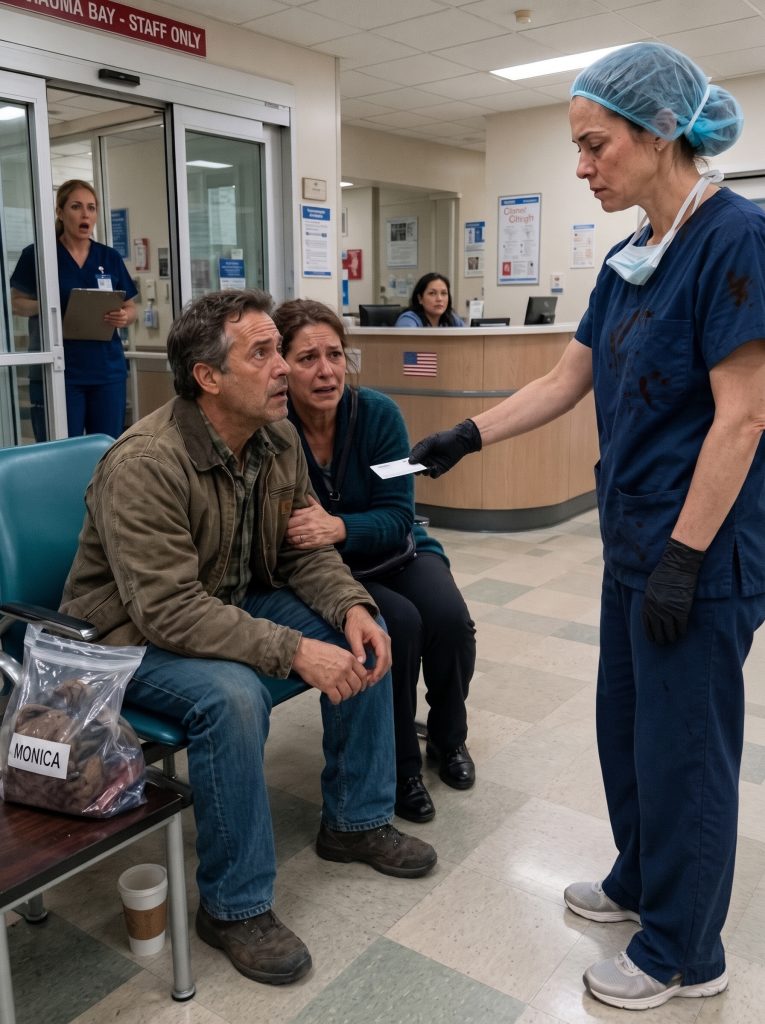
The waiting room looked like every hospital waiting room in America just before sunrise. Vinyl chairs in shades of muted blue. A vending machine running its motor at a volume slightly too loud for the hour. A television mounted near the ceiling with the volume turned down so low the closed captions were the only way to follow it. A paper coffee cup abandoned on a side table. A small American flag standing beside the reception desk between a stack of intake forms and a plastic cup full of pens with the hospital logo printed on them.
My parents sat beneath the television.
My mother looked older in a way that caught me off guard. Not fragile, she had never been fragile, but there was something different around her mouth, a tightness that had not been there before, the kind that accumulates when a person has been bracing for something for a long time. My father’s hair had thinned at the crown and his jacket hung a little looser on his shoulders than I remembered. Five years had moved through them the same way they had moved through me: without permission, without pause.
That did not make them innocent. It only made them human, which was in some ways harder to look at.
My father stood when he saw me coming. Not because he recognized me. Because he saw scrubs. Because he recognized the particular authority of someone walking toward them in a hospital at that hour, and because desperate parents will rise for anyone who might be carrying news about their child.
“Doctor,” he said, and his voice broke apart on the word in the way voices do when they have been held tightly for too long. “How is my daughter?”
My daughter.
I stopped in front of him. My mask was down. My badge was turned outward and visible. The name was printed clearly in black block letters: DR. IRENE ULETTE, MD, FACS. CHIEF OF TRAUMA SURGERY.
My father looked at my face and saw a doctor. Then he looked at the badge and saw his daughter. The shift between the two recognitions was visible on his face, one happening and then the other, like two transparencies placed over each other to show what was always underneath. His shoulders dropped. His jaw went soft. His eyes moved back up to my face with a terrible slowness, as if recognition had physical weight and he could barely manage to lift it.
My mother had been sitting. She stood when she followed his gaze, and her hand came up and wrapped around his arm hard enough that I could see her fingers pressing into the fabric of his jacket.
“Irene?” she said. The word came out barely above a breath.
My name in her mouth did not feel like coming home. It felt like a door opening into a house that had burned down. The frame was still there. The dimensions were familiar. But nothing inside was the way it used to be.
I looked at them both and said the only thing I could say without tearing the room in half.
“She’s stable.”
My mother made a sound behind her hand.
“She made it through surgery,” I continued. “She is still critical, but stable. We’ll know more over the next twelve hours.”
There is a younger version of me who had wanted this moment to be different. She had wanted collapse. She had wanted apologies so immediate and so overwhelming that they could somehow compensate for five years of silence. She would have wanted my father to understand everything at once, in one breath, in one terrible recognition.
Standing there in wrinkled scrubs at seven-thirty in the morning, I understood something about vindication that my younger self did not: it arrives much more quietly than the version you rehearsed. Sometimes it is simply a father reading a badge and realizing, in the span of a few seconds, that the daughter he chose to bury was the one who kept his other daughter alive through the night.
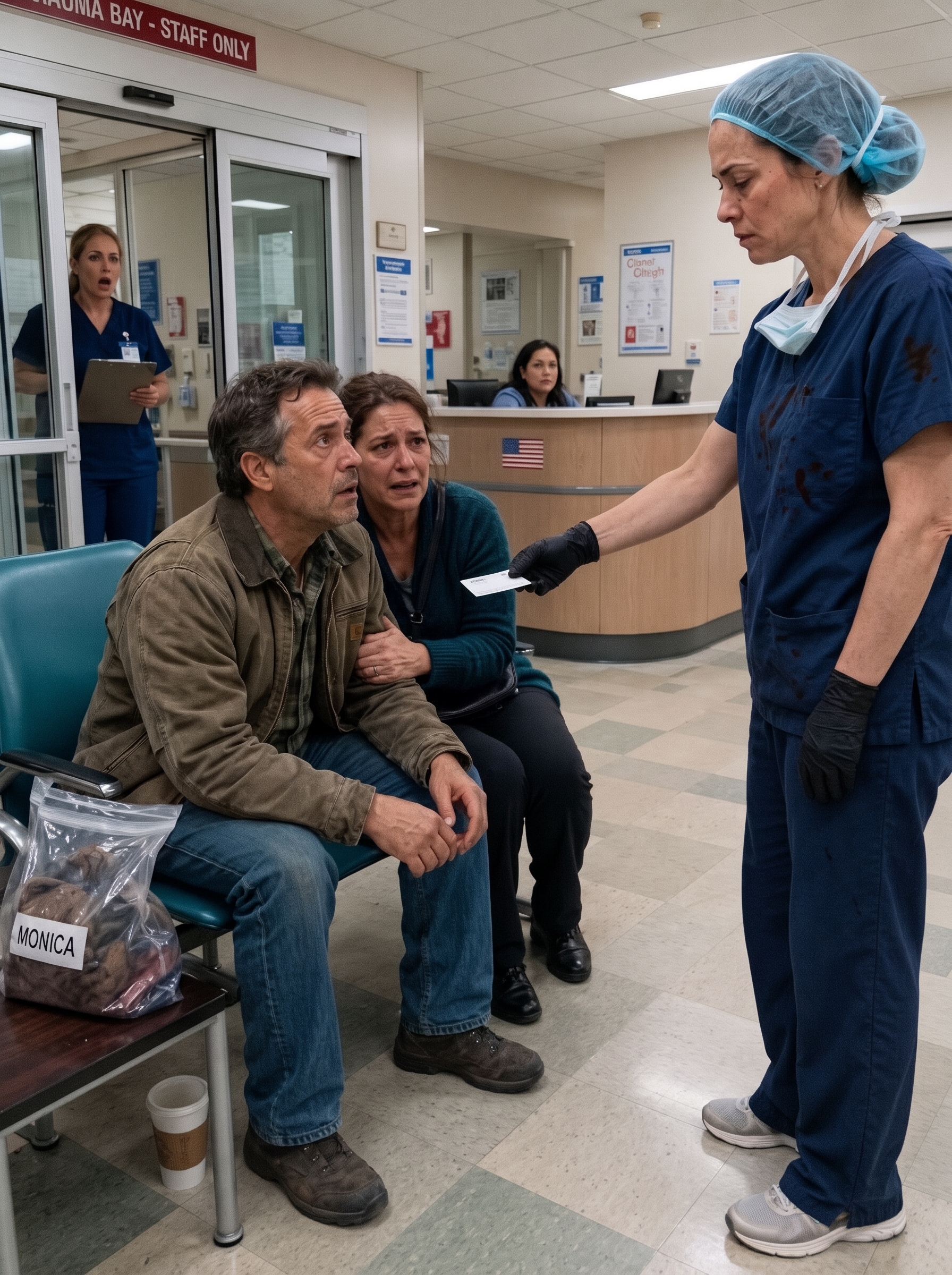
Behind the reception desk, the night clerk had stopped typing. A nurse stood near the doorway holding a clear plastic bag with Monica’s belongings sealed inside: a cracked phone, a watch, earrings, a set of keys, and a folded wallet. While we stood there, the phone buzzed inside the bag. Once, then again. The nurse glanced at me, uncertain about what to do with it.
Then the screen lit up through the plastic.
The preview was bright enough for all of us to read.
MOM: Please tell us what to say if Irene is really there.
The timestamp read 6:12 a.m. I had still been in the operating room at 6:12 a.m.
My mother stared at that phone the way a person stares at something that has just spoken out loud in a quiet room. My father saw it a moment later. The color left his face in a slow, uneven recession, moving from his forehead downward.
That message did what my three returned letters had never been able to do. It proved knowledge. It proved that Monica had not simply told a lie once and lost control of the story afterward. It proved she had been maintaining the lie in real time, actively, while sitting in a hospital waiting room at six in the morning, trying to manage her mother’s response to a sister she had spent five years erasing.
My father said her name. Just that: “Diane.”
My mother sat down hard into the vinyl chair, one hand on the armrest, the other pressed against her mouth. She looked winded, the way a person looks when something has knocked the air out of them not through violence but through the sheer weight of understanding arriving all at once.
“I didn’t know,” she said.
The words came out quickly and automatically, and I believed that part of her meant them, or at least believed them herself in that moment. That is the mercy people extend to themselves when the truth becomes too expensive to hold without softening it first. They did not know everything. They did not ask everything. They did not look hard enough at the edges of the story they were given. But not looking is still a choice. Choosing comfort over investigation is still a choice. And my parents had made that choice repeatedly for five years, which was not the same thing as ignorance.
My father turned toward me. “Irene,” he said. “What did Monica do?”
It was the first real question he had asked me in five years. Not where have you been, not why didn’t you try harder to reach us, not how could this have happened. What did Monica do? And the fact that he was asking it now, reading her words off a lit screen in a hospital bag at seven in the morning, was not the same as having asked it in 2019, or 2020, or any of the years in between when asking would have cost him something.
But I answered him anyway. Because answering was not for his comfort. It was for the record.
I thought about the kitchen table in Hartford the spring I was accepted. My father had held the acceptance letter the way people hold things they are still deciding whether to believe, reading it twice with his eyebrows raised. Oregon Health and Science. “That’s a real medical school,” he had said. Then, after a pause that lasted a beat too long, “Maybe you’ll make something of yourself after all, Irene.” It was not a good compliment. It was the kind that lands like a gift with conditions attached. But I had lived on it for months.
That night my mother had called Aunt Ruth and I heard her from the hallway, her voice changed by pride in a way that made her sound younger. “Irene got into medical school.” She said it like she was still a little surprised.
Across the dinner table, Monica had smiled. Not the smile that reaches someone’s eyes, but the other kind, the one that is measuring you while you are busy being happy. She started calling me more after that. Careful questions about classes, professors, study schedules, and my fears. How stressed was I? Did Mom and Dad understand how difficult the program was? I thought she was trying to be my sister. I did not understand that I was providing her with a detailed and intimate map of my vulnerabilities.
Every insecurity I admitted. Every exhausted sentence. Every 2:00 a.m. confession that I was afraid I might not be good enough. She took them all and used them to build a lie that was not a stranger dressed up as me, but the most frightened version of me, presented as the whole truth.
That was why my parents believed her. Because the person Monica described was recognizable. Because she had found the exact shape of my self-doubt and made it the entire story.
I looked at my father in the waiting room and said, “She told you I dropped out because it was easier for you to believe she was concerned than to believe I was succeeding.”
He flinched.
I was glad. Not because I wanted to cause him pain, but because flinching meant something in him was still responsive.
My mother had started crying while I was talking. First quietly, then with her shoulders shaking. “I called,” she said. “Monica told me you had changed your number.”
“I didn’t.”
“She said you didn’t want us there for graduation.”
“I mailed you an invitation. Both of you.”
My father closed his eyes. I watched him remember the returned letters, watched the understanding move across his face the way weather moves across open ground. People believe revelation is a single thing, one moment of lightning. It is not. It is a series of small doors opening into rooms you should have checked years ago, each one asking why you did not come sooner.
“We thought you were ashamed of yourself,” he said.
“I was ashamed,” I said. “But not of failing. I was ashamed that I kept hoping you would choose me without needing Monica’s permission to do it.”
My father put one hand on the back of the chair in front of him, as if he needed something solid to hold onto.
“Irene,” he said finally, in a voice that sounded older than his face looked. “We were wrong.”
The sentence arrived between us and I let it sit there. It was true. It was also not sufficient, which is not a contradiction. An apology can be genuine and still arrive years too late to open the same door it once closed. That is not cruelty. It is just the way time works. The years my parents missed were not returnable, and no amount of honesty in that waiting room would give me back my mother’s voice on the phone after my residency match, or my father standing at the back of an auditorium trying to look composed while I crossed a stage.
My pager went off before either of us could find the next sentence.
Monica needed post-operative review.
The body, again, indifferent to everything outside itself.
I stepped back. My mother reached toward my sleeve and then stopped, her hand suspended for a moment before she let it drop. That small hesitation was the first sign I had seen that she understood something had changed. She did not have automatic access to me anymore. She had once, and she had not protected it, and now it was something different, something that would need to be rebuilt carefully over time if it was ever going to hold weight.
“I have to check on my patient,” I said.
“Your patient,” my mother repeated softly, as if she needed to hear those two words together again to believe them.
“Yes,” I said. And I walked away.
Monica woke up later that afternoon, groggy and gray around the mouth and reaching for control before she was fully conscious. When she opened her eyes and saw me standing at the foot of the bed, she blinked. Then she turned her head and saw our parents behind the glass of the room door. Her face changed in the way faces change when a person realizes the specific thing they were afraid of has already happened. I had seen patients receive bad scan results with considerably less fear in their eyes.
“You,” she said, her voice stripped down to its minimum by the anesthesia.
“Me,” I said.
A nurse adjusted the drip near her arm. Monica’s eyes moved to my badge, then to the door, then back to my face.
“You operated,” she said. It was not quite a question.
“I did.”
Her lips parted. For one moment, reading her face, I thought she was going to say thank you. People surprise you in hospitals. The stripping away of ordinary life sometimes removes the defenses along with everything else and you see what is underneath.
Instead she whispered, “Did you tell them?”
That was all my parents needed. My mother made a sound behind the glass. My father stepped back from the door as if the floor had shifted under him. Real life rarely delivers dramatic justice with the timing it has in the versions we imagine. There was no shouting. There was no scene. There was instead a family standing in a hospital corridor while the truth organized itself quietly into a shape they could no longer disagree with.
Later that day, my parents asked me to sit with them in the consultation room down the hall. I stood in the doorway for a moment, weighing it. Then I sat.
The room had a round table and four chairs and a box of tissues positioned near the center and a framed map of the United States on the wall by the door. My mother held a twisted tissue between her fingers. My father looked at the table.
They told me what Monica had told them. That I had failed out. That I was drinking. That I was too proud to come home. That I had asked her specifically to keep my shame private so I would not have to face them. That if they pushed me too hard, I might disappear completely.
Each lie had been assembled from something real. I had cried during anatomy lab in my first semester, once, in the stairwell, when nobody was watching, and told Monica about it in a moment of exhaustion. I had told her I was afraid of failing. I had admitted that I sometimes did not answer calls when I was overwhelmed with studying. Monica had not invented a stranger and asked my parents to believe in her. She had taken the most depleted version of me and presented it as the definitive one. That was the particular genius of what she had done, and it was also why it had worked.
My father cried when I described the graduation. Not loudly. The way men cry when they are not fully prepared for it and the feeling arrives faster than the composure they usually deploy.
My mother pressed her lips together and looked out the window when I told her that Sarah, my best friend from residency, had stood beside me at the courthouse on my wedding day in a blue dress she bought on a Tuesday because I had called her the week before. Not because I had not wanted my mother there. Because I had believed, by then, that wanting her was something I needed to stop doing to myself.
I did not cry while I told them any of this. Perhaps I had already used those tears in Oregon in the years nobody was watching. Or perhaps I had simply gotten good at saving them for later, for private, which is a skill medicine teaches you whether you want it or not.
“I don’t know how to fix this,” my mother said eventually, and her voice had that particular quality of a person saying something true for the first time after a long time of saying things that were easier.
“You don’t,” I said.
She looked at me.
“You don’t repair five years in one conversation because you finally feel the full weight of them. That’s not how it works.”
My father nodded slowly, as if the words had mass.
“I know,” he said.
“I’m not sure you do yet,” I replied. “But what would help, what would actually help, is not asking me to manage your guilt so that this room feels less uncomfortable.”
That was the first direct boundary I had ever given them out loud, in explicit language, without apologizing for it or softening it into something easier to hear. It did not feel like victory. It felt like setting down something very heavy that my arms had been holding for so long they had forgotten what it was like to be empty.
In the weeks that followed, Monica recovered. The hospital discharged her with instructions and medications and a follow-up schedule that made everything look neat and sequential, the way discharge paperwork always does. Family damage does not come with paperwork. It does not come with a clear timeline or a set of instructions or a list of warning signs to watch for.
My parents called sometimes. I answered sometimes, not always, which was a choice I made deliberately and without excessive guilt. When I did answer, I kept certain things in place: no revisiting childhood at ten at night, no apologies that turned quietly into requests, no “but she is still your sister” as a way of skipping past the parts that required actual accountability.
Daniel listened after every call. He did not offer solutions unless I asked for them, which was one of the reasons I had married him. Sarah came over one Sunday with takeout and sat cross-legged on my living room floor, reading a text from my mother over my shoulder.
“She’s using a lot of ellipses,” Sarah observed.
“That’s her panic punctuation,” I said.
Sarah snorted. Then she leaned her head back against the couch and said, in a quieter voice, “Are you okay?”
I sat with the question for a moment before answering.
“No,” I said. “But I’m not where they left me.”
That was true in a way that mattered. For five years I had believed, at some level below conscious thought, that being erased by the people who were supposed to know you meant becoming less. It did not. It meant building a life without their witness, which was lonely in ways I will not minimize and which was also, in every important sense, mine. I had built it from the ground up with my own hands, in years they did not watch, through difficulties they did not know about, and it was solid in the way that things are solid when they are constructed rather than inherited.
My parents had missed my white coat ceremony. They had missed my residency graduation. They had missed my wedding and my fellowship appointment and the morning I was named chief of trauma surgery. They could not have those years back. Neither could I. That was simply the shape of what had happened, and no number of honest conversations in a consultation room would alter it.
One month after the accident, an envelope arrived in the mail from my father.
I left it on the kitchen counter for two days. Daniel did not mention it. I picked it up once and set it back down. I was aware, somewhere in my chest, of a careful bracing sensation, the particular tension of not wanting to be hurt by something that might be trying.
On the third day I opened it.
Inside was a letter in my father’s handwriting, the careful block letters he had used for grocery lists and birthday cards my entire childhood. It was brief. There were no speeches. No explanations of himself. No request that I find a way to extend grace to Monica.
He had written a list of dates.
White coat ceremony. Residency graduation. Fellowship appointment. Wedding. Chief of Trauma announcement.
Under each date, a single sentence.
I should have been there.
Five dates. The same sentence, written five times. That was the whole letter.
I read it once, then read it again, then folded it carefully along its original creases and placed it in the drawer of my desk alongside the three returned letters from five years earlier. Not because it resolved anything. Not because a list of dates and five repeated sentences erased five years of chosen absence. But because it belonged with the record. Because it was honest in the specific way that lists are honest: it did not try to explain or contextualize or defend. It named what had happened and said plainly that he should have been there.
Some families demand proof before they choose to believe in you. Mine had not demanded proof in 2019 and had paid for that failure in the years since, and so had I.
But standing in that operating room at four in the morning, scrubbing in to repair the body of the person who had done the most damage to my life, I had made a different choice. I had not asked whether Monica deserved the surgery. I had not weighed her history against her vital signs and arrived at a conditional answer. I had simply done the work I was trained to do, because the work existed independent of the history, and because medicine had taught me that showing up fully is not the same thing as forgiving, and both were possible at the same time.
That was something no one in my family had managed to do for me. But it was what I did for them, not because I owed it to them, but because it was who I had become in the years they were not watching. And who I had become, it turned out, was not someone who needed them to confirm it.
When my father’s letter arrived, I read it and put it away. When my mother called, I answered when I was ready. When I walked through the hospital each morning with my badge turned outward and my name visible, I walked through a building where I had saved lives, including one I had every complicated reason in the world to hesitate over.
I did not hesitate.
I had shown up.
I had done the work.
I had walked into that waiting room at seven in the morning with my hands steady and my name on my chest, and I no longer needed anyone standing in that room to tell me who I was. I had already been telling myself for five years, and I had not gotten it wrong.
The Settlement of Silence
In the weeks that followed Monica’s discharge, the quiet within our family shifted from something volatile to something dense and structural. It was the kind of silence that fills a room after a storm passes—not peaceful, but heavy with the debris of things that had been knocked over and could not simply be propped back up.
My mother called every Tuesday at seven in the evening. It was a precise, almost clinical timing that spoke to a calendar reminder she must have set for herself.
“I bought yellow roses today,” she said during one of those calls. She was standing in her kitchen in Seattle; I could hear the faint hum of the refrigerator in the background. “Your father said they reminded him of the ones by the back porch in the old house. Do you remember those?”
“I do,” I said, leaning against the counter in my apartment in Portland while Daniel chopped garlic for dinner behind me.
“We thought about coming down next weekend,” she said, her voice dipping slightly into that hesitant, testing register she used whenever she approached the perimeter of my life. “Just for lunch. We wouldn’t stay long.”
“Not next weekend,” I said cleanly. “I’m on call.”
“Oh,” she said. A pause followed, long enough for the distance between us to settle back into the line. “Of course. The hospital.”
Five years earlier, that “Oh” would have pulled an apology out of me. I would have offered an alternative date, explained the trauma schedule, reassured her that I wasn’t avoiding her even if I was. Now, I simply let the space exist. I didn’t fill it. I didn’t smooth it down.
Monica, meanwhile, had moved back into my parents’ guest room. Her physical recovery was proceeding on schedule—her femur was healing, the abdominal incisions were fading into neat, pink lines, and her physical therapy notes showed steady progress. But the narrative structure she had inhabited for half a decade had collapsed, and without it, she seemed oddly diminished.
Sarah saw her once, by accident, at a coffee shop near the medical center when Monica came down to Portland for a follow-up appointment with orthopedics.
“She looked at me,” Sarah told me over lunch in the hospital cafeteria later that day. “She knew who I was. She saw my badge. And then she just turned around and walked out without ordering.”
“She didn’t say anything?”
“Not a word,” Sarah said, dipping a French fry into ketchup. “It’s hard to play the victim when the audience knows the script was forged, Maya.”
I looked down at my hands. They were clean, the short-trimmed nails free of scrub ink, the skin slightly dry from the industrial soap we used between procedures. Those hands had held her liver back from tearing further. They had placed the clamps that kept her from bleeding out on an operating table at four in the morning. She knew that. My parents knew that. It was the one piece of reality that no version of her story could ever rewrite.
The Architecture of an Absence
Rebuilding a life in the wake of a revelation does not look like a dramatic confrontation; it looks like administrative work.
Two months after the accident, my father called me directly, bypassing my mother’s Tuesday schedule.
“Maya,” he said. His voice was clearer than it had been in the hospital, stripped of the immediate shock, but carrying a flat, subdued tone that had become his new default. “I went to the bank today.”
“Okay,” I said.
“I transferred the account,” he continued. “The one we set up when you were eighteen. The one we thought…” He cleared his throat. “It’s in your name now. Solely. It’s not much, but it was meant for your tuition. We kept it there because…”
He didn’t finish the sentence. He didn’t need to. They had kept the money untouched because Monica had told them I was using it for alcohol and rent after failing out, and they had frozen the funds out of a misguided sense of “tough love.” For five years, I had taken out federal loans with high interest rates, worked night shifts as a phlebotomist during my first two years of school, and eaten instant noodles in a basement apartment while that money sat in a high-yield savings account in Seattle.
“You don’t have to do that,” I said.
“I do,” he said. “It’s yours. It was always yours.”
“I paid off my loans last year, Dad,” I said quietly. “Daniel and I lived below our means. It’s already done.”
The silence on the line this time was different. It wasn’t awkward; it was the quiet of a man realizing that his help was not only unneeded, but obsolete. The debt had been paid by someone else—by me, through years of eighty-hour work weeks and missed holidays.
“Keep it,” I said finally. “Use it for Monica’s physical therapy. Or put it away.”
“Maya—”
“I don’t need the money, Dad. And receiving it now doesn’t rewrite the semesters I worked thirty hours a week to cover rent. Just leave it.”
When I hung up, Daniel was sitting at the dining table with his laptop open, drafting a grant proposal. He looked up at me over the rim of his glasses.
“How was he?” Daniel asked.
“He tried to give me the college fund,” I said, sitting down across from him.
Daniel closed his laptop slightly. “And?”
“I told him to keep it.” I looked at my wedding ring—a simple platinum band we had bought at a local jeweler two days before the courthouse ceremony. “It felt like buying a ticket to a train that left five years ago.”
“You don’t owe them the opportunity to make amends on their timeline,” Daniel said gently.
“I know,” I said. “I just wonder if there’s a version of this where I’m not the one holding the door shut.”
“You aren’t holding it shut, Maya,” Daniel said. “You just locked it from the inside, and you’re the only one with the key. You decide when—or if—you turn it.”
The Unraveling of Monica
In the third month, the truth began to bleed out into the wider circle of our extended family.
It didn’t come from me. I had no desire to wage a public relations campaign against my sister. But my mother, driven by an agonizing mix of guilt and a desperate need to fix her own moral accounting, had told my Aunt Clara—her older sister—the entire story during a Sunday phone call.
Clara was not a woman who tolerated ambiguity. Within forty-eight hours, the family network had processed the information. My cousin Ellen sent me a long text message that read simply: I am so, so sorry. We had no idea. We thought you had just cut everyone off because you were embarrassed.
I read the text while sitting in the physician’s lounge between an emergency appendectomy and an exploratory laparotomy.
It’s fine, Ellen, I typed back. It’s in the past.
It’s not fine, she replied instantly. Monica is telling people she was ‘confused’ back then because of her own anxiety. She’s trying to spin it.
I set the phone face down on the table.
Of course she was. The human mind, when caught in a lie of that magnitude, rarely surrenders entirely. It looks for mitigations. It looks for diagnostic categories. It converts deliberate malice into a symptom.
That evening, Monica called me directly for the first time since the night of the accident.
I picked up on the third ring. “Maya speaking.”
“Maya,” her voice was thin, sharp around the edges. “Mom told Clara.”
“I know,” I said.
“Why are you doing this?” Her voice cracked, not with sorrow, but with the indignation of someone whose narrative control was slipping away. “You got what you wanted. Mom and Dad feel terrible. You’re the hero surgeon who saved my life. Do you have to ruin everything else too?”
I stood by the window of my office, looking down at the ambulance bay below. Red lights flashed silently against the pavement as a unit pulled in.
“I didn’t tell Clara, Monica,” I said, keeping my tone strictly flat, the same voice I used when reading vitals to a surgical team. “Mom did.”
“Because you made her feel guilty!” Monica spat. “You sat in that room and gave them your little speech about boundaries! You knew what that would do to them. Mom hasn’t slept in weeks. Dad just sits in the garage for hours.”
“They are experiencing the reality of what happened,” I said. “That isn’t something I did to them. It’s something you did, and they chose to believe for five years.”
“I was sick, Maya!” she yelled into the receiver. “I was lonely! You went off to medical school and you had this whole grand life planned out, and I was just… here! Nobody looked at me the way they looked at you!”
There it was. The core of it. Stripped of the elaborate lies about dropped classes and alcohol abuse, it was the basic, ugly machinery of sibling jealousy, amplified by a family dynamic that had always prioritized the loudest squeaking wheel.
“I know,” I said quietly.
“What?” she demanded, caught off guard by the lack of argument.
“I know you were lonely,” I said. “And I’m sorry about that. But you took five years of my life with my parents, Monica. You let them believe I was destroyed so you could feel important. I saved your life three months ago because it was my job. But I am not going to protect your reputation now so you can feel comfortable.”
“You hate me,” she whispered.
“No,” I said, and as I spoke the words, I realized they were entirely true. “Hate takes energy. I just don’t know you anymore. And I don’t t
I hung up before she could respond. I didn’t block her number, but I set it to go straight to voicemail.
The Threshold
Spring arrived in Portland with the heavy, persistent rain that turns the city emerald green. The hospital was busy—trauma season was ramping up as the weather warmed and more people hit the highways.
My father drove down alone on a Thursday morning. He didn’t call beforehand; he simply showed up in the hospital lobby at eleven o’clock and asked the receptionist at the surgical desk if Dr. Maya Lin was available.
When my pager went off with the message from the desk, I felt a brief spike of annoyance, followed immediately by a strange, quiet calm.
I walked down to the main floor. He was sitting on one of the vinyl benches near the gift shop, holding a small brown paper bag in his lap. He looked older than he had in the hospital corridor months ago. The hair at his temples was completely silver, and his jacket hung slightly loose on his shoulders.
“Dad,” I said, stopping a few feet away.
He stood up quickly, nearly dropping the bag. “Maya. I’m sorry. I know you’re working. I just… I was passing through on my way to Salem for a delivery for the shop, and I wanted to drop this off.”
He held out the bag.
I took it. Inside was a small, framed photograph.
It was from my college graduation—the undergraduate one, the only milestone they had actually attended. I was twenty-two, standing on the lawn in my black cap and gown, smiling wide, flanked by my mother and father. Monica wasn’t in the picture; she had refused to go to the ceremony that day, claiming a migraine, and my parents had almost missed my walk because they were arguing with her in the parking lot.
“I found it in the attic,” my father said. “I noticed… I noticed we didn’t have any photos of you in the house after that one.”
I looked at the image. The girl in the cap and gown looked impossibly young, her face smooth, unburdened by the hundred small betrayals that were waiting for her in the years ahead.
“Thank you,” I said.
“Maya,” he said, stepping closer, his voice dropping so low the reception desk couldn’t hear him. “I didn’t ask her enough questions. Back then. When she started telling us those things.”
I stayed silent, letting him speak.
“It was easier,” he confessed, the words coming out hard and dry, like stones pulled from deep ground. “It was easier to believe you had failed and pull away than it was to deal with how broken she was every time we talked about you. If we celebrated you, she fell apart. If we ignored you… things were quiet. I let her lies stand because it made the house quiet.”
The admission hung between us in the sterile, fluorescent air of the lobby.
It was the truth, unvarnished and pathetic. It wasn’t a grand evil; it was the cowardly, small-scale compromise that parents make when they choose the child who demands all the room over the child who manages on her own.
“I know,” I said softly.
He looked at me, tears welling in his eyes. “Can you ever forgive that?”
I looked down at the photograph in my hand, then back up at him.
“I don’t know if forgiveness is the right word, Dad,” I said honestly. “Forgiveness sounds like putting things back the way they were. We can’t do that. That house isn’t my home anymore. But I’m not angry at you today. That’s the best I can give you right now.”
He nodded quickly, wiping his eyes with the back of his hand. “That’s… that’s fair. That’s more than I deserve.”
“Have you eaten lunch?” I asked.
He blinked, surprised. “No. Not yet.”
“Come to the cafeteria,” I said, gesturing toward the elevators. “I have twenty minutes before my next consult.”
The Dinner Table
Six months after the surgery, I agreed to go to Seattle.
It was not a grand reconciliation. It was a calculated step, taken after long conversations with Daniel and several sessions with a therapist I had started seeing to process the residual noise in my head.
Daniel drove. The sky over the I-5 corridor was gray and overcast, the rain steady against the windshield.
“You don’t have to stay if it gets weird,” Daniel said, keeping his eyes on the road. “We can get a hotel room in downtown Seattle anytime you want.”
“I know,” I said. “But I need to see what the room looks like now.”
The house I grew up in looked smaller than I remembered. The lawn was neatly trimmed; the yellow roses my mother had mentioned were blooming near the porch steps.
When we walked in, the smell of the house hit me instantly—lemon pledge, old paper, and roasted chicken. It was the scent of my childhood, unchanged by the decade of distance.
My mother met us at the door. She looked smaller, too, her shoulders slightly curved, her eyes anxious as she looked past me to Daniel, then back to me. She embraced me carefully, as if I were made of thin glass that might fracture under pressure.
“Maya,” she whispered. “Thank you for coming.”
“Hi, Mom. This is Daniel.”
My father came out of the kitchen, shaking Daniel’s hand with a firm, overly deliberate grip that betrayed his nervousness.
Monica was not there. My parents had arranged for her to stay with an aunt for the weekend—a boundary I had not asked for, but one they had established on their own. It was a small sign that they were finally beginning to understand the structure of the space between us.
Dinner was quiet. We talked about Daniel’s work in urban planning, the weather, the traffic on the bridge. We did not discuss the medical school years. We did not mention the hospital in Portland. We did not speak Monica’s name.
It was polite, careful, and deeply un-intimate—the kind of dinner you have with distant relatives you see once every few years.
As we were finishing dessert, my mother looked at me across the table. Her hands were folded over her napkin.
“Your father told me what he said to you in the lobby,” she said quietly.
My father looked down at his plate. Daniel stayed silent beside me.
“I was cowardly too, Maya,” she said. “Worse than him, maybe. Because I wanted to believe her. It was easier to think you were the one who had turned your back on us than to admit we had raised a daughter who could do what Monica did. If you were the bad one, then I didn’t have to look at what was happening under my own roof.”
I listened. The pain was still there, a dull ache behind my ribs, but it no longer had the sharp, breathless edge it used to carry.
“I know,” I said.
“We can’t ask you to love us the way you used to,” she said, her voice trembling slightly. “But we would like to be allowed to know you now. If you’ll let us.”
I looked around the dining room—at the old wooden sideboard, the family portraits on the wall that stopped abruptly at 2018, the empty chair where my sister used to sit.
“We can try,” I said. “Step by step. But it has to be based on who I actually am, not who you need me to be to make yourselves feel better.”
My mother nodded, tears spilling over her lower lids. “Okay,” she said. “Okay.”
The Shape of a Life
A year after the accident, I was invited to give the keynote address at the regional trauma surgery symposium in Seattle.
It was a significant professional honor, the kind of event that brings together chief surgeons, residents, and medical directors from across the Pacific Northwest.
I stood behind the podium in the large hotel ballroom, looking out over a sea of white coats and dark suits. In the third row, sitting next to Daniel and Sarah, were my mother and father.
They had bought their own tickets. They had arrived early to sit near the front. They had not asked to be introduced to my colleagues; they had simply sat there, quiet and attentive, holding the program booklets in their hands.
My talk was titled Decision-Making Under Dynamic Stress: Precision in High-Tension Environments.
I spoke about the mechanics of the operating room—about how to maintain cognitive clarity when every variable is failing, how to compartmentalize personal noise to perform critical procedures, how to make cold, necessary choices when the outcome is uncertain.
“In trauma surgery,” I told the room, my voice echoing clearly through the sound system, “you learn very quickly that you cannot control the condition of the patient when they arrive on your table. You do not get to choose their history. You do not get to judge how they arrived at the point of crisis. Your only job—your sole responsibility—is to perform the work in front of you with absolute precision, independent of how you feel about the person beneath the drape.”
I looked out at the third row. My father was looking at me, his face set in an expression of quiet, profound awe. My mother was holding Daniel’s hand, her eyes shining in the dim house lights.
“The work,” I continued, turning my eyes back to the audience, “is its own authority. It does not require validation from the past, and it does not ask for permission from the future. It simply demands that you show up, steady your hands, and do what you were trained to do.”
When the speech ended, the room stood up. The applause was long and loud.
I stepped away from the podium, accepted the commemorative plaque from the conference chair, and walked down the side steps of the stage.
My parents waited until the queue of colleagues wishing to speak with me had cleared. When they finally approached, my father didn’t say anything at first. He simply reached out and took my hand, squeezing it with a firm, steady pressure.
“That was wonderful, Maya,” my mother said softly. “You were… you were amazing.”
“Thank you, Mom,” I said.
“We’re going to head back home now,” my father said, releasing my hand. “We just wanted to see you speak.”
“Stay for dinner,” I said.
My mother blinked. “Are you sure? We don’t want to intrude on your colleagues—”
“I’m sure,” I said, looking at Daniel, who smiled and gave me a small, reassuring nod. “There’s a restaurant down by the waterfront. We have a reservation for four.”
The Clear Horizon
That evening, we sat near the window at a restaurant overlooking Puget Sound. The sun was dipping below the horizon, painting the water in long stripes of orange, violet, and deep blue. ferries moved slowly across the bay, their lights flickered on as the dusk deepened.
The conversation was easy. It wasn’t the forced intimacy of people trying to pretend nothing had ever gone wrong, nor was it the fragile silence of a truce. It was something new—a baseline established on real terms, built on the slow, deliberate work of showing up without expectations.
Monica was currently living in Spokane, working an administrative job, attending therapy twice a week. My parents visited her once a month. She and I had not spoken since our phone call, and we had both accepted that this was the safest shape our relationship could take for now.
As the waiter cleared our dessert plates, my father looked out at the water, then turned back to me.
“I read your article in the journal last month,” he said suddenly. “The one on thoracic damage repair.”
I raised my eyebrows. “You read Annals of Surgery?”
“He bought a subscription,” my mother said, smiling faintly, though her eyes were soft. “He looks up all the medical terms in a dictionary on his iPad.”
My father flushed slightly, looking down at his coffee cup. “I missed five years of learning what you were doing,” he said simply. “I have a lot of reading to catch up on.”
I looked at him—at the silver hair, the worn hands resting on the white tablecloth, the quiet effort of a man trying to learn the language of a daughter he had almost lost to a phantom version of herself.
“It’s a dry read, Dad,” I said, a slight smile touching the corners of my mouth. “I can just explain the next one to you.”
He looked up, his eyes meeting mine, clear and steady.
“I’d like that,” he said. “I’d really like that.”
Later that night, after we had said goodbye to my parents in the valet line and watched their car pull away into the Seattle night, Daniel and I walked along the pier. The cool salt air blew off the water, sharp and refreshing.
“How are you feeling?” Daniel asked, wrapping his arm through mine as we walked.
I stopped near the wooden railing, looking out over the dark water toward the lights of Bainbridge Island in the distance.
I thought about the hospital corridor in Portland. I thought about the white coat ceremony I had walked through alone, the residency graduation where Sarah had been my only witness, the operating room at four in the morning with my sister’s life resting beneath my gloved fingers, and the brief, five-line letter sitting quietly in my desk drawer at home.
None of those things had been erased. The scar was there, clean and permanent, running straight through the center of my history. But a scar is not an open wound. It is simply tissue that has healed stronger than the skin around it, built to withstand the pressure of living.
“I’m good,” I said.
And for the first time in five years, when I said it, there was no doubt left anywhere inside me.
I pulled my coat tighter against the cool evening breeze, turned my back to the dark water, and walked back toward the city lights with my husband by my side, completely, unshakably at home in the life I had built.
THE END..!