Eight. She isn’t the kind of child who invents frightening
things just to make a story sound more exciting. She
doesn’t lie for attention. She barely raises her voice even
when she’s thrilled. She is quiet, gentle, and still believes
the moon follows our car because it likes her. That was
why, when she said it so calmly that morning, something
inside me cracked. — Dad… every night a man enters your
room after you’ve already fallen asleep. My hands slipped
slightly on the steering wheel. — What did you just say?
She continued looking out the window as we drove toward
school, watching storefronts and traffic pass as if she were
describing the weather. — He walks very slowly, she said. —
Like he doesn’t want the floor to make noise. Mom closes
her eyes, but she doesn’t say anything. There was no fear
in her voice. No uncertainty. Only certainty. And that
certainty turned my blood cold. — Maya… where did you get that from?
She shrugged. — I see him. The rest of the drive felt wrong.
The air inside the car seemed suddenly too thick. I kept
checking her reflection in the mirror, waiting for a grin, a
laugh, any indication that this was some strange story she’d
invented. Nothing came. She simply adjusted the straps of
her pink backpack and hummed softly, as though she hadn’t
just opened a hole beneath my feet. Maybe she’d dreamed it. Maybe she’d watched something online.
Maybe she’d seen a shadow in the hallway and her imagination had turned it into a person.
Maybe.
But sometimes a sentence hits your chest before your mind has time to explain it away.
I dropped her at school. She kissed my cheek, climbed out, and hurried toward the gate with her pink backpack bouncing behind her.
I watched until she vanished among the other children.
For a second, it felt like the entire world tilted.
Then I drove straight home.
My wife was in the kitchen exactly where she normally was at that hour. Morning light filled the room. Coffee steamed beside the toaster. Her hair was tied back, and when she saw me, she smiled as though nothing had changed.
— You’re back already?
For the first time since marrying her, I didn’t know how to look at my own wife.
I wanted to laugh at myself.
I wanted to repeat what Maya had told me and let Sarah explain the whole thing away in ten seconds.
I wanted to believe our daughter had confused a dream with reality and that my marriage was still the safe place I’d always believed it was.
Instead, I stood there gripping my keys and noticed details I’d somehow ignored before.
The dark circles beneath Sarah’s eyes.
The long sleeves despite the warm weather.
The tiny flinch when I moved closer, as though she’d been somewhere distant and needed a moment to return.
She asked if everything was okay.
I said yes.
For the rest of that day, I moved through my own house like a stranger temporarily living there.
Every sound seemed sharper.
Every silence carried weight.
When Sarah’s phone buzzed on the counter, she picked it up too quickly. Later, when she stepped into the laundry room to answer a call, I caught only one sentence before her voice dropped.
— Tonight then… after he’s asleep.
My stomach dropped so suddenly I had to steady myself against the wall.
A moment later, Sarah returned carrying towels, completely calm, and asked whether I wanted chicken or pasta for dinner.
I told her I didn’t care.
She studied me a second longer than usual, as though she knew something had shifted, but neither of us said another word.
Not during dinner.
Not while Maya talked about spelling practice.
Not while we washed the dishes.
Not as the house gradually became quiet for the night.
Before bed, I stopped outside Maya’s room.
— Have you really seen him every night?
She nodded against her pillow.
— He always comes when it’s very dark. He carries something. Mom never screams. She just looks sad.
Sad.
That word should have made me slow down and think.
It didn’t.
Sarah came to bed around eleven. She smelled like soap and something faintly sterile that I couldn’t identify.
She asked whether I’d taken my sleeping pill.
I said yes.
I even let her hear the bathroom faucet running, but instead of swallowing the tablet, I spat it into the sink and slipped it into my pocket.
Then I climbed into bed beside her and waited.
I made my breathing slow and heavy.
Regular.
Believable.
Beside me, Sarah’s breathing sounded wrong too.
Too controlled.
Too awake.
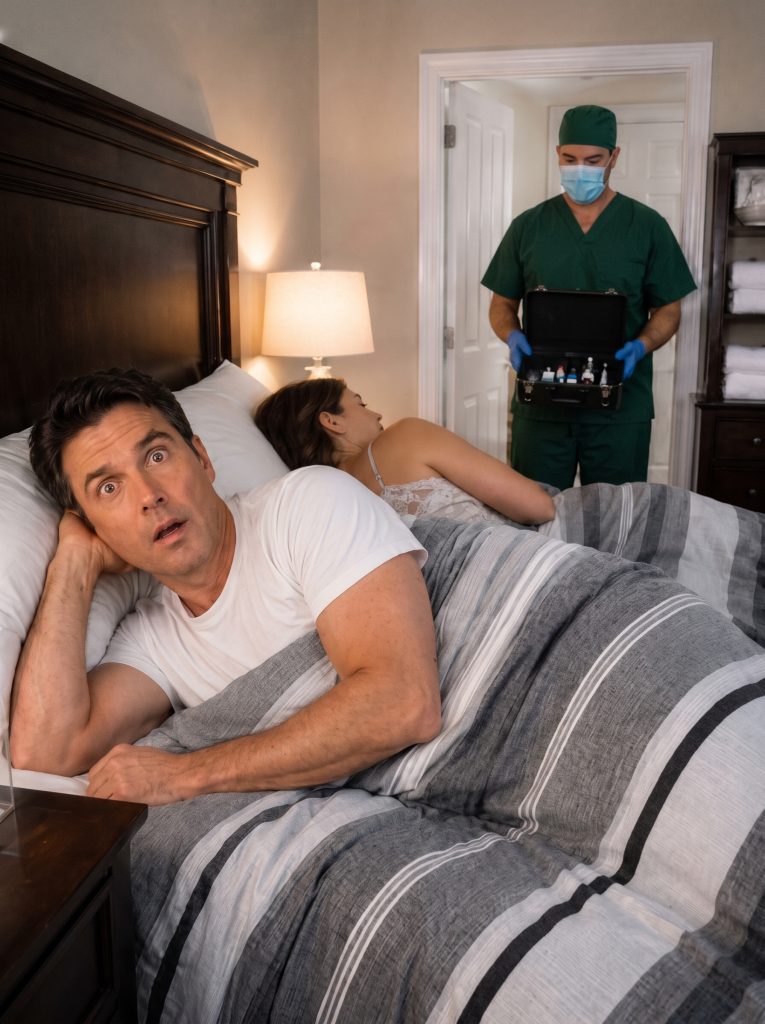
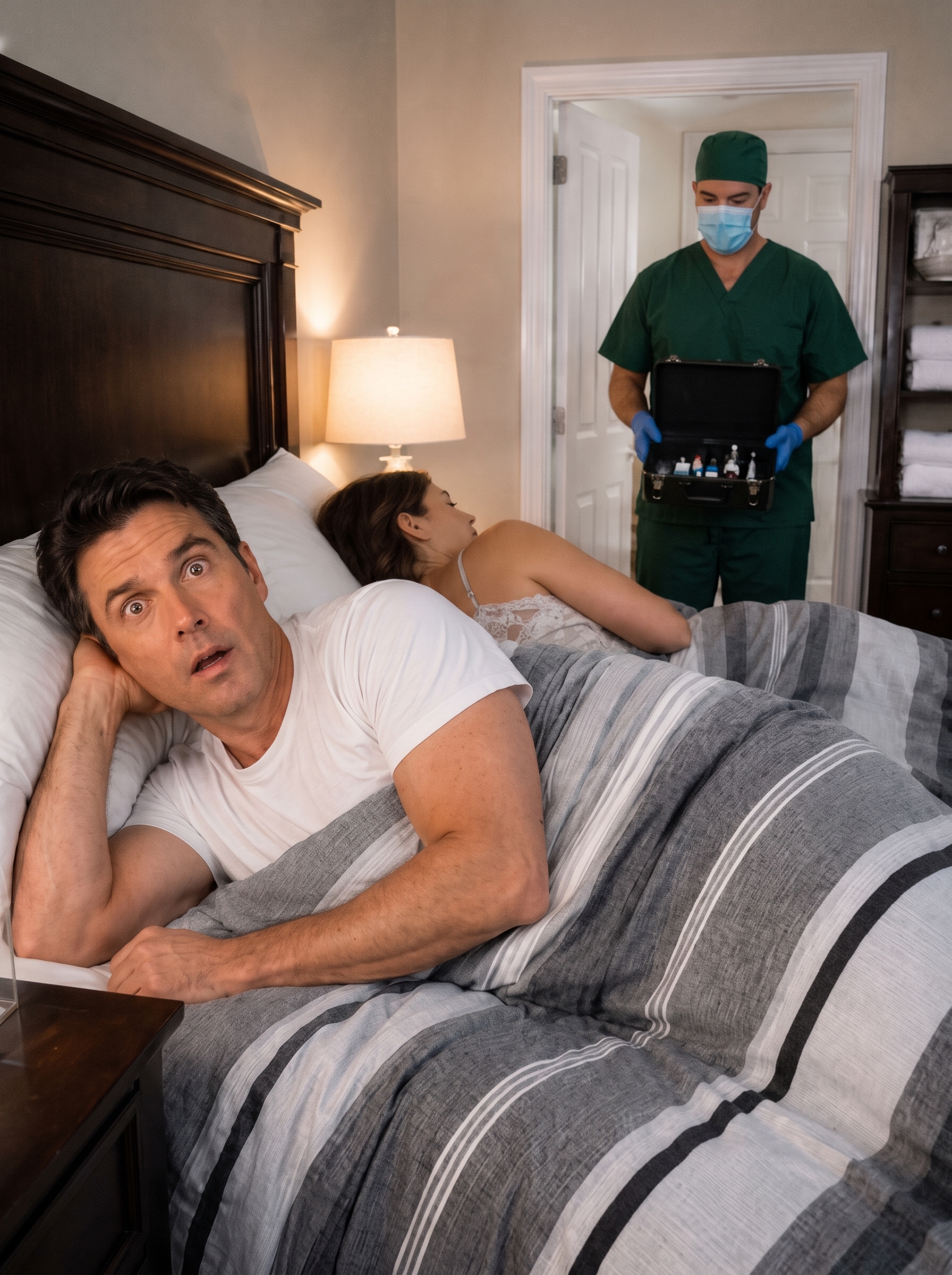
At 1:13, the bedroom door began to move.
Not quickly.
Slowly.
Like whoever was opening it had done this many times before.
A narrow strip of hallway light stretched across the floorboards.
Then someone stepped inside.
A man.
Tall.
Careful.
Silent.
He closed the door without allowing the latch to click.
In one hand, he carried a narrow black case.
He didn’t switch on a light.
He knew exactly where he was going.
Sarah’s side of the bed.
My entire body went rigid.
She didn’t move, but I saw her eyes squeeze tighter—not like someone sleeping, but like someone preparing herself.
The man stopped beside her.
For several seconds, nobody spoke.
Then he bent slightly and whispered in a voice so low it twisted my stomach.
— It’ll only take a minute.
Sarah gave the smallest nod.
Something primitive surged through me.
Rage.
Humiliation.
The hot, dizzy kind that wipes away reason.
I could already imagine myself lunging across the mattress.
Then I heard another sound.
A soft snap.
Rubber.
Latex.
A faint sterile smell reached me through the darkness.
Alcohol.
Plastic.
Something clinical and cold.
The black case opened with a soft metallic click.
Sarah lifted one trembling hand toward the collar of her nightshirt.
The stranger leaned over her, reached into the open case, and lifted something thin and silver into the narrow strip of light beside our bed.
My hand was already moving toward the lamp.
I clicked the switch.
PART 2- Every nite, a man comes into our room, according to my daughter. and I decided to appear to be asleep that nite in order to trap him.
Yellow light flooded the room, tearing through the shadows and blinding all three of us. The man spun around, shielding his eyes with one gloved forearm. I surged upright, the mattress groaning beneath me. My chest heaved, my hands clenched into fists, every nerve in my body ready for a confrontation. “Get the hell away from her!” I roared. Sarah gasped and sat up, clutching the collar of her nightshirt.

“David, stop! Wait!” The stranger cautiously stepped backward and raised both gloved hands. He wore a dark, unbranded tracksuit. A surgical mask rested beneath his chin, and a lanyard with a small identification badge hung around his neck. “Sir, please calm down,” the man said, his voice flat, exhausted, and entirely unbothered by my aggression. “I’m not here to hurt anyone.” My eyes jumped between him and Sarah. The narrow black case was open on the nightstand. Inside were organized compartments filled with sterile medical supplies—vials,
alcohol wipes, disposable syringes, and a sleek handheld mechanical pump attached to a thin silver needle.
An IV port applicator.
I turned toward my wife.
Her nightshirt collar had been pulled down on the left side, exposing a square patch of medical tape covering a semi-permanent port beneath her collarbone.
The skin surrounding it was bruised in shades of purple and yellow.
The rage disappeared from my chest so quickly that it left behind nothing but icy confusion.
“What… what is this?” I breathed, my voice cracking. “Sarah, what is this?”
She couldn’t look at me.
Sarah buried her face in her hands as her shoulders began to shake.
“I’m sorry,” the man murmured softly, reaching down to close the black case. “I should let you two talk. Mrs. Vance, we didn’t complete the infusion, but I set the line. I’ll step outside for ten minutes.”
“Infusion?” I repeated, the word tasting like ash in my mouth. “What infusion? Who are you?”
“I’m Marcus,” he said, pulling off his latex gloves with a crisp snap. “I’m a private home-care nurse. I’ve been coming here at night for the past three weeks to administer your wife’s late-stage trial treatment.”
He picked up his case and quietly left the room, closing the door behind him.
The silence afterward felt heavier than the darkness had.
I sat on the edge of the mattress staring at Sarah.
Under the bright lamplight, I suddenly saw everything I’d somehow failed to recognize during the previous six months.
The hollowed cheeks.
The sharpness of her collarbones.
The unnatural paleness of her skin.
“Sarah…” My voice was barely a whisper. “Talk to me. Please.”
She pulled her knees against her chest and wrapped her arms around them.
When she finally looked up, tears filled her eyes.
“It started eight months ago,” she said quietly, her voice trembling. “Persistent fatigue. Joint pain. I thought I was just getting older, or stressed from managing the house while you worked those eighty-hour weeks at the firm. I went for a routine blood test.”
She stopped and swallowed before forcing herself to continue.
“It’s aggressive, David. A rare strain of non-Hodgkin’s lymphoma. By the time they caught it, it was already advanced.”
The room seemed to move around me.
For a moment, I couldn’t speak.
“Why didn’t you tell me?” I finally choked out, my eyes burning. “How could you keep something like this from me? I’m your husband!”
“Because you were already drowning!” she cried, the raw emotion finally spilling over. “Your father had just passed away, you were trying to make partner, and you were having panic attacks in the car every morning! If I told you, you would have broken. You would have given up your career, your sanity, everything, to watch me deteriorate.”
“So you just… handled it alone?” I asked, tears finally slipping down my cheeks. “Every night?”
“I couldn’t do standard chemo during the day without you noticing the hair loss and the sickness,” she explained, wiping her eyes with the back of her hand. “My doctor managed to get me into an experimental targeted-immunotherapy trial. But the medication has a strict 24-hour cycle and causes extreme nausea and drop in blood pressure right after administration. The trial sponsor agreed to send a midnight mobile nurse so I could receive the infusion while you slept, take the anti-emetics, and recover by morning before Maya woke up.”
Her gaze dropped toward her hands.
“Every night, I gave you a mild herbal sleep aid in your evening tea so you wouldn’t wake up to the sound of the door opening or me being sick in the bathroom. I was trying to protect you. Both of you.”
I covered my face with my hands as a broken sob tore through my throat.
The weight of my own assumptions crushed me.
I’d spent an entire day imagining the worst kind of betrayal while Sarah had been quietly fighting for her life in the bed beside me.
“And Maya…” I whispered, glancing toward the bedroom door. “She saw him.”
“Marcus is always quiet,” Sarah said softly. “But our floorboards squeak outside her room. She must have woken up, peeked through the door crack, and seen him coming in. I never knew she saw.”
I moved around the bed and sat beside her.
Then I wrapped my arms around her thin frame, holding her so carefully and tightly that I was almost afraid she’d break.
“No more secrets,” I sobbed into her hair. “No more pills in my tea. No more hiding in the dark. I don’t care about the firm. I don’t care about making partner. I am here. We fight this together.”
She clung to me and cried, finally releasing the weight she’d carried alone for months.
—
The next morning, the house was quiet.
I sat at the kitchen counter with two cups of coffee cooling in front of me.
Sarah was resting upstairs. Marcus had completed the infusion after our conversation, and the medication had left her weak and nauseous.
I had already called out of work indefinitely.
No elaborate explanation.
No apology to my boss.
Nothing at the firm mattered more than the two people inside my house.
Small footsteps came down the stairs.
Maya appeared in the kitchen doorway with her pink backpack over one shoulder, her large brown eyes searching my face.
She looked uncertain, clearly sensing that something in our home had changed.
“Dad?” she asked softly. “Is Mom sick?”
I put down my mug and walked toward her.
Then I knelt until we were eye level and gently brushed her hair away from her face.
“She is, sweetie,” I said, keeping my voice calm and gentle. “She’s been sick for a little while, but she was trying really hard not to worry us.”
Maya lowered her eyes and bit her lip.
“Was that man… a doctor?”
“He’s a nurse,” I explained, smiling softly to reassure her. “His name is Marcus. He comes at night to give Mom special medicine that helps her body fight the sickness. He’s a good guy, Maya. He’s helping her get better.”
She stayed silent for several moments, trying to understand.
Then she looked back at me with an expression far too serious for an eight-year-old.
“Is Mom going to be okay?”
“We’re going to do everything we can to make sure she is,” I promised, pulling her into a warm hug. “And you helped us, Maya. Because you told me what you saw, I found out the truth. You were a brave little girl.”
Her arms tightened around my neck and she rested her head on my shoulder.
“I don’t want Mom to look sad anymore.”
“She won’t have to face it alone anymore,” I whispered. “Neither will we.”
—
The following months were the hardest our family had ever faced.
But at least we weren’t moving through them in darkness anymore.
I took a leave from the firm.
I cooked, cleaned, drove Maya to school, and kept track of Sarah’s seemingly endless medical appointments.
Marcus continued coming at night for another three months until the experimental treatment ended.
The difference was that now I met him at the door.
I brought him water.
And during every infusion, I sat beside Sarah and held her hand.
There were days when the treatment left her too weak to get out of bed.
Days when fear returned to the house and seemed to settle into every room.
But we didn’t hide from it anymore.
We talked.
We cried.
We held each other when things became unbearable.
By the time winter arrived, a different kind of quiet had settled over our home.
Not the secretive, heavy silence from before.
Something peaceful.
It was a Tuesday afternoon in December when Sarah’s oncologist called.
Sarah was sitting on the living-room sofa wrapped in a thick wool blanket while Maya read beside her.
I stood near the window with the phone against my ear, my heartbeat pounding against my ribs.
“David?” the doctor’s voice came through the speaker. “I have the results from Sarah’s latest PET scan.”
My grip tightened around the phone.
“Go ahead, Doctor.”
“The targeted trial was a complete success,” she said, her tone light and full of warmth. “The tumors have shrunk completely. There is no evidence of active disease. Sarah is officially in full remission.”
I lowered my head as tears spilled down my face.
For several seconds, I couldn’t speak.
Then I crossed the room, dropped to my knees in front of Sarah, and rested my forehead against her lap.
“David?” Sarah asked, her hand instantly finding my hair. “What did she say?”
I looked up at her through tears.
“It’s gone,” I choked out, looking up at her with a tearful smile. “It’s all gone, Sarah. You’re in remission.”
Sarah gasped.
Her hands flew to her mouth as tears filled her eyes.
Maya dropped her book and threw herself around both of us, squealing with happiness. She probably didn’t understand exactly what remission meant.
She only knew the frightening days were finally ending.
—
That night, for the first time in nearly a year, our house felt completely safe.
No midnight footsteps moved down the hallway.
No shadow quietly entered our bedroom.
No one carried a secret burden alone in the darkness.
I lay beside Sarah listening to the calm rhythm of her breathing.
Color had begun returning to her cheeks, and the deep shadows beneath her eyes had faded.
I reached across and switched off the bedside lamp.
The room settled into comfortable darkness.
Outside, light snow had started falling, covering the trees in soft white.
Then I heard Maya’s bedroom door open down the hallway.
A moment later, small feet padded across the floorboards.
She peeked into our room clutching her stuffed bear.
“Dad?” she whispered into the dark.
“Yeah, sweetie?” I replied, raising my voice slightly so as not to startle her.
“Can I sleep with you guys tonight?” she asked. “Just for a little bit?”
Sarah stirred beside me, smiling through the darkness, and lifted the edge of the duvet.
“Come here, Maya.”
Maya hurried over, climbed into the middle of the mattress, and wriggled beneath the covers between us.
Sarah wrapped one arm around her.
I reached across them both and rested my hand over theirs.
“Dad?” Maya whispered, staring at the ceiling.
“Yes, Maya?”
“The moon really does follow our car, right?”
I smiled into the darkness and pulled my family closer.
“It sure does, kiddo,” I said softy. “It follows us everywhere we go.”
PART 3- Six months after an accident took my sight, my wife left me sitting alone on a Central Park bench10
“I don’t know.” I laughed nervously. “Brightness, maybe.” Nobody celebrated. That made me trust her more. They repeated the test several times. Sometimes I sensed it. Sometimes I didn’t. The examination lasted nearly three hours. Afterward, Elena brought Daniel and me into her office. “You have measurable retinal responses,” she said. I gripped the arms of my chair. “What does that mean?” “It means your eyes are sending signals.” “Where are they going?” “That’s the question.” She described the visual system in language I could understand. My eyes were not cameras disconnected from power. They were more like cameras sending information through damaged cables.

The accident appeared to have affected the pathway behind them. “What can be done?” “I want updated imaging.” “And then?” “Then we determine whether the compression visible on your original scans is still present.” I stopped her. “Compression?” “The original radiology report mentioned it.” “No one ever said that word to me.” Elena became quiet. “I’d like to review the complete hospital record before drawing conclusions.” Daniel shifted beside me. I knew that sound. He was concerned. “When can we do the imaging?” “Today, if you’re willing.” “I am.”
By seven that evening, I had learned that hospitals sound different after visiting hours.
Quieter.
More honest somehow.
Cassandra came after Daniel called her.
I hadn’t asked him to.
I also didn’t tell her to leave.
She sat beside me while we waited for Elena.
For nearly twenty minutes, neither of us spoke.
Then Cassandra reached toward my hand.
Her fingers stopped before touching mine.
“May I?”
Six months earlier, she would simply have taken it.
That small question affected me more than I expected.
I turned my palm upward.
She placed her hand inside it.
We waited that way.
Finally the door opened.
Elena entered with another physician, Dr. Samuel Levin, a neurosurgeon specializing in injuries near the optic pathways.
He introduced himself and sat across from us.
“We’ve reviewed the imaging,” he said.
I heard papers moving.
“The good news is that Dr. Vale was right to investigate.”
Cassandra’s fingers tightened around mine.
Dr. Levin continued.
“The accident produced several injuries. Most healed as expected. However, there’s an area of post-traumatic scarring and tissue change near the pathway carrying visual information.”
“Can you remove it?” I asked.
“Possibly.”
One word.
Possibly.
Six months earlier I would have hated such uncertainty.
That night, it sounded almost beautiful.
“What are the chances?”
“We can’t responsibly give you a percentage yet.”
“Could surgery make things worse?”
“Yes.”
Cassandra flinched.
Dr. Levin explained that the procedure would not be simple, but neither was it unprecedented. More testing was needed to determine whether intervention offered a reasonable chance of restoring useful vision.
“Useful vision,” I repeated.
“That might mean light perception. Shapes. Movement. Possibly more.”
“Or nothing.”
“Correct.”
I sat back.
Cassandra whispered my name.
I heard fear returning to her breathing.
The same fear I’d heard in Central Park.
But now I understood it differently.
She wasn’t afraid that Lily knew some dark secret.
She was afraid of watching me hope again.
I squeezed her hand.
“I’m still going to find out.”
“I know.”
Elena remained behind after Dr. Levin left.
“There is one more thing,” she said.
I turned toward her.
“I requested your complete trauma record this afternoon.”
“And?”
“The original hospital team didn’t ignore these findings.”
That confused me.
“You said they hadn’t told me.”
“I said I wanted to understand why.”
Her chair moved closer.
“A specialist recommended repeat imaging six to eight weeks after your accident.”
My heart seemed to stop.
“Was it done?”
“No.”
“Why not?”
Cassandra’s hand went completely still.
Elena continued carefully.
“According to the file, the follow-up recommendation was sent to your designated medical contact.”
I already knew the answer.
Still, I asked.
“Who was that?”
Elena didn’t need to speak.
I turned slowly toward my wife.
“Cassandra?”
She was crying now.
Quietly.
Almost soundlessly.
“I received it,” she whispered.
The room seemed suddenly smaller.
“You knew this before Dr. Vale?”
“I knew they wanted another scan.”
“Why wasn’t it done?”
Her fingers slipped from mine.
“Because I canceled it.”
I heard Daniel inhale across the room.
I couldn’t speak.
Cassandra’s voice trembled.
“I thought it was just another scan, Adrian. Another appointment. Another doctor giving you another reason to believe everything could return to normal. The discharge specialist told me the chances of meaningful improvement were uncertain. You were barely sleeping. You hadn’t eaten properly in days.”
“So you canceled it.”
“Yes.”
“And never told me.”
“No.”
There was no defense now.
Only a truth she had apparently been carrying alone for months.
“Why did you contact Dr. Vale later?”
“Because I couldn’t stop wondering whether I’d made the wrong decision.”
Her words broke apart.
“I told myself I was protecting you. Then one night I realized I might only have been protecting myself from seeing you disappointed again.”
I stood.
Daniel immediately rose, but I lifted one hand.
“I can manage.”
My cane found the floor.
Tap.
Then the doorframe.
Tap.
Then the hallway.
I needed distance.
Not punishment.
Not revenge.
Just enough quiet to understand what had happened.
Before leaving, I turned back.
“Cassandra?”
“Yes?”
“I’m going through with every test Dr. Vale recommends.”
“I understand.”
“And from now on, nobody decides what I can bear except me.”
Her answer came softly.
“You’re right.”
I stepped into the hallway.
Daniel followed several paces behind, far enough to give me independence and close enough to help if asked.
At the elevator, Elena caught up.
“Mr. Whitmore.”
I stopped.
“There’s something you should understand.”
I waited.
“The scan today looks different from what I expected.”
“Better or worse?”
“Potentially better.”
My breathing stopped.
She continued.
“The signal pathway isn’t silent. Parts of it are still responding.”
I gripped my cane.
“What does that mean?”
“It means Dr. Levin believes there may still be enough preserved function to justify treatment.”
I swallowed.
“And if it works?”
“No promises.”
“I know.”
“But if it works,” Elena said, “you may not have to spend the rest of your life imagining what the autumn leaves look like.”
For six months, darkness had been the only future anyone allowed me to prepare for.
Now, for the first time, a different future existed beside it.
Not a guarantee.
Not a miracle.
A possibility.
And standing in that quiet hospital corridor, I realized the greatest question was no longer whether I might see again.
It was whether Cassandra and I could learn to see each other clearly after everything we’d stopped saying.
PART 4- Six months after an accident took my sight, my wife left me sitting alone on a Central Park bench10
For the next two weeks, my life became a calendar of tests. Cassandra offered to attend every appointment. I allowed her to attend none of them. Not because I wanted to punish her. At least that was what I told myself. The truth was more complicated. I needed to discover who I was when she wasn’t standing beside me anticipating every step. For six months, Cassandra had become my interpreter of the world. The coffee was three inches to my right. The elevator door was opening. There were four stairs ahead. Someone had entered the room. The sky was gray. My tie was crooked. Without realizing it, we had developed a relationship in which she constantly knew something I didn’t. After learning about the canceled scan, that imbalance became impossible to ignore.
So Daniel came with me instead. And sometimes I went alone. The first time I entered Dr. Vale’s building without anyone guiding my arm, it took nearly twenty minutes longer than usual. I missed the elevator bank. I entered the wrong hallway. I accidentally asked a man delivering bottled water whether he was the receptionist. He laughed. I laughed too. Eventually I reached the office. When Elena heard how I’d arrived, she said nothing congratulatory. I appreciated that. Blind adults are praised for strangely ordinary achievements. Crossing streets. Making coffee. Showing up. I didn’t need applause. I needed practice.
The tests confirmed what Elena and Dr. Levin suspected.
The accident had damaged tissue near my optic pathways, but enough function remained that surgery could potentially relieve pressure and improve signal transmission.
Potentially.
That word remained everywhere.
Potential improvement.
Potential complications.
Potential disappointment.
Dr. Levin explained it all to me twice.
Then I asked him to explain it a third time without Cassandra present.
“What would you do?” I asked.
He didn’t answer immediately.
“I don’t usually tell patients what decision I’d make.”
“Why?”
“Because I don’t have to live with the consequences.”
That was the best answer he could have given me.
“So tell me what matters.”
He outlined the risks.
Then the possible benefits.
Finally he said, “You should make this decision based on whether you can accept either outcome.”
That sentence followed me home.
Our apartment occupied the top floors of a building overlooking Central Park.
Before the accident, I’d chosen it largely for the windows.
Nearly every room contained glass from floor to ceiling.
I used to begin mornings with espresso while looking over the reservoir.
After losing my sight, the windows became an architectural fact rather than an experience.
That evening, I stood beside one of them.
I could feel cold radiating through the glass.
Cassandra entered quietly.
“I brought dinner.”
“I’m not hungry.”
“I ordered from Bellini’s.”
That had once been our favorite Italian restaurant.
“Still not hungry.”
She set the bag down.
Then she surprised me.
“All right.”
No persuasion.
No reminder that I needed to eat.
No carefully hidden frustration.
She began walking away.
“Cassandra.”
She stopped.
“When did you become afraid of me being disappointed?”
The room remained silent.
Then her shoes returned slowly.
She sat in the armchair behind me.
“I don’t know.”
“Try.”
Another pause.
“Before the accident.”
I turned.
“What?”
She exhaled.
“You think everything changed after Greenwich.”
“Didn’t it?”
“Some things.”
“What didn’t?”
“Us.”
The word hurt because of how gently she said it.
I moved toward the sofa, counting my steps.
Three.
Four.
Five.
My fingertips found the back cushion.
I sat.
“Explain.”
Cassandra was quiet for a long time.
“When we got married, you were building Whitmore Systems out of three rented floors in SoHo.”
“I remember.”
“You had forty employees.”
“Forty-three.”
She laughed softly.
“Of course you remember that.”
“We were happy.”
“We were.”
“You don’t sound convinced.”
“I’m convinced we loved each other.”
Past tense.
I noticed it immediately.
“Did that change?”
PART 5- Six months after an accident took my sight, my wife left me sitting alone on a Central Park bench10
“No.” “Then what did?” “Your company became enormous.” I almost smiled. “That was the plan.” “I know.” “And you supported it.” “I did.” There was no accusation in her voice. That made listening harder. “I loved watching you build something,” she continued. “You were brilliant and impossible and excited about everything. Then somewhere along the way, the company stopped being something you did and became the place you lived.” I looked down. “You could have told me.” “I did.” I opened my mouth. Then closed it. Fragments returned. Anniversary dinners interrupted by calls.
A canceled weekend in Vermont. Christmas morning when I’d spent two hours speaking with Singapore because of a server failure. A trip to Paris during which I’d taken meetings every morning before Cassandra woke and every night after dinner. At the time, each interruption had seemed necessary. One by one. Necessary things accumulate. Eventually they become a life. “I thought you understood,” I said. “I understood every individual reason.” There was a sad smile in her voice. “I just didn’t understand why there was always another one.” The refrigerator hummed in the adjoining kitchen. Outside, a siren passed far below. “Why are you telling me this now?” “Because you asked when I became afraid of your disappointment.” She folded her hands. “I think it happened when I realized how much your approval mattered to me.” “My approval?”
“You were so certain about everything.”
“I wasn’t.”
“You sounded certain.”
That stopped me.
She continued.
“When you disagreed with someone, you didn’t shout. You didn’t insult them. You simply explained why they were wrong until they got tired.”
Despite myself, I smiled.
“That’s terrible.”
“It was extremely effective.”
“I’m sorry.”
“Don’t apologize because I’m explaining something.”
“That’s an unusually specific instruction.”
“It needs to be.”
We both laughed quietly.
It felt strange.
Almost familiar.
Then Cassandra’s voice softened.
“After the accident, suddenly you weren’t certain anymore.”
“No.”
“And I was terrified.”
“Of taking care of me?”
“Of making the wrong decision.”
“You did.”
“I know.”
There was no self-defense.
Just recognition.
I leaned back.
“Why didn’t you tell me when Dr. Vale contacted you?”
“Because by then I’d already hidden the canceled scan.”
“So one bad decision became another.”
“Yes.”
“And another.”
“Yes.”
I thought about that.
People often imagine dishonesty as a dramatic choice.
Sometimes it is.
Other times it’s simply a door left unopened because opening it becomes more difficult every day.
My sister Claire arrived from Boston the following morning.
Claire was three years younger than me and had the irritating ability to speak to me as though my net worth had absolutely no relevance to anything.
“You look terrible,” she said when I opened the apartment door.
“Good morning.”
“Have you eaten?”
“Why does everyone ask me that?”
“Because apparently rich people forget food when emotionally inconvenienced.”
She hugged me.
Claire had been one of the few people who never changed her behavior after I lost my sight.
She still mocked my hair.
Still complained about my work habits.
Still moved my coffee cup without remembering I couldn’t see where she’d put it.
Oddly, I valued her carelessness.
It made me feel normal.
We sat at the kitchen island.
Cassandra had already left for the office.
Claire poured coffee.
I told her everything.
Lily.
Elena.
The scans.
Cassandra’s decision.
The possibility of surgery.
Claire remained unusually silent.
When I finished, she said, “Are you doing it?”
“I think so.”
“Good.”
“That’s your medical analysis?”
“No. That’s my brother analysis.”
I smiled.
Then asked, “Did Cassandra tell you anything?”
Claire stopped stirring her coffee.
“About the scan?”
“About any of this.”
“A little.”
My body stiffened.
“When?”
“After she contacted Dr. Vale.”
“You knew?”
“Only that she was getting another opinion.”
“And you didn’t tell me?”
Claire sighed.
“Here we go.”
“What does that mean?”
“It means you’re about to turn this into a courtroom because courtrooms are easier than families.”
“She lied to me.”
“Yes.”
“And you knew part of it.”
“Yes.”
“Why didn’t you say something?”
“Because Cassandra told me she was going to.”
“She didn’t.”
“I know.”
“You should have.”
“Maybe.”
That answer irritated me.
“Maybe?”
Claire set down her mug.
“Adrian, you want this to be simple.”
“It seems simple.”
“No. It seems painful. Those aren’t the same.”
I folded my arms.
“Enlighten me.”
“Cassandra made the wrong decision.”
“Thank you.”
“And you’re going to have to decide what that means.”
“What do you think it means?”
“I think it means she was scared, overwhelmed and trying to control something uncontrollable.”
“That’s generous.”
“It’s accurate.”
“You weren’t there.”
Claire’s tone changed.
“I visited you in the hospital four times that first month.”
“I remember.”
“Do you remember Cassandra leaving your room?”
“Sometimes.”
“Do you remember what happened outside?”
I didn’t answer.
“Of course not,” Claire said. “Because you couldn’t see it.”
The sentence was not cruel.
It was simply true.
“She cried in stairwells,” Claire continued. “She called insurance people, doctors, your board, your assistants, physical therapists. Your father kept calling her from Florida asking when you’d return to work. Reporters waited outside the hospital. Everyone wanted decisions.”
“She could have asked for help.”
“She didn’t know how.”
I laughed without humor.
“That sounds familiar.”
Claire let the sentence remain between us.
Yes.
It did.
Cassandra wasn’t the only person who had believed competence meant never admitting fear.
Dr. Levin scheduled surgery for three weeks later.
I signed the consent forms myself.
When the nurse asked whom they should contact afterward, I hesitated.
“Cassandra Whitmore.”
Saying her name felt like choosing something.
Not forgiveness.
Not yet.
But connection.
When I told Cassandra the date, she became very quiet.
“Do you want me there?”
“Yes.”
One word.
She inhaled sharply.
“All right.”
“And Claire.”
“Of course.”
“And Daniel.”
“That’s going to be a crowded waiting room.”
“Good.”
Cassandra laughed softly.
Then I said, “I’m afraid.”
She became silent again.
It was the first time I’d admitted those words to her since the accident.
“I’m afraid too.”
“I know.”
“No, Adrian. I mean I’m afraid even if you don’t do it.”
I waited.
“I’m afraid you’ll spend the rest of your life wondering.”
That mattered.
For once, she wasn’t protecting me from uncertainty.
She was accepting it with me.
The morning of surgery arrived cold and clear.
At least Cassandra told me it was clear.
We reached the hospital before sunrise.
Claire appeared carrying terrible coffee.
Daniel arrived wearing a tie, something I had never seen him do, although I obviously couldn’t see it now either.
“Why are you wearing a tie?” I asked.
He stopped.
“How do you know?”
PART 6- Six months after an accident took my sight, my wife left me sitting alone on a Central Park bench10
“Claire just whispered that you look like a substitute teacher.” Claire burst out laughing. The sound followed me as nurses wheeled me toward surgery. At the doors, Cassandra walked beside me. She touched my hand. This time I reached for hers first. “Whatever happens,” I said, “don’t tell me how I’m supposed to feel afterward.” “I won’t.” “Don’t protect me from bad news.” “I won’t.” “And don’t tell me everything is going to be fine.” She squeezed my hand. “I have absolutely no idea what’s going to happen.” I smiled. “Perfect.”
When I woke, there was still darkness. My first conscious thought was disappointment. Then pain. Then voices. A nurse. Dr. Levin. Cassandra. The procedure had gone according to plan. There had been no unexpected complications. Now we waited. “Can you see anything?” Cassandra asked. “No.” She went silent. I recognized the old instinct in her—the desperate urge to say something reassuring. She resisted it. Instead she said, “I’m here.” That was better.
Nothing happened the first day.
Or the second.
On the third morning, Elena entered my room and examined me.
Still nothing.
“Is that bad?” I asked.
“It’s early.”
“That’s doctor language.”
“Yes.”
“For what?”
“For it’s early.”
I groaned.
She laughed.
By the fifth day, I had begun preparing myself for failure.
This was exactly what Cassandra had feared.
Hope arriving.
Hope expanding.
Then hope shrinking until every quiet room felt heavier.
But something had changed.
I wasn’t collapsing.
I was disappointed.
There was a difference.
Daniel visited that afternoon.
“If it doesn’t work,” I told him, “I’m still going back to the office.”
“Good.”
“I’m going to finish Braille.”
“You’d better. You’re terrible at it.”
“I’m less terrible.”
“Debatable.”
“And I’m replacing the stove.”
“Why?”
“The touchscreen is impossible.”
Daniel grinned.
“Now you’re thinking like a blind person.”
“I am a blind person.”
“Exactly.”
Something about saying it without shame felt important.
I had spent months treating blindness like a temporary identity I refused to unpack my belongings inside.
Perhaps hope didn’t require rejecting the life I had already begun building.
Perhaps two futures could exist at once.
On the seventh morning, I woke before dawn.
Cassandra had fallen asleep in the chair beside the window.
I knew because her breathing was slow and deep.
I opened my eyes.
Darkness.
I closed them again.
Then opened them.
Something was different.
I frowned.
There was a pale patch somewhere to my left.
I turned my head.
The patch moved.
My heart stopped.
“Cassandra.”
She woke instantly.
“What? What’s wrong?”
“Turn on the light.”
“It’s already on.”
“No. Turn it off.”
A click.
The pale patch disappeared.
“Turn it on.”
Click.
There.
Again.
A faint silver presence.
Not shape.
Not color.
Light.
I began laughing.
Cassandra didn’t understand.
“Adrian?”
“Again.”
She switched it off.
Darkness.
On.
Light.
Off.
Darkness.
On.
Light.
“Cassandra.”
My voice broke.
“I can tell.”
She stopped breathing.
“What?”
“I can tell when the light is on.”
For several seconds, she made no sound.
Then I heard her crying.
Not loudly.
Not dramatically.
Just the quiet tears of someone who had spent months carrying too much.
I reached toward her.
She crossed the room and took my hand.
Neither of us said that everything would be fine.
Neither of us needed to.
Something had changed.
The improvement came slowly.
Painfully slowly.
Light became contrast.
Contrast became movement.
Movement became vague shapes.
Two weeks later, I could tell when someone stood in front of the window.
A month after that, I could distinguish the outline of a hand.
Colors appeared unpredictably.
Blue came first.
At least Elena believed it was blue.
She held cards in front of me.
“This one?”
“Dark.”
“This?”
“Also dark.”
“This?”
I froze.
Something inside the blur felt different.
Cooler somehow.
“Blue?”
Elena laughed.
“Blue.”
I cried that day.
I didn’t try to hide it.
During recovery, Cassandra and I developed a strange new routine.
She stopped describing everything unless I asked.
I started asking more.
She told me when she was tired.
I told her when I was afraid.
We ate dinner without phones.
Not because of some dramatic marital rule.
We simply put them in another room.
One evening, Cassandra said, “I need to tell you something else.”
I was sitting near the window practicing reading enlarged letters on a tablet.
I looked up.
Her face was still only a soft arrangement of light and shadow.
“What?”
She hesitated.
Then opened a drawer.
“I wrote you a letter before the accident.”
My stomach tightened.
“What kind of letter?”
“The kind I didn’t know how to say out loud.”
She placed an envelope on the table.
I could see it only as a pale rectangle.
“When?”
“Two days before Greenwich.”
I said nothing.
“I never gave it to you.”
“Why?”
“Because you had the accident.”
“What does it say?”
Her voice became small.
“I think you should read it when you’re able.”
“Read it to me now.”
“I can’t.”
I felt anger rise.
“Cassandra.”
“Not because I’m hiding it.”
She pushed the envelope toward me.
“Because if I read it, I’ll change the tone. I’ll explain things. I’ll defend myself. It should belong to the person I was when I wrote it.”
I reached across the table and found the envelope.
For the next three weeks it remained in my desk.
I could have asked Claire to read it.
Or Daniel.
Or used accessibility software.
I didn’t.
Something in me wanted to see those words myself.
Six weeks later, Elena fitted me with specialized lenses.
My useful vision remained limited, but the world was beginning to acquire edges.
Faces were difficult.
Large print was possible if the contrast was strong.
That evening, I sat alone at my desk.
The letter waited.
I switched on the reading lamp.
Slowly, painfully, I opened the envelope.
Cassandra’s handwriting blurred unless I held the page close.
I read one word.
Then another.
Then another.
Adrian,
I paused.
My eyes watered from effort.
I continued.
I love you.
Relief came first.
Then I found the next sentence.
But I don’t know how much longer I can live beside you while feeling invisible.
I stopped.
The room became very quiet.
I read slowly for nearly forty minutes.
There was no accusation.
No anger.
That somehow made it harder.
She wrote about dinners eaten alone.
Vacations postponed.
Conversations interrupted.
The way I asked about her day while looking at my phone.
The way every promise to slow down lasted until the next crisis.
Near the end came the sentence that changed everything I thought I understood about the last six months.
I think we need time apart, Adrian. Not because I have stopped loving you, but because I am afraid I will if we continue like this.
I lowered the page.
Two days later, our car had been struck on the highway.
She had never given me the letter.
Instead, she had stayed.
Through surgery.
Rehabilitation.
Dark mornings.
Angry appointments.
Cane training.
And somewhere inside all of that, the woman who had once been preparing to leave had convinced herself she no longer had the right to.
I read the final lines.
I don’t want your company.
I don’t want your name.
I want my husband back.
My hands trembled.
For months, I had believed the accident created the distance between us.
Now I understood something far more painful.
The accident had merely interrupted a conversation we should have had long before Greenwich.
From the hallway came the sound of Cassandra unlocking the apartment door.
I looked toward it.
For the first time in six months, I could make out the blurred outline of my wife’s body as she entered.
She stopped when she saw the letter in my hand.
Neither of us spoke.
And suddenly the question facing us was larger than whether my sight would return.
We had to decide whether the marriage we had nearly lost before the darkness was something either of us still wanted to save.
PART 7- Six months after an accident took my sight, my wife left me sitting alone on a Central Park bench10
Cassandra stood in the doorway for what felt like a very long time. My vision was still imperfect. From across the room, her face remained blurred. But I could see enough now to recognize posture. She was completely still. Her handbag hung from one hand. Her shoulders were slightly raised. Waiting. For six months I had learned to read her breathing. Now I was relearning everything else. “I read it,” I said. “I know.” She placed her bag carefully on the entry table. “All of it?” “Yes.” She moved closer. I could see the dark shape of her dress against the pale wall. “Do you want me to leave?” I looked at the letter again. The words blurred immediately. “No.” She sat opposite me.
Not beside me. That mattered. She was giving me distance without disappearing. “Why didn’t you give it to me?” I asked. “You know why.” “I want to hear you say it.” Cassandra folded her hands. “Because you almost died two days later.” I waited. “And because after the accident, everything that had seemed unbearable before suddenly felt selfish.” “Wanting a husband who was present wasn’t selfish.” “I know that now.” “You didn’t then?” “No.” Her answer came quickly. “I looked at you in that hospital bed and thought, How can I tell him I was planning to leave? You couldn’t see. You couldn’t walk without assistance. You didn’t even know whether you’d return to work.” “So you stayed.” “Yes.” “Because you loved me?” “Yes.” “And because you felt guilty.”
A long pause.
“Yes.”
That word hurt.
But perhaps truth always hurts most when it contains something we already suspected.
I leaned back.
“Did you resent me?”
“Sometimes.”
There it was.
Not softened.
Not denied.
“Did you resent taking care of me?”
“No.”
She thought for a moment.
“I resented feeling like I wasn’t allowed to be tired.”
“That’s different.”
“It took me months to understand that.”
I looked toward the window.
Central Park was a wash of pale green and brown from this distance.
It was more beautiful than perfect sight had ever allowed me to notice.
Maybe because now every visible thing felt borrowed.
“I spent years making decisions for everyone,” I said.
Cassandra gave a tiny laugh.
“Yes.”
“I told myself I was efficient.”
“You were.”
“I told myself that meant I was right.”
“Often you were.”
“That’s not the same thing.”
“No.”
I rubbed the letter between my fingers.
“Then after the accident, you started making decisions for me.”
Her posture changed.
“I know.”
“And I hated it.”
“I know.”
“I think partly because I recognized myself.”
Cassandra said nothing.
For the first time, I understood the strange symmetry of our marriage.
Before Greenwich, I had rarely asked Cassandra what she wanted because I believed I knew what was best for us.
After Greenwich, she had done the same thing to me.
Different circumstances.
Same mistake.
Love without listening eventually becomes assumption.
Assumption repeated often enough becomes distance.
“I should have told you about the scan,” she said.
“Yes.”
“I should have told you about Dr. Vale.”
“Yes.”
“I should never have spoken to you the way I did in the park.”
“No.”
Her voice trembled.
“I’m sorry.”
I believed her.
That didn’t magically erase anything.
Forgiveness isn’t a switch.
It’s closer to rebuilding a bridge after learning why it collapsed.
You inspect every joint.
You replace what failed.
Then someday you decide whether you’re willing to cross again.
“I forgive you,” I said.
Cassandra’s head lifted.
“But that doesn’t mean we pretend it didn’t happen.”
“I don’t want to.”
“And I need to ask you something.”
“Anything.”
“If the accident had never happened, would you have left?”
She stared toward me.
My improved vision allowed me to see the pale oval of her face.
Eventually she nodded.
“I think I would have moved out.”
“For good?”
“I don’t know.”
That answer brought unexpected relief.
Not because it was happy.
Because it was honest.
“What about now?”
Her breath caught.
“Now?”
“Do you still want to leave?”
For several seconds, the only sound was city traffic far beneath us.
“I don’t know,” she whispered.
Six months earlier, I might have argued.
I might have explained why we belonged together.
I might have listed seventeen years of shared history like evidence in a board presentation.
Instead I said, “Okay.”
Cassandra looked startled.
“Okay?”
“You don’t know.”
“No.”
“Then you don’t know.”
Tears appeared in her eyes.
This time I could almost see them.
PART 8- Six months after an accident took my sight, my wife left me sitting alone on a Central Park bench10
“What do you want?” she asked. “I want you to stay.” She closed her eyes. “But not because I’m blind.” I continued. “Not because I’m recovering. Not because you promised something in a hospital room. Not because people expect us to.” Her expression softened. “I want you to stay only if, eventually, you choose me again.” “And if I don’t?” I swallowed. “Then I’ll learn how to live with that too.” That was one of the hardest sentences I’d ever spoken. It was also the first truly loving thing I’d said to her in years.
Cassandra moved into the guest room. Not out of anger. Not because our marriage had ended. Because we had decided that pretending everything was normal would prevent us from discovering whether something better was possible. We began seeing a marriage counselor named Helen Brooks. I hated the idea. Cassandra hated it more. That became our first shared joke. During our second session, Helen asked how often we had meaningful conversations before the accident. “Daily,” I said. Cassandra said, “Twice a month.” I turned toward her. “Twice a month?” “You asking whether the contractor finished the kitchen isn’t meaningful.” “I asked about your day.”
“You asked while answering email.”
Helen let us argue for four minutes.
Then she asked Cassandra what she missed most.
“The version of Adrian who used to be curious about things that couldn’t make money.”
That silenced me.
“What things?”
“Architecture. Jazz. Terrible little restaurants. People.”
“I still like people.”
“You like talented employees.”
Even Helen laughed.
I couldn’t argue.
Then she asked what I missed about Cassandra.
I expected an easy answer.
Instead I realized most answers involved what she did for me.
Her organization.
Her calmness.
Her ability to make our home beautiful.
Her patience with people I found tedious.
Then another memory arrived.
“Cassandra used to dance in the kitchen.”
She looked at me.
“What?”
“When we first married.”
Her expression changed.
“I forgot about that.”
“You’d play music while cooking.”
“You complained about the volume.”
“I was an idiot.”
“Occasionally.”
Helen smiled.
“When did you stop dancing?”
Cassandra thought.
“I don’t know.”
That became the question we carried home.
Not who had failed whom.
Not who deserved forgiveness.
When had we stopped dancing?
My sight continued improving.
Not dramatically.
There was no morning when I opened my eyes and suddenly saw everything clearly.
Recovery arrived in small gifts.
The first time I recognized Claire’s face from six feet away.
The first time I read the elevator number without magnification.
The first sunset I could actually distinguish from the sky around it.
Red returned last.
I was sitting in Elena’s office when she held up a card.
“What color?”
I squinted.
“Orange?”
“Try again.”
I leaned closer.
Something warm glowed through the blur.
“Red.”
Elena smiled.
“Yes.”
I laughed.
Lily happened to be waiting outside with Elena’s husband that afternoon.
With her mother’s permission, she came inside.
“Can you see me?” she asked.
Elena immediately corrected her.
“Lily.”
“It’s all right.”
I turned toward the small figure near the doorway.
I couldn’t see details.
But I could see dark hair.
A purple sweater.
Bright shoes.
And a face.
A real face.
Soft features gathered beneath a cloud of curls.
“I can see you a little.”
She stepped closer.
“How many fingers?”
“Lily.”
“What? That’s what doctors do.”
I smiled.
“Three.”
She looked at her mother.
“I told you.”
Elena shook her head.
“You told everyone you could fix his eyes.”
“I was mostly right.”
“Mostly is doing enormous work in that sentence.”
Lily giggled.
Then she reached into her backpack.
“I made you something.”
It was a drawing.
I held it close.
There were four figures.
A tall man.
A woman.
A little girl.
Another woman.
Behind them stood several enormous trees.
“What is it?”
“The park.”
I recognized the bench.
“You drew the bench?”
“Yes.”
“And who’s this?”
“You.”
The tall figure had enormous blue circles around his eyes.
I laughed.
“Those are impressive glasses.”
“They’re superhero glasses.”
“Naturally.”
She pointed toward another figure.
“That’s your wife.”
Cassandra was represented with bright yellow hair despite being brunette.
“And that’s Mom. And that’s me.”
“Why are we all together?”
Lily seemed surprised by the question.
“Because that’s where everybody met.”
Adults complicate meaning.
Children often don’t.
To Lily, Central Park wasn’t where my marriage had nearly cracked open.
It was simply where four people had met.
I framed the drawing.
Whitmore Systems became another conversation I could no longer postpone.
For months, Cassandra and Claire had managed most operations with our executive team.
Before the accident, that idea would have terrified me.
Now the company appeared to be functioning perfectly well without my constant supervision.
I found that both insulting and liberating.
At my first full board meeting after surgery, I sat at the head of the conference table.
I could see twelve blurred faces.
Once, I would have walked into that room prepared to answer every question.
This time, I began with one.
“What are we building that blind people can’t use?”
Nobody answered.
I smiled.
“That’s not rhetorical.”
Within a month, we launched an internal accessibility review.
Not a charity campaign.
Not a public-relations project.
A product standard.
Daniel joined as a paid accessibility consultant and spent his first meeting informing a room full of engineers that half their touchscreen interfaces were “beautifully useless.”
I promoted him immediately.
He refused.
“I already have a job.”
“You could have two.”
“This is why everyone thinks billionaires are strange.”
Eventually he agreed to consult twice a month.
Claire took over more operational responsibilities.
One afternoon, I invited her into my office.
“I’m making you co-CEO.”
She stared at me.
“No.”
I blinked.
“Excuse me?”
PART 9- Six months after an accident took my sight, my wife left me sitting alone on a Central Park bench10
“I said no.” “Why?” “Because you don’t get to hand me half your company because you’ve experienced personal growth.” I laughed. “What do you want?” “An actual proposal.” So we negotiated. For four hours. Claire demanded authority over departments I had expected to retain. I disagreed. She challenged my assumptions. I challenged hers. Eventually we reached terms. As she left, she turned. “You’re getting better.” “My eyesight?” “Listening.” That compliment meant more.
Three months after reading Cassandra’s letter, she moved back into our bedroom. There was no ceremony. No dramatic reconciliation. One evening, I entered and found her books on the nightstand again. I stood in the doorway. “Are those permanent?” She looked up. “If that’s all right.” “It is.” The following morning, I woke to music. Soft piano floated from the kitchen. I followed it. Cassandra was making coffee. And dancing. Barefoot. Not dramatically. Just a small movement of her hips while she waited for the machine. I leaned against the doorway. “I can see you.” She froze. “That’s horrifying.” “Your dancing?”
“My dancing before coffee.”
I crossed the kitchen.
The early light framed her face.
For the first time since Greenwich, I could see her clearly enough to notice details.
The faint lines beside her eyes.
A few strands of gray near one temple I didn’t remember.
The woman standing before me was not exactly the woman I’d last seen six months earlier.
Neither was I the man who had last seen her.
“You’re staring,” she said.
“I know.”
“Why?”
“Because I missed your face.”
Her eyes filled.
I touched her cheek.
Then she smiled.
And I discovered something strange.
For months I had imagined what seeing Cassandra again would feel like.
I expected familiarity.
Instead, it felt like meeting someone new.
Perhaps that was exactly what we needed.
Nearly a year after the afternoon when Lily first took my hand, we returned to Central Park.
It was autumn again.
This time the leaves were unmistakable.
Gold.
Copper.
Red.
My vision would never return completely, Elena had told me.
Distance remained difficult.
Fine print required magnification.
Bright sunlight sometimes overwhelmed me.
I still carried my cane in unfamiliar places.
At first I’d considered that a disappointment.
Eventually I stopped measuring recovery against the person I had been.
I could see Cassandra walking beside me.
That was enough.
We reached the same bench.
“Is this it?” I asked.
She looked around.
“I think so.”
“You think?”
“All Central Park benches look alike.”
“I spent six months identifying locations by pigeons and hot-dog carts and now you’re telling me benches are difficult?”
She laughed.
We sat.
Children played nearby.
Leaves scraped across the pavement.
A saxophone musician performed somewhere in the distance.
For a moment, everything sounded exactly like that afternoon a year earlier.
Except we weren’t the same people.
Cassandra reached for my hand.
“Do you ever wish Lily hadn’t walked over?”
I considered it.
“No.”
“Even knowing everything it uncovered?”
“Especially because of what it uncovered.”
She looked toward me.
“If she hadn’t come along, Dr. Vale would probably have contacted me eventually.”
“Maybe.”
“And I might have told you.”
“Maybe.”
Cassandra nudged me.
“You’re enjoying that word.”
“Enormously.”
She smiled.
Then her expression became thoughtful.
“I used to think love meant preventing bad things from reaching the people you care about.”
“What do you think now?”
“That sometimes it means standing beside them while they decide what risks they’re willing to take.”
I squeezed her hand.
“That’s annoyingly wise.”
“Therapy.”
“Expensive therapy.”
“We can afford it.”
I laughed.
A small figure appeared down the path.
Even before I could recognize her face, I knew the bouncing curls.
Lily.
Elena walked beside her.
They had planned to meet us for lunch.
Lily spotted us and waved with both arms.
I waved back.
She stopped dramatically.
“You can see me!”
“You’re wearing a bright red coat.”
She ran closer, though Elena reminded her not to run too far ahead.
Lily stopped safely beside the bench.
“How many fingers?”
She held up a hand.
“Four.”
She lowered one finger.
“That’s unfair. You changed it.”
She giggled.
Elena approached.
“Apparently this examination will continue indefinitely.”
“I charge consultation fees now,” Lily announced.
“Send them to my office.”
Cassandra laughed.
Lily sat between us for a moment while Elena remained nearby.
“Do you remember what you said last year?” I asked.
Lily thought hard.
“I say lots of things.”
“You told me you could fix my eyes.”
“Oh.”
She grinned.
“I was right.”
“Your mother and Dr. Levin did most of the work.”
“Still.”
I nodded solemnly.
“Still.”
Then Lily jumped up to show Cassandra a collection of leaves she’d gathered for a school project.
Elena watched her.
I watched Cassandra.
The sunlight touched her hair.
I could see the color now.
Brown with warm strands of gold.
For years before the accident, I had looked at my wife every day without truly seeing her.
Then I lost my sight and believed darkness was the worst thing that could happen to me.
It wasn’t.
The worst thing had been moving through a life filled with people I loved while assuming there would always be another dinner, another weekend, another conversation.
Sight returned slowly.
Understanding returned even more slowly.
But both taught me the same lesson.
Attention is a choice.
So is trust.
So is forgiveness.
And sometimes a family isn’t saved by returning to what it used to be.
Sometimes it survives because everyone involved finally admits that the old version wasn’t working and chooses to build something different.
Cassandra looked over.
“What?”
I realized I was smiling.
“Nothing.”
“You’re staring again.”
“I know.”
She came back to the bench and sat beside me.
“Is the afternoon bright?” I asked.
She smiled at the memory.
“Very.”
This time, I didn’t need her to describe it.
Above us, autumn leaves moved in the sunlight.
Gold.
Orange.
Red.
A year earlier, I had been forced to imagine them.
Now I could see them swaying against the pale blue sky.
Not perfectly.
But clearly enough.
Lily took Elena’s hand and called for us to come see the ducks.
Cassandra stood.
Then she held out her hand toward me.
For a moment I looked at it.
Not because I needed help standing.
Because I finally understood that accepting someone’s hand and depending entirely upon it were not the same thing.
I took it.
We walked together.
Not caretaker and patient.
Not genius and supporting wife.
Not two people trapped by guilt or obligation.
Just Adrian and Cassandra.
Two imperfect people who had almost lost one another long before a highway accident changed everything—and who had been given the difficult, unexpected privilege of choosing each other again.
Behind us, the bench grew smaller.
Ahead, Lily’s laughter drifted through the trees.
Cassandra leaned against my shoulder.
And for the first time in longer than I could remember, I wasn’t worried about what tomorrow would resemble.
I had spent most of my life assuming tomorrow belonged to me.
Now I understood something better.
Today was enough.
I tightened my fingers around my wife’s hand.
She tightened hers around mine.
And together, beneath an autumn sky I could finally see again, we followed our friends down the path toward home.