I rushed them both to the hospital, but the moment the doctor examined them, her face turned pale. She looked straight at me and shouted, “Call the police now!”
Prologue
My name is Colin Parker, and I live in a working-class neighborhood just outside Columbus, Ohio. I work as a warehouse supervisor for a construction supply company, and my wife Jenna was the kindest person I had ever known.
She thanked cashiers who barely noticed her, apologized whenever strangers bumped into her shopping cart, and somehow made our modest rental house feel warmer and safer than it had any right to feel.
Seven days before my entire world fell apart, she gave birth to our first child, a little boy we named Wesley.
The morning I held him in the hospital, wrapped in a white blanket with a tiny blue cap slipping over one ear, I genuinely believed life had finally given us something pure and beautiful after years of struggle.
Four days after Jenna came home from the hospital, my office called with an emergency.
Another branch had serious paperwork problems involving missing inventory, a supplier threatening legal action, and documents carrying my signature.
My manager begged me to come and resolve it, promising it would only take four days and warning me the company could lose an important account if I declined.
I told him my wife had only recently given birth and my baby was not even a week old yet, but eventually I agreed to go anyway.
That decision will haunt me for the rest of my life.
Before leaving, I stood in the kitchen with my mother Diane and my younger sister Brooke while Jenna slept down the hallway with Wesley beside her.
The house held a faint scent of dish soap, and the dryer hummed softly in the laundry room while I carefully explained everything.
“Please take care of her,” I said. “The doctors said she needs rest, fluids, warm meals, and help with the baby.”
My mother softly touched my cheek, almost as if I were still a small boy.
“Colin, she’s family now,” she assured me. “Go do your job. Your wife and your son will be perfectly safe here.”
Brooke grinned as she raised Wesley’s tiny hand with one finger.
“You’re acting like you’re the only person who loves them,” she joked. “Relax. We’ve got this.”
I believed them.
That became my first mistake.
During the four days I was away, I called home constantly.
Every single time, my mother answered instead of Jenna.
Whenever she briefly aimed the camera toward the bedroom, Jenna looked pale, drained, and barely awake beneath the dull yellow light beside the bed.
Once, Jenna weakly whispered my name before my mother quickly pulled the phone away.
“She’s emotional,” Mom said sharply. “All women cry after giving birth. Don’t upset her more.”
Another evening, I heard Wesley crying intensely somewhere in the background.
Not normal crying.
It sounded dry and desperate, as if his tiny body was exhausted from pleading for help.
“Why is he crying like that?” I asked immediately.
Brooke laughed through the phone.
“He’s a baby, Colin. Babies cry. What do you expect him to do?”
Something deep inside my stomach twisted painfully.
“Put Jenna on the phone,” I demanded.
“She’s sleeping.”
“Then show me Wesley.”
“He just ate.”
“Mom,” I said slowly, “is Jenna eating properly?”
My mother’s face hardened instantly.
“Do you think I don’t know how to care for a woman after childbirth?” she snapped. “I raised two children myself. Your wife is not some fragile princess.”
I went silent after that.
Because she was my mother.
Because I was hundreds of miles away.
Because I desperately needed to believe my family would never hurt the people I loved.
On the fifth night, the work ended earlier than expected, and I decided not to tell anyone I was heading home. I drove through the darkness as rain beat steadily against the windshield and bitter gas station coffee burned my throat throughout the journey back.
When I finally pulled into the driveway before sunrise, the neighborhood was silent except for one dog barking somewhere far away.
A trash can had toppled beside the curb, and the wet morning air smelled chilly and stale.
But my house did not smell like somewhere with a newborn baby inside.
There was no scent of warm food, clean laundry, or baby lotion.
Only cold air and something sour beneath it.
The moment I walked through the front door, I saw my mother and Brooke asleep on the couch under thick blankets while the air conditioner blasted through the house. Empty pizza boxes, soda bottles, and chip bags littered the coffee table.
My chest tightened immediately.
Mom suddenly opened her eyes when she noticed me.
“Colin?” she asked in surprise. “Why didn’t you tell us you were coming home?”
I ignored the question.
“Where’s Jenna?”
“She’s in the bedroom,” Mom replied while rubbing her eyes. “Your son cried all night, so she’s probably sleeping.”
Then I heard Wesley cry. Except it barely sounded like crying anymore.
It sounded faint.
Broken.
As if he did not have enough strength left to scream properly.
I sprinted down the hallway and shoved open the bedroom door.
The smell hit me first.
Sweat. Sour milk. Dirty diapers. Stale heat trapped inside a room with shut windows and no fan running.
Jenna lay motionless on one side of the bed with her hair stuck to her forehead and one arm hanging off the mattress as though she had tried to lift herself before collapsing. Her shirt was soaked, her lips looked cracked, and her skin had taken on a frightening gray shade.
“Jenna?” I whispered.
No response.
Beside her lay Wesley, wrapped in a dirty blanket with dry lips, burning skin, and a tiny body so hot it frightened me the moment I touched him.
I picked him up, but he barely moved.
“Jenna!”
I shook her shoulder harder. Nothing. Her skin was burning. Much too hot.
I turned toward the hallway and screamed so loudly that I hardly recognized my own voice.
“MOM!”
My mother and Brooke rushed into the room, but as soon as they saw Jenna, both of them froze completely.
Not shocked. Not horrified.
Frozen like people suddenly facing consequences they had never imagined they would face.
“What happened to her?” I shouted.
Mom’s lips started trembling.
“She was fine last night.”
“Fine?” I screamed. “She’s unconscious!”
Brooke slowly stepped backward.
“Maybe she’s pretending,” she muttered. “She always wanted attention after the baby came.”
For one terrible second, I forgot Brooke was my sister.
I wrapped Wesley in my hoodie, lifted Jenna into my arms, and hurried barefoot outside.
Our neighbor Mr. Dawson opened his front door the moment he heard me yelling and grabbed his keys without asking a single question.
At exactly 5:42 that morning, we reached the hospital’s emergency entrance.
The intake nurse glanced once at Jenna and immediately pushed an emergency button before I could finish explaining what had happened.
Another nurse secured a triage band around Wesley’s tiny ankle while somebody else called pediatrics after writing “7 DAYS OLD — FEVER” across his chart.
I kept repeating the same words over and over.
“My wife just gave birth. My baby has a fever. Please help them. Please.”
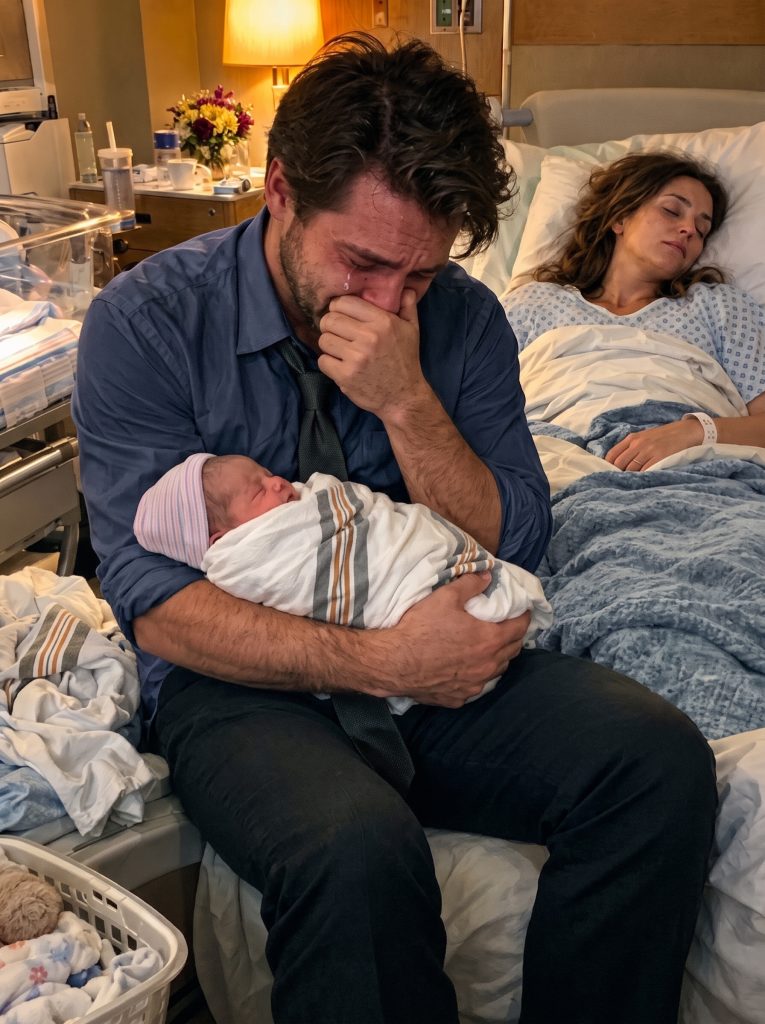
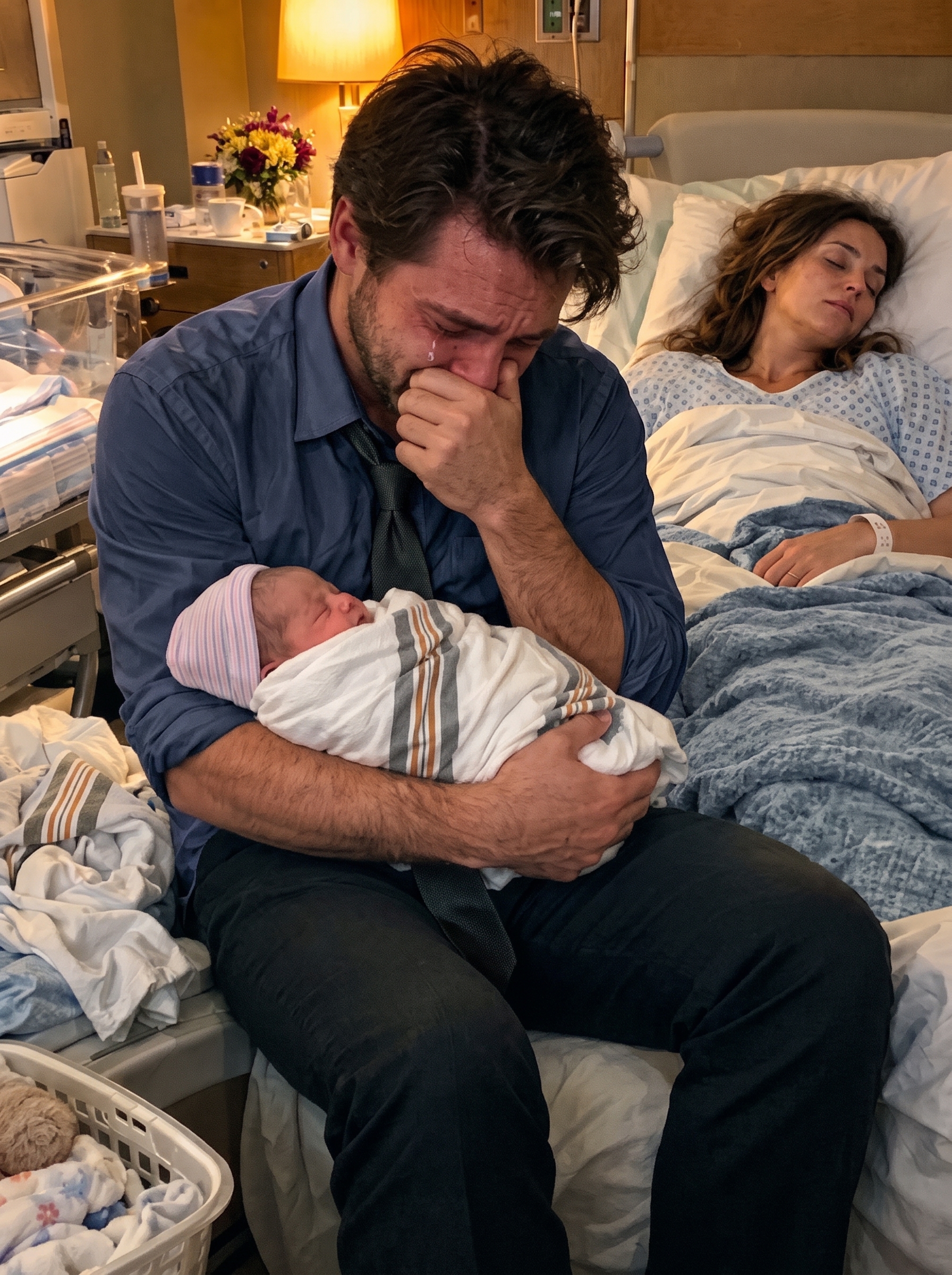
I rushed them both to the hospital, but the moment the doctor examined them, her face turned pale. She looked straight at me and shouted, “Call the police now!”
Then a doctor dressed in blue scrubs examined Jenna, measured Wesley’s temperature, and carefully inspected the severe diaper rash covering his legs.
The expression in her eyes changed instantly. Not like a doctor recognizing illness. Like a human being recognizing cruelty.
She looked directly at me and quietly asked, “Who was caring for them at home?”
“My mother and sister,” I answered shakily. “Why? What’s wrong?”
The doctor did not answer me right away. Instead, she turned toward a nurse, and her voice became icy and firm.
“CALL THE POLICE!”
The nurse reacted immediately.
She placed herself between me and the examination room door with the calm authority of someone who had seen families collapse before, then instructed another nurse to photograph Wesley’s blanket, the diaper bag, and Jenna’s discharge paperwork still trembling in my hands.
The Morning I Learned Trust Could Turn Into a Weapon
My son was just seven days old when I discovered him burning with fever beside his unresponsive mother.
Before that morning, I believed fear was the worst feeling anyone could endure. Later, I learned something much worse existed: discovering you had trusted the wrong people with the lives that mattered most.
My name is Colin Parker, and back then I worked as a warehouse supervisor for a construction supply company in a quiet Ohio suburb where nearly every street looked the same.
My job was simple but reliable, and most days I handled delayed deliveries, broken pallets, and employees frightened of losing dependable paychecks.
My wife Jenna moved through life differently than I did.
She possessed a gentleness the world had never managed to destroy.
She thanked cashiers who barely noticed her, remembered birthdays everyone else forgot, and left cookies for our mail carrier each December because she believed little acts of kindness mattered.
When we moved into our modest rental house, I kept promising to fix the porch step, repaint the walls, and replace our scratched kitchen table before the baby came.
Jenna simply smiled and reminded me that a home was not paint or furniture.
Then she purchased secondhand curtains, washed them twice, and somehow turned the nursery into a room filled with warmth despite how little money we had.
Seven days before everything fell apart, she gave birth to our son Wesley.
He entered the world furious, tiny and red-faced, with fists hardly larger than bottle caps.
Jenna cried when the nurse placed him against her chest, and although I tried hiding it from my family, I cried as well.
My mother Diane and my younger sister Brooke stood in that hospital room smiling with pride.
My mother gently touched Jenna’s forehead and promised they would support us after we returned home.
Brooke bent over Wesley’s bassinet, whispering that he was completely loved.
I trusted every word they spoke.
That memory troubles me more than almost anything that followed because I constantly return to that moment before trust turned into evidence.
Two days later, Jenna returned home carrying discharge instructions from the hospital.
The paperwork clearly warned about dehydration, infection, fever, extreme weakness, and symptoms of medical complications following childbirth.
I studied every sentence repeatedly because becoming a father scared me more than I ever admitted aloud.
Jenna laughed at how carefully I studied the papers.
“You’re going to memorize those instructions, aren’t you?” she asked.
I told her yes.
She smiled and said good.
Over the next few days, I hardly slept.
I heated soup, changed diapers awkwardly, checked Wesley’s breathing constantly, and helped Jenna sit upright whenever the pain became too intense.
Meanwhile, my mother and Brooke visited almost every day and gradually took control of the house.
Initially, I was thankful for their help.
My mother folded clothes and managed the kitchen while Brooke washed bottles and encouraged me to rest because I looked exhausted.
They repeatedly reminded Jenna how fortunate she was to have relatives nearby supporting her.
Still, one evening after Mom left the bedroom, Jenna quietly squeezed my hand and confessed that my mother scared her a little.
I kissed her knuckles and repeated the sentence I regret more than nearly anything else in my life.
“She means well.”
A man can construct an entire catastrophe from those three words.
Four days after Jenna came home, my workplace called before sunrise regarding missing inventory documents connected to my supervision.
My manager sounded desperate and insisted that I temporarily travel to another branch because the company feared financial losses and possible legal trouble.
At first, I tried to refuse.
I rushed them both to the hospital, but the moment the doctor examined them, her face turned pale. She looked straight at me and shouted, “Call the police now!”
My wife had recently given birth, my son was not even a week old, and leaving them immediately felt completely wrong.
But my manager continued pressuring me, warning that senior management was already asking questions involving my signatures on shipping records.
I should have refused once more.
I should have allowed the job to fall apart if that was necessary.
Instead, I persuaded myself that responsibility meant leaving.
Fear disguised itself as obligation, and I trusted my family to protect the two people I loved.
I called my mother.
She arrived with Brooke around noon while I packed my duffel bag in the kitchen, feeling strangely guilty.
I reminded them repeatedly that Jenna needed food, water, sleep, and assistance with Wesley, and I pointed directly toward the hospital instructions sitting on the counter.
My mother touched my cheek and promised that my wife and son would remain safe.
Brooke rolled her eyes and accused me of behaving as though nobody else could love them properly.
Before I left, I entered the bedroom one last time.
Jenna appeared exhausted, but she still tried reassuring me rather than focusing on herself.
I kissed her forehead, kissed Wesley’s tiny fist, and promised that I would come back quickly.
I had no idea that peaceful moment would become the dividing line between my previous life and everything that waited afterward.
The House Fell Silent While They Neglected My Wife
Throughout the work trip, I called home constantly because every instinct inside me kept warning me that something was wrong.
I called each morning, during lunch breaks, after meetings, and before bed, but nearly every conversation went through my mother first.
She carefully controlled the phone, allowing me to see Jenna only briefly before taking the screen away again.
Whenever I asked if Jenna was eating enough or drinking sufficient water, Mom assured me everything was perfectly fine.
Brooke remained somewhere in the background, making sarcastic remarks about newborn babies crying constantly and telling me to calm down because I was behaving like an overly protective first-time father.
Still, those calls disturbed me more with each passing day.
Jenna appeared weaker every time I saw her through the screen.
Her face grew paler, her lips seemed dry, and sometimes she could barely keep the phone upright.
Whenever she attempted to speak for more than a sentence or two, my mother interrupted immediately and claimed she needed sleep rather than emotional conversations.
On the second day, I heard Wesley crying through the phone.
It wasn’t the strong, healthy cry I remembered hearing at the hospital.
It sounded thin, dry, and strained in a way I couldn’t properly describe.
When I demanded to see him on camera, my mother brushed aside my concern and insisted he had already gone to sleep, even though I could still hear him crying in the background.
I should have listened to my instincts then.
Instead, I persuaded myself that exhaustion and anxiety were making me paranoid.
I reminded myself that my mother had already raised two children while I had been a father for only several days.
That experience became a blindfold I refused to take off.
On the third night, Jenna finally managed to hold the phone long enough to whisper my name clearly.
Her face filled the screen beneath dim bedroom lighting, and I instantly noticed sweat soaking her hair around her temples.
“What’s wrong?” I asked instantly.
Jenna looked nervously toward the doorway before she could respond.
Then the phone abruptly moved, and my mother appeared instead.
She described Jenna as emotional and dramatic, then criticized her for having difficulty after childbirth because, according to her, women from earlier generations managed motherhood without “turning the house upside down.”
I remained silent after that conversation.
I despise that silence now because silence can become approval when cruel people are listening.
Rather than defending Jenna firmly, I allowed my mother to describe my wife’s suffering as weakness while I remained hundreds of miles away, convincing myself things would eventually improve.
The work problem ended sooner than expected on the fifth night, and I chose to drive home immediately without telling anyone.
I rushed them both to the hospital, but the moment the doctor examined them, her face turned pale. She looked straight at me and shouted, “Call the police now!”
Around midnight, I began calling the house repeatedly, but nobody picked up.
Finally, at 2:03 a.m., Brooke sent me a text saying everyone was sleeping and that I needed to quit worrying.
Something about that message unsettled me deeply.
I stared at it for several minutes before driving faster through the rain toward home.
When I entered our neighborhood before sunrise, everything seemed strangely motionless.
The moment I stepped through the front door, I knew something was terribly wrong because homes with newborn babies usually contain constant sounds and movement.
There should have been quiet crying, footsteps, running water, or microwave noises from exhausted parents awake during unusual hours.
Instead, the house felt cold and completely silent.
The living room smelled of old pizza and stale air-conditioning while my mother and Brooke slept comfortably beneath blankets on the couch.
Empty soda bottles, chip bags, and pizza boxes covered the coffee table as though they had spent the entire night relaxing instead of helping a recovering mother and newborn child.
My mother woke up with a start when she noticed me standing there unexpectedly.
She immediately demanded to know why I hadn’t warned them that I was returning early.
I ignored her question and demanded to know where Jenna and Wesley were.
Mom casually replied that Wesley had cried throughout the night and Jenna was probably asleep now.
Then I heard Wesley.
Not an ordinary cry.
A weak, fractured sound coming from behind the bedroom door.
I immediately ran down the hallway.
The smell reached me before I even got to the bed: sour milk, sweat, stale diapers, blood, and overheated air trapped inside the sealed room.
Jenna lay completely still on one side of the mattress while Wesley rested beside her, wrapped inside a dirty blanket.
The room felt unbearably hot.
The windows were tightly closed, the fan was switched off, and Jenna’s face appeared gray beneath the early morning light.
One of her hands hung weakly over the side of the bed as though she had attempted to pull herself upright and failed.
When I placed my hand against Wesley’s forehead, intense heat struck my palm.
He barely responded when I picked him up.
Jenna was burning with fever as well, but she wouldn’t wake regardless of how firmly I shook her shoulder.
I screamed for my mother.
Both she and Brooke hurried toward the doorway, but their reaction horrified me most.
Neither one rushed toward Jenna or attempted to take Wesley.
They simply stood frozen like people suddenly facing evidence they never imagined another person would discover.
My mother insisted Jenna had appeared fine the night before, while Brooke nervously suggested that Jenna might be exaggerating everything for attention.
Hearing those words while my wife and newborn son burned with fever nearly broke something inside me forever.
I wrapped Wesley inside my hoodie, lifted Jenna into my arms, and rushed barefoot outside while yelling for help.
Our neighbor, Mr. Dawson, immediately stepped outside, saw their condition, and grabbed the keys to his SUV without asking a single pointless question.
During the ride to the hospital, Jenna’s head rested weakly against my shoulder while Wesley became quieter and quieter in my arms.
I repeated his name again and again because his silence frightened me more than his crying ever could.
At 5:42 a.m., we rushed through the emergency room doors carrying everything I loved most in this world
I rushed them both to the hospital, but the moment the doctor examined them, her face turned pale. She looked straight at me and shouted, “Call the police now!”
The Messages on Brooke’s Phone Changed Everything
The emergency room moved fast once the nurses realized how serious everything was.
Jenna was placed on a stretcher because she could barely respond, while Wesley was rushed for pediatric evaluation with a dangerously high fever.
A nurse fastened an emergency bracelet around his tiny ankle and wrote “7 DAYS OLD — FEVER” across his chart, and seeing those words made reality strike me harder than anything else that morning.
While doctors examined Jenna behind a curtain, another physician carefully checked Wesley and removed the filthy blanket wrapped around him.
The instant she saw his condition, her expression hardened completely.
She asked who had been responsible for looking after my wife and son while I was gone, and when I explained that my mother and sister had stayed with them, she turned toward the nurse beside her and quietly said, “Call the police.”
My mother and Brooke reached the hospital only minutes later.
Both of them were crying, but something about their behavior felt wrong immediately.
Rather than rushing over to ask about Jenna or Wesley, they instantly began defending themselves.
My mother insisted Jenna had been difficult and emotional following childbirth, while Brooke quietly repeated that they had tried their best to help.
The doctor stared directly at them and repeated the words “your best?” with such disbelief that both women became visibly uncomfortable.
A nurse then asked if I still had Jenna’s hospital discharge paperwork.
I suddenly remembered the instruction folder and panicked until Mr. Dawson helped me search through the diaper bag I had brought from home.
Inside, we discovered the folded papers with the warning section circled in blue ink by me before I left town.
The instructions clearly explained that caregivers needed to call immediately if Jenna developed fever, serious weakness, dehydration, fainting, or symptoms of infection.
My mother silently stared at the papers because she recognized my handwriting instantly.
There was no uncertainty about whether she had seen those warnings.
I had personally circled them before leaving, and both she and Brooke understood exactly which symptoms required immediate medical attention.
When police officers arrived, they started asking detailed questions about the timeline, phone conversations, and everyone who had been inside our house throughout the previous four days.
I willingly handed them my phone and showed them call records, messages, and Brooke’s final text from earlier that night saying everyone was sleeping and I needed to stop worrying.
Then Brooke’s phone vibrated.
The reaction across her face was immediate and unmistakable.
She appeared terrified the instant she looked at the screen, and both the officer and I noticed it right away.
When the officer asked what message had arrived, Brooke responded far too quickly and claimed it was nothing important.
My mother sharply snapped her name, and that single reaction told me both women were hiding something.
Later, investigators discovered the messages saved on Brooke’s phone, and those conversations destroyed every remaining excuse my mother attempted to offer.
The messages revealed Jenna repeatedly asking for water, food, and assistance while Brooke complained that Wesley was constantly crying.
Instead of expressing concern, my mother repeatedly described Jenna as dramatic and manipulative.
One message from my mother read, “Let him cry. She wanted to be a mother.”
Another said, “Don’t call Colin. He’ll take her side.”
The most disturbing message came from the night before I returned home.
Brooke texted my mother saying Jenna appeared seriously ill, and my mother responded simply: “She’s acting. Leave her.”
Reading those messages afterward changed something inside me forever.
I realized my mother had not neglected Jenna because she failed to recognize the danger.
She deliberately ignored her because she believed Jenna deserved to suffer for refusing to behave the way she expected.
The doctor returned later and explained that Jenna was severely dehydrated and battling a dangerous infection.
Wesley’s fever had also become life-threatening because infections in newborns can worsen incredibly quickly.
She told me that bringing them to the hospital when I did had probably saved both of their lives.
Even after hearing that, the guilt remained because I continued replaying the moment when I chose work instead of remaining home.
I had trusted the wrong people simply because they were family, and that trust nearly cost my wife and son everything.
At one point, Mr. Dawson quietly came back from the house carrying another grocery bag he had retrieved with police permission.
Inside were unopened baby formula, Jenna’s unused medication, a sealed water bottle, and the discharge instructions I had marked before leaving town.
Those items demonstrated something painful and undeniable: everything Jenna needed had been sitting only a few feet away while she and Wesley grew sicker inside that overheated bedroom.
My mother finally started crying harder after the evidence emerged, but even then I recognized the difference between guilt and exposure.
She did not appear devastated that Jenna had nearly died.
She seemed terrified because everyone surrounding her finally understood what had occurred inside that house.
Brooke eventually broke down entirely and admitted my mother repeatedly instructed her not to contact me because Jenna was supposedly exaggerating her condition for attention.
My mother immediately became furious with Brooke for speaking honestly in front of the police, and the officers quickly separated them before their argument could escalate further.
Shortly afterward, the doctor returned one final time and called my name.
The moment I saw her expression, I knew that whatever she said next would determine whether my family survived that morning.
I rushed them both to the hospital, but the moment the doctor examined them, her face turned pale. She looked straight at me and shouted, “Call the police now!”
The Edge of Collapse
The heavy double doors of the treatment area swung shut behind the doctor, sealing off the frantic rhythm of the emergency room and leaving me standing in a hallway that suddenly felt entirely stripped of air. The harsh fluorescent lights overhead hummed with a low, relentless vibration that resonated deep inside my skull. Mr. Dawson remained a few paces back, his weathered hands resting heavily on the handles of the diaper bag, his presence the only grounding anchor in a world that had completely shattered in the span of two hours.
“Colin,” Dr. Mercer said quietly. Her voice was steady, stripped of the sharp anger she had directed at my mother and sister moments earlier, replaced by the somber precision of a physician preparing a family for impact. “I need you to step into the consultation room. We have a lot to cover, and you need to sit down.”
“Are they…” My throat was so dry the words felt like sandpaper. “Are they alive?”
“They are alive,” she said, placing a firm hand on my shoulder and guiding me into a small, sterile room furnished only with vinyl chairs and a wall-mounted hand sanitizer dispenser. “But both of your family members are in critical condition. I’m going to explain exactly what we are doing right now, and then I am going to tell you what the next forty-eight hours look like.”
I sank into one of the chairs. Mr. Dawson stepped in behind me, closing the door softly, standing near the wall like an old sentinel who refused to abandon his post.
“Let’s start with Wesley,” Dr. Mercer began, pulling a digital tablet from her lab coat pocket and reviewing the initial panel results. “Your son presented with a rectal temperature of 104.2 degrees Fahrenheit. In a seven-day-old infant, any fever over 100.4 is a medical emergency because their immune systems are completely undeveloped. They cannot contain infections; pathogens move directly into their bloodstream and central nervous system with alarming speed.”
She tapped the screen, showing me a series of red-flagged values that meant nothing to me mathematically, but everything to me as a father.
“We have already initiated a full sepsis workup,” she continued. “That means we have drawn blood cultures, performed a urine catheterization, and our pediatric team is currently performing a lumbar puncture—a spinal tap—to check for bacterial meningitis. He is currently receiving broad-spectrum intravenous antibiotics, ampicillin and cefotaxime, along with IV fluids to combat severe hypernatremic dehydration. His sodium levels were dangerously elevated because he has not received adequate liquid for days. He was burning through his body’s reserves just trying to keep his internal temperature regulated.”
“A spinal tap,” I whispered, the image of a needle entering my seven-day-old son’s tiny spine sending a wave of physical nausea through my stomach. “He’s so small. He’s so small, Dr. Mercer.”
“It is standard, necessary protocol,” she said gently but firmly. “If bacteria has crossed the blood-brain barrier, we need to know immediately so we can adjust his treatment. He is currently stabilized in the Pediatric Intensive Care Unit. He is on continuous cardiac and oxygen monitoring. You cannot see him for another twenty minutes while they finish the procedure.”
“And Jenna?” I asked, my hands trembling violently in my lap. “What happened to Jenna?”
Dr. Mercer’s jaw tightened slightly, a fleeting glimpse of the fury that still simmered beneath her clinical demeanor. “Your wife is suffering from severe puerperal sepsis, secondary to an untreated uterine infection. When she discharged from the maternity unit five days ago, her body was already in a vulnerable state, as is typical following a difficult delivery. What is not typical is being denied basic hydration, nourishment, and hygiene support.”
She took a deep breath, looking me straight in the eyes. “Jenna’s blood pressure on arrival was 82 over 45. Her heart rate was pushing 140 beats per minute. She was in early septic shock. Her body was essentially shutting down because the infection in her uterus had spilled into her circulatory system. Furthermore, she has severe cracked and infected milk ducts—mastitis—that had gone untreated, causing her additional systemic stress. Her kidneys are showing early signs of acute injury due to extreme dehydration.”
“Is she going to make it?” The words felt heavy, like lead weights dropping from my mouth.
“We have aggressively loaded her with three liters of intravenous crystalloid fluids and started her on high-dose IV broad-spectrum antibiotics,” Dr. Mercer said. “We are monitoring her lactate levels closely. If her blood pressure does not respond to the fluids over the next hour, we will have to transfer her to the Intensive Care Unit and start vasopressors to force her blood pressure up. She is conscious now, but she is severely confused, delirious from the fever and metabolic imbalance. She keeps calling for Wesley. She thinks he is still in the bassinet next to her bed.”
A dry sob escaped my chest. I buried my face in my hands, the rough skin of my palms scraping against the stubble on my chin. I had left town four days ago thinking I was being a responsible provider, securing a project contract that would pay for our home’s winter heating and Wesley’s future. I had handed the keys to our life over to my mother, Evelyn, and my younger sister, Brooke, believing that maternal instinct and blood ties were absolute guarantees of safety.
Instead, I had left my dying wife and newborn son in the hands of two women whose deep-seated resentment had curdled into active, calculated cruelty.
“The police are outside,” Mr. Dawson spoke up for the first time, his voice low and gravelly. “Detective Vance from the Special Victims Unit is waiting in the corridor. He saw the initial medical reports coming out of triage.”
Dr. Mercer nodded at Mr. Dawson, then looked back at me. “I filed a mandatory report for vulnerable adult abuse and severe child neglect the second I saw Wesley’s core temperature and Jenna’s lab work. In this state, medical personnel are legally bound to report conditions that indicate deliberate deprivation of care. The physical evidence in your home—the locked door, the sealed supplies sitting unused downstairs, the state of the infant’s bedding—matches the clinical presentation of severe negligence.”
“It wasn’t negligence,” I said, lifting my head. The fear that had consumed me for the last two hours suddenly began to mutate, solidifying into a cold, dense core of pure rage. “Negligence means you forgot. Negligence means you didn’t know. My mother read the discharge papers. I marked them in blue pen. I put them on the kitchen counter next to the baby formula. She knew.”
“Then Detective Vance will want to hear every detail of what you found when you walked through that front door,” Dr. Mercer replied, standing up. “I will take you to see Jenna now. She is in Bay 4. She is weak, Colin. Be prepared. She doesn’t look like the woman who walked out of this hospital a week ago.”
The curtain around Bay 4 was partially drawn. The sound of rapid, shallow breathing met me before I even stepped inside.
Jenna lay on the narrow hospital bed, looking swallowed whole by the white sheets and the bulk of the cardiac monitors attached to her chest. Her skin, usually warm and glowing, was a sickly, translucent grey, stained with flush red patches across her cheekbones. An IV line ran into the back of each hand, one pumping clear fluid from a hanging bag, the other feeding a dark yellow solution of high-potency antibiotics through an infusion pump that beeped rhythmic warnings.
“Jenna,” I whispered, stepping to the side of the bed and taking her hand. Her skin was scorching hot to the touch, dry and paper-thin.
Her eyes fluttered open, unfocused and glazed with fever. It took her several seconds to track my face, her pupils dilating as she tried to piece together reality from the haze of delirium.
“Colin?” Her voice was barely a rasp, a thread of sound that threatened to break with every breath. “Colin… where is he? They took him. They took the baby.”
“He’s here, sweetheart. He’s in the pediatric unit,” I said, tears spilling over my eyes as I pressed her knuckles against my cheek. “The doctors are taking care of him. He’s getting medicine. You’re both safe now.”
“I tried… I tried to get up,” she whimpered, a tear tracing a clean line through the dried sweat on her face. “The door… the door was so heavy, Colin. I couldn’t reach the handle. I called for your mother. I asked her for water. I was so thirsty. My mouth felt like sand.”
Every word she spoke was a hammer blow to my heart. “I know, baby. I know. I’m so sorry. God, Jenna, I am so sorry.”
“She told me… she told me I was lazy,” Jenna whispered, her chest heaving as she fought for air. “She said… she said women in her day didn’t lie in bed all day. She took Wesley down… she took him downstairs on Tuesday, and she didn’t bring him back for hours. When he came back, he was crying so hard… his mouth was dry. He wouldn’t latch. I had no milk left because I didn’t have water…”
She began to hyperventilate, the monitor above her bed emitting a series of sharp, alarming beeps as her heart rate spiked past 150 beats per minute. A nurse immediately stepped around the curtain, checking the telemetry screen and adjusting the oxygen flow entering the nasal cannula clipped into Jenna’s nose.
“Easy, Mrs. Vance,” the nurse said gently, placing a hand on Jenna’s shoulder. “Breathe slowly. Deep breaths through your nose. Your body is fighting hard right now. You need to save your strength.”
“Colin,” Jenna gasped, her fingers tightening around mine with a desperate, surprising strength born of pure terror. “Don’t let them near him. Don’t let your mother near Wesley. She… she said he needed to learn. She said I was ruining him.”
“She will never touch him again,” I swore, the words tearing from my throat. “She will never see you or Wesley again for as long as I live. I promise you, Jenna. I swear to God.”
The nurse gave me a sympathetic but firm look, signing for me to step back to allow Jenna to rest. “The sedative in her IV is starting to take effect,” the nurse murmured. “Her body needs to conserve energy to fight this infection. You can stay by her side, but try to keep her quiet.”
I nodded, sliding a vinyl chair right next to the head of her bed. I held her hand, watching the erratic spikes on the heart monitor slowly smooth out as the medication pulled her under into a deep, necessary sleep.
Standing just outside the curtained bay, waiting in the shadows of the hallway, was Detective Vance. He was a tall man in his late forties, wearing a dark suit with a detective badge clipped to his belt next to his sidearm. He caught my eye and motioned toward a quiet corner near the nursing station.
I gently lowered Jenna’s hand back onto the mattress, kissed her burning forehead, and stepped out into the hall.
“Mr. Vance,” Detective Vance said, offering his hand. His grip was dry and firm. “I’m Detective Vance with the County Sheriff’s Office. I’ve already taken preliminary statements from your mother, Evelyn Vance, and your sister, Brooke Vance, down in the waiting area. I’ve also reviewed the digital evidence pulled from your sister’s device under consent, as well as the photographs taken by the responding officers at your residence.”
“What is happening to them?” I asked, my voice deadly flat. “Are they in custody?”
“Currently, both women are detained in interview rooms at the precinct,” Vance replied, pulling a small notebook from his jacket. “Given the preliminary medical reports from Dr. Mercer regarding the severity of your wife and son’s conditions, this has progressed far beyond a domestic dispute. We are looking at counts of felony criminal mistreatment, intentional neglect of a vulnerable adult, and child endangerment resulting in great bodily harm.”
He looked at me intently. “I need you to take me through everything, Colin. From the moment you left for your work assignment in Denver on Monday morning, to the exact moment you found your wife in that upstairs bedroom today. I need timestamps, text messages, phone calls, and any prior history of conflict between your wife and your family.”
“It started four months ago,” I said, leaning back against the wall because my knees felt like they were going to buckle. “When we found out Jenna was pregnant with a boy.”
I rushed them both to the hospital, but the moment the doctor examined them, her face turned pale. She looked straight at me and shouted, “Call the police now!”
The Blueprint of Malice
The detective pulled out an audio recorder, set it on a small table, and pressed record. The red light flickered on, capturing every word of the bitter truth I had denied for years.
My mother had never accepted Jenna. To Evelyn Vance, our family was a closed ecosystem—a tight-knit unit where she maintained total authority over my sister and me following my father’s death ten years ago. When I met Jenna, an independent, quiet graphic designer who didn’t bow to my mother’s passive-aggressive criticisms or demand her approval, Evelyn saw her not as a daughter-in-law, but as an intruder who had stolen her provider and son.
“When Jenna got pregnant,” I told Detective Vance, my voice trembling with a mixture of rage and profound self-loathing, “my mother made a huge show of wanting to ‘be there’ for us. She complained that Jenna’s family lived out of state in Oregon and couldn’t help immediately after the birth. She volunteered to stay at our home for the first week after I was called away for an emergency structural engineering job in Denver.”
“Did you pay her or offer compensation?” Vance asked.
“No,” I replied. “She refused money. She said, ‘Family takes care of family.’ But now I realize it was about control. She wanted to be in our house without me there. She wanted Jenna isolated.”
“Tell me about the setup before you left,” Vance instructed. “You mentioned blue ink on discharge papers.”
“I left on Monday at 5:00 AM,” I explained. “Jenna had been discharged from the hospital on Sunday afternoon after a brutal thirty-six-hour labor that ended in an emergency vacuum extraction. She was severely torn, in massive pain, and bleeding heavily. She could barely walk from the bed to the bathroom. Before I left, I sat down at the kitchen table with my mother and Brooke.”
I reached into my pocket, pulled out my own phone, and unlocked it, showing the detective a photo I had taken of the discharge sheet before leaving—a safety habit I had developed as an engineer.
“Look at this photo,” I said, thrusting the screen toward Vance. “This is the patient education sheet given to us by the labor unit. I used a blue Sharpie to circle three specific sections: Signs of Postpartum Infection, Newborn Fever Protocol, and Hydration Requirements for Lactation. I wrote my mother’s name at the top of the sheet and taped it to the refrigerator door. I pointed directly to the warning about fevers over 100.4 degrees in infants and high postpartum fevers in mothers. I told her: ‘If Jenna gets a fever, or if Wesley stops wetting diapers, call 911 immediately and then call me.’”
“And what did your mother say?”
“She smiled,” I recalled, the memory burning like hot acid in my brain. “She said, ‘Colin, I raised two children before you were born. I know how to handle a baby. Stop micromanaging me and go do your job.’”
Detective Vance nodded slowly, writing down notes. “Now let’s talk about the communication over the last ninety-six hours. What were you told while you were in Denver?”
“I called every morning, afternoon, and night,” I said. “Every time I called the house landline or my mother’s cell phone, she either didn’t answer or answered briefly to tell me everything was fine. She said Jenna was ‘resting’ and that I shouldn’t call so much because the phone ringing kept waking the baby.”
“Did you speak directly to your wife?”
“Twice,” I said, the guilt squeezing my heart like a vise. “On Tuesday evening and Wednesday morning. But both times, Jenna sounded strangely groggy and distant. She told me she was so tired she could barely keep her eyes open. She said my mother had given her some herbal tea to help her sleep. I asked to speak to her longer, but my mother took the phone back, saying Jenna needed sleep and that I was stressing her out by asking so many questions.”
“Did you receive any texts from your sister, Brooke?”
“Yes,” I said, scrolling through my text log and handing the phone to Vance. “Look at Thursday night. Yesterday. I was getting uneasy because Jenna hadn’t texted me back all day. I sent five messages to Jenna’s phone with no reply. I texted Brooke at 10:00 PM asking why Jenna wasn’t responding. Brooke texted back: ‘Jenna is totally fine! She’s just sleeping off a headache. Wesley is fed and asleep. Stop worrying so much, Colin, you’re being paranoid. We’ve got everything under control. Go to sleep.’“
Detective Vance looked at the text on my screen, his face hardening. “That text was sent at 10:14 PM last night. According to the data we just extracted from Brooke’s phone under a search warrant, here is what was actually happening in your house at 10:00 PM last night.”
Vance pulled a folder from under his arm and extracted a printout of a text thread between my mother and my sister, timestamped from the exact same hour. He laid it flat on the small table between us.
[TEXT LOG EXCERPT – BROOKE VANCE & EVELYN VANCE – THURSDAY 9:45 PM]
Brooke (9:45 PM): Mom, Jenna is throwing up in the bathroom. She can barely stand up. Her forehead feels like a stove. Should I call Colin or get the thermometer?
Evelyn (9:48 PM): Do NOT call Colin. He’s working. She is putting on a show because she wants him to fly home early and pamper her. She’s been dramatic since the day she met him.
Brooke (9:52 PM): Mom she isn’t acting. She tried to go downstairs for water and fell against the hallway wall. She’s crying that she can’t feel her legs. The baby is screaming because he hasn’t fed in six hours.
Evelyn (9:55 PM): Let him cry. She wanted to be a mother, now she can see what it actually takes. If you go in there and help her, you’re enabling her behavior. Put the baby in the crib, lock the hallway door so he doesn’t crawl out, and come downstairs. We are watching our movie.
Brooke (10:02 PM): Colin just texted me asking why Jenna isn’t answering. What do I say?
Evelyn (10:05 PM): Tell him everyone is sleeping and he’s being paranoid. If he thinks something is wrong he’ll interrupt his work trip and waste money. Send the text and turn your phone on silent.
I stared at the paper. The words seemed to burn into the white pulp of the page. The transcript was undeniable proof of deliberate, calculated malice. They hadn’t just neglected my family; they had actively constructed an environment of entrapment and deprivation.
“My mother locked the hallway door?” I whispered, my voice breaking. “She locked them in that heat?”
“We found the exterior latch on the second-floor master suite door,” Vance said soberly. “It appears your mother engaged a slide lock from the outside on Thursday morning. When questioned by officers at the scene, your sister admitted that your mother took away Jenna’s phone on Wednesday afternoon while Jenna was sleeping, claiming to ‘keep her from being disturbed by work calls.’ That’s why Jenna couldn’t call 911 herself. That’s why she couldn’t call you.”
“She stole her phone,” I said, the magnitude of the horror settling over me. “She locked a sick woman and a newborn baby in a room with no phone, no water, and closed air vents in ninety-degree heat.”
“Yes,” Vance replied. “And there’s more. Mr. Dawson—the neighbor who assisted you—provided a statement to our officers. He stated that on Wednesday afternoon, he noticed your mother bringing multiple heavy trash bags out to the curb. Officers executed a search of your outdoor bins two hours ago. Inside, they found five unopened tins of infant formula, three sealed twelve-packs of bottled spring water, and two prescription bottles filled with Jenna’s post-partum antibiotics and pain medications that had been picked up from the pharmacy on Monday afternoon.”
“She threw away their food and medicine,” I gasped, choking on the words. “She threw it in the trash.”
“She didn’t just throw it away, Colin,” Vance said quietly. “She hid the key to the main floor pantry and locked the kitchen cabinets. She was systematically starving your wife and infant son while convincing your sister that it was a ‘tough love’ lesson to break Jenna’s perceived entitlement.”
A loud commotion at the end of the hallway interrupted us.
I turned to see two uniformed Sheriff’s deputies escorting my mother down the corridor toward the exit doors. Her hands were cuffed behind her back, secured over her beige cardigan. Her face was red and blotchy, her hair disheveled, but as she caught sight of me standing with Detective Vance, her expression shifted instantly from panic to sharp, imperious indignation.
“Colin!” she shrieked, her voice echoing off the hard linoleum floor of the hospital corridor. “Colin, tell these officers to take these things off me right now! This is an absolute outrage! You are letting these strangers humiliate your mother!”
I stood motionless, watching her approach. Beside her, Brooke was being led by another officer, sobbing hysterically into a paper towel, her mascara streaked across her cheeks, unable to look me in the eye.
“Colin, listen to me!” my mother barked as the deputies paused near the consultation room. “That girl has manipulated you from day one! She was lying in that room throwing tantrums because she didn’t want me in her house! She refused to eat! She refused to feed the baby just to make me look bad! I was trying to discipline her! You cannot let them do this to me after everything I sacrificed to raise you!”
I stepped out into the middle of the hallway, stopping directly in front of her. The heat of my anger was gone, replaced by an iceberg of pure, unyielding clarity.
“You left my son to fever in a locked room, Evelyn,” I said, my voice dropping to a low, lethal register. “You threw away his formula. You threw away Jenna’s medicine. You watched her collapse on the floor and you went downstairs to watch a movie.”
“She was acting!” Evelyn yelled, her eyes bulging with desperate delusion. “She’s a liar, Colin! She’s trying to tear this family apart!”
“There is no family,” I said, leaning in until I was inches from her face. “You are not my mother. Brooke is not my sister. You are monsters who tried to murder my wife and child.”
“Colin, please!” Brooke wailed from behind her, her voice trembling. “Mom told me Jenna was fine! She said it was just baby blues! I didn’t know Wesley was that sick! I swear I didn’t know!”
“You had the phone in your hand, Brooke,” I said, turning my gaze to my sister with cold contempt. “You held the device. You read the texts where Jenna said she couldn’t stand. And then you texted me and lied to my face so I wouldn’t come home to save them.”
“Take them out,” Detective Vance instructed the deputies firmly.
“You’ll regret this, Colin!” Evelyn screamed as the officers dragged her toward the double doors. “She’s turned you against your own blood! You’ll have nothing left! Nothing!”
The doors swung shut, cutting off her voice, leaving only the sound of the hospital monitors and the steady, quiet hum of the ventilation system.
I turned back to Detective Vance. “What happens now?”
“Now,” Vance said, closing his notebook, “they are transported to the county jail for formal booking. Arraignment will be tomorrow morning before a magistrate. I will recommend no bail given the severe risk to the victims and the nature of the offenses. I need you to come down to the station later this evening to sign formal statements and sign off on protective orders.”
“I’ll sign whatever you put in front of me,” I said. “Just don’t let them near my family ever again.”
I rushed them both to the hospital, but the moment the doctor examined them, her face turned pale. She looked straight at me and shouted, “Call the police now!”
The Shadow of Recovery
The next seventy-two hours inside the hospital felt like an eternity stretched across a tightwire over an abyss.
While the police built their criminal case against Evelyn and Brooke Vance, my entire world was reduced to two locations: Bay 4 in the Progressive Care Unit where Jenna was fighting off septic shock, and Bed 6 in the Pediatric Intensive Care Unit where tiny Wesley was battling for his life against neonatal sepsis and severe dehydration.
On Saturday afternoon, three days after our arrival at the hospital, I sat in a hard plastic chair beside Wesley’s incubator in the PICU.
The infant who had been so quiet and lethargic when I found him in that suffocating bedroom was now buried beneath a maze of medical equipment. A tiny oxygen cannula was taped to his nose, a peripheral IV line was secured to his forearm with protective cardboard splints, and lead wires ran from his chest to a overhead monitor that displayed his heart rate, breathing, and oxygen saturation levels in bright neon lines.
Dr. Mercer walked into the room quietly, holding a chart. The exhaustion of a seventy-two-hour shift was visible in the lines around her eyes, but her expression was warmer than it had been since the morning we arrived.
“How is he doing, Colin?” she asked, standing on the opposite side of the incubator.
“He opened his eyes for a few seconds earlier,” I said, my voice thick with emotion. “He made a little noise. Not a scream… just a tiny squeak.”
“That ‘tiny squeak’ is a fantastic sign,” Dr. Mercer said with a gentle smile. “It means his energy levels are returning. I have the results from his seventy-two-hour spinal fluid and blood cultures.”
I held my breath, every muscle in my body locking up. “And?”
“The spinal fluid came back completely clear of bacterial growth,” she announced. “The sepsis was caught just before the bacteria could breach the blood-brain barrier. He does not have meningitis.”
A tremendous, crushing weight seemed to lift off my chest, allowing me to take a full, deep breath for the first time in days. Tears blurred my vision as I reached through the circular port of the incubator and gently touched Wesley’s tiny, soft fingers. His hand instinctively closed around my pinky finger, holding on with surprising strength.
“His sodium levels have normalized,” Dr. Mercer added. “His fever has been completely broken for twenty-four hours now. We are going to continue his IV antibiotic course for another four days to ensure the blood infection is totally cleared, but he is officially out of immediate danger. He is going to pull through this, Colin. He is a very tough little boy.”
“Thank you,” I choked out, pressing my forehead against the acrylic wall of the incubator. “Thank you so much.”
“Now,” Dr. Mercer said softly, tapping the chart. “Let’s go talk about your wife.”
I walked down the hallway to the Progressive Care Unit, my heart lightened by Wesley’s news, but still heavy with concern for Jenna.
When I pushed open the door to her room, I found her sitting up in bed. The terrifying grey pallor that had covered her skin on Wednesday was gone, replaced by a faint, natural color. The IV fluids had restored her volume, and the heavy antibiotics had brought her white blood cell count down from critical levels. She was still painfully frail, her collarbones sharp against her hospital gown, but her eyes were clear and focused.
Beside her bed sat Mr. Dawson, holding a paper cup of warm broth he had bought from the cafeteria, chatting quietly with her about his garden.
“Colin,” Jenna said, her voice stronger now, though still raspy. She held out her arms to me.
I hurried to her side, wrapping my arms around her carefully, terrified of hurting her sensitive body. I buried my face in the crook of her neck, smelling the clean hospital soap and feeling the steady, warm rise and fall of her chest.
“He’s okay, Jenna,” I whispered against her skin. “Wesley’s going to be okay. No meningitis. His fever is gone.”
Jenna let out a long, shuddering sob of pure relief, her fingers clutching the back of my shirt. “Oh God… thank God. Thank God.”
Mr. Dawson stood up quietly, setting the cup of broth on the bedside table and placing a hand on my shoulder. “I’ll give you two some time,” the old man murmured. “I’ll be out in the waiting room if you need anything, son.”
“Thank you, Mr. Dawson,” I said, looking up at him with profound gratitude. “For everything. If you hadn’t brought your truck and helped me break through that door…”
“Don’t mention it,” the old man said, his eyes hard as flint. “Neighbours take care of neighbours. That’s how it’s supposed to be.” He nodded to Jenna and slipped out the door.
Jenna pulled back slightly, looking into my eyes. “Where are they, Colin? The doctor said the police were involved.”
I sat on the edge of the bed, taking both of her hands in mine. I didn’t hold anything back. She deserved the absolute, unvarnished truth about the monsters who had tried to destroy our family.
“They are in the county jail,” I told her clearly. “Evelyn and Brooke were formally charged this morning. Evelyn is facing two counts of felony criminal mistreatment in the first degree, one count of intentional child abuse resulting in great bodily harm, and one count of unlawful imprisonment. Brooke has been charged as an accessory to felony neglect and obstruction of justice.”
Jenna listened quietly, her expression shifting from lingering fear to a deep, dark solemnity. “Brooke… Brooke was crying on Wednesday,” Jenna whispered. “She came into the room when your mother was downstairs. I begged her for a glass of water. I told her I would give her my ring—the gold ring my grandmother gave me—if she just brought me a pitcher of tap water.”
“What did she do?” I asked, my blood running cold again.
“She looked at me like she was terrified,” Jenna said, tears welling in her eyes. “She said, ‘Mom told me if I give you water, you’ll just keep making demands. Mom said you’re trying to make us your servants.’ And then she walked out and locked the door from the outside.”
I squeezed my eyes shut, processing the absolute depth of the brainwashing and cruelty my mother had inflicted on my sister, and the complete cowardice Brooke had shown in executing it.
“The prosecutor called me an hour ago,” I said, opening my eyes and looking directly into Jenna’s. “They are not offering a plea deal to Evelyn. The prosecutor told me that given the text messages, the locked doors, and the discarded medicine in the trash, this is one of the most clear-cut cases of deliberate criminal cruelty he has seen in twenty years. They are pushing for maximum sentencing. Evelyn is looking at ten to fifteen years in state prison. Brooke is looking at three to five.”
“Good,” Jenna said. There was no hesitation in her voice, no lingering desire to forgive or smooth things over for the sake of family harmony. The soft, quiet girl I had married had been burned away in that overheated bedroom, replaced by a mother who had survived a nightmare to protect her child. “I never want to hear their names again. I never want them near our son.”
“They won’t be,” I swore. “I filed an emergency permanent restraining order this morning. The judge signed it immediately. If they ever step within five hundred feet of you, me, or Wesley, they go straight back to a cell.”
“What about our house?” Jenna asked softly, looking around the sterile hospital room. “Colin… I can’t go back there. I can’t walk into that bedroom. I can’t look at that door.”
“We’re not going back,” I said instantly. “I’ve already called a real estate agent. Mr. Dawson agreed to keep an eye on the property while we put it on the market as-is. We’re moving. We’ll pack up our things, put them in storage, and find a new home—somewhere far away from here. Somewhere clean. Somewhere safe.”
Jenna leaned her head against my shoulder, letting out a long, shaky breath. “A new home. Just the three of us.”
“Just the three of us,” I confirmed. “Always.”
I rushed them both to the hospital, but the moment the doctor examined them, her face turned pale. She looked straight at me and shouted, “Call the police now!”
The Reconstruction
Six months later, the morning sun rose over the rolling green hills of western Oregon, casting a warm, golden light across the wooden porch of a small craftsman house nestled near the edge of a quiet pine forest.
The air here was crisp and cool, carrying the fresh scent of cedar and damp earth—a world away from the suffocating, humid suburban neighborhood where my life had nearly ended half a year ago.
I sat on the porch step holding a cup of hot black coffee, watching the fog lift from the valley floor. From inside the house, the quiet, rhythmic sound of a baby babbling softly broke the morning silence.
A moment later, the screen door creaked open. Jenna stepped out onto the porch, dressed in an oversized knit sweater and jeans. Her hair was pulled back in a loose bun, her cheeks flush with health and vibrant energy. The hollow, haunted look that had shadowed her eyes for months after our ordeal had finally faded, replaced by a deep, peaceful calm.
In her arms she held Wesley.
At seven months old, he was a thriving, robust boy with a head of thick dark hair and bright, curious blue eyes that tracked every moving leaf in the breeze. He weighed a healthy eighteen pounds, his chubby legs kicking enthusiastically against Jenna’s hip as he reached his tiny hands out toward the morning air.
“Look who decided he was done taking a morning nap,” Jenna said smiling, stepping down to sit beside me on the wooden step.
“Come here, little man,” I murmured, setting my coffee cup down and taking Wesley into my lap. He immediately grabbed the collar of my shirt, pulling it toward his mouth with a loud, gurgling laugh.
I kissed the top of his soft head, inhaling the sweet, clean scent of baby shampoo and fresh air—a scent that had completely overwritten the terrifying memory of that scorching, stale bedroom.
“Got a letter from the prosecutor’s office in the mail yesterday while you were at the hardware store,” Jenna said quietly, her eyes looking out over the misty valley.
I stilled for a moment, looking at her profile. “What did it say?”
“The sentencing hearing for your mother was finalized,” she replied, her voice steady and devoid of emotion. “The judge didn’t grant any of her appeals. Because of the clear evidence of premeditation—the text logs, the physical locking of the door, and the destruction of the medical supplies—she was sentenced to twelve years at the Coffee Creek Correctional Facility without eligibility for parole for the first eight years.”
“And Brooke?” I asked.
“Brooke accepted a plea bargain for full cooperation,” Jenna said. “She was sentenced to three years of probation, two hundred hours of community service, and mandatory psychological counseling. The judge also extended our permanent protection order indefinitely. She is legally barred from contacting any of us, directly or through third parties, for the rest of her life.”
I looked down at Wesley, who was busy attempting to chew on my thumb with his newly sprouted front teeth.
When the news of the trial had broken months ago, several distant relatives had tried to contact me. Uncles and cousins who hadn’t spoken to me in years sent messages pleading with me to “show mercy,” urging me to write a letter to the judge asking for leniency for my mother. They argued that she was old, that she was family, that “people make mistakes.”
I had deleted every single message without replying. I blocked their numbers one by one.
The concept of family is not an absolute pass for cruelty. Blood does not give anyone the right to abuse, neglect, or destroy. Family is not defined by the DNA you share; it is defined by the choices you make every single day to protect, love, and honor the people entrusted to your care.
Mr. Dawson had proven to be more of a family member in ten minutes of crisis than my mother and sister had been over a lifetime of toxic control. We still sent the old man care packages every month—photographs of Wesley, jars of local Oregon honey, and handwritten letters keeping him updated on our lives. He had become a grandfather to Wesley in every way that mattered.
“Are you okay?” Jenna asked, reaching out to lay her hand over mine.
“I’m more than okay,” I said, looking up at her and smiling. “I’m home.”
Jenna leaned over and kissed my cheek, then leaned down to blow a raspberry on Wesley’s stomach, sending our son into a fit of breathless, ringing giggles that echoed out over the quiet forest.
The road to recovery had not been easy. For the first few months after we moved to Oregon, Jenna suffered from severe post-traumatic stress. Every time Wesley cried, or every time a room felt slightly warm, a wave of panic would sweep over her. I had taken a remote position with a local engineering firm, refusing any assignments that required travel, ensuring I was home every single night to hold her when the nightmares came.
We had built this new life block by block, brick by brick, stripping away every remnant of the past until only the foundation of our love and resilience remained.
As the sun broke fully over the horizon, washing the porch in bright, warm light, Wesley let out another loud laugh, grabbing both of my hands and trying to pull himself up into a standing position on my lap. His legs were strong, his heart was healthy, and his future was wide open.
The messages on Brooke’s phone had exposed a nightmare that nearly destroyed us. But standing here now, surrounded by the cool mountain air and the safety we had fought so hard to secure, I knew that the story didn’t end in that hospital room.
It began right here—with a mother who survived, a father who learned what truly mattered, and a little boy who was loved beyond measure.
THE END..!