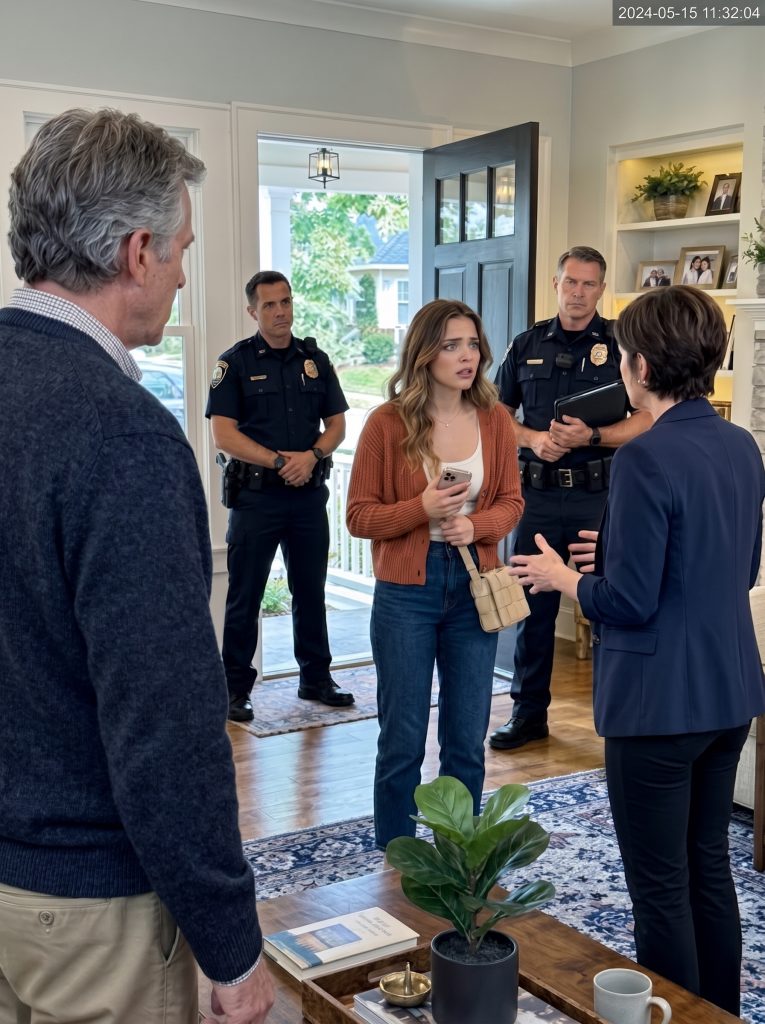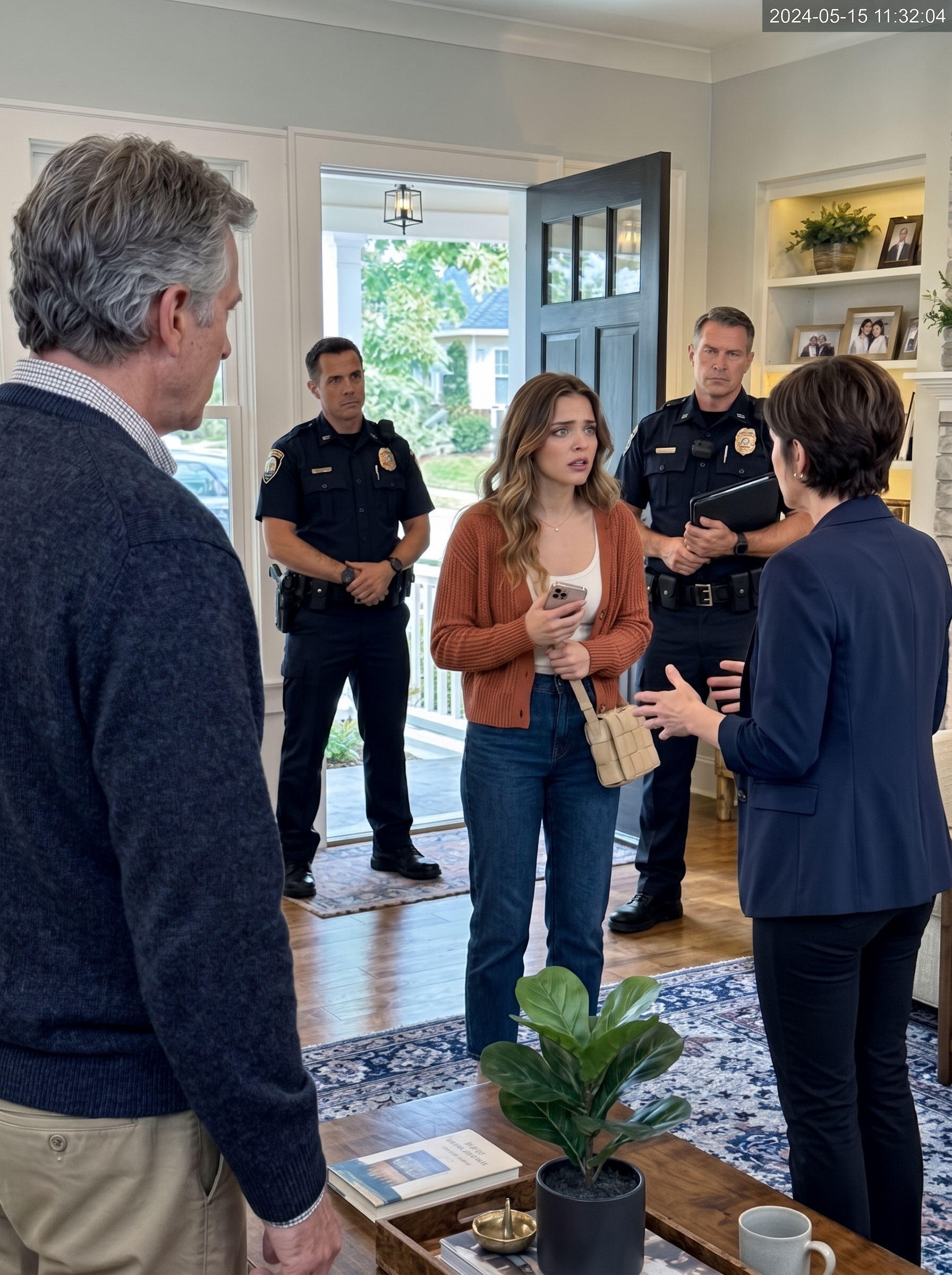
The moment my sister walked into our father’s house and
saw two police officers waiting for her, I realized the most
dangerous person in our family wasn’t the one holding the
phone. It was the man standing by the fireplace.
My father, Frank Bell, had always been the one who fixed
things: broken bicycles, leaky faucets, broken hearts. When
our mother died, he held my younger sister and me together.
He made pancakes every Saturday morning even when he could barely afford groceries.
I had trusted him for thirty-three years.
That Friday afternoon in September, I watched him stare at a police officer’s tablet like he’d seen a ghost.
My sister, Tessa, stood in the doorway clutching her phone with shaking fingers.
“Dad?” she whispered. “What’s going on?”
One of the officers stood. He introduced himself as Detective Daniel Price of the Raleigh Police Department, and his partner as Officer Rebecca Collins.
“Miss Bell, before we ask you about the video,” he said, “we need to know who told you to access your sister’s work computer.”
Tessa blinked. “What? Nobody. It was a joke.”
“A joke?” I said.
She turned to me. “Lauren, please. I already deleted it.”
“You posted my private financial information online!”
“I said I’m sorry!”
“You haven’t actually said that.”
Her eyes filled with tears, but I knew my sister well enough to tell regret from fear. She wasn’t crying because she’d hurt me. She was crying because something had scared her.
Detective Price glanced at his partner. “Miss Bell, do you know a man named Brandon Mercer?”
Tessa’s face changed. “He’s my business partner.”
“Did he ask you to photograph anything inside your father’s study?”
“No.”
The detective opened a folder. “Are you sure?”
Tessa hesitated. My father gripped the fireplace mantel so hard his knuckles went white.
And I understood something that made my stomach turn. Dad wasn’t surprised to hear Brandon Mercer’s name. He was terrified.
Detective Price turned his tablet toward us. On the screen was a photograph of an old document. Under a company logo I didn’t recognize were three signatures: Brandon Mercer’s father’s company, a woman named Helena Marsh, and Frank Bell.
My father’s signature sat beside a date from twelve years earlier, the same week my mother died.
Three hours before that moment, my biggest worry had been whether Dad remembered to buy enough potatoes for dinner.
My name is Lauren Bell. I’m thirty-three, and I live in Raleigh, North Carolina. For six years I worked as a compensation analyst at Ellison Risk Group, a corporate risk-management firm. I analyzed salaries, benefits, and pay structures to make sure companies paid people correctly and followed the rules.
I loved it. Numbers tell stories. They reveal patterns people would rather hide. They don’t flatter you or change their version of events depending on who’s watching.
My sister, Tessa, is twenty-seven, and she’s a social media influencer. If you asked her what she did, she’d say she was building a personal brand. If you asked Dad, he’d say she made videos about restaurants and handbags. If you asked me, I’d have said she’d spent most of her adult life convincing strangers her life was more glamorous than it really was.
That sounds mean, and it probably is. But Tessa never believed attention came with responsibility. To her, attention was money and power and proof that she mattered.
She could photograph a $14 cocktail so beautifully that thousands of people would ask where she got it. I could look at the same bar and notice the emergency exit was blocked.
“My girls came into this world speaking two different languages,” Dad used to say. Tessa was sparkle, and I was structure.
For years I thought those differences were harmless. Then Tessa started treating my privacy as content.
At Dad’s birthday dinner, she secretly filmed me turning down a third glass of wine and captioned it, “When your corporate sister forgets how to have fun.” Thousands of strangers laughed at my blouse and the way I held my fork. Another time, she photographed Dad’s insurance paperwork because the envelopes matched her morning coffee. His policy number was visible. I made her take it down, and she complained that I’d ruined her creative process.
Dad always stepped in with the same line. “Your sister doesn’t mean anything by it.”
That sentence followed me my whole childhood. When Tessa borrowed my clothes without asking, she didn’t mean anything by it. When she told relatives I was lonely because I didn’t have a boyfriend, or laughed at my small apartment and my fourteen-year-old Honda Accord, she didn’t mean anything by it.
Three weeks before everything happened, Tessa showed up at my apartment with two iced coffees and a folder of photos of a downtown production studio: exposed brick, huge windows, a recording booth, a rooftop terrace.
“Brandon handles the technical side, Chloe handles partnerships, and I’m the face of the brand,” she said. “And we’re giving you the chance to invest early. Twenty thousand dollars.”
I nearly choked on my coffee.
The projected profits looked spectacular. The assumptions behind them didn’t.
“How many clients have signed contracts?” I asked.
“Not yet, but we’re talking to people.”
“Who’s carrying the liability insurance? Who signed the lease?”
She sighed. “Lauren, you’re doing that thing again. Turning a family conversation into an interrogation.”
“I’m not investing twenty thousand dollars without understanding the risks.”
Her face hardened. “You could just admit you don’t have it.”
“Having money and agreeing to spend it are two different things.”
She stood up so fast her chair scraped the floor. “You’ve always been jealous because I’m actually building something. Stay in your little apartment with your spreadsheets.”
Two days later, she posted a video mocking people who “disguise fear of success as financial responsibility.” She didn’t use my name. She didn’t need to.
I saved the video and said nothing. I thought ignoring her was the mature choice. I didn’t know someone had been encouraging her to see me as the enemy.
Friday, September 12th, started with sunlight pouring through Dad’s living room windows. He’d spent weeks rebuilding the back deck and wanted to show it off. He’d invited both of us to dinner and asked me to come early.
“Bring your laptop if you’ve got work,” he said on the phone. “You can use my study. It’s quiet.”
I had a compensation review due Monday, so I brought my Ellison laptop.
Dad kissed my forehead at the door. “There’s my dependable girl.”
I settled into his study, surrounded by old baseball trophies, framed family photos, and a ceramic pencil holder my mother painted years before she died.
My mother, Nora Bell, was a gentle woman with an extraordinary memory. She remembered every birthday, every teacher’s name, every promise anyone made. She also wrote everything down.
“People forget what they said,” she used to tell me. “Paper doesn’t.”
She was a part-time bookkeeper, and she volunteered with a community legal aid clinic. She died in a car accident when I was twenty-one and Tessa was fifteen. Dad told us she lost control of her car in a heavy rainstorm on Route 64.
For years, I pictured her alone on that highway, trying to get home. I never questioned it. Why would I? After the funeral, I found Dad sitting on the kitchen floor holding one of her sweaters against his face. Grief had made him look small, and I believed it had made him honest.
That Friday, I worked for nearly two hours. Around lunchtime, I checked a retirement deduction in Ellison’s secure employee portal. My most recent paycheck appeared on the screen: $4,862.17.
It wasn’t my annual salary or even my monthly take-home pay. It was one biweekly direct deposit after taxes, health insurance, my 401(k) contribution, and other deductions. My actual salary was $118,000 a year. I’d been saving aggressively for a house, which is why I still drove the old Honda.
I left the portal open behind my report.
Around two, Dad appeared in the doorway. “Sweetheart, I forgot the potatoes and a few other things. Would you mind running to the store?”
“Sure.” I closed the laptop lid, grabbed my keys, and left. I thought the computer had locked. I later learned it hadn’t.
Nine minutes after I drove away, Tessa walked into the study. She’d later claim she was looking for a phone charger. What she found was my open employee portal, and what she saw was an opportunity.
She held up her phone and started filming.
“Guys, remember my older sister who thinks she’s a financial genius?” She turned the camera to the screen. “This is what she actually makes! She drives that ancient car, wears the same clothes for five years, and judges me for trying to build a business. I can make more than this from one sponsored post!”
Within minutes, the comments poured in. People mocked my apartment, my clothes, my car, my “financial failure.” Tessa replied with laughing emojis.
Then someone pointed out the number was one net paycheck, not a salary. Someone else spotted an annual compensation summary in the window behind it. Another person recognized Ellison Risk Group’s internal security banner across the top of the screen.
Suddenly, strangers weren’t talking about my salary anymore. They were asking why my sister had access to confidential corporate systems.
One of them contacted my employer.
A little after three, I was standing in the produce aisle at the Harris Teeter when my phone rang.
“Lauren Bell? This is Adrian Lopez from Ellison’s security department. Are you currently using your company laptop?”
“No.”
“Has anyone else been authorized to access it?”
“No.”
A pause. “Ms. Bell, images from your internal employee portal have appeared online. We’re remotely restricting the device. Please don’t delete or change anything.”
Then my cousin Melanie sent me a screenshot: my screen, my employee information, my sister’s grinning face, and hundreds of strangers laughing at me.
I left my cart in the aisle and walked out to the parking lot.
When I finally answered Tessa’s call, she was breathless. “Lauren, I deleted it! It was a joke!”
“You filmed my work computer! You could get me fired!”
“I’m trying to fix it!” Then she said something that didn’t make sense. “Just tell your company nobody else touched the laptop.”
I froze. “Why would you say that?”
Silence.
Before I could push, Dad called.
“Lauren, come home.” His voice sounded wrong. “And don’t tell Tessa anything else.”
That was how I ended up in Dad’s living room watching Detective Price show my sister a document with my father’s signature on it.
“Have you ever heard of Meridian Claims Administration?” the detective asked Tessa. “Or the Ashford Mill Relief Fund?”
She shook her head. Behind us, Dad made a quiet sound. He was staring at the floor.
“We’ve recovered messages between you and an account connected to Mr. Mercer,” Price said. “He contacted you about your sister’s computer several times.”
Tessa’s voice rose. “Brandon told me he needed proof Lauren was hiding money! He said I should find out what she makes.”
“Did he tell you to film my laptop?” I asked.
Her eyes filled. “He said it would be funny.”
Detective Price opened another file. “Miss Bell, your business partner is under investigation for unauthorized access to corporate computer systems. An attempt to break into a restricted Ellison database this afternoon was traced to internet service registered to your proposed studio.”
“But we haven’t even opened it!”
“The lease was signed six weeks ago. Your name is on it as the tenant and the personal guarantor.”
“I signed some paperwork,” Tessa whispered. “Brandon said it was preliminary.”
“Did you read it?”
She shook her head.
For the first time that afternoon, I wasn’t angry. I was afraid. My sister was reckless and cruel, but she wasn’t sophisticated enough to plan corporate data theft. Somebody had used her.
Detective Price looked at my father. “Mr. Bell, I think it’s time you explained your connection to Brandon Mercer.”
Dad’s shoulders shook. “I was trying to protect you girls.”
“From what?” I asked.
He didn’t answer.
The detective turned the tablet toward me. The document was a records transfer authorization from Meridian Claims Administration, dated October 2014, one week before my mother’s accident. There were three signatures under “Records Transfer Approval”: Helena Marsh, Frank Bell, and a name I didn’t recognize, Arthur Vale.
“You told us you worked in property management,” I said.
“I did,” Dad said.
“Then why is your signature on an insurance claims document? And why is Mom’s name in the attached records?”
His face crumpled.
“Miss Bell,” the detective said, “whoever was behind this wasn’t just trying to get your employee information. He wanted something your father has been hiding for twelve years.”
When I was sixteen, an old textile and chemical mill outside Raleigh became the center of a tragedy. On a cold March morning in 2009, a chemical storage accident at the Ashford Mill started a fire that spread through part of the plant. Seventeen workers died, and dozens more were injured or made sick.
The company faced lawsuits and state investigations. Eventually, as part of a court settlement, it created a $94 million relief fund for victims and their families. A company called Meridian Claims Administration ran the payments.
I remembered the news reports. I remembered Mom getting quiet whenever the story came on.
What I didn’t know was that she’d been helping several of the families through the legal aid clinic. She organized their paperwork, tracked their medical bills, and helped them understand the settlement letters. Somewhere along the way, she discovered that money was disappearing.
Payments meant for grieving families were being redirected through fake beneficiary records and shell companies.
Years later, Ellison Risk Group bought several of Meridian’s business units, including its old records and some of its liabilities.
And my father hadn’t been a property manager. He’d been a claims records supervisor for a subcontractor that ran Meridian’s records system.
I learned all this sitting in the same living room where we’d opened Christmas presents and watched football.
“The records were wrong,” Dad said, staring at his hands. “Beneficiary information, payment instructions. Things that should never have been changed.”
“Did you change them?” I asked.
He swallowed. “I approved some transfers.”
“Transfers of what?” Tessa said.
“Settlement money.” His voice nearly disappeared. “Over twenty-six million dollars moved through the system over several years.”
Tessa covered her mouth.
Twenty-six million dollars, meant for people who’d lost husbands, fathers, and children. It was supposed to pay for surgeries, rehab, rent, and funerals, and my father had helped move it.
He looked at me with wet eyes. “I didn’t take all of it.”
That made me physically sick. He hadn’t said he took none of it.
Detective Price stepped forward. “Mr. Bell, you should consider having an attorney present before you say anything more.”
Dad nodded and stopped talking. But I’d already heard enough to know the father I’d trusted was not the man standing in front of me.
That evening, Ellison placed me on paid administrative leave pending a security review. They took my laptop and suspended my access. I was told not to discuss company information or investigate anything myself.
At eight o’clock, my manager called.
Helena Marsh had been my mentor at Ellison for six years. She was in her late forties, elegant and brilliant and a little intimidating. She’d recruited me after reading a compensation report I wrote at my previous job. She pushed me to get my Certified Compensation Professional designation. When my confidence faltered, she reminded me that careful people were essential in an industry built on risk.
“Lauren, sweetheart,” she said, “I heard what happened. You’re the victim here.”
Hearing someone say that nearly broke me.
“Helena, my father is involved somehow.”
There was a pause. Then she said something strange.
“Families can surprise us. Don’t blame yourself for his choices.”
She offered to recommend an attorney and promised to protect my reputation. I thanked her.
After we hung up, I cried for the first time. It wasn’t because I trusted her completely. I just badly needed one familiar person who still seemed safe.
I didn’t yet know that her name was one of the three on my father’s document.
At eleven that night, Tessa knocked on my door. Her makeup was smeared, her hair was a mess, and she was wearing an oversized sweatshirt. She looked younger than I’d seen her in years.
“I didn’t know where else to go,” she whispered.
I almost closed the door. Then I saw how badly her hands were shaking, and I let her in.
“Brandon isn’t answering,” she said.
“Tessa, what exactly did you sign?”
She pulled a thick envelope from her bag: the studio lease, equipment financing documents, a management agreement, and several authorization forms.
I read the first page, then the second and third, and my heart started pounding.
“Why does this company have authority to open financial accounts in your name?”
“I thought that was for business expenses.”
“Did Brandon explain that you’re the sole personal guarantor on a five-year commercial lease at $7,400 a month? That’s over four hundred thousand dollars you’re personally responsible for if the business fails.”
Her face went white. “No.”
Several pages mentioned a holding company called Northbridge Media Partners. Tessa had signed an authorization letting Northbridge process payments and receive funds through the studio’s bank accounts.
“Lauren,” she whispered, “am I in trouble?”
For the first time in my life, my sister wasn’t asking me to admire her. She was asking me to save her.
“We need an attorney,” I said.
She started crying. “I’m sorry about the video.”
“Tessa, you humiliated me because I wouldn’t give you money. You put my career at risk and then expected me to lie for you.” I pushed the papers back to her. “Being sorry doesn’t make the consequences disappear.”
“I know,” she whispered. This time, I thought she was starting to understand.
The next morning, I called an attorney named Rachel Bennett. She was forty-two, sharp-eyed, and spoke with the calm precision of someone who’d spent years dealing with people who thought money made the law optional.
“Do not contact Brandon Mercer again,” she told Tessa. “Don’t delete any messages. And don’t post anything about this online.”
Tessa flinched.
“Your phone is evidence, Miss Bell,” Rachel said. “Treat it that way.”
By lunchtime, the investigation had taken a new turn. Brandon Mercer wasn’t just a charming entrepreneur. He’d worked as a contractor for a tech company that handled the migration of Ellison’s old Meridian records years earlier. He knew where the old data lived, which systems were hard to audit, and which employees had access to internal portals.
One of those employees was me.
Rachel called that afternoon. “Lauren, think carefully. How did you get your job at Ellison? Who referred you?”
“Helena Marsh contacted me after seeing my work.”
“Did you know her before that?”
“No. Why?”
“Because Helena Marsh’s name is on the historical documents connected to your father.”
I remembered the three signatures: Helena Marsh, Frank Bell, Arthur Vale.
“That’s impossible.”
“Maybe. But don’t contact her until we know more.”
I opened my old employment records and found Helena’s recruiting email from six years ago. She’d described a job perfectly suited to me: compensation analysis, legacy benefits administration, room to grow. I remembered feeling so lucky.
Now I wondered whether luck had anything to do with it.
On Sunday, Dad called and asked us to come to the house. Rachel warned me he might have legal reasons to hide things, but I agreed to meet him briefly with Tessa there.
He was sitting at the dining table with three mugs waiting. Mom’s yellow mug sat beside him. Seeing it almost broke my heart.
“Tell us about the relief fund,” I said.
In 2010, he told us, his employer assigned him to work on claims data for the Ashford settlement. His job was verifying records transferred between administrators. Then he noticed beneficiary records had been changed after they were approved. Some payment accounts no longer matched the original claimants. Others had been switched to accounts belonging to consulting companies.
He took it to his supervisor, Arthur Vale. Arthur said the changes were authorized adjustments. Then he offered Dad a promotion, a raise, and a $40,000 bonus, more money than Dad had ever seen.
“I told myself I was just doing my job,” he said.
“What did Mom say?” I asked.
“She didn’t know at first.”
But she found out. The families Mom helped were complaining about delayed or missing payments. When she compared their paperwork, she found inconsistencies. She brought them to Dad, and he tried to brush her off.
“She wouldn’t let it go,” he whispered. “Your mother was stubborn.”
“She was honest,” I said.
In 2014, Mom gathered enough evidence to show money was being moved through fake corporate accounts. She planned to take it to federal investigators. Dad said Arthur found out. Then the anonymous phone calls started, and a strange car parked near the house. An envelope arrived with photos of Tessa walking home from school.
“You never told us,” Tessa said.
“I didn’t want to frighten you.”
“What happened to Mom?” I asked.
“She was driving to meet someone who could help her. The road was wet. She lost control.”
He’d told that story hundreds of times. Now it sounded rehearsed.
“Did she have the evidence with her?”
He looked away. “Some of it.”
“Dad, did you tell Arthur where she was going?”
His mouth opened. No sound came out.
That was answer enough.
I backed away. “Don’t,” I said when he started to stand. “And don’t call me sweetheart.”
Out in the driveway, Tessa said something that stopped me.
“I remember that car. The one he mentioned. It was dark blue. I saw it outside the house twice that summer. I told Dad.”
“What did he say?”
Her eyes filled. “He said it belonged to a friend.”
For the next week, my life was waiting rooms, phone calls, and sleepless nights.
Brandon Mercer disappeared. Northbridge Media Partners stopped answering Tessa’s emails. Her studio’s social media accounts went silent.
Then the threatening texts started from unknown numbers. “You don’t understand what you’ve gotten involved in.” Then, after midnight: “Tell your sister to stop asking questions.”
Tessa showed me both. This time she didn’t post them or send screenshots to her followers. She called Rachel, and a detective collected them.
That small act of restraint shouldn’t have felt remarkable, but with Tessa, it did.
On Thursday evening, she came over with a cardboard box from Dad’s attic. Inside were old photos, a few childhood toys, and a battered silver camcorder with a blue strap.
Mom gave Tessa that camcorder for her twelfth birthday. Tessa filmed everything with it: birthday parties, school plays, me burning pancakes, Dad asleep in his recliner, Mom singing off-key at the kitchen sink. For months after Mom died, Tessa watched those videos every night. Eventually the camera disappeared into storage.
Tessa handed me a folded note in Mom’s handwriting.
“My beautiful girls, remember that what someone chooses to show the world isn’t always the truth. Look carefully. Look again. And always trust each other enough to ask why.”
“She wrote that when I got the camera,” Tessa said.
For years, we’d been so busy defending ourselves against each other that we forgot our mother once loved us together. I remembered her on the couch between us, one arm around each daughter.
“I miss her,” I whispered.
Tessa started crying. “So do I.”
For the first time in years, my sister reached for my hand without wanting anything from me.
Two days later, Rachel called with news. Arthur Vale had died in 2021. But his estate records showed payments from Northbridge Media Partners, the same company in Tessa’s studio paperwork. And Northbridge had received money from companies tied to the old Ashford relief fund.
“Investigators think the studio was meant to be a way to move money,” Rachel explained. “Tessa’s online business would explain large digital payments, sponsorship deposits, equipment purchases, consulting fees. Her business activity could hide transfers that had nothing to do with making content.”
“They wanted to use my followers?” Tessa said.
“They wanted to use your company. Some of your sponsorship deals may not have come from real advertisers.”
Tessa stared at the table, thinking of the hotel weekends, the sponsored dinners, the free handbags. Some of it might have been part of a laundering scheme.
For the first time, she understood that being paid well didn’t mean someone trusted you. Sometimes it meant someone had found a use for you.
That night I remembered something Mom used to say about Dad’s construction projects: “Frank can build a whole new deck, but he’ll never throw away a perfectly good board.”
Dad had just rebuilt his deck, right before inviting both of us to dinner.
I called Tessa. “Did you notice anything strange while Dad was working on the deck?”
She was quiet. “Actually, yes. He wouldn’t let anyone help with the section under the study window. He said the supports were dangerous.”
I called Rachel. She told me not to touch Dad’s property and passed it to Detective Price. The next afternoon, police got a search warrant.
Tessa and I stood across the street while officers pulled up boards from the back deck. Dad sat on the porch steps beside his lawyer. He looked old, like an exhausted stranger wearing my father’s face.
After an hour, an investigator came out carrying a sealed evidence bag with a small metal box inside. Dad stood up so suddenly his lawyer grabbed his arm. For one terrible moment, he looked ready to run.
That evening, Rachel called. “They found an encrypted storage drive inside. And a note.”
“What does it say?”
“‘The first key is where the girls learned to see.’”
My breath caught. I remembered Tessa at twelve in our backyard holding her new camcorder, and Mom laughing. “Point it at something important, sweetheart.”
I drove straight to Tessa’s apartment. “Where’s the camcorder?”
We laid it on her kitchen table. The battery was swollen, so we didn’t try to turn it on. Tessa ran her fingers along the foam lining of the carrying case.
“That seam wasn’t there before,” she said.
We looked at each other. Rachel had told us not to disturb evidence, so we stopped, photographed the case, and called her. An evidence technician picked it up that night.
Two days later, Rachel told us what they found. Under the lining was a tiny memory card in a protective sleeve. It held the decryption key for the drive.
Mom had deliberately separated the locked records from the key that opened them, so finding one hiding place wouldn’t expose everything. It was simple, and it was exactly like her.
“Tessa kept it all these years,” I said.
“Without knowing what it was,” Rachel said.
Tessa sat very still. “Mom trusted me with something important,” she whispered. “And I spent twelve years thinking all she left me was an old camera.”
The files on that drive changed everything. Investigators only shared pieces through Rachel, but they included transaction histories, payment authorizations, correspondence, and audio recordings. There were Meridian documents, shell company names, and instructions to change beneficiary information. There was evidence tying those changes to people who later held senior jobs at Ellison.
One name came up again and again: Helena Marsh, my mentor, the woman who called me sweetheart the night my world fell apart.
I refused to believe it for almost a week. Helena managed compensation systems, so of course her name would show up in payment records.
Then Rachel showed me a document that erased every excuse. It was a personnel memo written months before Helena recruited me. It had my name, my education, my work history, and a note about my connection to Frank and Nora Bell. At the bottom, Helena had written:
“Candidate would be advantageous for continued oversight of the legacy account structures.”
She knew who I was before she ever contacted me.
I thought about the lunches, the career advice, the promotions, every time she praised my attention to detail and talked me out of taking other job offers. She hadn’t been mentoring me. She’d been keeping me close.
Rachel explained why. Ellison’s compensation databases contained old payment structures inherited from Meridian, some of them used to hide transfers from the Ashford scheme. As a compensation analyst, I worked near systems that could eventually expose those problems. With me inside the company and my assignments under her control, Helena could make sure I never found them. If she ever needed leverage over my father, she had me.
I went home and read through my journals. Eighteen months earlier, I’d written about a discrepancy in an inherited benefits category: payments that didn’t match employee classifications. I asked Helena for permission to look into it. She said it was a data migration error, and two weeks later the project was reassigned.
I remembered her exact words. “You don’t have to solve every problem, Lauren. Sometimes the most responsible thing is knowing when to stop.”
I’d been standing next to the truth for years, and the person I trusted most at work kept steering me away from it.
The following Monday, Helena left me a voicemail. Rachel had told me to send everything through counsel, so I didn’t answer.
“Lauren, I know you’re frightened,” Helena said. “I just want to remind you that not everything being said is true. Please call me before you make a decision that hurts your future.”
Before you make a decision that hurts your future. The warmth was still in her voice, but under it was a warning. I forwarded it to Rachel.
That night, another text came from an unknown number. “Your mother should have stopped when she was told.” Then, a minute later: “You have the same unfortunate habit.”
I locked every door. Rachel called the detectives. Twenty minutes later, Tessa was on my doorstep with an overnight bag.
“I’m staying,” she said.
She slept on my couch for three nights. We watched terrible TV, ordered Chinese food, and argued about the thermostat. At three in the morning, when I woke from nightmares about Mom’s accident, Tessa sat with me until I stopped shaking.
One evening, she put her phone on the coffee table. “I deleted my main account.”
“Tessa, you spent years building it.”
“Every time I opened it, I saw myself laughing at you,” she said. “I wanted strangers to think I was better than you. And I never once asked myself why I needed that.” She took a breath. “I think I need to figure out who I am when nobody’s watching.”
The worst evidence came from two audio files. Rachel warned me I might want someone with me before I listened. I asked Tessa.
We sat in a small conference room at Rachel’s office with rain tapping the windows, and for the first time in twelve years, outside of old home videos, I heard my mother’s voice.
“Frank, I need you to look at these numbers.”
Dad answered. “Nora, we’ve discussed this.”
“No. You’ve talked around it. That’s different.”
Then Helena spoke, cool and controlled. “Mrs. Bell, you’re making accusations you don’t understand.”
My mother didn’t hesitate. “I understand that thirty-one families were denied payments they were legally owed. I understand that medical claims were marked closed while patients were still in treatment. And I understand that the money went somewhere.”
“The payment structures are complicated,” Helena said.
“Stealing from grieving people isn’t complicated.”
Tessa started crying.
Then Dad said, “Nora, think about the girls.”
“I am thinking about the girls,” Mom said, and her voice broke. “I don’t want our daughters growing up believing that keeping quiet is the same thing as being good.”
“You need to be very careful,” Helena said.
“No,” Mom said. “You need to be very careful. I’ve made copies. I’ve talked to someone outside your company. If anything happens to me, those records will not disappear.”
The recording ended.
My mother didn’t die because she was careless. She died trying to stop a crime.
“There’s one more recording,” Rachel said quietly. “From the night she died.”
It started with traffic noise, rain, and Mom’s breathing.
“October eighteenth, 2014. Seven forty-two p.m. Frank told me Arthur agreed to turn over the original account files. I’m supposed to meet him near the old bridge on Route 64. But Arthur hasn’t answered my calls. I don’t know who to trust anymore.”
A turn signal clicked.
“If Frank is listening to this someday, I want him to know I gave him every chance to do the right thing. And if my daughters hear this, I want them to understand that loving someone doesn’t mean you have to protect them from the consequences of what they’ve done.”
Tires hissed on wet pavement. A car horn blared. Mom gasped, and there was a loud impact.
The recording ended.
For twelve years, Dad told us Mom lost control of her car. But the recording suggested another vehicle had been there.
Then a memory came back that grief had buried. That night, Dad said he’d been home all evening, and that the police called him around ten. But I remembered waking up at twenty-one and seeing his truck gone from the driveway.
“Dad wasn’t home that night,” I whispered. “I think he knows exactly what happened on that road.”
The investigation expanded. The FBI and the U.S. Attorney’s Office took over the financial fraud case. Forensic accountants traced the money through shell companies, and the State Highway Patrol reopened Mom’s accident.
Brandon Mercer was arrested in Myrtle Beach, South Carolina, on charges of unauthorized computer access. Tessa’s other partner, Chloe Vance, started cooperating once she learned what the operation really was. Brandon had recruited Chloe to make convincing promotional materials. He’d recruited Tessa for her online presence and for her access to our family.
Helena Marsh was placed on leave.
That week, a padded envelope appeared outside my apartment door with no return address. Inside was a photocopy of an old family photo: Mom and Dad in our backyard, Tessa and me laughing. Someone had drawn a thick black line through my mother’s face. On the back were four words.
“Let the past stay buried.”
I called the police.
A week later, Detective Price showed us two photographs at the district attorney’s office. The first was from archived traffic camera footage: a dark blue sedan near an intersection on Route 64, timestamped October 18, 2014, at 7:56 p.m., fourteen minutes after Mom started her recording.
“Is that the car you saw outside the house?” he asked Tessa.
“I think so.”
The second photo showed the same car at a gas station. Two men stood beside it. One was Arthur Vale. The other was younger, with a distinctive way of leaning slightly to his left.
My father.
“Your father told investigators he was home that evening,” Price said.
“He lied,” I whispered.
Price laid down one more document, an old phone record. That night, Dad’s phone called Arthur Vale, then Helena Marsh, then 911. The emergency call was disconnected after forty seconds, before any real report was made, less than ten minutes after the estimated time of the crash.
Dad was arrested the following Tuesday on federal charges of wire fraud and conspiracy connected to the relief fund. The investigation into Mom’s death continued separately.
Reporters camped outside our childhood home. Old photos of our family showed up online, and strangers discussed my childhood like it was entertainment. The irony wasn’t lost on me. This whole nightmare started because my sister wanted an audience. Now the whole country was watching us.
Dad asked to see me. Rachel said I didn’t have to go. For three days, I refused. Then I agreed to a supervised visit at the detention center. I didn’t go to forgive him. I needed to hear whether he could tell the truth when he had nothing left to gain.
He sat behind the glass in a plain jumpsuit, unshaven, his cheeks hollow. He looked smaller than I’d ever seen him.
“Lauren,” he whispered into the phone. “I never wanted any of this.”
“Did you tell them where Mom was going?”
A long silence. “Yes.”
“Did you know they might hurt her?”
“I thought they only wanted the documents.”
“Did you follow her?”
He looked away. “Yes.”
“Did you see the accident?”
He nodded.
“Was she alive?”
He covered his face. I waited. Finally, he whispered, “When I got there, she was still breathing.”
The room seemed to disappear.
“Did you call an ambulance?”
“I tried. Arthur said if I involved the police, the girls would be next.”
“So you left her there?”
His silence was unbearable.
“YOU LEFT HER THERE?”
He flinched. “I was scared.”
I looked at him through the glass, the man who made pancakes every Saturday after the funeral and held her sweater against his face on the kitchen floor.
“Mom was scared too,” I said. “She still tried to save people.”
I hung up the phone. He shouted my name as I stood, and I didn’t turn around.
For weeks afterward I barely functioned. I started therapy and walked for hours. One Sunday morning, Tessa found me sitting on my kitchen floor holding Mom’s yellow mug, which Dad had given me months earlier.
“I used to think Dad was the good parent,” I whispered. “Every Saturday after she died, he made breakfast. I thought it meant he loved her.”
Tessa sat down next to me.
“Maybe he did love her,” she said. “But loving someone doesn’t make what you do to them okay.”
For once, she wasn’t performing wisdom for a camera. She was just telling me what she’d learned. I rested my head on her shoulder, and we sat there until the sunlight moved across the floor.
In November, Helena Marsh was arrested on federal charges of wire fraud, money laundering conspiracy, and obstruction.
The most painful discovery came from an internal message investigators recovered, dated six years earlier, the month before Helena recruited me. She’d written to Brandon:
“Frank Bell’s older daughter is entering compensation analysis. She may be useful if placed somewhere we can supervise.”
Brandon replied: “Does she know anything?”
Helena answered: “Not yet.”
My career had been part of someone else’s backup plan.
But they’d made one mistake. They thought I’d stay obedient because I respected authority. They thought my love for my father would keep me from asking questions. They didn’t understand what my mother taught me: being careful doesn’t mean being silent.
Three days before a major hearing, Rachel called. “There’s a document you need to see before you testify.”
The folder was labeled ASHFORD MILL RELIEF FUND — BENEFICIARY RECONCILIATION.
Mom had been afraid the original payment records would be altered or destroyed. So she’d worked with an independent attorney and a CPA to document every legitimate beneficiary and every dollar owed. The archive she hid wasn’t just accusations. It was a complete reconstruction of the missing money, family by family and payment by payment: what each family should have received, what they actually got, and where the difference went.
She hadn’t just wanted to prove a crime. She wanted the money given back to the people who needed it.
Rachel turned to the last page. Mom had set up a small trust with a $15,000 deposit to preserve copies of the records and pay for continued legal help for the families. Under “successor trustees” were two names: Lauren Bell and Tessa Bell.
Tessa leaned forward. “Why would Mom name me?”
Rachel smiled sadly. “Because she believed you’d grow into someone capable of carrying responsibility.”
My sister started crying. For years she’d measured her worth in followers, likes, and sponsorships. Now she was looking at proof that our mother trusted her with something far more important than money or fame. She trusted her with the truth, and with me.
The hearing was held on a gray morning in February in federal court. The gallery was crowded with Ashford families. Some held photos of relatives they’d lost. Others held folders worn soft from years of rejected claims.
Across the room, Helena Marsh sat in a dark suit, composed, almost bored.
Prosecutors presented the evidence: communications, authenticated records, and transaction histories. A forensic accountant explained how settlement money had been redirected. A former Meridian employee described being pressured to approve changes. Chloe Vance testified about how Brandon set up the studio.
Then Tessa was called. My little sister walked to the stand in a simple navy dress, with no designer bag, no dramatic makeup, and no camera.
She admitted she accessed my laptop without permission, filmed my private information, and posted the video because she wanted to humiliate me.
“Did you intend to embarrass your sister?” a defense attorney asked.
“Yes.”
“So you acted out of resentment?”
“At first.” She looked at me, then back at the attorney. “I wanted people to laugh at my sister because I thought it would make me feel better about myself. But when I learned what my business partners were doing, I turned over everything I had.”
“Because you were afraid of being charged?”
“Yes. I was afraid,” Tessa said, her eyes filling. “But I also learned that being scared doesn’t give you permission to keep hurting people. My mother died trying to help families get the money they were owed. I didn’t understand that when I made that video.” She looked at the families behind us. “Now I do. And I’m sorry.”
For once, my sister wasn’t talking to an audience. She was talking to people.
Then the prosecution called Detective Price, and I learned something I never expected.
The forensic exam of my laptop showed unauthorized activity before Tessa ever entered the room. At 1:51 p.m., while I was still in the house and before Dad sent me to the store, someone plugged a USB device into my laptop. It tried to collect data and disable part of the security software.
The prosecutor put up a still image from a small security camera Dad had installed over his back door, which covered part of the hallway to his study. At 1:49 p.m., a man walked into the study carrying something small. At 1:55, he walked out.
It was Dad.
Then the prosecutor put up text messages recovered from Dad’s phone, sent to Brandon Mercer the night before.
“She’ll be here tomorrow. I’ll make sure the computer is available.”
“Keep Tessa busy with the video. Lauren will be out.”
I stopped breathing.
Dad hadn’t just failed to protect us. He planned it. He invited me to dinner, told me to bring my laptop, and sent me to the store for potatoes he never forgot.
Beside me, Tessa was shaking her head. “No,” she whispered. “Dad told me the night before that you were hiding money. He said you were acting strange about your finances.”
“Why didn’t you tell me?”
“Because I thought he was right.”
Years of memories rearranged themselves. Dad excused Tessa whenever she humiliated me. He praised me for being responsible while quietly telling Tessa I was judgmental. He told us to keep family problems private and kept us from comparing notes.
He’d spent years making sure his daughters spoke different languages, because if we ever really talked, we might compare what he’d told each of us. Our rivalry wasn’t something he failed to stop. It was something he learned to use.
The rest came out over the following months through hearings, plea agreements, and evidence.
Dad never fully got out of the scheme. After Mom died, the people involved kept paying him to use his knowledge of the old records, about $310,000 over the years through fake consulting arrangements. When Ellison started auditing its legacy systems, he panicked that Mom’s hidden evidence might surface. Helena and Brandon wanted to find it first, and Dad believed cooperating would keep his role buried.
So he helped Brandon get access to my laptop. He fed Tessa’s resentment because he knew exactly how she’d react. He wanted her distracted by attention, me busy defending my job, and the security breach to look like a careless employee’s family drama instead of a coordinated attempt to reach sensitive records.
But he made one catastrophic mistake. The video was public. People saved it, and Ellison’s security system logged everything. Once investigators found Mom’s archive, the story he’d controlled for twelve years wasn’t his to tell anymore.
Rachel showed me one last message from Dad’s phone, sent to Helena right before Tessa’s video.
“The girls still don’t know anything. I can manage them.”
He didn’t call us his daughters. He called us problems he could manage.
In the end, Dad pleaded guilty in federal court to wire fraud conspiracy and was sentenced to fourteen years in prison. The judge also ordered him to forfeit the house on Willow Creek Drive and pay restitution of $310,000 to the Ashford families. The state charged him separately with failing to render aid and obstruction in connection with Mom’s death, and he pleaded guilty to those too.
Helena Marsh went to trial and was convicted on all counts. She received eighteen years. Brandon Mercer pleaded guilty to computer fraud and money laundering and got seven. Tessa was never charged. Prosecutors credited her cooperation and agreed she’d been manipulated. The studio’s landlord released her from the lease after Rachel showed that her signature on the guarantee was obtained through fraud.
Through civil asset forfeiture and lawsuits against Ellison and Meridian’s insurers, the government recovered about $19 million. Using Mom’s reconciliation as the roadmap, a court-appointed special master began paying the families what they’d been owed for more than a decade.
None of it brought Mom back. But her name was finally separated from the convenient story of a careless woman driving too fast in the rain.
Sixteen months after that afternoon at Dad’s house, Tessa and I went to a memorial event for the Ashford families at a community center in Raleigh. There were folding chairs, homemade cookies, and photos lined up along one wall.
A man in his sixties stood up and talked about Mom sitting at his kitchen table helping him fill out claim forms when he was too overwhelmed to understand them.
“She never made us feel stupid,” he said. “She told us we deserved answers.”
Afterward, an elderly woman came up to us holding a faded photograph. It showed Mom beside a hospital bed, smiling at a man with a bandaged arm.
“Your mother came to see my husband every Thursday,” she said. “Even after the insurance company told us there was nothing else to do. She’d be proud of you both.”
“I hope so,” Tessa whispered.
My sister never went back to her old influencer career. She took classes in journalism ethics and learned about consent. She learned that a camera can protect someone’s dignity instead of taking it away. She started a small documentary production company, and her first project followed families affected by delayed compensation claims. She didn’t make herself the hero, and she didn’t turn people’s grief into content. She let them speak.
She showed me an early cut one night. It ended with an Ashford survivor at his kitchen table.
“People think money fixes everything,” he said. “It doesn’t. But when somebody steals the money you need to keep your family alive, getting it back means somebody finally admits you mattered.”
“That’s the first thing I’ve ever made,” Tessa said, “that I don’t care whether it goes viral.”
I didn’t go back to Ellison. I joined an independent compensation consulting firm with good pay and kind people. I learned that success isn’t always proving you can survive any environment. Sometimes it’s knowing when to leave.
I kept the old Honda another year, until the transmission died on a Wednesday morning. Tessa laughed so hard when I called her that she nearly dropped the phone.
“Want me to help you shop?” she asked.
“Absolutely not. You’ll pick something with massage seats and a payment bigger than your rent.”
For the first time in a long time, laughing with my sister didn’t hurt.
On what would have been Mom’s birthday, Rachel arranged for us to receive copies of two personal letters found among Mom’s papers once they were no longer needed as evidence. One had my name on the envelope, and the other had Tessa’s.
Mine said:
“My darling Lauren, you’ve always believed that being strong means being responsible for everyone around you. But you are not responsible for protecting people from the truth about themselves. Not your sister, not your father, not even me. You are allowed to love someone and still tell them no. I hope you never mistake silence for kindness, or obedience for love. Most of all, I hope you always know how proud I am to be your mother.”
Tessa’s said:
“My beautiful Tessa, you’ve always wanted the world to look at you. I love your laughter and your imagination, and the way you notice beauty other people walk past. But I hope someday you learn that being seen is not the same as being known. You don’t have to make someone else feel small to feel important. You don’t have to convince strangers your life is wonderful. Make it wonderful. Tell the truth even when it costs you something. And take care of your sister. She’s stronger than she knows, but that doesn’t mean she should have to be strong alone.”
We sat at my kitchen table crying over words she’d written twelve years earlier. She’d known exactly who we were and what we’d need to learn.
“She knew I was going to be dramatic,” Tessa said through her tears.
“That part wasn’t hard to predict.”
She threw a pillow at me, and then we hugged each other so hard neither of us could speak.
A few weeks later, Rachel sent one more thing: a letter Mom wrote to her attorney shortly before she died, explaining why she named both of us as trustees.
“If the girls ever have to use these records, I hope they do it together. Lauren will know how to follow the numbers. Tessa will know how to make people listen. Neither gift is more important than the other. And if they ever forget that, I hope they remember I loved them both for exactly who they were.”
A year later, a letter from Dad arrived through his attorney. He wrote that he was sorry. He wrote about the pancakes, the school concerts, and the birthdays, and said he’d loved us.
I read it twice and put it in a drawer. I didn’t write back. Maybe someday I will, or maybe I won’t. I used to believe forgiveness was something I owed people because they shared my blood. I don’t believe that anymore. My father may have loved us, but love without honesty became a weapon in his hands, and I won’t let him use it on me again.
On the second anniversary of the day Tessa posted my paycheck online, we visited Mom’s grave. Tessa carried yellow flowers. I brought Mom’s ceramic pencil holder, which I’d glued back together after finding a crack in its base.
Tessa knelt by the headstone. “Hi, Mom. We’re doing okay. Lauren still makes spreadsheets for everything.”
“Not everything.”
“She made a spreadsheet for our road trip.”
“Because somebody refused to book hotels in advance.”
Tessa laughed. Then her voice softened. “I think you’d be proud of her. And I hope you’d be a little proud of me too.”
I knelt beside her and put my hand on the cool stone.
“We finally figured it out, Mom,” I said. “We learned how to listen to each other.”
When I think about all of it now, I always come back to one number: $4,862.17. My sister saw it on my laptop, decided it proved I was a failure, and posted it so strangers would laugh at me.
For years, Tessa believed money decided how much a person mattered. For years, I believed being responsible meant avoiding every conflict. And our father depended on both of those beliefs to keep us apart.
The truth survived in places none of them thought to look: under a wooden deck, inside an old camera case, in the careful records of a woman who refused to stay quiet, and in two sisters who finally chose to trust each other.
I once thought my sister ruined my life with forty-six seconds of video. Now I know she accidentally opened a door to a truth that had waited twelve years to come home, and this time neither of us turned away.
THE END..!