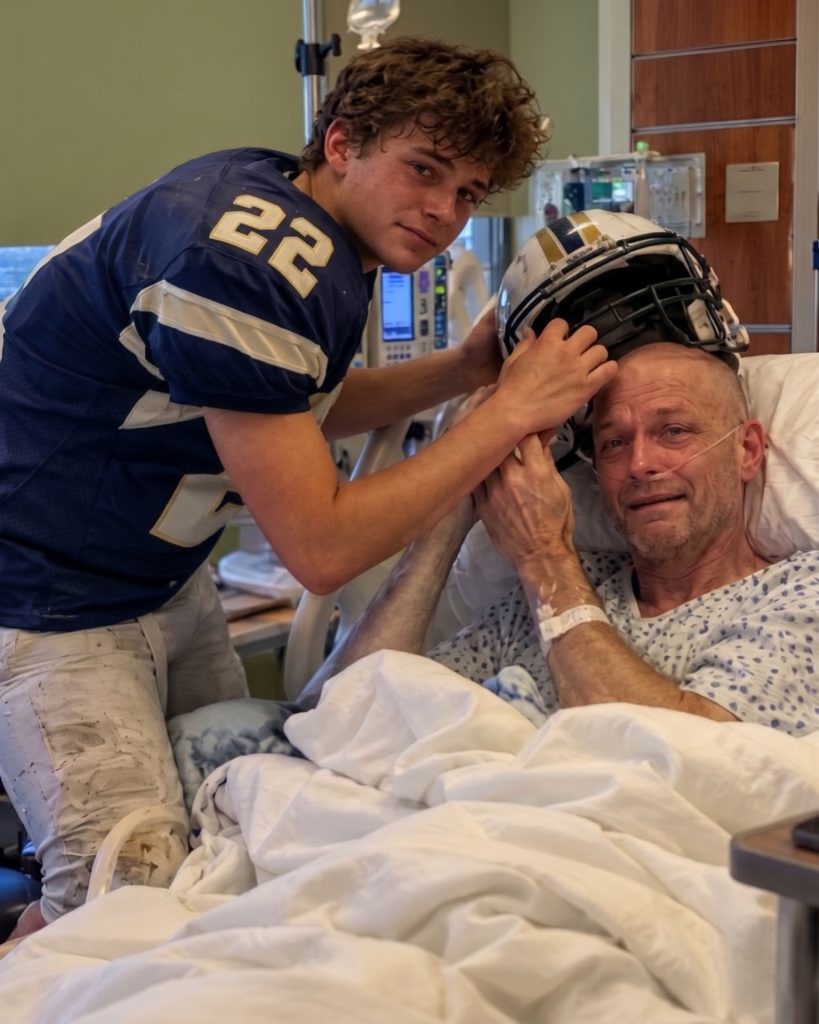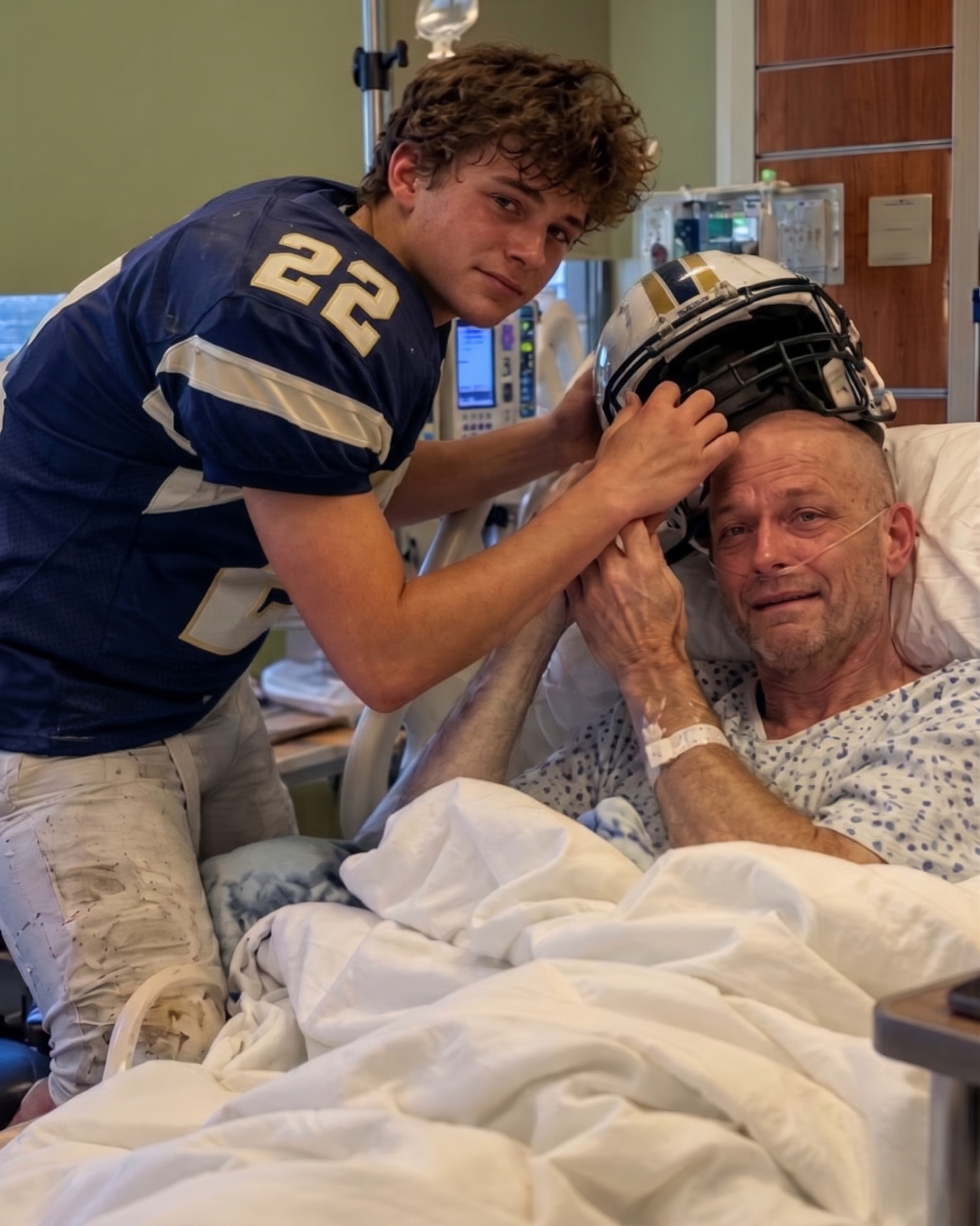
Five days after losing my husband, I took our son to his championship ceremony. I thought the coach had arranged a simple tribute. But when the stadium screen lit up, nothing could have prepared us for what came next.
The night before his championship ceremony, my 14-year-old son sat staring at his football jersey.
Clean.
Folded.
Beside a photograph of his father.
“They’re taking pictures with the dads,” Ethan whispered.
He looked down at his father’s photograph.
“Dad was supposed to be in mine.”
He swallowed.
“Do I have to go?”
“No, sweetheart.”
My husband, Mark, had died five days before the ceremony.
At his funeral, Ethan had stood beside me without crying.
He thanked everyone who came.
He even helped his grandmother find her seat.
But that night, I heard him crying into Mark’s old sweatshirt.
I hadn’t known what to say.
I still didn’t.
Football had always meant something special to Mark.
At 14, his father told him the family needed money more than it needed another player.
Mark went to work.
No practices.
No matches.
Not even a jersey with his name on it.
He rarely spoke about what he’d missed.
Then our six-year-old son came home asking to play.
Mark brought back registration forms that afternoon.
For the next eight years, he stood beside practice fields in his work clothes.
He learned every teammate’s name.
He cheered for every boy, not just Ethan.
He kept spare socks in the car because Ethan always forgot his.
And whenever Ethan looked toward the sidelines, Mark was there.
Until cancer made standing difficult.
Then walking.
Then leaving the hospital.
Mark watched the championship game through my phone.
I held it up from the stands, trying to keep Ethan in the frame.
When the final whistle blew, Ethan’s team had won.
On the screen, Mark was crying.
“Tell him I saw it,” he kept saying.
Afterward, Ethan called from the locker room.
“Next time, Dad, you have to be in the picture.”
“I’m planning on it, buddy.”
But Mark never got that chance.
And now, Ethan was afraid to attend the ceremony without him.
After Ethan went to bed, I messaged his coach that we might miss the ceremony.
My phone rang after 11 p.m.
“Please bring him,” the coach said.
I explained about the pictures.
“I know,” he answered. “But I’ve arranged something for Ethan. I think it might help.”
I hesitated.
“I don’t want him feeling worse.”
“I understand. Just ask him. And if he agrees, could you bring him an hour early?”
“Why?”
“There’s something I’d like to give Ethan. But I need to speak with him first.”
After we hung up, I went to Ethan’s room.
He was still awake.
“Your coach called,” I said. “He has something special planned for you tomorrow.”
Ethan looked at his father’s photograph.
“Will I have to take pictures with everyone?”
“Only if you want to.”
He was quiet for a long moment.
Then he touched his folded jersey.
“Dad would have wanted me there, wouldn’t he?”
I nodded.
“I think he would.”
Ethan looked down.
“Okay, Mom. I’ll try.”
The next morning, he put on his jersey without another word.
We drove mostly in silence.
At the stadium, the stands were nearly empty.
The coach met us outside the locker room.
“Ethan,” he said gently, “we want to remember your dad during the ceremony. Would that be okay?”
“Will everyone be looking at me?”
“Some people might. You can say no. Nobody will mind.”
After a moment, Ethan nodded.
“Okay.”
The coach opened the locker room door.
A single jersey hung from a hook.
Blue.
White numbers.
And across the back, “MARK.”
Ethan stopped walking.
“That’s Dad’s name.”
The coach lifted it down.
“Your father once told me he’d never had a jersey of his own.”
I swallowed.
The coach looked at the jersey.
“I thought it was time he did.”
Ethan ran a finger across the letters.
For a moment, he pressed the fabric against his face.
“Can I keep it?”
“It’s yours.”
The coach quietly asked me to step outside.
“There’s something else I’d like to include in the tribute. Do I have your permission?”
“Will it upset him?”
“It might be emotional. But I think he’ll treasure it.”
I glanced at Ethan through the doorway.
Then nodded.
“All right.”
When I returned, Ethan was still holding the jersey.
I thought I understood what the coach had arranged.
I was wrong.
When the ceremony began, the team lined up near the field.
Parents filled the lower stands.
A photographer waited beside the awards table.
Then the stadium screen went black.
A familiar voice filled the air.
“Okay, Ethan. Try again.”
My breath caught.
On the screen, a tiny boy in oversized boots chased a football across our backyard.
Mark ran after him, laughing.
Six-year-old Ethan.
I remembered filming that afternoon.
Then another clip appeared.
Mark kneeling to tie Ethan’s laces.
Mark cheering in the rain.
Mark tossing spare socks from the car window as Ethan ran toward him.
Some clips I’d shared with the coach over the years.
Others came from parents.
I hadn’t known they’d been collecting them.
Then the footage changed.
Mark sat in our backyard, a blanket around his knees.
Ethan stood several feet away with the ball.
“Easy one, Dad?”
“Easy one.”
Ethan rolled it gently.
Mark stopped it with his shoe.
And sent it back.
Again.
And again.
I remembered that day.
On the screen, Ethan rolled the ball to his father one last time.
Mark passed it back.
Then the picture faded.
For a moment, the screen was black.
When it lit up again, Mark was sitting in his hospital bed.
Thinner.
Paler.
Looking straight into the camera.
“Hey, buddy.”
Beside me, Ethan went still.
“Hey, buddy. I want you to remember something.”
Mark paused.
“I was proud of you before you ever kicked a football. And I’ll always be proud of you.”
Ethan covered his mouth.
“I might not be there on the sidelines, but you’ll never be alone.”
Mark smiled, his eyes filling.
“I thought football was the dream I’d lost. But being your dad gave me something better than I ever imagined.”
The screen went dark.
Silence.
Then Mark’s photograph appeared.
He stood beside Ethan at practice, his arm around his son’s shoulders.
The coach stepped to the microphone.
“Mark always showed up for our boys. Today, we’re showing up for his.”
Ethan’s teammates gathered around him.
Their fathers followed.
One rested a hand on Ethan’s shoulder.
Another wiped his eyes.
Parents in the stands were crying.
Then applause filled the stadium.
But Ethan kept looking at the screen.
At his dad.
The coach placed the medal around his neck.
Ethan clutched Mark’s jersey.
And when the photographer called everyone together, Ethan turned to me.
“Mom?”
I stepped beside him.
The coach positioned us with the screen behind us.
Mark’s smiling photograph remained there.
Ethan raised his father’s jersey between us.
His teammates and their fathers gathered close.
The photographer raised his camera.
“Smile!”
Ethan did.
Through his tears.
The camera flashed.
And everyone applauded again.
Later, at home, he placed the medal beside Mark’s photograph.
Then he hung the blue jersey above it.
“Dad finally got one,” he said.
I put my arm around him.
“Yes, sweetheart.”
Ethan looked up at the jersey.
“And he was in the picture.”
He was.
The Morning After the Lights Went Out
The silence of the house was different now. Before the stadium ceremony, the quiet had been hollow—a vacuum left behind by empty hallways, a favorite armchair that stayed vacant, and the persistent phantom echo of a cough down the corridor. But Sunday morning sunlight cut through the living room windows differently, casting sharp, golden angles across the hardwood floors and illuminating the dust motes dancing around Mark’s blue jersey hanging proudly on the wall.
Ethan had been up since dawn.
When I walked into the kitchen, the kettle was already humming on the stove, water trembling in anticipation of a boil. Ethan stood on his tiptoes, reaching into the upper cabinet for two ceramic mugs, his movements deliberate and steady. He was wearing an oversized flannel shirt that used to belong to his father, the sleeves rolled up thrice to free his hands.
“Morning, buddy,” I said softly, leaning against the doorframe.
Ethan turned, a small, tentative smile touching the corners of his mouth. “Morning, Mom. I’m making tea. Just like he taught me. Two sugars for you, right?”
“That’s right,” I replied, my throat tightening. Mark had always been the architect of our slow Sunday mornings, the one who insisted on a half-hour of hot tea and quiet conversation before the chaotic world of homework, chores, and soccer tournaments rushed in to claim the weekend. Now, at fourteen, Ethan was seamlessly stepping into that rhythm, not out of obligation, but out of a desperate, beautiful need to keep the tether intact.
We sat at the wooden kitchen table, the steam rising between us. Outside, the neighborhood was waking up to the crisp bite of late autumn. A blue jay darted across the lawn, landing on the weathered wooden fence Mark had built three summers ago.
“The coach texted,” Ethan said, staring into his mug. “Practice is optional this Tuesday. Because of… everything.”
“Are you going?” I asked, watching him carefully.
Ethan looked up, his eyes clear and resolute. “Yeah. Dad wouldn’t want me sitting around feeling sorry for myself. Besides, the regional finals are in three weeks. The team needs a captain.”
It was the first time he had fully claimed the word—captain. Coach Miller had officially given him the armband two weeks before Mark passed, but Ethan hadn’t worn it with any real conviction until yesterday. Looking at him now, sitting straight-backed in his father’s flannel shirt, I saw the invisible transition happen. He wasn’t just the boy who chased a football across the backyard anymore. He was the anchor of his team, carrying a legacy heavier than any gear bag.
“He’d be so proud of how you handled yesterday,” I murmured, reaching across the table to squeeze his hand. His fingers were long and calloused—the hands of an athlete, but also, increasingly, the hands of the man of the house.
Ethan turned his hand over, interlocking his fingers with mine. “I keep thinking about what he said on the screen, Mom. ‘I thought football was the dream I’d lost. But being your dad gave me something better than I ever imagined.’” He swallowed hard, his voice dropping an octave. “Do you think he really meant that? Even after he got sick? Even when he couldn’t walk the sidelines anymore?”
“Every single word, Ethan,” I said, my voice unwavering as I looked straight into his eyes. “Your dad lived and breathed the game, yes. But his whole world narrowed down to you the day you were born. Football was what he did. Loving you was who he was.”
Ethan nodded slowly, letting the truth of those words settle deep into his chest. He finished his tea in silence, set the mug in the sink, and walked over to the front hallway. I heard the familiar, heavy thud of his cleats hitting the floor.
“Going to the park?” I called out.
“Just for an hour,” Ethan replied, pulling on his jacket. “Need to work on my free kicks. Coach says the keeper from West Valley has a weak left side.”
I watched him step out into the sunlight, the blue jersey watching over him from the living room wall like a silent guardian angel.
The Empty Bleachers
The municipal soccer complex smelled of crushed grass, damp earth, and autumn frost. On Tuesday afternoon, the turf was coated in a thin sheen of morning dew that glittered under the low, slanted autumn sun.
When I pulled my sedan up to the gravel parking lot, I noticed Coach Miller leaning against the driver’s side of his pickup truck, a steaming paper cup of coffee in his hands. He watched Ethan jog across the parking lot, his backpack slung over one shoulder, a battered leather football tucked securely under his arm.
“He looks different today,” Coach Miller said quietly as I stepped out of the car to stretch my legs.
“Different how?” I asked, leaning against the passenger door.
“Taller. More centered,” the coach observed, blowing gently across his coffee. “Yesterday broke something open in him, but it also set something else in place. You don’t see many fourteen-year-olds carry that kind of weight without buckling. But Ethan? He’s running with it now, not under it.”
Across the pitch, the rest of the varsity squad was filtering out of the locker room. There was no boisterous shouting or horseplay today; the boys walked in a loose, respectful cluster. When Ethan stepped onto the green turf, Noah—the team’s sprawling center-back and Ethan’s closest friend—jogged over and tossed a neon-yellow bib without a word. Ethan caught it cleanly, slipped it over his head, and immediately began organizing the cones for the passing drills.
Coach Miller pushed off his truck. “Well, let’s see how the legs feel. Regional semis are ten days away, and West Valley isn’t going to roll over just because we have a cinematic backstory.”
For the next two hours, the pitch transformed into a rhythmic orchestration of shouts, leather striking turf, and heavy breathing. I sat in the metal bleachers—the exact spot where Mark used to sit wrapped in a woolen plaid blanket during the freezing November qualifiers. The wind picked up, carrying the crisp scent of burning leaves from a neighboring yard, but the chill didn’t bite as deeply today.
Ethan was everywhere. He was barking tactical instructions, demanding cleaner touches, and sprinting back on defense with a ferocity that made Coach Miller nod in silent approval. But what caught my attention wasn’t his athleticism; it was his leadership. When a freshman midfielder shanked an easy pass into touch, Ethan didn’t throw his hands up in frustration the way he used to a year ago. Instead, he jogged over, tapped the younger boy on the back, and whispered something that made the kid nod and square his shoulders.
Just like Mark, I thought, a familiar ache blooming behind my ribs. Mark hadn’t just coached teams to win trophies; he had coached boys into men by showing them how to treat failure not as a dead end, but as a pivot point.
At the end of practice, Coach Miller blew the final whistle. The team gathered in a tight circle around the center circle, breathing hard, vapor pluming from their mouths in the cooling air.
“Listen up!” Coach Miller called out, stepping into the circle. “West Valley is big, they’re physical, and they think they’ve got this bracket locked down. They remember last year. But they don’t know what we’ve built here. Two-touch passing, high press, and discipline. Wednesday at four. Don’t be late.”
“One, two, three—TEAM!” the boys roared in unison, their hands stacking in the center before breaking apart.
As the team drifted toward the locker rooms, Ethan lingered behind, shagging stray balls and dropping them into the mesh bag. I walked down the metal steps of the bleachers and crossed the green turf toward him.
“You played brilliantly out there,” I said, handing him a water bottle.
Ethan unscrewed the cap, took a long, greedy swallow, and wiped his forehead with the back of his wrist. “Thanks, Mom. My touch was a bit heavy in the first twenty minutes, but I settled in.” He looked down at the grass, hesitating. “Coach asked me to stay late on Thursday. To review set-piece strategy with him in his office.”
“That sounds like a great opportunity,” I encouraged.
“Yeah,” Ethan smiled faintly. “He said Dad used to spend hours in that office drawing up corner-kick schemes on a greasy white marker board. Coach still has some of them saved.”
He looked back out across the empty pitch, the shadows stretching long and deep across the green field. For a moment, the stadium was entirely still, as if holding its breath, waiting for a familiar figure to step out from the shadows of the storage shed and call out, ‘One more round of sprints, boys! Then we go home!’
The White Marker Board
Thursday evening found Ethan and me sitting in the cramped, windowless coaching office tucked beneath the stadium stands. The room smelled of old linoleum, athletic tape, and permanent markers. Coach Miller had stepped out for a moment to grab a stack of scouting reports from the equipment manager, leaving Ethan and me alone in the small space.
Ethan stood directly in front of a massive, wall-mounted white magnetic board. Covered in grease-pencil diagrams—red circles for opponents, blue crosses for our squad—it looked like a tactical map for a military campaign.
“Look at this, Mom,” Ethan whispered, tracing a faded black marker line that zigzagged across the penalty box. “This is Dad’s handwriting. See the way he loops his ‘s’s?”
I stepped closer, peering at the board. Mark’s distinct, slightly sloping handwriting was etched in the bottom right corner: ‘Final third execution—keep width, trust the runner.’ Written three years ago, during Ethan’s first year on the competitive travel squad, those words had guided generations of teenagers through regional tournaments, yet they remained frozen in time right here on this wall.
“He spent an entire Saturday afternoon drawing this up after we lost to Eastside,” I recalled, a soft laugh escaping my lips. “He was so frustrated because you guys kept crowding the center lane instead of stretching the defense.”
“And we won the next three games because of it,” Ethan added, his fingers hovering over the diagram. He picked up a fresh blue marker from the ledge, unsapped the cap with a sharp click, and drew a clean, arrowed line curving around the defensive wall. “If we shift the formation to a 4-3-3 against West Valley, their central midfielder will get isolated. Dad used to say that every defense has a blind spot if you move the ball fast enough.”
The door creaked open, and Coach Miller walked back in, holding a stack of laminated game sheets. He took one look at the white board, then at Ethan, and a slow, knowing smile spread across his weathered face.
“I see you found the sacred texts,” Coach Miller said, tossing the papers onto the cluttered metal desk.
“Is this really the formation we used in the district finals two years ago?” Ethan asked, looking up at the coach.
“Every single word of it,” Coach Miller replied, pulling out his chair and sitting down with a groan of old springs. “Your dad sat right in this chair for three hours after that Eastside loss, drinking lukewarm coffee and refusing to go home until every tactical contingency was mapped out. He didn’t care about the trophy, Ethan. He cared about seeing you boys figure out how to solve a hard problem together.”
Ethan stared at the board for a long moment, the blue marker still gripped tightly in his right hand. The silence in the small office was thick with memory, charged with the invisible presence of a man who had poured his heart into these kids and this game.
“Coach,” Ethan said quietly, turning around to face him. “Can we run this set-piece on Saturday? The one with the decoy run at the near post?”
Coach Miller looked at the diagram, then studied Ethan’s face—seeing the exact set of the jaw, the identical spark in the eyes that he had seen in Mark a thousand times before.
“Son,” Coach Miller said, leaning back and crossing his arms. “That play hasn’t been run on this pitch in two seasons. It requires absolute precision, and if you mess up the timing, you leave the back line totally exposed.”
“We won’t mess it up,” Ethan said, his voice entirely steady, devoid of childish bravado. “I’ll run the decoy myself.”
The coach held his gaze for three agonizing seconds. Then, slowly, he nodded. “All right. Put it on the board. But you’re running the extra twenty minutes of drills tomorrow to drill it into the freshmen’s heads.”
“Deal,” Ethan said.
That night, long after the house had gone dark, I walked down the hallway to check on Ethan. His bedroom door was cracked open, casting a narrow wedge of yellow light across the carpet. I pushed it open gently.
Ethan wasn’t sleeping. He sat cross-legged on his bedspread, a yellow legal pad covered in tactical sketches spread out around him. In his lap rested his father’s blue jersey, folded into a neat square, right beside a worn leather notebook. He was studying every single line, every tactical note, every piece of advice Mark had written down over the years—not just as a player studying a playbook, but as a son trying to make his father proud from across an unbridgeable distance.
I softly closed the door, letting him work, knowing that whatever happened on the pitch next week, Mark’s legacy was already winning.
The Weight of the Armband
The week leading up to the regional semi-finals dragged by with the excruciating slowness of a ticking clock. At school, Ethan walked through the crowded hallways with a focused intensity that kept even the loudest upperclassmen from disturbing him. At home, he ate his meals in near silence, his mind constantly turning over formations, defensive pressure points, and set-piece executions.
On Friday afternoon—the day before the big match—Coach Miller called an emergency tactical walk-through. It wasn’t a heavy practice; it was strictly mental, designed to review positioning and calm the nerves of a squad that hadn’t reached this stage of the tournament in four years.
I drove Ethan to the stadium. The autumn air had grown biting, carrying the sharp scent of frost and pine. When we stepped out of the car, the sky was a bruised shade of purple and slate gray, threatening rain or sleet before nightfall.
As the team gathered in the locker room, Coach Miller handed out the official captain’s armbands. Ethan’s was a heavy elastic band featuring the school’s crest embroidered in gold thread. But tucked inside the packaging was something else—a thin, faded piece of blue cloth with a hand-stitched ‘C’ that Mark had worn during his own collegiate playing days before a knee injury cut his career short.
Ethan pulled the vintage armband out, his fingers tracing the coarse, fraying stitches.
“Your dad gave that to me twenty years ago when I took my first assistant coaching job,” Coach Miller said quietly, standing beside Ethan’s locker. “He told me, ‘Keep this safe, Tom. Someday, someone worth a damn will need to wear it.’ I think today’s that day.”
Ethan looked up, his eyes shining with unshed tears. He slipped the vintage blue band over his left bicep, right above the school-issued elastic band, securing both with a firm tug.
“Thanks, Coach,” Ethan whispered. “I won’t let you down. And I won’t let him down.”
When the team took the pitch for the final walkthrough, the stadium lights flickered on, cutting through the gathering dusk like artificial suns. The stands were completely empty, save for a few parents stringing up supportive banners along the lower chain-link fence.
I sat in the front row of the bleachers, pulling my woolen scarf tighter around my neck. From out on the turf, I could hear Ethan’s voice carrying clearly across the damp grass—authoritative, encouraging, and utterly fearless. He was orchestrating the back line with the precision of a seasoned veteran, pointing, shouting instructions, and demanding total focus from every player on the pitch.
Yet, underneath the fierce competitive fire, I saw the vulnerable fourteen-year-old boy who still missed his father with every breath he took. During a water break, Ethan walked over to the technical area where Mark’s old folding chair sat empty—a chair the team had designated as a permanent memorial, draped with a fresh bouquet of white chrysanthemums and a spare soccer ball.
Ethan stopped in front of the chair. He didn’t cry. Instead, he reached out, touched the cold metal frame with his fingertips, and whispered something into the freezing evening air. Then he turned back to the team, squared his shoulders, and blew the whistle to resume the drill.
Later that evening, back at home, Ethan sat at the kitchen island cleaning his cleats with an old toothbrush, meticulously scrubbing the dried mud from the studs.
“You’re nervous,” I said, setting a mug of hot cocoa down beside him.
Ethan paused, looking down at the black leather shoe in his lap. “Not nervous, Mom. Just… ready. It feels like everything we’ve worked for, everything Dad taught me in the backyard, all those freezing mornings when he stood out there with me when he was already feeling sick—it all comes down to tomorrow.”
“He didn’t do those mornings for a trophy, Ethan,” I reminded him softly, resting my hand on his shoulder. “He did them because he loved being right there with you.”
“I know,” Ethan said, a gentle smile breaking through his serious expression. “And tomorrow, I’m going to play so he has the best seat in the house.”
Part 6: The Storm Before the Kickoff
Saturday morning arrived with a vengeance. A cold, relentless autumn rain lashed against the bedroom windows, turning the neighborhood streets into slick, glistening ribbons of asphalt and washing the colorful fall leaves into tangled gutters.
By noon, the weather reports had upgraded the forecast from a steady drizzle to a full-blown coastal front, complete with gusty winds and dropping temperatures.
When we arrived at the municipal stadium two hours before kickoff, the turf was already holding standing water in the low-lying corners near the western touchline. The white chalk lines were blurred and bleeding into the green grass, and the bitter wind swept straight off the nearby hills, driving the freezing rain sideways into the metal bleachers.
The opposing team—West Valley—was already out on the pitch warming up. They looked formidable: tall, athletic, and fiercely aggressive, clad in stark white jerseys that stood out sharply against the gloomy, slate-gray backdrop. Their supporters had already filled the covered middle section of the grandstands, banging drums and chanting fight songs that echoed off the damp concrete walls.
In our locker room, the atmosphere was thick with tension and the sharp smell of liniment and wet wool.
Ethan stood in the center of the room, wearing his full kit, the double armbands—the school gold and his father’s faded blue—strapped securely to his left arm. He held the team’s tactical clipboard under one arm as he addressed his teammates.
“Listen up!” Ethan’s voice cut sharply through the nervous chatter of the room. “The pitch is heavy, the ball’s going to skip, and they’re going to try to bully us in the midfield. But we didn’t grind through five months of two-a-days to let the weather beat us. We play our game: short passes, high pressure, and total trust in each other.”
The boys nodded, their eyes locked on him. There was no hesitation, no doubt—only the fierce collective loyalty that Ethan had quietly built over the past three weeks.
Coach Miller stepped into the center of the circle, placing a heavy hand on Ethan’s shoulder. “You heard the captain. Let’s go show them what this team is made of.”
As the players filed out of the tunnel into the freezing downpour, the roar of the crowd washed over us like a physical wave. The stands were packed despite the miserable weather; parents, alumni, and local supporters huddled under an ocean of colorful umbrellas, their voices blending into a wall of sound that shook the damp air.
I took my seat in the front row, pulling my waterproof hood tight around my face. Across the field, the stadium scoreboard flashed bright neon numbers against the gray sky: SEMI-FINALS: HOME VS. WEST VALLEY.
And right beside the scoreboard, mounted on the massive digital display, was a high-resolution photograph of Mark smiling out over the pitch, his arm wrapped proudly around Ethan’s shoulders, watching over every single player stepping onto the sodden turf.
The referee blew a sharp, shrill blast on his whistle. The ball was placed on the center spot.
The match had begun.
Ninety Minutes in the Mud
The first half was an absolute war of attrition. The driving rain turned the penalty boxes into thick, brown mire, making clean ball control nearly impossible. Within the first ten minutes, both teams had abandoned any pretense of delicate passing, resorting instead to long, lofted balls down the flanks and desperate defensive clearances.
West Valley capitalized on the conditions first. In the twenty-second minute, their towering center-forward broke through our defensive line on a slick counter-attack, driving a low, skidding shot past our diving goalkeeper into the bottom left corner of the net.
The West Valley supporters erupted, their drums echoing thunderously across the wet stadium.
On the sideline, Coach Miller didn’t panic. He simply stepped up to the technical area and gestured frantically to Ethan.
Ethan caught his eye, nodded sharply, and immediately turned to his teammates, clapping his hands together through the pouring rain. “Keep your heads up! Reset! Play our game!”
For the remainder of the first half, our midfield began to take control. Ethan dropped deeper into a holding role, intercepting West Valley’s long balls and instantly distributing short, crisp passes to our wingers. But despite three brilliant scoring chances—including a screaming thirty-yard free kick from Ethan that grazed the crossbar—we went into halftime trailing 1-0.
In the locker room, the boys slumped onto the wooden benches, panting heavily, water dripping from their hair and soaking their jerseys.
“We’re playing right into their hands by trying to match their long-ball game,” Ethan said, standing dripping wet in the center of the room, wiping rain from his face with the back of his wrist. “We need to keep it on the ground. Quick touches, short triangles. Trust the system.”
Coach Miller crossed his arms, looking at Ethan with a mixture of immense pride and fierce respect. “He’s right. Stop kicking and start playing. And Ethan—the set-piece we talked about on Thursday? Let’s deploy it early in the second half.”
When the teams re-emerged for the second half, the rain had mercifully eased into a cold, misty drizzle, but the wind had picked up, swirling unpredictably across the open turf.
The second half was a relentless, pulsating chess match. West Valley defended desperately, packing nine men behind the ball to protect their slender lead. Minute by grueling minute ticked away: 60th minute, 70th minute, 80th minute.
Then, with just six minutes remaining on the stadium clock, we earned a crucial free kick thirty yards out from the West Valley goal, just slightly to the right of the penalty arc.
The stadium held its breath.
Ethan stepped up to place the ball on the slick turf, carefully adjusting its position with the toe of his cleat. He took three deliberate steps back, wiping the rain from his eyes, his chest rising and falling in deep, rhythmic breaths.
Across the field, the massive digital screen flickered. Through the misty rain, Mark’s smiling face looked down from above the pitch, watching his son prepare for the most important kick of his life.
Ethan raised his right hand, giving the pre-arranged signal to his teammates.
The referee blew his whistle.
Ethan surged forward through the mud, his plant foot slamming firmly into the sodden grass. His right boot struck the center of the leather ball with a sharp, explosive thump.
The ball didn’t rise the way the West Valley wall expected. Instead, it dipped sharply under the driving wind, curving around the defensive barrier like a guided missile, spinning viciously toward the top right corner of the net.
The opposing goalkeeper leaped frantically, fingertips outstretched—but he was a fraction of a second too late.
The ball slammed into the upper netting with a violent rustle.
The Equalizer
For one frozen, heart-stopping second, the entire stadium went dead silent.
Then, the net billowed forward, and the explosion of sound that erupted from the home stands nearly shook the metal bleachers off their concrete foundations.
“GOOOOAL!” Coach Miller roared, throwing his clipboard into the air and charging down the technical area to embrace our assistant coach.
On the pitch, Ethan didn’t immediately turn toward the celebrating crowd. Instead, he dropped to his knees in the thick, wet mud, sliding a few feet across the soaked grass. His teammates swarmed him instantly, piling on top of him in a joyful, exhausted heap of blue jerseys and flying mud.
When Ethan finally emerged from the pile, his face completely caked in dark soil, he didn’t raise his fists in typical triumphant fashion. Instead, he stood up slowly, wiped the mud from his eyes, and pointed directly upward—straight at the massive stadium screen where Mark’s photograph looked down through the misty rain.
I sat in the front row, tears streaming freely down my cheeks, mixing with the cold rainwater dripping from my hood. My hands shook as I applauded until my palms stung.
He saw that, I whispered to the empty air beside me. He definitely saw that.
The game resumed with a furious, desperate intensity. Both teams traded frantic attacks in the dying minutes of regulation time, but neither could find a breakthrough before the referee blew the final whistle, signaling the end of normal time with the score locked at 1-1.
Under regional tournament rules, the match immediately proceeded into two ten-minute periods of golden-goal extra time.
The players looked exhausted, their movements heavier, their breathing ragged as plumes of white vapor puffed into the freezing air. During the short two-minute break before extra time, Coach Miller gathered the team around the bench.
“Listen to me!” Coach Miller’s voice cut through the howling wind. “We have the momentum, but legs are heavy. Stay disciplined, win your individual battles, and let the ball do the work. Ethan, you’re controlling the tempo from the center circle. Do not let them dictate the pace.”
Ethan nodded, taking a slow sip of water from the bottle I handed him. His chest heaved with every breath, but his eyes were locked, sharp and unflinching.
“We’ve got this, Mom,” he whispered to me, giving my hand a quick, muddy squeeze before turning back to the pitch.
As extra time got underway, the fatigue was palpable. Players were cramping up, stretching out their hamstrings during brief stoppages in play. West Valley threw everything forward, launching desperate crosses into our box, but our central defenders—marshaled masterfully by Ethan—cleared every single ball with desperate, heroic clearances.
Then came the 98th minute. Just two minutes away from a penalty shootout.
The Golden Goal
The ball bobbled erratically near the center circle in the thick, churned-up mud.
A West Valley midfielder tried to chest it down, but Ethan read the trajectory instantly. He burst forward with a sudden, explosive surge of energy that defied twenty-eight minutes of brutal extra-time exhaustion, intercepting the ball on the bounce.
With a quick, deft touch, Ethan flicked it past an approaching defender, slipped around him with a slick body feint, and drove hard down the right flank.
The opposing full-back lunged desperately for a sliding tackle, but Ethan anticipated the move, planting his left foot and cutting sharply back toward the center of the pitch.
Suddenly, he had an opening. Twenty-five yards out. No defender within five feet.
“SHOOT!” the entire home bench roared in unison, rising as one man.
Ethan didn’t hesitate. He cocked his right leg back and unleashed a thunderous, driven strike with the laces of his boot.
The ball sliced through the freezing, misty air like a cannonball, drawing a straight, screaming line toward the top left corner of the goal. The West Valley goalkeeper threw his entire body horizontally through the air, stretching his fingertips to their absolute limit—
CRACK.
The ball struck the underside of the crossbar with a deafening sound, bounced sharply downward across the white goal line, and billowed violently into the back of the netting.
The whistle blew instantly. A long, piercing, beautiful shriek that cut through the gray autumn sky.
Match over. Golden goal.
For a second, nobody moved. Then, the entire stadium erupted into a wall of sound so loud and powerful it felt like thunder rolling down from the hills.
Our bench emptied in a wild, chaotic sprint across the waterlogged turf, players sliding face-first through the mud like children running down a snowy hill. They converged on Ethan in a massive, tangled mountain of blue shirts and ecstatic screams.
Coach Miller dropped to his knees near the sideline, burying his face in his hands as tears mixed with the cold rain streaming down his cheeks.
In the stands, parents were hugging strangers, waving banners, and shouting ourselves hoarse. I stood frozen in the front row, my hands clamped over my mouth, watching my son emerge from the bottom of the celebratory pile.
Ethan stood up slowly, wiping the dark mud from his face. He didn’t run toward the grandstands. Instead, he walked slowly to the center circle, turned directly toward the massive digital screen where Mark’s smiling photograph looked down upon the pitch, and slowly raised his left arm—pointing his index finger straight up at the sky, displaying both his school captain’s band and his father’s faded blue armband for the entire stadium to see.
Under the Lights
An hour after the final whistle, the stadium lights were beginning to hum and flicker against the gathering darkness of the November evening. The grandstands were completely empty now, the crowds having long since dispersed into the warm cars and cozy homes scattered across the valley.
Only a few stragglers remained: Coach Miller locking up the equipment shed, the stadium caretaker hosing down the mud-spattered benches, and Ethan and me standing alone near the center circle of the pitch.
The rain had finally stopped, leaving behind a clean, crisp stillness in the air. The floodlights cast long, dramatic shadows across the grass, which was torn and scarred by ninety-plus minutes of fierce athletic combat.
Ethan stood right where he had scored the winning goal, wearing his muddy jersey and his father’s faded blue armband, which was now stained with dark earth and sweat. He was holding the match ball—scuffed, wet, and bearing the official tournament logo—in both hands, staring down at it with a quiet, peaceful expression.
I walked slowly across the turf toward him, my shoes making soft squelch sounds in the damp grass.
“Penny for your thoughts, Captain,” I said gently, stopping a few feet away.
Ethan looked up, a tired, radiant smile breaking through the dirt smudges on his face. He held the ball out toward me. “Look at it, Mom. Dad always said a good match ball tells a story by the time the final whistle blows.”
I reached out and touched the worn leather surface, feeling the scuffs and grass stains left behind by a legendary game. “It tells a wonderful story, sweetheart.”
Ethan turned slowly, gazing up at the massive digital scoreboard towering over the northern end of the pitch. The screen was dark now, cycling through corporate sponsors and upcoming community events, but we both knew what image was permanently burned into its memory.
“He was watching, Mom,” Ethan said softly, his voice steady and calm. “Every single minute of it.”
“I know he was,” I replied, wrapping my arm around his waist and pulling him close against my shoulder, despite the wet mud on his jersey. “And he’s never going to miss another match.”
Ethan nodded, slipping his arm around my shoulders in return. Together, we turned our backs on the quiet, empty pitch and walked slowly toward the parking lot, stepping side-by-side into the brilliant, welcoming glow of the parking lot lights, ready for whatever tomorrow would bring.
THE END..!