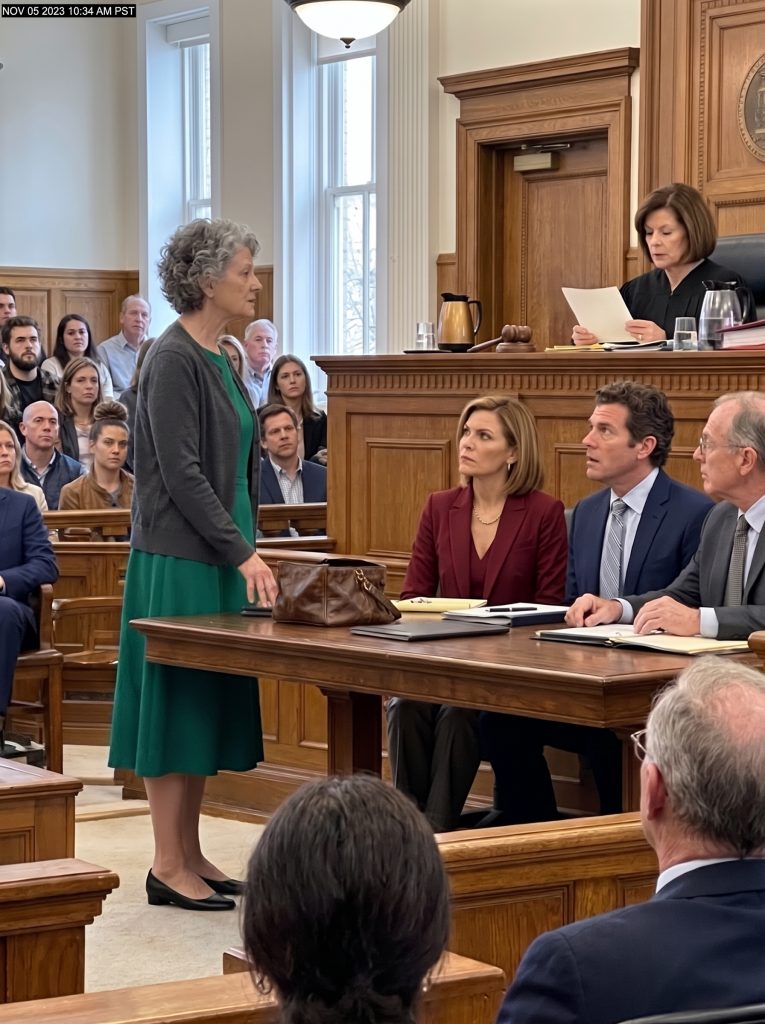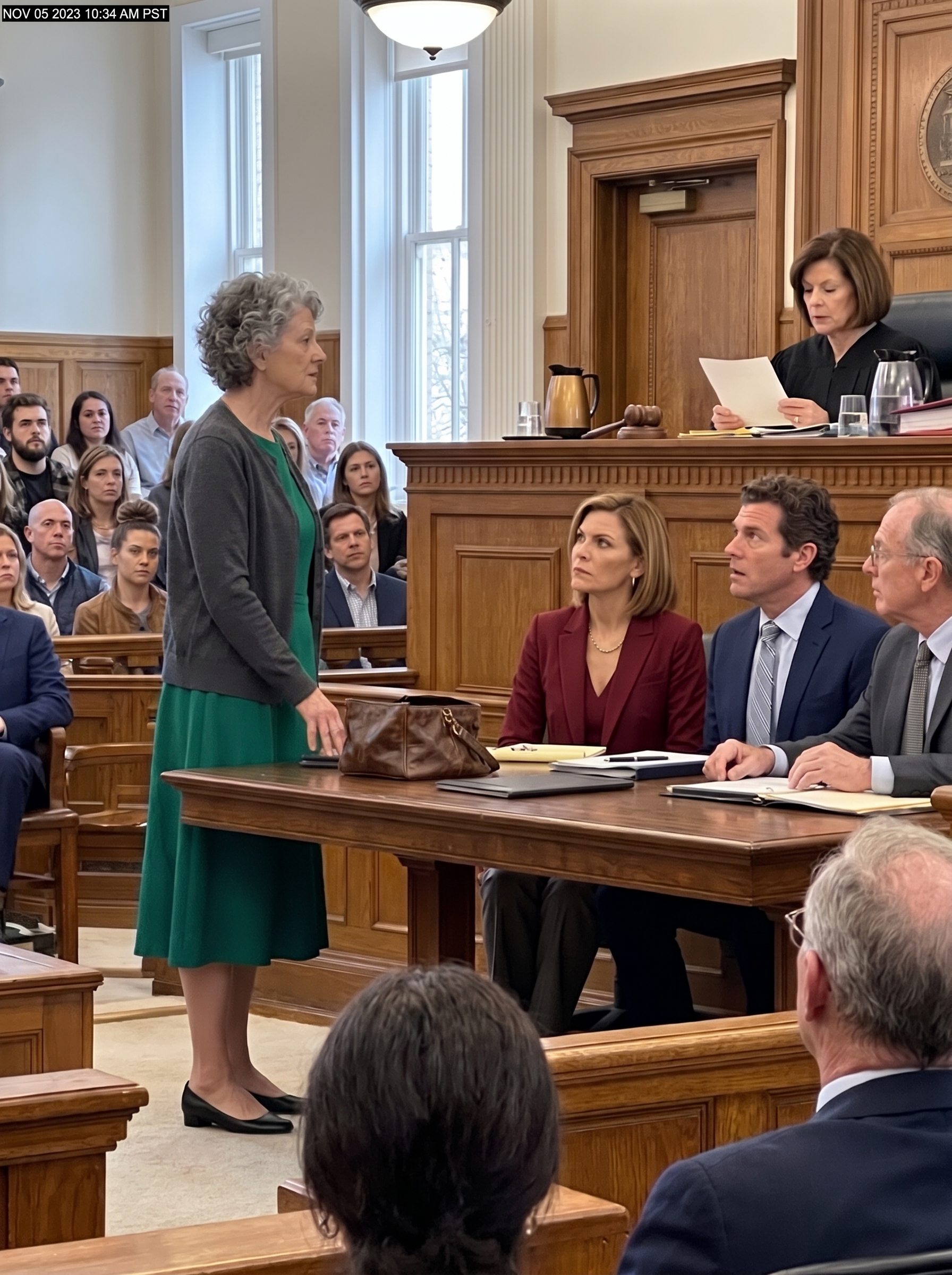
They laughed when I walked into that courtroom.
Not loud. Not the kind of laugh that would get you
scolded by a bailiff. Just a little snicker, the kind
schoolchildren make at the back of a classroom when
the substitute teacher trips over her own bag.
My daughter, Patricia, sat at the plaintiff’s table in a
cream-colored designer suit. Her husband, Michael, sat
beside her in charcoal gray, with a tie that probably cost
more than my first car. When they saw me come through
those heavy wooden doors, shuffling a little, my old brown
handbag hanging from my elbow and my sensible shoes
squeaking on the polished floor, they looked at each other and smirked.
Michael leaned over to the man sitting behind him in the gallery.
He said something I couldn’t hear. The man covered his mouth with his hand.
I knew exactly what the joke was. Look at her. The confused
old lady thinks she can defend herself.
I walked down the center aisle without hurrying. I sat down
at the defendant’s table. Alone. No attorney beside me. No
briefcase. No stack of binders with colored tabs. Just me, my
handbag, and a yellow legal pad I took out and placed squarely in front of me.
Across the aisle, Patricia’s lawyer, James Morrison, glanced
over and gave me the kind of smile you give a lost tourist. Pleasant. Pitying. A little bored.
I smiled back.
My name is Dorothy Hamilton. Six months ago, my husband
Robert passed away and left me everything. Every penny of his
fortune. Every investment, every property, every share of his
company. An estate worth about $62 million.
He left our daughter a family photograph and his wristwatch.
And so, my only child was suing me. She claimed I had forged
my husband’s will. She claimed I was suffering from dementia.
She claimed I had been manipulated by some unnamed parties
into stealing her inheritance, and that I was a danger to myself
with my “irrational financial decisions.”
She wanted the court to declare me incompetent. She wanted
a conservator appointed over my money. And she had already
decided who that conservator should be.
Her husband.
How else, after all, could a simple housewife end up with $62 million?
I sat there with my hands folded on the legal pad and watched my
daughter whisper with her lawyer. She looked so confident. So
prepared. She had no idea that her simple housewife mother
had been reading legal briefs since before she was born.
The bailiff stood up. “All rise.”
The door behind the bench opened, and Judge Margaret Walsh came in. She was a tall woman with silver hair cut short and sharp blue eyes behind rimless glasses.
She took two steps toward her chair. Then she saw me.
Her step faltered. Just slightly. Just for half a second. Our eyes met across the courtroom, and I saw something flicker behind those glasses. Recognition. Surprise. And something that looked very much like the beginning of a smile.
Patricia noticed nothing. She was too busy whispering to Morrison about their slam-dunk case against the incompetent old woman.
But I’m getting ahead of myself.
Because the real story didn’t begin the day we walked into that courtroom. It began the day Robert died.
I was holding his hand when he passed, just like I’d held it for thirty-five years of marriage.
The doctors had given us six months. Robert only lasted three. Cancer doesn’t care about your money or your plans or how many people need you. It just takes.
Near the end, he could barely lift his head off the pillow. But one evening, while the nurse was out of the room, he squeezed my fingers with a strength that surprised me.
“Dorothy,” he whispered.
“I’m here.”
“They’re going to come for you.”
I didn’t have to ask who. I knew.
“They think you don’t know anything,” he said. His breath rattled. “But I made sure you’d be protected. Everything is yours. Just like we discussed.”
“Hush,” I said, and I kissed his forehead. “I’ll be fine. You know I’ll be fine.”
He smiled a little. “I know. That’s why I’m not worried about you. I’m worried about them.”
Robert knew me better than anyone. Better than our daughter ever did. He died two days later, on a gray Thursday morning, with the radio playing softly and the window cracked open so he could smell the rain.
The reading of the will happened two weeks later in the downtown office of Harold Greene, Robert’s estate attorney of nearly twenty years.
Patricia arrived dressed head to toe in black, a travel pack of tissues already in her hand. She dabbed at her eyes in the elevator. She dabbed at them again in the waiting room. She was playing the grieving daughter perfectly.
Michael walked beside her with one hand on her back. He kept checking his phone. Once, I glanced at his screen and saw a real estate listing. A lake house in New Hampshire. $2.4 million.
He was already spending it.
Harold Greene’s conference room smelled of leather chairs and old coffee. Harold sat at the head of the long table with a thick folder in front of him. He was in his seventies, with bushy white eyebrows and the patient face of a man who had watched many families come apart in that room.
He put on his reading glasses and opened the folder.
“This is the Last Will and Testament of Robert James Hamilton,” he said. “Executed on March 9th of last year, witnessed by three individuals and notarized in this office.”
Patricia sniffed loudly.
“‘To my beloved wife, Dorothy Hamilton,’” Harold read, “‘I leave my entire estate, including all real property, investments, bank and brokerage accounts, retirement accounts, and business holdings, valued at approximately $62 million.’”
The silence in that room was so complete I could hear the clock ticking on the wall.
Patricia’s tissue pack slipped out of her fingers and fell to the carpet.
“That’s impossible,” she said. Her voice was shaking. “That’s not right. Daddy promised me the house on Martha’s Vineyard. He told me I’d inherit the business.”
Harold turned a page without looking up.
“‘To my daughter, Patricia Hamilton Brooks, I leave the framed family photograph that hangs in my study, and my Omega wristwatch.’” He paused. “‘To my son-in-law, Michael Brooks, I leave my golf clubs.’”
Michael made a sound like someone had stepped on his foot.
I watched my daughter’s face change. Grief to disbelief. Disbelief to fury. It took about four seconds.
“This isn’t right,” Patricia said, standing up so fast her chair rolled back into the wall. “Mom doesn’t know the first thing about managing money. She’ll lose everything within a year.”
Michael’s voice was harder, colder. “We need to see those documents. All of them. This has to be some kind of mistake.”
“There’s no mistake, Mr. Brooks,” Harold said quietly. “Robert reviewed this will with me personally. Twice. The signatures were witnessed by my paralegal, by my associate, and by Robert’s longtime physician, Dr. Elaine Foster, who confirmed in writing that he was of sound mind. Our notary, Janet Kowalski, notarized it the same afternoon.”
“Then someone got to him,” Michael snapped. “He was sick. He was on medication.”
“He signed it eight months before his diagnosis,” Harold said.
That shut Michael up. For a moment.
There was no mistake. Robert had been planning this for years. He updated his will every time Patricia showed him who she really was.
Like the time she borrowed $20,000 for a kitchen renovation and never paid back a dime. Robert had written her a check from our joint checking account, and she’d hugged him and said, “I’ll have it back to you by Christmas, Daddy.” That was six Christmases ago.
Or the night of Michael’s promotion party, when I brought a big pan of my pot roast and a basket of homemade rolls. Patricia laughed in front of all of Michael’s colleagues and said, “Mom always brings peasant food. It’s kind of her thing.” And everybody laughed with her.
Robert didn’t laugh. He set down his drink and walked out to the car. He waited for me there for an hour.
He saw how they treated me. How they took me for granted. How they saw me as weak and useless and undeserving of respect. And he decided, quietly, the way Robert decided everything, that they were not going to be rewarded for it.
After we left Harold’s office, Patricia and Michael followed me home.
They sat in my living room. The same room where I’d helped Patricia with her math homework at the coffee table. The same room where we’d celebrated her college acceptance with a cake shaped like a graduation cap. The same room where I’d held her when her first boyfriend broke her heart.
Now she sat on the edge of the sofa like a car salesman.
“Mom,” she said, and her voice was honey-sweet now. “Be reasonable. You can’t possibly manage all this money alone. Why don’t you let Michael help you? He’s very good with finances.”
Michael nodded eagerly. “We could set up a trust. I’d be the trustee. Make sure everything’s handled properly. You’d never have to worry about any of it.”
I poured myself a cup of tea. My hands were perfectly steady.
“I appreciate your concern,” I said. “But I’m perfectly capable of managing my own affairs.”
“Are you, though?” Patricia’s mask slipped. “Mom, you’ve never even balanced a checkbook. Daddy handled everything.”
I took a sip of tea and looked at my daughter over the rim of the cup.
That’s when I realized what they were really planning.
The lawsuit arrived on a Tuesday morning, three weeks later.
A young process server rang my doorbell at 8:15. He was maybe twenty-five, in a wrinkled windbreaker, and when I opened the door in my bathrobe with my reading glasses on a chain around my neck, his face turned bright pink.
“Are you Dorothy Hamilton?” he asked.
“I am.”
He held out a thick envelope. “Ma’am, you’ve been served. I’m, uh, I’m really sorry.”
“Don’t be sorry, young man,” I said. “It’s your job. Would you like a muffin? They’re blueberry.”
He looked like he might cry. He took the muffin.
Patricia had wasted no time.
I sat at the kitchen table and read every page while my coffee went cold. The petition had been filed in the Probate and Family Court. It asked the court to appoint a conservator over my finances. It asked the court to order a full competency evaluation. And it asked the court to set aside Robert’s will on the grounds of fraud and undue influence.
According to these documents, I was suffering from dementia. I had been manipulated by unknown parties into forging my husband’s will. And I was a danger to myself because of my irrational financial decisions.
The evidence they’d collected was almost impressive in its creativity.
They had found a gas station receipt from the day I got lost driving to Patricia’s house last year. Clearly a sign of cognitive decline. Not, say, the road construction on Route 9 that rerouted traffic through three towns I’d never driven through before.
They documented my inability to operate modern technology, because I’d once asked Patricia’s teenage daughter, my granddaughter Emma, to help me set up Netflix on the new television.
And the most damaging piece of all was a sworn affidavit from Michael. It said I had become “increasingly paranoid and secretive about finances” and had “refused helpful guidance” in managing Robert’s estate.
Helpful guidance. That’s what he called trying to make himself trustee of $62 million.
My phone rang within the hour. Patricia’s name lit up the screen.
“Mom,” she said. “I’m so sorry you had to find out this way.”
She didn’t sound sorry. She sounded like a woman reading from a script she’d practiced in the car.
“We tried to talk to you reasonably,” she went on. “But you’re just not capable of handling this kind of responsibility. You know that, deep down.”
“I see,” I said calmly.
“The good news is, once the court declares you incompetent, Michael and I can take care of everything. You’ll get a nice allowance every month. Enough for your needs. And you won’t have to worry about all those complicated investments and business decisions anymore.”
Out the kitchen window, a bright red cardinal landed on my bird feeder. Robert always said cardinals brought good luck. I watched it pick through the sunflower seeds.
“And where exactly would I be living,” I asked, “during this arrangement?”
There was a pause.
“Well,” Patricia said, “the Martha’s Vineyard house would be perfect for you. It’s smaller. Easier to maintain. And Michael and I would take the main house, of course, since we have more family obligations.”
Of course they would.
“Patricia,” I said. “Do you really believe I’m mentally incompetent?”
“Mom, it’s not about what I believe. It’s about reality. You married Daddy at twenty-five. You never had a career. You don’t understand business or law or money. This inheritance is just too much for someone with your background.”
Background.
As if thirty-five years of marriage and motherhood had erased everything I’d been before.
“I understand you’ve hired James Morrison to represent you,” I said.
“How did you—” She stopped herself. “See, Mom? This is exactly what I mean. You’re becoming paranoid. Suspicious. Snooping around. It isn’t healthy.”
“His name is on the petition, Patricia. Page fourteen. Right above his bar number.”
Silence.
“I have to go,” she said, and hung up.
That afternoon, I sat in Robert’s study, surrounded by his books and his framed awards and the leather chair that still held the shape of him.
On his desk was a photograph from our wedding day. Me in a plain white dress with no lace, because I thought lace was fussy. Robert in a rented tuxedo, looking at me like I held all the answers in the world.
Robert knew this day would come. He’d tried to warn me for years. He said Patricia and Michael saw our marriage as a business transaction, and that in their accounting, I had contributed nothing of value.
I opened the bottom drawer of his desk and took out the envelope.
He’d given it to me two years earlier, on a Sunday night after a particularly ugly dinner with Patricia and Michael. Michael had spent the whole meal asking Robert pointed questions about the company’s succession plan.
“When they come for you,” Robert had said, pressing the envelope into my hands, “and they will come for you, Dorothy, open this.”
I had put it in the drawer and never opened it. I had hoped I’d never need to.
Now I slid my thumb under the flap.
Inside was a single business card and a note in Robert’s slanting handwriting.
“Dorothy, call Margaret Walsh. She remembers you.”
The card read: Hon. Margaret Walsh. Probate and Family Court.
The name tugged at something deep in my memory. I couldn’t quite place it.
Not yet.
I decided to go see Patricia one more time before this turned into a war. Maybe, just maybe, I could make her understand what she was doing to our family.
I drove to her house on Saturday morning.
Their house was everything mine wasn’t. Modern, cold, and very impressive. Big glass windows. White walls. Furniture that looked like nobody had ever sat on it.
Robert and I had helped them buy it. We’d given them $85,000 toward the down payment as a wedding gift, back when Robert still thought Michael might grow up.
Patricia opened the door in yoga pants with her hair in a messy bun.
“Mom. What a surprise.” Her tone made it clear it wasn’t a pleasant one. “Michael’s at work.”
Good, I thought. This conversation needed to happen between a mother and her daughter.
I noticed she’d redecorated again since the funeral. New sectional sofa in pale gray velvet. A huge abstract painting over the fireplace, all slashes of orange and black. A glass coffee table with a single orchid on it.
All of it, I knew, paid for with money they’d “borrowed” from us over the years and never returned.
She made coffee in a machine that hissed like a cat. I accepted a cup more out of habit than desire.
“Patricia,” I said. “We need to talk about this lawsuit.”
“There’s nothing to talk about.” She sat down across from me and crossed her legs. “You’re sick, Mom. Even if you can’t see it. This is for your own protection.”
“I’m not sick, sweetheart. I’m grieving. I’m adjusting. But I’m not incompetent.”
She gave me a look that was half pity and half frustration.
“Mom. Yesterday you called me asking how to transfer money between your checking and your savings account. Last week, you couldn’t figure out how to pay your electric bill online. These aren’t normal aging issues.”
I studied my daughter’s face. Robert’s stubborn jaw. My own green eyes. The little scar on her chin from when she fell off her bicycle at seven and I carried her a quarter mile home.
When had she become so calculating?
“Patricia,” I said slowly. “What if I told you that I’ve been pretending?”
She blinked. “Pretending what?”
“Pretending to be helpless. Pretending to need help with things I understand perfectly well.”
For a moment, uncertainty flickered across her face. Then she shook her head and laughed.
“Mom, that doesn’t make any sense. Why on earth would you pretend to be confused?”
“Because people treat you differently when they think you’re weak,” I said. “They tell you things they’d never tell someone they considered a threat. They show you who they really are.”
Patricia’s laugh was sharp now.
“A threat? You? Mom, you’re almost seventy. You haven’t worked outside the home in thirty years. What kind of threat could you possibly be?”
I set down my coffee cup. I stood up and smoothed the front of my skirt.
“The kind you’re about to find out about.”
“What’s that supposed to mean?”
I walked to the front door. I put my hand on the heavy brass handle. Robert had admired that handle the day we toured this house with them. “Now that’s craftsmanship,” he’d said.
“It means, Patricia, that you and Michael have made a very serious miscalculation about who you’re dealing with.”
“Mom, you’re scaring me. This paranoid talk is exactly why we filed the petition.”
I turned back to her one last time.
“I love you, Patricia. I always will. But I will not let you or anyone else steal what your father spent his entire life building.”
I closed the door gently behind me.
Driving home, I felt something I hadn’t felt in years. Not fear. Not sadness. Something closer to anticipation. The old hum in my chest, the one I used to feel the night before a big trial.
Patricia thought she was hunting a rabbit.
She was about to discover she’d cornered a wolf.
That evening, I made the phone call I’d been putting off.
I sat in Robert’s chair with the business card in my hand and dialed. It rang twice.
“Judge Walsh’s chambers.”
“This is Dorothy Hamilton,” I said. “I’d like to speak with Margaret, if she has a moment. It concerns a case that’s coming before her court.”
There was a pause on the line.
“Dorothy Hamilton,” the clerk repeated. “As in Dorothy Mitchell Hamilton?”
“Yes.”
“Please hold.”
The hold music was something classical. Vivaldi, I think. It played for almost two full minutes.
Then the music clicked off, and a voice came on the line. Older now. Rougher around the edges. But I knew it instantly. The memory came rushing back all at once, like a window flying open in a storm.
“Dorothy? My God. Is it really you?”
“Margaret,” I said, and forty years of memories flooded in. “It’s really me. Dorothy Mitchell.”
“I should have realized it when I saw the docket,” Margaret said. “Brooks versus Hamilton. Your daughter is suing you?”
I could hear the disbelief in her voice.
Margaret Walsh had been Margaret O’Brien when I knew her. We were in law school together at Harvard. We studied together in the basement of the library until the janitors kicked us out. We competed against each other in moot court. We graduated in the same class in 1982.
She had red hair back then, and a temper to match, and she used to chew on her pencils until they splintered.
“She thinks I’m an incompetent old woman who stumbled into a fortune,” I said. “She has no idea who I used to be.”
Margaret laughed. It was the same laugh from forty years ago, a big, unladylike bark that used to get us shushed by librarians.
“Dorothy ‘The Destroyer’ Mitchell? Incompetent? Oh, that’s rich. Do you remember the Heartwell case? You took apart three expert witnesses in a single afternoon. The other side’s lawyer went out to the parking lot and threw up.”
I did remember. The Heartwell fraud case had been the biggest of my career. A pension fund manager who’d siphoned $11 million out of a union retirement fund, and the three accounting experts he’d paid to swear the money was simply “misallocated.” I’d had the bank records. I’d had the wire transfers. I’d had the dates. By four o’clock, the jury had stopped looking at the experts at all.
That was the last big case before I met Robert. Before Patricia. Before I became just Mom.
“Margaret,” I said, “I need to ask you something important. Can you ethically hear this case, given our history? I won’t put you in a bad position.”
She was quiet for a moment. I could almost hear her thinking.
“We were classmates, Dorothy. Colleagues once, a long time ago. Not close friends, and we haven’t spoken in more than thirty years. I’ll put our history on the record at the first hearing so both sides know. If their lawyer wants to ask me to step aside, he can. But if you’re planning what I think you’re planning—”
“I’m not planning anything,” I said, “except defending myself against false accusations.”
“With an attorney, I hope.”
I looked at Robert’s photo on the mantel.
“I’ll be representing myself.”
The line went very quiet.
“Dorothy,” she said carefully. “You’ve been out of practice for thirty years. The law has changed. The procedures have changed. Are you absolutely sure you want to do this?”
“I’ve kept my license active the whole time,” I said. “I’ve paid my dues every single year. I’ve done my continuing education credits. I read the advance sheets. I follow the appellate decisions. Old habits die hard, Margaret.”
“Your daughter’s attorney is James Morrison. He’s good. Very experienced in elder law.”
“I know.” I had been researching him since the morning the process server came. “He’s won about eighty percent of his competency cases. He specializes in families who want to put elderly relatives under conservatorship so they can take control of their assets.”
“Then you know what you’re walking into.”
I stood up and walked across Robert’s study to my own bookshelf in the corner. It was full of law books I’d never had the heart to give away. Casebooks from law school, their margins crowded with my notes. Old treatises on evidence and fraud. Three decades of bar journals.
“Margaret,” I said. “Do you remember what Professor Williams used to tell us?”
She didn’t even hesitate.
“Never let them see you coming.”
“Exactly.”
After we hung up, I spent the whole evening going through my old files. Cases I’d won. Strategies I’d used. The methodical preparation that had made me one of the most feared trial attorneys in Boston before I walked away.
Patricia thought she was dealing with a helpless widow.
Soon she would find out she was facing Dorothy Mitchell. The woman who’d voluntarily put down her briefcase to raise her daughter, only to have that same daughter try to destroy her.
I pulled a fresh yellow legal pad from the drawer and uncapped a pen.
The process of building a defense came back to me like riding a bicycle. My hand moved across the page faster than I could think.
Patricia’s entire case rested on one assumption. That I was mentally incompetent.
But competency isn’t about age. It isn’t about being confused by Netflix or getting lost in a construction detour. It’s about whether you understand the nature and consequences of your own decisions.
And I understood exactly what I was doing.
Then I found it. Morrison’s mistake.
He had painted me as a victim of manipulation, claiming unknown parties had influenced me to forge Robert’s will. But he’d never named a single one of these mysterious manipulators. Not one.
And Robert’s will had been witnessed by three people and notarized. Harold Greene had already had the signatures verified by a forensic document examiner when Patricia first started making noise. The report was sitting in the estate file.
So where was this alleged forgery?
I smiled and underlined the word twice on my legal pad.
Morrison was fishing. He was hoping I’d panic and settle. He was counting on me being overwhelmed by legal procedures and frightened into handing over half the estate just to make the nightmare stop.
I wrote one more line at the bottom of the page.
He has no medical evidence.
In Massachusetts, you can’t put someone under conservatorship on a hunch. A petition like that needs a medical certificate, signed by a doctor who has actually examined the person. I had pulled the court file the week before. Patricia’s petition had been filed without one. Morrison had asked the court for permission to get an evaluation later, claiming I’d refused to cooperate.
I had never been asked.
The morning of our first hearing, I dressed carefully.
Not in a tailored suit. Not in my good pearls. I put on my old navy blue dress, the one with the little white buttons. I put on my sensible black shoes with the rubber soles. I took my old brown handbag, the one with the cracked strap I’d repaired with a safety pin.
Let them see exactly what they expected to see.
Patricia and Michael arrived at the courthouse looking confident and well-rested. Morrison had obviously told them this would be a simple hearing. A formality. A quick stop on the way to a competency evaluation and a signed conservatorship order.
And that’s how I came to be sitting alone at the defendant’s table, listening to my daughter snicker, while Judge Margaret Walsh stopped mid-step and looked at me like she’d seen a ghost.
Margaret took her seat. She cleared her throat and looked at both tables over her glasses.
“Before we begin,” she said, “I want to make a disclosure for the record. Mrs. Hamilton and I attended law school together more than forty years ago. We have not spoken in over three decades. I don’t believe this affects my ability to be impartial, but if counsel for the petitioner wishes to raise an objection, now is the time.”
Morrison looked at me. He looked at the judge. He looked back at me, at my handbag with its safety pin, at my rubber-soled shoes.
I could see exactly what he was thinking. Law school? This woman? She must mean the old lady took a class once. Maybe she was a secretary in the dean’s office.
“No objection, Your Honor,” Morrison said with a little chuckle. “I’m sure it was a long time ago.”
“It was,” Margaret said. “Proceed.”
Patricia leaned over and whispered something to Michael. I caught the word “secretary.” Michael snorted.
Morrison stood up and buttoned his jacket.
“Your Honor, this is a straightforward case of financial elder abuse and potential fraud. Mrs. Hamilton, the respondent, has been left a substantial inheritance under highly questionable circumstances.”
I folded my hands and listened as he painted his picture of me.
Confused. Vulnerable. Easily manipulated. A woman who had been a homemaker her entire adult life, who had never held a job, who had no understanding of money, and who had somehow, mysteriously, ended up controlling a $62 million estate while her only child was left with a wristwatch.
“The petitioner requests an immediate competency evaluation,” Morrison said, “and the appointment of a temporary conservator to protect Mrs. Hamilton’s assets from further mismanagement. The petitioner respectfully suggests her husband, Mr. Michael Brooks, a financial professional, as a suitable temporary conservator.”
He sat down.
Margaret looked at me.
“Mrs. Hamilton. You’re representing yourself in this matter?”
I stood up slowly. I let my hand rest on the table for balance, the way an old woman would.
“Yes, Your Honor,” I said. “I couldn’t afford an attorney.”
Patricia actually smirked at that one. Sixty-two million dollars, and her mother couldn’t afford a lawyer.
“Do you understand the nature of these proceedings?” Margaret asked.
“I believe so, Your Honor. My daughter thinks I’m not smart enough to manage money.”
Morrison was on his feet. “Objection, Your Honor. That oversimplifies serious allegations of mental incompetence and fraud.”
“Sustained,” Margaret said. “Mrs. Hamilton, do you understand that the court is being asked to decide whether you have the mental capacity to manage your own financial affairs?”
“Yes, Your Honor.”
“And do you wish to contest these allegations?”
For the first time that morning, I looked directly at my daughter.
“Yes, Your Honor,” I said. “I do.”
Margaret wrote something down.
“Mr. Morrison, I’ve reviewed your petition. You’re alleging that Mrs. Hamilton forged her late husband’s will?”
“Not exactly forged, Your Honor,” Morrison said smoothly. “We believe she was manipulated into believing she was entitled to an inheritance that should rightfully go to the child.”
“I see. And you have evidence of this manipulation?”
Morrison hesitated. It was small. Most people wouldn’t have noticed. I noticed.
“We believe the evidence will emerge during the competency evaluation, Your Honor.”
I raised my hand a little, like a schoolgirl.
“Your Honor, may I ask a question?”
Margaret nodded. “Go ahead.”
I turned to Morrison.
“Mr. Morrison, you say I was manipulated into forging my husband’s will. But the will was properly witnessed by three people, including my husband’s own physician. It was notarized. And the estate’s attorney already had the signatures examined by a forensic document examiner, whose report is in the probate file. Are you suggesting that the witnesses, the doctor, the notary, and the handwriting expert were all manipulated, too?”
Morrison’s face tightened with annoyance.
“Your Honor, Mrs. Hamilton lacks the legal knowledge to understand the complexities of this case.”
“Actually,” I said quietly, “I understand it perfectly. You’re hoping this court will declare me incompetent based on my age and the fact that I’m a woman who stayed home with her child. Without any actual evidence of mental incapacity. Without any evidence of fraud. Isn’t that right, Mr. Morrison?”
The courtroom went very quiet.
Patricia was staring at me with wide eyes.
“Furthermore,” I went on, “you filed a petition for conservatorship without a medical certificate. No doctor has examined me. No doctor has signed anything. You told this court I refused to cooperate with an evaluation, but no one ever asked me to have one. Not you, not my daughter, not anyone. You have character testimony and speculation. That’s all you have.”
Morrison shot to his feet. “Objection, Your Honor! Mrs. Hamilton is clearly being coached!”
Margaret raised one silver eyebrow.
“By whom, Mr. Morrison?” she asked. “She’s sitting there alone.”
That was the moment I decided to stop pretending.
I straightened my shoulders. I lifted my chin. I let thirty years of careful pretense fall away like an old coat sliding off onto the floor.
“Your Honor,” I said, in a voice I hadn’t used since 1993, “I’d like to present my credentials to the court.”
I reached into my cracked brown handbag and took out a small laminated card. I walked to the clerk and handed it to her. She passed it up to the bench.
Margaret read it aloud for the record.
“Dorothy Mitchell Hamilton. Licensed to practice law in the Commonwealth of Massachusetts since 1982. Status: active. In good standing.”
The silence in that courtroom was deafening.
Patricia’s mouth fell open. Michael grabbed her arm so hard she flinched, and he started whispering into her ear.
James Morrison looked like he’d been slapped across the face with a wet fish.
Margaret examined the card with a perfectly neutral expression, though I could see the corner of her mouth trying very hard not to move.
“Mrs. Hamilton,” she said, “why didn’t you mention your legal background earlier in this proceeding?”
“Because, Your Honor,” I said, “I wanted to see exactly what accusations Mr. Morrison would make against someone he assumed knew nothing about the law.”
I turned and faced Morrison directly.
“You’ve spent the last twenty minutes arguing that I lack the mental capacity to understand simple financial matters. You never once bothered to look me up. My name has been in the Board of Bar Overseers registry for forty-four years, Mr. Morrison. It took me eleven seconds to find yours.”
Morrison finally found his voice.
“Your Honor, this changes nothing. Mrs. Hamilton hasn’t practiced law in decades. She has clearly been manipulated.”
“By whom?” I asked. “My dead husband? You keep mentioning these mysterious manipulators. You’ve never named a single one.”
I stepped out from behind the table and walked to the center of the courtroom. My rubber soles squeaked on the floor. I didn’t care anymore.
The old confidence was flooding back into me like warm water.
“Your Honor, before I married, I practiced criminal defense for years. I specialized in complex financial fraud. Pension theft. Embezzlement. Forged documents. I understand estate planning, trust law, and financial management better than most people in this room.”
Patricia’s voice came out small and shaky.
“Mom. You never told me you were a lawyer.”
I looked at my daughter. I felt a terrible mix of sadness and disappointment.
“You never asked, Patricia. In thirty-three years, you never once asked me about my life before I married your father.”
She opened her mouth. Nothing came out.
Morrison was scrambling now, flipping through his papers.
“Your Honor, regardless of Mrs. Hamilton’s past career, the evidence shows recent signs of cognitive decline—”
“What evidence?” I said. “That I asked my granddaughter to help me with Netflix? That I got lost on Route 9 the month they closed the bridge and sent everyone through Framingham?”
A few people in the gallery chuckled.
“Mr. Morrison, if technical difficulties and a bad detour are signs of dementia, then half the population over fifty should be under conservatorship. Including, I suspect, a few people in this courtroom.”
More chuckles. Margaret tapped her gavel lightly, but she didn’t look upset.
She leaned forward. “Mr. Morrison. Do you have any medical evidence of mental incapacity? Anything from a physician? Anything at all?”
“We request a full neurological evaluation, Your Honor.”
“Based on what medical grounds?”
Morrison shuffled his papers again. He was clearly unprepared for this.
“Based on behavioral observations from family members.”
I almost laughed out loud.
“Your Honor, my daughter observed me asking for help with tasks I could do in my sleep. After my husband’s death, I wanted to see how my family would treat someone they believed was helpless.”
“And what did you discover, Mrs. Hamilton?” Margaret asked.
I looked straight at Patricia. I saw the hurt and confusion in her eyes, and it nearly broke me. But I said it anyway.
“I discovered that my own daughter sees me as an obstacle standing between her and an inheritance. Not as a person who deserves respect.”
Morrison made one last desperate attempt.
“Your Honor, Mrs. Hamilton clearly orchestrated this entire scenario to make her daughter look greedy!”
Margaret’s expression went cold.
“Mr. Morrison,” she said slowly, “are you suggesting that Mrs. Hamilton tricked your client into filing a lawsuit against her own mother? Because that’s an interesting argument for your side to be making.”
Morrison opened his mouth. Then he closed it.
The trap was closing, and he’d walked right into it.
“We’ll take a twenty-minute recess,” Margaret said, and banged the gavel.
During the recess, I stood by the window in the hallway and watched Patricia, Michael, and Morrison huddled together near the elevators.
Patricia kept glancing over at me. Her face was a mixture of shock and something that looked a lot like fear.
Michael was pacing back and forth with his phone pressed to his ear. His voice carried down the marble hallway in pieces.
“Much more complicated than we thought—”
“No, she’s actually a lawyer—”
“We need to reassess our whole position—”
They had built their entire case on one belief. That I was a simple housewife who had stumbled into wealth by accident. Now they were scrambling to understand who they were really dealing with.
After about ten minutes, Morrison broke away from the huddle and walked over to me. His earlier swagger was gone. In its place was a careful, cautious respect.
“Mrs. Hamilton,” he said. “Perhaps we could discuss a settlement.”
“What kind of settlement, Mr. Morrison?”
He cleared his throat. “My client is willing to withdraw the conservatorship petition in exchange for a more equitable distribution of the estate. Say, the Martha’s Vineyard property and a cash payment of fifteen million. It would save everyone a great deal of time and expense.”
I almost smiled.
“You mean Patricia still wants her inheritance after all. Even after telling the court her mother is too senile to tie her shoes.”
“Mrs. Hamilton, surely you can understand your daughter’s position. She expected to inherit something significant from her father.”
“Mr. Morrison,” I said, “my daughter did inherit something significant from her father. A loving home. An excellent education, paid for in full. A down payment on her house. More than two hundred thousand dollars in loans that nobody ever asked her to repay. Every opportunity a person could want. The fact that she took all of it for granted doesn’t entitle her to his money.”
“But sixty-two million dollars is an enormous sum for one person to manage alone.”
I looked him in the eye.
“Are you questioning my mental capacity again, Mr. Morrison? Because I should warn you, that didn’t go very well for you in there.”
His professional mask slipped a little.
“I’ll be frank, Mrs. Hamilton. My clients are reconsidering their approach. They’d prefer to resolve this privately.”
“I’m sure they would.”
I picked up my handbag.
“But we’re past the point of a private resolution. Your clients made this public when they filed papers in a court of law saying I was mentally incompetent. They put it on the record. Now they can face the record.”
When court reconvened, Morrison asked for a continuance to reassess the evidence.
Margaret denied it flatly.
“Mr. Morrison, you filed this petition on an emergency basis. You told this court that Mrs. Hamilton’s assets were in immediate danger because of her mental state. You can’t now come back and tell me you need more time to figure out what your case is. Call your first witness.”
So Patricia took the stand.
I watched my daughter walk to the witness box. She looked smaller somehow. Her designer suit seemed too big for her. She raised her right hand and swore to tell the truth, and her hand was trembling.
“Mrs. Brooks,” Morrison began, “please describe your mother’s behavior following your father’s death.”
Patricia’s voice was uncertain.
“She seemed confused about financial matters. She asked me questions about banking. About investments. Things she’d never asked about before.”
“And did these questions concern you?”
“At the time, yes. But now I’m wondering if she—”
She stopped. She looked at me.
“If what, Mrs. Brooks?” Morrison prompted.
“If she was testing me,” Patricia said quietly. “Somehow.”
Morrison looked like he wanted to object to his own witness.
“Mrs. Brooks,” he said tightly, “do you still believe your mother lacks the capacity to manage her financial affairs?”
Patricia was quiet for a very long time. The whole courtroom waited.
When she finally answered, her voice was barely a whisper.
“I don’t know anymore.”
I could feel the foundation of their case crumbling in real time, like a sandcastle when the tide comes in.
Margaret adjourned for the day and ordered both sides back at nine the next morning.
That evening, Patricia called me at home.
I was sitting in Robert’s study when the phone rang. Her voice was different. Smaller. Younger. Like the little girl who used to crawl into my bed during thunderstorms and tuck her cold feet against my legs.
“Mom,” she said. “We need to talk.”
“I’m listening, Patricia.”
“Why didn’t you ever tell me? About being a lawyer? About Harvard? About any of it?”
I looked at the shelves of law books, their spines faded by thirty years of afternoon sun.
“Because when you were born, you became more important to me than any career,” I said. “I wanted to be your mother. Not your lawyer.”
“But you gave up everything for me.”
“No, sweetheart. I chose you. There’s a difference.”
She was crying now. I could hear her trying to catch her breath.
“I’m sorry, Mom. I’m so sorry. I thought—Michael said you didn’t understand money. He said you’d lose everything Daddy worked for. He said we had to protect it.”
“And you believed him,” I said gently, “because you wanted to believe him. It was easier to believe I was incompetent than to accept that your father made a conscious choice.”
“Why didn’t Daddy leave me anything?” Her voice cracked right down the middle. “What did I do wrong?”
The pain in her voice broke my heart. But she needed to hear the truth. She was thirty-three years old, and nobody had ever made her hear it.
“Patricia, your father loved you more than you will ever know. But he also saw how you and Michael treated money. You borrowed without paying back. You spent without thinking about tomorrow. The $20,000 for the kitchen. The $35,000 when Michael’s first business went under. The $48,000 to pay off your credit cards in 2021. He kept a ledger, sweetheart. Every check. Over two hundred thousand dollars. He knew that handing you millions would only make it worse.”
“So he punished me by giving it all to you?”
“He trusted me to make the right decisions about our family’s future. Including decisions about you and Michael.”
There was a long pause.
“What does that mean?”
“It means the money was never the point, Patricia. The point was teaching you that love isn’t measured in dollars. And that respect isn’t optional just because someone seems vulnerable.”
She sniffled. “Mom, can we fix this? Can we drop the lawsuit and just start over?”
I closed my eyes. I suddenly felt very, very tired.
“Patricia, tomorrow morning, Michael is going to ask you to keep fighting. He’s going to tell you I manipulated this whole thing. He’s going to tell you I made you look like a fool on purpose.”
“How do you know that?”
“Because I’ve been watching him for seven years. Michael sees dollar signs, not family. The only question is what you’re going to choose.”
The line went quiet, except for my daughter’s soft crying.
“I love you, Mom,” she whispered.
“I love you too, sweetheart. But love isn’t enough anymore. We need respect. Honesty. Trust. Until you’re ready to give me those things, we can’t move forward.”
After I hung up, I sat in the dark for a long time. I wondered if I’d been too harsh.
But thirty years of quietly enabling Patricia’s entitlement had led us straight to a courtroom. Sometimes love means drawing a line, even when it hurts to hold the pen.
The next morning brought a surprise.
Patricia arrived at the courthouse alone. She looked exhausted. Her eyes were swollen, and she was wearing yesterday’s suit with a different blouse. She sat down at the plaintiff’s table and stared straight ahead.
Michael walked in twenty minutes later.
He was not with Morrison. He was with a new lawyer. Someone younger, sharper, with slicked-back hair and a very expensive briefcase.
He’d escalated instead of backing down. Exactly as I’d predicted.
The new attorney introduced himself to the clerk as David Chen. Before Margaret had even settled into her chair, he asked for a sidebar.
I couldn’t hear what was said at the bench. But I could see Morrison standing off to the side looking deeply uncomfortable, and I could see Chen gesturing with both hands like a conductor leading an orchestra.
When they came back, Chen had a brand-new theory.
“Your Honor, we are amending our petition,” he announced. “We now allege that Mrs. Hamilton deliberately deceived her family about her mental state in order to manipulate them into filing this lawsuit. That pattern of deception proves she is unfit to manage an estate of this size.”
It was clever, in a twisted kind of way. Yesterday, I was too foolish to manage my money. Today, I was too cunning to be trusted with it.
Margaret looked at him over her glasses.
“Mr. Chen. Let me make sure I understand. You’re now arguing that Mrs. Hamilton is mentally unfit, and also clever enough to have engineered an elaborate legal trap. At the same time.”
“We’re arguing that her behavior shows a concerning disconnect from reality and from healthy family relationships, Your Honor.”
I stood up.
“Your Honor, may I respond?”
“Proceed, Mrs. Hamilton.”
“Mr. Chen appears to be arguing that defending myself against false accusations proves I’m unfit to defend myself,” I said. “That’s circular logic at its very finest. If I’d lost yesterday, I’d be incompetent. Because I won, I’m dangerous. There’s no version of this where I’m allowed to keep my own money.”
Chen shot back immediately.
“Mrs. Hamilton deliberately misled her family about her abilities and then used their natural concern against them.”
“Natural concern?” I let my voice fill the room. “Mr. Chen, my daughter and son-in-law did not express concern for my well-being. They expressed concern for their inheritance. There is a very big difference.”
I turned toward Patricia. She flinched.
“If Patricia had called me and said, ‘Mom, I’m worried about you. Can I take you to see Dr. Foster for a checkup?’ That would have been concern. If she’d said, ‘Mom, would you like help organizing Dad’s paperwork?’ That would have been support.”
I turned back to Chen.
“Instead, she filed legal papers asking a court to take away my rights. Without ever talking to my doctor. Without talking to my friends, my neighbors, my banker, or anyone else who sees me on a regular basis. And without ever once asking me to see a physician.”
Margaret nodded slightly.
“Mr. Chen, do you have any medical evidence of mental unfitness?”
“We have family testimony about concerning behaviors, Your Honor.”
“Behaviors that Mrs. Hamilton has explained, under oath, were deliberate tests of her family’s character.”
“Mrs. Hamilton’s own testimony proves she is manipulative and deceptive,” Chen insisted.
“Or intelligent and cautious,” Margaret said dryly.
I could see the exact moment Chen realized his brand-new strategy was blowing up in his face. Patricia was staring at the floor. Michael’s face had turned a deep, blotchy red.
That’s when I decided it was time.
“Your Honor,” I said. “I’d like to present additional evidence to the court.”
I reached into my cracked brown handbag and pulled out a thick manila folder. I’d been carrying it since the first day.
“These are financial records,” I said. “Canceled checks from our joint account. Wire transfer confirmations from our bank. And my husband’s own handwritten ledger, which he kept in his desk for seven years. Together, they show every dollar Patricia and Michael borrowed from Robert and me during their marriage.”
Chen jumped to his feet. “Objection! Your Honor, this evidence was never disclosed!”
Margaret looked almost amused.
“Mr. Chen, you amended your petition this morning with an entirely new theory of the case. Mrs. Hamilton is entitled to respond to it. Overruled. I’ll look at the documents.”
I handed copies to the clerk, and she passed them up to the bench and over to Chen.
“Your Honor, the total comes to $214,600,” I said. “Not one dollar of it was ever repaid. The kitchen renovation. A failed business venture of Mr. Brooks’s. Credit card debt. A car. Two years of private school tuition for my granddaughter, which I’m glad we paid. And a $40,000 ‘bridge loan’ last year that was supposed to cover a single month.”
Patricia’s face had gone white as paper. Michael grabbed her arm and whispered something urgent.
“And there’s one more thing, Your Honor,” I said.
I took a small digital voice recorder out of my bag. It was the little device I’d used for years to save the messages off my home answering machine. Robert used to tease me about it. “Who saves voicemails?” he’d say.
A lawyer does.
“Five weeks ago,” I said, “on October 12th, at 9:41 in the evening, my son-in-law called my home phone. He left a short message about picking up some of Robert’s golf clubs. But he didn’t hang up properly. My answering machine kept recording for another four minutes and thirty seconds. It recorded a conversation between Michael and my daughter in their car.”
The courtroom erupted.
Chen was shouting objections. Michael was on his feet. Patricia looked like she was about to faint.
Margaret banged her gavel twice. “Order! Order in this court! Mr. Chen, I’ll hear your objection. Calmly.”
“Your Honor, that recording was made without my client’s knowledge or consent! It’s inadmissible!”
I didn’t raise my voice.
“Your Honor, I didn’t record anyone in secret. I didn’t hide a device in anyone’s car. I didn’t call anyone. Mr. Brooks dialed my telephone number and spoke into my answering machine. I’ll let the court decide what weight it deserves, and I have the phone company’s call log showing the call came from Mr. Brooks’s cell phone. But I didn’t set anything up. Mr. Brooks did that all by himself.”
Margaret looked at the call log the clerk handed up. She looked at Chen.
“I’ll listen to it outside the presence of anyone but counsel first,” she said. “Then I’ll rule.”
She called Chen and me into chambers. Morrison came, too, looking like a man who wished he were anywhere else.
Margaret pressed play.
First came Michael’s voice, cheerful and fake. “Hey, Dorothy, it’s Michael. Just wanted to swing by this weekend and grab those golf clubs. Talk soon.”
Then a rustle. The sound of a car’s turn signal clicking.
Then Patricia’s voice, muffled but clear. “Did you hang up?”
“Yeah, yeah,” Michael said. “God, I hate talking to her. That sweet little old lady voice.”
“She’s my mother, Michael.”
“She’s a fossil sitting on sixty-two million dollars that should be ours. Look, Morrison says it’s a slam dunk. She can’t work her own TV. We file, we get the conservatorship, I’m the conservator, and that’s it. Once the old bat is declared incompetent, we can finally live the lifestyle we deserve.”
Patricia didn’t say anything for a few seconds.
Then she said, “What about the Vineyard house?”
“We’ll stick her in it. Pay her an allowance. She’ll be grateful for it. She’s always grateful.”
Margaret pressed stop.
Nobody in that room said a word.
When we went back out to the courtroom, Margaret announced that she would admit the recording. She asked the clerk to play the relevant portion for the record.
My son-in-law’s voice filled that courtroom. Every word. “Old bat.” “A fossil.” “The lifestyle we deserve.”
Patricia covered her face with both hands.
Michael sat frozen in his chair, staring at the recorder like it was a snake.
When it was over, Margaret leaned forward.
“Mrs. Hamilton,” she said, “did you plan this?”
“Your Honor, I didn’t plan that phone call. Nobody could have. But I knew Patricia and Michael would eventually challenge my inheritance. My husband warned me they would, two years before he died. So yes. I prepared. I kept records. I kept every message. And I let them believe what they wanted to believe about me.”
I turned to Patricia. She was crying openly now, mascara running down her cheeks.
“I hoped I was wrong about you, sweetheart,” I said softly. “I prayed I was wrong. I hoped you’d prove me wrong.”
Margaret spent the next half hour reviewing the bank records, the ledger, and the call log. The courtroom was so quiet I could hear the radiator ticking.
When she finally looked up, her face was stern.
“Mr. Chen. I am denying the petition in its entirety. All of it. The request for conservatorship, the request for an evaluation, and the challenge to the will. There is no evidence before this court of any forgery, any undue influence, or any incapacity whatsoever. Mrs. Hamilton has demonstrated exceptional mental acuity and legal knowledge. More importantly, she has exposed the true motivation behind this lawsuit.”
She turned to Patricia and Michael.
“Mrs. Brooks. Mr. Brooks. This court finds that this petition was not brought out of concern for Mrs. Hamilton’s welfare. It was brought in an attempt to gain control of assets you believed you were entitled to. I’m going to schedule a hearing on whether the petitioners should pay Mrs. Hamilton’s costs. And I would strongly advise both of you to speak with your attorneys about the statements on that recording.”
Michael jumped up. “Your Honor, we were genuinely concerned about her mental state—”
Margaret’s expression could have frozen a lake in July.
“Mr. Brooks. I have just listened to you call your mother-in-law an ‘old bat’ and a ‘fossil,’ and describe your plan to make yourself her conservator so you could, and I am quoting you directly, ‘finally live the lifestyle we deserve.’ Sit down.”
He sat down.
The courtroom was dead silent.
“Mrs. Hamilton,” Margaret said, and for just a moment the stern judge disappeared and I saw the red-haired girl from the library basement. “Not only are you competent to manage your own affairs. You are one of the most competent individuals who has ever stood in this courtroom.”
She picked up her gavel.
“Case dismissed.”
The gavel came down. It sounded like a door closing.
As Patricia and Michael gathered their things, Michael stormed out first. He didn’t wait for his wife. He didn’t hold the door. Chen hurried after him, and Morrison trailed behind, already loosening his tie.
Patricia was the last one at the table. She stood up slowly. She walked halfway down the aisle. Then she stopped and turned around.
“Mom,” she said. “I’m sorry.”
I nodded.
“I know you are, sweetheart,” I said. “But sorry isn’t enough anymore.”
She nodded back. Then she walked out through those heavy wooden doors alone.
Margaret came down from the bench after the courtroom emptied. She took off her glasses and hugged me, right there between the counsel tables, which I’m quite sure is against some rule.
“Dorothy the Destroyer,” she said into my shoulder. “Still got it.”
“I had a good teacher,” I said. “Never let them see you coming.”
The cost hearing was set for six weeks later. It never happened. Two weeks before the date, Morrison’s office sent a letter to the court. Patricia had agreed to reimburse every dollar of my expenses, the court filing costs, the forensic document examiner’s fee that the estate had paid, and the bank’s charges for pulling seven years of records. $14,200 in total. The check came from an account in Patricia’s name alone.
Not Michael’s. Just hers.
I noticed that.
Two months after the hearing, Patricia moved out of the cold, modern house with the brass door handle. She and my granddaughter Emma rented a small apartment across town. Michael kept the house for a while, until the mortgage payments he’d been making with our “bridge loans” ran out. The bank sent the first notice in March. By summer, the house was listed for sale.
Patricia filed for divorce in April.
Six months after the trial, I sold the big house. The one where Patricia did her homework at the coffee table. The one where Robert died with the window open to the rain. I couldn’t stay in it anymore. There were too many rooms and not enough people.
I bought a small cottage by the ocean in Chatham, on Cape Cod. Two bedrooms. A porch with a view of the harbor. A bird feeder by the kitchen window, and on most mornings, a red cardinal.
I met with Harold Greene in his office one last time, and we set up a new estate plan. And I made a decision that took me a long time to make.
I donated half of Robert’s money, $31 million, to legal aid organizations across Massachusetts that represent elderly people fighting financial abuse. People whose children and grandchildren and caregivers want to put them under conservatorship. People who can’t afford a James Morrison. People who don’t have a law license tucked in an old handbag.
The irony was not lost on me.
The first time I walked into one of those legal aid offices, a young attorney fresh out of law school looked up from a pile of files and asked if I needed help.
“No, dear,” I said. “I’m here to help you.”
I volunteer there two days a week now. Mostly I sit with the older clients before their hearings. I tell them what to expect. I tell them to bring their bank statements and their doctor’s name and every letter anyone ever sent them. I tell them not to sign anything they haven’t read twice.
And I tell them never to let anyone convince them they’re helpless.
Patricia calls me now. Not every day, the way she did when she was in college. But every Sunday evening, around six. At first the calls were short and awkward. Five minutes about the weather. Then ten minutes about Emma’s soccer games. Then, one night in late summer, she called and talked for an hour and a half.
She asked me about law school.
She asked me what Harvard was like in 1979, and whether I was scared on my first day, and what Margaret Walsh was like with red hair. She asked me about the Heartwell case. She asked me why I fell in love with her father.
I told her everything. It took three Sundays.
At the end of the third call, she was quiet for a moment.
“Mom?”
“Yes, sweetheart?”
“I’ve been thinking about going back to school. Not law. Maybe accounting. I want to actually understand money. For once.”
I smiled so wide it hurt my cheeks.
“Your father would have liked that,” I said.
“Would you help me study?”
“I’d be honored.”
We’re rebuilding, slowly. On new terms. With honesty, and respect, and boundaries. She’s paying me back, too. Not because I asked. She started on her own. $200 on the first of every month, deposited straight into my checking account, with a little note in the memo line that always says the same thing.
“Kitchen.”
I never cash it. Well, I deposit it. Then every December, I take every dollar of it and put it into a savings account in Emma’s name for college.
Patricia doesn’t know that yet. Someday she will.
As for the other half of Robert’s money, well, that’s funding a very comfortable retirement for a woman who spent thirty years pretending to be helpless, only to discover she was stronger than she had ever imagined.
Some mornings I sit on my porch in Chatham with a cup of tea and the wedding photo on the little table beside me. Me in a plain white dress. Robert in a rented tuxedo, looking at me like I held all the answers in the world.
“You were right,” I tell him. “They came for me.”
And I swear, sometimes, a cardinal lands on the railing right then.
Like he’s saying he never doubted it for a second.
THE END..!