At 12:03 on a Thursday, my phone rang while
I was answering emails at the kitchen table.
Lily was asleep under a blanket in the living room, the
house was quiet, and for one stupid second I almost let
the call go to voicemail because I thought it was spam.
Then I saw the school’s number and picked up.
The secretary sounded pleasant, almost casual. “Hi,
Mrs. Carter. Your mother-in-law picked Leo up a little
after eleven because of a family emergency. We just
wanted to check that everything was okay.”
For a moment I couldn’t make sense of the words.
Leo was in kindergarten. Brenda had no reason to
pick him up. And there was no family emergency unless
someone had dropped dead in the last ten minutes.
I asked the secretary to repeat herself. She did, slower
this time, and added that Brenda had said she was taking him straight home.
My throat went dry.
Brenda was not on the emergency contact list. She
had lied to the school, and somehow said it with enough
confidence that someone let my son walk out the door with her.
By the time I hung up, my hands were shaking so hard I nearly dropped the phone.
I called Brenda once, then again, then again after that.
Each call went to voicemail. I texted Mark, typed and
deleted six different versions of what had happened, and
finally sent the ugliest one: YOUR MOTHER TOOK LEO FROM SCHOOL. CALL ME NOW.
While I waited, I stood at the front window and watched the
driveway like I could force her car to appear. My mind kept racing
through possibilities. Car accident. Hospital. Kidnapping. Some
bizarre misunderstanding. Every scenario ended with Leo scared,
and every second without an answer made me sicker.
The truth was, Brenda had been circling this moment for months.
She hated Leo’s hair. Not in the harmless, old-fashioned way
some relatives dislike long styles on little boys. Brenda hated it
like it offended her personally. Every visit came with some cutting
remark. He looks like a girl. You need to do something about that
mess. People are going to think you don’t know how to raise boys.
Mark shut her down every time. He never raised his voice,
but he got very still when he was angry, and that stillness always
made Brenda back off for the moment. “Leo’s hair is not up for
discussion, Mom,” he would say. She would smile that stiff, polished
smile and move on, but I never believed she’d accepted it.
Brenda didn’t accept things. She waited.
When her car finally pulled into the driveway just after two, I
was outside before the tires stopped rolling.
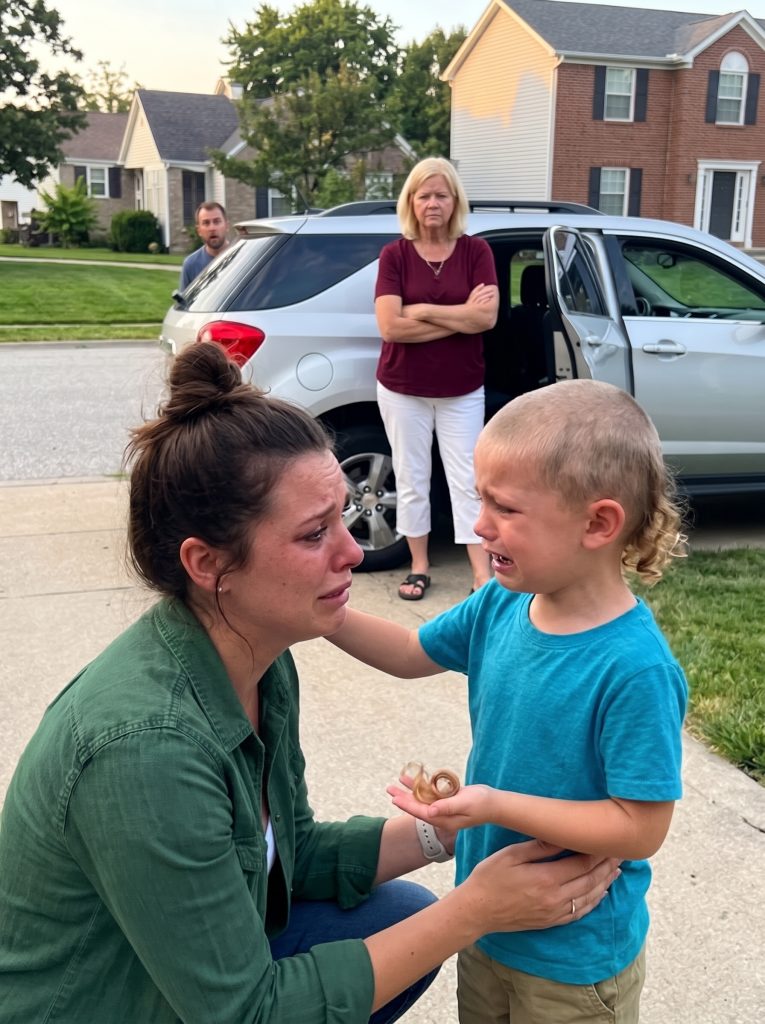
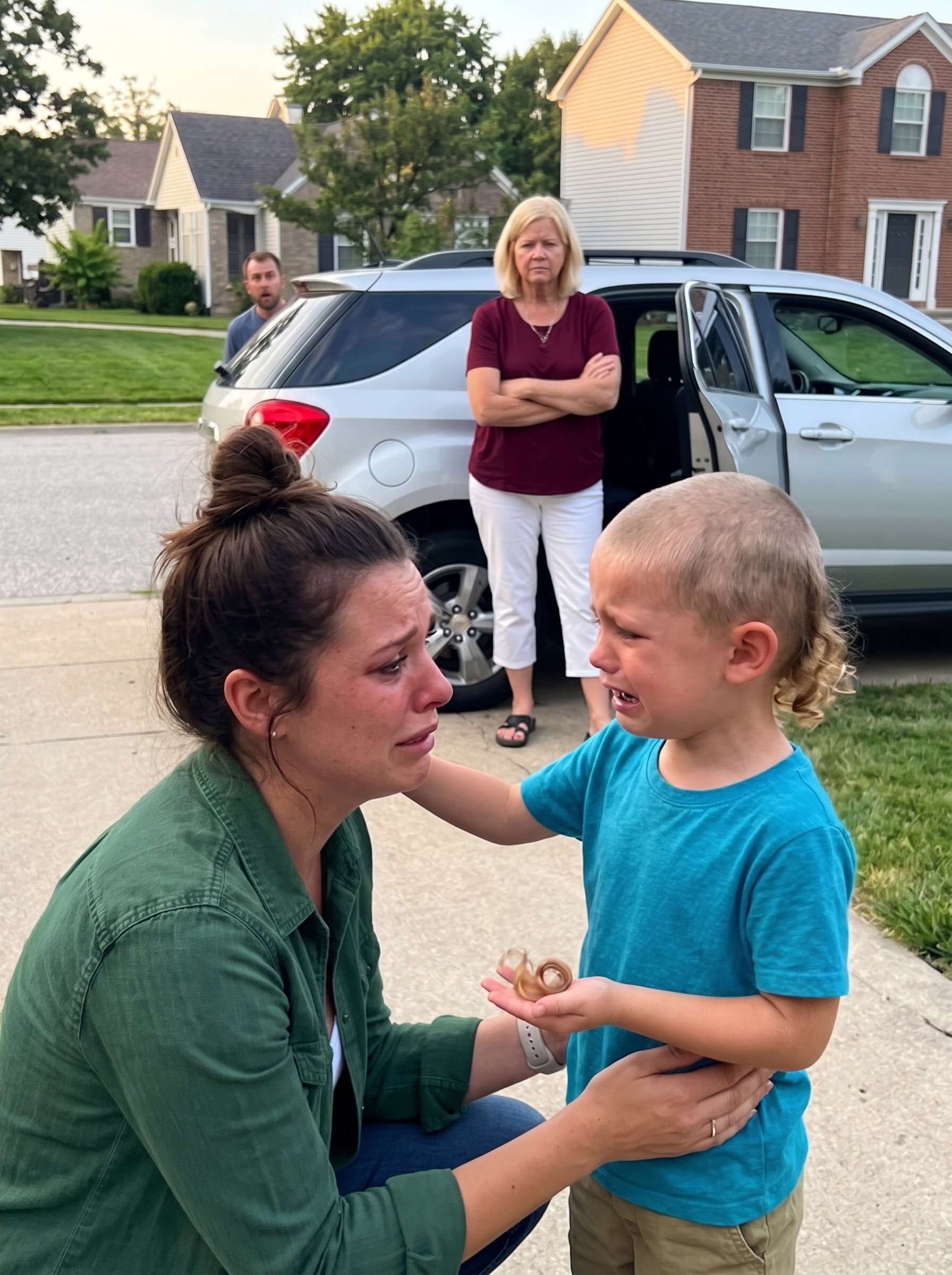
I opened the back door and Leo looked up at me with a face so
wet and blotchy it barely looked like my child. In his little fist, he
was clutching something curled and blond. One of his curls. The rest
of them were gone. All those soft golden spirals that bounced against
his forehead and ears had been shaved down into a choppy, uneven
buzz cut. It was so rough I could see where the clippers had bitten
too close in one spot above his temple.
Whatever Brenda had done, she hadn’t taken him to a barber who cared. It looked rushed. It looked angry.
“Leo, baby, what happened?” I asked, though I already knew.
His mouth trembled. “Grandma cut it, Mommy.”
Brenda stepped out from the driver’s side with the air of a woman delivering groceries.
“There,” she said, brushing her palms together. “Now he looks like a real boy. You can thank me later.”
I remember the rush of heat in my face and the cold in my hands at the same time. I remember asking her if she had lost her mind. I remember her rolling her eyes and saying I was being dramatic, that hair grew back, that someone had to do what was best for him.
I remember Leo flinching every time her voice got sharper.
I took him inside because if I stayed in that driveway another ten seconds, I would have said something none of us could take back. He curled against me on the couch, still holding that single blond ringlet so tightly it left a red half-moon in his palm. He cried until he hiccupped. Then he cried some more.
When Mark came home and saw our son, he stopped so abruptly his keys slipped out of his hand. He crossed the room, knelt on the rug, and looked at Leo’s head the way a person looks at damage after a storm. Very gently, he ran his fingers over the hacked-off patches.
Leo threw himself into Mark’s chest.
“Dad,” he sobbed, “why did Grandma cut my promise?”
Mark’s face changed when he heard those words. It didn’t twist or harden. It emptied out. He looked at me once, then wrapped both arms around Leo and held him close.
“I’ve got you, champ,” he said, his voice so quiet I had to lean forward to hear it. “I promise. I’ll take care of this.”
That night, after both kids were finally asleep, I found him at the kitchen table with his laptop open and a yellow legal pad beside him. He had written down the time of the school’s call, the names of the staff on duty, Brenda’s exact words in the driveway, and every place her lie had allowed her to cross a line. He was reading school policy, printing forms, and making a list of everyone who needed to be told that Brenda was never to remove our children again.
Mark is not a man who explodes. When he gets quiet, something serious is coming.
On Saturday, he asked me for a favor.
“Can you make a video?” he said. “Lily’s hospital visits. Her hair. Leo’s promise. Everything. I want everyone to see exactly what she cut.”
I sat down with my phone and opened a folder I had avoided for months.
Lily was seven, and the year before had hollowed all of us out. She’d been diagnosed with leukemia in the spring. Before the diagnosis, she had thick honey-brown hair that she wore in loose braids to school. After the second round of chemo, I found strands of it on her pillow, on her sweater, in the bathtub drain. One night she stood in the bathroom staring at the clump in her brush and asked me, in a voice so small I still hear it in my sleep, “Am I going to look scary?”
Leo was four then. He followed her everywhere. He stood in that bathroom doorway with his dinosaur pajamas on and watched Lily cry while I tried to tell her she would still be herself without hair. He climbed onto the closed toilet seat, looked at his sister with all the seriousness his little face could hold, and said, “Then I’ll grow mine until yours comes back.”
We thought it was a sweet thing a child says and forgets by morning. He didn’t forget.
The next week, when I reached for the spray bottle before preschool, he put his hand over his curls and said, “No cutting. It’s for Lily.” When Mark offered him a trim for summer, Leo shook his head. “Not yet. She still needs it.” He repeated it to nurses, neighbors, teachers, and anyone else who asked why his hair was getting so long.
As months passed, the curls became more than hair. They became a measure of time Lily could hold onto. Before scans, she would twist one around her finger and call it her lucky spring. On days she didn’t want to leave the hospital bed, Leo would lean beside her and say, “See? Mine’s still here. Yours is coming.” When his curls got long enough, he told Mark he wanted to donate them one day to a charity that made wigs for kids who lost theirs.
“But only after Lily isn’t sad anymore,” he said.
Brenda knew Lily had been sick. She knew about the hospital stays, the nausea, the way our life had narrowed into medicine schedules and blood counts and long nights. But she’d brushed Leo’s hair comments aside as childish nonsense. To her, a boy’s haircut mattered more than the reason behind it.
Maybe she had forgotten the promise. Maybe she never listened in the first place.
I still don’t know which is worse.
I spent two hours building that video.
I pulled clips from infusion days and quiet home days and the strange in-between days when Lily smiled for us because she was trying to be brave. There was Lily with a knit cap sliding off her bare head. There was Leo sitting beside her in a plastic hospital chair, pressing a juice box into her hands. There was a nurse laughing and asking why his hair was so long, and Leo answering, “Because promises grow slow.” There was a video from just three weeks earlier of Lily lying on the couch, running her fingers through one of his curls and whispering, “Don’t cut it yet. It still helps.”
By the time I finished editing, I couldn’t see the screen through my tears.
Sunday evening, we drove to Brenda’s house under a pink-gray sky that made everything look softer than it was. Mark had the laptop bag at his feet and a large manila envelope tucked under his arm. I knew better than to ask what was inside. Whatever it was, he had prepared it with the same terrifying calm he’d worn since Thursday.
Brenda opened the door in a pressed blouse and lipstick, smelling like perfume and rosemary. The dining room table was already set for the whole family. Her roast beef sat on the counter, filling the house with the kind of comforting smell that usually means safety.
That night it just made me nauseous.
She leaned down to kiss Lily’s head, then looked at Leo and smiled with ugly satisfaction. “There,” she said. “Isn’t that much neater?”
Leo moved behind Mark so fast it barely looked conscious. Mark put a hand back without turning around and rested it against Leo’s leg.
“We’re not doing that tonight, Mom,” he said.
Brenda’s husband Tom looked between all of us with the shell-shocked expression of a man who knew something was wrong but not how wrong. Mark’s sister Dana was there too, along with her teenage daughter. Nobody seemed to understand why the air in the room felt so thin.
Brenda kept talking anyway, bright and brisk, as if she could manage reality by keeping the conversation moving.
Dinner was miserable. Brenda carved the roast. Forks clinked against plates. Leo barely touched his food. Lily stared at her mashed potatoes and said almost nothing. Twice Brenda tried to make conversation about school, and twice Mark answered in one word. Every time I looked at my son and saw the ragged buzz where his curls had been, I had to unclench my teeth.
Halfway through the meal, Brenda reached across the table and said, far too cheerfully, “Well, at least we solved the hair issue before picture day.”
That was the moment Tom put his fork down.
Mark dabbed his mouth with his napkin, set it beside his plate, and stood. He didn’t rush. He didn’t raise his voice.
“Before dessert,” he said, “there’s something everyone needs to see.”
Brenda laughed once, a sharp little sound of disbelief. “Mark, don’t be ridiculous.”
He was already walking to the living room, pulling the laptop from its case. Dana shot me a questioning look. I didn’t answer. I just took Leo’s hand and followed.
One by one, the rest of them drifted in, carrying the tension with them.
Mark connected the laptop to the television, picked up the remote, and pressed play.
The first clip filled the screen.
It was Lily in a hospital bed wearing a paper bracelet too big for her wrist. She was smiling because I was filming, but her eyes were tired and her scalp showed through the thin new patchiness at her part.
The next clip came fast after that: hair collecting in a brush, hair on her pillow, Lily crying in the bathroom while I knelt beside her.
Then Leo, small and serious and still round-cheeked with babyhood, saying into my phone camera, “You can have mine until yours comes back.”
No one in the room moved.
The video kept going. Leo handing Lily one of his curls to tug when she got nervous before a blood draw. Leo refusing a trim in my kitchen chair. Leo on the back porch telling Mark, “Boys can have curls. Mine are busy.” A nurse’s voice asking, “Busy doing what?” and Leo answering, “Helping Lily.”
By the time the clip played of Lily whispering, “Don’t cut it yet. It still helps,” Dana had both hands over her mouth. Tom was staring at Brenda as if he had never seen her clearly before. Brenda herself had gone absolutely still. Her lips parted once, then closed again.
Mark let the final frame sit for a second after the video ended. It was a close-up of Leo leaning into Lily on the couch, his curls spilling over her shoulder while she smiled for the first real time in weeks.
Then the screen went black.
The silence afterward felt huge.
“This,” Mark said at last, “is what you cut.”
Brenda tried to recover. “Mark, I didn’t know it was all that dramatic. He’s five. It was hair.”
Mark didn’t blink. “No. It was a promise. It was comfort. It was the one thing he thought he could control while his sister was losing things a child should never have to lose.” He reached into the laptop bag and pulled out a clear sandwich bag. Inside was the single golden curl Leo had clutched in his fist that afternoon. Mark set it on the coffee table in front of Brenda.
“This is what he came home holding.”
Her face changed then. Not enough. But some.
Before she could say anything else, Mark picked up the manila envelope and held it out to her.
“And this is what I’m serving you tonight.”
She stared at it. “What is that?”
“Consequences.”
The room stayed silent as she took the envelope with stiff fingers and opened the clasp.
Inside were copies of new school authorization forms with her name removed from every pickup list and emergency contact section. There was a letter from our family attorney stating that any future attempt to remove either child from school, activities, medical appointments, or our home without our written permission would be treated as custodial interference and reported immediately. There was also a written notice that she was not to come onto school property on our children’s behalf again, and that she would have no unsupervised contact with Leo or Lily for the foreseeable future.
I had watched Mark prepare those papers, but seeing them in Brenda’s lap with the television still black behind her felt different. Final. Cold in the exact way cold can be merciful.
Brenda looked from the forms to Mark and then to me. “You got a lawyer over a haircut?”
Mark’s jaw tightened. “I got a lawyer because you lied to a school to gain access to my child, took him somewhere without our permission, and altered his body to satisfy your own beliefs. The haircut is not the only violation here. It is just the one you can see.”
She opened her mouth, shut it, and opened it again. “I was trying to help him. Children get teased. He looked—”
“Don’t,” Mark said.
It wasn’t loud, but it hit the room like a slap.
“He looked loved,” Mark continued. “He looked like a little boy keeping a promise to his sister while she fought through chemotherapy. He looked brave. And you decided your opinion about masculinity mattered more than his sense of safety, more than our authority as his parents, and more than what those curls meant to both of our children.”
Brenda turned to me, maybe because she thought I would be easier to move. “Amy, tell him this is too much.”
I almost laughed. Instead I said, “Leo cried himself sick because he thought his promise was broken. Lily cried because she thought it was her fault. So no, Brenda. This is exactly enough.”
At that, Lily, quiet, pale Lily who had barely spoken all through dinner, looked up from her lap and said in a voice steadier than any of us expected, “Grandma, he was doing it for me.”
The room went so still I could hear the clock in the hallway.
Brenda’s composure finally broke. Not dramatically. She just seemed to deflate, the stiffness leaving her shoulders all at once, and when she spoke again, her voice was different. Smaller. For the first time, she wasn’t explaining or defending or justifying. She was just sitting there with the papers in her hands and a curl on the table in front of her and two crying grandchildren who she had hurt trying to love on her own terms.
She said she was sorry.
It wasn’t magic. It didn’t undo anything. But it was the first truthful thing she’d said in months.
We agreed to one short, supervised visit in a therapist’s office. Brenda cried the minute she saw Leo. He did not run to her. He stayed beside Mark and stared for a long time before saying, “Don’t talk about my hair anymore.” Brenda promised she wouldn’t. Lily handed him a toy from the waiting room, and the three of them sat in a silence that felt earned rather than forced.
That day did not repair the relationship, but it established the only terms on which one might exist: honesty, boundaries, and no entitlement.
A year later, Lily’s hair had grown back in soft and wavy, darker than before. Leo’s curls came back too, a little tighter than they had been, springing gold in the sun like nothing had ever managed to erase them. The first time Brenda saw them again at a supervised family barbecue, she kept her hands in her lap and said nothing.
For once, silence suited her.
Some people in the family still think we were too hard on her. They say hair grows, grandparents make mistakes, and public humiliation at Sunday dinner was unnecessary.
Maybe they only see the haircut because it is easier than seeing everything underneath it.
I see a five-year-old standing in our driveway with a single curl in his fist, sobbing because he thought love had been cut off him.
I see a little girl touching her brother’s hair in a hospital room because it helped her believe she wasn’t alone.
And when I remember Brenda sitting there with those papers in her hand and no words left, I still think the same thing: for what she took, speechlessness was the lightest thing she deserved.
The fallout of that Sunday dinner did not vanish when we drove away from Brenda’s house, nor did it end when the legal papers were filed. It settled over our lives like fine, inescapable dust.
In the weeks following the video, the Carter family fragmented. Mark’s sister, Dana, who had sat white-faced at the dining room table while the clips played, called us two days later. Her voice was thick with residual shock.
“I didn’t know,” Dana admitted, her voice trembling over the phone. “Mom told me you were just being lax, that Leo’s hair was getting matted and you guys were too overwhelmed with Lily’s treatments to care for him properly. She made it sound like an act of charity.”
“It wasn’t charity, Dana,” Mark said into the receiver, his voice flat, steady, and devoid of the anger that had burned out days before. “It was control.”
Dana didn’t argue. She had seen the footage of Lily in the pediatric oncology ward. She had heard four-year-old Leo whisper about his promise. There was no spin Brenda could put on the situation that could survive the raw reality of those timestamps.
Yet, as is common in families built on decades of swept-under-the-rug dysfunction, not everyone saw it that way.
Mark’s uncles, men who viewed family loyalty as an absolute mandate regardless of conduct, reached out with heavy-handed attempts at mediation. “She’s your mother, Mark,” Uncle Tom said during a tense phone call a week later. “She made an error in judgment, sure. But serving her with legal notices? Restricting her from her own grandkids? You’re tearing the family apart over a haircut.”
Mark didn’t yell. He simply replied, “If a stranger walked into Leo’s school under a false name, picked him up without permission, and used clippers on his head, you’d call the police and demand felony charges. The fact that she shares my DNA makes what she did worse, not better. She used his trust to hurt him.”
When Tom tried to interrupt, Mark cut him off with a quiet finality: “If you insist on minimizing what she did to my children, you won’t be seeing them either.”
He hung up. That was the day Mark’s extended family realized the quiet, accommodating son they had known for thirty-five years was gone. In his place stood a father who had drawn an iron line in the sand, and no amount of emotional blackmail was going to move it.
Inside our home, the rebuilding was slow and fragile.
The physical damage to Leo’s hair was easily fixed by a professional barber named Ray, whom Mark had talked to beforehand. We took Leo to a small, quiet shop on a Tuesday morning when no other customers were there. Ray was gentle; he lowered the chair, let Leo inspect the clippers, and talked to him about sports while he smoothed out the jagged, uneven patches Brenda had left behind.
When it was finished, Leo had a neat, clean buzz cut. He looked handsome, but to me, he looked stripped. Every time I looked at his bare temples, I saw the ghost of the golden ringlets he had guarded so fiercely.
The emotional damage, however, didn’t trim away so easily.
For the first month, Leo developed a habit of checking his head every time he woke up. He would reach up with small, tentative fingers, feel the bristly stubble, and look at me with wide, searching eyes.
“Mommy?” he asked one morning, sitting on the edge of his bed in his pajamas. “Is Lily going to get sick again because I lost the promise?”
The question hit me like a physical blow. I sat beside him, pulled him into my lap, and held him so tightly I could feel his heartbeat against my chest.
“No, baby. Absolutely not,” I told him, fighting to keep my voice steady. “Your hair didn’t keep Lily safe. Your love did. The hair was just a picture of your love, but the love is still right here in your heart. Nobody can cut that away. Ever.”
Lily, who was standing in the doorway holding her favorite worn-out stuffed rabbit, walked over and pressed her forehead against Leo’s cropped head. Her own hair was just beginning to return—a light, fuzzy shadow of dark brown down that felt like velvet.
“See?” Lily whispered to him, running her hand over his short hair. “Mine is coming back now anyway. You don’t have to grow it anymore if you don’t want to.”
Leo looked at her, his big brown eyes filled with an adult weight no five-year-old should carry. “I want to,” he said softly. “I’m gonna grow it back bigger.”
The legal logistics proved to be a grueling process, but Mark handled every detail with surgical precision.
He met with the school principal and the superintendent. The secretary who had released Leo to Brenda had not acted out of malice, but out of severe procedural negligence—Brenda had used her familiarity, her polished suburban demeanor, and a convincing story about a family emergency to bypass the official emergency contact system.
The school district underwent an immediate audit of its dismissal protocols. The secretary was formally disciplined, and updated security measures were put in place: biometric check-ins for guardians, non-negotiable ID verification, and instant digital alerts sent to parents the moment a child was checked out early.
“I am so sorry, Mrs. Carter,” the principal said, her face pale as she reviewed the legal notice our attorney had drafted. “This was a catastrophic failure on our part.”
“It was,” I said simply. “And if she sets foot on this property again, we expect the police to be called immediately.”
“They will be,” the principal promised.
Brenda, meanwhile, retreated into a shell of bitter self-pity.
Through Dana, we learned that Brenda was telling her circle of friends a dramatically altered version of events. In her mind, she was the victim of an overly sensitive, modern daughter-in-law who had brainwashed her son. She claimed she had merely tried to give her grandson a “hygienic trim” and that we were overreacting to punish her.
But the paper trail, the school’s formal incident report, and the legal documentation stood as unyielding walls against her narrative. She couldn’t visit the kids. She couldn’t come to school plays, soccer games, or birthday parties.
When Thanksgiving approached, Brenda sent a long, handwritten letter to Mark.
I sat at the kitchen island while Mark read it. It was four pages of classic Brenda: two sentences of vague regret followed by paragraphs of defense, passive-aggressive remarks about how hard her holidays were going to be, and requests that we “put this unpleasantness behind us for the sake of family unity.”
Mark read the whole thing without expression. When he reached the end, he didn’t tear it up or stomp around. He simply folded it back into its envelope, walked over to his desk, and dropped it into a file labeled Brenda – Correspondence.
“Are you going to reply?” I asked.
“No,” Mark said. “A reply gives her a negotiation. There’s nothing to negotiate.”
“Mark,” I said, reaching out to touch his arm. “How are you holding up?”
He stopped, staring out the kitchen window into the gray November afternoon. For weeks, he had been the rock—the strategist, the protector, the unyielding wall. But standing there, under the flat autumn light, I saw the deep lines of exhaustion carved around his eyes.
“I spent my whole life watching her do things like this, Amy,” he said softly, his voice cracking just a fraction. “She’d overstep, she’d hurt someone, she’d make a mess, and then she’d manipulate everyone into pretending it didn’t happen so we could have a nice Sunday dinner. When I was a kid, I thought that was normal. I thought being dutiful meant taking the hit.”
He turned to look at me, his eyes fierce and clear.
“I won’t let her do that to Leo. I won’t let her do it to Lily. If being a good son means letting her break my kids, then I’d rather be a terrible son.”
Winter passed, cold and quiet.
Without Brenda’s constant, subtle interference, a strange kind of peace began to take root in our house. Lily’s bloodwork continued to come back clear. Month by month, her energy returned. She went back to school full-time in January, her new hair curling slightly at the nape of her neck.
Leo’s hair grew back, too.
By spring, the short, choppy buzz had given way to soft waves. By summer, the golden ringlets were bouncing around his ears again, bright and untouched.
In June, Brenda’s attorney contacted ours to request a formal review of the supervised visitation terms. The therapist who had conducted our initial session recommended a structured, highly controlled path forward: one thirty-minute visit per month at a family counseling center, under the strict condition that Brenda undergo individual therapy to address her boundary violations and lack of empathy regarding the family’s medical trauma.
Brenda agreed to the terms. The reality of her isolation had finally set in.
The first supervised visit took place on a humid Tuesday afternoon in July at a clinical office downtown. The room was bland, painted a soft beige, filled with plastic toys and comfortable armchairs. A licensed family therapist, Dr. Vance, sat in the corner with a notebook.
When Mark, the kids, and I walked in, Brenda was already sitting on the sofa.
She looked older than she had six months ago. The sharp, immaculate edge she usually wore was softened; her posture was slightly stooped, her hair lacked its usual shellacked stiffness.
When she saw Leo, her eyes welled with tears. She started to stand up, her arms extending instinctively.
Leo immediately took two steps back, tucking himself behind Mark’s leg.
Brenda froze. The rejection was visible, a sharp pang that caused her face to twist. She sat back down carefully, swallowing hard.
“Hello, Leo. Hello, Lily,” she said, her voice strained.
“Hi, Grandma,” Lily said politely. She didn’t move toward her either, but she didn’t hide. She took a seat at a small activity table in the corner and pulled out a box of crayons.
Mark remained standing near the door, his arms crossed, his gaze fixed on his mother. I sat in a chair near the window, keeping my attention entirely on the children.
“You can sit down, Brenda,” Dr. Vance said gently from her corner. “Remember what we talked about. Let the children set the pace.”
Brenda nodded. She looked at Leo, who was still peering out from behind Mark’s leg, his hand clutching his father’s denim jeans.
“Leo,” Brenda said, her voice small and tight. “I brought something for you. If that’s okay.”
She reached into her purse and pulled out a small, flat wooden box. She didn’t hand it to him; she placed it carefully on the coffee table between them and slid it forward.
Leo didn’t move. Mark looked down at him. “Do you want to see what it is, buddy?”
Leo looked at the box, then up at Mark, then at me. Finally, he gave a tiny nod. He walked forward slowly, his eyes never leaving Brenda’s face, and picked up the box.
He flipped the small brass latch and opened the lid.
Inside, resting on a bed of blue velvet, was a silver hairbrush with soft bristles, engraved with his initials: L.M.C. Next to it was a small, velvet-lined pouch.
Leo looked at the brush, confused. “What is it?”
“It’s a special brush,” Brenda said, her hands trembling in her lap. “For when your hair gets long again. It’s… soft. It won’t hurt.” She took a shaky breath, looking down at her own hands. “And the pouch is… if you ever decide to cut your hair when you’re older, to keep it safe. But only when you want to.”
The silence in the room was dense, but for the first time, it didn’t feel hostile. It felt heavy with the weight of someone finally trying to understand a language they had refused to learn for years.
Leo stared at the velvet pouch for a long moment. He didn’t say thank you. He didn’t smile. But he didn’t throw it away either. He closed the box, latched it shut, and carried it back over to where Mark was standing.
“Okay,” Leo said softly.
He walked over to the activity table, sat down next to Lily, and picked up a green crayon.
Brenda watched him draw for the remaining twenty minutes of the session. She didn’t push for hugs. She didn’t offer unsolicited advice about parenting, diet, or manners. She didn’t mention his hair again. She simply sat there, quiet and attentive, learning the hard lesson that trust, once shattered by arrogance, can only be rebuilt in millimeters.
When the thirty minutes were up, Dr. Vance signaled that the session was over.
Mark helped the kids pack up their drawings. Brenda stood up slowly, clutching her handbag to her chest.
“Thank you for coming,” she said to Mark, her eyes searching his face for any sign of thaw.
Mark looked at her for a long moment. The coldness that had defined him since that Thursday afternoon in the kitchen had settled into something calmer—not forgiveness, exactly, but a clear, unshakeable boundary.
“We’ll see you next month, Mom,” Mark said quietly.
It wasn’t a promise of reconciliation. It was an acknowledgment of the work ahead.
As we walked out into the bright July sunshine, the air was warm and heavy. Leo held my hand with one of his, carrying the wooden box in the other. Lily was walking ahead of us, her dark curly hair catching the light as she skipped toward the car.
Leo looked up at me, his golden curls bouncing against his forehead in the summer breeze.
“Mommy?” he asked.
“Yeah, sweetie?”
“Can we go to the park now?”
I smiled, running a hand over his soft, springy hair—the hair that had survived the clippers, the lies, and the storm of an arrogant woman’s hubris.
“Yeah, Leo,” I told him, opening the car door for him. “We can go to the park.”
He climbed in, setting his wooden box carefully on the seat beside him.
He had kept his promise. Lily was healthy. And for the first time in over a year, the house, the family, and the quiet were ours again.
THEEND…!