PART 3:
The first year of our reunited lives was not a cinematic montage of
easy laughter and perfectly resolved trauma. Healing, I quickly
learned, was not a destination but a grueling, daily practice. My small,
two-bedroom apartment, which had been a quiet sanctuary of
loneliness for so long, was abruptly transformed into a bustling,
chaotic ecosystem of survival and tentative hope. Every square inch of
space was claimed by the sheer volume of a young, grieving family
trying to find its footing.
Daniel took the couch in the living room for the first six months,
insisting that Maya and Leo share the second bedroom. I offered him
my room countless times, but he possessed a stubborn humility that
mirrored the pride I had wielded like a weapon all those years ago. He
was determined not to be a burden, constantly calculating his worth
by how much he could endure. He worked at the local hardware store
with a ferocity that frightened me, taking every extra shift, every
weekend opening, and every holiday rotation. His hands, already
rough from years of warehouse labor, grew thick with calluses. He was
trying to outwork his grief, trying to build a fortress of financial
stability so that his children would never have to stand in a food pantry line again.
But grief is a patient hunter. I saw it catch him in the quiet moments
between shifts. I would wake up at two in the morning to get a glass of
water and find him sitting on the edge of the sofa in the dark, his face
buried in his hands, his shoulders trembling silently. He was mourning
Sarah. He was mourning the youth they had lost to poverty, the
desperate medical decisions they had to make, and the mother of his
children who had slipped away in a sterile hospital room while he sat
helplessly by her side. In those dark hours, I didn’t force him to talk. I
would simply turn on the small lamp above the stove, put the kettle on,
and slide a mug of chamomile tea across the worn formica counter. I
would sit on the stool next to him, letting the silence wrap around us,
offering the physical presence I had denied him on that rainy night in
2010. Sometimes, he would reach out and grip my hand, holding it so
tightly my knuckles ached. It was a silent conversation, an
acknowledgment of the abyss he was staring into, and my promise that he wouldn’t fall in alone.
Leo, at seven years old, was a mirror of his father’s quiet intensity. For t
he first few months, the boy moved through the apartment like a
ghost, hyper-vigilant and perpetually ready to flee. He hoarded food,
sneaking crusts of bread and half-eaten apples into his pockets, a
heartbreaking habit forged in the fires of their transient years. I didn’t
scold him. Instead, I began a ritual. Every afternoon, when I picked him
up from the local elementary school, we would walk to the small
bakery on Elm Street. I would buy two warm, fresh rolls. I would eat
one, and I would hand the other to Leo, telling him, “There is always
more for tomorrow.” It took four months for him to stop hiding food in
his pillowcase. When I finally found his stash empty one Sunday
morning while changing the sheets, I sat on the edge of his bed and
wept, thanking God for the small, quiet victory of a child learning to feel safe.
Maya was our sunshine, oblivious to the heavy currents of trauma that
swirled around the adults. At three, she was a whirlwind of giggles,
sticky fingers, and endless demands for stories. She became the glue
that held our fragile new dynamic together. It is impossible to remain
lost in your own regrets when a toddler is demanding that you wear a
plastic tiara and drink imaginary tea. Through Maya, Daniel and I
found a safe bridge to each other. We could laugh at her antics,
collaborate on her bedtime routines, and share the exhausted,
knowing glances that only parents and grandparents understand.
By the second autumn, the air in the apartment felt lighter. Daniel had
been promoted to assistant manager at the hardware store, earning a
salary that finally allowed him to breathe. We had established a
routine, a rhythm of life that felt less like survival and more like actual living.
The turning point—the moment the last remnants of our fifteen-year
chasm finally closed—came on a cold, rainy evening in late November,
almost exactly two years after they had walked into the food pantry.
The children were fast asleep in their room. A heavy downpour was l
ashing against the living room windows, the rhythmic drumming a
sudden, vivid echo of the night I had sent Daniel away.
I was sitting in my armchair, knitting a winter sweater for Leo, when
Daniel walked out of the kitchen. He didn’t have his usual mug of tea.
Instead, he held a small, battered metal tin—the kind that once held
mints. He sat on the sofa opposite me, staring at the tin for a long time
before he finally looked up. The ambient light from the streetlamp
outside cast long shadows across his face, highlighting the deep lines
of premature aging, but also a newfound peace that had settled in his eyes.
“Mom,” he started, his voice steady but thick with emotion. “There’s something I need to tell you. Something I need to show you.”
I put down my knitting needles, my heart giving a familiar, anxious flutter. “What is it, sweetheart?”
He slowly opened the lid of the tin. Inside, resting on a bed of folded,
yellowed paper, was a small, inexpensive silver ring with a tiny, cloudy
cubic zirconia stone. Next to it was a faded, perfectly preserved
receipt from a pawn shop, dated October 2010.
“When I walked out that door fifteen years ago,” Daniel said softly,
looking at the rain beating against the glass, “I was so angry. I hated
you. I hated you for making me feel like a failure before I had even
tried, and I hated you for making me choose between my pride and my
family. I walked in the rain for three miles with that duffel bag,
clutching the two hundred and fifty dollars you threw at me.”
I closed my eyes, the shame of that memory still burning hot in my
chest. “Daniel, please… you don’t have to.”
“I do, Mom. Please let me finish,” he said gently. He picked up the ring
from the tin, turning it over in his calloused fingers. “I swore to myself I
wouldn’t spend a single cent of that money on myself. I was going to
prove you wrong. I was going to show you I was a man. For the first two
weeks, Sarah and I lived in a friend’s garage. We were freezing,
terrified, and hungry. But I wouldn’t touch your money for food.”
He looked up at me, his eyes shining in the dim light. “But Sarah… she
was so brave, Mom. She never complained, even when she was sick in
the mornings, even when she was cold. One night, I looked at her
sleeping on a mattress on a concrete floor, and I realized what being a
man actually meant. It didn’t mean carrying a grudge to stay warm. It
meant doing whatever it took to take care of the people you love.”
Daniel placed the small silver ring on the coffee table between us.
“I took the two hundred and fifty dollars,” he continued, a small, sad
smile playing on his lips. “I used fifty of it to buy a bus ticket to a better
town where I knew warehouses were hiring. I used fifty of it to buy
Sarah a warm winter coat. And with the remaining hundred and fifty… I
went to a pawn shop and bought this ring. I asked her to marry me that
same afternoon by a bus stop.”
Tears were streaming down my face now, blurring my vision. I reached
out with a trembling hand and touched the cold metal of the cheap
ring. It was the most beautiful thing I had ever seen.
“She wore it every single day,” Daniel said, his voice finally breaking.
“Even when she was sick at the end, she refused to take it off. She told
me that this ring was the foundation of our family. That it was the
moment we chose each other over everything else. When she passed away… I took it off her finger. It’s all I have left of her.”
He leaned forward, resting his elbows on his knees, and looked directly
into my eyes. The anger, the resentment, the distance—it was all gone.
There was only my son, whole and broken, beautiful and strong.
“I didn’t bring this out to make you feel guilty, Mom,” Daniel whispered,
reaching across the table to cover my trembling hand with his own. “I
brought it out to say thank you. You thought you were kicking me out,
but you gave me the tools to start my life. You gave me the money that
bought my wife’s ring. You bought the coat that kept my baby warm.
We survived those early years because of what you gave me. And we
are surviving now… because of what you are giving us today.”
A sob tore from my throat, raw and unrestrained. I slipped off my chair
and fell to my knees in front of him, wrapping my arms around his
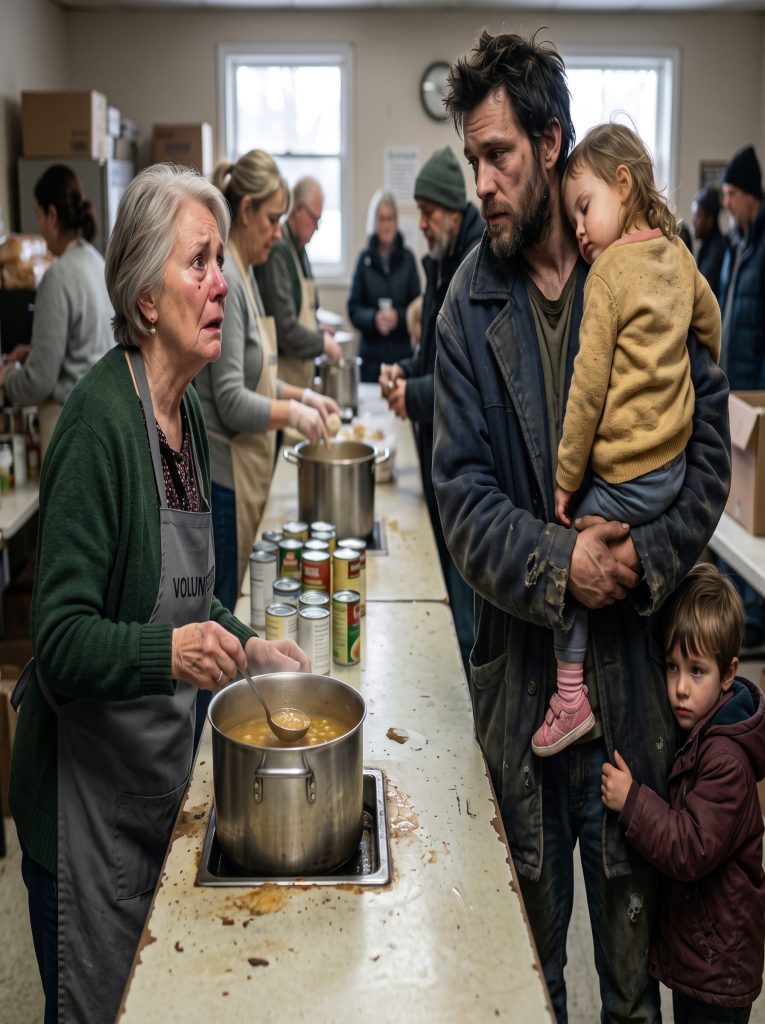
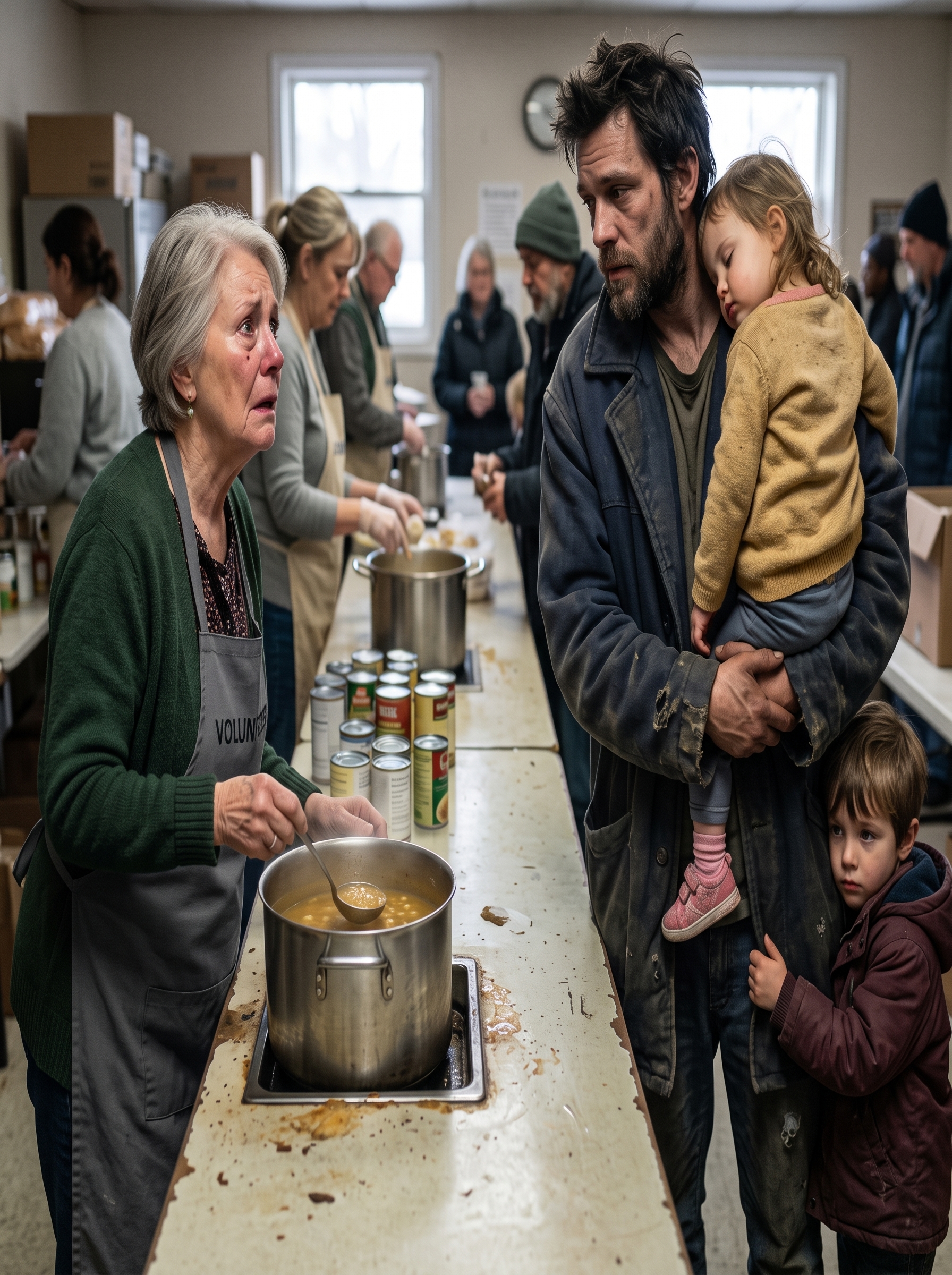
waist just as I had done in the food pantry two years prior. Daniel slid
off the sofa, kneeling on the floor with me, burying his face in my
shoulder as we both wept. We cried for Sarah. We cried for the
frightened eighteen-year-old boy and the proud, terrified mother. We
cried for the fifteen years of missed birthdays, lost Christmases, and silent phone calls.
But as the tears flowed, they washed away the final layers of guilt and
sorrow that had calcified around my heart. The debt of pride had f
inally been paid in full, not with money, but with the brutal, beautiful honesty of grace.
“I love you, Daniel,” I whispered into his hair, kissing his temple. “I am so incredibly proud of the man you are. I am so proud to be your mother.”
“I love you too, Mom,” he replied, his arms tightening around me. “We’re home.”
The storm outside eventually broke, the heavy rain tapering off into a
gentle drizzle as the night wore on. By the time morning arrived, the
sky was a clear, brilliant blue, washed clean of the previous day’s gloom.
We didn’t magically stop having problems after that night. The electric
bill was still high, the apartment was still too small, and the grief for
Sarah would always be a permanent resident in our hearts. But the
foundation of our family had fundamentally shifted. We were no
longer fragile. We were bound together by a shared understanding of
our flaws and a fierce, unyielding commitment to our future.
Years later, as I write this, I am sitting in the backyard of a modest
three-bedroom house that Daniel bought just outside of town. Leo is
fourteen now, a brilliant, quiet teenager who excels in mathematics
and helps his father fix old cars on the weekends. Maya is ten, a
spirited force of nature who dreams of becoming a veterinarian and
currently has three rescued stray cats sleeping on my porch.
And Daniel… Daniel is happy. The deep lines of exhaustion on his face
have softened. He is the manager of the hardware store now,
respected by the community, loved fiercely by his children, and
cherished by his mother. He wears Sarah’s silver ring on a chain around
his neck, a constant reminder of where he started.
I am an old woman now, my steps slower and my hands arthritic. But
my heart is infinitely lighter than it was during those fifteen silent
years. I learned the hardest lesson of all: that pride is a terrible
substitute for love, and that it is never, ever too late to ask for
forgiveness. The boy who walked out into the rain with a duffel bag
returned as a man carrying the weight of the world, and in doing so, he
taught me how to finally carry my own.