On Christmas morning, my 9-year-old daughter opened a gift box from my father-in-law. Seconds later, she screamed that her face was burning.
My husband rushed her to the hospital, but hours later, he returned with police officers. What they found inside our home exposed a truth none of us were ready for.
The box had been sitting beneath the tree since before sunrise, wrapped in silver paper and tied with a red velvet ribbon.
The tag read, For my sweet Emma. Love, Grandpa Richard.
Emma was nine—young enough to believe every present held a little magic, but old enough to notice when the adults around her were pretending not to be tense.
That morning, she noticed.
The lights on the tree were still glowing against the windows. Torn paper from the earlier gifts had started to gather around the couch, and Daniel’s coffee had gone cold on the end table.
Richard Pierce, my father-in-law, stood near the fireplace with a fresh mug in his hand.
He looked comfortable in our living room.
I did not feel comfortable with him there.
For months, Richard had been angry with me without ever raising his voice in front of anyone else.
That was his way.
He preferred comments delivered softly enough that everyone else could pretend they had misunderstood them.
He had called me ungrateful.
He had called me unstable.
He had told Daniel that I was trying to separate him from his family, even though all I had done was tell Richard he could not take Emma on an overnight hunting trip.
I had a reason.
A week earlier, I had learned that Richard had once left Emma sitting alone in his truck outside a bar while he went inside.
He said it had only been a few minutes.
Emma said it had been long enough for the parking lot lights to come on.
She had been smaller then. She remembered holding the door handle and watching strangers cross between the parked cars.
When I confronted Richard, he acted insulted that I had questioned his judgment.
He told me children needed to learn not to panic.
I told him adults needed to learn not to abandon them.
That was the first time I gave him a clear no and refused to soften it for Daniel’s sake, for the holidays, or for the comfort of the rest of the family.
Richard did not shout.
He simply looked at me and said, “You’ll regret teaching her to be afraid of her own family.”
I thought about that sentence every time he smiled at Emma afterward.
On Christmas morning, his gift was the last one under the tree.
Emma knelt in front of it and ran her fingers over the velvet ribbon.
Before she pulled it loose, she looked up at me.
“Mom?”
It was one word, but I heard the question inside it.
Is this okay?
Daniel sat beside the couch with one hand on his knee.
He gave a strained laugh. “Go ahead, sweetheart. Grandpa picked that out himself.”
Across the room, Richard watched over the rim of his mug.
His expression was pleasant, almost bored, but there was a stillness in his face that made my stomach tighten.
Emma untied the ribbon.
Inside the box was a pale pink skincare set with a face mist, lotion, lip balm, and a small jar labeled Snow Angel Glow Cream.
It looked expensive and grown-up.
It was exactly the kind of thing a nine-year-old would think was beautiful because it came in matching bottles and smelled faintly sweet when the lid opened.
“Oh,” Emma whispered. “It’s pretty.”
Richard smiled over the rim of his mug.
“Try the cream,” he said. “It’s gentle. For sensitive skin.”
The words sounded harmless.
The tone did not.
I stood up.
“Maybe later.”
Emma had already opened the jar.
She dipped two fingers into the pale pink cream and touched both cheeks.
For three seconds, nothing happened.
The tree lights blinked.
Daniel leaned forward.
Richard did not move.
Then Emma’s smile disappeared.
Her hands flew to her face.
“Mommy…”
The sound of her voice changed everything in the room.
“My face burns.”
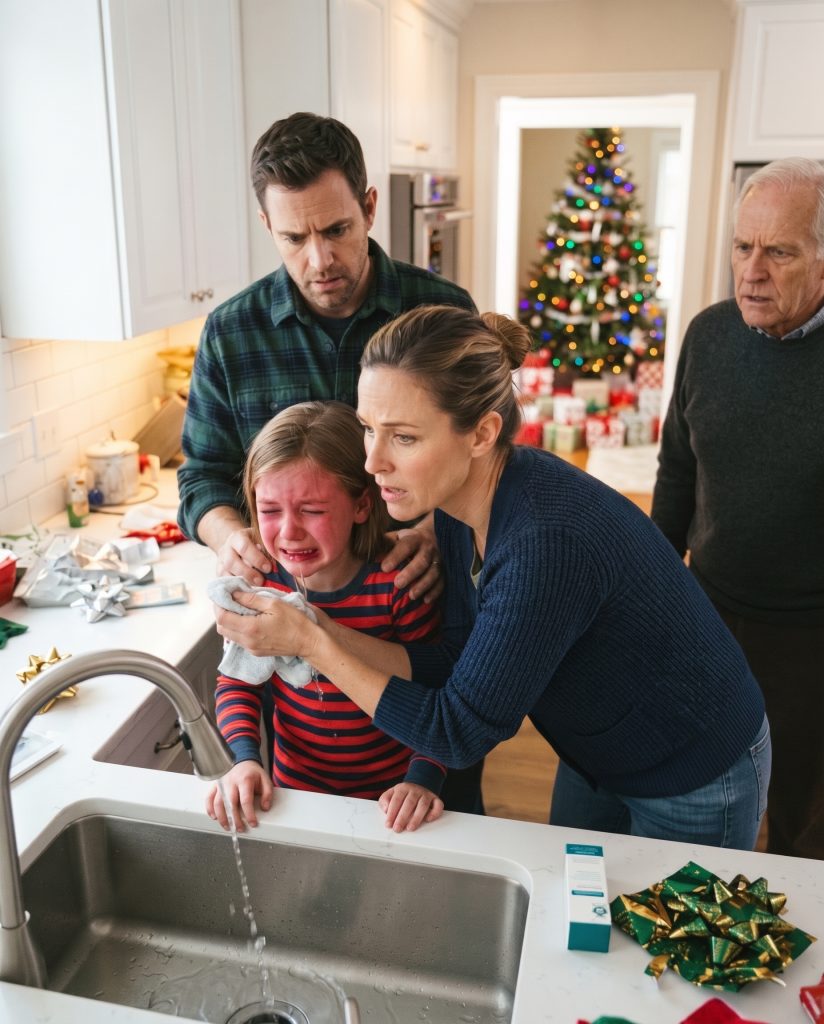
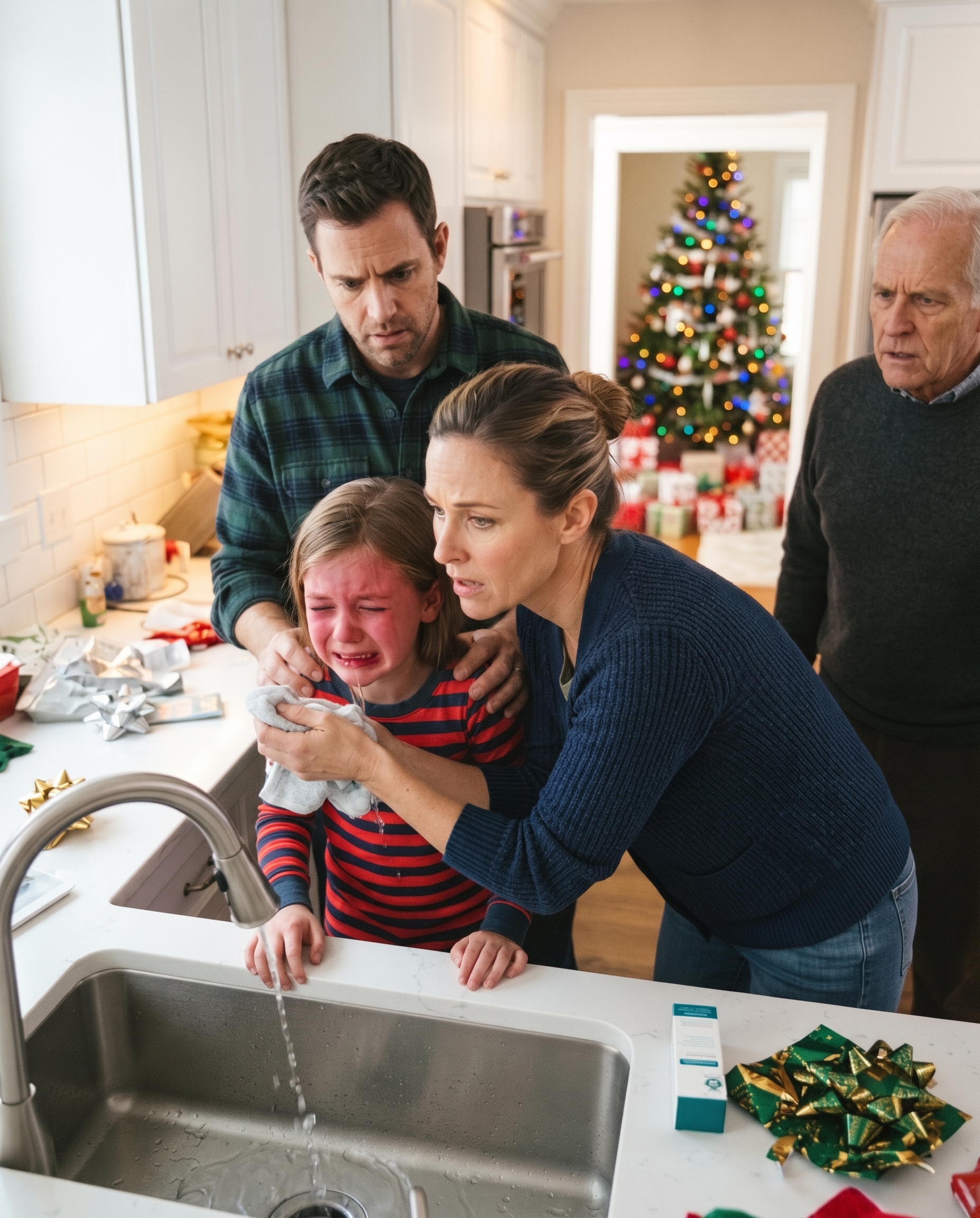
I reached her as she began to scream.
“It hurts! Mommy, it hurts! Make it stop!”
Her cheeks turned red almost immediately.
The color deepened in uneven patches while she tried to rub at her skin.
I caught her wrists.
“Don’t touch your eyes.”
Daniel was beside us a second later.
He lifted her beneath the arms while I pulled her toward the kitchen sink and twisted the faucet open so hard the metal handle struck the backsplash.
“Cold water,” I yelled. “Emma, keep your eyes closed. Don’t rub.”
Daniel held her steady while I rinsed her face.
Water ran over her wrists and soaked the front of her Christmas pajamas.
Her wet hair stuck to her forehead.
She was sobbing so hard that each breath came in a broken pull.
Behind us, wrapping paper covered the living-room floor.
The red ribbon had landed beside the open cream jar.
Richard still had not moved.
Not one step.
Daniel looked over his shoulder at him.
“What was in that?”
Richard’s mouth tightened, but his voice stayed calm.
“It’s skincare. She probably had a reaction.”
“A reaction?” I snapped. “Look at her.”
He took one slow sip of coffee.
That small motion frightened me more than shouting would have.
Emma was screaming at our kitchen sink, and he was drinking coffee as though we were arguing over a spilled cup of juice.
Daniel wrapped Emma in his coat and lifted her against his chest.
She kept whispering that she was sorry.
That was the part I could not bear.
She apologized for opening a Christmas gift.
She apologized for crying.
She apologized while her face burned because, somewhere in the panic, she had decided the emergency must be her fault.
I reached for my shoes.
“Stay here,” Daniel said.
He was already moving toward the front door.
“Find the box. Bring it if you can. Don’t let anyone touch anything.”
I wanted to argue.
I wanted to go with my daughter.
But I also knew someone had to preserve whatever had caused the reaction.
Daniel carried Emma to the family SUV and settled her in the rear seat, curled against his coat.
The vehicle backed out of the driveway and disappeared down our neighborhood street.
Then the house went quiet.
The quiet was not peaceful.
The faucet was still dripping.
Water covered the counter.
Emma’s damp footprints led from the kitchen toward the door.
Richard placed his mug on the side table beside the fireplace.
“You’ve always made everything bigger than it is,” he said.
I stared at him.
“You told her to use it.”
“I told her it was cream.”
“You picked it out.”
His eyes hardened for half a second.
“Be careful what you accuse people of.”
He spoke like I was the dangerous person in the room.
I wanted to grab the jar and throw the entire set into a grocery bag.
I wanted to drive after Daniel and Emma.
Instead, I forced myself to slow down.
I took pictures of everything exactly where it had fallen.
The red velvet ribbon.
The silver wrapping paper.
The open lid.
The smear of pink cream along the edge of the jar.
The damp marks on the floor.
The wet path from the living room to the kitchen.
Richard watched me document each item.
He did not ask whether Emma could see.
He did not ask which hospital Daniel was taking her to.
He did not ask whether he should come.
He only watched my phone move from one object to the next.
Then he walked down the hall.
I heard the back door open.
By the time I reached the kitchen, he was gone.
The door stood slightly ajar.
Cold air moved across the wet tile.
I called Daniel, but he did not answer.
I called again.
Still nothing.
I knew he was driving, and I knew Emma needed him focused on the road, but every unanswered ring made the house feel larger and less familiar.
I closed the back door without locking it.
Then I returned to the living room and sat on the floor beside the ruined gift.
The pale pink bottles looked ordinary.
That was what made them terrifying.
Nothing about the packaging announced danger.
There was no broken seal that I could see.
No warning written across the label.
Just a child’s gift arranged neatly in a silver box.
I thought about Richard saying, Try the cream.
Not the mist.
Not the lip balm.
The cream.
I replayed the moment until I could hear the exact pause before he said it was gentle.
I called Daniel again.
This time he answered.
“We’re here,” he said.
His voice sounded far away.
I could hear movement behind him, shoes on a hard floor, someone giving instructions, Emma crying and then going quiet enough that I panicked.
“Is she okay?”
“They’re treating her.”
“What did they say?”
“They need the box. Don’t touch the jar.”
“I haven’t.”
“Where’s my dad?”
“He left through the back door.”
Daniel stopped speaking.
The silence on the line lasted only a second, but it felt like an answer.
“I’m coming back as soon as I can,” he said.
“Stay with her.”
“They’re asking questions. I need to tell them exactly what happened.”
I looked at the jar on the floor.
“He watched her put it on.”
“I know.”
“No, Daniel. He told her to.”
His voice broke when he answered.
“I know.”
The call ended.
I remained on the floor because I did not trust my legs.
The tree lights kept blinking across the silver paper.
At some point, the morning light shifted across the front window.
The coffee in Richard’s mug sat untouched on the side table.
Hours passed in fragments.
I answered a call from Daniel.
I repeated the same facts.
I took another photograph from farther back so the position of the box, the ribbon, the jar, and the couch could be seen together.
I did not clean the sink.
I did not move the wrapping paper.
I did not close the cream jar.
By late afternoon, the house smelled like cold coffee, wet cotton, and the sweet artificial scent from the skincare set.
Then headlights swept across the front window.
I stood so quickly that my knee struck the coffee table.
Daniel came through the front door.
He was not alone.
Two police officers entered behind him.
Their attention moved first to the open box, then to the kitchen, and finally to the empty space beside the fireplace where Richard had been standing.
Daniel’s face was pale.
His coat was still damp from holding Emma at the sink.
I searched behind him for our daughter.
“She’s still at the hospital,” he said. “They’re keeping her there for now.”
I wanted to ask a dozen questions.
Before I could speak, one officer addressed me.
“Mrs. Pierce, where is Richard Pierce?”
“He left.”
“When?”
“Right after Daniel took Emma.”
“Which door?”
“The back.”
The second officer looked toward the hallway while the first asked me not to touch anything else.
I pointed to the jar, the lid, the ribbon, and the box.
I showed them the photographs on my phone without stepping closer.
One officer crouched beside the skincare set.
The other remained standing near Daniel.
Then I turned toward the side table.
Richard’s coffee mug was still there, exactly where he had left it.
Beside the mug sat a small plastic bottle I had never seen before.
For one second, my mind refused to read the label.
Then the words came into focus.
Industrial drain cleaner.
The officer stepped between me and the table.
He pulled on gloves and told Daniel to keep me back.
He photographed the coffee mug, the bottle, and the path from the living room to the kitchen before touching anything.
Daniel’s hands began to shake.
He explained what the hospital staff had asked him to preserve: the cream jar, every part of the gift box, every label, and anything Richard might have handled.
Then Daniel looked at me.
“Emma asked me if Grandpa knew it would hurt.”
The sentence took the strength out of my knees.
Not the police car in our driveway.
Not the evidence bags.
Not the bottle beside Richard’s coffee.
My little girl had spent the ride to the hospital trying to decide whether the man who called her his sweet Emma had meant to hear her scream.
One officer sealed the skincare set in a clear evidence bag.
The other lifted the drain-cleaner bottle without opening it and turned it beneath the lamp.
There was pale pink residue dried around the inside edge of the cap.
Daniel saw it at the same moment I did.
The officer’s expression changed.
“Did Richard prepare this gift alone?”
I looked at the silver paper.
The ribbon had been tied perfectly.
The tag was written in Richard’s blocky handwriting.
I remembered how he had stood still while Emma screamed.
I remembered how he had told me to be careful what I accused people of.
Then Daniel’s phone rang.
The hospital.
He answered immediately.
He listened for less than ten seconds.
His eyes moved from the evidence bag to me.
“They found something else,” he said.
The officer lowered the bottle.
“What did they find?”
The word hung in the air between us, heavy and metallic, like the clinking of handcuffs before they clicked shut. The living room felt suddenly claustrophobic, the blinking multi-colored Christmas lights casting frantic, rhythmic red and green shadows across the faces of the two police officers.
Officer Vance, the taller of the two with a severe, weathered jawline and sharp gray eyes, stepped away from the coffee table. He kept his gloved hands raised slightly, palms outward, as if he were trying to contain an explosion that had already gone off.
“Mr. Pierce,” Vance said, turning his gaze from Daniel back to me. “You mentioned the hospital found something else. Did they specify what kind of substance was detected in the sample?”
Daniel swallowed hard, his throat working convulsively. He looked down at his phone, the screen dark now against his palm, as though he were afraid it would ring again with worse news. “They… they ran an initial chemical screen on the swabs from Emma’s face and neck. They also tested the rim of the jar I brought with me.”
“And?” the second officer, a younger woman named Officer Hayes, prompted gently. Her boots squeaked slightly against the hardwood as she shifted her weight.
“It wasn’t just industrial drain cleaner,” Daniel said, his voice dropping an octave, hollowed out by exhaustion. “Or at least, not by itself. They said it was a compound. Lye mixed with something else. Something designed to break down tissue rapidly on contact, but engineered to smell like cosmetic rose extract. They said… they said whoever put it together knew exactly what they were doing. It wasn’t an accidental cross-contamination at a factory. It was deliberately formulated.”
My chest tightened until I could barely draw breath. Deliberately formulated.
I looked at the silver wrapping paper still glittering on the floor. I thought of Richard sitting in his armchair yesterday afternoon, humming under his breath while he tied that red velvet ribbon. I had thought it was just grandfatherly affection. I had smiled at him, feeling a rare moment of domestic peace in a household that had grown increasingly cold and fractured over the years.
“He watched her open it,” I whispered, the words escaping before I could stop them. My voice sounded thin, alien to my own ears. “He didn’t just give it to her. He guided her hands. He told her specifically to try the cream first.”
Officer Vance pulled a small black notebook from his breast pocket and clicked a pen with a sharp, metallic snap. “Mrs. Pierce, I need you to walk me through the timeline of this morning. From the moment your daughter unwrapped the gift until your husband left the house.”
I forced my mind to steady, anchoring myself to the coldness of the floor beneath me and the steady, grounding presence of Daniel standing beside my shoulder. I recounted every detail: the sound of wrapping paper tearing, Emma’s delighted squeal, the bright pink cream dabbed onto her cheek, the sudden, terrifying shift from laughter to agonizing screams, the frantic run to the bathroom sink, and finally, Richard’s chilling calmness as he placed his coffee mug down and accused me of making everything bigger than it was.
As I spoke, Officer Hayes moved methodically through the house. I heard her footsteps echo down the hallway toward the master bedroom, then pause near the back door where Richard had slipped out into the freezing December air.
“And your husband,” Vance said, writing rapidly in his notebook. “Did he express any concern for the child? Did he attempt to assist Mr. Daniel or offer to drive?”
“No,” I said bitterly. “He told me I was making a fuss. He told me to be careful what I accused people of. And then he walked out.”
“Did he take a vehicle?”
“His truck was still in the driveway when I looked out five minutes later,” Daniel interjected, his eyes flashing with a sudden, sharp anger. “His keys were on the kitchen counter by the coffee maker. I saw them when I carried Emma out to the SUV. He didn’t drive away. He walked.”
Vance stopped writing. He looked up, his gray eyes narrowing. “On foot? In this weather? It’s thirty-two degrees outside, and he left without a coat?”
“He was wearing his fleece vest,” I said, remembering the dark blue zipper hanging open over his flannel shirt. “Just the vest. No hat, no gloves.”
Officer Hayes reappeared from the hallway, holding a clear plastic evidence bag by its corner. Inside was a heavy, dark-blue fleece vest.
“Found it hanging on the back porch hook, Sergeant,” Hayes said, her expression grim. “I checked the pockets. His wallet and cell phone are inside. But there’s something else in the right-hand pocket.”
She tilted the bag slightly so Vance and I could see. Nestled against the dark blue fabric was a small, amber-glass dropper bottle, identical in style to the ones used for essential oils, but bearing no label whatsoever. The rubber bulb at the top was stained a faint, corrosive pink.
The sight of the amber bottle in the evidence bag felt like a physical blow. The air in the room seemed to grow thin, suffocatingly tight.
“That wasn’t on the side table,” I whispered, staring at the vest. “When I cleaned up… when I was taking pictures, that pocket was empty. He must have slipped it into his vest right before he walked out the back door.”
“Or he had it with him the entire time,” Daniel said, his fists clenched so tightly at his sides that his knuckles had turned stark white. “While Emma was screaming at the sink, while I was panicking and trying to wash that poison off her face, he was standing right there with the antidote—or more of the chemical—sitting in his pocket.”
Officer Vance stepped forward, carefully taking the evidence bag from Hayes. He held it up to the light of the living room lamp, examining the dark stains around the dropper’s tip.
“Mrs. Pierce, has your husband ever worked in chemistry, manufacturing, or any industry involving corrosive agents?” Vance asked, his voice entirely devoid of emotion, clinical and sharp.
I shook my head numbly. “No. He worked in commercial real estate administration for thirty years. He retired four years ago. He spent most of his time gardening, reading history books, and… and staying in his workshop.”
“Workshop?” Vance’s ears visibly pricked up. “What kind of workshop?”
“A detached shed in the backyard,” I said, a cold dread washing over me as memories of the padlocked wooden building at the far end of our property surged into my mind. “He called it his woodworking shop. But… but over the last year, he started keeping it locked all the time. He told us it was because of expensive tools. He wouldn’t even let Emma go in there to paint or help him build birdhouses anymore.”
Daniel let out a harsh, humorless laugh that sounded more like a sob. “Expensive tools. Right. That’s why he spent hours out there with heavy-duty ventilation masks and rubber gloves coming out in the trash.”
Vance didn’t hesitate. He turned to Hayes. “Call dispatch. Have a patrol unit secure the perimeter of the property immediately. Call for the county forensics team and a K-9 unit to track him if he’s still on foot in the neighborhood. And contact animal control or local shelters just in case—no, wait. If he’s on foot without a vehicle, he can’t have gotten far in this cold without shelter. Check abandoned properties, utility sheds, or the wooded park behind the subdivision.”
“On it, Sergeant,” Hayes said, already reaching for her radio as she strode toward the front door.
“Wait,” I said, stepping forward. My legs felt stronger now, driven by a sudden, fierce surge of adrenaline and protective fury. “There’s a storm cellar beneath the shed. Most of the houses in this development have them from the old farm days before the lots were subdivided. Richard kept the key on his key ring.”
Vance looked down at the key ring sitting beside Richard’s abandoned coffee mug on the side table. Among the silver house keys and the ignition key for his pickup truck was a heavy, brass skeleton key with a notched head.
“Is that it?” Vance asked, pointing with a gloved finger.
“Yes,” I breathed. “That’s the storm cellar key.”
Within fifteen minutes, the quiet suburban cul-de-sac was transformed into a staging ground for a full-scale police operation. Red and blue emergency lights flashed silently against the brick facades of our neighbors’ houses, painting eerie neon patterns across the windows. Neighbors peeked through sheer curtains, whispering behind locked doors, watching as uniformed officers fanned out across the frost-covered lawns.
Daniel stayed by my side inside the living room, though his phone buzzed continuously with updates from the pediatric intensive care unit. Emma was stable, the doctors reported, but the chemical burns on her cheek and neck were severe, requiring specialized dermatological treatment to prevent permanent scarring. Hearing that she was out of immediate danger should have brought relief, but the knowledge that the man who had kissed her forehead every night for seven years was the one who had inflicted the pain kept my stomach tied in agonizing knots.
“Mrs. Pierce, Mr. Daniel, stay here while we clear the structure,” Officer Vance instructed, his hand resting on the holster of his sidearm. He was flanked by two armed patrolmen wearing heavy tactical vests.
They moved out through the back door into the freezing twilight, their flashlights cutting sharp beams through the descending winter mist.
Daniel and I stood at the kitchen window, watching their progress across the dark backyard. The lawn glistened with a hard layer of morning frost that had refused to melt under the pale December sun. The wooden shed stood at the very back of the property, silhouetted against the dark line of the treeline bordering the creek. Its windows were dark, covered from the inside with thick brown paper.
We watched as Vance approached the heavy wooden double doors of the shed. He tried the handle; it was firmly padlocked. Without hesitation, he signaled to one of the officers, who stepped forward with a heavy bolt cutter. With two sharp crunches, the steel shackle snapped.
The doors swung outward, revealing a black interior swallowed by the beam of high-powered tactical flashlights.
For a long moment, nothing happened. The officers disappeared inside. The flashlights bounced against the walls, creating erratic patterns of light that spilled out into the dark yard.
Then, Vance’s voice crackled faintly over the shoulder radio clipped to Hayes’s uniform jacket inside the house.
“Control, this is Sergeant Vance. We’re inside the primary structure. Suspect is not present. But we have a secondary entrance. The storm cellar doors are open from the inside.”
My breath hitched.
“Be advised,” Vance’s voice continued, a slight edge of tension cutting through the static. “We have active lab equipment down here. Improvised chemical processing station. Multiple containers of industrial solvents, lye, and organic compounds. Requesting HAZMAT team to the scene immediately. And get detectives down here now.”
The arrival of the county HAZMAT unit and the detective division turned our home into a fortress of blinking amber warning lights, yellow crime-scene tape, and grim-faced investigators in white Tyvek suits.
Daniel and I were moved out of the house and seated inside the warmth of a patrol car while technicians swarmed the property. Through the frosted glass of the vehicle, I watched investigators carry out box after box of glass beakers, digital scales, tubing, and rows of identical pale pink cosmetic bottles filled with the corrosive compound that had nearly blinded my daughter.
Detective Miller, a tall, impeccably dressed man with sharp features and tired eyes, slid into the front passenger seat of the patrol car a little after six o’clock. He flicked on the overhead map light, illuminating a notebook filled with handwritten notes.
“Mr. and Mrs. Pierce,” he began, his voice surprisingly gentle given the grim nature of his surroundings. “We’ve processed the workshop and the cellar. We also have units sweeping the wooded creek area behind your property. Based on what we’ve found so far, this wasn’t a sudden impulse or an accident. Your husband had been manufacturing these customized chemical mixtures for at least six months.”
I stared straight ahead at the dashboard, the red reflection of a tail-light pulsing against the windshield. “Why?” The word felt dry, cracking in my throat. “Why would he do this? What did he have to gain by making… by making poison disguised as gifts?”
Miller turned slightly in his seat, looking between Daniel and me. “Did your husband have any financial difficulties recently? Gambling debts, risky investments, or insurance policies?”
Daniel shook his head sharply. “No. Dad was conservative with money. He managed his pension, and the house was paid off years ago.”
“What about grievances?” Miller asked. “Neighbors, former colleagues, family disputes?”
“None that we knew of,” I said, though even as the words left my lips, a cold memory stirred in the back of my mind. I thought of the way Richard had looked at me during dinner parties, the quiet, almost clinical way he observed people when they spoke, as though he were conducting a silent experiment. “He was always quiet. Distant, sometimes. But he loved Emma. Or at least… he always acted like he did.”
“People who engage in this kind of specialized product adulteration often aren’t motivated by simple anger, Mrs. Pierce,” Miller said quietly. “They’re motivated by control. By curiosity. By the desire to see how a system—or a family—responds to a controlled catastrophe.”
He opened his notebook to a fresh page and turned it toward us. Stapled to the page was a photograph taken from Richard’s workbench in the underground cellar.
It was a corkboard covered in pinned index cards, magazine clippings, and handwritten notes. At the center of the board was a photograph of our family taken last Thanksgiving at the dining room table. Red ink lines connected Emma’s smiling face to various chemical formulas scrawled across the paper, tracking toxicity levels, skin absorption rates, and reaction times.
Beside the photograph was a handwritten journal page, dated just three days ago:
Hypothesis: The threshold of domestic stability is remarkably fragile. A single variable, introduced under the guise of benevolence, can completely restructure the hierarchy of trust within forty-eight hours. Observation subject: Emma. Tolerance test scheduled for holiday morning.
The horror of those words paralyzed my thoughts. For a long time, the inside of the patrol car was dead silent except for the low hum of the engine and the muffled chatter of police radios outside.
“He’s still out there,” Daniel finally whispered, his voice trembling with a mixture of grief and rage. “He’s walking around somewhere in this freezing weather, and he has a journal like that in his head.”
“He won’t get far,” Detective Miller said firmly, closing his notebook with a definitive snap. “Every state trooper and local sheriff’s department within a fifty-mile radius has his description and his vehicle information. Our K-9 units picked up a scent leading from the back of the shed toward the old railway easement behind the park. He’s on foot, and hypothermia will set in quickly without proper winter gear.”
As if on cue, the radio on Miller’s shoulder squawked to life.
“Unit Four to Detective Miller. We have a possible sighting. A local store clerk at the Sunoco station on Route 9 reports a man matching the suspect’s description—no coat, wearing a dark fleece vest over a flannel shirt—purchasing bottled water and a burner phone about twenty minutes ago heading south on foot.”
Miller’s eyes sharpened. He pressed his radio mic to his mouth. “Copy that, Unit Four. All units converging on Route 9 corridor. Maintain perimeter distance, do not engage alone, and keep aviation support informed.”
He slid out of the patrol car, pausing to look back at us. “Stay here, Mr. and Mrs. Pierce. We’re going to bring him in.”
The door clicked shut, sealing us inside the quiet capsule of the car while the world outside erupted into a coordinated pursuit. Through the frost-rimed windows, I watched cruisers peel away from the curb with sirens wailing, their red and blue lights cutting violent streaks across the winter night.
Daniel reached across the console and took my hand. His fingers were ice-cold, shaking slightly. I squeezed them back, finding a strange, desperate strength in the contact. We had spent years living in the shadow of Richard’s quiet, inscrutable presence, mistaking his coldness for mere eccentricity. Now, the mask had slipped entirely, revealing something monstrous underneath.
The pursuit lasted another two agonizing hours.
We were eventually escorted back inside our home, though the living room no longer felt like a place where we lived. It was a crime scene, illuminated by heavy portable work lights brought in by investigators, the air thick with the faint, sharp smell of chemical residue and fingerprint powder.
At approximately 8:45 PM, Daniel’s phone rang. It was the lead detective at the hospital.
I held my breath as Daniel answered, listening intently to the low murmur of his voice. When he hung up, a heavy weight seemed to lift slightly from his shoulders, though his eyes remained haunted.
“She’s resting,” Daniel said, his voice thick with emotion. “The burns are superficial enough that they won’t need skin grafts, but she’ll have to wear protective bandages for weeks. The doctors said she’s asking for us.”
Before I could answer, the front door swung open, and Detective Miller stepped inside. He looked tired, his trench coat damp from the mist outside, but there was a quiet resolution in his expression.
“It’s over,” Miller said, walking into the living room. “State troopers intercepted him behind an abandoned railway warehouse about two miles down Route 9. He was suffering from mild hypothermia and exhaustion, but he didn’t resist arrest.”
“Did he say anything?” I asked, my voice barely audible over the hum of the police generators outside.
“Not a word,” Miller replied. “When they put the cuffs on him, he just smiled. Like he was watching the final scene of a play he’d written himself.”
Miller looked down at the empty space beside the fireplace where Richard’s coffee mug still sat untouched. “We’ve transported him to the county jail for booking. He’ll be arraigned in the morning on multiple counts of poisoning, attempted aggravated assault, and manufacturing hazardous substances.”
He nodded respectfully to both of us. “An officer will remain stationed outside your home through the night. If you need to go to the hospital to be with your daughter, let us know and we can arrange transport.”
By midnight, the flashing lights of the police cruisers had finally departed, leaving our street wrapped in a heavy, unnatural silence. The neighborhood looked the same as it had yesterday morning—neat lawns, holiday wreaths hanging on front doors, a gentle dusting of winter frost glistening under the streetlamps—yet everything felt fundamentally, irreversibly altered.
Daniel and I packed a small overnight bag with clothes and toiletries for Emma. We didn’t speak much as we moved through the quiet rooms. Every corner of the house seemed haunted by the ghost of what had almost happened, by the terrifying realization of how close we had come to losing our little girl to a monster who shared our breakfast table.
We drove to the hospital in silence, the heater in the SUV humming softly against the winter chill.
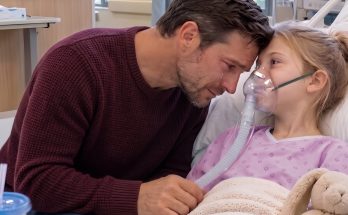
When we walked into Emma’s hospital room, the lights were dimmed. Our daughter was propped up against a stack of white pillows, her right cheek and neck covered in soft white gauze dressings. Her eyes were wide and tired, reflecting the gentle glow of the bedside monitor.
When she saw us, a small, tentative smile broke across her pale face.
“Mommy. Daddy.”
I rushed to the side of the bed, dropping our bag to the floor, and wrapped my arms gently around her, careful not to press against her bandaged cheek. Daniel sat on the edge of the mattress, burying his face in her small hands as his shoulders shook with silent, releasing sobs.
“We’re here, sweetheart,” I whispered, pressing my lips against her hair, breathing in the scent of hospital soap and antiseptic. “We’re right here. You’re safe.”
Emma blinked sleepily, her little fingers tightening around my sleeve. “Is Grandpa gone?”
The question hung in the quiet room, heavy with the weight of everything we had survived and everything we would have to heal from in the days and months to come.
I looked up, meeting Daniel’s eyes across the bed. Through the window, the first pale traces of a new morning were beginning to break along the horizon, banishing the shadows of the longest night of our lives.
“Yes, baby,” I whispered, brushing a stray lock of hair away from her forehead. “He’s gone. And we’re going to be okay.”
THE END..!