Vanessa punched the old four-digit code into the gate keypad and waited for the click.
Nothing happened.
She punched it in again, harder this time, her long acrylic nails tapping the buttons.
“What is wrong with this thing?”
“I changed the code,” I said.
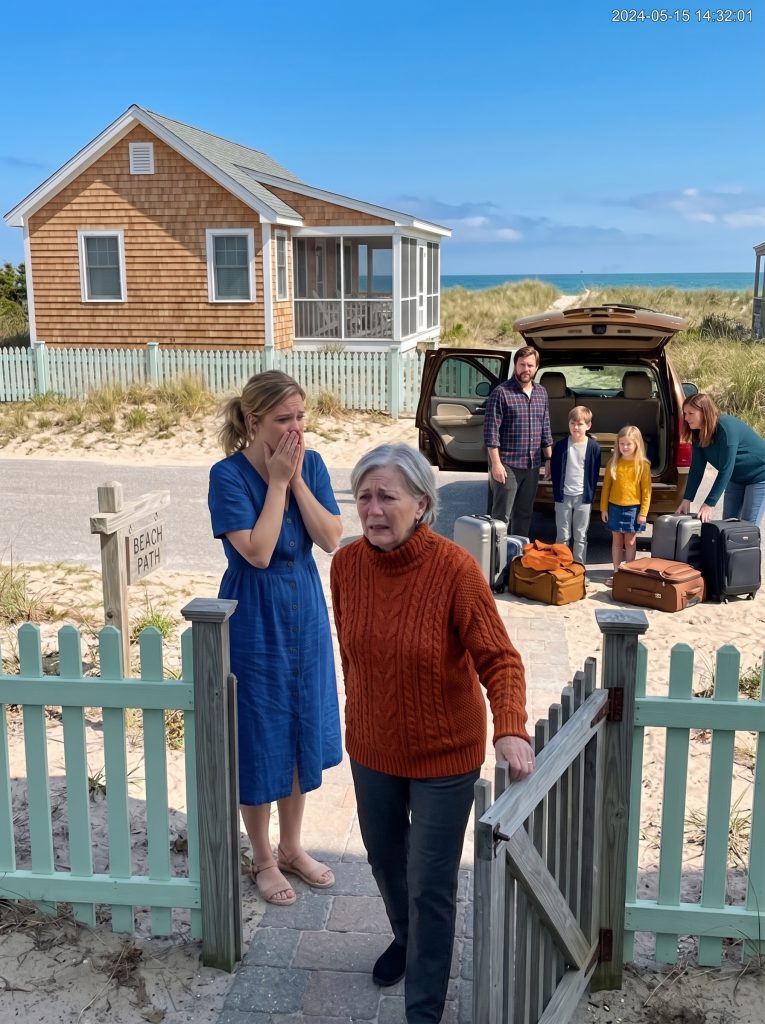
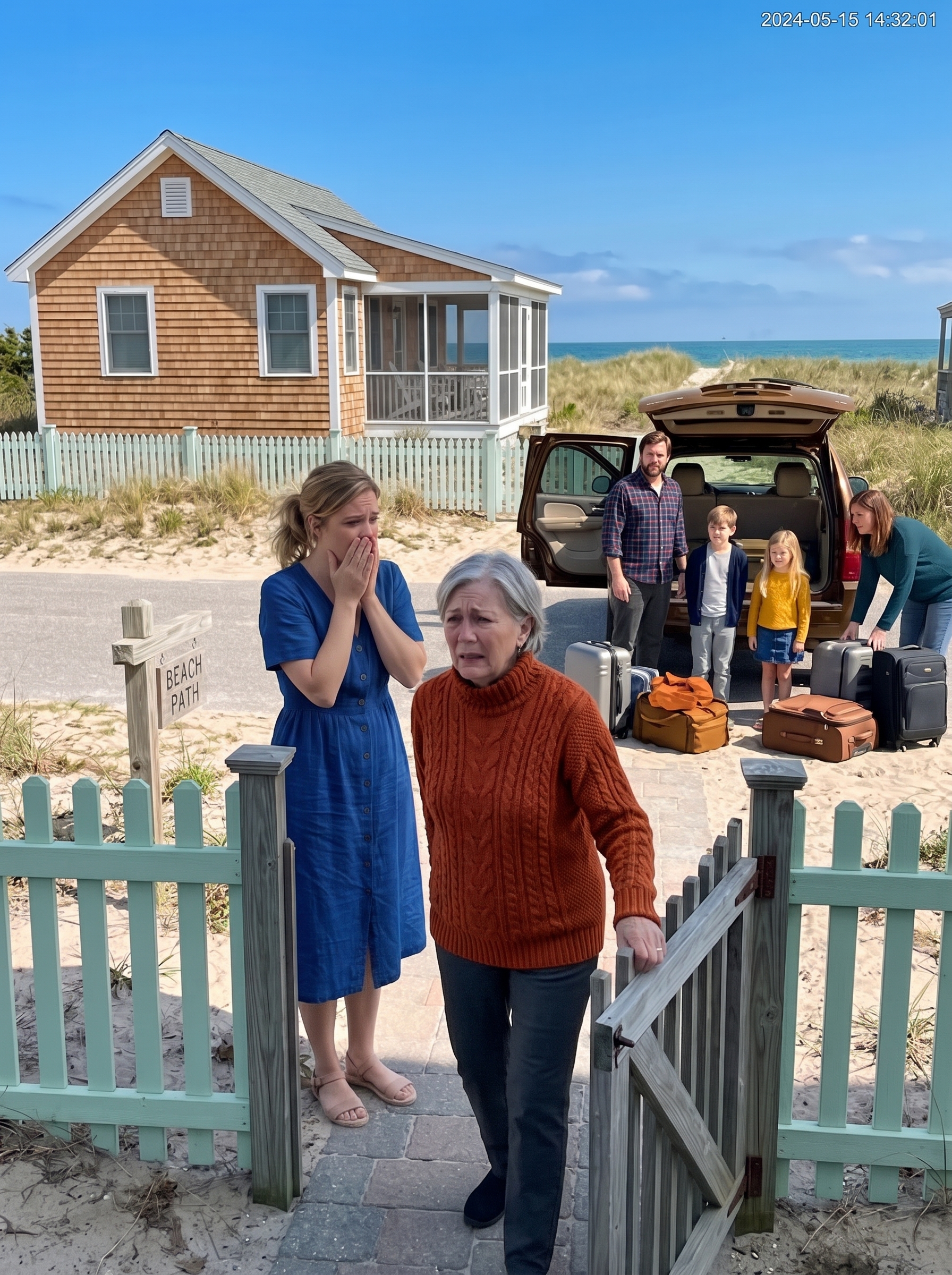
I was standing on the other side of the black iron gate in my gardening hat and an old linen shirt that had belonged to my husband. Behind me, my little gray-shingled house on Oak Island sat in the noon sun, its porch railings white against the blue North Carolina sky.
In front of me, two SUVs were parked crooked across my crushed-shell driveway. Five suitcases were strapped to the roof racks and stacked in the back. There was a cooler, a collapsible wagon, and a pink inflatable flamingo pressed against the rear window of Vanessa’s white Tahoe.
Vanessa turned slowly to look at me through the bars.
“I told you not to come,” I said.
She laughed, but there was less confidence in it than there had been in her text messages.
“Clara. The kids are already here.”
Her mother, Gloria, climbed out of the second SUV, a silver Highlander, fanning herself with a paperback novel.
“We drove five hours from Raleigh,” Gloria said. “In traffic. With a seven-year-old who gets carsick.”
My grandchildren, Mason, who was ten, and Ava, seven, pressed their faces against the Tahoe’s back window and waved at me. I waved back. None of this was their fault, and I wanted them to know I saw them.
My son, Ethan, got out last.
He was thirty-eight, tall like his father, with the same habit of rubbing the back of his neck when he was uncomfortable. He didn’t say anything. He just looked from his wife to me and back again, waiting for me to do what I’d always done.
He was waiting for me to give in.
“It’s only a few days,” Vanessa said. “You’re making this way harder than it needs to be.”
“This is my property,” I said.
Her voice softened into the sweet tone she used when she wanted something.
“At least let the kids in. They need to use the bathroom. We can talk about everything after.”
“No.”
This time I didn’t follow the word with an apology, an explanation, or a chance to negotiate. It just sat there in the salty air between us.
Vanessa stared at me through the locked gate.
“What am I supposed to tell my children?”
“The truth,” I said. “Tell them you brought them here after you were clearly told not to come.”
Ethan looked at the overloaded cars, the waiting children, and his wife’s hand still resting on the useless keypad. For the first time, I watched him understand that keeping the peace would require someone other than me to give in.
My name is Clara Whitaker. I’m sixty-six years old, and that house on Oak Island belongs to me and nobody else.
It isn’t big or modern. It has three bedrooms, two bathrooms, a screened porch facing the marsh, and a wooden walkway over the dunes to the beach. The kitchen still has the original 1987 cabinets. The outdoor shower drips no matter how many times you fix it. My husband, Robert, and I bought it in 1994 for $118,000, back when Oak Island was mostly fishermen and retirees and nobody from Raleigh or Charlotte had discovered it yet.
Robert died four years ago this June of pancreatic cancer. It took him eleven weeks from diagnosis to the end.
After he was gone, our house in Cary felt like a museum of everything I’d lost. Every room had his reading glasses on a side table, or his coffee mug in the cabinet, or the indentation in his recliner. I couldn’t breathe in that house.
So I sold it. With the proceeds and the money from Robert’s life insurance policy, I paid off the small remaining mortgage on the beach house, put the rest in savings and a conservative brokerage account, and moved to Oak Island full-time.
Our daughter, Lily, moved with me.
Lily was twenty-three that spring. She’s my quiet child, the one who notices everything and says almost nothing. When Robert was sick, she was finishing her last year at UNC Wilmington. She drove up every weekend to sit with her father and read to him from his favorite fishing magazines. After he died, she stopped sleeping. She stopped eating at the table. She’d sit in the corner of every room watching the doorways, as if she expected someone to walk in with bad news.
At the beach house, something changed. She started sleeping through the night. She took long walks on the beach at sunrise and came back with pockets full of shells. She got a job at the Oak Island library and started talking to me again, really talking, about books and the people she met and the little things that made her laugh.
That’s why that house was worth more to me than any mansion. It was the place where my daughter came back to life.
And it was the place my daughter-in-law had decided belonged to her.
The text came on a Monday morning in March. I was on the porch with my coffee, watching a great blue heron stalk through the marsh grass.
“We’re using your beach house for spring break. My kids and my mother are coming with me. Stock the kitchen before Thursday.”
I read it twice. It wasn’t a question. There was no “Could we stay?” or “Does that week work for you?” It was an announcement followed by a grocery list.
I started typing a polite explanation: I already had plans, I needed more notice, maybe another time. Then I deleted it, and I typed one word.
“No.”
Vanessa answered within seconds with three laughing-face emojis. Then: “We’re coming whether you approve or not. You barely use the place anyway.”
I live there, I thought. It’s my home. But I didn’t answer.
It wasn’t the first time she’d treated my permission like an optional courtesy.
It started with money, the way it so often does.
The first time was about eight months after Robert died. Ethan called and said, “Mom, we’re a little short this month. Vanessa’s hours got cut at the salon. Could you help with the mortgage? Just this once.” I sent him $2,100.
Then it was the kids’ school expenses: $600 for Mason’s travel soccer team, $450 for Ava’s dance recital costumes. Then Vanessa’s car needed new tires. Then there was a “temporary cash flow problem” because Ethan’s commission check from the HVAC company was late.
Each request seemed harmless on its own. I was a widow with savings, and my son had two young children. Robert would have helped. That’s what I told myself.
Then, last fall, I sat down at my kitchen table to go through my bank statements from Coastal Federal Credit Union. I do that every quarter, the way Robert taught me. He was an accountant for thirty-one years, and he used to say, “Clara, money doesn’t disappear. It goes somewhere. Always check where.”
I found transfers I didn’t remember making.
There was $480 in July to an account ending in 7712. In August, there was $650, then $1,200. In September, there was a transfer of $2,940, labeled “temp adjustment — will repay.”
The total over four months was $5,270.
I knew how it had happened. When Robert was dying, I was drowning: hospice paperwork, insurance claims, Social Security survivor benefits, the funeral home. Ethan offered to help. I gave him my online banking password so he could pay bills while I sat with his father. After the funeral, I never changed it.
I called him that night.
“Ethan, there are transfers out of my checking account I didn’t make. Over five thousand dollars.”
There was a long pause.
“Oh. Yeah. Vanessa handles our bills. She must have, um… she probably thought you’d approved those.”
“I didn’t approve them.”
“Mom, she’s under a lot of pressure right now. With the kids and her mom moving in with us, it’s been a lot. We’ll pay it back. Things will settle down.”
“Ethan…”
“You’ve always helped us, Mom. You know that.”
That was how it always went. Ethan thought silence prevented conflict. In reality, it just made sure I carried every uncomfortable consequence.
I changed my banking password that night. I never told Ethan the new one.
But I didn’t push for the money back. I didn’t want a fight. I told myself it was just money.
I didn’t know yet that the money was only a small part of it.
Gradually, Vanessa started calling the beach house “our place.”
“We should take the kids to our place for the Fourth,” she’d say at Sunday dinner in Raleigh, as if I weren’t sitting right there.
She assigned bedrooms before anyone had asked whether they could visit.
“Mom’s going to take the downstairs bedroom this time,” she announced at Thanksgiving. “Her knees can’t handle the stairs. The kids can share the bunk room. Ethan and I will take the master.”
The master bedroom was my bedroom.
Ethan kept eating his sweet potato casserole. Lily, sitting beside me, went very still. I stayed quiet because I didn’t want to cause tension at the table.
I was always the one expected to absorb the discomfort.
People rarely take someone else’s property in one dramatic moment. They start by testing the edges in ordinary conversations: a word here, an assumption there. They wait to see whether anyone objects, and when nobody does, they move a little farther.
The moment that finally frightened me involved Lily.
It was in January. We’d driven up to Raleigh for Ava’s seventh birthday, a party at a trampoline park in Cary. Afterward, everyone went to a pizza place. Mason and Ava were loudly deciding what everybody would do next: mini golf, then ice cream, then a movie.
Nobody asked Lily what she wanted. And before anyone could even turn to her, Lily stepped back from the group.
“It’s fine,” she whispered to no one. “Whatever everybody wants.”
She gave up her place before anyone could openly take it from her.
I knew that behavior instantly, because I’d done exactly the same thing for years: stepping back and saying it’s fine, making myself small so nobody had to be uncomfortable.
My daughter was learning it by watching me.
That night, driving home on I-40 in the dark, I glanced at Lily in the passenger seat. She was staring out the window at the passing headlights.
“Lily,” I said, “can I ask you something?”
“Sure.”
“When we were at the pizza place, and everybody was deciding what to do, what did you want to do?”
She was quiet for a long time.
“I wanted to go home,” she said finally. “To the beach house. I wanted to sit on the porch and read.”
“Why didn’t you say so?”
She shrugged. “Because Vanessa always gets what she wants, and you always let her. I figured it was easier not to try.”
I gripped the steering wheel so hard my knuckles turned white.
Two months later, when Vanessa sent that text about spring break, I understood that my silence had helped build this. And I decided it was going to stop with me.
I called Ethan that afternoon.
“I told Vanessa she can’t stay at the beach house over spring break.”
He let out a long, tired sigh. “Mom, they’ve already planned the whole trip. Vanessa took the week off. Gloria’s coming. The kids are so excited. Please don’t make this into a big thing.”
“My answer is no.”
“It’ll sort itself out.”
That sentence made everything clear. They’d heard my refusal. They just didn’t believe it would affect them.
That night, I did something I should have done years earlier. I sat at my kitchen table with a legal pad and a cup of chamomile tea, and I made a list of everything that belonged to me.
The house was titled in the name of the Clara A. Whitaker Revocable Trust. Robert and I set that up with an estate attorney in Wilmington in 2016, and after he died it became mine alone. Ethan was named as successor trustee. If I died or became incapacitated, he’d manage the house and my accounts for himself and Lily.
I stared at that line on my copy of the trust for a long time.
Then I opened my laptop and did something on a hunch. I searched for my own address on the big vacation rental websites.
On the third website, I found it.
The listing was titled “Charming Oak Island Beach Cottage — Steps to the Sand! Sleeps 8!”
There were eighteen photographs of my house: my screened porch, my kitchen with the 1987 cabinets, my bedroom with the blue and white quilt Robert’s mother made. There was even a photo of the dune walkway at sunset that I recognized because I took it myself and posted it on Facebook two summers earlier.
The listing said: “Hosted by Vanessa. Superhost. 4.9 stars, 23 reviews.”
The nightly rate was $285 in the off-season and $425 in summer, with a $175 cleaning fee.
My hands were shaking. I scrolled down to the reviews.
“Perfect little cottage! Vanessa was so responsive and the keypad check-in was easy!” That was from a family in Charlotte, dated last October.
“Loved the porch and the beach access. Only complaint: the outdoor shower drips.” That was from a couple in Asheville, dated November.
“Great stay! We’ll be back!” That was from a group of four from Greensboro, in January.
In January. Lily and I had gone up to my sister’s house in Durham for a week after New Year’s.
I checked the calendar on the listing. The house was blocked as booked for every one of the dates Lily and I had been away over the past eleven months: the week at my sister’s, the long weekend in October when I went to a friend’s daughter’s wedding in Savannah, the three nights at Thanksgiving when we were in Raleigh.
And it was blocked as booked for the week after spring break, April 7th through 14th, along with most of June.
For almost a year, my daughter-in-law had been renting out my home to strangers while I was away, using the gate code and the house key I’d given Ethan for emergencies.
I counted the reviews. I counted the nights. I did the math the way Robert taught me.
At the rates listed, minus the website’s fee, Vanessa had collected somewhere between $12,000 and $15,000 renting my house.
I didn’t sleep that night.
At five the next morning, I got in my car and drove to the house. It was only six minutes from where I’d been parked. I’d been staying a couple of nights at a friend’s condo on Caswell Beach while the floors were refinished, which explained a lot about why Vanessa thought the house would be empty.
The house was exactly as I’d left it: quiet and clean, smelling faintly of cedar and salt air.
But now that I knew, I saw things I’d missed. A cheap plastic laminated sign was taped inside the kitchen cabinet door: “WIFI: OakIslandCottage / Password: beachlife2024. Please start dishwasher before checkout! Thanks, Vanessa.” There was an extra set of cheap white towels in the hall closet I’d never bought, and a lockbox, the kind realtors use, hanging under the porch stairs where I’d never think to look.
I photographed all of it.
Then I changed the security gate code and tested the new one three times. I called a locksmith in Southport, a gruff old man named Hank Stevens who’d changed the locks for Robert and me back in 1994, and he came out by eight o’clock and rekeyed every lock in the house for $185.
“Somebody bothering you, Mrs. Whitaker?” he asked.
“Family,” I said.
He grunted. “Worst kind.”
Then I called Coastal Security Systems, the company that monitors the house’s alarm. I explained that several people might show up with luggage over the next few days, and that none of them had permission to come in.
“Are you expecting a confrontation, ma’am?” the young man on the phone asked.
“I’m expecting them to show up,” I said.
He added a note to my account. If the alarm was triggered or anyone tried to force the gate, they’d call me and the Brunswick County Sheriff’s Office immediately.
At ten o’clock, I called the attorney who drew up our trust in 2016, Margaret Hale of Hale & Associates on Front Street in Wilmington. She was in her sixties now, sharp and calm, and she remembered Robert.
“Clara,” she said, “I’m so sorry I haven’t checked on you. How are you?”
“I need help, Margaret.”
I told her everything: the transfers from my checking account, the vacation rental listing, the reviews, the lockbox under my porch stairs.
Margaret was quiet for a long moment.
“First,” she said, “do not confront Vanessa about the rental listing yet. Screenshot everything. Every photo, every review, the calendar, the host profile. Do it today, before she figures out you know and takes it down.”
“I already did. Last night.”
“Good. Second, change the successor trustee on your trust. I can have an amendment ready by Friday. Who do you want instead of Ethan?”
I thought about it. “Lily. And maybe someone independent. A bank, or a professional.”
“Lily and First Citizens Bank as co-trustees,” Margaret said. “That way Lily isn’t carrying it alone, and nobody can pressure her. Third, what are you planning to do when they show up?”
“Not let them in.”
“Good. It’s your property, titled in your trust. You don’t have to let anyone in. If they refuse to leave, call the sheriff. In North Carolina, once someone’s been told they’re not allowed on your property and they stay anyway, that’s second-degree trespass. The deputies know how to handle it.”
“Margaret, what about the money? The rentals?”
“That’s a bigger conversation,” she said. “And I want you in my office to have it. Can you come Friday at two?”
“I’ll be there.”
That was how I came to be standing behind my own locked gate on Thursday afternoon, watching my daughter-in-law punch the wrong code into the keypad.
After I told her to tell her children the truth, Vanessa stared at me for a long moment. Then she pulled out her phone.
“Fine,” she said. “I’m calling the police.”
“Go ahead,” I said.
She looked surprised that I didn’t argue.
She dialed. I heard her say, “My mother-in-law has locked us out of our vacation house,” and, “We have a right to be here,” and, “She’s being unstable.”
Ethan put his hand on her arm. “Vanessa…”
She shook him off.
While we waited, Gloria walked up to the gate.
“Clara,” she said in a syrupy voice, “I know you’ve had a hard few years since your husband passed. Grief makes people do strange things. But you’re punishing your grandchildren. Is that really what Robert would want?”
That was a mistake.
“Gloria,” I said, “Robert spent thirty-one years as an accountant. If he were standing here, the first thing he’d want to know is why there’s a lockbox hanging under my porch stairs that I didn’t put there.”
Gloria’s face went blank. Vanessa’s head snapped toward me.
Twenty minutes later, a Brunswick County Sheriff’s cruiser pulled into my driveway. A deputy got out, a tall, sunburned man in his forties whose name tag read DEPUTY R. COLLINS.
“Afternoon, folks,” he said. “Somebody call about a property dispute?”
“I did,” Vanessa said, stepping forward. “This is our family beach house. My husband’s family. And his mother has changed the locks to keep us out. We have small children. We’ve been coming here for years.”
Deputy Collins looked at me. “Ma’am?”
I’d brought a folder out with me. I handed him a certified copy of the deed, recorded at the Brunswick County Register of Deeds in 2016. It showed the house titled to the Clara A. Whitaker Revocable Trust, with me as sole trustee. Under it was a copy of my North Carolina driver’s license with this address on it, and my property tax bill for $3,840, paid in January.
“This is my house,” I said. “I live here full-time with my daughter. I told my daughter-in-law by text on Monday that she couldn’t stay here. I told her again just now. They don’t have a key or my permission.”
The deputy read the deed. Then he looked at Vanessa.
“Ma’am, is your name on this property anywhere?”
Vanessa opened her mouth. “Well, not technically, but…”
“Is your husband’s?”
Ethan looked at the ground. “No, sir.”
“Do you have a lease? A rental agreement? Anything in writing giving you a right to stay here?”
Vanessa hesitated a fraction of a second too long. “No.”
Deputy Collins handed the deed back to me.
“Folks,” he said, not unkindly, “I understand this is a family situation, and I’m sorry it’s come to this, with the little ones here and all. But the homeowner has told you you’re not welcome. That means you need to leave. If you come back onto the property after being told to stay off, that’s trespassing, and I’d have to cite you.” He glanced at the children in the Tahoe. “There’s plenty of hotels in Southport. Nobody has to sleep in their car tonight.”
Vanessa stared at him. “You’re taking her side?”
“I’m not taking anybody’s side, ma’am. I’m just reading the deed.”
They left.
It took them ten minutes to turn the SUVs around in my narrow shell driveway. Vanessa didn’t look at me. Gloria muttered something about elder abuse. Mason waved at me through the window, confused, and Ava was crying.
That nearly broke me. I walked to the edge of the gate and waved back at both of them until the cars disappeared around the bend on Oak Island Drive.
Ethan was the last one in. He stood by the driver’s door of the Highlander and looked at me across the shells.
“Mom,” he said quietly, “what was that about a lockbox?”
I looked at my son for a long moment.
“Ask your wife,” I said. “Then call me. Just you.”
He got in the car and drove away.
Deputy Collins lingered by his cruiser, writing in a notebook.
“Ma’am, you mentioned a lockbox,” he said. “You want to tell me about that?”
So I showed him: the lockbox under the stairs, the laminated Wi-Fi sign in the kitchen cabinet, and the rental listing on my phone with eighteen photos of my house and twenty-three reviews from strangers who’d slept in my bed.
He whistled softly. “That’s a new one.”
“Is it illegal?”
“Renting out somebody else’s house without permission and keeping the money?” He shook his head. “That’s not really a sheriff’s call today. That sounds like a conversation with a lawyer, and maybe the DA’s office if it comes to that. But I’ll put it in my report.” He handed me a card with the incident number. “If they come back, you call 911. Don’t argue with them yourself.”
“Thank you, Deputy.”
“For what it’s worth, ma’am,” he said, getting into his cruiser, “you handled that better than most folks would have.”
After he left, I sat down on my porch steps, and my whole body started to shake.
The screen door creaked behind me. Lily came out with two glasses of iced tea and sat down next to me without a word. She’d been inside the whole time. I’d asked her to stay in, so she wouldn’t have to be part of it.
“I watched from the window,” she said quietly.
“I’m sorry, honey.”
“Don’t be.” She handed me a glass. “Mom, you didn’t apologize. Not once. You just kept saying no.”
“I know.”
She looked out at the marsh, where the heron was still hunting in the shallows.
“I didn’t know you could do that,” she said.
I put my arm around her.
“Neither did I,” I said.
Ethan called me at 9:40 that night. He was alone, sitting in the parking lot of a Hampton Inn in Southport, with Vanessa, Gloria, and the kids asleep upstairs in two rooms that cost $219 a night.
“Mom,” he said. His voice sounded strange. “I asked her about the lockbox.”
“And?”
“At first she said it was for emergencies. In case we ever needed to get in when you weren’t home.” He paused. “Then I asked her to show me her phone. And she wouldn’t.”
“Ethan…”
“So I logged into our joint checking account on my phone. I never look at it. Vanessa handles everything. I just get my paycheck deposited, and she pays the bills.” He took a ragged breath. “Mom, there are deposits from a vacation rental company. Every month or two for almost a year. Twelve, thirteen, fourteen hundred dollars at a time.”
I closed my eyes.
“How much altogether?” I asked.
“I added it up in the car. $13,870.” His voice cracked. “Mom, I didn’t know. I swear to God, I didn’t know. She told me she was picking up extra clients at the salon. She said she was doing weekend bridal parties.”
“I believe you.”
“When I asked her, she said, ‘Your mom never uses that house. It’s just sitting there. Why shouldn’t somebody make money off it?’” He laughed bitterly. “Like it was a perfectly reasonable thing to do. Rent out my mother’s house behind her back.”
“Ethan, there’s more,” I said. “The transfers from my checking account last fall. The $5,270.”
“She told me you’d approved those. She said you offered.”
“I didn’t.”
There was a long silence.
“She used my login,” he said slowly. “The one you gave me when Dad was sick. She knows all my passwords. I never…” He stopped. “Oh my God, Mom.”
I could hear him crying, quietly, in the dark parking lot of a hotel. It was the first time I’d heard my son cry since his father’s funeral.
“I’m sorry,” he said. “I’m so sorry. I kept telling you things would settle down. I kept telling you not to make it a big thing. And the whole time…”
“I know, honey.”
“Why didn’t you tell me?” he asked. “About the transfers? Last fall?”
“I did tell you,” I said gently. “You said Vanessa was under a lot of pressure. You said you’d pay it back. You said I’d always helped you.”
He went quiet for a long time.
“I did say that,” he whispered.
“I’m meeting with Margaret Hale tomorrow,” I said. “My attorney in Wilmington. Two o’clock.”
“Can I come?”
I thought about it.
“Yes,” I said. “But only if you’re coming to listen. Not to make excuses for her.”
“I’ll be there,” he said.
Margaret Hale’s office was on the second floor of an old brick building on Front Street in downtown Wilmington, overlooking the Cape Fear River. There were tall windows, worn Oriental rugs, and law books with cracked leather spines lining every wall.
Ethan was waiting on the sidewalk when I arrived. He looked like he hadn’t slept at all. He was wearing yesterday’s clothes.
“Vanessa took the kids and her mom back to Raleigh this morning,” he said. “She’s not speaking to me.”
“Okay.”
“She says I betrayed her by siding with you.”
“Did you?”
He thought about it. “I don’t think so. I think I just finally looked at the bank statement.”
Upstairs, Margaret went through everything slowly and carefully: my screenshots of the rental listing and all twenty-three reviews, my photos of the lockbox and the laminated Wi-Fi sign, my credit union statements showing $5,270 in transfers to an account ending in 7712, and Deputy Collins’s incident report.
Then Ethan slid a printout across the desk. It was the statement from his joint checking account at a bank in Raleigh, showing the deposits from the rental platform, eleven of them totaling $13,870. The account ending in 7712 was theirs.
Margaret read it twice. Then she took off her reading glasses.
“Clara, Ethan, I’m going to tell you what this is, in plain English,” she said. “And then I’m going to tell you what your options are.”
We waited.
“Vanessa took a key and a gate code that were given to Ethan for emergencies. She used them to rent your home to strangers without your knowledge, and kept the money. That’s not a family misunderstanding. In civil terms, it’s conversion and unjust enrichment. She took something of value that belonged to you and profited from it. You can sue her to get that money back, plus interest. Depending on the facts, a court could also award damages for the use of your property, and potentially more.”
“And the transfers from my checking account?”
“If she used Ethan’s login to move money from your account into theirs without your permission, that’s even more serious. That’s unauthorized access to your financial accounts. If the district attorney chose to pursue it, it could be a criminal matter.”
Ethan put his face in his hands.
“There are other problems too,” Margaret went on. “Clara, does your homeowner’s insurance policy cover short-term rentals?”
“I don’t think so.”
“It almost certainly doesn’t,” Margaret said. “Most standard homeowner’s policies exclude business use. If one of those renters had slipped on your dune walkway and broken a leg, your insurance company would likely have denied the claim. The renter could have sued you personally. You could have lost the house.”
My stomach dropped.
“And the Town of Oak Island and Brunswick County both require short-term rental owners to register and collect occupancy taxes. Six percent combined, if I remember right. If Vanessa collected rent on your property and never paid those taxes, the county could come after the property owner, which is you, for the unpaid taxes and penalties.”
“So she put my house at risk,” I said slowly. “Not just took money. Put my house at risk.”
“Yes,” Margaret said.
“What do you want to do, Clara?” Margaret asked.
I looked at my son. He was sitting very still, staring at the printout of his own bank statement.
“I don’t want to destroy my son’s family,” I said. “I don’t want my grandchildren to see their mother arrested.”
Ethan looked up. “Mom…”
“But I’m not going to pretend this didn’t happen,” I said. “I did that for four years, and all it did was teach everyone, including my own daughter, that I’d always step back.”
Margaret nodded. “Then here’s what I recommend. We send Vanessa a formal demand letter. It will lay out exactly what she did and what she owes. The $13,870 in rental income, the $5,270 in unauthorized transfers, and the occupancy taxes and penalties we’ll calculate with the county, plus my fees. We’ll give her thirty days to pay or agree to a payment plan, and to take down the listing and cancel every future booking, today. If she refuses, we file suit in Brunswick County Superior Court.”
“What about the people who booked for April and June?” I asked. “They’ve already paid her.”
“That’s her problem,” Margaret said firmly. “She has to cancel them and refund their money. But Clara, I’d also contact the rental platform directly. You’re the property owner. They’ll want to know their host has been listing a house she doesn’t own.”
“And the criminal part?”
“That’s your decision. You don’t have to make it today. But the evidence will keep.”
I looked at Ethan. “Ethan, I need to ask you something, and I need you to be honest.”
“Okay.”
“Do you want to be part of this letter? As in, are you going to stand with your wife, or with me?”
He was quiet for a long time. Through the tall windows, a tugboat was pushing a barge slowly up the Cape Fear.
“I’m not choosing between you and Vanessa,” he said finally. “I’m choosing between right and wrong. And what she did was wrong.” He took a deep breath. “And what I did, telling you not to make a big deal, telling you things would settle down, was wrong too.”
He turned to Margaret.
“The $5,270 came out of my mother’s account into our joint account. I’m a joint owner of that account. I want to pay that back myself. Today. From my own savings.”
Margaret raised her eyebrows. “Ethan, you don’t have to do that. The demand can be directed to Vanessa.”
“I know,” he said. “But I gave her the password. I let it happen. And I’m the one who told my mother she was overreacting.” He pulled out his phone. “What’s the routing number for your account, Mom?”
Before we left Margaret’s office that afternoon, $5,270 was back in my account at Coastal Federal Credit Union.
Margaret’s demand letter went to Vanessa by certified mail and email the following Monday. It was four pages long, calm and precise, with nineteen exhibits attached. One was a screenshot of every review. Another was a photo of the lockbox under my porch stairs. And there was a copy of the joint bank statement showing $13,870 in payouts from the rental platform.
I also called the rental platform’s trust and safety department myself. A patient young woman named Priya listened to my story and asked me to upload a copy of my deed and my driver’s license.
Two days later, Priya called back.
“Mrs. Whitaker, we’ve reviewed the documentation. We’ve permanently deactivated the listing and suspended the host account. All future reservations have been canceled, and the guests are receiving full refunds.” She paused. “I also want you to know we’ve flagged the host’s account for a fraud investigation. Listing a property you don’t own or have permission to rent violates our terms of service.”
“What happens to the families who booked for April and June?”
“They’ll get their money back from the host’s pending payouts. And our team is reaching out to help them find other accommodations on Oak Island. One of the families booked with us for six years running. They were very upset to hear the cottage was never really available.”
“Please tell them I’m sorry,” I said.
“Mrs. Whitaker,” Priya said gently, “you have nothing to apologize for.”
Vanessa didn’t call me. She didn’t answer Margaret’s letter for twenty-six days.
On the twenty-seventh day, Margaret got a call from an attorney in Raleigh representing Vanessa Whitaker. He wanted to talk about “resolving the matter amicably.”
They settled three weeks later. Vanessa agreed to repay the full $13,870 in rental income, plus $1,260 in Brunswick County and Town of Oak Island occupancy taxes and penalties, which Margaret had calculated with the county tax office, plus $2,400 toward my attorney’s fees. That came to $17,530, payable in eighteen monthly installments of $973.89, guaranteed by a confession of judgment Margaret insisted on. If Vanessa missed a single payment, Margaret could have a judgment entered against her in Brunswick County Superior Court immediately, without another lawsuit.
Vanessa also agreed in writing never to enter my property, list it, rent it, or represent it as her own again.
I didn’t pursue criminal charges for the transfers from my checking account.
“Are you sure?” Margaret asked when she brought me the settlement papers to sign.
I thought about Mason waving at me through the window of the Tahoe, and Ava crying in the back seat.
“I’m sure,” I said. “Ethan paid it back. And those children need their mother more than I need to see her in a courtroom.”
Margaret looked at me over her glasses. “You’re a better woman than most, Clara.”
“No,” I said. “I’m just a woman who finally said no. That turns out to be enough.”
That Friday, after we signed the settlement, I went back to Margaret’s office to sign the trust amendment.
Lily came with me. It was the first time I’d ever brought her to anything having to do with money. I wanted her to understand it.
“Lily,” Margaret said, sliding the document across her desk, “your mother is naming you and First Citizens Bank as co-successor trustees of her trust. That means if anything ever happens to her, you and a professional trust officer at the bank would manage the beach house and her accounts together. You’d make decisions for yourself and your brother. Do you understand what that means?”
Lily looked at the papers, then at me.
“Why me?” she asked quietly. “Why not Ethan? He’s older.”
“Because you see things,” I said. “You notice everything. You always have. And because I want the person in charge of this house to be someone who loves it the way your father did. Not as something to use, but as somewhere to live.”
Lily’s eyes filled with tears.
“And the bank?” she asked.
“So nobody can ever pressure you into giving it away,” Margaret said. “Not your brother, not your sister-in-law, not anybody. If someone wants something from the trust, they’ll have to get past a trust officer with a law degree and absolutely no interest in being nice.”
Lily laughed through her tears.
She signed her acknowledgment as successor co-trustee. Margaret’s paralegal notarized it, and the amendment went into my file.
On the drive home down Highway 17, Lily was quiet for a long time.
Then she said, “Mom? Can I tell you something?”
“Of course.”
“When we were at the pizza place in January, and I said ‘It’s fine, whatever everybody wants,’ I saw your face. You looked like somebody had hit you.”
“I felt like somebody had.”
“I’ve been thinking about it ever since,” she said. “About how I always step back, and how I learned it from watching you.” She looked out the window at the passing pines. “And then I watched you at that gate. You didn’t step back. Not one inch.”
“No,” I said. “I didn’t.”
“I want to learn that too,” Lily said.
I reached over and squeezed her hand.
“Then we’ll learn it together,” I said.
Ethan and Vanessa separated in June.
It wasn’t because of me, or not only because of me. Ethan told me later that the rental listing and the transfers were the first time he’d really looked at the family finances, and once he started looking, he couldn’t stop. There were credit cards in his name he’d never opened, with $22,000 in balances. There was a home equity line of credit on their house in Raleigh that Vanessa had taken out by signing his name to the application, with $41,000 drawn. A $3,800 payment to a jeweler in North Hills had never shown up in any piece of jewelry he’d seen.
“She was drowning, Mom,” he said, sitting on my porch one evening in July with a glass of sweet tea. “Credit cards, the salon, her mom’s medical bills after Gloria’s hip surgery. And instead of telling me, she just kept finding money wherever she could. Your account. Your house. My name on applications I never saw.”
“Are you going to be okay?”
He rubbed the back of his neck. “I talked to a lawyer in Raleigh. A family law attorney. She says the credit cards and the home equity line might be considered Vanessa’s separate debts, since she forged my signature. I filed fraud reports with the credit bureaus and the bank.” He sighed. “It’s going to be a long year.”
“And the kids?”
“We’re working out custody. Fifty-fifty, probably. Vanessa’s a good mom, in her way. She loves them. She just…” He trailed off.
“She just treated everyone else’s things like they were hers,” I said.
“Yeah.” He looked out at the marsh. “Mom, I’m sorry. For all of it. For the ‘it’ll sort itself out’ and the ‘don’t make it a big thing.’ You were the only person in the family telling the truth, and I kept asking you to stop.”
“You stopped asking,” I said. “That’s what matters.”
He was quiet for a while. Then he said, “Can I bring the kids down next weekend? Just me and them. I’ll get a hotel.”
I looked at my son, really looked at him, for the first time in years. I didn’t see the boy who used to defend his wife over every disappointment. I saw a man who’d finally started looking at the numbers himself.
“You don’t need a hotel,” I said. “The bunk room’s open. But you’ll need to ask Lily.”
Ethan blinked. “Lily?”
“She’s co-trustee now,” I said. “And she lives here too. It’s her home as much as mine. So you ask her.”
He turned toward the screen door, where Lily was sitting inside at the kitchen table with a library book.
“Lil?” he called. “Can I bring Mason and Ava down next weekend? Would that be okay with you?”
Lily looked up from her book. For a long moment, she didn’t answer. I watched her think about it, really think about it, the way she never used to.
Then she said, “Yes. But Mason has to help me wash the porch, and Ava has to come shell hunting with me at sunrise. Those are my conditions.”
Ethan laughed, the first real laugh I’d heard from him in months.
“Deal,” he said.
They came the following Saturday.
Ethan drove down from Raleigh in the Highlander, alone with the kids. He’d picked it up from Gloria, who had moved into a senior apartment in Garner and given up driving.
When the car pulled up to the gate, Ethan didn’t punch in a code. He rolled down the window and pressed the call button on the keypad.
My phone rang. I looked at the camera feed on my screen: my son, my grandson, and my granddaughter, all waving at the little lens.
“It’s us, Mom,” Ethan said. “Can we come in?”
I pressed the button, and the gate swung open.
Mason helped Lily wash the porch with a hose and a bucket of soapy water. He got more water on himself than on the porch. Ava went shell hunting with Lily at sunrise on Sunday and came back with a lightning whelk the size of her hand, the best one any of us had found all year. She made Lily promise to keep it on the kitchen windowsill until the next time she visited.
That evening, after the kids were asleep in the bunk room, Ethan and I sat on the porch watching the last of the light go pink over the marsh.
“Mom,” he said, “the kids asked me something today.”
“What’s that?”
“Ava asked why we couldn’t come in that day in March. When Mommy brought us and Grandma locked the gate.” He looked down at his hands. “She asked if Grandma was mad at her.”
My heart squeezed. “What did you tell her?”
“I told her the truth,” he said. “Like you told Vanessa to.” He took a breath. “I told her that Grandma’s house belongs to Grandma, and you have to ask before you go into somebody’s house. And that Mommy didn’t ask, and Grandma said no, and that was Grandma’s right.”
“What did Ava say?”
Ethan laughed softly. “She said, ‘That’s like when Mason comes in my room without knocking.’”
I laughed too, and it surprised me how good it felt.
“She gets it,” I said.
“She gets it better than I did,” Ethan said. “For thirty-eight years.”
It’s been almost a year since my daughter-in-law stood at my gate and punched in the wrong code.
Vanessa has made every payment on time, eleven of them so far, each one $973.89, wired on the first of every month to my account at Coastal Federal Credit Union. We don’t speak much. When we do, at a soccer game or a birthday party, she’s polite and careful, and so am I.
Last month, at Ava’s eighth birthday party, she walked up to me by the snack table.
“Clara,” she said quietly. “Can I say something?”
I braced myself. “Of course.”
“I’m in therapy,” she said. “Have been since January. My therapist says I have a problem with boundaries. That I treat other people’s things like they’re mine because I grew up never having anything that was mine.” She looked down at her paper plate. “I’m not making excuses. I’m just telling you. I’m working on it.”
“I’m glad, Vanessa,” I said, and I meant it.
“Mason says the porch is the best place in the world,” she said. “He talks about it all the time.”
“He’s welcome on that porch any time,” I said. “When he’s invited.”
Vanessa almost smiled. “When he’s invited,” she repeated. “I’ll remember that.”
Lily turned twenty-four in February. She got a promotion at the library to youth services coordinator. She runs a story time every Saturday morning for little kids, and twelve families come every week. She’s started saying no to things she doesn’t want to do. Last month she even told me no, when I asked her to drive me to a doctor’s appointment on her day off.
“I’ll drive you on Thursday instead,” she said. “Saturday is my porch day.”
I nearly cried, I was so proud.
This morning, I woke up before sunrise and took my coffee out to the porch. The heron was back in the marsh, standing perfectly still in the shallows with the light just starting to come up pink and gold over the water.
Lily came out a few minutes later with her own mug and sat down next to me on the porch swing Robert built in 1996.
We didn’t talk for a while. We just watched the heron and the light.
“Mom?” Lily said finally.
“Hm?”
“Thank you for not letting them in.”
I put my arm around her shoulders.
“Thank you for watching,” I said. “That’s why I finally did it. I didn’t want you to learn to step back.”
She leaned her head on my shoulder, the way she used to when she was little.
“I didn’t,” she said. “I learned to say no.”
For years I believed being a good mother and grandmother meant always saying yes: opening my wallet, unlocking my door, making room no matter what it cost me.
But my daughter-in-law taught me something without meaning to. She texted me a list of instructions, I answered with one word, and she laughed and asked what exactly I was going to do.
I did exactly what I’d planned. I changed the code and locked the gate, and then I stood behind it and told the truth.
In the end, it wasn’t the locked gate that changed my family. It was my daughter watching from the window, seeing her mother refuse to step back for the first time in her life, and deciding she didn’t have to step back either.
THE END..!