But what I discovered after checking the security cameras exposed
a shocking betrayal by my own family—and soon, I was filing a police report.
“Where are my wife and sons?” I asked as I unlocked the front door, but
the only answer was the faint, weak cry of two newborns echoing from the kitchen.
It was almost 11:30 PM on New Year’s Eve. I was supposed to still be in
Stuttgart, Germany, inspecting industrial machinery until the first week
of January. But I had swapped my flight, paid a fortune for a last-minute seat,
and flown back to New York without telling a soul. I wanted to surprise Joanna,
my wife, who had given birth via emergency C-section eleven days prior,
and hold our newborn twin sons, Wyatt and Hudson, for the very first time. In
my luggage, I had thermal clothes for the babies, recovery lotions for Joanna,
chocolates for my mother, and an expensive bottle of perfume for my sister,
Bethany. I still foolishly believed they all deserved gifts.
Our apartment in Park Slope, Brooklyn was dark, freezing, and devoid of
any sign of a New Year’s Eve celebration. No festive spread, no champagne,
not even leftovers. In the living room, I found used diapers, an open tub of
cheap formula, and empty glasses scattered around. I walked toward the
kitchen, and my heart dropped into my stomach.
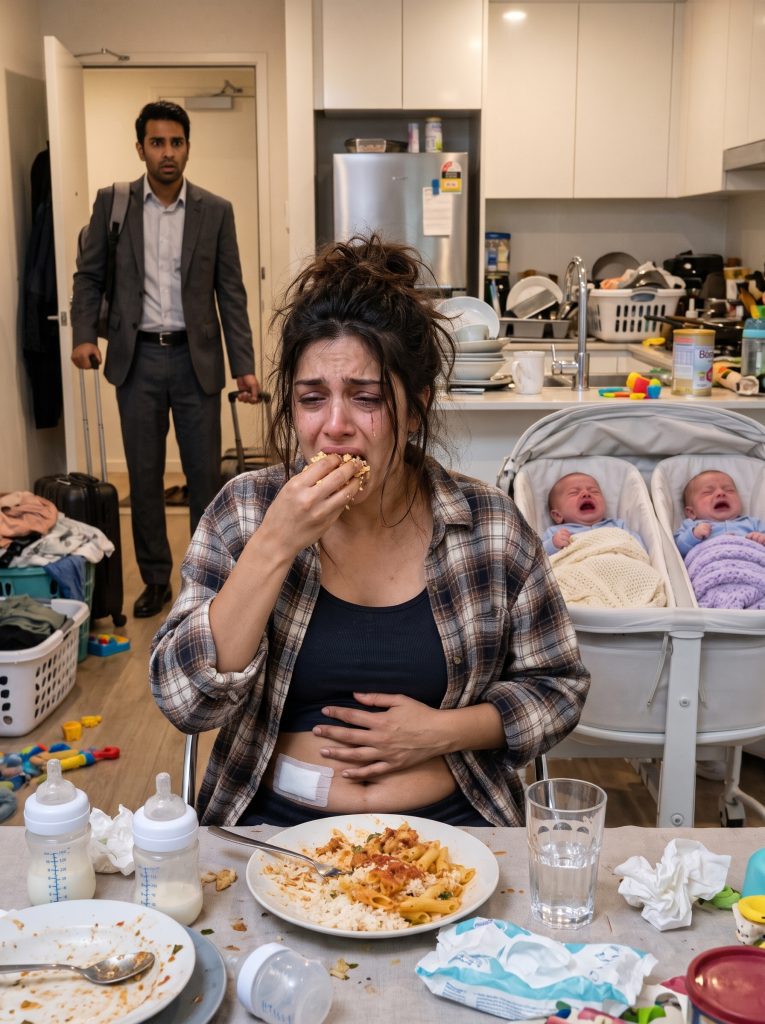
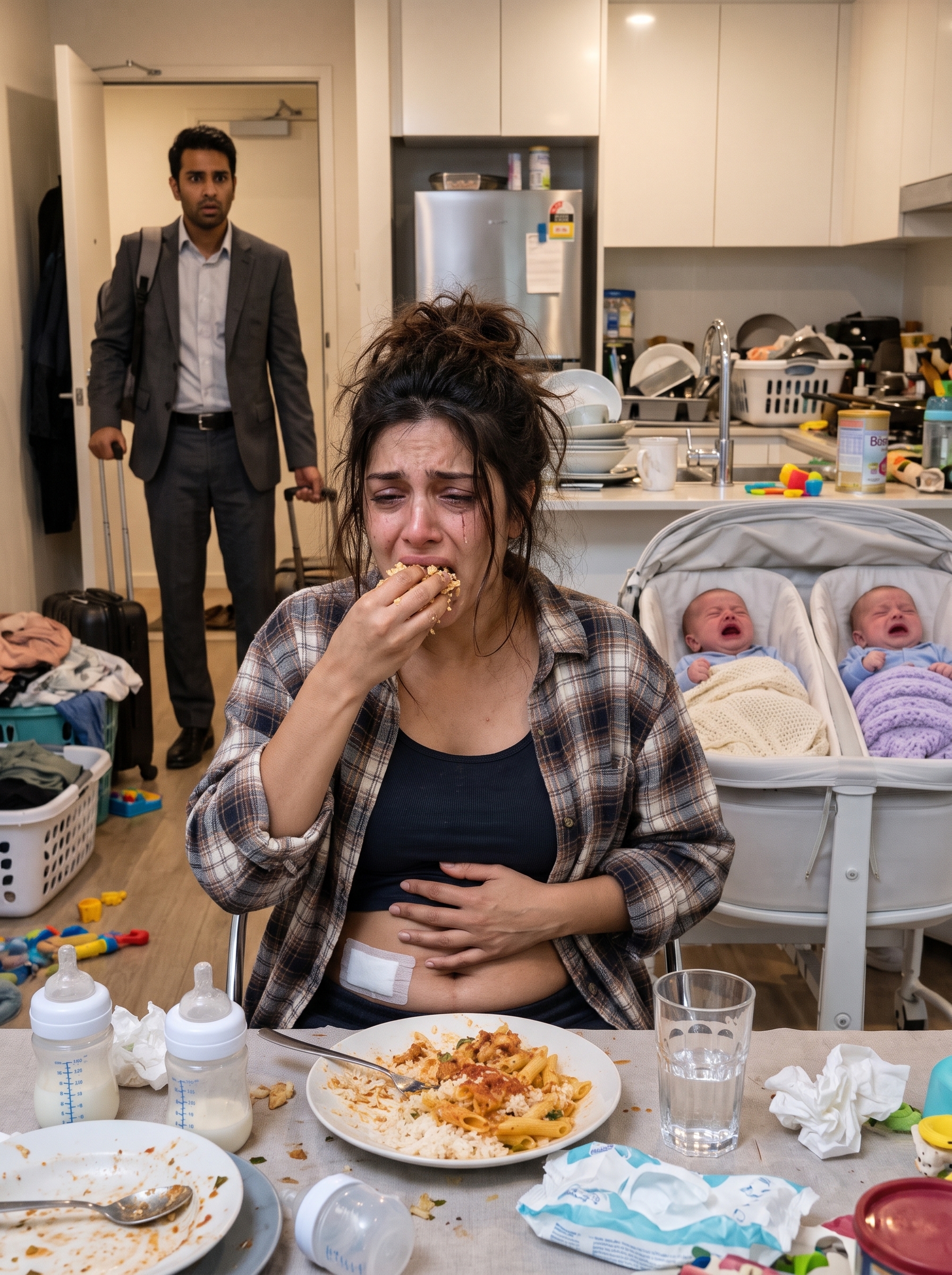
Joanna was huddled in a hard plastic folding chair, wearing thin pajamas and
an old cardigan. Her face was ash-gray, her lips chapped and bleeding, and one
hand pressed tightly against her surgical incision. The fabric was stained with blood.
Sitting in front of her was a plastic cup of instant ramen noodles, lukewarm,
swollen, and looking like wallpaper paste. Wyatt and Hudson were crying softly
inside a wicker bassinet, bundled together beneath a blanket far too thin for a December night.
“Gavin… why are you back?” Joanna stammered, trying to stand up. “Go rest. I’ll… I’ll make you something to eat.”
Her legs buckled beneath her. I caught her before she slammed onto the hardwood floor.
“Where are my mother, Bethany, and Trevor? Where is all the food I bought?” I asked, my voice shaking. “I wired them fourteen thousand dollars to take care of you!”
Joanna lowered her eyes, unable to meet my gaze.
“They went to Miami for a few days. I just wanted some soup, that’s all. Please, Gavin, don’t make a scene. Your mother said a woman recovering from surgery needs to eat light to ‘cleanse’ her system.”
I yanked open the refrigerator. It was completely bare. The platters of smoked salmon, prime beef, broths, fresh fruit, milk, vitamins, and even the twins’ imported prescription formula were gone. Taped to the inside door was a note written in my mother Margaret’s sharp, haughty handwriting:
We went down to South Beach to ring in the New Year with Bethany, Trevor, Preston, and his family. Make do with whatever is in the pantry. Don’t go crying to Gavin and playing the victim. He’s working hard for all of us.
Joanna clutched my arm, her eyes wide with terror.
“Please don’t confront her. She’ll just say I turned you against her.”
I didn’t yell. My anger was far too massive to be expressed through noise. I took out my phone and snapped clear photos of the empty fridge, the cold instant soup, the bloodstain on her sweater, and the note. Then I tucked both boys against my chest beneath my heavy winter coat, wrapped my free arm around Joanna, and helped her out the door.
In the cab on the way to the hospital, while New Year’s fireworks lit up the Manhattan skyline across the East River, my wife shivered with a rising fever. Before slipping my phone into my pocket, I opened my banking app and canceled every authorized user card linked to my account, the ones my mother, my sister, and her husband Trevor used daily.
At that exact hour, they were sipping champagne at a five-star resort in South Beach, convinced my income was a bottomless pit. They had no idea what was waiting for them when the sun came up.
The attending physician walked out of the emergency room with a grim expression.
“Your wife is suffering from severe malnutrition, severe hypoglycemia, an infection in her surgical wound, and early signs of postpartum depression,” he said sternly. “If you had brought her in a few hours later, she could have slipped into a coma. Your sons are being warmed and fed. Both were mildly hypothermic and dehydrated.”
I didn’t try to defend myself. I had been working fourteen-hour days in Germany, naively believing that wiring money was enough to be a good husband. Sitting in that hospital hallway, I realized that my absence and blind trust in my family had nearly killed my wife.
At 3:00 AM, I pulled up my bank statements. The fourteen thousand dollars intended for a night nurse, groceries, and medical care had been spent on five round-trip first-class tickets, an oceanfront suite, spa treatments, lobster dinners, and a VIP table at a New Year’s bash. Next, I accessed our home security camera feeds.
The footage from three days prior showed my mother and Bethany packing our refrigerator contents into heavy coolers. Joanna, bent over in pain, was practically begging them to leave at least the babies’ formula.
“Don’t be dramatic, Joanna,” Margaret’s voice rang out clearly on the tape. “You have bread and instant soup. All of this high-end food will just spoil while we’re gone if we don’t take it.”
Trevor appeared behind them with a suitcase, adding smugly, “Don’t even think about calling Gavin. You’ll stress him out on his business trip and he’ll realize what a high-maintenance wife you are.”
I saved the video files and forwarded them directly to Spencer, my best friend and attorney.
By 10:00 AM on New Year’s Day, the declined card notifications began firing off in Miami. First at a resort spa, then a luxury brunch spot, and finally at the hotel checkout desk. My phone blew up with dozens of missed calls and frantic text messages. I sent a single text to the family group chat:
Joanna is in the hospital. The money I sent for her recovery was stolen. Every account is frozen while my lawyer compiles the evidence.
Two days later, they were forced to return to New York after pawn-shopping Bethany’s jewelry just to settle their hotel bill. My mother created a massive scene in the lobby of our apartment building, screaming to the neighbors that I was an ungrateful, heartless son. Trevor chimed in, claiming Joanna was faking her illness to turn me against my own blood.
I asked the building manager to activate the large monitor in the resident conference room. In front of assembled neighbors and relatives who had gathered during the commotion, I played the financial logs, the certified hospital diagnosis, and the unedited security footage. When the room heard Margaret commanding that a woman fresh out of surgery be left with nothing to eat, every single voice defending her went dead silent.
But Trevor didn’t back down. That night, he posted a long rant on Facebook claiming Joanna had postpartum psychosis, had thrown away perfectly good food in a fit of rage, and that I had kicked an elderly, innocent woman out into the cold. He attached a heavily edited video clip and pictures of my mother crying. Within hours, internet strangers were flooding Joanna’s social media with vicious insults.
Joanna read the comments from her hospital bed without breaking down.
“I’m done hiding,” she said, her voice firmer than I had ever heard it. “Publish everything.”
With Spencer’s legal guidance, we released the full, unedited security video, the itemized bank statements, and the hospital’s psychological evaluation. Within hours, the narrative flipped completely.
Then, Spencer received an unexpected call from the District Attorney’s office.
It turned out Trevor had been running a scheme for months, collecting tens of thousands of dollars from families across New Jersey and Connecticut by promising them fake subcontracts through my engineering firm. He had forged my signature, falsified company seals, and issued fake corporate sponsorship letters. My text message about freezing the bank accounts had made him panic, thinking I had uncovered his financial fraud, which was why he had desperately launched the public smear campaign to silence me.
Spencer placed a thick legal folder on my desk and looked at me gravely.
“The arrest warrant has been signed,” Spencer said. “But when they pull him in, a truth is going to come out that nobody in your family is prepared to hear.”
Trevor was arrested the following morning at a cheap motel near JFK Airport. The police recovered fake IDs, fraudulent corporate contracts, lists of victims, and text messages where he bragged about charging people $10,000 a pop for fake job visas through my company.
Bethany arrived at the hospital later that afternoon, dragging her six-year-old son, Owen, by the hand. She wasn’t wearing designer clothes anymore, nor was she speaking with her usual smug authority. Her makeup was running and her eyes were bloodshot.
“Gavin, please help us,” she sobbed, dropping into a chair. “Trevor owes money to dangerous people. Debt collectors came to my door. Mom fainted when the police dragged him away.”
“He committed grand larceny and fraud,” I said coldly. “He can face the law.”
Bethany sank to her knees and pulled out her phone. The night before Trevor’s arrest, he had come home drunk. She had searched his phone while he slept and recorded a call between him and another woman.
“As soon as I squeeze enough cash out of Gavin to drop the charges, I’m liquidating the property and moving to Mexico,” Trevor’s recorded voice sneered over the speaker. “Bethany is an idiot. I only married her to get close to her brother’s money. And all I had to do with Margaret was keep telling her that Joanna was trying to steal her place as head of the family. The old woman did the rest of the dirty work for me.”
On the recording, the female voice asked why he was so obsessed with driving a wedge between Joanna and my mother.
“Because if Gavin divorced her, Margaret would control the apartment, the family trusts, and whatever allowances Gavin sent home. With newborn twins in the middle, we could bleed Gavin dry for the next eighteen years.”
Bethany wept hysterically, holding her little boy tight. For the first time in her life, she realized she had spent years abusing her sister-in-law just to defend a man who viewed her as nothing more than an entry ticket to my bank account.
“I’m not asking you to forgive me,” Joanna said softly from her hospital bed. “But I will never let your fear terrorize my home again. You have to decide what kind of mother you’re going to be after today, Bethany.”
Bethany handed the audio file to Spencer and agreed to give a full deposition to the police. She also gave us access to a private account Trevor managed from his phone. In it, we found receipts for paid online trolls, wire transfers to rumor blogs, and a draft for a second smear campaign.
Trevor had been planning to accuse me of physical elder abuse against my mother, using old photos of bruises she sustained from a fall a year prior. He didn’t care about anyone. He just wanted to terrorize me into paying off his debts.
Joanna asked to record a short video message from her hospital room. Sitting beside the twins’ bassinet, she held up her medical chart, her patient ID wristband, and the admission records. She didn’t insult Margaret or Bethany. She simply said:
“I stayed silent for years because I didn’t want to break up a family, and I almost left my newborn sons without a mother. No woman should ever endure starvation, humiliation, or abuse just to prove she is a ‘good’ daughter-in-law.”
The video was shared tens of thousands of times. Countless women replied with their own stories, and for the first time, Joanna understood that her silence had never kept the peace. It had only protected the people who were hurting her.
A few days later, several extended family members requested a gathering at my mother’s apartment. My eldest uncle arrived ready to “restore order,” demanding that I drop all criminal charges against Trevor to spare the family from public shame.
“Family matters stay inside the family,” he declared sternly. “A mother is still a mother, no matter her mistakes.”
Spencer quietly set five criminal fraud complaints from victimized families on the coffee table. I pulled out my speaker and played Trevor’s recorded phone call. His arrogant voice filled the living room, mocking Margaret, calling Bethany a useless fool, and detailing exactly how he had manipulated my mother’s insecurity to isolate Joanna and get his hands on my money.
My mother sat frozen on the sofa. For years, she had bragged to everyone about her “successful entrepreneur” son-in-law while treating my wife like an ungrateful outsider. She had handed over her savings, her trust, and her authority to a con man who laughed at her behind her back.
“Did you hear that, Mom?” I asked, standing over her. “You starved Joanna because this man convinced you she was your enemy. You almost killed the mother of your grandsons just to fund a vacation for a guy who called you an old fool.”
Margaret tried to speak, but her lower lip began to quiver unnaturally. She reached a trembling hand toward her chest, lost control of her left side, and slumped sideways off the couch.
Several relatives panicked, trying to yank her up. Joanna, who had insisted on accompanying me despite my protests because she didn’t want me facing the family alone, immediately stepped forward and pushed everyone back.
“Don’t move her!” Joanna shouted authoritatively. “It could be a stroke! Clear the space and call 911 immediately!”
Joanna had taken advanced pediatric and adult first-aid courses for her former job as an elementary educator. She loosened my mother’s collar, checked her airways, and kept her turned on her side until the paramedics arrived. The very woman my mother had left bleeding and starving on a cold kitchen floor had just saved her life.
At the hospital, the neurologist confirmed a severe ischemic stroke triggered by a hypertensive crisis. Joanna’s swift intervention had saved her life, but the stroke left Margaret with partial paralysis on her left side and significant speech impairment.
When Joanna walked into her room days later, my mother began to cry silently. She tried to stammer out an apology, but could only manage garbled, slurred sounds. Joanna gently reached out and held her hand, not with a dramatic embrace, but with quiet, dignified calm.
“Focus on recovering, Margaret,” Joanna said gently but firmly. “I don’t wish you any harm. But saving your life does not mean I will ever allow you to control mine again, or have unlimited access to my sons. Compassion does not erase what you did.”
Those quiet words carried more weight than any screaming match ever could.
Just when we thought we had uncovered all the filth, another layer peeled back weeks later. A woman named Brenda arrived at Spencer’s law office carrying a USB drive, bank ledgers, and property deeds for a parcel of land in Upstate New York.
She was Trevor’s secret girlfriend. Trevor had laundered nearly $150,000 of the scammed families’ money into accounts under her name and converted the rest into cryptocurrency. Brenda was coming forward because Trevor had begun threatening her from county jail, demanding she liquidate everything to pay for his high-priced criminal defense team.
Before leaving, Brenda handed over a separate sealed envelope.
“This isn’t related to the financial fraud,” she said quietly. “But it explains why Trevor was so obsessed with keeping Owen around.”
Inside was a certified DNA test and old custody filings.
Six-year-old Owen was not Trevor’s biological child, nor was he Bethany’s. He was actually the son of Trevor’s late older brother and sister-in-law, who had both passed away in a tragic car accident six years ago. Trevor had taken temporary guardianship of his orphaned nephew, but when he met Bethany, he concocted a story that the boy was his biological son abandoned by an ex-girlfriend. He knew my mother was desperate for a grandson to carry on a legacy, and he used an orphaned baby as the ultimate key to unlock my family’s sympathy and wallets.
I broke the news to Bethany at a quiet café near the hospital. She read the DNA report three times before letting out a sob that turned heads across the room. She had spent six years raising Owen, enduring Trevor’s emotional abuse, and defending him because she believed she was bonding with her husband’s child. In reality, the boy was Trevor’s nephew, and his entire identity had been weaponized for money.
“So… none of it was real?” she wept.
“Your marriage was a lie, Bethany,” I told her gently. “But the love you gave Owen wasn’t. The boy is innocent in all of this.”
Bethany looked out the window at Owen, who was happily coloring at a table nearby, completely oblivious to the adult devastation around him. She wiped her eyes and pulled him into a tight, fierce hug.
“I’m not abandoning him,” she whispered. “He already lost his real parents, and now he’s losing the man he thought was his dad. I’m going to be the mother he deserves.”
I didn’t forgive Bethany overnight, and neither did Joanna. But Bethany began making real amends through her actions. She filed for divorce, surrendered any claims to Trevor’s assets, took a job at a logistics firm, and fully cooperated with the DA’s office to help recover stolen funds for the victims. She took full-time care of our stroke-impaired mother and raised Owen under legal guardianship, never again using him as an excuse to ask me for financial handouts.
Three months later, Trevor’s criminal trial began. The courtroom was filled with hard-working families who had taken out second mortgages or emptied retirement funds to pay for Trevor’s fake visa contracts.
Trevor appeared in an orange jumpsuit, thin, haggard, and completely stripped of the slick arrogance he once wore like armor. The forensic handwriting evidence, the text messages, Brenda’s testimony, Bethany’s recorded phone calls, and the financial audit shut down every possible defense. His public defamation campaign against Joanna was also entered into evidence as an aggravating factor.
The judge sentenced Trevor to twelve years in state prison and ordered full financial restitution. As he was led away in handcuffs, Trevor looked at me frantically, mouthing, “Think of the family, Gavin! Sign a waiver!”
“The family died for you the night you left my wife bleeding on a kitchen chair while you spent her recovery money in Miami,” I said silently as he was marched through the doors.
The victims recovered a significant portion of their stolen savings through seized assets and liquidations. It didn’t erase the trauma Trevor had caused them, but justice was finally served under my name.
I also sat down with the executive board of my engineering firm and presented the entire case. I had spent weeks fearing I would lose my partnership over a fraud scheme I knew nothing about. But the internal corporate audit confirmed that my digital signature had been copied from private family documents I had once emailed to my mother years ago.
It was a different kind of pain: knowing that even my professional accomplishments had been weaponized by my family to exploit others.
A year later, I spent New Year’s Eve back home in Brooklyn. I had turned down the permanent executive promotion in Germany and taken a slightly lower-paying regional director role based in New York.
I used to believe that sacrificing my physical presence to earn huge paychecks was the ultimate proof of love. Now I knew that a husband and father cannot delegate the care of his family, especially not to people who never respected his boundaries in the first place.
Our apartment smelled of roasting herbs, fresh bread, and cider. Wyatt and Hudson, now healthy, energetic one-year-olds, were toddling across the rug chasing a plush ball. Joanna had recovered her physical health and her vibrant spirit, but she was no longer the naive woman who let people walk over her. She managed her own accounts, held a part-time remote consulting job, and went to therapy. She no longer asked for permission to say “no.”
That afternoon, we visited my mother at the small ground-floor apartment I rented for her and Bethany. Margaret was still wheelchair-bound. When she saw Joanna walk in, she shakily extended a small box of bakery cookies and managed to slur out a soft, humble “thank you.”
Joanna accepted the gesture gracefully and reminded Bethany about Margaret’s physical therapy schedule. There was no dramatic movie embrace, nor a fake declaration that everything was forgotten.
I covered my mother’s medical expenses because it remained my moral responsibility as a son, but no credit cards were in her name, and she did not have a key to our home. Bethany could call us in a genuine emergency, but she no longer had a say in how we raised our sons.
Forgiveness, we had learned, isn’t about giving someone the exact same knife they used to stab you in the back.
At midnight, we toasted with sparkling cider. Fireworks burst in bright colors across the cold night sky, visible through our living room window, and the twins clapped their chubby hands, one boy in my arms and the other in Joanna’s. She raised her glass to mine.
“To a family where nobody has to bleed to be heard,” she said softly.
I pulled her close and kissed her. I remembered that cold cup of instant ramen, the bare refrigerator, and the cruel note meant to demand obedience through isolation. For years, I had confused family loyalty with total endurance, and success with sending checks from thousands of miles away.
I learned the hard way that blood makes you related, but only mutual respect makes you a family.
Since that night, I’ve kept one simple rule: anyone who hurts my wife or my children loses the right to hide behind the titles of “mother,” “sister,” or “brother-in-law.”
You can help someone without handing them the keys to your peace of mind. You can forgive without forgetting. And you can honor your family of origin without letting them destroy the family you chose to build.
As Joanna laughed and Wyatt and Hudson tried to catch the reflections of the fireworks on the windowpane, I realized we weren’t just ringing in a new year. We were celebrating the end of a generational curse of fear, silence, and blind obedience.
The real spring in our home began the moment we stopped calling cruelty “love.”
The Weight of Tomorrow
The first year after Trevor’s conviction was quiet, though quietness in our house was never passive—it was earned.
When you spend years living under the threat of emotional extortion and financial ruin, peace feels fragile, almost suspicious. In the early months after moving back to Brooklyn, I would find myself waking up at three in the morning, stepping silently into the living room, and checking the lock on the front door three times. It wasn’t that I expected Trevor to break out of state prison; it was that my mind had been wired for so long to anticipate the next catastrophic demand from my family.
Joanna understood. She never made fun of my hyper-vigilance, nor did she pretend that everything was completely fine. Sometimes, she’d sit next to me on the couch in the dark, resting her head on my shoulder while the distant hum of the Brooklyn-Queens Expressway filled the room.
“We’re here, Gavin,” she’d whisper softly. “Nobody is taking this away from us.”
Rebuilding our life meant dismantling every toxic pattern we had inherited. It wasn’t just about refusing to give my mother blank checks or cutting off Trevor; it was about learning how to be present in our own home without carrying the heavy phantom of expectation.
The Cost of Amends
Bethany’s path to redemption was far from neat or dramatic. There were no emotional speeches, no grand scenes of tearful reconciliation, and certainly no immediate dynamic shifts.
Her daily reality was grueling. She woke at five every morning to prepare Margaret’s medication, manage her physical therapy exercises, and get six-year-old Owen ready for school before heading off to her job at the logistics terminal in Queens. It was unglamorous, repetitive work—processing bill of ladings and handling freight discrepancies—a far cry from the life of comfortable leisure Trevor had promised her.
Once a month, I met Bethany at a local diner midway between our apartments to deliver a cashier’s check covering my mother’s medical expenses and baseline rent support. I kept the interaction strictly professional.
“Here’s the check for March,” I said, sliding the envelope across the formica table during one of our meetings. “The pharmacy bill for Margaret’s stroke medication is included.”
Bethany looked tired. Dark circles sat under her eyes, and her hands were rough from constant household work and caring for our mother. She took the envelope without looking inside.
“Thank you, Gavin,” she said quietly. “I dropped off the updated financial affidavits for the DA’s office yesterday. Trevor’s appellate lawyer tried to contact me last week, asking if I’d sign a character affidavit regarding his role in the household finances.”
I paused, watching her closely. “And?”
“I blocked the number,” she replied simply, taking a sip of black coffee. “I told the advocate at the prosecutor’s office that if he contacts me again, I want it added to the record as harassment.”
She pulled out a small notebook from her purse and pushed it toward me. It contained a meticulously itemized ledger of every dollar spent on my mother’s care—groceries, physical therapy co-pays, adult diapers, and utility bills. Down to the exact cent.
“You don’t have to show me this, Bethany,” I said, glancing at the tidy columns of figures.
“I do,” she said, her voice firm despite her exhaustion. “Because for six years, I let Trevor make excuses for where the money went. I pretended I didn’t see what he was doing because it was easier than facing the truth. I’m not doing that anymore. If I’m taking your help for Mom, you deserve to know where every single penny goes.”
She looked out the diner window toward the street.
“How is Owen doing?” I asked quietly.
A faint, real smile broke through her tired features—the first genuine smile I had seen on her face in years. “He’s doing well. His teacher says he’s reading above grade level now. He asked about Trevor once last month… asked why he couldn’t visit him.”
“What did you tell him?”
“I told him the truth,” she said steadily. “In a way a six-year-old could understand. I told him that Trevor made very bad choices that hurt a lot of people, and that he has to stay away to learn how to be responsible. I told him that being a family means protecting people, not using them.”
I nodded slowly. The woman sitting across from me was no longer the entitled, enabling sister who had once called me selfish for refusing to bankroll her husband’s lifestyle. Pain had stripped away her pretenses, leaving behind someone grounded and accountable.
We weren’t best friends, and the deep wounds of the past hadn’t magically vanished, but respect was slowly filling the space where resentment used to live.
Shadows of the Past
In the fall of that year, a letter arrived at our apartment stamped with the return address of the correctional facility in upstate New York.
It wasn’t addressed to me. It was addressed to Joanna.
I stood by the kitchen counter holding the white envelope, feeling an old, instinctual flare of anger in my chest. My immediate impulse was to tear it into pieces and throw it in the trash bin. I didn’t want Trevor’s toxicity touching my home or my wife ever again.
When Joanna came into the kitchen after putting Wyatt and Hudson down for their afternoon nap, she saw me standing there with the letter.
“What is it?” she asked.
“A letter from prison,” I said, setting it down on the table between us. “It’s addressed to you from Trevor. I can burn it right now if you want.”
Joanna looked at the envelope for a long moment. A year prior, seeing his handwriting would have triggered a panic attack or sent her into a spiral of defensive anxiety. Today, she simply walked over, picked up the butter knife from the counter, and cleanly sliced the top of the envelope open.
“We don’t hide from things anymore, Gavin,” she said calmly.
She unfolded the lined paper and read it silently. I watched her expression closely, watching for any sign of distress. But her face remained entirely unreadable.
After finishing, she handed the letter to me.
Joanna, the letter read in Trevor’s sharp, sloping handwriting.
I am writing this from a place of deep reflection. The conditions here are harsh, and I have had time to contemplate the misunderstandings that led to this unfortunate outcome. I know things got out of hand during our last conversation in Brooklyn, but I believe much of what happened was blown out of proportion by external pressures and angry creditors.
I am petitioning for an early parole review based on my non-violent status and good behavior. A statement from you confirming that the distress caused during the financial dispute was settled civilly would weigh heavily with the review board. Gavin will not listen to me, but you have always been the sensible one. For the sake of the boys having their uncle available as they grow up, I ask that you consider this.
Sincerely,Trevor
I let out a harsh, cold laugh as I finished reading. “Misunderstandings? Blown out of proportion? He left you bleeding on the floor while he ran off with people’s life savings, and he calls it a ‘misunderstanding’?”
“He hasn’t changed,” Joanna said smoothly, taking the letter back from my hands. “People like Trevor don’t change because they’re punished; they only refine their tactics to look like victims.”
“I’ll call the prosecutor,” I said, reaching for my phone. “If he’s attempting to contact you directly to influence parole, it violates the terms of his post-conviction protective order.”
“No need to get worked up, Gavin,” Joanna said softly, putting a gentle hand on my arm. She walked over to the desk, pulled out a small folder where she kept our legal correspondence, and slid the letter inside. “We don’t need to react with anger. We just handle it through the proper channels.”
She looked at me, her eyes clear and unshakeable.
“Two years ago, a letter like this would have made me feel guilty. It would have made me wonder if I was being too hard on him, or if I was breaking the family apart,” she said. “Now, I just see it for what it is: ink on paper from a man who lives in a box because of his own actions.”
That afternoon, she mailed a copy of the letter directly to the district attorney’s victim advocate with a brief, formal cover note documenting the unwanted contact. She didn’t rage. She didn’t cry. She simply closed the door on him, locked it, and moved on with her day.
The Gathering
By the second winter, my mother’s physical health had stabilized, though the stroke had left permanent markers. She retained partial mobility in her right arm and walked with a pronounced limp, relying heavily on her cane and wheelchair.
Her cognitive faculties were mostly intact, but the fiery, domineering personality that had once ruled our family with guilt and sharp demands was gone, replaced by a quiet, subdued awareness of her limitations.
For Thanksgiving, we invited Bethany, Margaret, and Owen over to our apartment for dinner. It was the first time my mother had been inside our home since the entire scheme collapsed.
When I wheeled Margaret through the front door, she sat quietly in her chair, her hands folded tightly in her lap. She looked around the bright, sunlit living room—at the clean hardwood floors, the framed photos of the twins on the wall, and the warm, welcoming setup of the dinner table.
“Gavin…” she slurred slightly, her voice barely above a whisper.
“Yes, Mom?”
“It’s… very nice,” she managed to say, looking up at me with pale, watering eyes. “You built… a good home.”
“Thank you, Mom,” I said gently.
Joanna walked out of the kitchen holding a platter of roasted vegetables. She greeted my mother with a polite nod and a warm smile. “Happy Thanksgiving, Margaret. Let me help you get comfortable near the table.”
Throughout the dinner, the atmosphere was reserved, grounded in a quiet respect rather than forced cheerfulness. Owen sat between Bethany and the twins’ high chairs, happily showing four-year-old pictures to his younger cousins and helping feed them small pieces of bread. Watching Owen, it was striking how much he had flourished. The anxious, quiet child who used to hide behind furniture while Trevor screamed into his phone was gone. In his place was a confident, polite boy who felt safe.
As dinner finished, my mother reached out shaky fingers and touched Joanna’s wrist.
“Joanna,” Margaret said haltingly, struggling to form the words clearly. “I… I was… wrong. To you. I thought… family meant… staying together… no matter what.”
The room grew quiet. Bethany paused while clearing the dishes from the table, and I stood near the doorway, watching my wife.
Joanna looked at my mother for a long moment. She didn’t minimize the past, nor did she offer a hollow “it’s okay.”
“Family means keeping each other safe, Margaret,” Joanna said softly, placing her hand gently over my mother’s frail fingers. “We are all learning how to do that now.”
My mother nodded slowly, a single tear slipping down her weathered cheek. It wasn’t a complete erasure of the years of emotional damage, but it was an acknowledgment. And in our family, an acknowledgment of the truth was a monumental victory.
The Legacy We Choose
Years passed, as they inevitably do, smoothing over the jagged edges of old trauma until they became quiet scars rather than open wounds.
My regional director role at the engineering firm flourished. By choosing to stay local rather than chasing international promotions in Germany, I missed out on a higher salary tier, but what I gained in return was priceless. I was there to see Wyatt and Hudson take their first steps, to hear their first clear words, and to attend every parent-teacher conference, soccer practice, and weekend outing.
I was no longer a ghost sending wire transfers from across the world; I was a father living inside the daily fabric of my children’s lives.
One sunny afternoon in early spring, I took Wyatt and Hudson—now active, curious five-year-olds—to Prospect Park. Owen, now eleven, came along with us, throwing a football back and forth with the twins on the wide open grass.
As I sat on a park bench watching them run under the blooming cherry trees, my phone buzzed in my pocket. It was an automated notification from the state Department of Corrections victim notification portal.
Trevor’s initial application for parole had been formally denied. The board cited the severity of the financial fraud, the lack of genuine remorse, and the attempt to contact victims as primary reasons. He would remain in prison for his full term.
I stared at the screen for a moment, feeling neither triumph nor malice. Just a quiet, clear sense of closure.
“Dad! Look!” Wyatt shouted, running up to the bench with a scraped knee and a bright green leaf held proudly in his fist. “Owen showed me how to throw a spiral!”
“Did he now?” I smiled, kneeling down to check his knee. It was just a minor scratch. I wiped the dust off his jeans and patted his shoulder. “Let’s see it then.”
Hudson ran over, tumbling onto the grass next to his brother, both of them laughing as Owen called out plays from twenty yards away.
I looked back at the bench where Joanna was walking up, carrying two iced coffees and a bag of snacks for the boys. She sat down beside me, handing me a cup and leaning her head against my arm as we watched the children play in the afternoon sun.
“Everything alright?” she asked, noticing the phone in my hand.
“Yeah,” I said softly, slipping the phone back into my pocket without opening the notification again. “Everything is completely fine.”
For generations, my family had believed that love was measured by how much pain you could endure for the people who shared your last name—that loyalty meant staying silent while you were bled dry, and that protection meant covering up the faults of broken men.
We had broken that chain.
My sons would grow up knowing a different kind of family. They would grow up knowing that strength isn’t shown through endurance of cruelty, but through the courage to set boundaries. They would know that love doesn’t demand sacrifice at the expense of your integrity, and that a real home is a place where you are safe, respected, and heard.
As the sun began to dip behind the Brooklyn skyline, casting a warm golden light across the park, I reached out and took Joanna’s hand, holding it tight.
We had survived the storm, paid the price for our freedom, and built something honest from the ruins. And as our boys’ laughter echoed across the open grass, I knew that the foundation we had laid would last for generations to come.
THE END..!