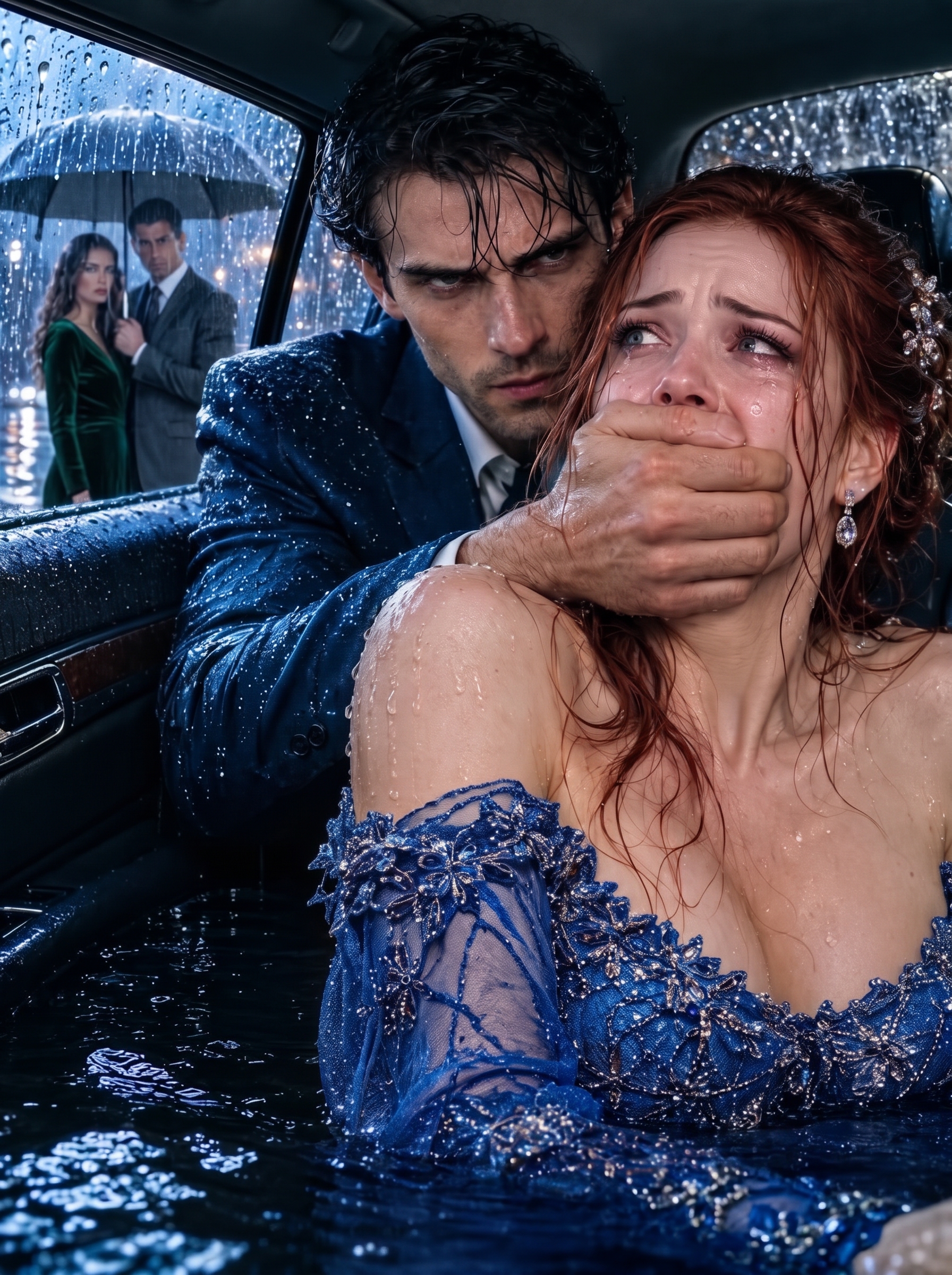
Someone is watching us.” I didn’t ask a single question. But when
I saw who was waiting for my husband on the riverbank,
I realized this was far worse than I had imagined…
“Don’t bother trying to open the door, Rosalind. It’s already too late for you.”
Those were the last words my husband, Garrett, said to
me before he climbed out the window and left us inside a car sinking into the river.
I still remember the icy water pouring into my shoes, the smell
of soaked upholstery, and the sound of metal groaning under the
pressure. It all happened so fast that, for the first few seconds,
I didn’t even understand that the man I had been married to for three years had just tried to kill me.
That afternoon, we were driving along the coastal highway toward Savannah Creek.
Garrett was behind the wheel.
I was in the passenger seat.
And in the back sat my brother, Tobias, in the wheelchair he had used
since the accident that killed our parents fifteen years earlier.
We had learned to live with that tragedy.
Or so I thought.
I always made a point of checking that Tobias was comfortable
before any trip. Since our parents died, I had felt a special responsibility
for him, even though he constantly insisted he didn’t need to be treated like a child.
That day, though, we didn’t have time to argue about it.
Garrett jerked the steering wheel.
The car veered toward the guardrail.
“Garrett!” I screamed.
He didn’t brake.
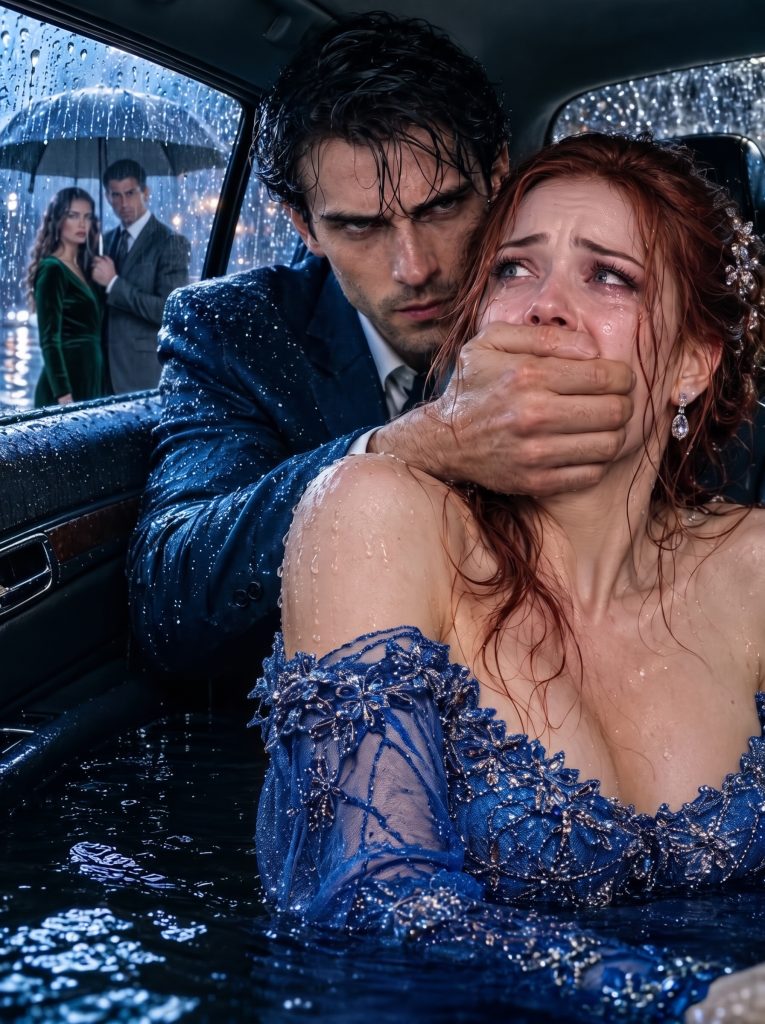
Our car smashed through the guardrail and plunged straight into the river.
The impact shook my whole body.
For a few moments, I didn’t know where I was. I heard a roar, felt
my head spinning, and saw the water slamming against the windows.
By the time I got my bearings, my ankles were already submerged.
“Garrett! I can’t get the door open!”
He didn’t answer.
I looked at him, waiting for him to tell me what to do.
But my husband seemed strangely calm.
He unbuckled his seat belt.
He rolled down his window.
And he began climbing out.
“Wait! Tobias is still in the back!”
Garrett didn’t even turn his head.
I watched him push himself outside and swim toward the surface.
Then he disappeared from sight.
I sat frozen for several seconds.
I couldn’t comprehend what had just happened.
The man who told me every night that I was the love of his life had left us trapped underwater.
I tried to release my seat belt.
The latch wouldn’t give.
I pressed again.
Nothing.
The water was up to my knees.
I bent over as far as I could and felt under the seat with my fingers.
Then I touched something metal.
A wire.
I followed it with my hand, and my stomach dropped.
Someone had deliberately fastened the seat belt to the frame of the car.
It wasn’t jammed from the crash.
It had been rigged so I couldn’t get free.
Garrett hadn’t lost control of the car.
He had driven us here so we would die.
The water kept rising.
First to my waist.
Then to my chest.
I fought the seat belt until my fingers hurt, but I couldn’t break the wire.
Then I looked up toward the window.
Through the water, I could make out Garrett heading for the shore.
He wasn’t looking for help.
He wasn’t looking desperately back at our car.
He was swimming toward someone who was waiting for him.
A woman stood beneath an umbrella beside the river.
When Garrett climbed out of the water, she walked up to him.
And then I saw her face.
Penelope.
My half sister.
The shock hit me so hard that for a moment I forgot about the water still pouring in.
Penelope was pregnant.
Her belly showed beneath her clothes as she stood next to Garrett.
I watched him wrap his arms around her.
She raised a hand and stroked his face.
Then they both turned their heads toward our car as it slowly sank.
My husband was smiling.
He wasn’t crying.
He wasn’t calling for help.
He was smiling while he waited for his wife and his brother-in-law to disappear beneath the water.
Three years of marriage.
Three years of listening to his promises.
Three years of believing I had found a man who wanted to build a family with me.
All those nights Garrett made me warm milk because, he said, I worked too hard running part of the shipyard my family had founded in Baltimore.
All that attention I had mistaken for affection.
And now I was watching him hold my own half sister while he waited for me to die.
I tried to scream.
All I managed was to gulp air in desperation.
“Rosalind…”
Tobias’s voice came from the back seat.
I turned around.
The water was almost at his mouth.
My brother’s face was pale, and his eyes were fixed on me.
Fifteen years.
For fifteen years, I had watched Tobias get around in a wheelchair since the accident that took our parents.
I had learned to help him with everything he needed. I had organized our family life around his mobility. I had spent nights worrying about him when the grief of losing our parents seemed unbearable.
And now I had led him to his death with the man I had trusted.
“I’m sorry,” I whispered, crying. “Tobias, forgive me.”
He looked at me.
“Rosalind, listen to me…”
I shook my head.
“I brought Garrett into our family. I’m the one who trusted him.”
The water kept climbing.
I squeezed my eyes shut, convinced we would never get out.
Then I heard a thump behind me.
A sharp, metallic one.
Someone is watching us.” I didn’t ask a single question. But when I saw who was waiting for my husband on the riverbank, I realized this was far worse than I had imagined…
Then another.
I opened my eyes.
At first I thought the water was making me hallucinate.
Tobias’s wheelchair was empty.
My brother was no longer sitting.
He was standing inside the car.
On his own two legs.
He gripped the back of my seat while he searched for something under his jacket.
I stared at him, unable to speak.
Fifteen years of believing he couldn’t walk.
Fifteen years of helping him into cars, through doorways, from one place to another.
And now he was standing right in front of me while our car disappeared under the water.
“Your legs…?” I managed to whisper.
Tobias pulled out a small cutting tool he had hidden.
“I’ll explain later.”
He leaned over my seat.
He found the wire holding my seat belt.
He cut it.
The latch came free.
The relief was so intense I nearly collapsed.
But Tobias didn’t let me lose a single second.
“Don’t look at the shore,” he ordered quietly.
“Garrett’s out there! With Penelope!”
My brother didn’t seem surprised.
And that scared me even more.
“I know.”
I stared at him.
“What do you mean, you know?”
Tobias put a hand on my shoulder.
“Rosalind, I need you to do exactly what I tell you.”
The water was already at my neck.
I felt the pressure in my ears and could barely breathe.
My brother moved toward the rear door.
He waited while the water finished filling the car and the pressure began to equalize.
Then he planted his foot hard.
And kicked the door.
The first blow made the metal shudder.
The second moved it.
With one last effort, Tobias forced it open.
The water swirled around us.
He grabbed my arm and pulled me toward the opening.
I tried to push straight up toward the surface.
I needed air.
I needed to get out of this nightmare.
But Tobias stopped me.
“No.”
I looked at him, terrified.
“We’re going to drown!”
My brother pulled out a small waterproof pouch he had hidden.
Inside was an emergency breathing mouthpiece.
He pressed it into my hand.
“Listen to me. Garrett is watching the car from the shore.”
I felt my tears mixing with the river water.
“We have to call for help!”
Tobias held me firmly.
His face was so close to mine that I could see the fear he was holding back in his eyes.
“If he finds out we’re still alive, he’ll try again.”
I looked toward the surface.
I thought of Garrett embracing Penelope.
Of the tampered seat belt.
Of my husband’s smile as our car went under.
And then I looked at Tobias, the brother I had spent fifteen years believing couldn’t walk.
“What is going on?” I whispered.
He put his lips to my ear.
“Play dead, Rosalind. They’re watching us.”
Then he pointed toward the darkness beneath the old pier.
And just before we started to swim, he said something that turned my terror into an even worse question:
“When we reach somewhere safe, you’ll have to hear the truth about our parents’ accident…”
Tobias gripped my arm, and we began swimming beneath the old pier, away from the spot where Garrett and Penelope were watching the river.
The water was freezing.
I struggled to coordinate my movements, and every time I thought about how far we were from the surface, the panic came rushing back.
But my brother seemed to know exactly where he was going.
Between two enormous concrete pillars, we found a maintenance opening, hidden from the road.
We took shelter there.
When I could finally breathe normally, I turned to Tobias.
He was right in front of me.
Standing.
Without the wheelchair.
All the rage I had stored up since the accident collided with the terror we had just survived.
“Fifteen years!” I exclaimed, grabbing his jacket. “You’ve been pretending you couldn’t walk for fifteen years!”
Tobias didn’t try to defend himself.
“I know.”
“I’ve taken care of you for fifteen years! I thought that accident had taken the use of your legs!”
My brother lowered his eyes.
Then he gently took me by the shoulders.
“Because I needed everyone to believe it, Rosalind.”
I went still.
“Everyone? Who are you talking about?”
Tobias glanced toward the entrance of the shelter.
“The same kind of people who wanted to see us dead today.”
My heart began to race.
“Garrett?”
My brother took a deep breath.
“Mom and Dad’s accident wasn’t an accident either.”
For a few seconds, I couldn’t speak.
We had spent fifteen years remembering that tragedy as something that had taken our parents through unavoidable misfortune.
“What are you saying?”
“That Garrett’s family has been trying to take our shipyard for fifteen years.”
Someone is watching us.” I didn’t ask a single question. But when I saw who was waiting for my husband on the riverbank, I realized this was far worse than I had imagined…
I leaned back against the concrete.
Tobias went on, his voice barely audible:
“Garrett didn’t marry you for love, Rosalind. And today he was finishing something his father started a long time ago.”
I remembered the nights my husband made me warm milk.
His insistence that I rest.
And suddenly a fear washed over me that had nothing to do with the river.
“Tobias… what else do you know?”
My brother looked straight at me.
“I need to tell you something about what Garrett has been giving you for the past three years, without you knowing.”
“The warm milk,” Tobias said. “Did you ever taste anything in it?”
I thought back to those nights. Garrett standing in the kitchen doorway with the blue mug, watching me drink.
“It was always a little bitter. He said it was the honey and cinnamon he’d started adding.”
“It wasn’t honey.” Tobias’s jaw tightened. “About eight months ago I started noticing how tired you were. You forgot meetings. You slept through your alarm. You told me you felt foggy, like you were underwater. So I took a mug from the sink one night and had it tested.”
“Tested by whom?”
“By a friend from my physical therapy days. A toxicologist.” He said the word gently, the way you’d set down something fragile. “It was a sedative, a low dose, taken daily. Enough to keep you slow and agreeable. Enough that a few signatures on the right documents wouldn’t have registered.”
I thought of the papers Garrett had slid in front of me over breakfast, a refinancing here, a trust amendment there. Just routine, babe. Your lawyer already looked at it.
I had signed every one without reading.
“He’s been moving pieces of the shipyard out of our family’s control for three years,” Tobias said. “Shell companies, a voting trust, everything routed through his father’s firm. Today was supposed to be the last step. If you died, Garrett inherited as your husband. And if I died with you, no one was left to contest it.”
“Penelope,” I whispered. “Why would she…”
“Because Conrad Voss promised her a place in the family and a share of the proceeds, and because she’s been resenting you since the day Dad’s affair came out.” Tobias looked at me with sympathy and something like shame. “I should have told you about her too. I didn’t think you were ready.”
I laughed, a cracked, awful sound that echoed off the concrete. “Ready. I’ve been married to him for three years.”
“I know.”
“Why didn’t you just tell me?”
His answer came quietly.
“Because you’d have confronted him, Rosalind. You always walk straight toward the problem. And if you had, he would have killed you sooner.”
He told me the rest as we shivered in that dark opening, the river lapping at the edge of the platform.
The night our parents died, fifteen years earlier, Tobias had been sixteen, in the back seat. He remembered a pair of headlights coming up fast behind them on the mountain road, the nudge of a bumper, our father swearing, the guardrail giving way. He remembered being thrown clear and lying on the gravel unable to move, and he remembered a man in a gray jacket climbing down to check the wreck.
The man had looked straight at him, and Tobias had closed his eyes and held perfectly still.
“I heard him say my name into a phone,” Tobias said. “He said, The boy’s alive. What do you want me to do?”
Tobias had been paralyzed for real that night, from the shock and a spinal bruise that left him numb for almost three weeks. He recovered feeling in his legs in the hospital. But on the second day, he’d overheard a nurse tell a visitor in a gray jacket that the boy could “probably walk again with therapy.”
That was when he decided to stay in the chair.
“If they believed I couldn’t walk, they believed I was harmless. And if they believed I was harmless, I could stay alive long enough to learn what happened.” He opened his hands. “I’ve spent fifteen years collecting evidence. Bank records. The name of the man in the gray jacket. A recording of Conrad Voss’s lawyer discussing the plan. All of it is in a safe deposit box in Baltimore, and a copy has been with an FBI agent named Miriam Cho for the past four months.”
I stared at him. “You were working with the FBI and you let me drive into that car.”
“I didn’t let you.” His voice cracked. “Rosalind, I begged Agent Cho to move first. She said they needed Garrett to commit an overt act, something that tied him directly to attempted murder. Today was the day the surveillance team said he’d do it. They were supposed to be waiting at the bridge.” He looked toward the water. “The wire on your seat belt wasn’t something we saw coming. And the team is late.”
He took out a small waterproof radio from the pouch.
“They’re coming,” he said. “But if Garrett and Penelope see us surface, they run, and we lose everything. So we stay under here and we let them think we’re gone.”
I leaned my head against the concrete and let myself cry for exactly one minute. Then I wiped my face.
“Okay,” I said. “What do I do?”
Agent Cho reached us forty minutes later.
She came by boat, quietly, with two divers and a medic, and she covered us in thermal blankets without saying a word until we were out of sight of the shore. She was small and gray-haired, with the tired eyes of someone who had waited a long time for a case to break.
“Mrs. Voss,” she said. “I’m sorry you went through that. We had a unit stuck behind an accident on Route 9. Your brother’s signal is the only reason we found you.”
“Don’t call me that,” I said. “My name is Rosalind Hale.”
She smiled faintly. “Ms. Hale. We have Garrett and Penelope on the dock. They haven’t left. They’re waiting to see if a body surfaces. They’ve been on the phone with Conrad Voss for forty minutes.”
“What happens now?”
“Now they believe you’re dead,” Cho said. “We’d like to keep it that way for forty-eight hours.”
I understood immediately what she was asking.
“The board,” I said.
Tobias nodded. “The emergency meeting. If Garrett thinks you’re gone, he’ll rush to claim control before anyone asks questions. He’ll bring the transfer documents, the voting trust, everything. Conrad will be there too.”
“And all of them will be in one room,” Cho said, “with the paper trail in their hands.”
So we waited.
Two days later, a memorial notice appeared in the Baltimore Sun. Rosalind Hale Voss, beloved wife, taken tragically in a car accident. Garrett gave a statement to the local news outside the hospital, his eyes red, his voice breaking. I watched it on a laptop in a safe house with a bowl of soup going cold in my lap.
“He’s good,” I said.
“He’s had practice,” Tobias said.
Penelope stood behind him, one hand resting over her stomach, her face arranged into grief. I studied her for a long time. She was pregnant with Garrett’s child. Whatever she had done, there would be a baby at the end of this who had nothing to do with any of it.
“Don’t let them hurt the child,” I told Cho.
“We won’t,” she said. “No one has to.”
Someone is watching us.” I didn’t ask a single question. But when I saw who was waiting for my husband on the riverbank, I realized this was far worse than I had imagined…
The board meeting took place on Friday morning in the glass conference room on the top floor of our shipyard headquarters.
I watched from a monitor in the security office with Tobias, who had finally stood up out of the wheelchair for good. He wore a dark suit now and walked with a slight hitch, the muscle memory of fifteen years finally giving way to something steadier.
Garrett sat at the head of the table in a black tie. Conrad Voss sat to his right, silver-haired and calm, a man who had built an empire on patience. Penelope had come too, pale and elegant in gray.
“I want to begin,” Garrett said, “by thanking everyone for their kindness during this unspeakable time. Rosalind and Tobias were the heart of this company. In their memory, I intend to honor their legacy.”
He slid a folder across the table.
“As the surviving spouse and sole executor of Rosalind’s estate, I’m presenting the documents that transfer her voting shares to the Voss family trust. It’s what she would have wanted.”
“Would she?” asked a voice from the doorway.
Every head turned.
I walked in wearing the same navy suit I’d worn to board meetings for six years, my hair pulled back, my hands steady. Tobias walked beside me, tall and upright, his eyes locked on Garrett’s.
Garrett’s face went the color of paper.
Penelope’s chair scraped backward. She clamped a hand over her mouth.
“Rosalind,” Garrett whispered. “You’re… They told me…”
“They told you I drowned,” I said. “Because you watched the car go under and you smiled.”
Conrad Voss rose slowly. His eyes moved from me to Tobias, to the room’s second door, where Agent Cho stood with four federal agents in dark jackets.
“Conrad Voss,” Cho said, “Garrett Voss, Penelope Hale. You’re under arrest for conspiracy to commit murder, attempted murder, and fraud.”
“This is absurd,” Conrad said, but his voice had lost its smoothness. “You have no evidence.”
“We have a toxicology report on the milk,” I said. “We have fifteen years of financial records, and a recorded conversation with your lawyer. We have the man in the gray jacket, who, as of this morning, is cooperating.” I looked at him. “And we have a seat belt with a wire still wrapped around the latch, which the divers recovered with Garrett’s fingerprints on it.”
Garrett stared at me as if seeing a stranger. “I loved you,” he said.
“No,” I said. “You loved the shipyard.”
The agents were already cuffing him. As they led him out, he turned his head one last time. I expected anger, or pleading. What I saw instead was the look of a man who had spent three years building a house on sand and was finally watching the tide arrive.
It took fourteen months for the trial to end.
Conrad Voss was convicted of conspiracy, fraud, and the murder of my parents, sentenced to life without parole. Garrett received thirty years. The man in the gray jacket, whose name was Dale Mercer, testified against both and got a reduced sentence for it, though no one in the courtroom believed that was justice.
Penelope accepted a plea. She served eighteen months, and her baby, a boy named Elliot, was placed temporarily with my aunt in Annapolis. When Penelope was released, she wrote me a letter. It was short and unadorned.
I don’t expect you to forgive me. I’m not asking. I only want you to know he’s healthy and he’s safe, and I’m trying to be someone who deserves him.
I wrote back. We aren’t sisters now, not the way we might have been, but I sent her the name of a counselor and a job at the shipyard’s front office, and I kept my promise about the baby. Elliot has our father’s eyes. I try to be kind to him for reasons that have nothing to do with anyone’s sins.
Tobias moved back into the house on the bay, the one we grew up in. He took the wheelchair to a hospital donation drive and watched it roll away. Then he went home, stood in the kitchen, and made us both coffee with his own two hands.
We sat on the back porch that evening, watching boats slide out of Baltimore harbor, the way we did when we were kids.
“Do you forgive me?” he asked. “For the lie.”
I thought about fifteen years of carrying his groceries, rearranging furniture, planning vacations around ramps and elevators. I thought about the nights I had cried over him.
“You kept us alive,” I said. “I’m angry. I’ll probably be angry for a while. But no.”
“No what?”
“No, I don’t need to forgive you. I understand you.” I reached for his hand. “That’s different.”
He gripped mine hard and looked at the water for a long time.
A year later, I stood on the deck of the first ship we built after the trial, a cargo vessel with a name painted in white along her bow: Hale & Brother. The crew cheered when she slid down the ways into the harbor, and Tobias raised his arm beside me, and I laughed out loud.
I had been drowning once. Not in the river, but in a marriage that fed me poison and called it love, in a life organized around a lie I never questioned.
The river had been the end of one life.
It was also the moment my brother stood up and told me to play dead, so that one day I could finally stand up myself.
Someone is watching us.” I didn’t ask a single question. But when I saw who was waiting for my husband on the riverbank, I realized this was far worse than I had imagined…
The Aftermath of Light
The courtroom had been silent during the sentencing, but the real quiet came after.
When a fifteen-year lie dissolves and a three-year marriage is dismantled by federal indictments, the world does not instantly fill the void with peace. It fills it with paperwork, deposition transcripts, and the hollow ring of an empty house.
The house on the bay was too large for two people who had forgotten how to live without fear. For the first three months after Garrett and Conrad were transported to the federal penitentiary in Cumberland, Tobias and I spent our days in the shipyard office, buried under decades of audited balance sheets. The Voss family had bled Hale Maritime through forty-six shell companies, hiding dry-dock maintenance kickbacks behind falsified steel procurement invoices.
“They were planning this before you even met him, Rosa,” Tobias said one Tuesday evening. He sat across from me at our father’s old oak desk, massaging his left calf where the deep tissue had shortened from years of feigned disuse. “Conrad picked Garrett for you. It wasn’t a romance; it was a targeted acquisition.”
I looked out the window at the harbor. The tide was pulling back, exposing the black, barnacled pilings of Dock 4.
“I know,” I said. “What hurts isn’t that he didn’t love me. What hurts is that I spent three years believing his hesitation was gentleness.”
That night, I went through Garrett’s personal office in the east wing of the house. In the back of a locked cedar wardrobe, behind his tailored coats, I found a leather-bound ledger that hadn’t been seized by the FBI. It contained hand-drawn diagrams of our property lines, water depth charts for the mouth of the Patapsco River, and a timeline marked in red ink.
The red ink began three years before our wedding.
The final entry, dated the day before the car went into the river, contained five words written in his neat, technical script:
Phase Three: Complete structural transfer.
He hadn’t just watched the car go under. He had scheduled it.The Weight of Steel
Rebuilding Hale Maritime was not a matter of sentiment; it was a battle against total insolvency.
The Voss family trust had left the yard with four unfulfilled naval contracts, two defaulted bank loans, and a workforce that hadn’t seen a performance bonus in four years. When I walked through the main fabrication shop on my first full day as Chief Executive, the welders stopped their torches. The yellow sparks died down, leaving the vast steel cavern filled with the smell of ozone, rust, and suspicion.
“They think you’re a ghost, Rosalind,” said Marcus Vance, our veteran yard foreman, who had worked under my father for twenty years. He stood beside me wearing a grease-stained canvas apron, his grey beard flecked with metal dust. “Half these boys saw the news. They don’t know if they’re working for a shipyard or a crime scene.”
“Tell them the yard is open,” I said, my voice echoing off the corrugated iron walls. “Tell them the payroll clears on Friday from the Hale estate, not the Voss trust. And tell them if anyone asks about Garrett Voss, his name has been scrubbed from every vessel hull in this harbor.”
Tobias took over supply-chain logistics. Watching him walk through the yard was still strange—his gait was slightly stiff, his shoulders broad and square after years of upper-body overcompensation. The men who had seen him in a wheelchair for fifteen years looked at him with a mixture of awe and uneasy confusion.
“Let them stare,” Tobias told me as we reviewed the keel design for what would become the Hale & Brother. “A miracle makes people uncomfortable because it reminds them how easily they can be deceived. Let them think I’m a miracle. It’s better for business.”
“And what about Penelope?” I asked, looking down at a formal petition from her defense attorney requesting a reduction in her asset forfeiture.
Tobias’s face hardened. The softness he carried when he looked at me vanished whenever our cousin’s name was spoken.
“Penelope chose her side when she signed the dummy corporation papers,” he said quietly. “She knew about the milk, Rosa. She might not have held the bottle, but she knew why you were sleeping sixteen hours a day.”
I didn’t answer. I thought of little Elliot, sitting in my aunt’s sunlit kitchen in Annapolis, reaching for wooden blocks with hands that had never touched steel or poison.
Someone is watching us.” I didn’t ask a single question. But when I saw who was waiting for my husband on the riverbank, I realized this was far worse than I had imagined…
The Shadow on the Bank
Eight months after the trial, Dale Mercer—the man in the gray jacket who had served as Conrad’s enforcer—requested a meeting from the regional detention center.
Agent Cho accompanied me to the visitor room. The glass was thick, smudged with oily fingerprints, and the air smelled of floor wax and stale disinfectant. Mercer sat on the other side in an orange jumpsuit. His face was thin, his eyes deep-set and hollowed by early-stage liver failure.
“I didn’t ask for you to get pity,” Mercer said, his voice a raspy whisper through the mesh speaker. “I asked for you because there’s one thing that wasn’t in the state’s evidence file.”
I kept my hands folded on the narrow metal ledge. “Go on.”
“Conrad didn’t just want the yard,” Mercer said, leaning closer until his breath fogged the glass. “He wanted the dry-dock vaults. Underneath Dock 2. The old coal storage from 1942.”
I frowned. “Dock 2 was sealed after the war. My father used it for structural footings.”
“Your father sealed it because he found what the original yard owners left there,” Mercer replied, a faint, bitter smile touching his lips. “Industrial bonds. bearer shares from the 1930s rail expansion. Conrad found the land surveys in your grandfather’s personal papers when he took over the legal trust. That’s why Garrett married you so fast, Miss Hale. It wasn’t the surface business. It was what was buried under sixty feet of reinforced concrete.”
When I returned to the yard that afternoon, I took Tobias and Marcus down to the waterline beneath Dock 2.
The air was damp, thick with the smell of salt rot and old silt. Using an industrial torch, Marcus cut through the rusted steel hatch that had been welded shut before I was born. Inside, past thirty yards of flooded brick conduit, we found three iron filing safes submerged in brackish water.
Inside were not bearer bonds, but something far more dangerous: the original, unredacted corporate ledgers detailing how Conrad Voss’s father had stolen the land from my grandfather during the Great Depression through black-market foreclosures.
The Voss empire hadn’t just been built on patience. It had been built on a theft that spanned three generations.
The Unbroken Line
We drained the vault, turned the historical records over to the state archives, and used the recovered legal titles to clear every remaining debt on the shipyard.
By the spring of the following year, the Hale & Brother was ready for launch.
The morning of the ceremony was bright and crisp, the blue sky over Baltimore clear of fog. Hundreds of yard workers, naval contractors, and city officials gathered along the slipway.
Tobias stood beside me on the elevated wooden platform, his dark suit tailored to fit his standing frame, his chin held high against the breeze coming off the river.
As the traditional bottle of champagne shattered against the ship’s steel stem, the crowd erupted into cheers. The vessel groaned, her wooden blocks dropping away, and she slid smoothly down the greased ways into the dark, welcoming water of the Patapsco.
She hit the tide with a massive spray of white foam, leveled out, and floated—strong, balanced, and entire.
Tobias looked down at me, his eyes bright with unspoken years.
“She’s steady,” he said.
“She was built right,” I replied, wrapping my arm through his.
That evening, after the crowds had cleared and the yard was silent, I walked down to the edge of the riverbank alone. The water was dark, mirroring the first stars appearing over the harbor.
I thought about the night the car went over the embankment—the ice-cold rush of water through the broken windows, the terror of the dark, and the moment Tobias’s hands had pulled me clear of the seat belt. I thought about Garrett’s smile as he watched from the top of the ridge, believing he had erased us both.
He had thought he was burying a family.
He didn’t realize that some things, when pushed under the surface, only learn how to breathe under water until it’s time to rise.
The Shoreline of Tomorrow
Three years after the board meeting, life at the house on the bay had found its true anchor.
The porch steps had been rebuilt, replacing the wide concrete ramp we had used for fifteen years. In the garden, the hydrangeas my mother had planted were blooming in rich, deep blues, fed by a spring that had finally turned sweet again.
Once a month, Penelope brought Elliot to visit.
She didn’t come into the main house; she stayed near the wooden gazebo by the water, sitting on a bench while the boy ran through the grass with a wooden toy boat Tobias had carved for him. Penelope had grown thin, her hair cut short, her eyes quiet and watchful. We didn’t talk about Garrett, or Conrad, or the milk. We talked about Elliot’s reading lessons, the weather on the bay, and the schedule for the yard’s autumn maintenance cycle.
It was not reconciliation. It was something more durable: a quiet acknowledgment of survival.
On a warm October evening, Tobias and I sat on the back deck, watching the lights of the Hale & Brother as she cleared the harbor mouth on her way out to the open sea.
“Are you thinking about him?” Tobias asked softly, setting two mugs of tea on the small table between us.
“No,” I said, taking a warm mug in both hands. “I was thinking about the morning we built the small skiff out of cedar scraps when we were twelve.”
Tobias smiled—a real, unburdened smile that reached all the way to the corners of his eyes. “We sank it five minutes after launching.”
“We did,” I laughed. “But we pulled it back to shore, fixed the seams, and put it right back in the water.”
“And it floated,” he said.
“It floated,” I agreed, looking out across the calm, dark surface of the bay.
The water was quiet now. The shadows had receded, the river was clear, and for the first time in my life, I knew exactly who I was standing beside.
THE END…!