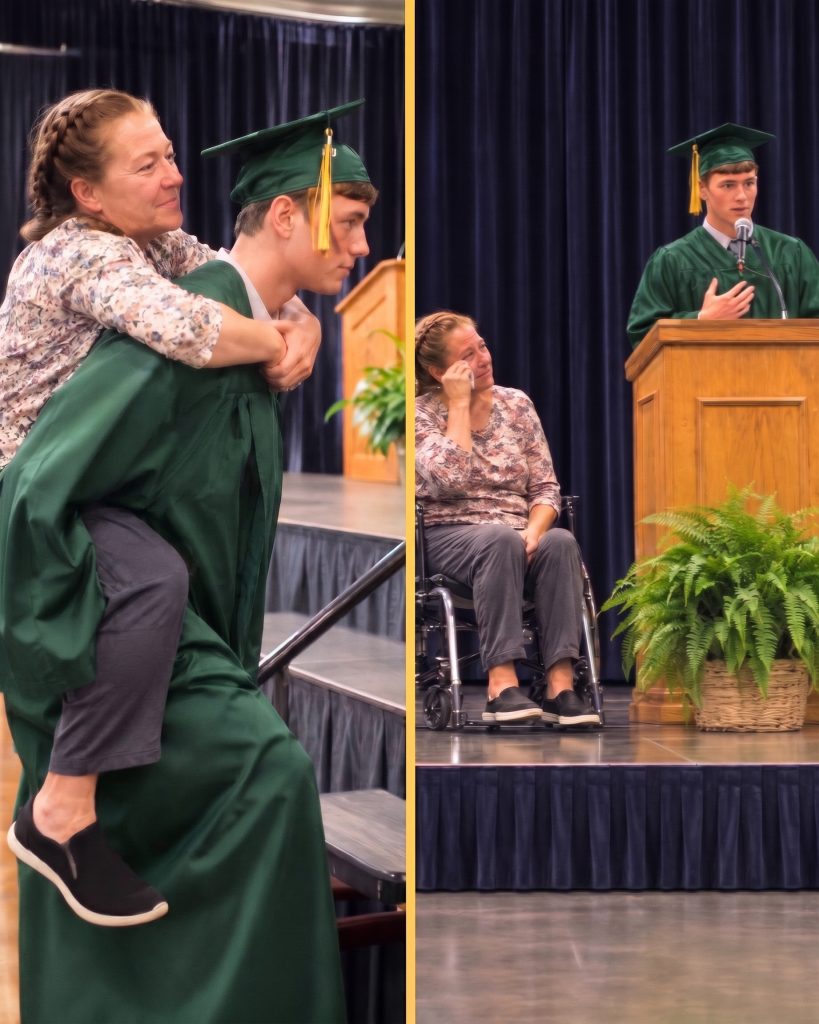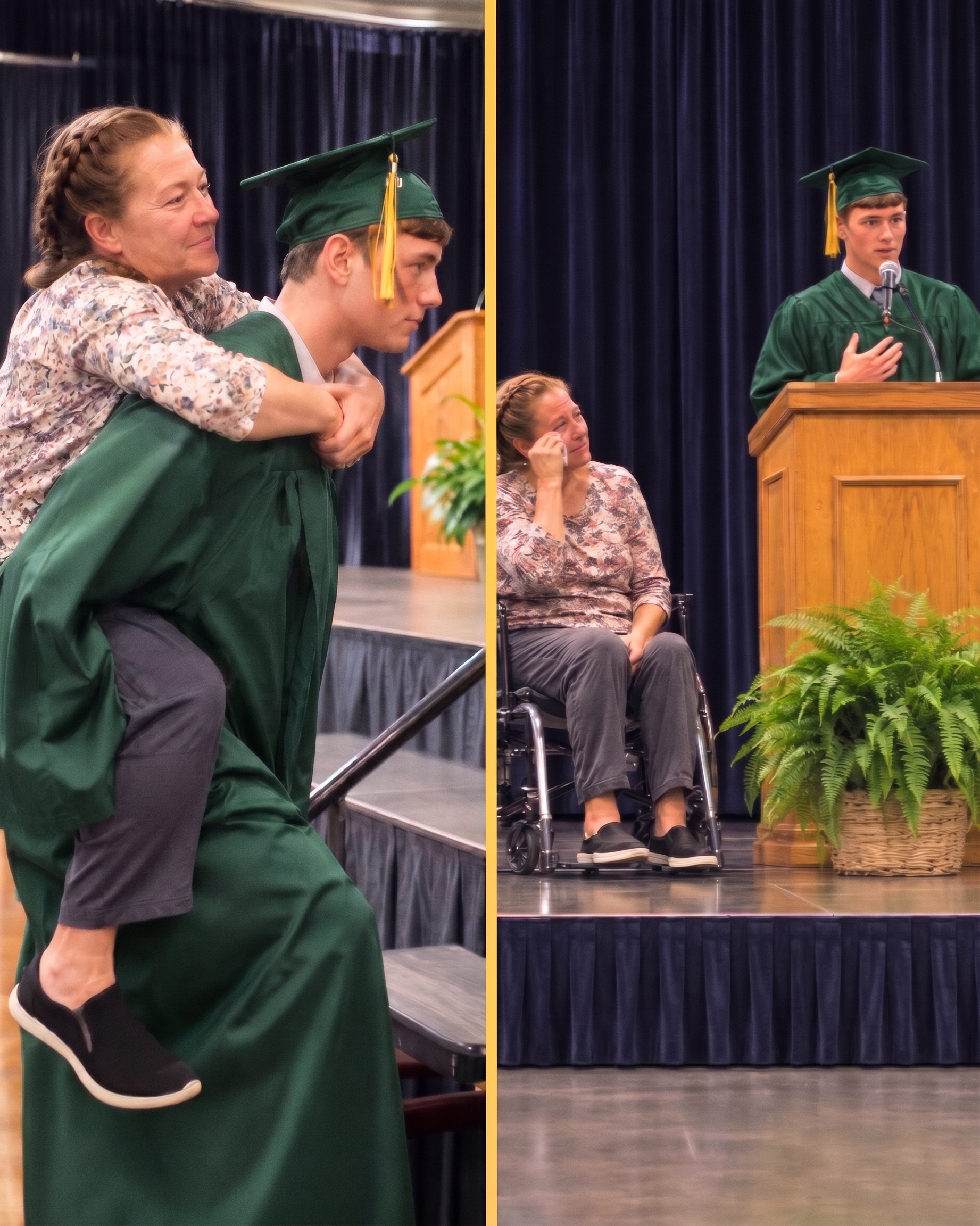
I thought my son’s graduation would be the happiest day of my life. But when he suddenly carried me onto the stage, took the microphone, and confessed he’d been hiding something from me, I realized I didn’t know everything my boy had been going through.
When my son Caleb carried me onto the stage at his high school graduation, I thought he just wanted to share his special moment with me.
But when he took the microphone and said, “Mom, there’s something I’ve done that I haven’t told you about,” my stomach dropped.
Then he looked at me and said, “I almost didn’t graduate.”
I couldn’t believe what I was hearing.
I’m 51 years old, and I’ve been in a wheelchair since Caleb was 12.
I was in a car accident that left me paralyzed from the waist down.
I still remember waking up in the hospital and hearing the doctors explain that I would never walk again.
My husband, Daniel, didn’t stay long enough to see me learn how to live with it.
“This isn’t what I signed up for,” he told me. “I want a better life.”
Then he left.
I remember lying in that hospital bed, wondering how I was supposed to raise a child when I couldn’t even get out of bed without assistance.
Caleb sat beside me, holding a paper airplane he’d made while waiting for the doctors.
He didn’t understand everything, but he knew his father wasn’t coming back.
The first few years were incredibly difficult.
I had to learn how to cook, clean, and manage our home from a wheelchair.
But Caleb still needed dinner, clean clothes, help with homework, and someone cheering at his school performances.
Eventually, I found a remote job handling customer accounts.
The pay wasn’t wonderful, but it allowed me to support us.
Money was always tight.
Sometimes I’d sit at the kitchen table calculating whether we could afford groceries and the electricity bill in the same week.
Caleb never complained.
When he was younger, he’d sometimes ask why we couldn’t take vacations like his friends.
I’d explain that we needed to save.
He’d nod and say, “That’s okay, Mom. We can do something here.”
Then we’d make popcorn and watch movies together.
I thought I understood how much those years had affected him.
Apparently, I didn’t understand half of it.
By his senior year, Caleb had become an excellent student.
He was responsible, determined, and had always earned good grades.
He’d been talking about college since middle school.
He also worked part-time at a neighborhood grocery store.
At first, he worked a few afternoons and weekends.
I wasn’t thrilled because I wanted him concentrating on school, but he insisted he liked earning his own money.
“Besides,” he told me, “I can’t keep asking you for everything.”
I reminded him that providing for him was my responsibility.
He smiled and changed the subject.
Looking back, I should have paid more attention.
Around October, I noticed he was coming home later.
Sometimes he’d walk through the door after 9:00 p.m., heat up leftovers, and sit at the kitchen table with his textbooks.
I’d hear him moving around long after I went to bed.
One morning, I found him asleep with his cheek pressed against an open notebook.
“Caleb, honey, you can’t keep doing this.”
He lifted his head.
“I’m okay. Just studying.”
“You’re exhausted.”
“I’ve got a lot of college stuff going on.”
That sounded reasonable.
Between school assignments, scholarship applications, and his job, he had plenty to do.
Still, I worried.
I offered to help organize his applications, but he said he had everything handled.
I even suggested he quit his job until graduation.
“Mom, please,” he said. “I promise my grades are fine.”
Because Caleb had always been honest with me about school, I believed him.
But he started losing weight.
He stopped spending time with his friends, and some mornings, he looked pale enough that I asked whether he was sick.
He always had an explanation.
I didn’t realize how much he was hiding.
A few weeks before graduation, I received an email from his English teacher, Grace, asking whether we could arrange a conversation.
My stomach dropped.
When I called, she reassured me that Caleb was graduating and that several teachers wanted to recognize his determination.
She also mentioned that he’d had a demanding year and asked whether he was getting enough rest.
“I keep telling him to sleep more,” I admitted.
“Please keep doing that,” she said.
I remember thinking she sounded unusually serious.
But she didn’t explain what had happened, and I didn’t press her.
I wish I had.
Graduation morning arrived warm and sunny.
I put on my favorite printed blouse, the blue one with little white flowers.
Caleb came into my room wearing his graduation gown.
“How do I look?”
I nearly cried.
“Like someone who’s about to make his mother very proud.”
He laughed.
“Pretty sure I’ve already done that.”
He helped me get my purse, then checked his phone.
He seemed nervous, but I assumed it was because of the ceremony.
We arrived early, and I found a seat near the stage.
Caleb joined his classmates.
I noticed him whispering with his friends, Ethan and Marcus, and occasionally glancing toward me.
When the ceremony began, I couldn’t stop taking pictures.
Then they started calling names.
When I heard “Caleb,” I grabbed my phone, ready to record.
He stood and walked toward the stage.
But halfway there, he turned and came straight to me.
“Caleb? What are you doing?”
He knelt beside my wheelchair.
“Mom, I want you up there with me.”
I stared at him.
“Oh, sweetheart, this is your special day! How am I supposed to get up there?”
He smiled.
“Then let’s make it our day.”
Before I could argue, he carefully helped me onto his back.
Caleb had carried me short distances before, but never in front of an auditorium full of people.
I wrapped my arms around his shoulders while he carried me up the stage steps.
Ethan and Marcus followed with my wheelchair and placed it near the microphone.
Caleb helped me back into my chair.
People were applauding, and I couldn’t decide whether to laugh or cry.
The principal, Robert, handed Caleb his diploma, then stepped aside.
Someone passed Caleb the microphone.
“Excuse me, everyone,” my son said. “There’s something important I wanted to say.”
The room quieted.
Caleb looked at me.
“Mom, I have something for you. There’s something I’ve done that I haven’t told you about yet. I can’t hide the truth anymore, and I want to admit it in front of everyone.”
My smile disappeared.
“What did you do?” I whispered.
He took a breath.
“Mom, I almost didn’t graduate.”
For a moment, I thought I’d misunderstood him.
“What?”
He turned toward the audience.
“Everyone probably thinks I had a normal senior year. I went to school, worked part-time, applied to colleges, and got everything done.”
He paused.
“But that’s not exactly what happened.”
I looked toward Grace, who was sitting with the other teachers.
Caleb continued.
“Last summer, I started picking up extra shifts at work. At first, it was just a few hours. Then I started covering for people whenever I could.”
I stared at him.
“Caleb, you told me you were only working weekends.”
“I know, Mom. That was one of the things I lied about.”
He explained that he’d been working several evenings a week, sometimes staying until closing, then coming home to finish assignments.
Some nights, he barely slept.
He started falling asleep in class and missing deadlines.
His grades, which had always been strong, began slipping.
“Grace caught me sleeping during a lesson,” he said. “She asked if something was wrong. I told her I was just tired.”
He glanced toward his teachers.
“She warned me I couldn’t keep doing that. My math teacher, Thomas, said the same thing. They told me I could lose everything I’d worked for.”
My eyes filled with tears.
“I promised them I’d slow down. But I didn’t. Not right away.”
He admitted that he’d fallen so far behind in two classes that his teachers had to help him make a plan to finish his missing work.
He’d been dangerously close to missing the requirements needed to graduate.
“I thought I could handle everything,” he said. “I was wrong.”
I wanted to interrupt.
I wanted to ask why he hadn’t trusted me and why he’d put himself through something so unnecessary.
But then he said something that stopped me.
“Mom, remember when you told Linda you were worried about paying for college?”
I remembered.
My younger sister had come over for coffee the previous spring.
I thought Caleb was upstairs doing homework.
I’d told Linda that I didn’t know how we’d manage tuition, books, housing, and everything else
I’d also admitted that I was exhausted from working.
I hadn’t realized Caleb could hear us.
“You said you wished you could take a break someday,” he continued. “But you couldn’t because you still had to get me through college.”
I covered my mouth.
“Caleb…”
“I heard you, Mom.”
His voice shook.
“And I decided I was going to do something about it.”
He explained that the money he’d been earning wasn’t for clothes, a car, or spending money.
He’d been saving it for me.
His plan was to save enough that when he left for college, I could reduce my work hours without constantly worrying about bills.
“I know it’s not enough for you to stop working forever,” he said. “But I wanted you to have a little room to breathe.”
I couldn’t speak.
For years, I’d worried that Caleb was missing out because of my accident.
Now he was standing in front of everyone, admitting he’d nearly exhausted himself trying to make my life easier.
Then he reached into his gown and pulled out a folded sheet of paper.
“But that’s not everything.”
He smiled nervously.
“I knew saving money wasn’t going to solve the college problem. So I started applying for scholarships.”
He paused.
“Actually, I applied to 50 colleges across the country.”
I blinked.
“Fifty?”
He nodded.
“Fifty, Mom.”
He explained that he’d spent months researching colleges, completing applications, writing essays, and asking teachers for recommendations.
Some schools rejected him.
Others offered partial scholarships that still would have left us with expenses we couldn’t afford.
But he kept applying.
Grace and Thomas helped him organize deadlines and improve his essays, especially after realizing how overwhelmed he’d become.
Eventually, he reduced his work hours enough to catch up on his assignments.
“I didn’t do this alone,” Caleb said. “My teachers reminded me that none of it would matter if I made myself too sick to finish school.”
He turned toward them.
“Thank you for not giving up on me.”
Grace was crying.
Then Caleb looked back at me.
“Mom, I wanted to tell you when I knew everything was going to work out.”
He unfolded the paper.
“Out of those 50 colleges, 20 offered me full-ride scholarships.”
The auditorium went silent.
I stared at him.
“Twenty?”
He nodded, smiling through his tears.
“Twenty, Mom. Full rides. Tuition, housing, meals, and the other major expenses covered.”
I shook my head.
“Are you serious?”
“Completely serious.”
He held up the paper.
“I made a list. I have all the offer letters saved, too.”
People began applauding.
Caleb waited for them to settle.
“I still have to make my final choice from the schools that kept my offers open. But wherever I go, Mom, you won’t have to pay for my college.”
I started crying so hard I could barely see him.
He came closer and knelt beside my wheelchair.
“Remember how you always showed up for everything, even when getting there was difficult?”
I nodded.
“Remember how you worked late and still helped me study?”
“Caleb, sweetheart…”
“You did all of that for me.”
He looked down.
“And I know I went about this the wrong way. I should’ve told you how tired I was. I shouldn’t have risked my grades.”
Then he looked at me again.
“But I wanted you to know that everything you did mattered.”
He stood and faced the audience.
“My mom raised me by herself after my dad left. She learned how to do almost everything differently after her accident, but she never stopped being there for me.”
His voice cracked.
“She made sure I had food, clothes, school supplies, and somebody cheering for me. Even when she was exhausted.”
Someone in the front row began crying.
“People keep telling me I worked hard to get here. And I did. But she worked hard for years before I was old enough to understand what that meant.”
He turned toward me.
“Mom, you spent all those years making sure I could have a future. Now I want you to have one, too.”
He smiled.
“This isn’t just my graduation day. It’s ours.”
Then he said the words I’ll remember forever.
“We made it, Mom. And now we finally get to live our lives.”
For a moment, nobody moved.
Then Grace stood.
Thomas stood beside her.
Robert, the principal, wiped his eyes before standing, too.
Within moments, the entire auditorium was on its feet.
People were clapping, cheering, and crying.
Caleb put down the microphone and hugged me.
“I’m so proud of you,” I whispered.
He held me tighter.
“I’m proud of you, too, Mom.”
After the ceremony, people kept coming over to congratulate us.
Grace told me that Caleb had worked harder than almost any student she’d taught.
“But we were worried about him,” she admitted. “He needed to understand that he couldn’t keep pushing himself like that.”
I thanked her for helping him.
Then I told Caleb we needed to talk at home.
He looked nervous.
“Am I in trouble?”
“A little,” I said.
He laughed.
That evening, we sat at our kitchen table with his scholarship letters spread between us.
There really were 20 offers.
I read through them, asking questions about housing, meal plans, and which expenses were covered.
Then I closed the folder.
“I’m grateful for what you’ve done,” I told him. “More than I can explain.”
He smiled.
“But I never wanted you to work yourself sick trying to take care of me.”
His smile faded.
“I know.”
“No, sweetheart. I don’t think you do.”
I reached across the table and took his hand.
“Your job was to be my son. To study, make friends, and figure out what you want from life. You weren’t supposed to become responsible for mine.”
He looked down.
“I just hated seeing you so tired.”
“I know. And I love you for caring.”
I squeezed his hand.
“But I’m still your mother, and I’m capable of making decisions about my life. If I need help, I’ll ask. And if you’re struggling, you have to tell me.”
He nodded.
“I’m sorry I lied.”
“I forgive you. But no more secrets like this.”
“Deal.”
We spent the next hour comparing colleges.
When Caleb hesitated over one of the distant schools, I asked whether he liked it.
“A lot,” he admitted.
“Then don’t cross it off because of me.”
“Are you sure?”
“Absolutely.”
I’m still working remotely, and we’re not suddenly rich.
But knowing that Caleb can attend college without leaving us with enormous bills has changed everything.
Last weekend, we went out for breakfast.
As we were leaving, Caleb reached for the handles of my wheelchair.
“I’ve got you, Mom.”
I smiled and gently stopped him.
“I can manage, sweetheart.”
He stepped beside me.
“I know.”
My son had carried me onto that stage because I couldn’t walk.
But the greatest gift he gave me wasn’t the scholarships or the money he’d saved.
It was knowing that after everything we’d been through, he had a future full of possibilities.
And so did I.
The Transition of Independence
The morning sun cast a warm glow across our modest kitchen, highlighting the stack of college acceptance letters we had meticulously sorted through the night before. For years, my world had shrunk to the boundaries of what I could manage from my wheelchair and the immediate walls of our home. Caleb’s protective instincts, forged in the crucible of our shared hardships, had sometimes manifested as overprotectiveness. But last night’s conversation had marked a turning point.
When Caleb came downstairs, dressed in a comfortable gray hoodie and jeans, he wasn’t carrying the quiet, strained tension that had shadowed him for months. He poured a cup of coffee for himself and a glass of orange juice for me, setting them on the table with a reassuring smile.
“Morning, Mom. Did you sleep okay?” he asked, pulling out the chair opposite me.
“Better than I have in a long time,” I replied genuinely. “Knowing we’ve cleared the air feels like lifting a physical weight off my shoulders.”
“Me too,” Caleb admitted, tracing the rim of his mug. “So… about University of Oregon. I looked at their campus layout online last night. They have great accessibility services, and their undergraduate research program in environmental science is top-tier.”
I smiled, watching the enthusiasm sparkling in his eyes—the same enthusiasm he had tried to suppress to avoid burdening me. “Then that’s where you should apply your focus, sweetheart. We will figure out the logistics together. True independence means trusting each other to handle our respective lives.”
He nodded slowly, a profound sense of relief washing over his features. We spent the next two hours mapping out his enrollment timeline, discussing housing applications, and scheduling virtual orientation sessions. For the first time, it didn’t feel like a daunting mountain to climb alone; it felt like a shared adventure.
Reclaiming My Own Horizons
While Caleb focused on finalizing his college choice, I found myself confronting a quiet question I had buried long ago: What do I want for my own future?
Ever since the accident that left me wheelchair-bound, my existence had revolved around survival, rehabilitation, and making sure Caleb lacked nothing. My remote freelance copywriting job paid the bills, but it had become an insulated routine. Inspired by Caleb’s courage on stage, I decided it was time to step beyond my comfort zone.
That afternoon, I logged onto the community college portal and browsed their continuing education catalog. A remote certification course in digital project management caught my eye. It was challenging, modern, and entirely mine.
When Caleb came home from helping a neighbor with yard work, I was deep into reviewing the syllabus. He walked into the living room, tossed his keys onto the counter, and paused when he saw the screen.
“What are you looking at, Mom?” he asked, curious.
“Professional certification programs,” I answered, looking up with a grin. “If you’re heading off to conquer the academic world, I figured it’s time I upgrade my own toolkit.”
Caleb’s face lit up with a grin that mirrored my own. “Are you serious? That’s amazing! Which one?”
“Digital Project Management,” I said. “It starts next month. Fully online, so I can keep working, but it’ll push me to take on bigger contracts and grow professionally.”
He walked over and wrapped his arms around my shoulders, pressing a gentle kiss to the top of my head. “See? I told you we both get to live our lives now.”
Summer’s Quiet Rhythm
June unfolded with a gentle, sunlit rhythm. The frantic pace of high school deadlines had vanished, replaced by the warm hum of cicadas outside our windows and the unhurried cadence of summer mornings.
Grace, Caleb’s former teacher, stopped by one afternoon bearing a basket of fresh strawberries from her garden. We sat on the front porch, the cool breeze rustling the wind chimes we had hung up years ago.
“It’s strange, isn’t it?” Grace remarked, watching Caleb down the street as he loaded some gear into his car for a weekend camping trip with old friends. “Watching them grow up is like watching a bird leave the nest—you spend your whole life teaching them how to fly, and then suddenly, they’re actually in the air.”
“It’s both terrifying and wonderful,” I confessed, accepting a strawberry. “For a long time, I defined my entire worth by my ability to protect him. Letting go of that control is an adjustment.”
“You didn’t just protect him, Clara,” Grace said gently, placing a hand on my arm. “You gave him your strength. Look at the young man he is. He’s compassionate, resilient, and deeply grounded. That doesn’t happen by accident.”
Her words anchored me. As the summer weeks progressed, Caleb and I established a new rhythm of household teamwork. He handled the heavy lifting—groceries, home maintenance, and gardening—while teaching me shortcuts to make certain tasks easier from my chair. We laughed through our mistakes, turning mundane chores into shared moments of bonding.
Part 5: Packing Up and Letting Go
By late August, the reality of college departure drew near. Our living room transformed into a staging ground for cardboard boxes, bedding sets, laundry hampers, and a mountain of school supplies.
Caleb’s room, usually a chaotic sanctuary of textbooks and guitar picks, slowly emptied out until only bare walls and the faint outline of posters remained. Walking past his open door gave me a strange, hollow ache, yet beneath the melancholy pulsed a fierce pride.
On the night before we drove him to campus, we ordered takeout from his favorite local diner and ate sitting cross-legged on the living room rug, just like we used to do when he was a little boy.
“Are you nervous?” I asked, breaking the comfortable silence.
Caleb looked around the room, then met my eyes. “A little bit. It’s a big change. New city, new people, no home-cooked meals every night.” He paused, smiling softly. “Mostly, I’m just going to miss you.”
“I’ll miss you too, sweetheart,” I replied, my voice thick with emotion. “But remember, distance doesn’t change anything. You’re just a phone call or a video chat away. And I expect regular updates on your classes—and your laundry habits.”
He laughed, tossing a cushion at me. “Deal. Promise I won’t turn all my white clothes pink.”
We sat together for a long time after finishing dinner, talking about everything and nothing, savoring the final hours of living under the same roof as a tight-knit duo of two.
The Campus Drop-Off
The drive to the university campus took three hours. The highway wound through lush green valleys and rolling hills, the late-summer foliage just beginning to hint at the amber tones of autumn. Inside the car, an upbeat playlist hummed quietly, keeping the mood light and conversational.
When we finally arrived, the campus was a vibrant maze of moving boxes, enthusiastic upperclassmen student guides, and parents navigating parking lots with mixed expressions of excitement and anxiety.
Caleb’s dorm building was a modern brick structure nestled under towering oak trees. We unloaded his belongings onto a rolling cart, and together we navigated the elevators and corridors until we reached room 304.
His roommate, a friendly economics major named Leo from a neighboring town, was already unpacking. Within five minutes, the two of them were comparing music tastes and arguing over where to position the mini-fridge.
I stood by the window, watching them bond, feeling a profound sense of peace settle over me. My job as the day-to-day manager of Caleb’s life was complete; now, my role was that of a cheering spectator from afar.
When it was time to leave, Caleb walked me down to the car. The afternoon sun cast long shadows across the pavement.
He pulled me into a long, tight hug. “Thanks for everything, Mom. Truly.”
“Go change the world, Caleb,” I whispered against his shoulder, blinking back tears. “I love you.”
“Love you too, Mom. Drive safe, and I’ll call you the minute I get settled.”
I watched in the rearview mirror as he stood by the curb, waving until my car turned the corner and he became a small, cherished figure fading into the distance.
Embracing Solitude
Returning to a quiet house for the first time in eighteen years was surreal. The silence was heavy, devoid of guitar chords drifting down the hallway or the sound of footsteps on the stairs. For the first two days, the emptiness felt loud.
However, as I settled into my daily routine, the silence transformed from loneliness into tranquility. I focused entirely on my digital project management certification, diving deep into case studies, agile frameworks, and collaborative software tools. My mind, previously occupied by constant low-grade anxiety over finances and Caleb’s well-being, expanded to embrace new professional challenges.
By the end of the second week, I landed a major freelance contract redesigning the content workflow for a regional non-profit organization. Working late into the evening, fueled by coffee and a renewed sense of purpose, I realized something vital: I was no longer just “Caleb’s mom.” I was Clara—a professional, a student, and an independent woman carving out her own chapter.
Caleb called every Sunday evening without fail. We talked for over an hour each time—he telling me about his professors, campus dining hall food, and his first essay grades; I telling him about my coursework, my freelance projects, and the stray cat that had started visiting my porch.
Autumn’s Return and a Visit
By October, the campus maples had erupted into brilliant shades of crimson and gold. Caleb called on a Tuesday afternoon with an excited proposition.
“Mom, are you free this weekend? My anthropology professor canceled Friday’s lecture, and I was wondering if you’d want to come up for a visit. I can show you around the campus quad and take you to that coffee shop downtown you liked on moving day.”
“I would love nothing more,” I replied instantly.
That Friday, I made the drive up, my heart swelling with anticipation. When I arrived, Caleb was waiting by the main entrance, wearing a cozy wool sweater and holding a travel mug of hot tea for me.
He walked over to the driver’s side door as I parked, opening it with a bright grin. “Welcome to my turf, Clara.”
I laughed, stepping out into the crisp autumn air. “It’s wonderful to see you, sweetheart. You look great—are you sleeping enough?”
“More than enough,” he promised, taking the handles of my wheelchair with practiced ease. But this time, before he could push, I placed my hand gently over his.
“Let’s walk side-by-side down the brick path,” I suggested, smiling. “I’ve been practicing my arm strength with light resistance bands, and I want to roll myself across the quad.”
Caleb’s eyes widened with surprise, followed by a proud, beaming smile. “You got it, boss.”
We strolled together through the bustling campus, the autumn leaves crunching beneath our wheels and shoes, stopping to chat with one of his classmates and grabbing pastries at the local café. It was a perfect afternoon, proving that distance hadn’t fractured our bond; it had elevated it into an adult The First Holiday Reunion
Thanksgiving arrived with a crisp frost coating the grass and the comforting aroma of roasted turkey and cinnamon drifting through our home. Caleb walked through the front door on Wednesday afternoon, dropping his duffel bag in the hallway and calling out, “I’m home!”
The kitchen immediately felt whole again. Within minutes, we were both elbow-deep in flour and pie crusts, laughing as we tried to recreate my mother’s classic apple pie recipe.
Over dinner that evening, surrounded by candlelight and warmth, we shared our recent triumphs. Caleb talked about his growing interest in environmental policy and an internship he was applying for over the winter break. I shared the successful completion of my digital project management certification and the permanent contract offer I had received from the non-profit organization.
“Look at us,” Caleb said, raising his glass of sparkling cider. “Who would have thought a few years ago that we’d both be thriving like this?”
“We survived because we never gave up on each other,” I replied, clinking my glass against his. “And more importantly, because we learned how to let each other grow.”
The holiday was peaceful, filled with board games, movie marathons, and long conversations that stretched late into the night. When it was time for him to head back to campus for final exams, the parting pangs were gentle rather than sharp, cushioned by the certainty of our shared strength.
Looking Ahead
As the year drew to a close, sitting by the living room window watching the first snowflakes drift softly across the lawn, I reflected on the remarkable journey that had brought us here.
The wheelchair I sat in was no longer a symbol of limitation; it was simply a tool, part of the apparatus of a life well-lived. My son had carried me onto a graduation stage when I couldn’t walk, but in doing so, he had also unlocked the door to my own independence. We had crossed the threshold from codependency into a healthy, thriving partnership of mutual love and autonomy.
My phone buzzed on the coffee table. A text message from Caleb flashed across the screen: “Final exam in environmental science finished, aced it! Coming home tomorrow, Mom. Can’t wait for hot chocolate and movies.”
I smiled, typing back: “Safe travels, sweetheart. I’ll have the hot chocolate ready. We made it.”
And as I looked out at the quiet, beautiful winter landscape, I knew with absolute certainty that our story was only just beginning.
THE END..!