The first thing my sister said when she returned from Hawaii wasn’t, “Is Dad okay?”
It wasn’t, “Where’s our father?” or even, “Why are there hospital papers on the coffee table?”
It was, “Chelsea, grab my suitcase.
I’m exhausted.”
And the first thing my mother said was, “Why haven’t you cleaned this house?”
I stood in our living room, staring at the two women who had abandoned my father during the most terrifying week of his life.
My mother wore a white designer jacket and oversized sunglasses pushed into her highlighted hair.
My sister, Sabrina, had a fresh tan and a diamond-studded shopping bag hanging from her wrist.
They looked happy.
Relaxed.
Not remotely concerned.
Neither of them knew that my father had come within five minutes of dying.
Neither knew he had spent three days in intensive care.
And neither knew that behind the closed door of his home office sat an attorney carrying documents that would turn their comfortable lives upside down.
I watched Sabrina drop her luggage beside my feet.
“Well?” she demanded.
“Are you deaf?”
I didn’t move.
For twenty-eight years, I had been the daughter who obeyed.
The daughter who forgave.
The daughter who cleaned up everyone else’s messes.
But seven days earlier, I had found my father gasping for air in an empty, freezing house, with a yellow sticky note beside him.
“Your mother and sister went to Hawaii.
Stay and take care of your father.”
That note changed everything.
And the secret my father revealed afterward would change far more than any of us could have imagined.
But to understand what happened when my mother finally read page three of those legal documents, you need to understand the family I had spent my entire life trying to please.
My name is Chelsea Morgan.
At twenty-eight, I was a preschool teacher in a small Ohio town, earning barely enough to cover my apartment, my aging car, and the occasional dinner out with friends.
I loved my job.
Every morning, twenty little faces greeted me with sticky fingers, crooked smiles, and stories that seemed monumentally important to them.
One child had lost a tooth.
Another had learned to tie his shoes.
A third had discovered that worms came out after rain.
They trusted me with their entire worlds.
And somehow, despite being exhausted by the end of every workday, I always went home feeling that what I did mattered.
My family didn’t see it that way.
My younger sister, Sabrina, was twenty-five and worked in marketing, although nobody could ever explain exactly what her position involved.
She changed jobs frequently, complained constantly, and somehow always had enough money for designer clothes, expensive restaurants, and weekend trips.
The secret was simple.
My father paid for almost everything.
Her apartment deposit.
Her car payments.
Her credit card balances.
When Sabrina decided she needed a fresh start, Dad financed it.
When she decided she deserved a vacation, Dad helped cover the cost.
And when I questioned why she never seemed to contribute anything herself, my mother would give me that familiar disappointed look.
“Chelsea, sweetheart, you know your sister is different.”
Different.
That word had followed me throughout my childhood.
Sabrina was sensitive.
Sabrina needed encouragement.
Sabrina had expensive tastes.
Sabrina wasn’t meant for an ordinary life.
Apparently, I was.
When I was sixteen, I worked evenings at a grocery store to save for college.
Sabrina received a new car for her sixteenth birthday.
When I graduated with honors, Mom congratulated me, then spent dinner discussing Sabrina’s upcoming dance competition.
When Sabrina failed a college course, Dad paid for private tutoring and Mom called the professor unreasonable.
I never hated my sister.
At least, not then.
I just kept believing that if I worked hard enough, behaved well enough, and asked for little enough, someone would eventually notice.
Dad noticed sometimes.
He was a quiet man named Robert, with silver hair, strong hands, and the tired kindness of someone who had spent his whole life avoiding arguments.
He had worked in construction management before retiring early because of heart problems.
He loved repairing old furniture, watching baseball, and drinking coffee on the back porch while the neighborhood woke up.
When I was little, he taught me to ride a bicycle.
When I scraped my knee, he carried me home.
When I was seventeen and couldn’t afford the application fee for my dream college, he slipped an envelope containing eighty dollars into my schoolbag.
He wasn’t perfect.
His greatest weakness was that he confused keeping the peace with keeping his family together.
My mother, Diane, knew that better than anyone.
She could turn a disagreement into a tragedy with a single sigh.
She could make Dad feel guilty for working too much, resting too much, spending too little, or asking too many questions.
And Dad almost always surrendered.
I hated watching it.
But I told myself their marriage was their business.
Until New Year’s Eve.
I had planned to spend the holiday at my parents’ house.
Mom usually hosted a family dinner, complete with elaborate decorations and an enormous roast that she insisted nobody appreciated enough.
That year, she had mentioned nothing about canceling.
I finished helping clean my classroom, wrapped Dad’s gift, and drove the forty minutes to my childhood home.
Snow lined the curbs.
Christmas lights glowed in neighboring windows.
Everything looked peaceful.
Except our house.
The driveway was empty.
The porch light was off.
And when I unlocked the front door, a blast of cold air greeted me.
“Mom?”
Silence.
“Dad?”
Nothing.
I set my bag down and stepped inside.
The thermostat displayed fifty-seven degrees.
That was strange.
Dad hated the cold, especially since his cardiologist had warned him to avoid unnecessary physical stress.
I walked toward the kitchen.
No food.
No decorations on the dining table.
No signs that anyone had been preparing for a holiday.
Then I heard it.
A faint, terrible sound coming from upstairs.
At first, I thought someone was coughing.
Then I realized it was breathing.
Or trying to breathe.
I ran upstairs.
Dad sat hunched on the edge of his bed, one hand clutching his chest.
His skin looked almost gray.
Sweat darkened his pajama shirt.
“Dad!”
He lifted his head.
His lips moved, but no words came out.
I grabbed his shoulders.
“What’s happening?
Are you having chest pain?”
He managed one small nod.
My entire body went cold.
I reached for my phone.
That’s when I noticed the yellow sticky note on the nightstand.
I recognized my mother’s handwriting immediately.
“Your mother and sister went to Hawaii.
Stay and take care of your father.”
For several seconds, my brain refused to understand what I was reading.
Hawaii?
They had gone to Hawaii?
Dad had a serious heart condition.
His doctors had repeatedly warned him about his blood pressure and the possibility of another cardiac event.
And they had left him alone?
I called 911.
The dispatcher asked questions while I struggled to keep my voice steady.
“He’s sixty-three.
He has a history of heart problems.
He’s sweating.
He’s having trouble breathing.”
Dad reached for my wrist.
His grip was weak.
“Chelsea.”
“Don’t talk, Dad.
The ambulance is coming.”
His eyes fixed on mine.
“Will you help me?”
“Of course.”
He swallowed painfully.
“Help me teach them a lesson.”
I stared at him.
It was the strangest thing he could have said at that moment.
But something in his expression made me answer immediately.
“Yes, Dad.
I promise.”
His fingers loosened.
Minutes later, paramedics rushed into the bedroom.
I followed them downstairs as they carried him out.
I remember the flash of red emergency lights against the snow.
I remember somebody asking whether my father had taken his medication.
And I remember realizing that I had absolutely no idea.
My mother had left instructions for me to care for him, but not one word about what medication he needed or how sick he had become.
At the hospital, doctors worked behind closed doors while I sat alone in a hallway.
My phone lay in my lap.
I called Mom.
No answer.
I called Sabrina.
Straight to voicemail.
I sent both of them the same message.
“Dad’s in the emergency room.
Please call me immediately.”
Then I waited.
One hour.
Two hours.
Three.
No response.
At 2:17 in the morning, a doctor finally approached.
He introduced himself as Dr.
Aerys.
“Your father suffered a severe heart attack,” he said.
I felt the hallway tilt beneath me.
“Is he going to live?”
“We’ve stabilized him, but the situation was critical.”
He paused.
“If you had arrived five minutes later, we might not have been able to save him.”
Five minutes.
I had nearly stopped for gas.
I had considered buying dessert on the way.
If I’d done either of those things, my father might have died alone.
I covered my face and cried.
The following morning, Dad lay in intensive care surrounded by machines.
His face looked smaller against the white pillow.
For the first time in my life, I was frightened by how fragile he seemed.
He opened his eyes shortly after ten.
“Chelsea?”
“I’m here.”
He looked around.
“Where’s Diane?”
My throat tightened.
“Dad…”
He studied my expression.
Then he slowly reached for his phone.
I tried to stop him.
“You should rest.”
But he shook his head.
With trembling fingers, he opened his social media feed.
There was my mother.
Smiling beneath a palm tree.
Holding champagne.
The caption read:
“Starting the New Year in paradise with my favorite girl!”
Beside her stood Sabrina, wearing a pink sundress and enormous sunglasses.
The next photograph showed an oceanfront restaurant.
Then a shopping mall.
Then cocktails beside a swimming pool.
Dad stared at the screen.
I watched him scroll through picture after picture.
Finally, he turned the phone facedown.
For a long time, he said nothing.
I wished he would get angry.
I wished he would shout or swear or demand explanations.
But he just stared at the ceiling.
Then he whispered, “I suppose they didn’t want me spoiling their vacation.”
The sadness in his voice broke something inside me.
“Don’t say that.”
He looked at me.
“Did they call?”
I hesitated.
“No.”
“Did you tell them?”
“Last night.”
“And?”
“Nothing.”
He closed his eyes.
A tear slipped into his gray hair.
I had never seen my father cry.
Not when his business partner cheated him.
Not when his own father died.
Not even when the doctors first told him his heart was failing.
But that morning, a man who had spent decades taking care of his family finally understood that some of the people he loved most had stopped seeing him as a person.
They saw him as a provider.
A bank account.
A solution to their problems.
Someone who would always be there.
Until he wasn’t.
After a while, he opened his eyes again.
“Chelsea, I need you to do something for me.”
“Anything.”
“Go home.
In my office, beneath the oak desk, there’s a loose floorboard.”
I frowned.
“What?”
“The third plank from the wall.”
He drew a careful breath.
“There’s a safe underneath.
Bring it here.”
“What’s inside?”
“Something your mother must never find.”
His expression hardened.
“And Chelsea?”
“Yes?”
“Don’t tell anyone.”
I drove home that afternoon feeling as though I had stepped into someone else’s life.
Dad had always been predictable.
He paid bills on time.
Recycled cardboard.
Watched the evening news.
He didn’t hide safes beneath floorboards.
Or keep secrets from his wife.
Or ask his daughter to teach anyone a lesson.
But beneath his office desk, exactly where he said it would be, I found a loose plank.
I pried it upward with a screwdriver.
Underneath was a gray metal safe coated with dust.
It was surprisingly heavy.
I carried it to my car, drove back to the hospital, and placed it beside Dad’s bed.
He opened it using a small key hidden inside his watchband.
Inside were several thick folders.
Legal documents.
Bank statements.
Notarized agreements.
And an envelope bearing the name Theodore Morgan.
My grandfather.
Dad’s father.
Grandpa Theodore had been a complicated man.
He had built a successful property business from almost nothing, then spent his later years living quietly in a modest house.
Growing up, I knew him as a stern old gentleman who smelled of peppermint and polished leather.
He rarely smiled.
But whenever I visited, he asked about school.
He wanted to know what I was reading.
What I wanted to become.
What I thought made somebody a good person.
He died three years earlier.
I knew his estate had been tied up in legal proceedings.
But Dad had never discussed the details.
Now he lifted a document from the safe.
“The court finally settled your grandfather’s estate six weeks ago.”
I glanced down.
Numbers covered the page.
There were property valuations, investment accounts, and percentages of ownership in several companies.
I looked at the final total.
Then looked again.
“Eleven million dollars?”
Dad nodded.
I almost dropped the folder.
“Grandpa had eleven million dollars?”
“More, when everything is properly accounted for.”
I sat down hard.
I couldn’t reconcile those numbers with the man who used to repair his own lawn mower.
“Why didn’t you tell us?”
Dad smiled bitterly.
“Because I wanted to know whether my family loved me before they knew I had something else to give.”
I thought about Mom’s shopping trips.
Sabrina’s expensive apartment.
The endless requests for money.
Dad must have followed my thoughts.
“I’ve spent years telling myself generosity would make them happy.
But the more I gave, the more they expected.”
He looked at his hands.
“When your grandfather’s estate was settled, I decided not to announce it immediately.
I wanted time to think.”
“About what?”
“About who should be trusted with it.”
He pointed toward another folder.
“Your grandfather left certain properties in a protected trust.
Other assets passed to me.
Mr.
Vance has been helping me sort through everything.”
“Mr.
Vance?”
“My attorney.”
Dad leaned closer.
“There’s something else, Chelsea.
Something I discovered before Christmas.”
His expression changed.
“I think money has been disappearing from my accounts.”
I stared at him.
“How much?”
“I don’t know yet.”
“Have you told Mom?”
“No.”
“Why?”
He held my gaze.
“Because I’m afraid I already know who’s taking it.”
By Thursday, Dad was well enough to meet with Mr.
Vance.
The attorney was a tall, silver-haired man in his late fifties with a calm voice and the kind of careful manner that made every sentence sound important.
He arrived at the hospital carrying a leather briefcase.
A notary and an independent witness accompanied him.
Before anything was signed, Dr.
Aerys examined Dad again.
He asked questions about the date, the hospital, Dad’s finances, and the decisions he intended to make.
Dad answered clearly.
The doctor documented that he understood his choices.
Only then did Mr.
Vance open his briefcase.
Documents covered the hospital tray.
A new will.
Trust amendments.
Updated beneficiary instructions.
A financial power of attorney naming someone other than Diane.
And written authorization for a review of Dad’s accounts.
I sat quietly beside him.
At one point, Mr.
Vance turned toward me.
“Chelsea, your father wants you to understand something.
He is making these decisions voluntarily.
You haven’t asked him for money?”
“No.”
“Have you pressured him to change his estate plan?”
“Absolutely not.”
Dad interrupted.
“She didn’t even know the money existed.”
Mr.
Vance nodded.
“That’s important.”
For nearly two hours, they reviewed documents.
Dad signed every page with deliberate care.
When they finished, he looked exhausted.
But also strangely relieved.
Later, Mr.
Vance asked me to step outside while he discussed certain financial details with Dad.
I waited beside the vending machines.
When the attorney finally emerged, his expression was serious.
“Your father has authorized a forensic review of his personal accounts.”
“Do you really think somebody stole from him?”
“I think there are transactions that require explanation.”
“How bad is it?”
He hesitated.
“Potentially very bad.”
Then he said something I would remember for the rest of my life.
“Chelsea, sometimes the most dangerous person in a financial crisis is the person who believes they’re entitled to somebody else’s money.”
Dad came home on Friday afternoon.
We arranged a temporary wheelchair, filled his prescriptions, and turned the living room into a comfortable recovery area.
I cleaned the kitchen.
Changed his bedding.
Prepared meals he could eat without upsetting his stomach.
And placed his medication schedule on the refrigerator.
Dad watched me moving around the house.
“You’re doing too much.”
“I’m fine.”
“You have your own life.”
I smiled.
“Right now, this is where I need to be.”
He looked at me for a long moment.
Then he said, “I should have told you that more often.”
“Told me what?”
“That you matter.”
I stopped folding the blanket.
He continued softly.
“Your mother always said you were strong enough to manage on your own.
And I believed her because it was convenient.”
“Dad…”
“No.
Let me say it.”
His eyes filled.
“I let your sister take up all the room in this family.
I kept telling myself you didn’t need as much attention.”
I stared at the floor.
Because the truth was, I had needed it.
I had needed someone to celebrate my achievements.
To ask whether I was lonely.
To notice when I was struggling.
To choose me occasionally.
Dad held out his hand.
“I’m sorry, Chelsea.”
I crossed the room and hugged him.
For a moment, I was eight years old again, clinging to the safest person I knew.
Neither of us spoke.
We didn’t need to.
But that peaceful moment wouldn’t last.
Because on Saturday evening, my mother and sister returned.
The front door opened at 6:42.
I heard suitcases rolling over the hardwood floor.
Then Sabrina’s voice.
“Oh my God, it’s freezing in here!”
Mom followed.
“Honestly, Robert never remembers to adjust the thermostat.”
I stood near the living room doorway.
Sabrina spotted me.
“Finally!
Chelsea, take these bags upstairs.”
She dropped her suitcase beside my feet.
Mom removed her sunglasses.
“Why are there so many things on the coffee table?”
I looked at the prescription bottles.
The discharge instructions.
The hospital bracelet Dad had left there.
Sabrina wrinkled her nose.
“Can somebody clean this up?
I need to sit down.”
Mom sighed.
“And make us tea, Chelsea.
Traveling all day is exhausting.”
I stared at them.
Something inside me went very still.
“Did either of you get my messages?”
Mom frowned.
“What messages?”
“The ones about Dad.”
“Oh, sweetheart, reception was terrible at the resort.”
Sabrina rolled her eyes.
“Seriously, Chelsea?
We were on vacation.”
“He’s been in the hospital.”
Mom blinked.
Then glanced at the paperwork.
“Well, he’s home now, isn’t he?”
I felt my stomach turn.
“He had a heart attack.”
Sabrina made an irritated sound.
“Dad’s always having something wrong with him.”
I couldn’t believe what I was hearing.
“He nearly died!”
Mom raised her voice.
“Don’t be dramatic.”
Those three words landed harder than a slap.
Don’t be dramatic.
I had heard them when I was sick.
When I was hurt.
When I was disappointed.
When I tried to explain that something wasn’t fair.
But this time, I didn’t swallow my feelings.
“The doctor said another five minutes and he would have been dead.”
Silence.
Mom’s face changed briefly.
Then she recovered.
“Well, thank goodness you were here.”
Sabrina crossed her arms.
“Exactly.
So everything worked out.”
Everything worked out.
As if Dad’s suffering had been a minor inconvenience.
I opened my mouth.
Then heard something behind me.
The soft squeak of wheelchair wheels.
Dad entered the hallway.
He looked pale, but his eyes were clear.
A wooden cane rested across his lap.
Mom stared.
“Robert?”
He lifted the cane and struck its brass tip against the floor.
Once.
“Sit down.”
Sabrina frowned.
“Dad, what’s going on?”
“Sit down, Sabrina.”
Something in his voice made her obey.
Mom lowered herself onto the sofa.
Then the office door opened.
Mr.
Vance stepped into the room.
He carried two stapled packets and a black leather briefcase.
Mom looked from the attorney to Dad.
“Who is this?”
“My lawyer,” Dad answered.
“Your lawyer?
Why on earth would you need—”
“Because there are things we need to discuss.”
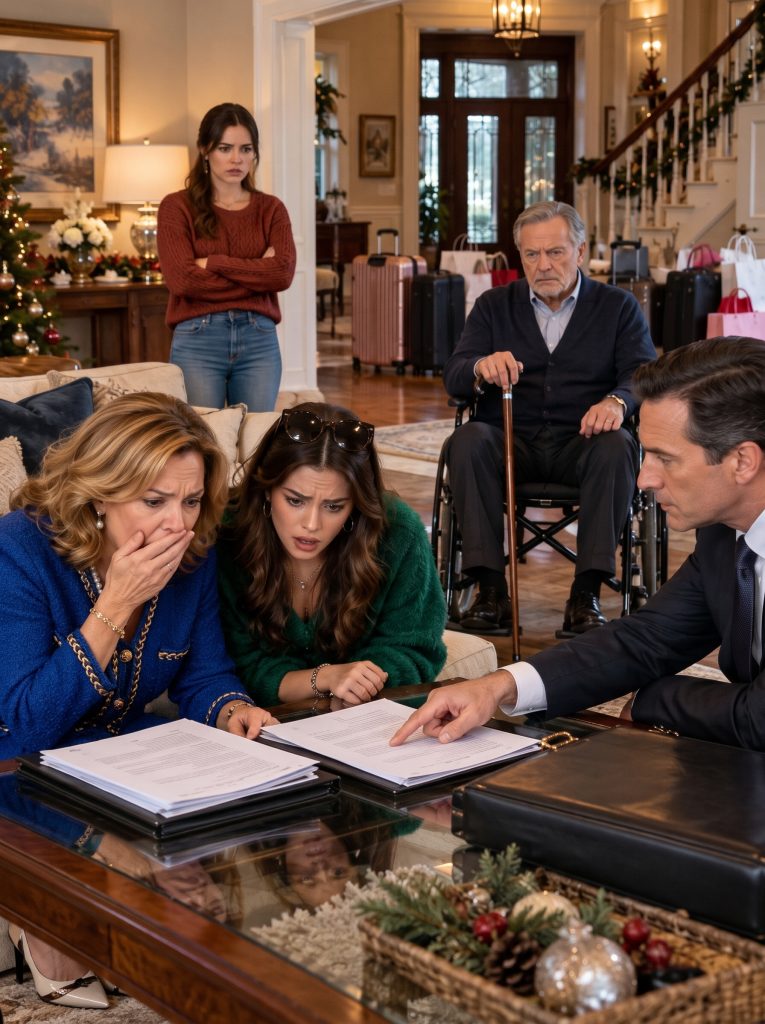
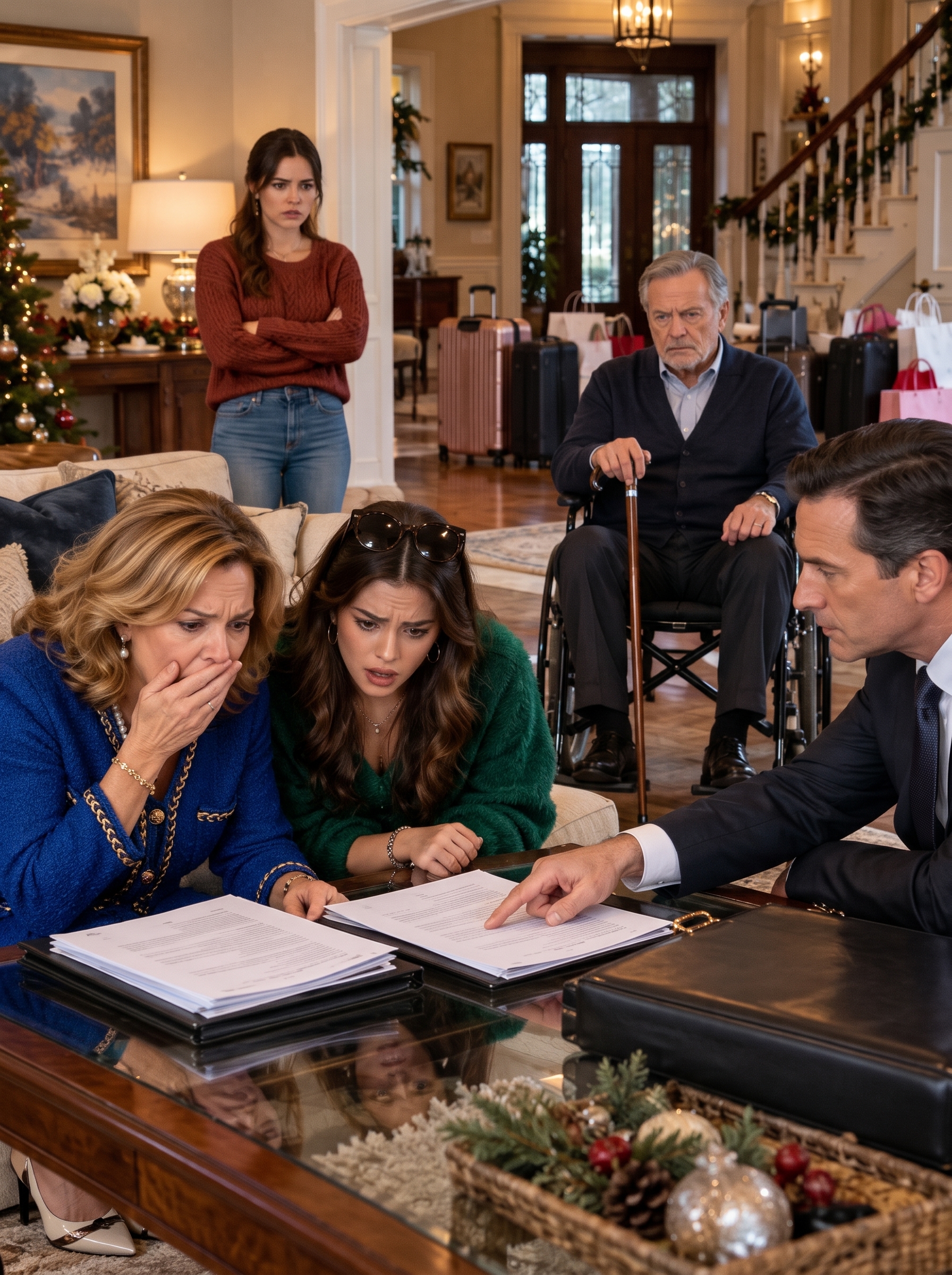
Mr.
Vance placed the packets on the coffee table.
“Mrs.
Morgan, Miss Sabrina, please review these.”
Mom opened the first packet impatiently.
Sabrina leaned over her shoulder.
Mr.
Vance waited.
Then he turned to page three.
And pointed to one sentence.
My mother’s face drained of color.
“Robert…” she whispered.
“You can’t do this.”
Dad leaned back.
“I already have.”
Page three contained a summary of the changes Dad had made to the management and distribution of his separate assets.
Chelsea Morgan was now the primary beneficiary of his estate planning documents.
His attorney had replaced Diane as the person authorized to make financial decisions if he became incapacitated.
Access to his personal accounts had been restricted.
Cards issued to authorized users had been canceled.
And the assets inherited from Theodore were being organized under a trust arrangement designed to prevent unauthorized transfers.
Sabrina snatched the papers.
“Wait.
Chelsea gets everything?”
Mr.
Vance answered carefully.
“Your father has revised his estate plan.
Certain protected trust assets remain subject to their existing terms, and your mother may have rights under state law.
But these documents clearly express his wishes.”
Sabrina stared at Dad.
“You’re giving her the inheritance?”
Dad didn’t answer immediately.
“Why?” she demanded.
He pointed toward the hospital bracelet.
“Because she was here.”
Mom slammed the packet onto the table.
“This is ridiculous!
You’ve been in the hospital!
You aren’t thinking clearly!”
Mr.
Vance folded his hands.
“Your husband’s medical capacity was independently evaluated before the documents were executed.”
“He was manipulated!”
I felt heat rise into my face.
“Mom, I didn’t even know about Grandpa’s estate.”
Sabrina laughed bitterly.
“Oh, please.
You’re always pretending to be the perfect daughter.”
Dad raised his hand.
“Enough.”
Then Mr.
Vance opened another folder.
“There’s an additional matter.”
He placed several bank statements on the table.
My mother glanced at them.
Her expression tightened.
Mr.
Vance pointed to highlighted withdrawals.
“Over the past four months, two hundred and eighty thousand dollars was transferred from accounts held solely in Mr.
Morgan’s name.”
Sabrina’s mouth fell open.
Mom went perfectly still.
Dad looked directly at her.
“Diane, where did the missing $280,000 go?”
Nobody answered.
The room seemed to shrink around us.
Finally, Mom laughed.
It was a thin, unnatural sound.
“What are you talking about?”
Mr.
Vance slid forward another page.
“These transfers were authorized electronically using credentials belonging to your husband.
He disputes approving them.”
Mom’s eyes darted toward Sabrina.
That tiny movement told me more than anything she could have said.
Sabrina stood suddenly.
“I’m not staying here to be accused of something.”
“Sit down,” Dad said.
“I’m an adult!”
“Then behave like one.”
Sabrina froze.
I had never heard Dad speak to her that way.
Mom’s voice rose.
“Robert, this family has expenses.
You know perfectly well how much things cost.”
“Two hundred and eighty thousand dollars?”
“Some of that money was for investments.”
“What investments?”
She hesitated.
Sabrina looked at her.
“Mom…”
“Diane,” Dad said quietly, “I’m asking you one last time.”
Mom’s expression hardened.
“Fine.
Yes, I moved money.
I was protecting our future.”
“From what?”
“From you making foolish decisions!”
Dad stared at her.
Then he asked a question that made my blood run cold.
“How long have you been planning to have me declared incompetent?”
My mother looked as though he had struck her.
“What?”
Mr.
Vance placed another document on the table.
It was a preliminary petition prepared for a court proceeding concerning Dad’s capacity to manage his affairs.
My name appeared several times.
Apparently, I was unstable.
Financially irresponsible.
Emotionally manipulative.
And trying to isolate my father from his family.
I stared at the pages.
“You’re saying I did these things?”
Mom avoided my eyes.
Mr.
Vance continued.
“The draft petition alleges that Chelsea has exerted undue influence over your husband.”
I looked at Dad.
He seemed deeply tired.
Mom recovered quickly.
“That was only a precaution.”
“A precaution?”
I repeated.
“Your father has been forgetting things!”
Dad gave a humorless laugh.
“I forgot where I put my glasses twice, Diane.”
“You were confused!”
“I was tired.”
Mr.
Vance turned another page.
“There’s more.”
An invoice showed that a substantial portion of the missing money had been routed through a company called Horizon Property Partners.
The name meant nothing to me.
But Sabrina reacted instantly.
She sat down so abruptly that her knees struck the coffee table.
Mom shot her a warning look.
I noticed.
So did Dad.
Mr.
Vance closed the folder.
“I believe we’ve discussed enough for tonight.”
Mom stood.
“You’re not throwing me out of my own home.”
Dad shook his head.
“No.
But you are going to stop treating this house like a place where everyone exists to serve you.”
He turned toward Sabrina.
“And you will stop speaking to your sister that way.”
Sabrina’s eyes filled with angry tears.
“I can’t believe you’re doing this to us.”
Dad looked at her for a long time.
“Neither can I.”
Then he added quietly:
“I almost died, Sabrina.
And you’re upset about money.”
For the first time, my sister had no answer.
I expected the confrontation to change everything immediately.
I thought Mom would apologize.
I thought Sabrina would finally recognize what she’d done.
Instead, the next morning, my phone began ringing.
Aunt Linda called first.
“Chelsea, what on earth is happening?”
“What do you mean?”
“Your mother says you’ve taken control of your father’s accounts.”
My stomach sank.
Then a cousin texted.
Then an old family friend.
By noon, Mom had posted a long message online.
She described herself as a devoted wife being pushed aside by an ungrateful daughter.
She implied that Dad’s medical condition had made him vulnerable.
And she suggested I had manipulated him into changing his will.
She never mentioned Hawaii.
She never mentioned the heart attack.
And she certainly never mentioned the missing money.
Within hours, relatives who hadn’t spoken to me in years were sending messages.
“Money changes people.”
“You should be ashamed.”
“Your poor mother.”
One particularly cruel message came from Sabrina’s best friend.
“I always knew you were jealous of her.”
I sat at the kitchen table reading everything until my hands began to shake.
Dad found me there.
“What’s wrong?”
I showed him.
He read silently.
Then he picked up his phone.
“What are you doing?”
I asked.
“Calling Linda.”
I reached for his hand.
“Dad, please.
You need to rest.”
He looked at me.
“No, Chelsea.
I’ve spent twenty-eight years telling you to ignore things.”
His voice softened.
“I’m not asking you to be quiet anymore.”
He called Aunt Linda.
I heard only his side of the conversation.
“No, Linda.
Chelsea didn’t ask me for anything.”
A pause.
“She saved my life.”
Another pause.
“Because my wife and daughter were in Hawaii.”
He listened.
Then his voice became firm.
“And if Diane wants to discuss loyalty, tell her to start with the truth.”
He ended the call.
I stared at him.
“Who are you?”
Dad smiled faintly.
“A man who should have found his backbone twenty years ago.”
But Mom’s accusations had already begun spreading.
And the damage would reach far beyond our family.
On Monday morning, I returned to Little Lantern Preschool.
I had barely entered the building when the director, Mrs.
Alvarez, asked to speak privately.
She was a warm woman in her sixties who had worked in early childhood education for decades.
She usually greeted me with a hug.
That morning, she looked worried.
“Chelsea, I received a phone call about your family situation.”
My heart dropped.
“From whom?”
“A woman who identified herself as your mother.”
I closed my eyes.
Mrs.
Alvarez continued gently.
“She said there may be a legal dispute involving your father’s finances.”
“That’s not really what happened.”
“I believe you.”
But her expression told me there was more.
“She also suggested you might be under investigation for financial misconduct.”
I stared at her.
“That’s a lie.”
“I know.
But I thought you should hear it directly from me.”
I sank into a chair.
For years, this classroom had been my safe place.
My family could dismiss my work, but here I knew I mattered.
Now Mom had reached into that part of my life too.
Mrs.
Alvarez took my hand.
“Listen carefully.
I’m not firing you.
I’m not accusing you of anything.
But if reporters or angry relatives begin contacting the school, we need a plan to protect the children.”
I nodded miserably.
Then she added something unexpected.
“There’s another issue.”
She pulled a letter from her desk.
It came from a property management company.
The building housing Little Lantern Preschool had been listed for possible redevelopment.
Our lease might not be renewed.
I read the letter.
The company handling negotiations was called Horizon Property Partners.
My breath caught.
The same company receiving money from Dad’s accounts.
“Mrs.
Alvarez, where did this come from?”
“An attorney delivered it last week.”
I read the company name again.
Then the address.
Then the signature.
Sabrina Morgan.
My sister.
My own sister was listed as a representative of the company trying to acquire the preschool property.
I felt sick.
This wasn’t simply about Dad’s inheritance anymore.
It was about my job.
My children.
The school where I’d spent six years helping families who couldn’t afford expensive childcare.
I photographed the document and called Mr.
Vance.
He answered immediately.
“Chelsea?”
“I think you need to see something.”
That afternoon, Mr.
Vance met me at his office.
He studied the letter for several minutes.
Then he asked, “How long has the preschool occupied that building?”
“Almost thirty years.”
“And who owns the property?”
“I thought it was some investment company.”
He leaned back.
“What’s the address?”
I told him.
His expression changed.
He turned toward his computer and opened several property records.
Then he went very still.
“Well,” he murmured.
“What?”
He looked at me.
“Your grandfather owned an interest in several properties on that block.”
I stared at him.
“What does Grandpa have to do with my preschool?”
“Possibly quite a lot.”
He printed a document.
A parcel map.
Three adjoining buildings were highlighted.
One contained Little Lantern Preschool.
Another had been a hardware store.
The third was an empty commercial building.
Mr.
Vance explained that Theodore had held the properties through a family trust and associated companies.
The exact ownership had been complicated by probate disputes.
But the school property was included in the assets now being reviewed.
I looked at the map.
“Are you saying my family owns the building?”
“Not quite.
The ownership structure is more complicated.”
He tapped the page.
“But someone has apparently tried to negotiate development rights without proper authority.”
He pointed to Horizon Property Partners.
“That company had no legitimate power to promise this property to anyone.”
I felt my pulse quicken.
“Then what was Sabrina doing?”
“That’s what we need to find out.”
He studied the signature.
“Did your sister ever mention becoming involved in commercial property?”
I laughed bitterly.
“Sabrina once called me at eleven at night because she couldn’t figure out how to reset her Wi-Fi.”
Mr.
Vance almost smiled.
Then his expression hardened.
“There’s something else you should understand.”
He pulled out a separate document.
Horizon had entered into preliminary negotiations with a large development firm called Calder Residential.
The proposed project involved luxury apartments and commercial space.
The potential transaction value was enormous.
Far beyond the money missing from Dad’s accounts.
I stared at the number.
“Eight million dollars?”
“Potentially more.”
Suddenly, the picture began to make sense.
Mom and Sabrina hadn’t simply stolen money to pay for expensive vacations.
They were trying to position themselves to control property worth millions.
And apparently, destroying my preschool was part of the plan.
That evening, I sat beside Dad and told him everything.
He listened without interrupting.
When I finished, he closed his eyes.
“I was afraid of this.”
“You knew?”
“I suspected someone had been asking questions about your grandfather’s properties.”
“Why didn’t you tell me?”
“Because I hoped I was wrong.”
I stood.
“Dad, they were trying to sell the building where I work!”
He nodded slowly.
“I know.”
“How can you be so calm?”
He looked up.
“I’m not calm, Chelsea.
I’m ashamed.”
“Of what?”
“Of what I allowed this family to become.”
I sat beside him.
He explained that Theodore had always cared deeply about the old downtown properties.
Years earlier, the neighborhood had been struggling.
Businesses were closing.
Families were moving away.
Developers wanted to demolish several buildings.
Theodore refused.
He preferred renting spaces to small businesses, often for less than market value.
Little Lantern had benefited from that arrangement for years.
I remembered something then.
When I was ten, Grandpa Theodore had taken me downtown.
We stopped outside a yellow brick building.
Children were laughing behind its windows.
He asked me what I thought of it.
I told him it looked happy.
He asked why.
“Because little kids get to play there,” I said.
He smiled.
Then he bought me an ice cream cone.
I hadn’t thought about that afternoon in nearly twenty years.
Now I wondered what else he had been trying to teach me.
Dad reached for my hand.
“Your grandfather wasn’t always an easy man.
But he believed property should serve people, not the other way around.”
I looked toward the window.
“And Mom was trying to sell everything.”
Dad nodded.
“She has always believed wealth is something you display.”
“What happens now?”
“We prove what they did.”
I hesitated.
“Are you going to call the police?”
He looked down at his hands.
“I don’t know.”
That answer frightened me.
Because despite everything, I could see him fighting the same old instinct.
Protect Diane.
Protect Sabrina.
Avoid conflict.
Make excuses.
I squeezed his hand.
“Dad, if you protect them again, you’re going to lose yourself.”
He looked at me.
Then nodded.
“You’re right.”
But before we could decide what to do, Sabrina came to my apartment.
And she brought something that changed the investigation completely.
It was nearly ten on Tuesday night when someone knocked.
I opened the door.
Sabrina stood in the hallway wearing jeans and an oversized sweatshirt.
Without makeup, she looked younger.
And frightened.
“Can I come in?”
I almost said no.
Instead, I stepped aside.
She walked into my small apartment and looked around.
“You still live here?”
I folded my arms.
“Did you come to insult my furniture?”
“No.”
She sat on the edge of my couch.
For several seconds, neither of us spoke.
Finally, she whispered, “Mom says you’re going to have us arrested.”
“Did you steal Dad’s money?”
She looked away.
“Sabrina.”
“I didn’t know it was that much.”
My stomach tightened.
“So you did know.”
She began twisting the sleeve of her sweatshirt.
“Mom said Dad had been making bad decisions.
She said Grandpa’s estate was going to change everything, and we needed to protect our interests.”
“Our interests?”
“She said Chelsea would try to take it all.”
I stared at her.
“You believed that?”
Sabrina’s eyes filled.
“Mom said you’ve always hated me.”
For a moment, I couldn’t speak.
Then I laughed.
Not because anything was funny.
Because the cruelty was almost too familiar.
“I spent my childhood helping you, Sabrina.”
“I know.”
“I did your homework when you were overwhelmed.
I drove you to practices.
I covered for you when you broke Mom’s jewelry box.”
“I know.”
“I paid your rent once when you told me Dad was cutting you off.”
She lowered her head.
“I remember.”
“Then how could you believe I hated you?”
She started crying.
“Because if you didn’t hate me, I would have to admit how terrible I’ve been to you.”
The honesty startled me.
I sat across from her.
“What is Horizon Property Partners?”
She wiped her eyes.
“A company Mom registered.
She put my name on the paperwork.”
“Why?”
“She said it would make me financially independent.”
“Using Dad’s money?”
She nodded.
I felt a surge of anger.
“You were going to sell my school.”
“I didn’t know that was your school.”
“How could you not know where I work?”
She looked at me helplessly.
I had no answer to that.
Because maybe that was the whole problem.
My sister had spent so many years being the center of everyone’s attention that she’d never learned to look outward.
Then she whispered, “Chelsea, there’s something worse.”
My chest tightened.
“What?”
She reached into her purse.
Pulled out a folded paper.
And placed it on the table.
It was a copy of an email.
The subject line read:
“Capacity Evaluation and Emergency Placement.”
The recipient was a private medical assessment service.
And the patient named in the message was Robert Morgan.
My father.
I read the first paragraph.
Then the second.
By the third, I could barely breathe.
The email requested an urgent evaluation to determine whether Dad should be removed from his home and placed in supervised residential care.
It claimed he was confused.
Combative.
Unable to manage his medication.
And vulnerable to manipulation by his older daughter.
My name appeared again.
I looked up.
“Who wrote this?”
Sabrina whispered, “Mom.”
“When?”
“Three weeks before Hawaii.”
I stared at the date.
Dad had still been living independently.
Driving.
Cooking.
Managing his own appointments.
There had been no medical crisis.
No emergency.
And yet Mom had already begun preparing documents to take control of his life.
Then I noticed an attachment listed beneath the email.
“Medical Authorization.”
I pointed to it.
“What’s this?”
Sabrina went pale.
“That’s why I came.”
She reached into her purse again.
And removed another document.
A copy of a form supposedly signed by Dad.
It authorized Diane to communicate with certain healthcare providers and manage confidential medical information.
His signature sat at the bottom.
I knew Dad’s handwriting.
I had seen it on birthday cards and checks my entire life.
And the signature on that form was wrong.
Someone had forged my father’s name.
The next morning, Mr.
Vance contacted a financial-crimes investigator and began organizing the evidence.
Dad agreed to cooperate.
Sabrina reluctantly handed over the emails and company records she possessed.
But she was terrified.
“Mom will hate me,” she whispered.
I looked at her.
“She’s already willing to destroy people who trust her.
You need to decide whether you want to become the same kind of person.”
Sabrina cried.
“I don’t know how to fix this.”
“You start by telling the truth.”
That was the last conversation we had for several days.
The investigation moved quickly in some ways and painfully slowly in others.
The investigator, Detective May Ortiz, was a sharp, direct woman who seemed unimpressed by family drama.
She wanted dates.
Documents.
Bank records.
Verified signatures.
Not feelings.
When I described the Hawaii trip, she listened carefully.
Then asked, “Did your mother know your father was experiencing chest pain before she left?”
I hesitated.
“I don’t know.”
Dad was sitting beside me.
He looked toward the floor.
“Robert?”
Detective Ortiz asked.
Dad took a breath.
“The day before they left, I told Diane I’d been having pressure in my chest.”
My stomach dropped.
“What?”
He nodded.
“I told her I wanted to call the cardiologist.”
“What did she say?”
Dad stared at the wall.
“She said I was probably anxious about the holidays.”
I felt tears rising.
“And you believed her?”
“I wanted to.”
He swallowed.
“Later, she told me she’d arranged a medication review and that I should wait for instructions.”
Detective Ortiz made a note.
“Did any doctor actually contact you?”
“No.”
“Did you take your prescribed medication?”
Dad hesitated.
“I took what was in my pill organizer.”
My heart began pounding.
“What do you mean?”
He looked at me.
“Diane had been filling it.”
Detective Ortiz’s expression changed.
“Do you still have that organizer?”
I nodded.
It was in the kitchen drawer.
When investigators examined it, they found something alarming.
Several compartments contained tablets that did not match Dad’s current prescriptions.
Some were ordinary over-the-counter supplements.
His prescribed emergency chest-pain medication was missing from its usual place.
The findings didn’t prove anyone had intentionally caused his heart attack.
But they raised disturbing questions.
And Dad remembered something else.
The morning Diane left for Hawaii, he had asked where his emergency medication was.
She told him he didn’t need to worry.
Then she kissed his forehead.
And left.
She had known he was complaining of chest pain.
She had known he was medically vulnerable.
And she had still boarded a plane.
I was furious.
But Detective Ortiz warned us not to jump beyond the evidence.
“We need to establish what happened, who handled the medications, and whether any changes were intentional,” she explained.
I nodded.
But inside, one terrible question kept repeating.
Had my father suffered a heart attack because my mother was careless—or because she wanted him helpless?
Three days later, Mom’s attorney filed an emergency challenge to Dad’s new estate documents.
His name was Gregory Beckett.
He accused me of exploiting an elderly parent.
He claimed Dad had been confused after his heart attack.
He suggested I had isolated him from his lawful wife and manipulated him into making financial decisions.
When I read the petition, I felt physically ill.
Every act of love had been rewritten as evidence of greed.
Driving Dad to the hospital became “controlling access to medical care.”
Helping organize his medications became “assuming authority over treatment.”
Staying in the house became “isolating him from family.”
And bringing him food became “creating emotional dependency.”
I called Mr.
Vance in tears.
“How can they say these things?”
“Because they hope the court will accept their version before examining the evidence.”
“What if the judge believes them?”
“We’re going to tell the truth.”
“But Mom lies so easily.”
Mr.
Vance paused.
“Then we’ll rely on things that can’t be talked out of existence.”
He meant records.
The 911 call.
The ambulance report.
The hospital admission.
The unanswered messages.
The medical capacity evaluation.
The independently witnessed signatures.
And the financial transfers.
But the most important evidence arrived from a source none of us expected.
Sabrina.
She sent Detective Ortiz a file recovered from her mother’s cloud storage.
It contained a draft business plan prepared before the Hawaii trip.
The document outlined the proposed acquisition and redevelopment of the downtown properties.
An attached financial projection estimated profits from selling the land.
One section discussed the “anticipated transfer of decision-making authority” over Robert’s assets.
The projected date was January.
Another section contained a note:
“Contingency: accelerate capacity determination if medical condition deteriorates.”
I read those words three times.
If medical condition deteriorates.
It wasn’t a spontaneous reaction to Dad’s heart attack.
My mother had been preparing to take control of his property before he collapsed.
The discovery sickened me.
But there was still a question I couldn’t answer.
Why Hawaii?
Why leave the country—or, in this case, the mainland—at the exact moment she expected something to happen?
Was it simply selfishness?
Was she creating distance?
Or was there some other reason?
The answer arrived during the hearing.
And it was worse than I imagined.
The courtroom smelled of old wood and paper.
Dad sat beside Mr.
Vance, wearing a charcoal suit that hung loosely from his shoulders.
He still looked tired.
But he insisted on attending.
“I want the judge to see me,” he said.
“I want someone to finally listen.”
Mom sat across the aisle beside Mr.
Beckett.
She wore a pale blue dress and carried a tissue.
Sabrina sat behind her, staring at the floor.
Mom looked heartbroken.
It was an extraordinary performance.
She wiped her eyes as her attorney described their long marriage.
Her devotion.
Her concern.
Her fear that an ambitious daughter was taking advantage of a sick father.
At one point, Mom looked toward Dad and whispered loudly enough for several people to hear:
“I only want my husband back.”
I wanted to scream.
Instead, I dug my fingernails into my palms.
Mr.
Beckett argued that Dad’s new documents should be temporarily disregarded until his capacity could be evaluated.
Then Mr.
Vance stood.
He was calm.
Methodical.
Almost gentle.
He began with the hospital records.
The cardiologist’s findings.
The formal capacity assessment.
The notary’s testimony.
The independent witness.
The precise dates and times.
Then he presented the bank statements.
The unauthorized transactions.
The forged medical authorization.
And the company records.
Mom’s expression gradually changed.
By the time Mr.
Vance introduced the redevelopment proposal, she was no longer crying.
She was whispering urgently to her attorney.
Finally, Mr.
Vance asked the court for permission to present evidence relating to the Hawaii trip.
Mr.
Beckett objected.
The judge reviewed the proposed material.
Then allowed limited testimony concerning the timeline.
Mr.
Vance approached Mom.
“Mrs.
Morgan, when did you book your vacation?”
“Several months earlier.”
“Did you know your husband had recently complained of chest pain?”
She hesitated.
“He was always complaining about something.”
“Yes or no?”
“Yes.”
“Did you arrange a medical appointment for him?”
“I told him to contact his doctor.”
Dad stared at her.
That wasn’t what he had told us.
Mr.
Vance placed an email on the screen.
It had been sent from Mom’s account to a private medical service.
The date was December twenty-seventh.
“Mrs.
Morgan, this email requests that a physician’s evaluation be delayed until after January fifth.
Is that correct?”
Mom swallowed.
“I don’t remember.”
“Did you send it?”
“I may have.”
“Why delay an assessment if you believed your husband was medically unstable?”
Mom looked at her attorney.
Mr.
Beckett rose.
The judge reminded him that the witness should answer.
Mom’s voice became defensive.
“We had travel plans.”
Mr.
Vance nodded.
“Now, when your husband was hospitalized, did you receive messages from Chelsea?”
“I didn’t have service.”
Mr.
Vance displayed the resort’s communication records and a series of messages obtained through lawful document requests.
Mom had been active online throughout the trip.
She had exchanged numerous messages with business associates.
She had also discussed Dad’s finances with Sabrina.
But she had not replied to my emergency texts.
Then Mr.
Vance displayed a photograph.
It showed Mom and Sabrina smiling beside the ocean.
I recognized it.
I had seen it on social media while Dad was in intensive care.
Mr.
Vance pointed to the timestamp.
“Mrs.
Morgan, this photograph was posted approximately forty minutes after Chelsea informed you that your husband had suffered a heart attack.”
Mom stared at the screen.
The courtroom became silent.
Then Mr.
Vance asked:
“Why did you have time to post vacation photographs, but not to ask whether your husband was alive?”
Mom opened her mouth.
Nothing came out.
For one glorious second, I thought the truth had finally won.
But then Sabrina stood.
“Your Honor, I need to say something.”
Mom spun toward her.
“Sabrina, sit down!”
My sister was shaking.
“I can’t.”
“Sabrina!”
The judge ordered silence.
Sabrina looked toward Dad.
Then toward me.
Tears streamed down her cheeks.
“My mother told me Dad was going to die anyway.”
The words hit the courtroom like a gunshot.
Mom surged to her feet.
“That is a lie!”
Sabrina flinched.
Then straightened.
“She said his heart was failing.
She said there was no point ruining our vacation because he probably wouldn’t last much longer.”
Mr.
Beckett hurriedly asked for a recess.
The judge granted one.
But the damage was done.
In the hallway, Mom cornered Sabrina.
“How dare you embarrass me!”
Sabrina began crying.
“You told me he was being dramatic!”
“I told you what you needed to hear!”
Dad stood a few feet away, leaning on his cane.
His expression was unlike anything I’d ever seen.
Not angry.
Not devastated.
Empty.
As though something inside him had finally stopped hoping.
Mom noticed him.
“Robert, please.
You know I didn’t mean—”
He raised one hand.
“Don’t.”
She froze.
He looked at her for a long time.
“Thirty-four years, Diane.”
Her face crumpled.
“We’ve been married thirty-four years.”
He nodded.
“And I spent most of them trying to make you happy.”
“Robert—”
“But somewhere along the way, you decided my happiness didn’t matter.”
Mom reached toward him.
He stepped back.
That small movement hurt her more than shouting would have.
“I loved you,” she whispered.
Dad’s voice broke.
“I loved you too.”
Then he turned away.
“That’s why it took me so long to see what you were doing.”
The judge declined to grant the emergency relief Mom sought.
Dad’s independent medical evaluation and the surrounding evidence strongly supported his capacity to make decisions.
The disputed financial transactions and forged documents would be investigated separately.
The judge did not decide every issue that day.
There were still questions concerning property.
Marital rights.
Business arrangements.
And potential criminal conduct.
But Mom’s attempt to take immediate control had failed.
For the first time in years, she couldn’t simply demand something and expect everyone to surrender.
As we left the courthouse, Sabrina approached me.
“Chelsea.”
I stopped.
She looked exhausted.
“I’m sorry.”
I studied her face.
For most of my life, I’d wanted those words.
Now that I’d heard them, they felt smaller than I expected.
“Do you know how close Dad came to dying?”
She nodded, crying.
“I do now.”
“And you didn’t care enough to ask.”
“I know.”
I looked away.
She wiped her cheeks.
“Mom always told me you thought you were better than me.”
I almost laughed.
“Sometimes I thought you were better than me, Sabrina.
Because that’s what everyone kept telling me.”
Her expression collapsed.
“I never knew.”
“That’s the problem.”
She stared at me.
Then whispered, “Can you ever forgive me?”
I thought about every birthday forgotten.
Every sacrifice ignored.
Every insult swallowed.
And the sight of Dad on that hospital bed.
“I don’t know.”
She nodded slowly.
“I understand.”
For once, she didn’t argue.
She didn’t demand reassurance.
She just walked away.
It was the first time I’d ever seen my sister accept an answer she didn’t like.
The investigation continued over the following weeks.
Detective Ortiz and financial specialists traced the missing money through bank records and company accounts.
Some had been transferred into Horizon Property Partners.
Other funds had been used for consulting fees, deposits, travel, and legal preparations.
The supposed property investment had been built around documents that appeared to contain forged authorizations.
Sabrina eventually admitted that she had signed papers without fully understanding them.
She had accepted Mom’s explanations because they promised wealth.
Independence.
A future where she wouldn’t have to ask Dad for money anymore.
But the future Mom envisioned depended on taking control of Dad’s assets.
And when she couldn’t obtain that control directly, she had tried to obtain it through questions about his mental competence.
Investigators found additional emails suggesting Mom had explored placing Dad in a residential care facility.
She had even toured one.
Without telling him.
I couldn’t stop thinking about that.
Dad loved his garden.
His books.
His workshop.
His comfortable chair by the window.
Mom had apparently been prepared to remove him from all of it.
Not because he needed care.
But because it would make controlling his affairs easier.
One afternoon, Dad asked me to drive him past the facility.
I didn’t want to.
But he insisted.
We parked across the street.
It was a perfectly respectable-looking building.
Clean windows.
Neatly trimmed hedges.
A cheerful sign.
Dad stared at it.
“She was going to put me there.”
I said nothing.
He watched an elderly man walk slowly through the garden with a caregiver.
Then he whispered, “I wonder how many people end up somewhere like that because their families are tired of them.”
I reached for his hand.
“Dad, you would have had me.”
He looked at me.
“I know.”
Then he squeezed my fingers.
“That’s what saved me.”
By February, my mother had moved into a rented townhouse.
Dad had begun the process of separating their finances and seeking a divorce.
It wasn’t simple.
Thirty-four years of marriage created legal and emotional entanglements that couldn’t be erased with a signature.
Some assets were marital.
Others were separate.
The inherited properties had their own restrictions.
And legal proceedings would be necessary to determine what Mom was entitled to and what she had wrongfully taken.
Dad understood all of that.
For the first time, he wasn’t trying to avoid the difficulty.
He was facing it.
Sabrina moved into a smaller apartment.
Her involvement in the company became part of the investigation.
She found ordinary work at a local office.
She started paying her own rent.
It wasn’t glamorous.
But she seemed to be trying.
I didn’t immediately welcome her back into my life.
Trust wasn’t a switch.
It was something rebuilt slowly.
And sometimes, I wasn’t sure I wanted to rebuild it at all.
As for Mom, she kept insisting she was the victim.
She blamed Sabrina for misunderstanding the business plan.
She blamed Dad for hiding the inheritance.
She blamed Mr.
Vance for interfering.
And she blamed me most of all.
One afternoon, she sent me a message.
“You destroyed this family because you couldn’t stand seeing your sister happy.”
I stared at the screen.
Then typed a reply.
“I didn’t destroy our family, Mom.
I stopped pretending it wasn’t already broken.”
I sent it.
Then blocked her number.
I expected to feel guilty.
Instead, I felt something unfamiliar.
Peace.
But the biggest surprise was still ahead.
It happened on a rainy Thursday in March.
Mr.
Vance called and asked me to come to his office.
“There’s a matter involving your grandfather’s trust that I think you’ll want to discuss in person.”
I assumed it concerned the preschool property.
The redevelopment deal had fallen apart after questions about the authorization documents became public.
Little Lantern’s immediate future was safer.
But Mrs.
Alvarez was still worried.
The building needed repairs.
Enrollment was rising.
And several families were struggling with tuition.
I hoped Mr.
Vance had found a way to secure a longer lease.
When I arrived, Dad was already sitting in the conference room.
He looked nervous.
That surprised me.
Mr.
Vance closed the door.
“Chelsea, your grandfather left instructions concerning certain documents held by the trustee.”
He placed a long envelope on the table.
My name was written across the front.
In Grandpa Theodore’s unmistakable handwriting.
I stared.
“That’s for me?”
Dad nodded.
Mr.
Vance explained that the trust contained a private letter and certain property instructions.
The letter had been kept with the estate records while the legal proceedings were completed.
Now the trustee had authorized its release.
My fingers trembled as I opened it.
Inside was a handwritten letter.
“Chelsea,
If you’re reading this, then I am no longer here to explain myself.
I know I was not the kind of grandfather who gave many hugs or said many sweet things.
I hope you understood that silence did not mean I wasn’t watching.
When you were ten years old, I took you to see an old school building.
I asked what you would do if you had a great deal of money.
You didn’t say you’d buy a mansion.
You didn’t say you’d buy a car.
You said you would make sure every child had somewhere safe to go when their parents were working.
I never forgot that.”
Tears blurred the page.
I remembered that day.
The yellow brick building.
The ice cream.
Grandpa’s strange questions.
I continued.
“Money can reveal character.
Sometimes it reveals greed.
Sometimes cowardice.
But occasionally, it reveals an opportunity to do something good.
I have watched you choose a difficult career because you love children.
I have watched you help people who could offer you nothing in return.
And I have watched you ask for very little yourself.
I want you to understand something.
You were never invisible to me.”
I covered my mouth.
Dad reached for my hand.
The letter continued.
“I have placed the downtown educational properties in a protected trust for a purpose.
The trust instrument provides for you to become the controlling trustee of a fund dedicated to education and community care.
The school property is to be preserved for children, not sold merely because a developer offers an attractive price.
You will receive professional support.
You will receive an appropriate salary for the work.
But most importantly, you will have the power to build something that lasts longer than any of us.”
I looked up.
Mr.
Vance nodded.
“Your grandfather created an educational charitable trust.
The court proceedings delayed its full implementation, but the governing documents are now effective.”
My voice shook.
“Does that mean Little Lantern…?”
“The property will remain dedicated to educational use under the trust’s terms.”
“And the money?”
“Enough has been set aside to maintain the buildings and support early childhood programs for many years, if responsibly managed.”
I stared at him.
“How much?”
He placed a financial summary before me.
I looked at the total.
Then looked again.
Four million, six hundred thousand dollars.
A protected fund.
For children.
For the school.
For the community.
Not a personal fortune to spend recklessly.
A responsibility.
A chance to change lives.
I burst into tears.
Dad wrapped his arm around my shoulders.
“Your grandfather knew exactly what he was doing,” he whispered.
I thought of the countless mornings I’d spent in that building.
The children who arrived hungry.
The parents working two jobs.
The little boy whose family couldn’t afford winter boots.
The mother who cried when we helped her secure childcare so she could finish nursing school.
Grandpa had somehow looked beyond his own lifetime and seen a future I hadn’t dared imagine.
But there was another envelope.
And what it contained would reveal the cruelest secret of all.
Mr.
Vance didn’t hand me the second envelope immediately.
He looked toward Dad.
“Robert, are you certain?”
Dad nodded.
“She deserves the truth.”
I felt my stomach tighten.
“What truth?”
Dad took a long breath.
“Your grandfather discovered something before he died.
Something I hoped we would never have to discuss.”
Mr.
Vance opened the envelope.
Inside were old bank statements, letters, and a notarized declaration.
The oldest document was dated twenty-three years earlier.
I was five years old then.
At first, I couldn’t understand what I was looking at.
Then I saw my name.
Chelsea Morgan.
And beside it, a financial account established for my benefit.
I frowned.
“What is this?”
Dad looked away.
Mr.
Vance spoke quietly.
“When you were a child, your grandfather established an education trust in your name.”
I stared at him.
“I never knew about that.”
“The trust was intended to help pay for college and provide a financial foundation when you became an adult.”
I looked down.
The original amount was substantial.
Invested over the years, it should have grown considerably.
But the statements showed withdrawals.
Repeated withdrawals.
Year after year.
By the time I turned eighteen, very little remained.
My hands went numb.
“Who took it?”
Dad whispered, “Diane.”
I looked at him.
“No.”
He nodded miserably.
“Your mother had access to the account when you were young.
Your grandfather believed she was handling the money responsibly.”
I stared at the transactions.
Tuition withdrawals.
Household expenses.
Family purchases.
Large transfers.
Some occurred during the years Sabrina was attending private dance academies.
Others matched periods when Mom had purchased expensive furniture or taken elaborate vacations.
My chest tightened.
All those years.
I had worked after school.
Saved every paycheck.
Applied for scholarships.
Taken out student loans.
Worn the same winter coat until its lining tore.
I had cried when I couldn’t afford a study-abroad opportunity.
And through it all, money meant for my education had been used to finance the lifestyle of the people who kept telling me to be grateful.
I turned toward Dad.
“Did you know?”
He looked devastated.
“Not then.”
“When did you find out?”
“Your grandfather told me shortly before he died.
He’d discovered irregularities and was trying to reconstruct the records.”
“Why didn’t you tell me?”
Dad lowered his head.
“Because I was ashamed.”
The room became painfully quiet.
He continued.
“I knew your mother had handled money badly.
I knew she’d favored Sabrina.
But I didn’t understand how much she had taken from you until Theodore showed me.”
I felt something fracture inside me.
“You knew for three years?”
Dad nodded.
Tears spilled down his face.
“I thought I could find a way to replace it quietly.”
I stood.
My chair scraped against the floor.
“Replace it quietly?”
“Chelsea—”
“You let me believe I had nothing!”
He flinched.
“You let me work two jobs through college while Mom used money Grandpa left for me?”
“I wanted to fix it.”
“But you didn’t tell me!”
My voice broke.
For the first time since the heart attack, I wasn’t angry at Mom.
I was angry at Dad.
At the man I’d saved.
The man I’d defended.
The man I’d believed was finally telling me the truth.
He reached toward me.
I stepped back.
“You didn’t just let them take my money, Dad.
You let them teach me that I wasn’t worth investing in.”
His face crumpled.
I turned and walked out.
I drove for nearly an hour.
Rain streaked the windshield.
My phone rang repeatedly.
Dad.
Mr.
Vance.
Then Dad again.
I couldn’t answer.
I parked beside a quiet lake and cried until my chest hurt.
Not because of the money.
Or not only because of the money.
I thought about the young girl I had been.
The girl who believed college was something she had to earn without help.
The girl who apologized for needing new shoes.
The girl who sat quietly while Sabrina opened expensive gifts.
The girl who worked so hard to prove she deserved a place in her own family.
And all along, a grandfather I thought barely noticed me had tried to give me security.
He had seen me.
He had planned for me.
And someone had taken that gift away.
Worse, Dad had known enough to tell me there was a problem and had stayed silent.
I loved him.
But love didn’t erase his choices.
That was the hardest lesson of all.
I had spent so much time blaming Mom and Sabrina that I hadn’t wanted to admit Dad had his own responsibility.
He had allowed the unequal treatment.
He had avoided uncomfortable conversations.
He had protected himself from arguments by letting me absorb the consequences.
Being the kinder parent did not automatically make him the innocent one.
By the time I finally drove home, I knew what I needed to do.
I called Mr.
Vance.
“I want a full accounting of the education trust.”
“Of course.”
“And I want every document.
Not just the ones that make Dad look good.”
There was a pause.
“That’s a reasonable request.”
I swallowed.
“I also want to know whether I have any legal options concerning the missing money.”
“We can review that.”
“And one more thing.”
“Yes?”
“I’ll consider serving as trustee of Grandpa’s education fund.
But I want independent advice before accepting anything.”
Mr.
Vance sounded almost relieved.
“Your grandfather would have approved of that.”
I looked at the rain-darkened road.
Then answered:
“I’m done letting other people decide what’s best for me.”
Dad came to my apartment two days later.
He looked older.
More fragile.
But he didn’t ask me to forgive him.
He didn’t make excuses.
Instead, he sat across from me and said, “I was a coward.”
I waited.
He continued.
“I told myself I was protecting you from family conflict.
But I was protecting myself from having to face your mother.”
His voice trembled.
“Your grandfather was furious when he discovered what happened to your account.
He wanted me to confront Diane.”
“Why didn’t you?”
“Because I knew she would turn it into a war.”
I looked at him.
“And letting me struggle was easier.”
He nodded.
“Yes.”
The honesty hurt.
But I needed it.
He leaned forward.
“I can’t give you those years back.
I can’t undo the things I allowed.
And I won’t ask you to pretend they didn’t happen.”
Tears filled my eyes.
“Then what are you asking?”
“Nothing.”
He swallowed.
“I just want you to know that whatever you decide, I will respect it.”
We sat quietly.
Then he placed a folder on the table.
It contained records of money he had begun setting aside after Theodore confronted him.
Not enough to replace everything.
But evidence that he had been trying.
“I intended to give this to you when I could explain what happened.”
I closed the folder.
“Dad, I don’t want secret gifts anymore.”
He nodded.
“Understood.”
“I want honesty.”
“You’ll have it.”
“And I want you to stop making decisions for me because you’re afraid I’ll be upset.”
His eyes filled.
“I promise.”
I watched him for a long time.
Then reached across the table.
He took my hand.
We didn’t pretend the damage was gone.
But for the first time, we were facing it together.
Spring arrived slowly.
The snow melted.
Green buds appeared along the trees.
And my life began changing in ways I had never expected.
With independent legal and financial guidance, I accepted the role of trustee for Grandpa’s educational fund.
Mrs.
Alvarez agreed to help develop a long-term plan for Little Lantern.
We hired experts.
Reviewed budgets.
Repaired the roof.
Expanded the playground.
And established a scholarship program for families struggling with childcare costs.
One morning, I watched a little girl named Lily race across the playground toward her mother.
Her mother had recently returned to work after months of unemployment.
Without our tuition assistance, Lily would have lost her place at school.
Instead, she was laughing.
Safe.
Learning.
Happy.
I stood beside Mrs.
Alvarez.
“Can you believe this is happening?”
She smiled.
“Yes.”
I looked at her.
“Really?”
She nodded.
“Because I’ve watched you spend six years caring for children when nobody was paying you extra to do it.”
She squeezed my shoulder.
“Money didn’t make you generous, Chelsea.
It just gave your generosity more room.”
I thought about Grandpa Theodore.
About the little yellow building.
About the ice cream cone.
And for the first time since reading his letter, I smiled without crying.
But the criminal investigation had not ended.
Detective Ortiz called one afternoon.
Her tone was serious.
“Ms.
Morgan, we’ve made a significant discovery.”
My stomach tightened.
“What kind of discovery?”
“We traced additional records concerning the forged authorizations and the missing funds.”
“Okay.”
“There may be another person involved.”
I frowned.
“Another person?”
“Someone who helped prepare the documents.”
I sat down.
“Who?”
She hesitated.
Then gave me a name I didn’t recognize.
Martin Keller.
A financial consultant.
He had worked with Horizon Property Partners.
And investigators believed he had helped organize the transactions.
But something about the name seemed familiar.
After the call, I searched through the estate documents.
I found it on an old invoice.
Then on a letter.
Then on a bank form.
Martin Keller had served as a consultant to Grandpa Theodore’s business years earlier.
My breath caught.
He wasn’t some random outsider.
He had known my grandfather.
He had known the properties.
And he had known about the family trust.
I called Mr.
Vance immediately.
“Why didn’t anyone tell me Martin Keller worked for Grandpa?”
There was silence.
Then Mr.
Vance said quietly:
“Because until now, I didn’t realize he was involved with Horizon.”
My skin prickled.
“What does that mean?”
“It means your mother may have had help from someone who knew exactly which assets she was targeting.”
Investigators eventually established that Keller had helped create the shell company and prepare questionable property documents.
He had access to old financial information.
He understood which trust assets were valuable.
And he had apparently encouraged Diane to believe that gaining control over Dad’s decisions could give her access to property transactions worth millions.
The scheme was more sophisticated than we’d imagined.
Diane had supplied access to Dad’s personal information.
Sabrina had signed business documents.
Keller had prepared financial structures and introduced potential investors.
The missing $280,000 had helped finance the effort.
It was a plan built on greed and the assumption that Dad would never resist.
But the investigation uncovered one additional fact.
Keller had been communicating with Diane for much longer than we knew.
Years.
Their relationship extended back to the period when money disappeared from my childhood education trust.
I felt sick when Detective Ortiz told me.
There were limitations on what could be established about transactions from so long ago.
Records had been destroyed.
Some accounts had closed.
Certain claims might be difficult or impossible to pursue.
But the pattern was clear enough to raise serious questions.
My mother’s financial betrayal hadn’t begun when Grandpa’s estate was settled.
It had begun when I was a child.
And someone had been helping her understand exactly what she could take.
As the investigation progressed, formal charges were eventually brought in connection with the more recent fraudulent transactions.
Mom continued denying wrongdoing.
Keller attempted to blame her.
Sabrina cooperated and accepted responsibility for the documents she had signed.
The legal proceedings took months.
There were negotiations.
Hearings.
More documents than I thought one family could possibly produce.
I learned that justice rarely moved as quickly as anger.
Sometimes it was slow.
Complicated.
Exhausting.
But the truth was no longer trapped inside our house.
It was finally being examined where excuses weren’t enough.
One evening in late summer, Dad invited me to dinner.
He had been cooking more often.
His cardiologist was pleased with his recovery, though he still needed medication, monitoring, and regular appointments.
He walked slowly.
Rested when he needed to.
And took better care of himself than I had ever seen.
He also started volunteering at Little Lantern.
Not every day.
Just a few hours each week.
He repaired shelves.
Built wooden puzzles.
And helped the children plant flowers.
They called him Grandpa Robert.
He pretended to complain.
But I could tell he loved it.
That evening, we ate chicken soup at his kitchen table.
The house felt different.
Quieter.
Lighter.
Mom’s expensive decorations were gone.
So were the endless arguments about money.
Dad had placed family photographs on the mantel.
But not all the old photographs.
One showed Grandpa Theodore holding me when I was a toddler.
Another showed Dad teaching me to ride a bicycle.
A third showed children playing at Little Lantern.
I smiled.
“You’ve redecorated.”
Dad shrugged.
“Thought it was time.”
After dinner, he handed me a small wooden box.
“I found this in your grandfather’s belongings.”
Inside was a silver charm bracelet.
Several tiny charms hung from it.
A book.
A heart.
A small house.
And a little silver apple.
I recognized it immediately.
Grandpa used to keep it in a drawer.
When I was little, I’d begged him to let me wear it.
He always said, “When you’re older.”
Dad smiled.
“Seems you’re older now.”
I fastened it around my wrist.
Then noticed something tucked beneath the velvet lining.
A photograph.
It showed Grandpa Theodore standing outside Little Lantern.
Beside him was a young woman holding a small child.
I recognized myself.
But the woman wasn’t Mom.
She had dark hair.
A gentle smile.
And eyes that looked startlingly familiar.
I turned the photograph over.
On the back, Grandpa had written:
“Grace and Chelsea — the beginning of everything.”
I stared.
“Dad?”
He looked up.
“Who is Grace?”
The color drained from his face.
For several seconds, he said nothing.
Then he sat down slowly.
And I realized there was one final family secret nobody had told me.
Dad looked at the photograph for so long that I began to worry about him.
Finally, he whispered, “Grace was your mother.”
I stared.
“What?”
He swallowed.
“Your biological mother.”
The room seemed to lose its air.
I looked back at the photograph.
The young woman smiled at the camera while holding me close.
Her face was unfamiliar.
Yet somehow, not entirely.
I had her eyes.
Her dark hair.
Even the same little dimple near the corner of my mouth.
I gripped the table.
“But Diane…”
Dad closed his eyes.
“Diane adopted you when you were four.”
I couldn’t move.
My whole childhood rearranged itself in a single instant.
Mom’s strange distance.
Her preference for Sabrina.
The way relatives occasionally went silent when I entered certain rooms.
The absence of pregnancy photographs or stories about my birth.
I had never thought to question any of it.
“Why didn’t you tell me?”
Dad’s face crumpled.
“Because I was afraid.”
“Of what?”
“Of hurting you.
Of opening wounds I didn’t know how to explain.”
I laughed bitterly.
“That’s becoming a theme, Dad.”
He nodded.
“I know.”
I stared at the photograph.
“What happened to her?”
Dad’s voice broke.
“Grace died when you were three.”
My throat tightened.
“How?”
“A car accident.”
I lowered myself into a chair.
Dad began speaking slowly.
Grace had been his first wife.
They met in college.
She studied early childhood education.
She loved music, books, and children.
They married young.
And after several difficult years, I was born.
He smiled through tears.
“She used to say you were going to change the world.”
I looked down.
“She was a teacher?”
“She wanted to be.
She was working toward her certification.”
A strange ache spread through my chest.
My entire adult life, I had believed my desire to teach was something I had chosen alone.
Now I discovered it connected me to a woman I barely remembered.
Dad continued.
When Grace died, he fell apart.
I was too young to understand.
He struggled to work.
To sleep.
To care for me while grieving.
Diane had been a family acquaintance.
She helped with meals.
Offered childcare.
Made herself indispensable.
Eventually, Dad married her.
Then Sabrina was born.
“Diane was kind at first,” he whispered.
“I wanted to believe we could be a happy family.”
I stared at him.
“Did Grandpa know?”
“Of course.”
“Why didn’t he tell me?”
Dad looked at the photograph.
“I asked him not to.
He disagreed.
We fought about it more than once.”
I thought of Grandpa’s quiet questions.
His unusual concern for my education.
His efforts to preserve the preschool.
The trust he’d established in my name.
Suddenly, so many things made sense.
Then Dad said something that made me look up sharply.
“Grace’s family had money too.”
I frowned.
“What?”
“Not a fortune.
But she had inherited property and savings from her parents.”
I felt my stomach turn.
“Where did it go?”
Dad looked miserable.
“Some was used to support you after she died.
Some was supposed to remain protected.”
I stared at him.
My mind raced back to the documents.
The education trust.
The old withdrawals.
The missing money.
And the photograph.
“Did Diane know?”
Dad nodded.
“Yes.”
My voice was barely audible.
“Did she know that some of the money she spent belonged to my dead mother?”
Dad covered his face.
And in that silence, I understood.
For several minutes, I couldn’t speak.
Then I stood.
I walked to the window.
Outside, the garden lights glowed softly against the summer darkness.
I thought about Grace.
A woman who had loved me.
Held me.
Planned a future for me.
Then died before I was old enough to remember her clearly.
I thought about Grandpa Theodore trying to protect me financially.
About Diane taking money intended for my education.
About Dad hiding the truth because he was afraid of conflict.
And about the strange, painful path that had led me to this moment.
A heart attack.
A vacation.
A yellow sticky note.
A safe beneath the floor.
An inheritance.
A betrayal.
And now, a mother I’d never known.
I turned toward Dad.
“Do you have anything else that belonged to Grace?”
He nodded.
“There are boxes in the attic.”
“Photos?”
“Yes.”
“Letters?”
“Some.”
I swallowed.
“Then I want to see all of it.”
His eyes filled.
“Of course.”
“And Dad?”
“Yes?”
“From now on, no more secrets.”
He nodded.
“No more secrets.”
That night, we carried down two dusty cardboard boxes.
Inside were photographs.
Birthday cards.
A wedding album.
Books with handwritten notes.
And a small blue notebook.
Grace’s handwriting filled the pages.
Some entries described ordinary things.
The weather.
Grocery lists.
Appointments.
Little moments from my childhood.
“Today Chelsea laughed so hard at the ducks in the park that she fell over.”
“She has learned to say butterfly.”
“She wants the same bedtime story every single night.”
I cried as I read.
Not because the words were extraordinary.
Because they were ordinary.
They proved that once, before everything became complicated, I had been somebody’s whole world.
Then I reached the final pages.
Grace had written about wanting to open a small childcare center.
A place for working parents.
Somewhere children would feel safe.
Somewhere families with little money would still be welcomed.
She had even drawn a rough sketch of a building.
A yellow brick building.
With large windows.
A playground.
And a bright front door.
My hands began to shake.
I recognized it.
Little Lantern.
The school where I worked.
The building Grandpa had preserved.
The property now protected by the educational trust.
I looked toward Dad.
“Did Grandpa know about this?”
He nodded slowly.
“Grace talked to him about it all the time.”
I stared at the drawing.
Then back at the notebook.
Dad continued.
“After she died, your grandfather bought an interest in the property.
He couldn’t build the exact school she envisioned immediately, but he helped keep the childcare center operating.”
My throat tightened.
“He did it for her?”
Dad looked at me.
“And for you.”
I pressed the notebook against my chest.
All those years.
All those mornings.
All those children.
I had believed I’d found my calling by accident.
But somehow, I had spent six years working inside a dream my biological mother had once carried.
The school I loved wasn’t merely my workplace.
It was the dream my mother had left behind for me.
And my grandfather had protected that dream until I was old enough to carry it forward.
The following Saturday, I visited Little Lantern alone.
The building was quiet.
Sunshine streamed through the classroom windows.
Tiny chairs stood around low tables.
Crayon drawings covered the bulletin boards.
I walked into my classroom and sat on the reading rug.
Then I opened Grace’s notebook.
I read her plans again.
Her hopes.
Her worries.
Her love.
For the first time, I allowed myself to imagine the life we might have had together.
Maybe she would have taught me to bake.
Maybe we’d have argued about clothes when I was a teenager.
Maybe she would have cried at my graduation.
Maybe we’d have become friends when I grew up.
I would never know.
That loss was real.
Nothing could replace it.
But as I looked around the classroom, I realized something else.
She hadn’t disappeared entirely.
Her dreams had survived in small, unexpected ways.
In Grandpa’s quiet generosity.
In Dad’s memories.
In a yellow brick building.
And somehow, in me.
I whispered into the empty classroom:
“Mom, I think we did it.”
Then I cried.
Not the angry tears I’d cried after finding Dad in bed.
Not the helpless tears I’d cried over the stolen money.
These were different.
They were grief and gratitude tangled together.
I finally understood that the people who hurt me had never possessed the power to define my worth.
I had spent my whole life trying to earn love from someone who treated affection like a reward.
But love had been present in places I hadn’t known to look.
In a grandfather’s carefully preserved dream.
In a dead mother’s handwritten notebook.
In a father who had finally learned that love required courage.
And in the children who ran into my classroom every morning, trusting me to make the world feel safe.
A year after that terrible New Year’s holiday, Little Lantern held its grand reopening.
The renovated building shone beneath clear blue skies.
We had added classrooms.
Created a family resource center.
Expanded the scholarship program.
And established a memorial fund in Grace’s name.
Parents crowded the entrance.
Children waved handmade flags.
Mrs.
Alvarez delivered a short speech.
Dad stood beside me, healthier and stronger, though still careful with his heart.
Sabrina attended quietly.
She had been working consistently and had begun making repayments under the arrangements arising from the financial case.
Our relationship remained cautious.
There were good days.
Awkward days.
Days when I remembered the things she’d said and needed distance.
But she was learning something she had never learned as a child.
Love doesn’t mean escaping consequences.
Sometimes love means finally facing them.
Mom wasn’t there.
Her legal troubles had continued, and the consequences of the financial scheme had changed her life dramatically.
She had lost the luxurious lifestyle she’d valued so much.
She had lost Dad’s unquestioning devotion.
And most painfully, she had lost the ability to control our family simply by demanding obedience.
I didn’t celebrate her suffering.
But I no longer felt responsible for saving her from it.
That was freedom.
Real freedom.
Not wealth.
Not revenge.
The freedom to let other people face the results of their decisions.
When it was time to cut the ribbon, Mrs.
Alvarez handed me the scissors.
I looked at the crowd.
Then at Dad.
Then at the little silver bracelet around my wrist.
Grandpa Theodore’s gift.
Grace’s dream.
My future.
I cleared my throat.
“When I was young, I thought family meant people who shared a name or lived in the same house.”
The crowd grew quiet.
“But I’ve learned that family is also something we build through the way we care for one another.”
I looked toward the children waiting excitedly beside their parents.
“Every child deserves to feel safe, loved, and important.”
My voice trembled.
“Every child deserves someone who shows up.”
I took a breath.
“And that’s what this school will always stand for.”
Dad began crying.
Mrs.
Alvarez squeezed my shoulder.
I cut the ribbon.
The children cheered.
And for one beautiful moment, the world felt exactly the way it should.
That evening, after everyone had gone home, I returned to my classroom to collect my belongings.
On my desk sat a small envelope.
I recognized Mr.
Vance’s handwriting.
Inside was a final letter from Grandpa Theodore.
Apparently, it had been kept with the last of the trust records.
The note was short.
Only a few sentences.
“Chelsea,
If you ever wonder whether you deserved the things I left you, remember this:
You were never chosen because you were the most successful.
You were never chosen because you were the most obedient.
You were chosen because when someone needed help, you didn’t ask what you would receive in return.
You simply showed up.
That is the kind of wealth no one can steal.”
I held the letter against my chest.
And finally, after so many years, I stopped wondering why I hadn’t been enough for my mother.
The answer was simple.
I had always been enough.
The wrong people had simply been measuring me with the wrong things.
I turned off the classroom lights.
Outside, the evening sky glowed pink and gold.
Dad was waiting by my car.
He waved when he saw me.
I smiled and walked toward him.
A year earlier, I had arrived at a dark house and nearly lost the person I loved most.
I thought the story would end with revenge.
With money.
With my mother finally receiving the punishment she’d earned.
But the truth was far bigger than that.
The inheritance hadn’t simply changed who controlled the family’s wealth.
It had uncovered a history of betrayal.
A hidden childhood.
A mother’s stolen legacy.
And a dream that had survived decades of silence.
Most importantly, it had taught me something I would carry for the rest of my life.
Sometimes the greatest victory isn’t watching the people who hurt you lose everything.
It’s discovering that what they tried to take from you was never theirs to give in the first place.
Dad opened the passenger door.
“Ready to go home, sweetheart?”
I looked once more at the glowing windows of Little Lantern.
Then at the bracelet on my wrist.
And finally, at the father who was still learning how to love without hiding from the truth.
I smiled.
“Yeah, Dad.”
I climbed into the car.
“I’m ready.”