“Open the gate, Paige. We’ve been driving for three hours, and the children are tired.”
That was the first thing my mother said to me in twelve years.
Not hello. Not how are you. Not I’m sorry.
Open the gate.
Her voice came through the little intercom speaker on the corner of
my desk at 2:14 on a Tuesday afternoon in October. I was halfway
through approving payroll for twelve employees. I had a coffee going
cold beside my keyboard and a stack of supplier invoices I’d been avoiding since Friday.
I looked up at the security monitor on the wall.
And there she was.
Diane Whitaker. Sixty years old now. Standing under the
camera at the end of my gravel driveway in a beige wool coat,
with her arms folded and the exact same impatient look on her
face I remembered from every single day of my childhood.
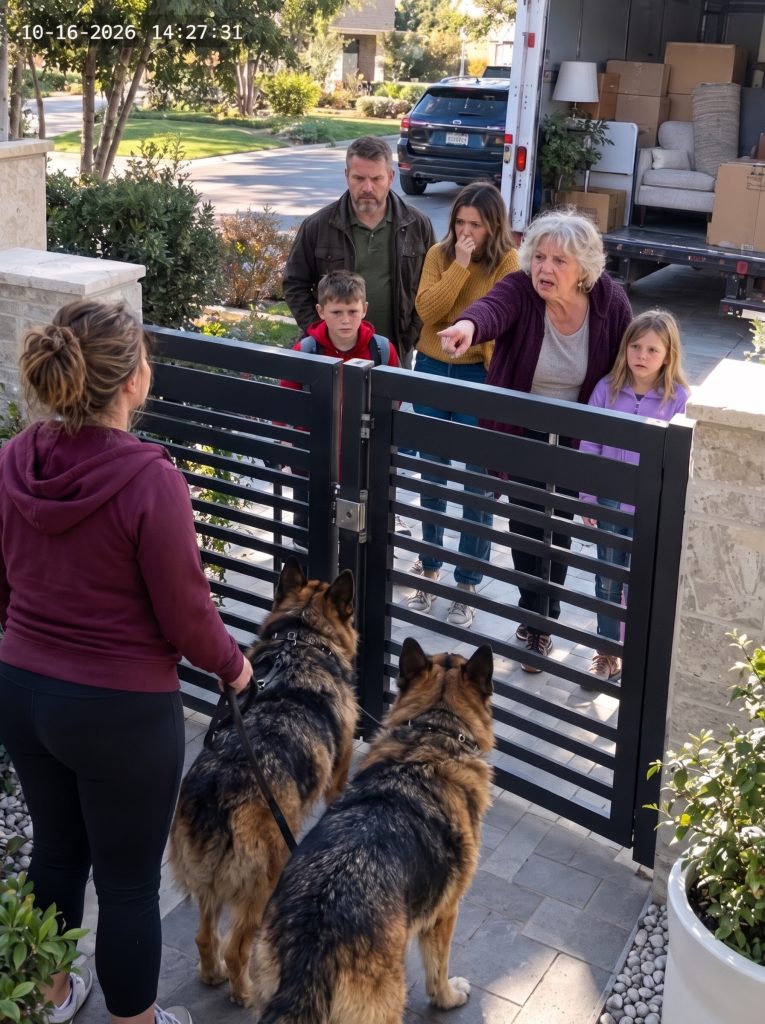
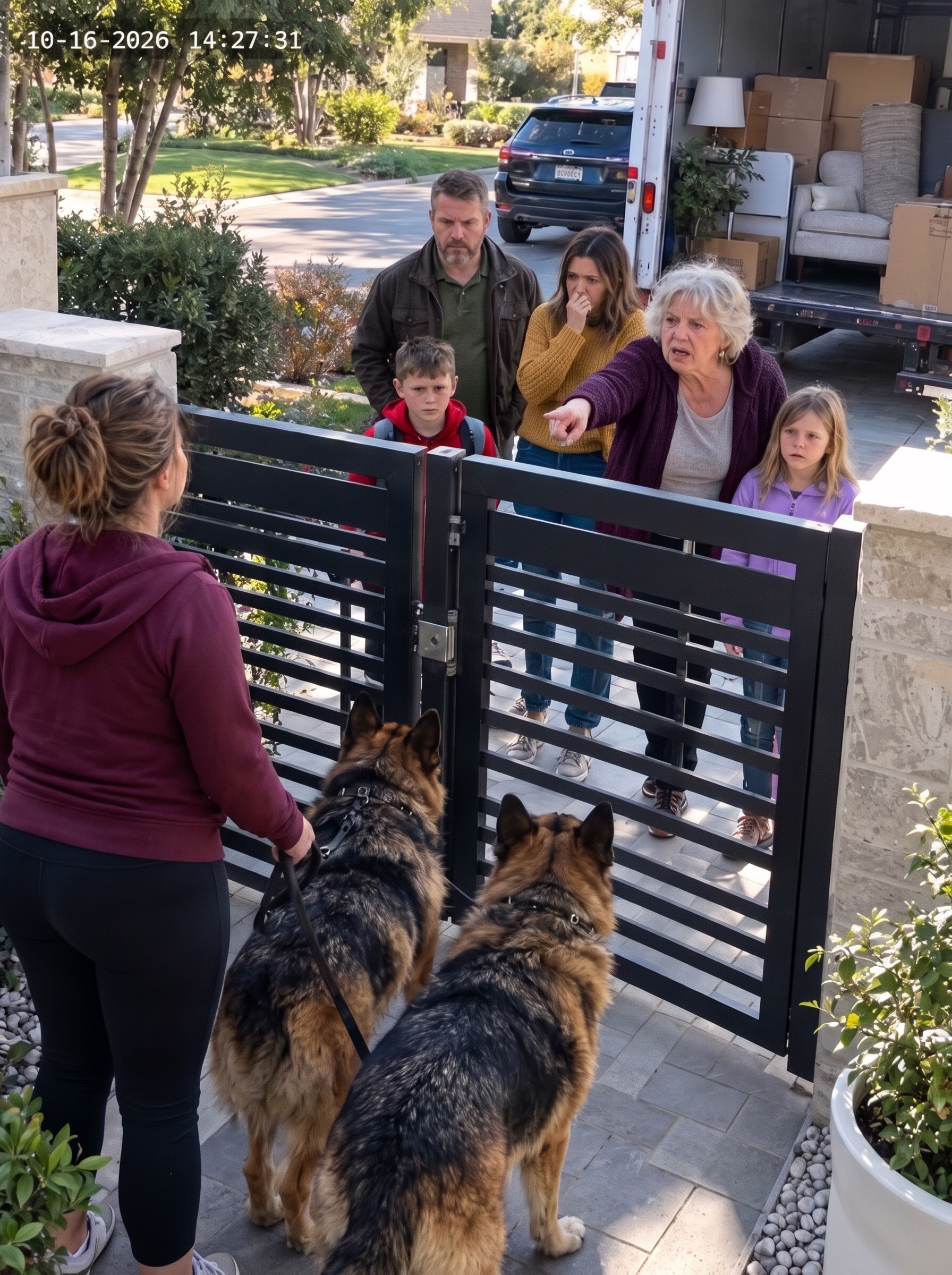
Behind her stood my twin sister, Mallory. Her husband, Grant. And three children.
And behind them, blocking half of my gravel entrance, was a rented yellow moving truck.
Boxes were stacked up beside my gate. A dozen of them, at least. Cardboard boxes with packing tape wrapped around them twice and words written on the sides in black marker. KITCHEN. BOYS’ ROOM. SOPHIE. WINTER CLOTHES.
Every single one of them had been taped shut before anybody had asked me if they were welcome.
I sat very still in my chair and stared at the screen.
Mallory stepped up to the intercom box on the gatepost and leaned in close.
“The downstairs suite will be perfect for us,” she said. “The kids can take the rooms across the hall.”
The downstairs suite.
She’d never been inside my house. She’d never been on my property. As far as I knew, until that moment, she didn’t even know what town I lived in.
But she knew there was a downstairs suite.
Her husband, Grant, was squinting past the iron bars of the gate toward the old detached workshop that sat behind my house, near the tree line.
“Hey, does that building have heat?” he said. “I could set up a furniture business in there.”
I sat there and watched them stand at my gate and discuss my property. My house. My rooms. My workshop. Calmly. Casually. Like I’d already said yes.
My mother glanced over her shoulder toward the road, where my nearest neighbor’s mailbox stood at the end of his long driveway.
“Paige,” she said into the intercom, sharper now. “Don’t you dare embarrass me by making everyone stand out here.”
For twelve years, I had imagined what I would say if my mother and sister ever came back needing something from me.
In those imaginary conversations, I was always brilliant. Eloquent. I had long, perfect speeches.
Sitting behind my desk, looking at that moving truck, I realized I needed very few words.
Mallory and I were born seven minutes apart.
But from the very beginning, our mother treated those seven minutes like proof that my sister had arrived first in every way that counted.
Mallory got the bedroom with the window. I got the one next to the water heater that rattled all night.
Mallory got the new winter coat every November. I got her coat from the year before, with the broken zipper.
Mallory got dance lessons on Tuesdays and Thursdays. Mallory got birthday parties at the roller rink with all her friends. I got a cupcake with a candle in it at the kitchen table, on the same day, because we shared a birthday and Mom said one party was plenty.
“You’re independent, Paige,” Mom would say. Every time Mallory needed something I had. “You don’t need all that fuss.”
For years, it sounded like a compliment.
Then I got old enough to understand what it really meant.
Independent meant nobody was planning to show up for me.
The only person who ever noticed was our grandmother. Dad’s mother. Elaine.
Dad left when Mallory and I were four. He moved to Arizona and sent a birthday card most years. But Grandma Elaine never left. She lived twenty minutes away, in a small yellow house outside Ridge Hollow, Pennsylvania, with a garden full of tomatoes and a garage full of broken furniture.
Every Saturday morning, she’d pick me up in her old green Buick. Just me. Mallory never wanted to go.
We went to estate sales. Garage sales. Church rummage sales. Auctions in old barns. Grandma would walk right past the jewelry and the dishes and head straight for the furniture. Old dressers with broken drawers. Rocking chairs with cracked spindles. Dining tables with water rings and cigarette burns.
“Look underneath, Paige,” she’d say, getting down on her knees on some stranger’s driveway. “Always look underneath. That’s where it tells you the truth.”
She taught me how to tell real oak from veneer. How to check a joint. How to spot a cheap repair. On Sunday afternoons, we sat in her garage with sandpaper and wood glue and her old radio playing Patsy Cline, and we brought dead furniture back to life.
One day, I was sanding down an old walnut nightstand with a long, ugly crack running down one side. I wanted to throw it away.
Grandma put her hand over mine.
“Never be ashamed of a crack,” she said. “Just pay attention to what caused it.”
At her kitchen table, I was allowed to talk. I was allowed to want things. Nobody told me I was making things difficult.
And then, in the spring of my senior year of high school, Grandma Elaine had a stroke in her garden.
She died three days later.
And everything inside our house changed.
Mallory stopped pretending to share.
Mom stopped pretending to be fair.
It was like Grandma had been holding up one corner of a table that only I was sitting at. And when she was gone, the whole thing tipped over.
A few months after graduation, Mallory announced at dinner that she was pregnant.
Her boyfriend, Grant, moved into our rented duplex on Fourth Street the following week. He brought two laundry baskets of clothes, an enormous flat-screen TV, and no steady paycheck. He said he was “between things.”
Two weeks later, Mom came and stood in the doorway of my bedroom.
“Mallory’s going to need this room,” she said. “For the crib.”
I looked up from the community college brochure I’d been reading. I’d been accepted to Lehigh Carbon Community College for the spring semester. Business management. I’d been saving every dollar from my job at the hardware store.
“Okay,” I said. “Can I sleep on the couch? Just until classes start? I’ll figure something out by January.”
Mom shook her head.
“Grant has back trouble. He may need the couch.”
“What about the basement? I can put an air mattress down there.”
“We need the basement for the baby supplies.”
I sat there on my bed and looked at her.
And then Mom folded her arms across her chest and said the sentence that cut my life into two pieces. Everything before. And everything after.
“You’re nineteen, Paige. At some point, you have to stop being my responsibility.”
Mallory was standing in the hallway behind her. One hand resting on her stomach.
“You’ve always acted like you don’t need us,” Mallory said. “So this should be easy for you.”
I packed two black trash bags that night.
That’s all I had. Two trash bags. Clothes. My toothbrush. The college brochure. And a small wooden box Grandma had given me on my seventeenth birthday, with my baby bracelet from the hospital inside and a pressed four-leaf clover we found together in her yard.
Mom and Mallory and Grant sat in the living room watching TV while I packed. Nobody got up.
At the front door, Mom handed me a plastic grocery bag. Two cans of Campbell’s soup and a sleeve of saltine crackers.
“Tell people you chose to move out,” she said. “It sounds more mature.”
For a few weeks, I slept on friends’ floors.
A girl from my high school chemistry class let me stay on her futon for nine days, until her stepdad said it was getting to be too much. A coworker from the hardware store let me sleep in her spare room for a week, until her boyfriend came back from a job in Ohio.
And then I ran out of friends.
It was late September. I had two hundred and eleven dollars and a job collecting shopping carts and stocking shelves at the Weis Market off Route 309.
I walked into a Walmart and bought the cheapest tent they had. Thirty-four dollars. A little green two-person dome.
There was a flea market on the edge of Ridge Hollow, out on the old county road. Open Saturdays and Sundays. Empty the rest of the week. Behind it was a row of rusted storage sheds and a strip of overgrown grass, and behind that, the woods.
Nobody ever went back there.
I set my tent up behind the third shed. I tucked it in close to the tree line where nobody could see it from the road.
For two months, that was my home.
I washed in the bathroom at the Sunoco station on Route 309 before every shift. Quickly. With the door locked. Hoping nobody would knock. I kept my one clean work shirt sealed inside a plastic grocery bag so it wouldn’t smell like wet grass and mildew.
I learned that a tent is cold in October. Very cold. I learned to sleep in all of my clothes at once. I learned that rain on a tent sounds like gravel. I learned to eat peanut butter with a plastic spoon straight out of the jar, because bread goes moldy in a tent in four days.
And one rainy afternoon in early November, I was pushing a long line of shopping carts across the Weis Market parking lot when a car pulled in.
Mom’s silver Toyota Camry.
She pulled into a parking spot about thirty feet from me. Mallory was in the passenger seat.
I stopped pushing the carts.
Our eyes met through her windshield.
I was soaked. Rain dripping off the hood of my store-issue rain jacket. My hands were red and raw from the cold metal of the carts.
Mallory was looking down at her phone, laughing at something.
Mom looked right at me.
For three seconds. Maybe four.
And then she put the car in reverse. And she backed out of that parking spot. And she drove away.
Slowly.
Slowly enough for me to understand that she had recognized me. That she’d seen me. Soaking wet in a grocery store parking lot in November.
And that she’d chosen not to turn around.
That night, in my tent behind the flea market, I held my prepaid flip phone in my hand for almost an hour.
Rain was hammering on the nylon over my head. I was wrapped in every piece of clothing I owned. I had Mom’s number pulled up on the little screen. My thumb was right on the green button.
I didn’t press it.
Instead, sitting there in the dark, I made myself a promise.
Someday, I would build a life so stable, so solid, so completely mine, that no one could ever make me feel homeless again.
Not my mother. Not Mallory. Not anyone.
Ever.
The next morning, my day off, I walked into Reed’s Furniture Restoration on Main Street in Ridge Hollow.
I’d walked past it a hundred times. A narrow brick storefront with a faded green awning and a window full of old chairs. Grandma used to take furniture there when a repair was too big for her garage.
A bell jingled over the door.
A man looked up from a workbench in the back. He was about sixty-two, with silver hair sticking up in every direction, thick glasses, and big hands that were stained permanently brown from wood stain and decades of sanding.
He looked at my worn-out sneakers. He looked at the plastic grocery bag in my hand with my lunch in it.
“Help you?”
“Do you need any help?” I said. “In the shop. I’ll do anything. Sweep. Carry things. Whatever you need.”
His name was Thomas Reed.
“You ever restore furniture before?” he asked.
“My grandmother taught me. Elaine Whitaker.”
Something changed in his face.
“Elaine,” he said slowly. “Green Buick. Patsy Cline.”
“Yes, sir.”
He didn’t say anything else about her. He just pointed toward the corner of the shop, where a big oak dresser was sitting under a work light. One of the drawers was hanging crooked. There was a crack running down the side panel. The finish was cloudy and gray with age.
“Show me,” he said.
I spent six hours on that dresser.
I didn’t eat my lunch. I didn’t sit down. I pulled out the broken drawer runners and cut new ones. I glued the crack and clamped it. I stripped the cloudy old finish with steel wool and mineral spirits, one careful section at a time. I sanded it down by hand, with the grain, the way Grandma taught me. And slowly, the real wood came back up underneath. Golden. Warm. A tiger-stripe grain that had been hiding under eighty years of grime.
When I finally stepped back, my arms were shaking.
Thomas walked over. He ran his big stained fingers slowly across the top of the dresser.
For a long time, he didn’t say anything.
Then he said, “How much do you need to make to keep coming back here tomorrow?”
I almost cried right there in the shop.
Not because he was offering me a job.
Because he asked me what I needed. Instead of telling me what I deserved.
Nobody had done that since Grandma died.
I started working there the next Monday. Eleven dollars an hour. I kept my job at the Weis Market on weekends.
I swept the floors. I carried lumber in from the truck. I repaired chair rungs and reglued table legs. Thomas taught me how to estimate what a job would cost. How to price materials. How to tell a customer no when they wanted something that couldn’t be done.
At night, in my tent, I studied business management with a flashlight. Secondhand textbooks I bought for three dollars each at a used bookstore in Allentown.
In January, I finally got a check in the mail. Forwarded to the shop. From a lawyer’s office in Hazleton. Grandma Elaine’s estate had finally gone through probate. Fourteen months after she died, it had cleared. She’d left me a gift. A small one. Six thousand dollars, and a sealed letter I didn’t open for a very long time.
I used part of it to start my classes at community college.
And I used part of it for the security deposit on a room.
It was a tiny room on the second floor of an old building on Chestnut Street, right above a laundromat. Two hundred and seventy-five dollars a month. The ceiling leaked whenever it rained. The only window looked out at a brick wall about four feet away. The floor vibrated when the industrial dryers ran downstairs.
But I had a key.
That first night, I locked that door three times. Then I checked it. Then I locked it again.
Then I sat down on the bare floor with my back against the door, and I cried until the sun came up.
I wasn’t crying because my life was hard.
I was crying because, for the first time since I was nineteen years old, nobody could throw me out of my own room.
I never called my mother.
I never called Mallory.
And they never called me, either. Not once.
I found out years later, from a cousin, what they’d been telling people. Mom told everyone in the family that I’d gotten selfish and abandoned my pregnant sister when she needed me most. Mallory told people I’d always been jealous of her. That I’d stormed out because I couldn’t handle her being happy.
I let them tell whatever story helped them sleep at night.
I had work to do.
Mallory had her baby that spring. A little girl. They named her Sophie. I found out from a Facebook post a friend showed me. I looked at that picture for a long time. Then I went back to work.
Three years later, Thomas Reed decided to retire.
His wife, Margaret, had gotten sick, and he wanted to take care of her. He called me into his little back office one Friday afternoon and sat me down across his cluttered desk.
“I want to sell you the shop, Paige.”
I laughed. “Thomas. I have eight hundred dollars in my checking account.”
“I know. That’s why we’re going to do it the slow way.”
He’d already talked to his accountant and his lawyer. It was called seller financing. Instead of me going to a bank, which would never have given a twenty-two-year-old with a community college degree a business loan, Thomas would be the bank. I’d pay him a small down payment, then monthly payments over seven years, with interest, out of the shop’s profits. His lawyer drew up a promissory note and a sales agreement. I took it to a lawyer of my own, a free one at the county’s small business development center, who went over every single line with me.
The shop wasn’t glamorous.
The roof needed repairs. Two of the machines were older than I was. The back office smelled like damp cardboard and old coffee.
But it had something I had never owned before in my life.
A future I could build myself.
I signed those papers on Thomas’s desk with my hands shaking so badly my signature looked like a seismograph.
Thomas shook my hand when it was done.
“Your grandmother would be very proud of you,” he said.
I made every single payment to Thomas, on time, for seven years. I paid off the note eleven months early.
Over those seven years, I turned that little shop into something Thomas never imagined.
I started taking on restoration work for old houses. Historic homes in Bethlehem and Jim Thorpe and Doylestown. Original woodwork. Staircases. Built-in cabinets from the 1890s that nobody else in eastern Pennsylvania knew how to repair. Then custom cabinetry. Then high-end furniture.
I hired my first employee after I landed a contract to restore all the original woodwork in a boutique hotel in an old mansion in Bethlehem. A young guy named Luis, fresh out of vo-tech school, who was better with a router than anybody I’d ever met.
Then I hired another employee. And another.
I learned how to negotiate with lumber suppliers. How to run payroll and withhold taxes properly. How to read a balance sheet. How to tell the difference between a profitable job and an expensive mistake. I learned what workers’ compensation insurance was the hard way, after Luis cut his thumb in my second year.
Every dollar was accounted for. Every contract was reviewed by a lawyer before I signed it. Every major decision was written down.
Grandma always said, look underneath. That’s where it tells you the truth.
So I always looked underneath.
When the shop on Main Street got too small, I bought an old industrial property on the outskirts of Ridge Hollow. A shut-down machine shop on four acres, with a big steel building I could turn into a real workshop. I got an SBA loan for it. The bank actually said yes this time.
Two years later, I bought the ten acres next to it.
And on those ten acres, set back from the road beyond the town’s old stone bridge, was a house.
A white farmhouse built in 1908. Wraparound porch. A long gravel driveway. A big old barn out back that had been somebody’s workshop once. Eleven-foot ceilings. A downstairs suite with its own bathroom that the old owners had added for an elderly parent.
It needed everything. New roof. New wiring. New plumbing. Every inch of woodwork had to be stripped and refinished.
I did most of it myself. Nights and weekends. For two years.
I didn’t buy that house to impress anyone. I bought it because I wanted one place on this earth where I could wake up in the morning without worrying about what someone might take from me.
The gravel driveway led to both the house and the main workshop, with a service road around the back for deliveries and employees.
At the front, I put in an iron gate. And cameras.
Thomas came to see the place when it was finished. Margaret had passed by then. He’d moved into a little apartment in town, and he came out every few weeks to tell my employees they were sanding wrong.
He stood in my driveway and looked up at the camera on the gatepost. Then at the one on the barn. Then at the one over the workshop door.
“Expecting trouble?” he said. He was laughing.
“No,” I said. “I’m making sure trouble doesn’t get to decide where I live.”
He stopped laughing.
He looked at me for a long moment. Then he nodded, slowly. And he didn’t laugh about it again.
By the time I was thirty-one, Whitaker Restoration had twelve employees. We had contracts with three historic preservation societies, two hotels, and a long list of private clients. I had a reliable accountant named Gloria. A business attorney named David Kessler. And enough money in savings to survive a bad year without losing everything.
I hadn’t heard from my mother or my sister in twelve years.
Not a birthday call. Not a Christmas card. Not one message asking if I was even alive.
And then, on an ordinary Tuesday afternoon in October, they showed up at my gate with a moving truck.
And suddenly I was nineteen again. Standing in a doorway with two black trash bags while my mother explained why there was no room for me.
Except this time, I owned the doorway.
And I had the keys.
“Paige!” Mom snapped through the intercom. “I know you’re in there. I can see the cars.”
I pressed the button on my desk.
“I am.”
Her whole face changed on the monitor. She smiled. Satisfied. Like she’d won something.
“Good. Now open the gate.”
“Why?” I said.
She stared at the speaker box on the gatepost like I’d just answered her in Chinese.
“Because we’re moving in.”
I glanced at the stack of boxes beside the truck. KITCHEN. BOYS’ ROOM. SOPHIE.
“Who told you that you could move in?” I said.
Mallory stepped forward. She pushed her hair back behind her ears. She’d colored it blond. She looked tired. Older than thirty-one.
“Oh, come on, Paige,” she said. “Don’t make this complicated. We’re family.”
I almost smiled.
Twelve years. Not one word.
But one afternoon at my gate, standing next to a rented truck, they’d suddenly remembered the word family.
Mom lifted her chin.
“You have plenty of space. Aunt Patricia saw pictures of this place in the newspaper last spring. That article about your company. We know exactly how big this house is. We need somewhere to stay while we get back on our feet.”
“Where are you staying now?” I asked.
“That’s not the point.”
“It seems pretty relevant, if you’re planning to move into my house.”
Grant walked up to the gate and examined the lock. Like he was trying to figure out how it worked.
“Look, Paige,” he said. “We’ve had a rough few months. Real rough. The bank is foreclosing on our house in Hazleton. The sheriff’s sale is in three weeks. We had to be out by the end of the month. Mallory and I just thought we could stay here. Temporarily. The kids need stability.”
I looked past them at the three children sitting in the open side door of the moving truck.
The oldest was a girl. Eleven years old. Sophie. The baby from the Facebook photo. She had my nose. Mallory’s nose. Our nose. She was watching me on the camera with scared, careful eyes. Like she already knew this wasn’t going the way the grown-ups had promised.
The two boys were maybe eight and five. The littlest one was clutching a stuffed green dinosaur against his chest.
Those children weren’t responsible for anything the adults had done. I understood that. I felt it in my chest like a stone.
But feeling compassion for children did not mean I had to hand my home over to their parents.
“How long is temporarily?” I asked.
Grant shrugged. “A few months. Maybe six.”
Mallory cut in.
“Mom thinks we should take the downstairs suite, since it has its own bathroom. The boys can share one of the rooms across the hall, and Sophie can have the other one. And Grant can use that old barn workshop until we find a place. He’s going to restart his business.”
I stared at my sister on the monitor.
She’d already assigned the rooms.
She’d already assigned my workshop to her husband.
She had already decided that the life I’d built, by myself, from a tent behind a flea market, belonged to her family whenever she happened to need it.
“Did you bring a lease?” I said.
Mallory frowned. “What?”
“A lease. A rental agreement. A letter. An email. A text. Anything at all showing that I invited you to live here.”
Mom’s face went hard as stone.
“Don’t be ridiculous, Paige. I’m your mother.”
“And I’m the owner of this property.”
The silence that followed was almost satisfying.
Almost.
Because underneath all of my anger, there was still a small, foolish part of me that wanted her to say something. Something I’d been waiting twelve years to hear.
I’m sorry.
I should never have put you out.
I should have protected you.
Instead, my mother leaned toward the speaker and said:
“You owe me more respect than this.”
I took my finger off the intercom button.
And I sat there for a second, remembering.
Twelve years ago, I stood soaking wet in a grocery store parking lot, holding a line of shopping carts, and watched her back out of a parking space and drive away.
I remembered how badly I’d wanted her to stop. How badly I’d wanted to see her brake lights come on. How badly I wanted her to turn around.
She never did.
I pressed the button again.
“You need to leave.”
On the monitor, Mom blinked.
“Excuse me?”
“This is private property,” I said. “You do not have permission to enter it. Please take your truck and go.”
Mallory laughed. A short, disbelieving laugh.
“You cannot be serious.”
“I am completely serious.”
Her face went red.
“You have a huge house! You have a whole business! We have three children, Paige! Three!”
“And I built all of this without one ounce of help from either of you.”
Mom’s mouth fell open.
Then she pulled herself together and delivered a line I’m fairly sure she’d rehearsed during the three-hour drive.
“We are the reason you exist, Paige. The least you could do is help your own family.”
I looked straight into the camera lens. Straight at her.
“No, Mom,” I said. “You gave birth to me. You didn’t build my life.”
She started shouting.
I turned off the intercom.
For a few minutes, I watched them on the monitor, arguing with each other in my driveway.
Then Grant walked up to the gate and grabbed the bars with both hands. He pulled on it. He tried the latch. He shook it, hard, so the whole gate rattled on its hinges.
Then he turned around and said something to Mallory. I couldn’t hear it. I didn’t need to.
My security system recorded every second of it.
I saved the footage to a separate drive. I didn’t plan to use it. I didn’t want to use it. But I’d learned a long time ago that memories can always be argued with.
Records are much harder to rewrite.
They didn’t leave.
Instead, Mom sat down on one of the moving boxes next to my gate and pulled out her phone.
Ten minutes later, my cell phone rang.
Aunt Patricia. Mom’s younger sister.
“Paige, sweetheart. Your mother just called me crying. She says you’re refusing to help her.”
“I’m refusing to let her move into my house without asking me first.”
“But she says you’ve got so much room.”
“I do.”
“And your sister is really struggling, honey. They’re losing their house.”
“I understand that.”
“Then why won’t you help them?”
I looked out my office window. Across the gravel lot, through the big open bay doors of the workshop, I could see Luis and two other employees carefully lifting a set of custom walnut cabinets onto a dolly. A job for a new restaurant in Easton. Three months of work.
“Because helping someone,” I said, “doesn’t mean handing them control of everything you’ve ever worked for.”
Patricia sighed. A long, heavy, disappointed sigh.
“Your mother says you got rich and forgot where you came from.”
And I felt something inside me settle. Like a dresser finally sitting level on the floor.
“No, Aunt Patricia,” I said. “I remember exactly where I came from. A tent. Behind a flea market. Your sister knew. She saw me in the Weis Market parking lot in the rain. Ask her about it sometime.”
There was a long silence on the line.
“I didn’t know that,” Patricia said quietly.
“I know you didn’t.”
I ended the call gently.
And I went back to my payroll.
For the next hour, I let my phone ring. Mom. Mallory. Grant. Numbers I didn’t recognize. I didn’t answer any of them.
At 4:37, there was a knock on my office door.
Rebecca, my office manager. Fifty-eight, sharp as a tack, ex-Navy. She’d run the front office for four years and had never once looked rattled.
She looked rattled.
“Paige. There’s a woman at reception asking for you.”
“Who?”
“She says she’s your mother.”
I stared at her.
“How did she get onto the property? The gate’s locked.”
“She walked around to the service road. Came in through the employee entrance while the lumber delivery truck was pulling out. Marco caught her in the parking lot before she got to the building, but she says she won’t leave until she talks to you.”
I stood up.
“Ask her to wait outside the office. In the front entryway. I’ll speak with her there.”
Rebecca hesitated.
“Do you want me to call the police?”
“Not yet,” I said. “Just keep the inner doors locked.”
When I walked out into the front entryway of the workshop office, Mom was standing next to the glass doors, holding a thick manila envelope against her chest.
Her face had changed.
She didn’t look angry anymore.
She looked wounded.
It was an expression she’d perfected over many years. The one she put on whenever she wanted somebody else to feel guilty.
“I knew you’d come to your senses,” she said.
I stopped about six feet away from her. And I stayed there.
“What do you want, Mom?”
She held the envelope out toward me.
“Your sister needs money. You heard Grant. They’re behind on their mortgage. Seven months. Grant’s business went under. The bank says if they pay the full past-due amount and the lawyer’s fees before the sheriff’s sale, they can keep the house. It’s called a reinstatement. It’s all in here. We thought you could help them get caught up.”
I didn’t take the envelope.
“How much?”
“Eighty thousand dollars.”
I just stood there.
Eighty thousand.
Not eight hundred dollars. Not a few hundred for groceries or a security deposit on an apartment.
Eighty thousand dollars.
“Did Mallory send you in here?” I asked.
“Of course.”
“Did she ask me herself? Did she come to this door?”
Mom hesitated.
“She knew I’d explain it better.”
I almost laughed.
“You drove three hours with a moving truck to claim my house. And when I said no, you snuck in the back way, and now you’re asking me for eighty thousand dollars.”
“Don’t make it sound so ugly.”
“What would you call it, Mom?”
She tightened her grip on the envelope.
“I raised you.”
“And then you put me out.”
Her eyes narrowed.
“That was twelve years ago, Paige. Are you going to punish us forever?”
“No,” I said. “I’m going to live my life.”
She looked past me, toward the hallway, toward the offices and the workshop beyond. Twelve employees. Everything I’d built.
And then she said the one thing she still knew could hurt me.
“Your grandmother would be ashamed of you.”
Grandma Elaine.
The only person on this earth who ever made me feel like I mattered.
Mom knew it. She’d always known it. That’s exactly why she said it.
And for one second, I was nineteen again, standing in our kitchen on Fourth Street, trying to understand why love always seemed to come with a price I could never afford.
Then I remembered Grandma’s hands. Smoothing over the top of an old cracked nightstand in her garage, with Patsy Cline on the radio.
Never be ashamed of a crack. Just pay attention to what caused it.
I looked my mother in the eye.
“Don’t you use Grandma to make me feel guilty.”
She went very still.
“I loved her,” I said. “She taught me how to work with my hands. She taught me how to stand on my own two feet. She taught me that being family doesn’t give anybody permission to hurt you.”
Mom’s eyes flickered.
“She would never have wanted you to turn out this cold.”
“Mom. Grandma would have asked you why you never once checked whether I had a place to sleep.”
For the first time, my mother had no answer ready.
So I kept going before she could find one.
“I slept in a tent behind the flea market on County Road for two months. In November. I washed my hair in the sink at the Sunoco station on 309. I worked two jobs until my hands cracked and bled, because I couldn’t afford to stop. And one afternoon, you pulled into the Weis Market parking lot, and you looked right at me. You looked right at me, Mom. And you drove away.”
Mom looked down at the floor.
“I was upset,” she said.
“So was I.”
“I didn’t know what to do.”
“You could have stopped the car.”
Her eyes filled with tears.
And for one dangerous second, I really thought she might finally say it. I’m sorry.
Instead, she whispered:
“I had Mallory to think about.”
There it was.
Even now. Even after twelve years. Even standing inside the business I’d built from absolutely nothing.
Mallory still came first.
I nodded slowly.
“Thank you, Mom. Thank you for reminding me.”
I turned toward the door.
“Paige. Wait.”
I stopped. I didn’t turn around.
“You can’t just abandon your own mother.”
I looked back at her over my shoulder.
“You taught me how to live without you,” I said. “I’m just very good at it now.”
Then I asked Rebecca to please walk my mother back out to the front gate.
She did. Very politely. Rebecca is always polite. She’s also five foot ten and was a master-at-arms for twenty years.
By six o’clock, the moving truck was still parked in my entrance.
On the monitor, I watched Mallory pacing back and forth in the gravel. Grant was on his phone, walking in circles. Mom was sitting in the cab of the truck with the door open.
And the kids. The kids were sitting on the edge of the truck bed. The little one had fallen asleep against Sophie’s shoulder with his dinosaur. Sophie was just staring at the gate.
It was getting dark. It was getting cold.
I watched that footage for a long time.
Then I made a decision.
I called the Carbon County family services office. A woman named Denise answered. I told her there was a family with three children who’d just lost their house to foreclosure and had nowhere to stay that night. She said they had emergency family housing available. A furnished two-bedroom apartment in Lehighton. Clean. Safe. Available tonight. And a caseworker who could help with rental assistance and a housing plan starting the next morning.
Then I called Rosa’s Pizzeria on Main Street and ordered three large pizzas, a big salad, and a gallon of milk. Delivered to the end of my driveway. I paid with my own credit card over the phone.
Then I turned the intercom back on.
“Mallory.”
She spun around to face the camera.
“I just spoke with Carbon County family services. They have an emergency apartment ready for you tonight in Lehighton. I’m going to read you the phone number. Their caseworker can help you with rental assistance tomorrow. And there’s dinner on the way for the kids. It’ll be here in twenty minutes.”
She stared at the camera.
“You’re kidding me.”
“I’m not.”
I did not offer them my house.
I did not offer Grant my barn.
And I did not hand over eighty thousand dollars.
Mallory marched right up to the gate and grabbed the bars.
“You’re going to pay for this, Paige!”
I answered her through the speaker. Calmly.
“The children aren’t responsible for our history. That’s why I ordered them dinner, and that’s why I found you a safe place to stay tonight.”
“We don’t need your charity!”
“Then you don’t have to accept it.”
She stared up into the camera, breathing hard.
“You think you’re better than us because you’ve got money?”
“No, Mallory. I think I’m responsible for what I built.”
“Mom says you owe us!”
“Mom can say whatever she wants.”
Mallory stepped closer to the camera.
“You were always the selfish one,” she said.
I took a deep breath.
“Mallory. When we were nine, Mom bought one winter coat, and I gave it to you, because Mom said you needed it more. When you wanted the room with the window, I took the one next to the water heater. When you got pregnant, I was the one they told to leave.”
Her face tightened.
“You offered to give up your room.”
“No. I asked if I could sleep on the couch. Mom said Grant needed it for his back.”
“You’re twisting everything!”
“I’m remembering it.”
She looked away from the camera.
And then she said something that told me more than she ever meant to.
“You always made everything so difficult. Acting like you were the victim.”
I looked at my sister on that screen.
“I was homeless at nineteen, Mallory.”
“And I was pregnant!”
Those words hung in the cold air at the end of my driveway.
There it was. The one sentence that had justified everything in her mind for twelve years.
She was pregnant. So I had to leave.
She had children. So I had to give up my house.
She had money problems. So I had to hand over my savings.
There had never been one single moment in our entire lives when what I needed mattered as much as what she wanted.
I pressed the intercom button one last time.
“You have until seven o’clock to move the truck off my driveway. If it’s still here at seven, I’ll call the state police and report a trespass.”
Mallory stared up at the camera.
“You wouldn’t do that to your own sister.”
“I gave you twelve years to remember you had one.”
And I turned off the monitor.
At 6:52 p.m., I heard the moving truck’s engine start.
I didn’t watch it go.
But the story wasn’t over.
The next morning, at 9:15, my attorney, David Kessler, called me.
“Paige. I wanted to let you know your mother called my office this morning.”
I set down my coffee.
“How did she get your number?”
“My name is on your company’s state filings. It’s public record.” He paused. “She claims you made a verbal agreement several months ago to provide housing for your sister’s family. She says you promised them they could live with you if they lost their house.”
I closed my eyes.
Of course.
When guilt didn’t work, they’d moved on to the next strategy.
“David, I haven’t spoken to my mother in twelve years. Not one word. Not until yesterday.”
“I believe you. Did she provide any evidence? A text? An email? A recording?”
“There’s nothing to provide.”
“That’s what I assumed. Under Pennsylvania law, an agreement about who lives on real property generally has to be in writing to be enforceable. And there’s no agreement at all here. But I recommend you keep everything. Every phone log. Every message. And that security footage from yesterday.”
“I already saved it.”
“Good.” He paused again. “There’s one more thing, Paige. Your mother also brought up your grandmother’s estate.”
I sat up straight in my chair.
“What about it?”
“She claims you received money from Elaine Whitaker’s estate that your sister was entitled to share. She says you got more than your fair share and kept it hidden.”
I sat perfectly still.
Six thousand dollars. I’d used it for community college tuition and the deposit on a room above a laundromat. I’d never hidden it from anybody.
But I’d also never known my mother had been telling relatives a completely different story for twelve years.
“What exactly is she claiming?” I asked.
“That you got more than your share, and that Mallory’s owed the difference. With interest.”
“Can you get the estate records?”
“Already requested them from the Carbon County Register of Wills. I’ll have them by noon.”
He emailed them to me at 11:40.
I sat at my desk and read through the old probate file. The will. The inventory. The final accounting. All of it signed and filed with the court, fourteen years earlier.
Grandma’s will was perfectly clear.
She’d left her house to be sold, with the money split between Mom and Uncle Ray. And she’d left each of her granddaughters a gift. Six thousand dollars to me. Six thousand dollars to Mallory. Exactly the same.
And there, in the final accounting, was a record of Mallory’s check. Cashed fourteen years ago. Endorsed on the back in my mother’s handwriting, as Mallory’s guardian, because Mallory had still been a minor for two more weeks when the check arrived.
There was no missing money. No secret transfer. Nothing I owed anybody.
David called me back an hour later.
“I’ve reviewed everything. They have no basis for this claim at all. If anything, it shows your sister’s share went to your mother. Keep everything. Don’t argue with them directly. If they make a formal written demand, we’ll respond through the proper channels. And if they keep coming onto the property, we can send a formal no-trespass letter.”
I thanked him.
Then I opened the bottom drawer of my desk.
Inside was the small wooden box Grandma gave me on my seventeenth birthday. The one I’d carried in a trash bag out of the house on Fourth Street. The one that sat inside my tent behind the flea market. The one I’d moved from the room above the laundromat to my first apartment, to this office.
My baby bracelet. The pressed four-leaf clover.
And Grandma’s letter. The one that came with the estate check from the lawyer in Hazleton.
I’d been too scared to open it for almost a year after it arrived. I was afraid it would be the last new thing she’d ever say to me. And once I read it, there wouldn’t be anything left.
The paper had gone yellow around the edges. The creases were soft from being folded and unfolded hundreds of times.
I unfolded it one more time.
My dearest Paige,
You have a habit of believing that being easy to love means asking for less.
It doesn’t.
Never make yourself smaller just to keep someone else comfortable.
You are allowed to have a home of your own. You are allowed to say no. And you are allowed to walk away from people who only remember your name when they need something from you.
If you ever feel lost, remember what we did in the garage. Good things can be repaired. Including a life.
Love, Grandma Elaine
I pressed that letter flat against my chest.
For twelve years, I’d believed my greatest achievement was building a successful business out of nothing.
Sitting at my desk that morning, I understood it was something else.
I’d survived it all without turning into the kind of person who hurts other people just because she can.
I could protect my home without humiliating my sister’s children.
I could say no to my mother without wishing her any harm.
I could remember exactly what they did to me, every bit of it, without letting it run the rest of my life.
That was the difference between us.
They thought power meant getting whatever they wanted.
I’d learned that real power meant being able to say no. And living with that decision without needing anybody else’s permission.
Three days later, Mallory texted me.
It was the first direct message my sister had sent me in twelve years.
The kids keep asking why their aunt won’t let them stay with her.
I read it twice.
Then another one came in.
I hope you’re happy. Mom’s been crying all day.
I didn’t answer.
A minute later, she sent a photograph.
The three children, sitting on the carpet of a small apartment. Sophie was holding the green stuffed dinosaur. The two boys were eating pizza off paper plates.
The room was plain. But it was clean. And warm. There was a lamp on in the corner. A real bed behind them, with a blue blanket.
I stared at that picture for a long time.
I felt sorry for those children. I really did.
I felt sad for the nineteen-year-old girl in the tent behind the flea market.
But I didn’t feel guilty.
They had a roof over their heads. A warm room. A caseworker. Help finding a permanent place. Their parents had choices and resources and help. More than anybody gave me when I was nineteen and alone.
I typed a reply.
I’m glad the kids have somewhere safe and warm to stay. I hope you and Grant use this time to make a stable plan for your family.
I stopped there.
No money. No promises. No invitation.
Just a sincere wish that they’d find their way forward.
Mallory read the message. I saw the little word “Read” appear underneath it.
She didn’t respond.
For the next several weeks, I heard nothing at all. No calls. No texts. No letters from lawyers.
Then, in December, Aunt Patricia called me. Her voice was different this time. Softer.
She told me Mallory and Grant had found a smaller rental house in Lehighton with help from the county rental assistance program. The bank had gone ahead with the sheriff’s sale on their old house. Grant had gotten a job at a furniture manufacturing plant in Allentown. Steady hours. Health insurance for the kids. He was trying to rebuild his own business on the side, slowly, the right way.
“Sophie’s doing well in school,” Patricia said. “She asks about you. She wants to know if you really fix furniture for old mansions.”
Something caught in my throat.
“Tell her yes,” I said. “Tell her I really do.”
“I’ll tell her.”
Patricia was quiet for a moment.
“Paige. I asked your mother about the Weis Market. About the parking lot.”
I didn’t say anything.
“She didn’t deny it,” Patricia said. “She just cried. I’m sorry, honey. I’m so sorry. I should have asked a long time ago.”
“Thank you, Aunt Patricia,” I said.
I meant it.
I didn’t ask for any more details. I didn’t send money. And I didn’t reopen the gate.
Six months later, in April, we finished the biggest job my company had ever done.
A complete restoration of the Asa Packer Inn, a historic hotel in Jim Thorpe built in 1872. Every piece of woodwork in all thirty-four rooms. The grand staircase. The front desk. The dining room paneling. Eleven months of work.
The owners invited my whole team to the grand reopening. We stood together on the front steps of the inn while a photographer from the newspaper took our picture.
Thomas came. He was seventy-four now. He wore the same old brown corduroy jacket he’d been wearing the day I first walked into his shop with my lunch in a grocery bag.
He stood right beside me in the photo.
“You built something good here, Paige,” he said quietly, while the photographer fiddled with his camera.
I looked around at my people. Luis. Rebecca. Marco. All twelve of them, in their nice shirts, grinning.
“I had a lot of help,” I said.
“That’s true,” Thomas said. “But you had to be willing to keep going before anybody knew your name.”
After the party, I drove home.
The evening sun was low and gold across my gravel driveway. Beyond the iron gate, my old farmhouse stood quiet and warm, with the porch light on. Down the hill, the workshop lights were still glowing where somebody had forgotten to shut them off.
For years, I’d imagined that success would feel like proving my mother wrong.
I’d thought I would feel satisfied once I owned a beautiful home. Once I employed a dozen people. Once I had enough money that nobody could ever make me feel powerless again.
But sitting there in my truck at the gate, I realized something.
I didn’t need my mother’s regret to make my life real.
I didn’t need Mallory to admit she’d been wrong.
I didn’t need an apology to prove the past happened.
What happened to me at nineteen mattered. Whether they ever admitted it or not.
And what I built afterward mattered. Whether they ever understood it or not.
I pressed the button on my visor. The gate swung open.
I drove through.
And then I closed it behind me.
Not because I was afraid of the world.
Not because I wanted revenge on anyone.
But because I’d finally learned something my nineteen-year-old self, shivering in a tent behind a flea market, needed more than anything to know.
A locked gate isn’t always a sign of bitterness.
Sometimes it’s just the line between the life other people expect you to give up, and the life you fought with everything you had to build.
My mother once told me I was no longer her responsibility.
She meant it as a punishment.
I spent twelve years turning it into a promise.
I would take responsibility for my own life. I would protect my own peace. I would decide who came into my home. And I would never again confuse being a good daughter, or a good sister, or a good human being, with letting somebody take everything I had.
Two weeks after the reopening, a small envelope came in the mail at the workshop. Pink. Handwritten. A return address in Lehighton.
Inside was a drawing done in colored pencil. A big white house with a wraparound porch. An iron gate in front. And a stick-figure woman holding a hammer, with a speech bubble that said “I FIX OLD THINGS.”
At the bottom, in careful eleven-year-old handwriting:
Dear Aunt Paige. Thank you for the pizza. Aunt Patricia says you fix furniture for mansions. Can you teach me someday? Love, Sophie. P.S. Max says thank you too. He still has his dinosaur.
I sat at my desk and read it about ten times.
Then I took it out to the workshop and pinned it on the corkboard by the time clock, right next to the newspaper photo from the Asa Packer Inn.
I wrote back that same afternoon. On real stationery. I told Sophie that yes, I’d teach her. Someday, when she was a little older, if her mom said it was okay. I told her the most important thing my grandmother ever taught me about wood.
Always look underneath. That’s where it tells you the truth.
And never be ashamed of a crack. Just pay attention to what caused it.
My name is Paige Whitaker.
At nineteen, I walked out of my mother’s house carrying two black trash bags.
At thirty-one, I stood behind a gate I owned, in front of a home I’d earned and a business I’d built with my own two hands.
My mother and my sister came expecting the quiet girl who always stepped aside.
They left finding out that the girl they’d pushed out had finally learned how to stand her ground.
I didn’t shout. I didn’t beg them to understand. I didn’t slam any doors.
I simply kept the gate locked.
THE END..!