The first thing I noticed was the quiet.
Forty laying hens are never quiet at two in the afternoon. There’s always one bragging about an egg, and three more arguing with her about it. My mother used to say you could tell time by her hens. She said two o’clock sounded like a church basement right before the coffee was ready.
That Tuesday, the day after we buried her, the yard sounded like nothing at all.
I had spent the whole morning in town. Settling up at the funeral home. Carrying casserole dishes back to the church. Now I sat in my car with the engine off and a box of thank-you cards on the seat beside me, and I listened to the wind work at the wire on the chicken run.
The little pop door on the coop was standing open. The big door was open too, propped with the cement block Mom always used when she cleaned.
There wasn’t a hen in the run.
Not one under the lilac. Not one dusting herself in the bare spot by the propane tank, where they’d worn a bowl into the ground over thirty-five years of afternoons.
Then I saw the sign.
It was a flap torn off a cardboard box, leaned against the mailbox post at the end of the lane. I’d driven right past it coming in, because I’d been busy trying to remember how to spell the organist’s last name.
I walked back down the lane to read it.
Black marker. My aunt’s tidy, slanted printing.
Laying hens. Two dollars each.
And under that, smaller:
All must go today.
I stood there in my funeral shoes, because I hadn’t thought to change them, and the April mud came up over the sides.
Aunt Lucille met me at the kitchen door. She had on yellow rubber gloves and one of Mom’s aprons. Behind her, the kitchen smelled like bleach instead of coffee.
“There you are,” she said. “I’ve got the pantry about done. You would not believe what that woman kept.”
“Where are the hens?”
“It’s handled.”
She peeled off one glove, finger by finger.
“I called it in to the swap program on the radio this morning. And I put a sign out. They were gone by one o’clock. Every last one. People came with boxes. One man had a feed sack.”
“You sold them.”
“I sold them.”
She took a bank envelope out of the apron pocket and held it up, the way you’d hold up a good report card.
“Eighty dollars. I thought that was something, for a bunch of old chickens.”
I looked at the envelope.
“Forty hens,” I said. “Two dollars apiece.”
“The realtor comes Friday at ten, Annette. She said herself a place shows better without livestock. You can’t have a yard full of chicken mess and expect anybody from town to see past it.”
She set the envelope on the kitchen table and squared it with the edge.
“Nobody has time for chickens. You work. Dale works. That boy has school. Somebody had to be sensible.”
I should explain about the realtor. Because that part was partly my own fault.
Mom died in her sleep on a Thursday night. Her heart, the doctor said. No warning to speak of.
On Friday, I sat in the arrangements room at the funeral home with my head in my hands, and I said out loud that I did not know what on earth we were going to do with the place.
I meant it the way you mean anything on a day like that. I meant I was tired.
Aunt Lucille heard a decision.
She’s seventy-eight. My mother’s older sister. She left the farm for Lincoln the week she finished high school, and she worked forty-one years in the claims office of an insurance company. In forty-one years, she never once left a file open on her desk overnight.
By Saturday, she’d found a realtor.
By Sunday, she’d moved into Mom’s spare room with a bucket and a box of trash bags.
I didn’t have the strength to stop her. And I thought there’d be time. I thought the worst thing that could happen before Friday was a clean pantry.
The place was coming to me. Mom and Dad had settled that years ago, and Lucille knew it as well as I did. She wasn’t stealing from anybody. In her own mind, she was saving me the trouble.
“Who bought them?” I asked.
“People.”
“Which people, Aunt Lucille?”
“People from the radio. I don’t know them. I don’t know anybody out here anymore.” She pulled the glove back on. “A young woman with a van full of children. A heavy man. Somebody’s hired man in a seed cap.”
“Did you write down a single name?”
“It was cash, honey. You don’t write a receipt for two dollars.”
“Not one name.”
She thought about it.
“One. An old man. Zeller. He said to tell you he’d taken twelve. He said it twice, like I was hard of hearing.”
So there it was.
I couldn’t pick up the telephone and undo it, because there was nobody to call. Forty hens had gone down that lane in the backs of strangers’ cars. And the only record of it was eighty dollars in a bank envelope.
I felt like screaming.
I’m forty-seven years old. I have never screamed at a relative in my life. I came closer that afternoon than I ever hope to come again.
But arguing with Lucille had never once, in my whole lifetime, changed what Lucille had already done. And it wouldn’t bring home a single hen.
And she was right about one thing, though not the way she meant it.
A laying hen in her second spring is worth fifteen dollars to anybody in York County who knows a hen from a hat. Two dollars is what a spent hen brings at the sale barn. The kind that’s headed for somebody’s soup pot.
Whoever answered that radio call had either gotten the bargain of the year, or meant to wring some necks.
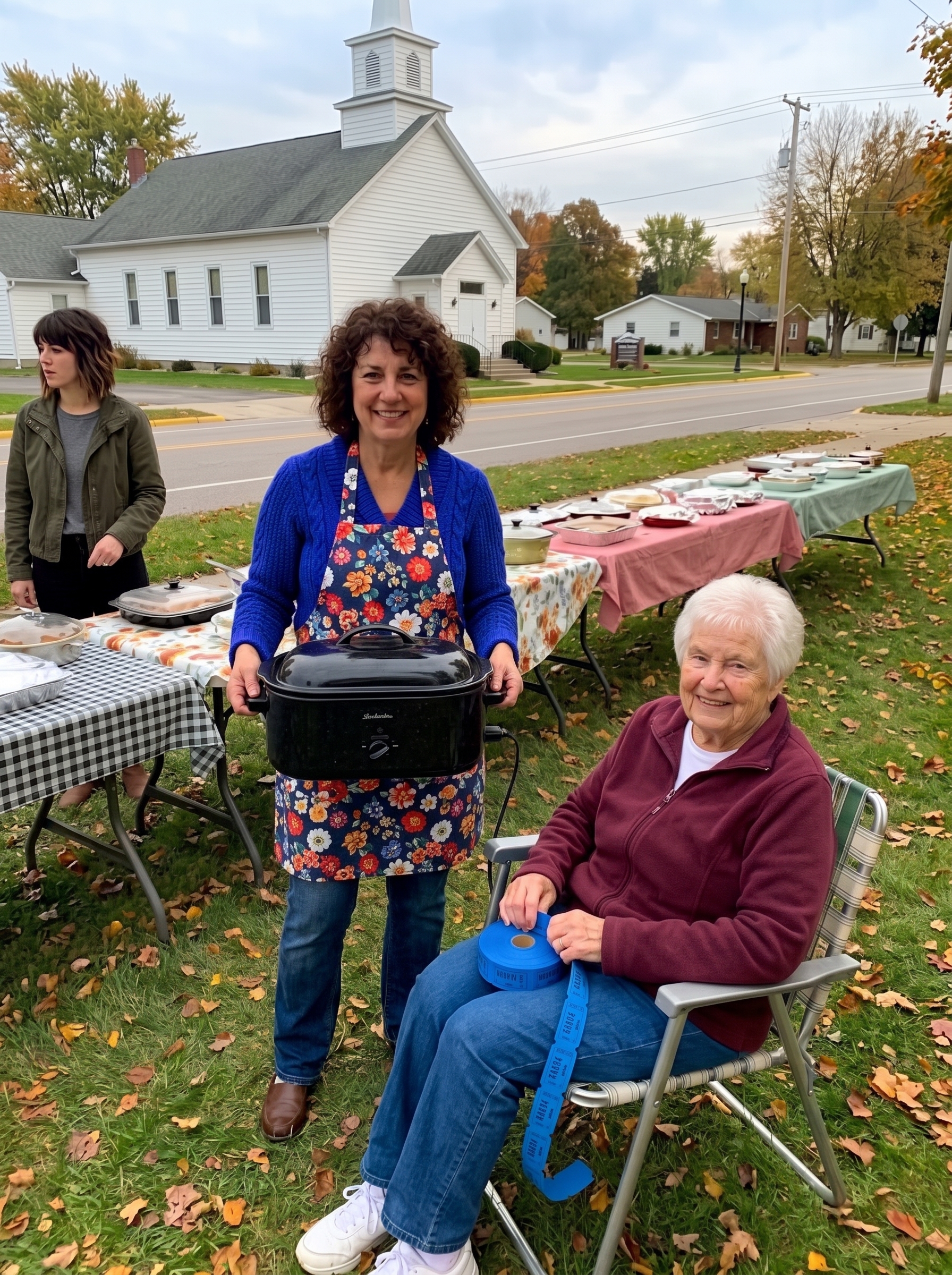
PART 2: Our Church Ended Mom’s Free Wednesday Supper After 34 Years So I Set Up Six Tables on My Lawn Across the Street
Mom called the refrigerator the icebox her whole life. On top of it, pushed back against the wall, sat a red coffee can with a plastic lid gone cloudy with age.
I reached up and took it down.
That was her egg money.
She’d sold eggs out of that kitchen door since 1991, the year I turned twelve. That was the year she decided the hens were going to buy the groceries. Three dollars a dozen, lately. Two for most of the years before that. It all went in the can. And it was nearly all ones.
I took the lid off and counted it out on the table, next to Lucille’s envelope.
A hundred and twelve dollars.
“What are you doing?” Lucille said.
“They paid two,” I said. “I’ll pay three.”
“For chickens.”
“For Mom’s.”
“Annette, you can’t even find them.”
“I can find twelve.” I put the money back in the can and pressed the lid down. “That’s a start.”
She didn’t have anything sensible to say to that.
I picked up the can and went outside to call my husband.
Dale drives the anhydrous truck for the co-op. And the last week of April is no time to ask a co-op man for a day off. He’d already used his three days of funeral leave standing next to me. Every farmer in the county wanted nitrogen on before the corn went in, and he was hauling tanks from before daylight until after dark.
He listened to the whole thing without interrupting. I could hear his truck idling.
“Two dollars,” he said finally.
“Two dollars.”
He was quiet for a second.
Dale loved my mother. She fed him every Sunday for twenty-two years and never once let him leave without a carton of eggs under his arm.
“Take my pickup,” he said. “The keys are on the hook. Put Duke’s crate in the back. The big wire one. It’ll hold six or eight if you don’t go far.”
Then he said, “Bring them home, Annie. I’ll be out there the minute I can.”
Our son, Colt, is fourteen.
I picked him up at the school at three-thirty with the dog crate already in the truck bed and the coffee can on the seat. And I told him what his great-aunt had done.
He didn’t say a word for about a mile.
Colt had been feeding those hens since he was big enough to carry the scoop. He’d fed them all four days since Mom died. Morning and night. He’d gathered the eggs and put them in the icebox on the back porch, the way she taught him.
“Did she sell Pearl?” he said.
“She sold all of them, honey.”
He looked out the window at somebody’s planter crawling across a field.
“Pearl’s seven,” he said. “She lays about one egg a week. Whoever got Pearl is going to eat her.”
“Then we’d better get moving,” I said.
I had one name, and it wasn’t enough. So I drove to the feed store before it closed.
Lucille had tacked a card on the bulletin board there too. I took it down and handed it across the counter to Jeff, who’d sold my mother layer pellets and oyster shell for as long as I could remember.
He read it. His face changed.
“I wondered,” he said. “I heard it on the radio, and I thought, that’s not Rosalie’s voice, and that’s not Rosalie’s price.”
“Do you know anybody who went?”
“Kim Kroeker was in here at noon. Bought a sack of pellets. Told me she’d gotten eight hens for sixteen dollars and felt like a thief.”
He was already writing on the back of the card.
“North of Benedict. Second place past the church. Go on. She’s good people.”
She was.
Kim Kroeker came out on her front step with a baby on her hip and two more children behind her. Before I’d even finished saying my name, she said, “Oh, no. Oh, it was your mother.”
“It was.”
“I knew two dollars was wrong. I said so at dinner. I said, somebody’s grandma has died and somebody’s cleaning out, and I just didn’t know whose.” She shifted the baby. “I’ve got them penned by themselves. You don’t put strange hens in with your own the first week.”
It was getting on toward dusk by then. That’s the only sensible time to catch a chicken. A hen on the roost at dark will let you lift her off like a loaf of bread, as long as you hold her wings snug and keep the light out of her face.
Colt went in with the flashlight pointed at the floor.
He came out with a Rhode Island Red under each arm. He turned them toward me so I could see their legs.
A blue band on one.
A yellow band on the other.
Mom banded every bird she ever raised. A little plastic spiral on the right leg. A different color for each year’s hatch, so she always knew how old a hen was without guessing. Green for the birds from three springs back. Blue for the next year. Yellow for last spring’s pullets.
I’d never thought of it as anything but one of her fussy ways.
That week, those bands were the only proof we had.
We put eight hens in the crate.
The Kroekers’ little girl, maybe five years old, stood by the tailgate with her chin shaking. She’d named one of them Butterscotch that very afternoon.
Colt got down on one knee in the gravel.
“She’s going back to my grandma’s house,” he told her. “That’s where she’s from. You can come see her any Saturday. I’ll show you where she sleeps.”
I counted twenty-four ones out of the coffee can.
Kim Kroeker put her free hand behind her back.
“I can’t take more than I paid.”
“You bought them fair,” I said. “You fed them, and you penned them right. I don’t want anybody out a dime because of my family. Please.”
She took it at last.
Then she walked me to the truck door and said, low, so the children wouldn’t hear, “Is your aunt all right? She seemed like she was in an awful hurry to be finished with something.”
I thought about that most of the way home.
PART 3: The Night Before I Was Supposed to Become an Air Force Officer, My Father Made Sure I Couldn’t Leave Home—He Told Everyone I Had Fallen, Until Investigators Found a Message He Sent My Mother Two Hours Earlier
When they showed him the garage footage, he said he could not remember what he had carried upstairs.
When they showed him the messages, he blamed pressure from his business problems.
Each explanation weakened the one before it.
Outside the courtroom, the polished life he had maintained for years began disappearing.
Customers left his company.
Lenders demanded repayment.
Property had to be sold.
Friends who had once accepted Marlene’s explanation became less willing to do so after the messages became part of the case.
At a neighborhood charity luncheon, a woman who had known my mother for nearly twenty years reportedly asked her a simple question in front of several people.
“When you saw Claire on those stairs, why didn’t you call for help immediately?”
Marlene had no answer.
For months, relatives contacted me.
Some apologized.
Some admitted they had known Russell could be controlling but had never imagined how far he might go.
Others told me stories from years before, trying to help me understand him.
Eventually, I stopped reading most of the messages.
I no longer needed to reconstruct the family I had lost.
I needed to build the life I still had.
The trust remained protected.
Russell never gained authority over it.
Once the final legal requirements were satisfied, the assets were transferred fully under my control.
The irony was impossible to miss.
My father had tried to stop my independence because he feared losing influence over my future.
His actions ensured that he would never again have influence over any meaningful decision I made.
The court proceedings took place many months later.
There were no theatrical surprises.
Real courtrooms are quieter than movies.
There were medical reports, purchase records, timestamps, emails, security footage, financial documents, witness statements, and text messages.
Facts.
When it was finally my turn to speak, Russell sat several yards away from me.
I had not seen him in months.
He seemed smaller.
As a child, I had thought he could control a room simply by walking into it. Everyone monitored his mood. Everyone knew when not to argue. Everyone learned to measure each word.
That day, the room belonged to rules he had not written.
I described the evening.
The argument.
The trip to the garage.
The steel bar.
My mother standing nearby.
The story they prepared.
Then I looked directly at him.
“You wanted me to depend on you forever.”
His jaw tightened.
“You changed the career I had planned for years,” I continued. “But you made one mistake.”
The courtroom became very still.
“You thought changing my life meant you got to decide what happened to it afterward.”
My voice trembled, but I kept going.
“You injured my spine. You did not get to choose the woman I became afterward.”
Russell eventually received a lengthy sentence, financial restitution obligations, and other penalties.
Marlene faced separate legal and civil consequences.
The house where I had grown up was eventually sold.
Someone sent me the listing.
I expected to feel satisfied.
Instead, I closed it after looking at one photograph.
That house had stopped being home long before another family bought it.
The Ceremony I Thought I Had Lost
The unexpected part of my story began after the courtroom chapters were mostly finished.
A nonprofit organization supporting injured service members and veterans contacted me about joining an adaptive career program.
At first, I assumed they wanted me to tell my story at an event.
Instead, they offered me work.
They were building programs for people whose physical circumstances had abruptly changed the professional futures they had spent years preparing for.
They wanted someone who understood what it felt like to wake up one morning and realize the map you had trusted no longer applied.
I started with a few hours a week.
Eventually, I began coordinating projects.
Later, I helped connect injured service members with adaptive equipment, education programs, counselors, employers, and families who had already traveled the same difficult road.
I met young men and women who had spent years defining themselves by what they could physically do.
I met people learning to use wheelchairs, prosthetic devices, braces, and mobility aids.
I met spouses who had no idea what to say anymore.
I met parents who were frightened to hope.
And somewhere in those conversations, I discovered something I had not expected.
I could still serve.
It simply looked different from the future I had designed when I was seventeen.
With part of the inheritance my grandmother left me, I established a small foundation that provided rehabilitation grants, adaptive equipment, career training, and temporary housing assistance.
I named it Open Horizon.
I deliberately left my family name off it.
My life had revolved around Russell Dawson’s need to preserve his authority for long enough.
Five years after the night on the staircase, an email arrived from the university where I had completed ROTC.
They were preparing their spring commissioning ceremony.
They wanted me to attend as a guest.
Then I reached the final paragraph.
They wanted me to speak to the new officers.
I read that sentence three times.
On the morning of the ceremony, I dressed slowly.
I still used mobility supports, especially for longer distances, and years earlier I would have tried to hide them.
I no longer did.
They were not evidence of weakness.
Every assisted step represented ground I had reclaimed.
From behind the stage, I could hear families filling the auditorium.
Mothers called out reminders.
Fathers adjusted cameras.
Young officers checked uniforms and laughed nervously.
For a moment, I was twenty-five again, standing in my childhood bedroom with a garment bag over my arm.
I remembered brass buttons tapping against wooden stairs.
I remembered Russell saying I would not leave.
Then someone announced my name.
I walked onto the stage.
The audience stood.
It took me several seconds before I could speak.
“Five years ago, I was supposed to be sitting where you are sitting today.”
The room became quiet.
“I wasn’t.”
I did not tell them every detail.
I did not mention the amount of the trust.
I did not explain the court documents.
I did not describe every month of rehabilitation.
Instead, I talked about plans.
I told them how easily we begin believing that one path is the only proof that our lives matter.
I talked about people who call their behavior love when what they really want is control.
I talked about the difference between helping someone become stronger and needing that person to remain dependent on you.
Then I told them the lesson I had needed years to understand.
“Some of the people who should encourage you may try to hold you back. Sometimes circumstances will change your direction without asking permission. But never mistake a different future for an empty one.”
After the ceremony, a newly commissioned officer approached me.
She could not have been much older than I was when my own plans changed.
“Ma’am, I heard about what happened to you,” she said. “I always thought you lost everything.”
I smiled.
“For a while, I thought so too.”
She glanced toward the stage.
“What was left?”
I thought about Natalie.
My friends.
My work.
Open Horizon.
The people who had become family without sharing my last name.
I thought about the apartment I had chosen myself, the money no one else controlled, the career I had built from a future I once considered ruined.
And, for just a moment, I thought about Russell, living far from me and unable to decide where I went, whom I trusted, what work I accepted, or how I used the inheritance he had once believed should belong to him.
“The most important thing was left,” I told her.
She waited.
“What?”
“The right to decide what I did next.”
That evening, I left campus while families gathered outside taking photographs.
For the first time, I could watch a commissioning ceremony without measuring my life against the career I never got to have.
I could appreciate what had been lost without allowing it to erase what had been built.
Russell changed my life.
I will never pretend otherwise.
There are limitations I still live with. There are things my body does differently now. There was a career I prepared for years to begin and never had the opportunity to live in the way I imagined.
But he failed at the one thing he had actually wanted.
He never made me his.
He never returned me to the frightened daughter who believed adulthood required her father’s permission.
He never gained control of my grandmother’s trust.
He never chose my home.
He never chose my work.
He never chose my future.
The man who believed stopping me from walking out of his house would keep me under his authority eventually had to watch from a distance as I built a life containing no place for his control.
Some parents confuse love with ownership.
Some families use the word loyalty when they mean fear, and gratitude when they mean obedience.
But love does not require another person to become smaller so that you can feel powerful.
It does not need to weaken someone’s independence in order to remain important.
And sometimes the greatest victory is not watching the people who tried to control you lose everything they valued.
Sometimes it is much quieter than that.
Sometimes it is standing in a place you once believed you would never see again, looking at a future that bears almost no resemblance to the one you planned, and realizing with absolute certainty that it still belongs to you.
PART 4
A single tear—thick and slow—rolled from the corner of his eye, tracking through the deep lines of his weathered face before disappearing into the pillow.
It wasn’t a tear of physical pain.
It was a tear of absolute heartbreak.
This man had faced the Viet Cong, had built a career, had raised a stepson as his own, had given everything he had to his family.
And they had just told him he wasn’t worth the price of an airline change fee.
He closed his eyes, and a shudder went through his frail body—not from pain, but from the weight of that final betrayal.
Then he opened them again and turned his head slowly toward the corner of the room.
Patricia, the lawyer, was sitting there in the shadows in the wingback chair. She had been there the whole time, a silent witness.
She had heard every word.
Her face was pale, her lips pressed into a thin white line of professional fury.
Victor turned his head toward me. He didn’t speak—he didn’t have the breath for it.
But he gave a single, sharp nod.
Execute the mission.
Patricia stood up immediately, no words necessary.
She walked over to the coffee table and carefully laid out the documents she had drafted earlier—the amendment to the revocable trust and the new last will and testament.
“I need you to witness this, Jana,” Patricia said softly, her voice thick with emotion she was trying to control. “And I’m recording the signing on my phone as well for legal redundancy and to prevent any challenges.”
She placed a pen in Victor’s trembling hand.
His hand was shaking violently now—the tremors uncontrollable, his body shutting down system by system.
I reached out instinctively to steady his hand, but he pulled away.
He wanted to do this himself.
He gripped the pen like it was a weapon, like it was the last tool he had to fight back against the people who had destroyed him.
He summoned every ounce of strength left in his dying body, channeling all the betrayal, all the anger, all the love he’d had for me into his right hand.
The pen touched the paper.
Scratch. Scratch.
It wasn’t a pretty signature. It was jagged, shaky, barely legible.
But it was there, in black ink that would outlast him:
Victor J. Harmon
He dropped the pen. It rolled across the table and fell onto the floor with a tiny clatter that sounded impossibly loud.
He looked at me, and for the first time in days, the tension left his face completely.
The shame was gone.
The worry was gone.
The fear was gone.
He had severed the ties. He had protected his legacy. He had made sure the parasites would get nothing.
He squeezed my hand, his grip weak but present, meaningful.
The deal was sealed.
The family on the cruise ship was still dancing, still drinking, still celebrating—completely oblivious to the fact that they had just lost a fortune.
More importantly, they had lost the only man who had ever truly loved them despite their flaws.
“It’s done, Victor,” I whispered, leaning down to kiss his forehead gently. “Rest now. You’ve completed your mission. I’ve got the watch from here.”
His breathing slowed, the pauses between breaths growing longer.
Patricia left around midnight, taking the signed, witnessed, notarized documents with her, sealed in a legal envelope.
She promised to file them first thing Monday morning at 8:00 AM, before the courthouse even unlocked its doors, before Brady and Elaine’s cruise ship even docked.
Now it was just the two of us again—me and the commanding officer.
The house settled into deep silence, the kind that comes in the hours before dawn when even the wind stops blowing.
Victor was awake but barely, his eyes tracking things I couldn’t see—maybe memories, maybe visions of what comes next.
“Peaches,” he whispered suddenly, the word barely audible.
I leaned in close. “What was that, Victor?”
“Peaches,” he rasped again, licking his dry, cracked lips with effort. “Mom’s cobbler.”
My heart squeezed painfully.
He wasn’t asking for medication or water. He was asking for a memory, for comfort, for the taste of home one last time before he left it forever.
“I’m on it,” I said softly.
I went to the kitchen and opened the pantry, searching through cans and boxes. I found a can of Del Monte sliced peaches in heavy syrup that had probably been sitting there since last Thanksgiving, forgotten in the back.
I grabbed a stick of butter from the fridge and the cinnamon shaker from the spice rack.
I didn’t have time to bake a real cobbler with crust—and Victor wouldn’t be able to chew it anyway—but I could give him the essence of it, the memory.
I dumped the peaches into a small saucepan on the stove, adding a generous chunk of butter and enough cinnamon to turn the golden syrup a rich, dark brown.
As the mixture heated up, bubbling gently, the smell began to fill the kitchen—sweet, spicy, warm.
It smelled like safety. Like childhood. Like the comfort Victor was searching for in his final hours.
I poured a small amount into a mug and carried it carefully back to the living room.
“Careful,” I said, sitting on the edge of the ottoman next to his recliner. “It’s hot.”
I blew on a spoonful, cooling the golden slice of fruit until it was safe, then touched it gently to his lips.
He opened his mouth slightly, and I let the warm, sweet peach and syrup slide onto his tongue.
He didn’t chew. He just let it sit there, let the taste settle, let the memory wash over him.
A look of pure, unadulterated bliss relaxed every line of pain around his eyes.
For just a moment, he wasn’t a dying man in a house that had betrayed him.
He was a little boy enjoying his mother’s cooking on a summer afternoon.
“Good,” he breathed, the word barely more than an exhale.
“The best,” I agreed, my voice thick with tears I was trying to hold back.
I fed him three more spoonfuls before he gently turned his head away, unable to take any more.
That was all his failing body could handle.
He rested for a moment, gathering strength, then moved his right hand slowly toward his left hand.
He was fumbling with his left ring finger, trying to remove something.
His Marine Corps signet ring.
The heavy gold band with the scarlet stone in the center and the eagle, globe, and anchor etched into the side—the ring he had worn every single day for fifty years.
It was loose now on his skeletal finger, spinning around the knuckle.
“Help me,” he whispered.
I set the mug down carefully and took his left hand in both of mine.
Gently, reverently, I slid the ring off his finger.
It was warm from his body heat, heavy with meaning and history.
He held it in his trembling palm for a moment, the gold catching the lamplight, gleaming like a promise.
Then, with a surge of effort that made his whole body shake, he reached out and pressed the ring firmly into my palm, closing my fingers around it.
“Take it,” he commanded, his voice weak but filled with steel. “You are the only one worthy of carrying it.”
“Victor, I can’t—I shouldn’t—”
“Listen to me,” he interrupted, squeezing my hand with surprising strength. “Brady is my wife’s son. You”—he locked eyes with me, his blue gaze piercing through the fog of morphine and approaching death—”you are my daughter. You are my only true child.”
Tears spilled down my cheeks, hot and unstoppable.
“Do not let them have it,” he hissed, his grip on my wrist tightening with desperate urgency. “Do not let them laugh on my grave. Do not let them sell my life for another cruise ticket.”
“I won’t,” I vowed, my voice breaking. “I promise you, Dad. I won’t let them dishonor you.”
He smiled then—a real smile, peaceful and content.
It was the first time I had called him Dad, and it would be the last.
“At ease, Sergeant,” he whispered, his voice fading like smoke. “At ease.”
His hand relaxed in mine.
I sat there for hours, holding his hand as the warmth slowly leeched out of it, as his breathing changed and slowed.
The pauses grew longer. Ten seconds. Twenty. Thirty.
Forty-five.
At exactly 3:00 AM according to the cable box clock, Victor took one final breath.
It was shallow, hitching, almost a sigh.
And then nothing.
I waited, counting in my head, hoping irrationally that he’d gasp again, that the pattern would continue.
But the silence stretched on.
One minute.
Two minutes.
The chest didn’t rise. The struggle was over.
Victor James Harmon had been permanently relieved of duty.
I didn’t scream. I didn’t wail. I didn’t throw myself across his body in theatrical grief.
That’s not what he would have wanted.
He was a Marine, and he deserved dignity in death as he’d had in life.
I stood up slowly, my legs stiff from sitting in one position for so long.
I reached out with gentle fingers and closed his eyelids, smoothing the worry lines from his forehead, making him look peaceful.
He looked younger somehow, the pain finally gone from his weathered face.
I picked up the signet ring from where I’d set it on the side table.
Slowly, with ceremony, I slipped it onto my right thumb—the only finger it would fit.
It was too big, so I curled my hand into a fist to keep it from sliding off.
Then I took a step back from the recliner.
I straightened my spine, pulled my shoulders back, lifted my chin.
In the empty living room at 3:00 AM on a dark Sunday morning, I raised my right hand slowly to my brow.
I held the salute—slow, somber, perfect in form—for a fallen comrade, for a father figure, for a hero who had been discarded by everyone except me.
“Mission accomplished, sir,” I whispered into the darkness. “You are relieved of duty. Rest easy, Marine.”
I dropped my hand.
The house felt massive and empty around me.
By all rights, I should have been terrified—alone in a house with a dead body, essentially bankrupt, facing a war with my husband’s family when they returned.
But I didn’t feel fear.
I looked down at the ring on my thumb, feeling its weight, its history, its meaning.
Victor hadn’t just left me a ring.
He had left me his resolve, his strength, his mission.
He had passed command to me.
The tears came then—hot and silent, sliding down my cheeks unchecked.
But I wiped them away quickly.
There would be time to mourn later, time to grieve properly.
Right now, there was work to be done.
I had a phone call to make to the funeral home.
Documents to secure.
A battlefield to prepare.
Because in exactly thirty-six hours, Brady and Elaine would walk through that door expecting everything to be the same.
They had no idea their world had already ended.
They just didn’t know it yet.
If you believe that our veterans deserve to die with dignity and honor—not abandoned for a vacation—please remember Victor’s story. Remember that family isn’t about blood. It’s about loyalty. It’s about showing up. It’s about doing the right thing even when it’s hard.
Some people fail that test.
And some people, like Victor, pass it even in their final moments by choosing to protect the one person who protected them.
I was about to make sure his final act of defiance wasn’t in vain.
The war was just beginning.
And I was ready.