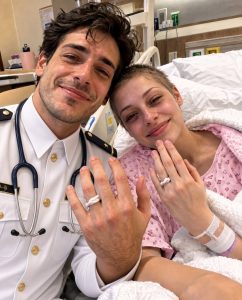
PART 2: THREE DAYS TO LOVE A LIFETIME
I wish I could say I answered Alicia immediately.
I didn’t.
I sat beside her bed, staring at the pale blue blanket across her knees, trying to understand how one sentence could leave me so completely unprepared.
Marriage.
She was asking me to marry her.
A young woman who had only days left to live.
A patient whose medical records I had reviewed that morning.
Someone who, despite everything, could still look at me with a smile.
“Alicia,” I said carefully, “you understand what you’re asking?”
She tilted her head.
“Pretty sure. Marriage usually involves two people and some paperwork.”
“This is serious.”
“So am I.”
Her answer was gentle.
That made it harder.
I looked at the flowers beside her bed.
The vase was nearly empty.
A few white petals had fallen onto the table.
“Why me?” I finally asked.
Alicia didn’t laugh.
She studied my face for a long moment.
“Because when everyone else looks at me, I can see how afraid they are.”
I started to interrupt.
She raised one finger.
“Let me finish.”
I closed my mouth.
“My sister loves me. The nurses have been wonderful. I know how lucky I am.”
She swallowed.
“But sometimes people talk to me as though I’ve already disappeared.”
Her eyes filled with tears.
“They tell me I’m brave. They tell me I’m strong. They tell me how sorry they are.”
She looked straight at me.
“You ask me what flavor ice cream I like.”
I felt my throat tighten.
“You remember that I hate pudding.”
“Alicia…”
“You laugh at my terrible jokes, even when you pretend you don’t.”
She reached for the folded blanket.
“And when I’m scared, you don’t tell me not to be.”
I lowered my eyes.
“You just stay long enough for me to breathe again.”
For several seconds, neither of us spoke.
Then she whispered:
“I don’t want a big wedding. I don’t want promises about fifty years from now. I know I can’t have that.”
Her voice trembled.
“I just want one day when I’m not somebody’s sick little sister or somebody’s patient.”
A tear slipped down her cheek.
“I want to be a bride.”
I stared at her.
She smiled through her tears.
“Preferably to a handsome doctor who desperately needs a personality.”
I laughed.
Not because it was funny.
Because if I didn’t, I might have started crying.
But there was something we couldn’t ignore.
I was still involved in her medical care.
And marrying a current patient raised serious ethical concerns.
I told her that gently.
She listened without interrupting.
When I finished, she nodded.
“I know.”
“Do you?”
“Lucas, I’ve had plenty of time to think.”
I leaned forward.
“This can’t happen simply because you’re afraid of dying.”
She held my gaze.
“I’m not asking because I’m afraid.”
“Then why?”
“Because I love you.”
The words struck me with unexpected force.
She said them quietly.
Without drama.
Without demanding an answer.
As though she were telling me something she had known for a long time.
I tried to find a response.
Nothing came.
Alicia smiled sadly.
“You don’t have to say it back.”
I shook my head.
“That’s not why I’m quiet.”
“Then why?”
“Because I don’t know what to do with what I’m feeling.”
She watched me.
I could hear distant footsteps in the hallway.
A monitor beeped somewhere behind us.
Finally, I said something I hadn’t planned to admit.
“I care about you more than I should.”
Her eyes softened.
“I know.”
“And I don’t want you to misunderstand that.”
“I don’t.”
I rubbed my forehead.
“Alicia, there are things about this that aren’t simple.”
“I never said they were.”
She looked toward the window.
“Nothing about dying at eighteen is simple.”
That sentence ended every argument I had prepared.
I sat there for another minute.
Then I made the only decision I could responsibly make at that moment.
I told her I needed to speak with the senior physician and the hospital’s ethics team before giving her an answer.
She nodded.
“Okay.”
I stood.
Then she added:
“Lucas?”
“Yes?”
“Whatever you decide, please don’t avoid me.”
I looked back at her.
“I won’t.”
She smiled.
“Good. Because I’m still going to make fun of your face.”
I left her room with my heart breaking.
That night, I barely slept.
I walked through my apartment, thinking about everything Alicia had said.
I thought about professional responsibility.
About grief.
About how difficult it would be to separate compassion from love.
And about the possibility that I had already crossed an emotional boundary without admitting it to myself.
I didn’t want to turn Alicia’s last wish into a decision that would hurt her or compromise her care.
The next morning, I met with the senior physician responsible for her treatment.
I explained everything.
He listened quietly.
Then he asked the most important question.
“Lucas, what do you want?”
I looked at him.
“I don’t know.”
“Then you need to figure that out before doing anything.”
He paused.
“And whatever happens, you cannot continue as her treating physician while considering a personal relationship.”
I nodded.
“I understand.”
The care team arranged an immediate transfer of my clinical responsibilities.
Alicia’s treatment and comfort remained under the supervision of other physicians.
The hospital’s ethics and legal staff reviewed the extraordinary circumstances.
No one pretended the situation was ordinary.
No one treated her request as something to approve without careful consideration.
Alicia was an adult, but she was also medically vulnerable.
She was offered private opportunities to speak with a member of the care team and a counselor about her wishes.
She was clear, consistent, and fully able to understand her decision.
I was asked to reflect just as seriously.
There could be no pressure.
No expectation.
No medical authority influencing a personal choice.
Even with those safeguards, I understood that some people would question what I was considering.
Perhaps they always would.
But I kept returning to one simple question.
If Alicia had never been my patient, and I had met her somewhere else, would I have wanted to know her?
The answer was yes.
Absolutely.
I wanted to hear every ridiculous story she could tell.
I wanted to take her to a field of flowers.
I wanted to watch her eat strawberry ice cream on a summer afternoon.
I wanted to see her grow older.
And the unbearable truth was that none of those ordinary dreams were possible.
By the time I returned to her room as a visitor instead of her doctor, I knew what I wanted.
I found Hannah sitting beside her.
Alicia was sleeping.
Hannah looked up.
“Lucas.”
“Can we talk?”
She followed me into the hallway.
I told her about Alicia’s request.
Hannah listened without surprise.
When I finished, she leaned against the wall.
“She told me.”
I looked at her.
“She did?”
“Last night.”
“What did you say?”
Hannah smiled through tired eyes.
“I asked whether she had completely lost her mind.”
Despite everything, I laughed.
“That sounds reasonable.”
“She told me she wasn’t crazy. Just in love.”
I looked down.
Hannah became serious.
“Lucas, I love my sister more than anything. I’ve spent months watching her lose pieces of her life.”
Her voice trembled.
“Her school. Her friends. Her hair. Her strength.”
She paused.
“And now we’re going to lose her.”
I didn’t know what to say.
Hannah wiped her cheeks.
“But yesterday, after she talked to you, she smiled for hours.”
She looked into my eyes.
“I’m not going to tell you what to do. And I’m not going to let anyone use her illness to make a decision for her.”
“Of course.”
“But if you truly care about her, don’t say yes out of pity.”
I felt those words settle deep inside me.
“I won’t.”
“Promise?”
“I promise.”
When I entered Alicia’s room, she was awake.
She watched me nervously.
“Well?”
I pulled the visitor’s chair beside her bed.
“Alicia, I need to tell you something.”
Her smile faded.
“Oh.”
“I spent all night thinking.”
“That sounds dangerous.”
I took her hand.
She went still.
“I can’t promise you a long marriage.”
Her eyes began to shine.
“I know.”
“I can’t promise that tomorrow will be easy.”
“I know.”
“And I can’t promise that I won’t be scared.”
She squeezed my fingers.
“Me neither.”
I looked at her.
“But I can promise that if we do this, it won’t be because I feel sorry for you.”
She stopped breathing for a moment.
I continued.
“It will be because you’ve become one of the most important people I’ve ever known.”
Tears slid down her cheeks.
“And because I want to give you something honest.”
Her lips trembled.
“Lucas…”
I smiled.
“So, Alicia Morgan…”
Her eyes widened.
“Are you asking me to marry you?”
She laughed through her tears.
“That’s supposed to be my line!”
I leaned closer.
“Then ask me again.”
She raised her chin.
“Lucas Bennett, will you marry me?”
I kissed her hand.
“Yes.”
She stared at me.
Then she burst into tears.
Not the quiet tears I had seen her cry when she thought nobody was watching.
These were enormous, joyful tears.
Hannah appeared in the doorway.
“What happened?”
Alicia looked at her.
“He said yes!”
Hannah covered her mouth.
Then she started crying too.
And somehow, in a room filled with fear and exhaustion, the three of us began laughing.
It was the strangest, most beautiful moment of my life.
The wedding happened the following day.
We had almost no time to prepare.
Alicia was growing weaker, and the medical team was honest about what that meant.
The paperwork and arrangements were handled with the help of Hannah and the hospital staff.
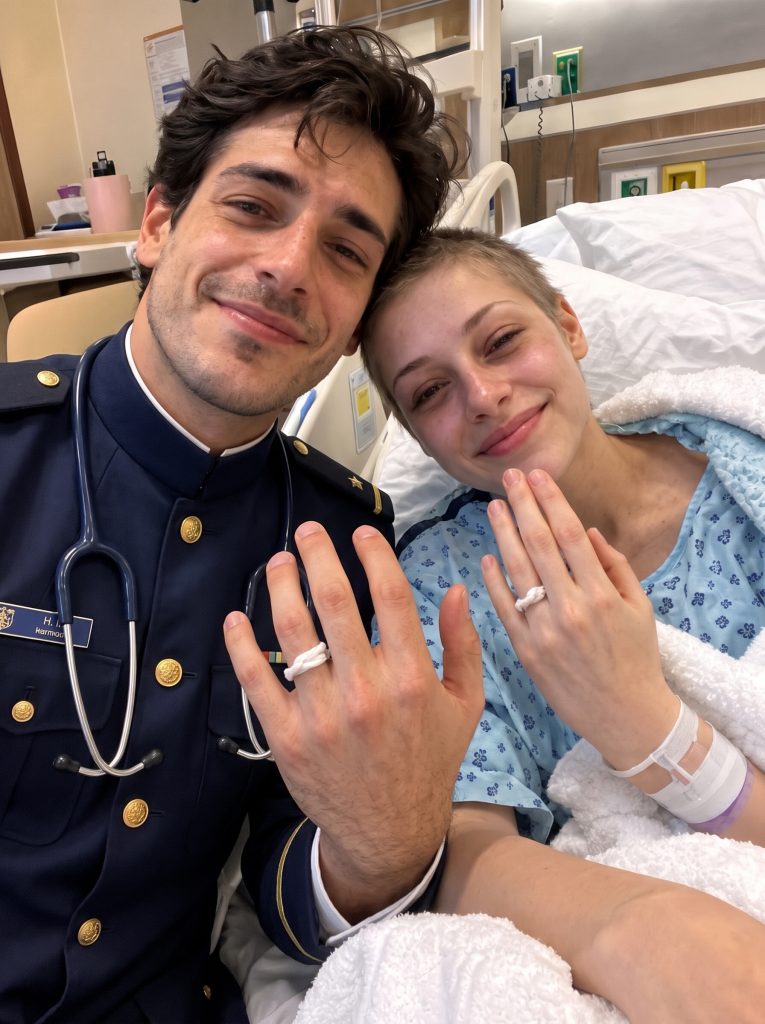
The ceremony itself was held in Alicia’s room, small enough that everyone could remain close to her.
One nurse found a length of soft white fabric.
Another brought fresh flowers.
Hannah carefully helped Alicia put on a clean hospital gown and draped a white scarf over her head.
Alicia insisted that the scarf looked like an elegant bridal veil.
“It does,” Hannah said.
“You don’t have to lie just because I’m dying.”
“Alicia!”
“What? I’m still allowed to make jokes.”
I arrived wearing dark trousers, a white shirt, and the only tie I owned.
It was navy blue.
My mother had given it to me when I graduated from medical school.
When Alicia saw me, she covered her mouth.
“Oh, wow.”
I smiled nervously.
“Is something wrong?”
“No.”
She looked me up and down.
“You look like a handsome accountant.”
The nurses laughed.
I shook my head.
“That’s the best compliment you can give me?”
“Don’t push your luck.”
A nurse had made two symbolic rings from clean strips of bandage, carefully braided into tiny circles.
They weren’t metal.
They weren’t valuable.
They wouldn’t last forever.
But when I saw them resting on a white cloth beside Alicia’s bed, I felt more emotion than I had ever felt looking at expensive jewelry.
Hannah had brought a small bouquet of white daisies.
Alicia held them against her chest.
Her hands were trembling.
I stood beside her.
“Are you tired?” I whispered.
“A little.”
“We can stop.”
She shook her head.
“Absolutely not. I’ve already got the flowers.”
I laughed softly.
Then the ceremony began.
There were only a handful of people in the room.
Hannah.
Two nurses.
The person officiating.
And us.
No orchestra.
No ballroom.
No expensive decorations.
Just afternoon sunlight moving slowly across the floor.
Alicia looked at me as though nothing else existed.
When it was time for our vows, I took her hands.
They were cool and impossibly delicate.
I had spent the previous night trying to write something meaningful.
Every sentence seemed inadequate.
So I put the paper away.
And spoke from my heart.
“Alicia, when I first met you, I thought you were the most impossible patient I’d ever encountered.”
She grinned.
“Accurate.”
Everyone laughed.
I swallowed.
“You made fun of my serious face. You complained about pudding. You found reasons to smile on days when I couldn’t understand how you had the strength.”
Her eyes filled with tears.
“And somewhere along the way, you reminded me why I wanted to become a doctor.”
I paused.
“Not because I could fix everything.”
My voice cracked.
“But because every person deserves to feel seen.”
Alicia squeezed my hands.
“I can’t promise you all the tomorrows you deserve.”
A tear rolled down my cheek.
“But I promise you this one.”
I leaned toward her.
“Today, I choose you.”
She began crying.
Hannah turned away to wipe her eyes.
Then Alicia spoke.
She hadn’t written anything down.
She said she wanted her words to be a surprise.
“Lucas, when you first came into my room, I thought you were the grumpiest handsome man alive.”
I laughed.
She smiled.
“And I decided somebody had to do something about it.”
Her voice was weak.
She paused to catch her breath.
I waited.
Nobody rushed her.
“You were always trying to make everything better.”
She looked into my eyes.
“But I want you to know something.”
Her smile trembled.
“You made something better that you never even knew was broken.”
I swallowed hard.
“What was that?” I whispered.
She pressed my hand against her heart.
“Me.”
I couldn’t stop crying.
She continued.
“I know we don’t have a long story.”
Her voice shook.
“But I think even a short story can be beautiful.”
She lifted our joined hands.
“So I promise to love you for every minute I have.”
The room fell silent.
Then, with a familiar mischievous smile, she added:
“And I promise to haunt you if you stop smiling.”
Everyone laughed through their tears.
The bandage rings were exchanged.
I placed hers gently on her finger.
She placed mine on mine.
Then we were pronounced married.
I leaned forward and kissed her forehead first.
Then, at her whispered insistence, I kissed her lips.
She smiled against mine.
“Finally,” she murmured.
I laughed.
For a moment, she wasn’t a patient waiting for the end.
She was a bride.
My bride.
And for a little while, the room felt brighter than anywhere else in the world.
After the ceremony, Alicia wanted photographs.
Hannah used her phone.
We took pictures of the flowers.
The rings.
The nurses.
The tiny wedding cake someone had brought from the cafeteria.
Alicia couldn’t eat much, but she insisted I taste a piece.
“Well?” she asked.
“It’s good.”
She narrowed her eyes.
“You’re lying.”
“It’s a little dry.”
“I knew it.”
She laughed.
Then her expression softened.
“Lucas?”
“Yes?”
“Are you happy?”
I looked at her.
I knew what tomorrow might bring.
I knew how little time remained.
But I also knew that at that exact moment, I was holding the hand of someone I loved.
“Yes,” I said.
“I really am.”
She smiled.
“Good.”
That evening, when the visitors had gone and the room was quiet, I sat beside her bed.
She was drifting in and out of sleep.
At one point, she opened her eyes.
“Lucas?”
“I’m here.”
“Can I ask you something?”
“Anything.”
“When I’m gone…”
I felt my chest tighten.
She noticed.
“Hey. Don’t make that face.”
I tried to steady myself.
“What do you want to ask?”
She took a slow breath.
“Will you keep the ring?”
I looked down at the braided bandage around my finger.
“Of course.”
“Even though it’s ridiculous?”
“It’s not ridiculous.”
“It’s literally made from medical supplies.”
I laughed softly.
“It’s my wedding ring.”
Her eyes shone.
“Then promise me something else.”
“What?”
“Don’t let this be the end of your happiness.”
I stared at her.
She continued quietly.
“I know you’ll be sad.”
“Alicia…”
“Let me finish.”
I nodded.
“But someday, when something makes you laugh, I want you to laugh.”
A tear slipped down my cheek.
“And when you see flowers, I want you to stop and look at them.”
She squeezed my hand.
“And when somebody needs you, I want you to keep being the doctor I know.”
I lowered my head.
“I don’t know if I can do that.”
She smiled sadly.
“You can.”
“How do you know?”
“Because I know you.”
She closed her eyes.
Then she whispered:
“And because I still have one more surprise for you.”
I looked up.
“What surprise?”
But she was already asleep.
I didn’t ask again.
And two days later, when Alicia took her final breath, I remembered that sentence.
I had no idea what it meant.
Not until her funeral.
Not until Hannah placed that wooden box in my hands.
And not until I saw the photograph dated almost a year before Alicia and I had supposedly met.
PART 3: THE GIRL WHO REMEMBERED ME FIRST
The last time Alicia opened her eyes, she asked me to smile.
That was all.
Not for medicine.
Not for water.
Not because she was uncomfortable.
Just a smile.
I had spent the night beside her bed.
Her breathing had become slower.
The nurses moved gently around the room.
Hannah sat on the other side, holding her sister’s hand.
Alicia looked from Hannah to me.
She tried to speak.
I leaned closer.
“What is it, sweetheart?”
Her lips barely moved.
“You’re doing it again.”
I frowned.
“Doing what?”
She gave the smallest smile.
“That face.”
I tried to laugh.
Instead, I cried.
She watched me for a moment.
Then she whispered:
“Smile for me.”
I did.
It was the most painful smile of my life.
She seemed satisfied.
Her eyes closed.
Hannah bent forward and kissed her forehead.
I rested my hand over Alicia’s.
A short while later, with both of us beside her, she died peacefully.
I had been present for death before.
As a doctor, I understood what was happening.
I understood the changes in her breathing.
I understood why the room became quiet.
I understood the gentle professionalism of the medical staff.
But none of that prepared me for the moment when someone I loved was suddenly gone.
I looked at her face.
She seemed impossibly young.
Eighteen.
An age when life should be expanding, not ending.
Her white wedding scarf still rested in the drawer beside her bed.
The flowers from our ceremony stood near the window.
One of the petals had fallen.
I remember that detail clearly.
I remember thinking I should pick it up.
Then wondering why I was thinking about something so unimportant.
Grief did strange things to my mind.
It made small objects feel enormous.
A cup.
A blanket.
A paper flower.
A ring made from bandages.
After the medical staff gave us time alone, Hannah reached across the bed and took my hand.
“She was happy,” she whispered.
I couldn’t answer.
“Lucas, she was so happy.”
I looked at the place where Alicia’s hand had rested.
“I know.”
Hannah began crying again.
I wanted to comfort her.
But I couldn’t find any words.
So I sat beside her.
And we cried together.
The funeral took place a few days later.
I barely remember getting dressed.
I remember putting on my navy tie.
The same one I had worn at our wedding.
I remember looking at myself in the bathroom mirror.
Thirty years old.
A doctor.
A husband.
A widower.
I had been married for only two days.
It felt impossible that all four descriptions could belong to the same person.
At the service, people spoke about Alicia.
Her teachers remembered how she could make an entire classroom laugh.
Her friends talked about her ridiculous messages and the way she always remembered birthdays.
Hannah described the little sister who used to leave handwritten notes around their home.
Some were affectionate.
Some were ridiculous.
One had been taped to the refrigerator when Alicia was fourteen.
It read:
DEAR FUTURE ME,
PLEASE DO SOMETHING INTERESTING.
LOVE, CURRENT ME.
The room laughed.
Then cried.
When it was my turn to speak, I stood with shaking hands.
I hadn’t prepared a speech.
I had tried.
Every time I wrote something, it sounded too small.
How could a few sentences explain someone who had changed my life?
I looked at the people gathered in front of me.
Then I began.
“I knew Alicia for only a small part of her life.”
My voice trembled.
“But I learned something from her that I wish I’d understood years ago.”
I looked toward her photograph.
“She taught me that being alive isn’t the same as living.”
I paused.
“Before I met her, I was always waiting for the next thing. The next shift. The next achievement. The next day off.”
I swallowed.
“Alicia didn’t have the luxury of assuming tomorrow would come.”
Several people began crying.
“But she never stopped making today matter.”
I touched the bandage ring on my finger.
“She married me knowing our time would be short.”
My voice broke.
“And somehow, she made those two days feel fuller than years I had wasted.”
I took a breath.
“I couldn’t save her life.”
The words hurt.
“But she changed mine.”
I sat down before I completely lost control.
After the burial, people gathered outside the cemetery.
Some approached me with condolences.
Others looked uncertain about what to say.
I understood.
What could anyone say to a man who had married someone three days before her death?
Eventually, I walked toward my car.
I needed a moment alone.
The afternoon was cool.
A light breeze moved through the trees.
I stood beside the driver’s door, staring at my wedding ring.
It had begun to loosen.
The soft material was already wearing thin.
I adjusted it carefully.
Then I heard someone call my name.
“Lucas!”
I turned.
Hannah was hurrying toward me.
She was carrying a small wooden box.
Her eyes were red.
Her hands were shaking.
“Wait,” she said. “Please.”
I stepped toward her.
“Are you all right?”
She nodded, though she clearly wasn’t.
“Alicia made me promise something.”
She held out the box.
“She said I had to give you this after the funeral.”
I looked down.
My name was written across the lid.
LUCAS.
The handwriting was unmistakable.
I had seen it on folded notes, little drawings, and the complaint she once wrote about my serious face.
“What is it?” I asked.
Hannah shook her head.
“She didn’t want me to explain. She said you’d understand better if you opened it yourself.”
I lifted the lid.
Inside was a stack of letters tied with a pale pink ribbon.
A small paper star.
A photograph.
And an envelope with the words:
OPEN THIS LAST.
I picked up the photograph.
Alicia was standing outside the hospital.
She looked healthier.
Her long brown hair fell over her shoulders.
She was smiling at the camera and holding a piece of paper.
On it were the words:
I FOUND MY DOCTOR.
I turned the photograph over.
The date was almost a year before I remembered meeting her.
Below it was a sentence.
“If he doesn’t remember me, that’s okay. I remember him.”
I stared at it.
“Hannah…”
She took a shaky breath.
“She remembered you before you remembered her.”
I looked up.
“What?”
Hannah leaned against the car beside me.
“Do you remember last spring? The hospital’s outpatient building?”
I searched my memory.
I’d worked countless shifts there.
“Maybe.”
“Do you remember a girl sitting alone near the entrance on a rainy afternoon?”
I frowned.
Something flickered in my mind.
Rain.
A bench.
A paper bag.
A young woman with long brown hair.
But the memory was faint.
Hannah watched my face.
“You gave her your lunch.”
I went still.
And suddenly, I remembered.
It had been an awful day.
I had been working an extended shift when I stepped outside for a few minutes.
Near the entrance, a young woman sat on a bench.
She looked pale and exhausted.
Rain had started to fall, and she had no umbrella.
I asked whether she needed help.
She said she was waiting for her sister.
She’d just received difficult news about her health.
I remember offering to help her find somewhere warm to sit.
She refused politely.
Then I noticed she was staring at the sandwich in my hand.
I asked whether she’d eaten.
She shook her head.
So I gave her my lunch.
It wasn’t much.
Just a chicken sandwich and an apple.
She stared at the bag.
“Are you sure?”
I nodded.
“Absolutely.”
“What about you?”
“I’ll survive.”
She smiled.
Then she asked:
“Are you a doctor?”
I looked down at my badge.
“Apparently.”
She laughed.
I remember that laugh.
It was the same laugh I’d heard hundreds of times later.
But I hadn’t recognized it.
Because when I encountered Alicia as a patient, she was much thinner.
Her hair was gone.
Her illness had changed her appearance.
And I had met so many people since that rainy afternoon.
I looked at Hannah.
“That was Alicia?”
She nodded.
I pressed my hand against my mouth.
“Oh, my God.”
Hannah began crying.
“She never forgot you.”
I looked back at the photograph.
The girl holding the paper seemed so alive.
So full of hope.
“Why didn’t she tell me?”
Hannah wiped her eyes.
“She wanted to.”
“Then why didn’t she?”
“She said she didn’t want you to feel obligated to remember her.”
I stared at her.
Hannah continued.
“After that day, she kept talking about the doctor who gave her his lunch.”
I shook my head.
“It was just a sandwich.”
“Not to her.”
Hannah’s voice trembled.
“Lucas, that was the day Alicia found out how serious her illness might be. She was terrified.”
I looked down.
“She had been sitting outside because she didn’t want me to see her crying,” Hannah said.
“Then you came along.”
I remembered asking the girl on the bench whether she needed help.
I remembered how she had tried to smile.
Hannah continued.
“You didn’t know her name. You didn’t know her diagnosis. You didn’t know anything about her.”
A tear slipped down her cheek.
“But you noticed she was hungry.”
I couldn’t speak.
“She told me later that she had never felt so invisible as she did that afternoon.”
Hannah touched the photograph.
“And then a stranger stopped.”
I lowered my head.
All those months, Alicia had remembered.
Every time she joked about my serious face.
Every time she smiled when I entered her room.
Every time she acted as though we shared a secret.
She had recognized me.
I had thought I was meeting a stranger.
But to Alicia, I was someone she had been waiting to see again.
My hands began trembling.
“She should have told me.”
Hannah shook her head.
“Read the letters.”
I looked inside the box.
There were several envelopes.
Each one had been carefully labeled.
BEFORE WE MET AGAIN.
THE DAY YOU REMEMBERED MY NAME.
WHEN I WAS AFRAID.
THE WEDDING.
AND WHEN YOU MISS ME.
I stared at the last envelope.
My chest tightened.
Hannah touched my shoulder.
“She wrote some of them while she still had the strength.”
I couldn’t stop looking at the handwriting.
“She made me promise you’d get them.”
I nodded slowly.
“Thank you.”
Hannah stepped back.
Then she hesitated.
“Lucas?”
I looked up.
“She wasn’t afraid you’d forget her.”
My eyes filled.
“She was afraid you’d stop living because you couldn’t.”
I stood beside my car long after Hannah walked away.
Then I carefully closed the box.
I knew I couldn’t open those letters in the cemetery.
Not yet.
I drove home.
Placed the box on my kitchen table.
And sat in front of it for almost an hour.
Finally, I untied the pink ribbon.
The first letter began with six words that made me start crying.
“Dear Lucas, you saved my Tuesday.”
PART 4: WHAT SHE NEVER TOLD ME
I unfolded Alicia’s first letter so carefully that I was afraid the paper might tear.
Her handwriting leaned slightly to the right.
She had dotted the letter I in my name with a tiny heart.
That made me smile.
Then I began reading.
“Dear Lucas,
You probably don’t remember me.
That’s okay.
To you, I was probably just one more person sitting outside the hospital on a rainy day.
But to me, you were the doctor who saved my Tuesday.
I had just heard words I wasn’t ready to hear.
Tests. Treatments. Possibilities.
Everyone was talking about what might happen to me.
Nobody was talking about what was happening inside me.
I was scared.
I was hungry.
And I felt completely alone.
Then you came outside with a sandwich.
You asked if I was okay.
I lied and said yes.
You looked at me for a second and said, ‘That’s a very unconvincing yes.’
I almost laughed.
Then you gave me your lunch.
You didn’t give me a speech.
You didn’t tell me to stay positive.
You didn’t ask me to be brave.
You just sat beside me for a minute.
And when you stood up to leave, you said something I haven’t forgotten.
‘Whatever today looks like, it isn’t the whole story.’
I don’t know whether you remember saying that.
But I do.
Because I needed to hear it.
So thank you.
For the sandwich.
For the apple.
And for making a terrible Tuesday a little less terrible.
Love,
The Girl on the Bench.”
By the time I finished, the words were blurred by my tears.
I remembered the conversation now.
Not every detail.
But enough.
I remembered the girl staring down at her shoes.
I remembered sitting beside her.
And I remembered saying something about one bad day not being the whole story.
It was the sort of thing I might say to someone who seemed overwhelmed.
Nothing extraordinary.
Nothing carefully planned.
I hadn’t known that she would carry those words with her.
I put the letter down.
Then I opened the next one.
“THE DAY YOU REMEMBERED MY NAME.”
It had been written after Alicia was admitted to the hospital.
The first sentence made me laugh through my tears.
“Dear Lucas,
Congratulations.
You finally learned my name.”
I could almost hear her voice.
I continued.
“I knew who you were the moment you walked into my room.
Same serious face.
Same tired eyes.
Same man who looked as though smiling required a medical license.
I wanted to say, ‘Hey, Sandwich Doctor, remember me?’
But I didn’t.
At first, I thought it might be fun to see whether you figured it out.
Then I realized you genuinely didn’t recognize me.
I wasn’t offended.
I barely recognized myself sometimes.
The girl on the bench had long hair.
She wore jeans.
She could walk across a parking lot without getting tired.
The girl in the hospital bed looked very different.
But when you introduced yourself and looked at me like I mattered, I knew you hadn’t changed.
You still listened.
You still noticed little things.
And you still had absolutely no sense of humor.
So I decided to fix that.
You’re welcome.”
I laughed.
Then cried again.
The letter continued.
“I didn’t tell you about the bench because I wanted you to know me as Alicia.
Not as the girl you helped once.
I wanted us to make new memories.
And we did.
You remembered my favorite ice cream.
You noticed when I was pretending not to be afraid.
You sat beside me during the rain.
I know you were doing your job.
But you made a difficult place feel less lonely.
I hope someday you understand how much that meant.
Love,
Alicia.”
I pressed the paper against my chest.
For the first time since the funeral, I didn’t feel only the sharp pain of losing her.
I felt the warmth of having known her.
I remembered how she used to straighten her blanket whenever I entered.
How she pretended to be offended if I forgot to smile.
How she would say “Doctor Lucas” in the exaggerated voice of someone announcing royalty.
She had known me before I knew her.
And instead of using that memory to make me feel guilty, she had turned it into a private little joke.
I looked at the wooden box.
There was another paper star inside.
I lifted it gently.
On one side, she had written:
SMILE NUMBER FOUR.
I laughed aloud.
The sound startled me.
My apartment had been so quiet that hearing myself laugh felt almost forbidden.
Then I remembered her words.
“When something makes you laugh, I want you to laugh.”
I held the paper star.
“Okay, Alicia,” I whispered.
“I’m trying.”
The third letter was labeled:
WHEN I WAS AFRAID.
I hesitated before opening it.
Something about the words frightened me.
Alicia had spent so much time making other people comfortable that I sometimes forgot how terrified she must have been.
I unfolded the paper.
“Dear Lucas,
This is the part I didn’t always let you see.
Sometimes I was afraid.
Really afraid.
Not just of pain.
Not just of treatment.
I was afraid of disappearing.
I was afraid that one day my sister would wake up and forget what my laugh sounded like.
I was afraid my friends would grow older and stop mentioning my name because it hurt too much.
I was afraid that eventually all anyone would remember was that I got sick.
I wanted people to remember that I loved strawberry ice cream.
That I laughed too loudly.
That I once got in trouble at school because I convinced my entire class to sing happy birthday to a teacher whose birthday was actually six months away.
I wanted people to remember me as a girl.
Not a diagnosis.
You helped me remember that I was still a girl.
A stubborn, annoying, occasionally brilliant girl.
And when you smiled at me, I felt normal.
I know that sounds like a small thing.
But sometimes the smallest things save the biggest pieces of us.”
I stopped reading.
My eyes burned.
I remembered all the times Alicia had smiled while I reviewed her medical results.
All the times she had made a joke immediately after a difficult conversation.
I had admired her courage.
But perhaps I had misunderstood part of it.
She wasn’t fearless.
She had simply decided that fear wouldn’t be allowed to occupy every moment she had left.
I continued.
“Please don’t be angry with yourself for the things you couldn’t change.
I know how your face looks when you’re trying to solve a problem.
I know you’ll think about every treatment.
Every test.
Every decision.
You’ll wonder if there was something else you could have done.
Lucas, please listen to me.
I didn’t need you to be a miracle worker.
I needed you to be honest.
I needed you to care.
I needed you to remember I was still here.
You did all of that.
Please let it be enough.”
I dropped the paper onto the table.
And cried harder than I had at the funeral.
Because she had known.
She had known exactly what I would do after losing her.
I would replay the medical records.
Question every decision.
Wonder whether a different treatment, a different consultation, a different moment could have changed the outcome.
I had already begun doing it.
Even though I understood her illness.
Even though I knew how aggressively it had progressed.
Even though other physicians had reviewed her care.
Some part of me still believed that loving her should have given me the power to save her.
Alicia had understood that before I did.
And she had written the words I needed.
“Please let it be enough.”
I stayed at the kitchen table until the light outside faded.
Then I opened the fourth letter.
“THE WEDDING.”
This one was shorter.
The handwriting was less steady.
I knew she had written it during her final days.
“Dear Husband,
I can’t believe I get to call you that.
I’ve been practicing.
Hello, Husband.
How are you, Husband?
Please stop making that face, Husband.
Honestly, it’s a very useful word.”
I smiled.
Then read on.
“I know our wedding probably didn’t look like the weddings you imagined when you were younger.
There was no fancy dress.
No beautiful ballroom.
No dancing until midnight.
I didn’t even have real rings.
But I need you to know something.
It was perfect.
When I saw you wearing that navy tie, I forgot about the hospital for a moment.
I forgot about the machines.
I forgot about the days I wouldn’t have.
I only saw you.
And when you promised me today, I knew it was the most honest promise anyone had ever made to me.
People make big promises all the time.
Forever.
Always.
A lifetime.
But you knew exactly how little time we had.
And you chose me anyway.
That is something I will carry with me wherever I go.
I wish I could have given you more.
A real honeymoon.
A kitchen full of dishes.
Silly arguments about what to watch on television.
A thousand ordinary mornings.
I wish I could have stood beside you in a field of flowers.
I wish I could have watched you become the doctor you will be ten years from now.
I wish we could have grown old.
But wishing doesn’t change the truth.
So instead, I’m going to be grateful for what we had.
Because for one beautiful day, I got to be your bride.
And you made me feel like the luckiest girl alive.”
I covered my face.
I cried until my shoulders hurt.
Then I kept reading.
“There’s something else I want you to know.
When I asked you to marry me, I was afraid you’d say yes because you felt sorry for me.
I never wanted your pity.
I wanted your choice.
That’s why I was so happy when you took time to think.
It meant you understood how important this was.
When you came back and said yes, I believed you.
I believed every word.
And Lucas?
I love you.
Not because you’re a doctor.
Not because you tried to fix everything.
I love you because you’re kind when nobody is watching.
I saw that on a rainy Tuesday.
And I saw it again every day in that hospital.
Please remember that about yourself.
Love,
Your Very Annoying Wife.”
At the bottom, she had drawn two small figures.
One wore a tie.
The other wore a white scarf.
Between them was a crooked heart.
I traced the drawing with my fingertip.
“You’re not annoying,” I whispered.
Then I laughed through my tears.
“Well, maybe a little.”
I read that letter three times.
By the time I finished, it was almost midnight.
I knew I should sleep.
But one envelope remained.
The one Alicia had marked:
OPEN THIS LAST.
I picked it up.
It was heavier than the others.
Inside, I could feel a small folded object.
My name was written on the front.
Underneath it were seven words.
“Only when you’re ready to live again.”
I held the envelope for a long time.
Part of me wanted to open it immediately.
Another part was afraid.
It felt like the last conversation I would ever have with Alicia.
And I wasn’t ready for that conversation to end.
So I put it back inside the box.
I closed the lid.
Then I went to bed.
For the first time since Alicia died, I dreamed about her.
We were standing in the hospital garden.
She was wearing her pink scarf.
The sunlight was warm.
She looked at me and smiled.
“Doctor Serious.”
I tried to speak.
But she lifted one finger.
“Don’t forget.”
Then I woke up.
My face was wet with tears.
And the unopened envelope was still waiting on my kitchen table..
PART 5: LOVE DOESN’T END WHEN SOMEONE LEAVES
I didn’t open Alicia’s last envelope the next morning.
Or the morning after that.
In fact, almost three weeks passed before I could bring myself to touch it again.
During those weeks, I learned that grief wasn’t one feeling.
It was a thousand small moments.
It was waking up and reaching for my phone before remembering there would be no message from Alicia.
It was seeing strawberry ice cream in a grocery store and standing in front of the freezer until my eyes filled with tears.
It was hearing someone laugh in a restaurant and turning my head because, for one impossible second, I thought it was her.
It was finding the tiny yellow paper star in the pocket of my coat.
It was reaching for the ring on my finger every time I felt overwhelmed.
The braided bandage had become fragile.
I stopped wearing it constantly because I was afraid it would fall apart.
Instead, I placed it in a small clear box beside my bed.
Every morning, I looked at it.
Every night, I remembered the way Alicia’s hands had trembled when she slipped it onto my finger.
I returned to work gradually.
The hospital arranged time away from my usual duties, and I spoke with a counselor about the complicated grief and professional boundaries surrounding what had happened.
Returning wasn’t easy.
Every corridor held a memory.
Every flower arrangement reminded me of Alicia.
Sometimes I passed her old room and instinctively expected to hear her voice.
“Doctor Lucas, you know smiling is free, right?”
But the room belonged to another patient now.
Life had continued.
That was one of the hardest things to accept.
The hospital hadn’t stopped.
People were still arriving.
People were still leaving.
There were still charts to read, treatments to discuss, and frightened families waiting for answers.
For a while, I wondered whether I could keep doing the work I had once loved.
Then one afternoon, I met a patient who reminded me of something Alicia had written.
An older man had been admitted after a difficult diagnosis.
He was sitting alone in his room, staring at an untouched lunch tray.
I entered to speak with him.
He answered my questions politely.
But I noticed he wasn’t eating.
“Is something wrong with the food?” I asked.
He shrugged.
“Not hungry.”
I sat in the visitor’s chair.
“Would you like to tell me what’s on your mind?”
He looked surprised.
Then he began talking.
He told me about his wife.
His grandchildren.
The fishing trips he missed.
His fear of becoming a burden.
I listened.
I didn’t offer false reassurance.
I didn’t promise things I couldn’t guarantee.
I simply stayed for a few minutes and let him speak.
When I stood to leave, he looked at me.
“Doctor?”
“Yes?”
“Thank you for sitting down.”
I nodded.
“Of course.”
He smiled faintly.
“Most people seem to be in a hurry.”
I walked into the hallway and stopped.
I remembered Alicia’s letter.
“You made a difficult place feel less lonely.”
I leaned against the wall.
And for the first time, I understood that the kindness Alicia had noticed in me wasn’t something I had lost with her.
It was something I could keep giving.
That evening, I called Hannah.
We hadn’t spoken much since the funeral.
Neither of us knew how to begin conversations without Alicia.
Hannah answered on the second ring.
“Lucas?”
“Hi.”
“Are you okay?”
I hesitated.
“Some days.”
She gave a small, sad laugh.
“Me too.”
We were quiet for a moment.
Then I said:
“I read her letters.”
Hannah inhaled sharply.
“All of them?”
“Not the last one.”
“Oh.”
I looked toward the wooden box.
“I don’t know why I can’t open it.”
Hannah was quiet.
Then she said:
“Maybe because you know it’s the last one.”
I swallowed.
“Maybe.”
She sighed.
“Lucas, Alicia worked so hard on those letters.”
“I know.”
“Toward the end, she could barely hold the pen.”
I looked down.
“She kept asking me whether her handwriting was readable.”
My eyes filled.
“She wanted every word to be right.”
I closed my eyes.
Hannah continued softly.
“She wasn’t trying to give you another reason to be sad.”
I wiped my cheek.
“Then what was she trying to do?”
There was a long pause.
Finally, Hannah said:
“She wanted to make sure you didn’t spend the rest of your life standing beside her hospital bed.”
I couldn’t answer.
Because that was exactly what I had been doing.
Not physically.
But inside my mind.
Every day, I returned to those final hours.
Every night, I imagined different outcomes.
I replayed conversations.
Reconsidered decisions.
Tried to find some moment when I could have changed what happened.
And somewhere in the middle of all that grief, I had stopped noticing my own life.
Hannah seemed to understand.
“Lucas, can I tell you something?”
“Of course.”
“On the morning of the wedding, Alicia asked me to help her put on the scarf.”
I listened.
“She was so weak that day. I remember being afraid she wouldn’t have enough strength to get through the ceremony.”
My throat tightened.
“But she kept smiling.”
Hannah paused.
“At one point, I asked whether she was scared.”
“What did she say?”
Hannah’s voice cracked.
“She said, ‘Of course I’m scared. But I’m not going to let fear be the only thing I remember about my last days.’”
I stared at the wall.
Then Hannah added:
“She wanted the same thing for you.”
After the call, I sat at the kitchen table.
The wooden box was where I had left it.
I opened the lid.
The letters were neatly stacked inside.
The photograph rested beneath them.
Alicia smiled up at me from a sunny afternoon almost a year before our wedding.
I looked at the words on the paper she was holding.
I FOUND MY DOCTOR.
Then I noticed something I hadn’t considered before.
She had found me long before I understood how badly I needed to be found.
I had spent years burying myself in work.
I had forgotten how to rest.
How to laugh without feeling guilty.
How to appreciate ordinary moments.
Alicia had entered my life for such a short time.
Yet she had changed all of those things.
I picked up the last envelope.
My hands trembled.
“All right,” I whispered.
“I’m ready.”
I broke the seal.
Inside was a folded letter and one additional piece of paper.
I opened the letter first.
“Dear Lucas,
If you’re reading this, it means I’ve been gone for a little while.
I hope Hannah remembered to give you the box.
If she didn’t, I’m going to be very disappointed in her.
Just kidding.
Mostly.”
I laughed softly.
Then I continued.
“I wish I could see your face right now.
Actually, I can imagine it perfectly.
You’re probably sitting somewhere looking serious.
Your eyebrows are doing that thing they do when you’re trying not to cry.
And you’re probably wondering why I needed to write so many letters.
The answer is simple.
I knew I wouldn’t get to say all the things I wanted to say while I was alive.
So I borrowed a little time from the future.
Every letter is one more conversation.
Every memory is one more moment we get to share.
I hope they have made you smile.
I hope some have made you laugh.
And if they made you cry, that’s okay too.
You never have to apologize for missing me.”
I paused.
Tears were already falling.
Then I reached the next paragraph.
“But Lucas, I need you to understand something.
When I asked you to marry me, I wasn’t asking you to stop your life when mine ended.
I was asking you to share a little piece of it with me.
You gave me that.
More than I ever dreamed.
You made me feel loved.
You made me feel beautiful.
You made me feel like I was more than what was happening to my body.
You gave me a wedding.
You gave me a husband.
And most of all, you gave me a memory that wasn’t about being sick.
I want you to have memories like that too.
New ones.
Happy ones.
Silly ones.
Ordinary ones.
I want you to go outside when the weather is beautiful.
I want you to eat something ridiculous without worrying about whether it’s healthy.
I want you to take a day off when you’re tired.
I want you to laugh at terrible jokes.
And I want you to keep being kind to people who might need a little kindness more than you realize.
Because I know what that kindness can do.
It saved my Tuesday.
And later, it made the end of my life beautiful.”
I pressed my fingers against my lips.
I thought about the girl sitting on the bench.
I had given her a sandwich.
She had given me something I couldn’t begin to measure.
The letter continued.
“There’s one final thing I want you to do.
Inside this envelope, you’ll find a piece of paper.
It’s my last little wish.
Don’t panic.
I’m not asking you to marry anyone else.
One husband is already enough work.”
I laughed through my tears.
“Open it when you’re done reading.”
I looked at the smaller folded paper.
Then returned to the letter.
“I know you couldn’t save me, Lucas.
But please don’t let that convince you that you failed.
You gave me something medicine couldn’t.
A reason to look forward to tomorrow, even when I knew there weren’t many tomorrows left.
And if you ever wonder whether our marriage mattered because it lasted only two days, I want you to remember this.
A beautiful song doesn’t become meaningless because it’s short.
A sunset doesn’t become less beautiful because it ends.
And love doesn’t become less real because time runs out.
I loved you.
I was happy.
And I wouldn’t trade our little wedding for anything in the world.
Now do me one last favor.
Keep living.
Not instead of loving me.
But because you loved me.
Forever your wife,
Alicia.”
At the bottom, she had drawn another crooked heart.
Inside it were two initials.
A + L.
I lowered the letter.
For a long time, I sat without moving.
Then I unfolded the smaller piece of paper.
There were only two sentences.
“Take me to the field of flowers.
And when you get there, smile.”
I stared at those words.
Then I remembered the rainy afternoon when Alicia had told me what she would do if she could leave the hospital.
She wanted strawberry ice cream.
She wanted sunshine.
And she wanted to stand in a field of flowers.
I had promised myself I would take her someday.
But someday never came.
Now I understood.
She wasn’t asking me to spend my life regretting the trip we never took.
She was asking me to take it anyway.
The following Saturday, I called Hannah.
“Do you remember Alicia talking about a field of flowers?”
Hannah became quiet.
“All the time.”
“I want to go.”
There was a pause.
Then she whispered:
“Can I come?”
“Of course.”
We chose a botanical garden outside the city.
It had broad meadows filled with seasonal flowers.
The weather forecast promised clear skies.
For the first time in weeks, I made plans that had nothing to do with work or grief.
Before leaving, I bought two cups of strawberry ice cream.
One for Hannah.
One for me.
Hannah looked at them when she got into my car.
“Strawberry?”
I nodded.
“Alicia’s favorite.”
She smiled sadly.
“She would have approved.”
The drive took a little over an hour.
We didn’t talk much at first.
Then Hannah began telling me stories.
About Alicia as a little girl.
About the time she convinced their mother that their neighbor’s cat understood English.
About the birthday cake she accidentally dropped and tried to repair with extra frosting.
About how she used to leave silly notes inside Hannah’s schoolbooks.
I laughed.
Hannah laughed.
Then we cried.
Then we laughed again.
And somewhere along the road, I realized that remembering Alicia didn’t always have to hurt.
Sometimes remembering her could feel like having her in the room again.
When we arrived, the garden was glowing beneath the afternoon sun.
Flowers stretched across the hills in soft waves.
White.
Yellow.
Pink.
Purple.
A light breeze moved through them.
Hannah stopped beside me.
“Oh,” she whispered.
I looked out across the field.
It was exactly the kind of place Alicia had described.
For a moment, I could almost hear her voice.
“See, Doctor Serious? I told you flowers deserve a nice view.”
I smiled.
Hannah noticed.
“She’d love that.”
“I know.”
We walked along a narrow path until we reached a quiet bench overlooking the meadow.
I sat down.
Hannah remained beside me.
For several minutes, neither of us spoke.
Then I reached into my coat pocket.
I had brought the photograph.
The one showing Alicia holding the words:
I FOUND MY DOCTOR.
I placed it carefully on the bench beside me.
The wind lifted one corner.
I held it down.
“Well, Alicia,” I whispered, “we made it.”
My voice broke.
“I know it’s not the way we planned.”
Hannah put her hand on my shoulder.
I looked toward the flowers.
“But you were right.”
I swallowed.
“They’re beautiful.”
Tears slipped down my face.
I didn’t try to stop them.
For the first time, I wasn’t crying because I wished I could rewrite the ending.
I was crying because I understood that our story, however short, had been real.
I remembered our wedding.
The white scarf.
The flowers.
The bandage rings.
The tiny cake.
Alicia looking at me with tears in her eyes and saying she loved me.
I had spent weeks thinking about everything we wouldn’t get to do.
Everything we had lost.
But sitting in that garden, I began thinking about what we had been given.
A rainy afternoon.
A sandwich.
A ridiculous complaint about my serious face.
A paper star.
A hospital wedding.
Two days as husband and wife.
And a love that had changed me.
Hannah sat beside me.
“Can I tell you something?” she asked.
I nodded.
“Before Alicia died, she asked whether I’d be okay.”
I turned toward her.
Hannah wiped her eyes.
“I told her I’d try.”
She smiled sadly.
“Then she said, ‘Good. You and Lucas can be sad together for a while. But eventually, you’re both going to have to stop being boring.’”
I burst out laughing.
Hannah laughed too.
It was so perfectly Alicia.
For a moment, I imagined her standing in front of us, hands on her hips, looking thoroughly unimpressed by our emotional breakdown.
I could almost hear her saying:
“Seriously? You came all this way just to cry? Look at the flowers!”
I laughed harder.
Then cried again.
Hannah squeezed my hand.
And together, we watched the sunlight move across the meadow.
Several months passed.
Life did not suddenly become easy.
Some mornings still hurt.
Some memories still caught me by surprise.
There were days when I missed Alicia so much that I couldn’t explain the feeling to anyone.
But slowly, I began keeping the promises I had made.
I took occasional days off.
I visited my parents more often.
I stopped eating every meal in a hurry.
I paid attention to the people around me.
And when someone made me laugh, I let myself laugh.
At the hospital, I became more intentional about the little things.
I still worked hard.
I still took my responsibilities seriously.
But I also tried to remember that every person in a hospital bed had a life beyond their medical chart.
A favorite song.
A favorite meal.
A family.
A dream.
A story.
Sometimes, the most important thing I could do was listen.
I began keeping a small paper star inside my coat pocket.
Not as a lucky charm.
Not because I believed it could change outcomes.
But because it reminded me that even on the hardest days, kindness still mattered.
One afternoon, a young patient noticed it when I took out my pen.
“What’s that?” she asked.
I looked down.
The yellow paper star rested in my palm.
I smiled.
“A reminder.”
“Of what?”
I thought about Alicia.
Then I answered:
“That smiling is free.”
The patient laughed.
I laughed too.
And somewhere inside me, something that had been broken began to heal.
On the first anniversary of the rainy Tuesday when I had unknowingly met Alicia, I returned to the bench outside the outpatient building.
The same bench.
The same entrance.
The same place where a young woman had once sat alone, frightened by news she didn’t know how to face.
It was raining again.
I stood beneath the awning holding a paper bag.
Inside was a chicken sandwich and an apple.
I sat down.
For a while, I simply watched the rain.
Then I took out Alicia’s photograph.
I had kept it carefully protected.
Her smile was still bright.
Her eyes still full of life.
I studied the words she was holding.
I FOUND MY DOCTOR.
I smiled.
“No, Alicia,” I whispered.
“You found a man who still had a lot to learn.”
I looked up at the rain.
“And you taught him.”
A woman hurried past with an umbrella.
Someone laughed near the entrance.
A nurse held the door open for an elderly visitor.
Life moved around me.
Ordinary life.
The kind Alicia had wanted more than anything.
I reached into my pocket and took out the little paper star.
Its edges had softened from being carried so often.
On the back, in Alicia’s handwriting, were the words:
SMILE NUMBER FOUR.
I held it carefully.
Then I thought about our wedding day.
She had been so weak.
So pale.
So impossibly beautiful.
I remembered the way she looked at me when I said:
“Today, I choose you.”
For so long, those words had been a source of pain.
Because the next day had come.
And then another.
And she hadn’t been there to share them.
But now, sitting on that bench, I understood something.
Choosing Alicia hadn’t only meant loving her while she was alive.
It meant honoring what she had taught me after she was gone.
It meant not allowing grief to erase the beautiful things we had shared.
It meant carrying her love forward without being trapped in the moment I lost her.
And it meant remembering that the value of a life is not measured only by its length.
Alicia had lived eighteen years.
We had been married for two days.
But she had filled those two days with more love, courage, humor, and meaning than I could have imagined.
I took a breath.
Then I stood.
Before leaving, I placed the untouched sandwich and apple in my bag to take with me.
I wasn’t going to leave them on the bench.
Alicia would have made fun of me for wasting perfectly good food.
I laughed at the thought.
Then I looked back once more.
“Goodbye, sweetheart,” I whispered.
The rain continued falling.
And for the first time, saying goodbye didn’t feel like losing her all over again.
It felt like making room for the rest of my life while keeping the part of it that belonged to her.
Years from now, I know people may ask about the ring I keep in a small clear box.
They may ask why I still own a faded photograph of a girl with long brown hair holding a piece of paper.
They may wonder why I have a collection of letters tied with pink ribbon.
And perhaps they’ll ask why a grown man keeps a tiny yellow paper star in his coat.
When that happens, I’ll tell them about Alicia.
I’ll tell them about the girl who hated hospital pudding.
The girl who believed flowers deserved sunshine.
The girl who could make exhausted nurses laugh.
The girl who asked her doctor to marry her when she had only three days left to live.
I’ll tell them about our wedding.
About the white scarf.
The bandage rings.
The tiny cake.
And the promise I made to love her for whatever time we had.
Then I’ll tell them about the box her sister gave me after the funeral.
About the photograph that proved our story had begun long before I knew it.
About the letters Alicia wrote because she knew there would be conversations we wouldn’t get to have.
And about the final note that sent me to a field of flowers.
Most of all, I’ll tell them what she taught me.
That love isn’t always measured in years.
That kindness can change a day without us ever knowing.
That we don’t have to cure someone’s pain to make them feel less alone.
And that sometimes, the people we cannot save are the ones who teach us the most about living.
I became a doctor because I wanted to help people.
I met Alicia because she needed medical care.
I married her because I loved her.
And I continue living because she asked me to.
I once believed our story ended the day we buried her.
But I understand now that I was wrong.
Our wedding lasted one afternoon.
Our marriage lasted two days.
Her life lasted eighteen years.
But the love she left behind still reaches into ordinary moments.
A smile.
A flower.
A rainy Tuesday.
A paper star.
And every time I remember her voice saying, “Doctor Lucas, you know smiling is free, right?”
I smile.
Because Alicia Morgan Bennett may have been my wife for only two days.
But she will always be the girl who taught me how to live.
And that is a love story I will carry for the rest of my life.
THE END