PART 2: “I CAN’T GO TO SCHOOL IF EMMA IS SICK.”
The paramedics arrived eleven minutes later.
By then, I’d opened the curtains and found bottled water in the kitchen.
Emma was still feverish.
Lily sat beside Noah on the sofa, clutching her rabbit.
And Noah watched every movement the paramedics made.
Not with curiosity.
With responsibility.
When one of them lifted Emma gently from the bed, Noah stood immediately.
“Be careful with her.”
The paramedic smiled.
“We will.”
“She doesn’t like strangers.”
“That’s okay.”
“And she gets scared when people talk loudly.”
The paramedic nodded.
“We’ll be gentle.”
Noah followed them toward the door.
“Can I come?”
I stepped beside him.
“We’re going to make sure you know what’s happening.”
He looked at me.
“Are they taking her away?”
“She’s going to get checked by medical professionals.”
His eyes filled.
“Will she come back?”
I crouched.
“I don’t know exactly what the doctors will decide yet.”
He swallowed.
“But I’m going to make sure the people helping her know how important it is to keep you informed.”
He nodded slowly.
Then whispered:
“She likes it when I sing.”
My throat tightened.
“What do you sing?”
He looked embarrassed.
“The moon song.”
I smiled gently.
“What’s the moon song?”
He hesitated.
Then began singing in a tiny voice.
“Moon up high, stars so bright…”
His voice trembled.
“Keep my baby safe tonight…”
He stopped.
I looked at him.
“Who taught you that?”
He stared at the floor.
“My mom.”
I swallowed.
“Does she still sing it?”
He shook his head.
“No.”
I waited.
Then he whispered:
“She left.”
I sat beside him.
“When?”
“Last winter.”
I nodded.
“Do you know where she went?”
He shook his head.
“Daddy says she didn’t want us.”
I felt my jaw tighten.
But I kept my expression calm.
“Has she called?”
Noah looked uncertain.
“Sometimes the phone rings and Daddy gets mad.”
I filed that away.
A social worker arrived shortly afterward.
Her name was Rachel Morgan.
She spoke softly to the children.
She explained what would happen next.
And she listened when Noah asked whether Lily could bring her stuffed rabbit.
“Of course,” Rachel said.
Noah looked relieved.
Then he asked:
“What about my backpack?”
Rachel smiled.
“You can bring that too.”
He hesitated.
“Can I bring my homework?”
I stared at him.
Rachel’s expression softened.
“Yes, Noah.”
He nodded.
“Okay.”
Then he whispered:
“Because if I don’t turn it in tomorrow, I’ll get in trouble.”
I looked away for a moment.
The boy was facing a frightening situation.
His little sister needed medical care.
His father wasn’t home.
And he was worried about homework.
That was when I understood how completely he’d learned to carry responsibilities no child should have.
At the hospital, Emma was evaluated and treated for dehydration and an infection.
The medical team monitored her carefully.
Lily stayed close to Noah.
And Noah refused to sit down until someone told him Emma was receiving care.
When Rachel finally convinced him to eat a sandwich, he divided it into three pieces.
One for himself.
One for Lily.
And one he placed on a napkin.
“For Emma,” he explained.
Rachel’s eyes filled.
I sat beside him.
“Noah, the hospital will make sure Emma gets what she needs.”
He looked at the sandwich.
“But what if she’s hungry?”
I swallowed.
“Then they’ll help her.”
He nodded.
But he still saved the piece.
Later that evening, his father arrived.
His name was Thomas Bennett.
He was thirty-four.
Tall.
Broad-shouldered.
Wearing a construction company jacket.
He entered the hospital waiting area looking furious.
“Where are my kids?”
Rachel stood.
“Mr. Bennett?”
“Yes.”
She introduced herself.
Then explained that the children were safe and that Emma was receiving medical attention.
Thomas looked toward me.
“You took my children out of my house?”
I remained calm.
“Your son asked for help.”
His face reddened.
“Noah?”
The boy shrank against the sofa.
Thomas looked at him.
“What did you do?”
Noah’s eyes filled.
“I didn’t—”
Thomas stepped forward.
“You brought the police home?”
I moved slightly between them.
“Mr. Bennett, let’s speak away from the children.”
He glared at me.
“This is a family matter.”
I nodded.
“And there are serious concerns about the children’s supervision and safety.”
He scoffed.
“I work.”
Rachel spoke gently.
“We understand you have employment responsibilities.”
Thomas turned toward her.
“Then you understand I can’t be everywhere.”
She nodded.
“But a seven-year-old cannot safely be expected to supervise a four-year-old and a two-year-old for hours.”
Thomas laughed bitterly.
“You people have no idea what it’s like.”
I looked at him.
“Then tell us.”
He stared.
I continued.
“Tell us what happened.”
For a moment, he said nothing.
Then his shoulders sagged.
“My wife left.”
His voice was suddenly quieter.
“I work ten-hour shifts.”
He looked down.
“The daycare closed. My mother lives three states away. I couldn’t afford another place.”
Rachel nodded.
“Those are serious challenges.”
Thomas swallowed.
“So what was I supposed to do?”
I looked toward Noah.
The little boy was sitting beside Lily.
Holding her hand.
Watching his father.
Waiting to see whether he’d be punished.
I turned back.
“You were supposed to ask for help.”
Thomas’s face hardened.
“From who?”
Rachel stepped closer.
“From the school. From community services. From relatives. From agencies that help families access childcare.”
Thomas looked away.
She continued.
“We can help you understand what resources are available.”
He shook his head.
“You’ll take my kids.”
Rachel answered carefully.
“Our immediate responsibility is their safety. Decisions about placement and reunification will be made through the appropriate process.”
Thomas stared at the floor.
Then whispered:
“I didn’t want anyone knowing I couldn’t handle it.”
I felt anger rise.
Not because he was struggling.
But because his pride had placed three children in danger.
I looked at him.
“Your son is seven.”
Thomas nodded.
“He’s been trying to keep your family together.”
His eyes filled.
I continued.
“He thought it was his fault the house was messy.”
Thomas closed his eyes.
“He thought he was responsible for his sisters being hungry.”
A tear slipped down Thomas’s cheek.
“And he was terrified that asking for help would get him in trouble.”
Thomas covered his face.
For a long moment, nobody spoke.
Then he whispered:
“I never meant for it to get this bad.”
I looked at him.
“But it did.”
He nodded.
And for the first time that evening, he didn’t argue.
PART 3: “SHE DIDN’T ABANDON US.”
The next morning, I returned to Evergreen Elementary.
I needed to speak with the principal and provide information for the child welfare investigation.
The principal, Mrs. Ellen Whitmore, was waiting in her office.
She looked exhausted.
“Officer Dunham.”
I nodded.
“Mrs. Whitmore.”
She gestured toward a chair.
“Rachel told me what happened.”
I sat.
Her eyes filled.
“I had no idea.”
I looked at her.
“Did Noah ever tell anyone he was taking care of his sisters?”
She shook her head.
“Not directly.”
Then she paused.
“But there were signs.”
I waited.
She continued.
“He was often tired.”
I nodded.
“He sometimes fell asleep during reading time.”
My chest tightened.
“He’d ask for extra crackers from the cafeteria.”
I looked down.
“And he was very anxious whenever school ran late.”
I swallowed.
Mrs. Whitmore wiped her eyes.
“We thought he was having trouble adjusting after his parents separated.”
I nodded.
“That may have been part of it.”
She looked at me.
“But we missed the bigger picture.”
I took a breath.
“What’s important now is that the right people are involved.”
She nodded.
Then she opened a drawer.
“There’s something you should see.”
She removed a folder.
Inside were attendance records.
Notes from teachers.
And several drawings Noah had made.
One showed a house.
Three small figures stood inside.
A larger figure stood outside.
I pointed.
“Who’s this?”
Mrs. Whitmore looked at the paper.
“Noah said it was his mother.”
I stared.
In the drawing, the woman stood behind a fence.
There was a large red X between her and the house.
My stomach tightened.
“What did he say about the X?”
Mrs. Whitmore looked down.
“He said his daddy wouldn’t let her come in.”
I went still.
For a moment, neither of us spoke.
Then I asked:
“Has the school ever received calls from Noah’s mother?”
Mrs. Whitmore hesitated.
“Yes.”
My heart tightened.
“How many?”
She opened another folder.
“Several.”
I stared.
“She called asking about the children?”
“Yes.”
I swallowed.
“What did the school tell her?”
Mrs. Whitmore looked uncomfortable.
“Thomas had provided paperwork concerning their separation and custody arrangements. Staff followed the restrictions they understood to be in place.”
I nodded.
“Do you have copies?”
She handed me the documents for review through the proper process.
I looked at the dates.
Then the signatures.
Something felt wrong.
One page appeared incomplete.
Another referenced a court order that wasn’t attached.
I looked up.
“Has anyone verified the current custody order directly?”
Mrs. Whitmore hesitated.
“I don’t know.”
I nodded.
“Let’s make sure the investigators have this.”
That afternoon, Rachel contacted me.
“Officer Dunham, we located Noah’s mother.”
My heart began pounding.
“Where is she?”
“About forty minutes away.”
I stared.
“Forty minutes?”
“Yes.”
I leaned back.
For months, Noah had believed his mother abandoned him.
But she was less than an hour away.
Rachel continued.
“Her name is Sarah Bennett.”
I nodded.
“What did she say?”
Rachel took a breath.
“She says Thomas prevented her from seeing the children.”
I felt cold.
“She claims he changed phone numbers, refused visits, and told her the children didn’t want contact.”
I looked down.
Rachel continued.
“She has been trying to resolve custody issues through legal channels.”
I swallowed.
“Does she have documentation?”
“Yes. Her attorney has provided records of repeated attempts to arrange contact.”
I closed my eyes.
Noah’s drawing.
The woman outside the fence.
The red X.
I whispered:
“He told Noah she didn’t want them.”
Rachel’s voice softened.
“I know.”
I looked toward the window.
“Can she see the children?”
“That will depend on verification of the current legal arrangements and safety assessment. But we’re working to make sure the children aren’t separated from a safe parent unnecessarily.”
I nodded.
“Please keep me updated.”
Two days later, Sarah came to the family services office.
I was there to provide a statement.
She was thirty-two.
Her hair was pulled into a loose ponytail.
She wore jeans and a faded green sweater.
Her face was pale.
And her hands trembled around a folder of documents.
When she saw me, she stood.
“Officer Dunham?”
I nodded.
“Yes.”
Her eyes filled.
“Are my children okay?”
I swallowed.
“They’re receiving care, and the professionals involved are working to keep them safe.”
She covered her mouth.
“Emma?”
“She’s being treated and monitored.”
Sarah began crying.
“I’ve been trying to see them.”
I nodded.
“I understand.”
She shook her head.
“Thomas told me they’d be better off without me.”
Her voice broke.
“He said if I kept pushing, he’d make sure I never saw them again.”
I looked at her.
She continued.
“I left because the marriage had become unbearable.”
Tears slipped down her cheeks.
“But I never wanted to leave my children.”
I swallowed.
She opened her folder.
Inside were letters.
Birthday cards.
Photographs.
And copies of messages she’d sent.
One was addressed to Noah.
My sweet boy,
I miss you every day.
I hope you’re eating your favorite pancakes.
I hope you’re still drawing dinosaurs.
And I hope you know Mommy loves you.
Always.
I stared at the letter.
Then looked up.
“Did Noah receive this?”
Sarah shook her head.
“No.”
I felt my chest tighten.
She continued.
“Thomas returned everything.”
I looked down.
Sarah whispered:
“Does Noah think I abandoned him?”
I hesitated.
Then answered gently.
“He’s been told that you left.”
She covered her face.
A sound escaped her that I will never forget.
Not a scream.
Not a sob.
Something deeper.
The sound of a mother realizing her children had been taught she didn’t want them.
I sat beside her.
“Sarah, the professionals involved are reviewing the situation.”
She nodded through tears.
I continued.
“What’s important now is making sure the children have safe, stable care and accurate information.”
She looked at me.
“Will they ever forgive me?”
I swallowed.
“I can’t speak for them.”
Then I added:
“But they’re young. And they deserve the chance to understand what really happened.”
Sarah nodded.
And whispered:
“I just want to hold them.”
PART 4: “MOMMY, DID YOU REALLY LOOK FOR US?”
The first supervised reunion took place two weeks later.
By then, the appropriate agencies had reviewed the available custody documents and arranged a safe meeting.
Emma was recovering well.
Lily had begun sleeping more peacefully.
And Noah was attending school regularly while the children stayed together in temporary care.
But he remained anxious.
Rachel told me he asked the same question every night.
“Are we all staying together?”
Every night, someone reassured him that the adults were working to protect all three children and keep their sibling bond central to the plan.
I was invited to attend the reunion because Noah had asked for me.
When I arrived, he was sitting on a small sofa beside Lily.
Emma played with blocks on the carpet.
Noah looked up.
“Officer Dunham!”
I smiled.
“Hey, buddy.”
He hurried toward me.
Then stopped.
“Is it true?”
I crouched.
“Is what true?”
He swallowed.
“That Mommy’s coming.”
I nodded.
“Yes.”
His eyes widened.
He looked down.
“Daddy said she didn’t want us.”
My throat tightened.
I chose my words carefully.
“Your mom has been trying to see you.”
He stared.
“For real?”
“Yes.”
His lower lip trembled.
“Then why didn’t she come?”
I took a breath.
“Sometimes grown-ups have disagreements and problems that make it hard for families to see each other.”
He looked confused.
I continued.
“But those problems are not your fault.”
He stared at me.
“And they don’t mean you weren’t loved.”
His eyes filled.
He whispered:
“Did she forget my birthday?”
I swallowed.
“Noah, I saw a birthday card she wrote for you.”
His mouth opened slightly.
“She wrote one?”
I nodded.
“Yes.”
He began crying.
Not loudly.
Just quiet tears slipping down his cheeks.
I sat beside him.
He whispered:
“I thought she forgot.”
I shook my head.
“She didn’t.”
A few minutes later, the door opened.
Sarah stepped inside.
She stopped immediately.
Her eyes found Noah.
Then Lily.
Then Emma.
For a moment, she couldn’t move.
“Noah?”
Her voice broke.
The little boy stared at her.
He looked as though he couldn’t decide whether to run forward or hide.
Sarah knelt.
“Hi, sweetheart.”
Tears streamed down her face.
“I’ve missed you so much.”
Noah stood frozen.
Then whispered:
“Mommy?”
Sarah nodded.
“Yes, baby.”
He took one small step.
Then another.
And suddenly, he ran.
He threw himself into her arms.
Sarah caught him.
Held him.
And began sobbing.
“Oh, my boy.”
She kissed his hair.
“My sweet boy.”
Noah clung to her.
Then asked the question that broke everyone in the room.
“Mommy, did you really look for us?”
Sarah closed her eyes.
“Yes.”
He pulled back.
“For all this time?”
She nodded.
“Every day.”
His face crumpled.
“Daddy said you didn’t want us.”
Sarah’s expression filled with pain.
She took a breath.
“Noah, I love you.”
He stared at her.
“I never stopped loving you.”
Tears slipped down his cheeks.
She continued.
“I tried very hard to see you.”
He swallowed.
“Then why couldn’t you?”
Sarah glanced toward Rachel.
Then answered carefully.
“There were grown-up problems that made it difficult.”
She held his face gently.
“But none of that was because of you.”
Noah began crying harder.
Sarah hugged him.
“You did nothing wrong.”
Lily approached slowly.
“Mommy?”
Sarah opened one arm.
“Oh, Lily.”
The little girl ran toward her.
Then Emma toddled across the room.
“Mama!”
Sarah reached for her.
And suddenly, all three children were in her arms.
Noah.
Lily.
Emma.
A family holding on to one another as though afraid the moment might disappear.
I turned away.
I had seen difficult things during my career.
Accidents.
Violence.
Grief.
But nothing had prepared me for the sight of a seven-year-old boy finally allowing himself to stop being the adult.
Noah leaned against his mother’s shoulder.
And for the first time since I’d met him, he looked like a child.
Not a caretaker.
Not a protector.
Not the man of the house.
Just a little boy who wanted his mom.
Later, while Sarah helped Emma with a snack, Noah approached me.
“Officer Dunham?”
I crouched.
“Yes?”
He looked toward his mother.
“She’s really here.”
I smiled.
“She is.”
He swallowed.
“Can I ask you something?”
“Of course.”
He looked down.
“Do I still have to take care of everybody?”
My chest tightened.
I took a breath.
“You can still be a wonderful big brother.”
He nodded.
“But the grown-ups are responsible for making sure you and your sisters are safe.”
He stared.
“So I can just go to school?”
I smiled.
“Yes.”
“And play?”
“Yes.”
“And do my homework?”
I laughed softly.
“Absolutely.”
He thought about that.
Then whispered:
“Can I ride a bike?”
I smiled.
“That’s something you can ask the adults caring for you.”
He nodded seriously.
Then smiled.
A real smile.
Bright.
Wide.
Missing one front tooth.
And suddenly, he looked seven.
Exactly seven.
I had never been so relieved to see a child smile.
PART 5: “YOU KEPT YOUR PROMISE.”
A year later, I returned to Evergreen Elementary for the school’s spring celebration.
The playground was filled with children.
Parents stood near tables covered with cookies and lemonade.
Teachers organized games.
And someone had set up a small obstacle course near the basketball court.
I was speaking with Mrs. Whitmore when I heard someone shout:
“OFFICER DUNHAM!”
I turned.
A little boy came running toward me.
He wore bright red sneakers.
A blue T-shirt.
And a backpack decorated with dinosaurs.
His hair was neatly cut.
His cheeks were healthy.
And his smile was enormous.
“Noah!”
He ran into my arms.
I laughed.
“Whoa, buddy! You’re getting big.”
He grinned.
“I’m eight now.”
I smiled.
“Eight?”
He nodded proudly.
“Almost eight and a half.”
I laughed.
“That’s very important.”
He nodded seriously.
“It is.”
Then he grabbed my hand.
“Come see!”
I followed him across the playground.
Near the fence stood Sarah.
Lily was beside her, holding a purple balloon.
Emma sat in a stroller, eating crackers.
Sarah smiled when she saw me.
“Officer Dunham.”
I nodded.
“Sarah.”
She stepped forward and hugged me.
“It’s good to see you.”
“You too.”
I looked at the children.
They looked happy.
Healthy.
Safe.
Sarah had worked through a long process involving child welfare professionals, legal counsel, and the family court.
The custody issues had been reviewed.
The children’s needs had been assessed.
And after a period of supervised contact and careful planning, the children had been placed in her care under an approved arrangement.
Thomas had also been required to address the serious neglect concerns.
He participated in parenting education and received assistance connecting with services.
His contact with the children was governed by the appropriate safety and legal arrangements.
It hadn’t been simple.
There had been difficult meetings.
Court dates.
Counseling sessions.
And moments when the children were confused or frightened.
But the adults responsible for their care had worked toward a safer, more stable future.
And now, standing on the playground, I could see the difference.
Noah wasn’t watching every doorway.
He wasn’t scanning the crowd for danger.
He wasn’t checking whether Lily had eaten.
He was excited about something.
Something ordinary.
Something wonderful.
He pulled my sleeve.
“Come on!”
I laughed.
“Okay, okay.”
He led me toward the bicycle rack.
There stood a bright green bicycle.
It had a small bell.
A black seat.
And no training wheels.
I stared.
“Noah, is that yours?”
He nodded proudly.
“Mommy got it for my birthday.”
I smiled.
“It’s fantastic.”
He grinned.
“And I can ride it.”
I raised an eyebrow.
“Really?”
He nodded.
“Watch.”
He climbed onto the bike.
Sarah stood nearby.
“Helmet, Noah.”
He stopped.
Grinned sheepishly.
Then put it on.
I laughed.
“Good call, Mom.”
Sarah smiled.
Noah pushed off.
For a moment, he wobbled.
Then found his balance.
He pedaled across the playground.
Around the cones.
Past the benches.
And back toward us.
He stopped with a triumphant smile.
“DID YOU SEE?”
I clapped.
“I saw!”
He laughed.
“I didn’t fall!”
I grinned.
“You did great.”
He looked toward Sarah.
“Mommy, did you see?”
She smiled.
“Every second.”
Noah beamed.
Then ran toward Lily, who was trying to blow up her balloon.
I watched him kneel beside her.
He helped tie the string.
Then ran back toward the obstacle course.
Not because he was responsible for her.
But because he wanted to play.
Sarah stood beside me.
For a moment, neither of us spoke.
Then she whispered:
“Thank you.”
I shook my head.
“You don’t have to thank me.”
She looked at me.
“Yes, I do.”
Her eyes filled.
“If he hadn’t trusted you…”
Her voice broke.
I looked toward Noah.
He was laughing with another boy.
I swallowed.
“He was very brave.”
Sarah nodded.
“He still is.”
I smiled.
“Yes.”
She looked down.
“Sometimes he still wakes up worried.”
I turned toward her.
She continued.
“He asks whether everyone is home.”
My chest tightened.
“He checks on Emma.”
She swallowed.
“And sometimes he asks if he did something wrong.”
I looked toward the playground.
Sarah continued.
“But we’re working through it.”
I nodded.
“He’s had a lot to carry.”
She smiled sadly.
“Yes.”
Then she looked at me.
“But he’s learning he doesn’t have to carry it alone.”
I watched Noah race across the grass.
He was laughing.
Really laughing.
And I thought about the boy who’d stood beside me outside Evergreen Elementary.
The oversized backpack.
The worn shoes.
The guarded expression.
The way he’d said my name so carefully.
Officer Dunham?
Can you walk me home?
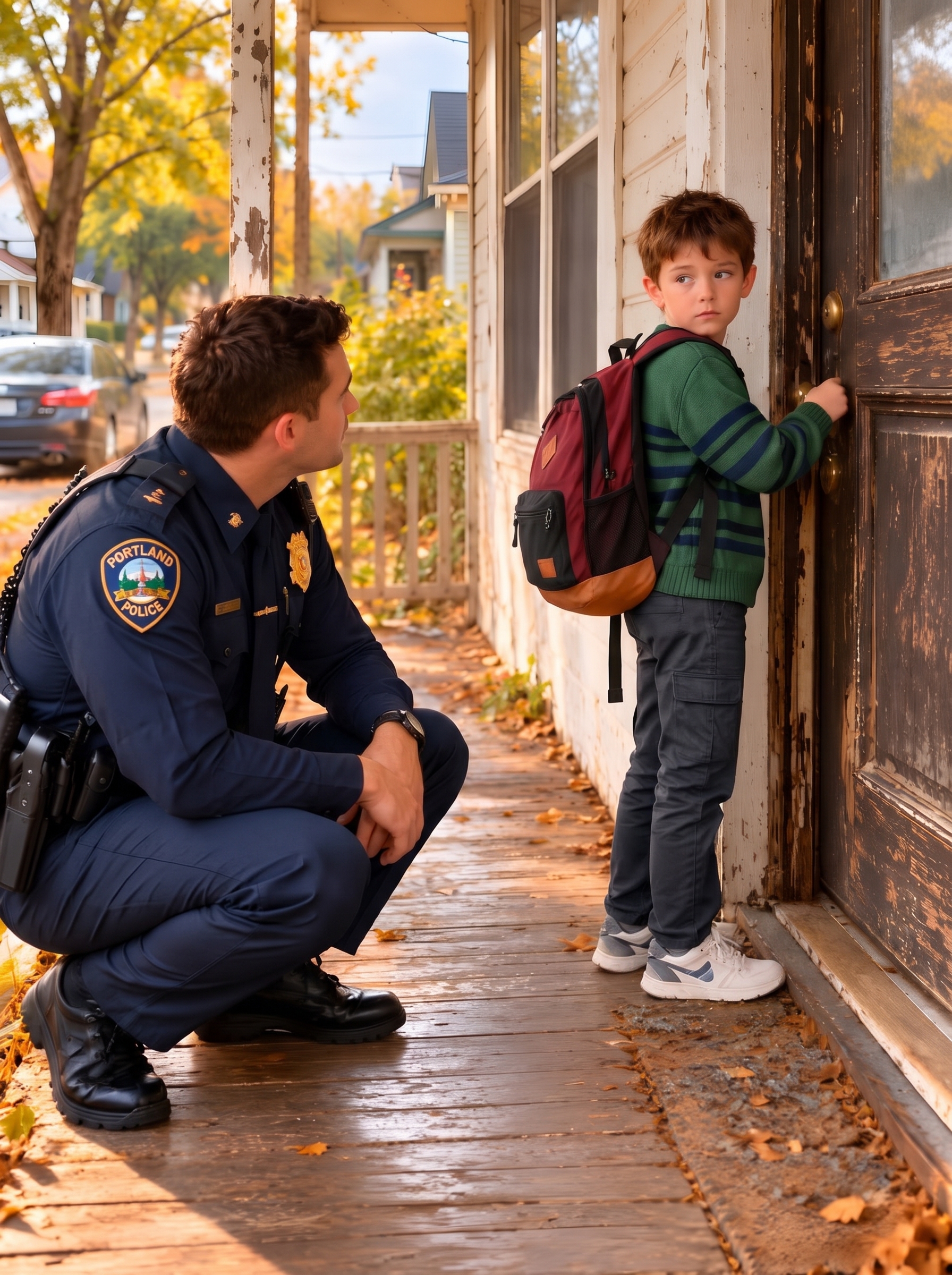
I remembered the porch.
The trembling key.
The promise he’d asked me to make.
And the terrible fear in his eyes.
If I show you what’s inside, you won’t let them make me go back and act like everything is okay… right?
I had promised to listen.
To take him seriously.
To help keep him safe.
And now, a year later, I was watching him ride a bicycle.
I felt my throat tighten.
Sarah noticed.
“You okay?”
I smiled.
“Yeah.”
I looked toward Noah.
“I’m okay.”
A few minutes later, he ran back toward us.
His cheeks were flushed.
His hair stuck to his forehead.
And he was holding a small paper bag.
“Officer Dunham!”
I crouched.
“Yes, buddy?”
He held out the bag.
“This is for you.”
I blinked.
“For me?”
He nodded.
I opened it.
Inside was a small keychain.
A blue plastic star.
On the back, someone had written:
THANK YOU FOR LISTENING.
My eyes filled.
I looked at him.
“Noah…”
He smiled.
“Mommy helped me make it.”
I swallowed.
“It’s beautiful.”
He looked pleased.
Then his expression grew serious.
“Can I tell you something?”
I nodded.
“Anything.”
He glanced toward his mother.
Then back at me.
“You kept your promise.”
My chest tightened.
I crouched a little closer.
“What promise?”
He looked at me.
“The one at my old house.”
I swallowed.
He continued.
“You said you’d listen.”
I nodded.
“And you did.”
Tears slipped down my cheeks.
Noah looked worried.
“Are you sad?”
I laughed softly.
“No, buddy.”
I wiped my face.
“I’m happy.”
He smiled.
“Good.”
Then he leaned forward.
And hugged me.
I held him gently.
For a moment, I remembered how small he’d seemed that first afternoon.
How carefully he’d spoken.
How terrified he’d been that telling the truth would make things worse.
Now he was laughing.
Playing.
Going to school.
Riding a bike.
And learning that he didn’t have to earn love by taking care of everyone else.
I hugged him once more.
Then whispered:
“You were very brave, Noah.”
He pulled back.
And said something I’ll never forget.
“I was scared.”
I nodded.
“I know.”
He looked at me.
“But I asked anyway.”
I smiled through tears.
“Yes, you did.”
He grinned.
Then ran back toward the playground.
I stood slowly.
Watched him go.
And looked down at the little blue star in my hand.
I’d received awards during my career.
Commendations.
Certificates.
Letters from supervisors.
But that small plastic keychain meant more to me than any of them.
Because it reminded me why I’d become a police officer.
Not for the badge.
Not for the authority.
Not for the uniform.
But because sometimes, one frightened person needs another person to listen.
And sometimes, that person is seven years old.
Wearing worn sneakers.
Carrying an oversized backpack.
And trying desperately to protect two little sisters.
I looked toward Noah.
He was laughing so hard he nearly fell over.
Sarah watched him with a smile.
Lily waved her purple balloon.
Emma clapped from her stroller.
And for one beautiful moment, the world felt exactly as it should.
Children being children.
Adults taking responsibility.
And a little boy finally free to enjoy the childhood he’d almost lost.
I clipped the blue star to my keys.
Then whispered to myself:
“That’s what matters.”
Because the most important thing I learned from Noah wasn’t about danger.
It was about courage.
The courage to speak when you’re afraid.
The courage to ask for help when everyone tells you to stay quiet.
And the courage to believe that your life can become different from the one you’ve always known.
Noah didn’t need to become stronger.
He needed adults who would stop asking him to be strong all the time.
And when he finally found the courage to ask for help, the adults around him had a responsibility to answer.
I watched him climb back onto his green bicycle.
He looked over his shoulder.
“OFFICER DUNHAM!”
I waved.
He grinned.
“WATCH ME GO!”
I smiled.
And watched.
Because this time, Noah wasn’t running toward danger.
He wasn’t racing home to cook dinner.
He wasn’t rushing to soothe a crying toddler.
He was simply riding his bike.
With the wind in his hair.
The sun on his face.
And an entire childhood still waiting ahead of him.
THE END