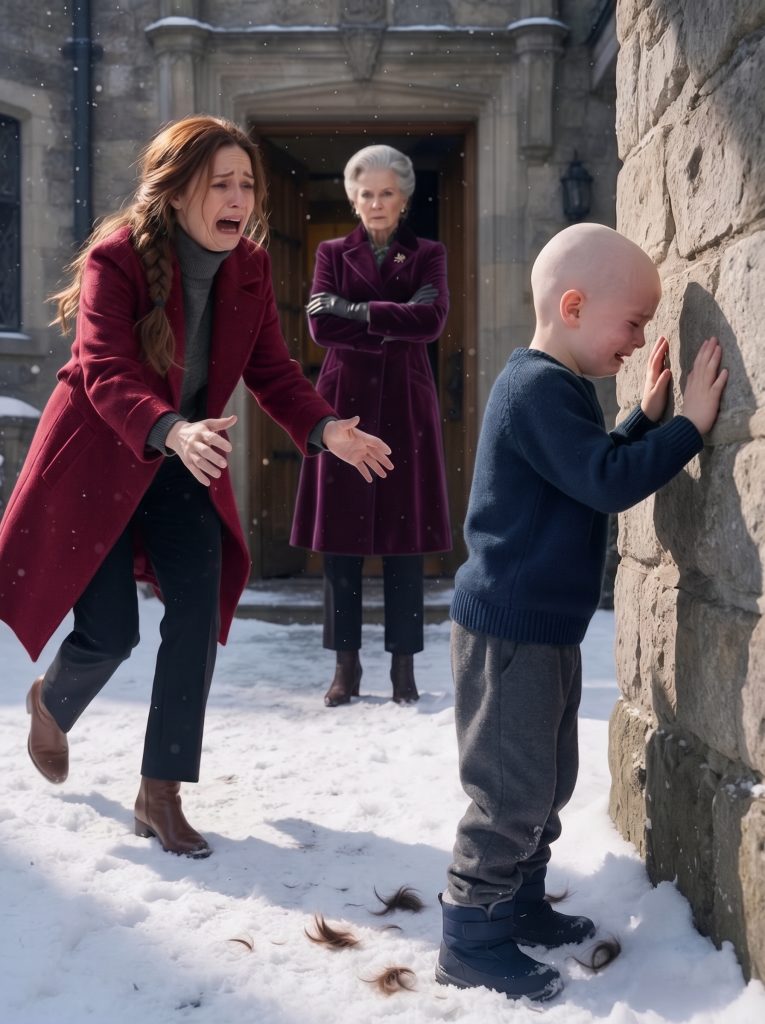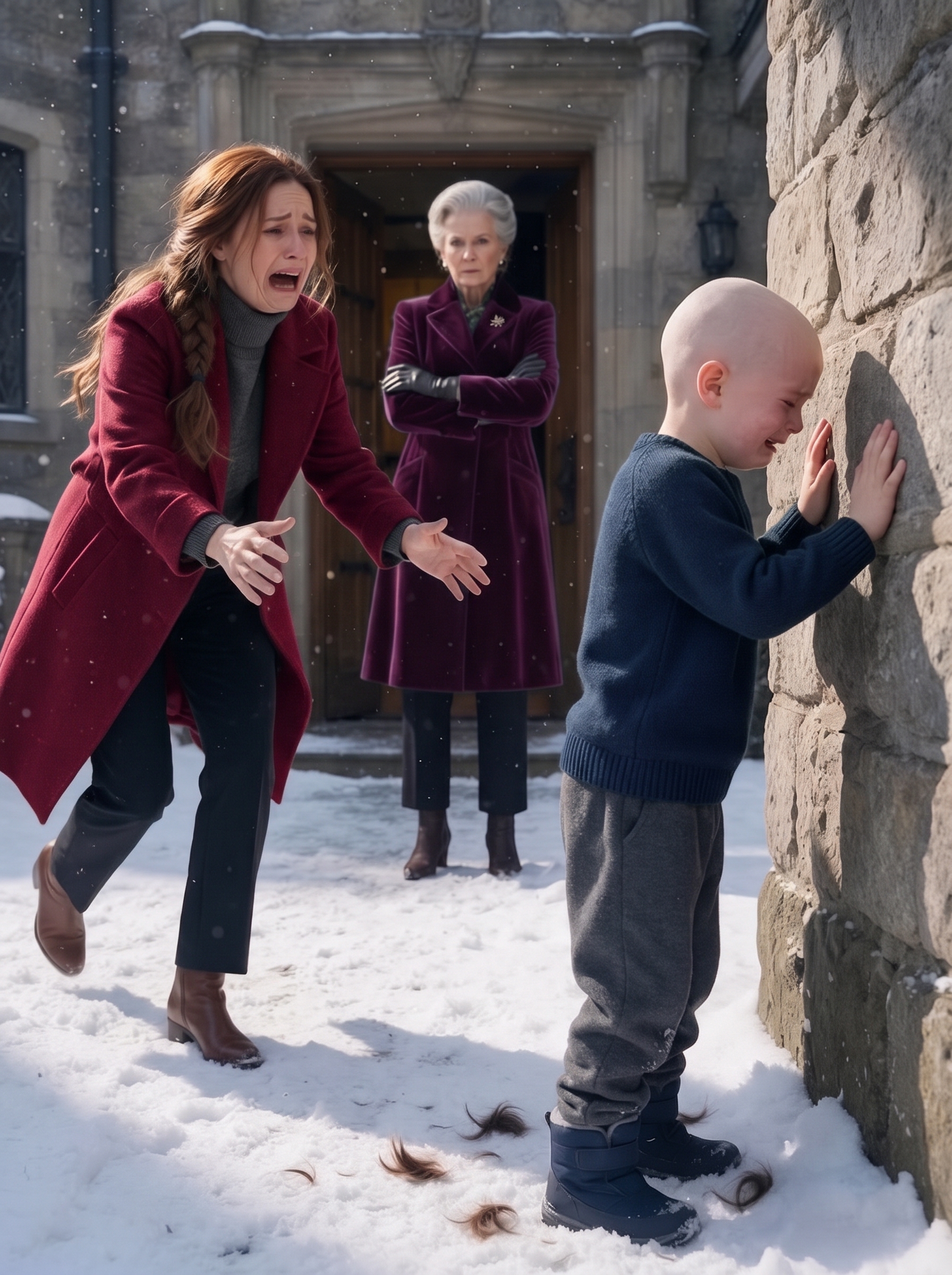
I didn’t argue. I picked up my little boy and left. But that very night, I
turned on the hidden camera in the living room… and discovered
that the real thief had been sleeping under that very roof.
PART 1
“They shave the heads of little thieves so they learn what shame feels like!”
Agnes shouted as I held my three-year-old son, completely bald and shaking with fear.
I had just returned to Columbus after a week-long work trip in Cincinnati.
Every night while I was away, my little Toby had asked if I would bring
back the chocolate teddy bears he loved so much. I walked into the apartment
expecting him to run into my arms, but instead I found him standing on the
balcony, facing the wall, wearing only thin pajamas, his bare head exposed to the cold January air.
“Mommy… I didn’t take anything,” he whispered the moment he saw me.
Something inside me shattered.
My mother-in-law, Agnes, walked out of the kitchen, drying her hands on her apron.
My sister-in-law, Bridget, remained on the couch with her phone in hand. My father-in-law,
Raymond, stood by the dining room smoking as if nothing unusual had happened.
“My gold bracelet disappeared,” Agnes said. “The one my mother left me. Toby was the only one who went into my bedroom.”
“That’s a lie. Toby can’t even reach the drawer where you keep it.”
Bridget let out a little laugh.
“Oh, Vivian, you never really know what children do when their mother isn’t around.
Maybe he saw something shiny and slipped it into his backpack.”
Agnes stepped closer and pointed at my son.
“He takes after you. You came into this family with nothing, and now your son steals from other people.”
Toby buried his face against my neck. I felt his warm tears soaking through my blouse.
“Never call him a thief again,” I said. “And never lay another finger on his hair.”
Raymond crushed out his cigarette.
“Watch your tone. You’re in our house.”
“This isn’t discipline. It’s abuse.”
I never got to finish. Raymond stood up and slapped me so hard that I crashed into the glass door. My lip split open. Toby started screaming.
Agnes didn’t help me. Neither did Bridget. They simply looked down at me as if I deserved it.
Then something strange happened.
I stopped being afraid.
I went into the bedroom, packed our documents, some clothes, my savings card, and Toby’s stuffed bear. When I came back out with a suitcase, Agnes tried to stop me.
“If you walk out that door, don’t ever come back.”
“I certainly hope not.”
My husband, Warren, was working in Indianapolis. I sent him a single message:
“Your father hit me, and your mother shaved Toby’s head over a theft he didn’t commit.”
His reply arrived before I even got into the taxi.
“My mom is very upset. Come back, apologize, and stop making this into a bigger problem. We’re family.”
I blocked his number.
That night, in a modest hotel on the outskirts of town, Toby fell asleep clutching my hand. As I gently stroked his injured scalp, I remembered something I had completely forgotten for almost two years.
Hidden behind a row of books in the living room of that apartment was a small camera I had installed when we hired a nanny.
I opened the app.
And as the recording began to load, I had no idea what I was about to discover…
PART 2
The digital image on my phone screen was quite blurry for a few seconds. Then I clearly recognized the familiar living room, the gray armchair, and the heavy wooden door to Agnes’s bedroom.
I began to fast-forward the footage back three whole days.
At exactly 2:17 p.m., Agnes left the apartment to go grocery shopping. Toby was completely asleep in our bedroom at the time. Bridget carefully checked the empty hallway, put her cell phone down on the wooden table, and walked directly into her mother’s bedroom. Five minutes later, she came out with the gold heirloom bracelet glittering in her hand. She wrapped it tightly in a cloth handkerchief and hid it deep inside her leather purse.
I felt incredibly nauseous watching the betrayal happen before my eyes.
I kept moving the video timeline forward.
When Agnes returned to the apartment and discovered the empty jewelry case, Bridget feigned absolute surprise. Then she pointed her finger directly toward our bedroom door. The recording’s audio was not perfect, but it was clear enough when she spoke Toby’s name to her mother.
Hours later, the horrifying scene that completely devastated my soul unfolded on the screen. Agnes held my screaming son down in a kitchen chair while Bridget tightly immobilized the poor boy’s legs. Toby cried, kicked, and repeatedly begged them that he had not stolen anything at all. The loud electric clippers ran over his beautiful hair again and again until it all fell in clumps to the dirty floor.
I saved the incriminating video files in three different digital places and immediately called my trusted friend Brenda, who worked as a dedicated family lawyer.
Brenda answered on the third ring, her voice thick with the haze of late-night paperwork. “Vivian? It’s nearly one in the morning. Did your flight get delayed?”
“I’m in a motel outside the city,” I whispered, keeping my hand gently rested against Toby’s small, shivering chest. His eyelashes fluttered against his cheeks, damp with dried tears. Even in sleep, his fingers remained clutched tightly around the worn fabric of my sleeve. “Raymond hit me. Agnes and Bridget shaved Toby’s head. They left him out on the balcony in twenty-degree weather because Agnes lost her heirloom bracelet.”
A sharp silence cut through the line, followed by the rustle of sheets and the heavy click of Brenda sitting upright at her desk. “Are you safe right now? Did you call the police?”
“I have footage, Brenda. I need you to listen to me carefully. The living room camera from two years ago was still plugged into the baseboard behind the encyclopedias. I have high-definition video of Bridget walking into Agnes’s room, taking the bracelet, wrapping it up, and slipping it into her bag. And I have… I have the video of what they did to my son.”
My voice finally cracked on the word son, the jagged edges of my composure tearing open. Brenda’s voice turned entirely into steel—the brilliant, uncompromising attorney she was during the day.
“Do not send those clips over unencrypted text,” she ordered, her tone brisk and grounding. “Email the cloud drive links to my firm’s secure portal immediately. First thing tomorrow morning, 7:00 AM, you meet me at the county medical center. We need a documented physical exam for Toby: exposure, hypothermia markers, scalp lacerations, and the psychological assessment. We also need your lip and jaw examined for battery charges against Raymond.”
“What about Warren?” I asked, staring at the muted neon light bleeding through the motel’s thin curtains.
“Warren made his choice the moment he told you to apologize for being assaulted,” Brenda said plainly. “We file for an emergency temporary custody order and an ex parte restraining order by 9:30 AM. When they find out what’s coming, they won’t even have time to invent another lie.”
I didn’t sleep. I sat in that stiff vinyl armchair beside the motel bed, watching the slow, rhythmic rise and fall of Toby’s ribs. Every few hours, his little body would jolt awake with a sudden, frightened whimper. He would reach up blindly to touch his head, find only the prickle of stubble against his tender skin, and begin to sob silently, burying his face into the cheap motel pillow.
“I didn’t touch Grandmas’s box, Mommy,” he mumbled in the dark, his voice hoarse. “I stayed in bed like you said.”
“I know, my brave boy,” I whispered, kissing his temples, feeling the faint, angry red scratches left by Agnes’s dull clippers near his neckline. “Mommy knows everything. You will never have to go back there again.”
At sunrise, I dressed Toby in his warmest woolen sweater, pulling a soft knit beanie gently down over his ears so he wouldn’t have to look in the mirror. We met Brenda at the pediatric urgent care clinic. The attending physician, a quiet woman with kind eyes, took careful, high-resolution photographs of Toby’s irritated scalp, noting two distinct nicked abrasions where the metal clippers had cut into the skin. She documented my split lip, the swelling along my cheekbone, and the deep purple finger marks Raymond had left on my collarbone when he shoved me against the door frame.
By mid-morning, Brenda had assembled an undeniable dossier: medical forensic reports, timestamps matching the cold-weather balcony confinement, and three separate video angles showing Bridget’s theft and the horrific ritual Agnes called discipline.
While Brenda walked into the courthouse to submit the emergency petitions, my phone began to blow up with incoming calls.
It was Warren. He had apparently arrived back in Columbus from Indianapolis, expecting to find me kneeling on the living room rug, begging his mother for forgiveness.
I answered and put the call on speakerphone in Brenda’s conference room.
“Vivian, what the hell is wrong with you?” Warren’s voice boomed through the speaker, frantic and irritated. “My mother has been crying for five hours! My dad’s blood pressure is through the roof, and Bridget says you made a scene that terrified the entire neighborhood! Where are you? Bring Toby home right now!”
“Toby isn’t your son to bargain with anymore, Warren,” I said, my tone colder than the January morning outside. “Did you ask your father why my face is bruised? Did you ask your mother why she sheared off our child’s hair like an animal?”
“They were disciplining him!” Warren shouted, defensive and blind as he had always been to his family’s cruelty. “He’s three! You spoil him, you let him run wild, and now he’s stealing jewelry that belonged to my grandmother! A little tough love isn’t abuse, Vivian. My mom raised three kids that way, and we turned out fine. You’re overreacting because your pride is hurt. Get your things, bring Toby back, and tell my mother you’re sorry. If you don’t, I swear to God I will file for full custody and leave you with nothing.”
I listened to him, feeling an overwhelming, liberating sense of finality. For four years, I had excused his spinelessness as filial loyalty. I had forgiven his mother’s sneers, his sister’s snide remarks about my modest background, and his father’s casual violence, all because I wanted my son to grow up in a complete family.
“You won’t have to file for anything, Warren,” I replied evenly. “And you won’t need to look for your mother’s bracelet in Toby’s toy chest. Check Bridget’s leather shoulder bag. Or better yet, check the pawn shop on Broad Street where she usually goes when she owes money to her credit card companies.”
There was a sudden, confused pause on the other end. “What are you talking about?”
“Check your email,” I said, and ended the call.
Brenda walked through the double doors of the office fifteen minutes later, holding a stamped blue folder. “The judge signed the emergency temporary restraining order against Raymond, Agnes, and Bridget. They are barred from coming within five hundred yards of you and Toby. The court has also granted you sole temporary physical and legal custody pending our full hearing next month.”
“And the police?”
“Detective Miller from the domestic violence unit is already reviewing the footage,” Brenda said, offering me a warm, grim smile. “Child endangerment, assault on a minor, battery against you, and grand larceny for Bridget. It’s out of our hands now, Vivian. The state takes over from here.”
THE FINAL SETTLEMENT
The confrontation did not happen in private.
Two days later, Detective Miller, accompanied by two uniformed officers, knocked on the door of the apartment in Columbus. Thanks to the shared building entryway and the sudden presence of patrol cars, several neighbors stood in the hallway, watching.
According to the police report Brenda received later that afternoon, Agnes had opened the door with her customary arrogance, barking that the police had no business knocking on an honest family’s home. She began spouting the narrative she had practiced: that her ungrateful daughter-in-law had abandoned the family and kidnapped her grandchild after the boy was caught stealing valuable jewelry.
Detective Miller didn’t even argue. He simply produced the search warrant and the arrest warrants.
“Ma’am, we aren’t here about your grandson,” Miller told her calmly. “We are here for Bridget Cole for grand larceny, Raymond Cole for domestic battery, and both you and Bridget for felony child endangerment.”
Bridget, who had been sitting in the dining room smoking one of Raymond’s cigarettes, went pale as chalk. She tried to dart down the hallway toward the back bathroom, clutch in hand, but an officer intercepted her in the corridor. When they opened her purse right there on the credenza, wrapped in the exact red-and-white handkerchief shown in the surveillance footage, was Agnes’s mother’s gold heirloom bracelet.
Agnes stared at the bracelet, her mouth opening and closing like a fish pulled from water. “Bridget? How… why is that in your bag?”
Bridget immediately began screaming, pointing fingers, sobbing that she only took it because she was behind on her car payments and that Agnes had plenty of jewelry anyway. She shrieked that she hadn’t meant for Toby to take the blame, that she only mentioned his name so their mother wouldn’t look at her.
The illusion of their respectable, united family shattered into ugly, screeching accusations right in front of the arresting officers.
Raymond tried to push past the officers to grab Bridget’s purse, shouting obscenities, but was immediately forced against the wall and handcuffed. By noon, mugshots of Raymond, Agnes, and Bridget were logged into the Franklin County system.
Warren attempted to call me dozens of times from the courthouse steps. When I refused to pick up, he began sending frantic, groveling voice notes.
“Vivian, please, I didn’t know!” he pleaded, his voice cracking with panic. “I swear to God I didn’t know Bridget took the bracelet! My mom was just confused, she’s an old woman, she didn’t mean to hurt Toby! My dad is sixty-two, he can’t survive in jail! Please, drop the charges! Talk to the prosecutor! If they go to prison, my family’s name will be ruined! What about our marriage? We can move! We can go somewhere else, just the three of us!”
I listened to the voice note once, then forwarded it directly to Brenda’s legal file.
Warren had never cared that his son had been terrorized. He had never cared that his wife had been struck across the face. His panic was born solely out of embarrassment, the sudden realization that the comfortable pedestal his family sat upon had crumbled into public disgrace.
Six weeks later, we stood in the county family court for the permanent custody and divorce hearing.
Agnes arrived looking ten years older, her silver hair unkempt, wearing a drab wool coat instead of her usual pristine blouses. Raymond sat beside their appointed attorney with a sullen, downcast stare, his bail conditions strictly forbidding him from speaking to or looking at me. Bridget was not present; she was currently being held on separate probation violation charges related to pawning stolen property.
Warren sat at the petitioner’s table, looking disheveled, bags under his eyes. When I walked in wearing a clean navy suit, holding my head high, he tried to catch my gaze, mouthing, Vivian, please.
I walked past him as if he were made of air.
Brenda presented our case with surgical precision. The surveillance video was played on the courtroom monitors. The sound of Toby’s terrified, childish screams as Agnes forced him into the chair echoed off the wood paneling, filling the room with an unbearable, sickening truth.
The judge, a seasoned family court magistrate named Judge Martinez, watched the screen with an expression of cold disgust. When the clip ended, the courtroom remained dead silent except for Agnes’s quiet, self-pitying sniffles.
“In my twenty-four years on this bench,” Judge Martinez said, her gaze cutting down at Warren and his parents, “I have rarely seen such callous, unprovoked cruelty disguised as family discipline. To punish a three-year-old child for a crime committed by a grown adult—to strip him of his dignity, to subject him to physical mutilation and winter exposure—is unconscionable. And for you, Mr. Cole,” she turned her icy stare directly onto Warren, “to demand that your victimized wife apologize for the brutalization of her child demonstrates a complete abdication of your duties as a father and a spouse.”
The ruling was total and decisive.
I was awarded sole physical and legal custody of Toby, with zero visitation rights granted to Agnes, Raymond, or Bridget under any circumstances. Warren was granted only supervised visitation once a month at an approved state facility, contingent upon his completion of anger management and child welfare courses—a privilege he would have to pay for out of pocket.
The judge ordered the immediate division of our marital assets, awarding me the entirety of our joint savings account, our primary vehicle, and substantial child support garnished directly from Warren’s engineering salary. In addition, the court ordered Warren to pay all of my legal fees.
Outside the courtroom, Agnes broke down completely. She shuffled toward me, tears streaming down her wrinkled cheeks, trying to reach out a trembling hand.
“Vivian… please,” she whimpered, her arrogant veneer entirely gone. “He’s my only grandson. You can’t cut me out of his life. I made a mistake. I thought… I thought he had taken it. I was just trying to teach him right from wrong.”
I stopped and looked down at her.
“You didn’t want to teach him right from wrong, Agnes,” I said, my voice quiet, firm, and steady. “You wanted someone weak to blame, someone you could control because you hated that he came from me. You shaved his head so he would feel shame. But the only shame left in this family belongs entirely to you.”
She pulled her hand back as if she had been burned, weeping into her handkerchief as Raymond steered her away toward the elevators, muttering under his breath.
Warren stood near the marble pillars, his shoulders slumped, watching everything he took for granted vanish down the hallway.
“Vivian,” he said, his voice barely a rasp. “Is there really nothing left? Can we ever fix this?”
“There was nothing left the second you hit send on that text message, Warren,” I replied. “Goodbye.”
I walked out of the courthouse into the crisp afternoon air. The winter wind was still cold, but the sky above was a brilliant, cloudless blue.
Three months later, Toby and I were settled into our new townhouse in Dayton, two hours away from Columbus. The living room was bright and flooded with sunlight, filled with colorful rugs, shelves of picture books, and Toby’s toy trains spread neatly across the floor.
His hair had grown back into thick, dark, soft curls.
Every evening before bed, we had a new ritual. Toby would sit on the edge of his bed in his pajamas, and I would gently brush his hair with a soft-bristled brush, humming the lullabies my own mother had taught me. He no longer woke up crying in the middle of the night. He no longer looked at doors with wide, terrified eyes.
“Look, Mommy,” Toby said that night, pointing to his reflection in the oval mirror hanging beside his bookshelf. He ran his chubby little fingers through his curls, a bright, triumphant smile spreading across his face. “It’s all back.”
I leaned down, wrapped my arms around his shoulders, and kissed the top of his head.
“It is, my sweet boy,” I said, resting my chin against his cheek. “It’s all back. And no one will ever touch a single strand of it again.”
The Unraveling
The townhouse in Dayton was quiet in a way I hadn’t experienced in years.
For four years, my life had been soundtracked by the low-frequency hum of perpetual tension—the sharp clinking of silverware at Sunday dinners, Agnes’s passive-aggressive comments about my cooking or my career, Raymond’s booming, authoritative lectures, and Warren’s constant, desperate pleas for me to “just keep the peace.”
Now, the only sound was the gentle clack-clack-clack of Toby’s wooden train tracks as he pushed an engine around a brightly painted track in the living room. Sunlight streamed through the floor-to-ceiling windows, highlighting tiny specks of dust suspended in the warm, still air.
Toby stopped his train and looked up at me from the rug. His dark curls were long enough now to flop forward over his forehead when he tilted his head.
“Mommy? Do we go to Grandma’s house on Sunday?” he asked, his voice hesitant, carrying a trace of the old anxiety that used to consume him whenever the weekend approached.
I knelt on the floor beside him, tucking a curl behind his ear. I looked into his clear, dark eyes—eyes that no longer held the haunted, wide-eyed terror of that horrific winter morning.
“No, sweet boy,” I said softly, keeping my tone light and absolute. “We don’t go there anymore. Sunday is our day. We’re going to the park, and then we’re going to bake banana bread.”
A slow, tentative smile blossomed across his face. “Just us?”
“Just us.”
He let out a contented little breath and returned to his train set. Watchful, steady, but no longer afraid.
While Toby played, I sat at the kitchen counter with my laptop, opening a folder labeled Legal Finalization & Asset Division. Brenda had been relentless. In the weeks following our court date, she had pursued every avenue of financial recovery available to us.
Because the court had determined Warren’s actions constituted gross spousal neglect and child endangerment accomplice behavior, the financial settlement was far more favorable than a standard 50/50 split.
I received the entirety of our joint liquid savings—roughly $85,000—which served as a strong safety net while I established my new routine. The house in Columbus, which had been purchased with a down payment drawn primarily from my pre-marital savings, was ordered to be sold, with 70% of the net equity designated for me and placed into a secure trust for Toby’s education.
Warren had been furious when his attorney called to explain the court’s decree, but he had no leverage. He was facing direct earnings garnishment for child support, tied directly to his Senior Systems Engineer salary at the aerospace firm where he worked.
I opened my email to find a message from Brenda, forwarded from the Franklin County Prosecutor’s office. It contained an update on the criminal proceedings against the rest of the Cole family.
Agnes had pleaded guilty to misdemeanor child endangerment and filing a false police report. Given her age and lack of a prior criminal record, the judge suspended her prison sentence, placing her on two years of strict probation. She was required to complete 100 hours of community service and submit to a mandatory psychological evaluation.
The social humiliation, however, was far more devastating to Agnes than any court sentence.
Word of the incident had spread through her country club, her church circle, and her suburban neighborhood like wildfire. The local crime beat had published the mugshots of the three family members side by side: Agnes, disheveled and wild-eyed; Raymond, red-faced and glaring; and Bridget, pale and smirking.
Agnes’s carefully cultivated image of upper-middle-class matriarchal respectability was utterly obliterated. Former friends stopped inviting her to bridge games. Her position on the neighborhood garden board was quietly revoked. She had become a pariah in the very community she had spent thirty years trying to impress.
Raymond’s situation was significantly worse. His history of temper, combined with the clear surveillance evidence of him violently pinning me and grabbing my wrist, resulted in a conviction for domestic battery.
The court gave him six months of home confinement with an electronic ankle monitor, alongside mandatory domestic violence intervention classes. The physical reality of his confinement meant he could not leave his house except for medical emergencies and court appointments. The proud, domineering man who had spent decades lording over his household was now confined to his living room, under the constant surveillance of the state.
As for Bridget, her legal troubles were the most acute. The heirloom bracelet wasn’t the only thing she had stolen. The police search of her apartment uncovered multiple pawn shop receipts for jewelry, electronics, and high-end outerwear stolen from acquaintances and small local boutiques.
Combined with her existing probation for a prior drug possession charge, the grand larceny charge stuck. She was sentenced to eighteen months in a state correctional facility.
I closed the laptop screen. There was no joy in reading these details—only a profound, cold sense of closure. They had reaped exactly what they had sown. They had used their power, their collective status, and their physical size to intimidate a child and bully a mother. Now, the cold weight of the law had laid them bare.
My phone buzzed on the counter. It was a text from an unknown number.
I opened it.
Vivian, please. It’s Warren. I’m using a work phone. The court says I can start my supervised visits next month at the center in Dayton. Please, can we talk before then? Just ten minutes. I need to explain things to you. I’m doing the classes. I’m taking the anger management modules. I want to show you I’m changing.
I stared at the screen for a moment. Four months ago, a message like this would have sent a wave of panic through my chest. It would have triggered an instinct to explain, to argue, to try and make him understand the depth of the horror he had allowed.
Now, I felt nothing. No anger, no resentment, no pity.
I took a screenshot of the text message, forwarded it directly to Brenda’s email address with the note Violation of no-contact order via work line, and then blocked the number.
The System of Control
Two weeks later, the day arrived for Warren’s first supervised visitation with Toby at the Family Support Center in downtown Dayton.
The facility was a clinical, brick building designed specifically for safe, court-monitored interactions. Inside, the walls were painted a cheerful yellow, decorated with colorful posters of animals and educational charts, but the heavy metal doors, security cameras in every corner, and armed guards at the check-in desk served as a stark reminder of why people were there.
I sat in the waiting area, holding Toby’s small hand in mine. He had a small coloring book in his lap, meticulously filling in the lines of a race car with a red crayon.
“Remember, Toby,” I said softly, leaning down to his level. “You’re going to play in the big room with some toys for one hour. There will be a nice lady in the room named Miss Sarah. Daddy will be there, too. If you ever feel uncomfortable, or if you want to come back to Mommy, you just tell Miss Sarah, okay?”
Toby looked up, his brow furrowing slightly. “Is Grandma going to be there?”
“No,” I assured him, holding his gaze. “Grandma is never, ever going to be there. Only Daddy, and Miss Sarah will be watching the whole time.”
He nodded, reassured, and went back to his coloring.
A few minutes later, the social worker, Miss Sarah—a calm, professional woman in her late thirties—stepped into the waiting room.
“Vivian? Toby?” she called out with a warm smile. “We’re ready for you.”
I stood up and walked Toby to the door of the visitation room. As the door swung open, I saw Warren sitting at a low child-sized table in the center of the room.
He looked terrible. He had lost at least fifteen pounds, his shoulders were slumped, and his clothes hung loosely on his frame. His hair was overgrown and unstyled, and deep dark circles bruised the skin beneath his eyes.
When his eyes met mine, his face crumpled with a mixture of desperate relief and intense sorrow. He half-stood from his chair, reaching out a hand. “Vivian—”
“Mr. Cole,” Miss Sarah interrupted instantly, her voice crisp and authoritative. “You know the rules of this facility. You are not permitted to address Ms. Vance. Your interaction today is strictly limited to your child.”
Warren swallowed hard, his face flushing red with embarrassment as he slowly sat back down. “Right. Sorry. I’m sorry.”
I didn’t say a word. I knelt, gave Toby a quick kiss on the cheek, and whispered, “Have fun, sweetie. I’ll be right outside.”
I stepped back out into the waiting room, taking a seat where I could view the room through the one-way observation window set high in the wall.
For the next fifty minutes, I watched the interaction unfold.
It was painful to observe, not because I felt sympathy for Warren, but because it exposed the complete absence of a real father-son bond between them. For years, Warren had left all actual parenting to me, viewing Toby primarily as an accessory to his family’s legacy—a grandchild to be presented to Agnes on weekends, a prop in their family photos.
Warren didn’t know how to play with his own son. He tried to force Toby to build a wooden block tower, taking the blocks out of Toby’s hands when the boy tried to line them up by color.
“No, Toby, look, we build it high like this,” Warren said, his voice carrying clearly through the monitoring speaker in the waiting room. “See? You have to build it big.”
Toby shrank back slightly, his hands pulling into his lap. He didn’t cry, but he became quiet and withdrawn, watching Warren build the tower alone.
“Toby, don’t you want to play with Daddy?” Warren pleaded, his voice tinged with the familiar, subtle irritation he always displayed whenever things didn’t go according to his script. “Look at the tower! Look how high it is!”
“Mr. Cole,” Miss Sarah’s voice rang out quietly from her corner desk. “Let Toby lead the play. Follow his interest.”
Warren stopped, his hands hovering over the blocks. He looked over at Miss Sarah, his jaw tightening. For a fraction of a second, I saw the old Warren—the man who believed his authority should never be questioned, the man who had stood by while his mother humiliated his son and hit his wife.
He wanted to argue. He wanted to demand that he be respected as the father. But the presence of the officer by the door and the supervisor’s clipboard kept him tethered.
He let out a heavy sigh, knocked down the tower, and sat back, looking defeated. “Okay, Toby. What do you want to do?”
Toby picked up a small blue train and quietly rolled it back and forth along the edge of the rug. He didn’t look at Warren.
When the hour ended, Miss Sarah called time. Warren stood up quickly, stepping toward Toby. “Give Daddy a big hug, buddy,” he begged, reaching down to pull the boy up.
Toby stiffened, leaning his body away from Warren’s arms. He didn’t reach back.
“Okay, buddy… next month, then,” Warren whispered, his voice cracking as he released him.
Miss Sarah escorted Toby out to the waiting room. Toby ran straight to me, wrapping his small arms around my legs. I picked him up, holding him tight against my chest.
As we turned to walk toward the exit, Warren stepped out into the hallway, ignoring Miss Sarah’s warning gesture.
“Vivian!” he called out, his voice desperate, echoing down the tiled corridor. “Please! Just look at me! I lost my house! I’m living in an apartment near the highway! My mother can barely leave her house without people staring at her! My father won’t even talk to me because of the legal bills! Haven’t you punished us enough?”
I stopped. I turned around slowly, holding Toby firmly in my arms.
The security guard stepped forward, putting a stern hand on Warren’s shoulder, but I held up a hand to indicate I didn’t need intervention.
“Punished you?” I asked, my voice calm, clear, and utterly devoid of emotion. “You think this is a punishment, Warren? This is just accountability. You spent four years letting your family tear me down, and the moment they turned their cruelty on your son, you asked me to accept it. You didn’t care about Toby’s pain. You only care about your own comfort.”
“I was trying to keep my family together!” he yelled, tears finally spilling over his eyelids.
“No,” I replied, turning back toward the glass exit doors. “You were keeping your family happy at the expense of your wife and child. But we aren’t your victims anymore. We’re gone.”
I walked out into the afternoon sun, the heavy glass doors sliding shut behind us, cutting off his desperate calls once and for all.
Rebuilding from the Ashes
Six months passed.
Spring bloomed into summer in Dayton, bringing long, warm days filled with trips to the local splash pad, afternoon visits to the public library, and quiet evenings on our back patio.
I had secured a full-time position as a senior project manager at a reputable tech firm in downtown Dayton. The work was engaging, the pay was competitive, and for the first time in my professional life, I wasn’t carrying the silent, crushing weight of domestic dread into the office every morning. My colleagues knew me as a sharp, capable, independent woman—not the meek, anxious wife who was constantly checking her phone for angry texts from her husband or mother-in-law.
Toby had transformed entirely.
He was enrolled in a wonderful local preschool where his teachers raved about his kindness, his intelligence, and his creativity. His hair had grown out into a thick, glossy mop of dark brown curls that framed his bright, chubby face. He laughed easily now. He ran without hesitation. He spoke up when he wanted something, no longer flinching if a toy dropped or if a door slammed shut.
One Saturday afternoon in late July, Brenda called me.
“Hi, Vivian,” she said, her voice warm. “I just wanted to give you a quick administrative update on the case file. All the property sales have cleared. The net proceeds from the house in Columbus—$210,000—have been successfully transferred into the restricted trust account for Toby. The court-ordered legal fee reimbursement from Warren has been paid in full.”
“Thank you, Brenda,” I said, leaning back against the kitchen counter, watching Toby color at the dining table. “For everything. I don’t know where we would be if you hadn’t taken my case that morning.”
“You did the hard part, Vivian,” Brenda said softly. “You walked out. Most people stay far too long because they’re terrified of the storm. You faced the storm to protect your boy.”
She paused, then added in a more businesslike tone, “I should let you know… Warren’s attorney filed a motion last week requesting an increase in his visitation rights—specifically asking for unmonitored weekend visits.”
My grip on the phone tightened slightly, but the old surge of paralyzing fear didn’t come. “What happened?”
“The judge rejected it outright,” Brenda replied with a light chuckle. “Judge Martinez reviewed his compliance records. Warren completed his required anger management course, but his supervisor at the visitation center submitted a detailed report noting that Mr. Cole consistently exhibits low engagement, becomes easily frustrated when the child does not follow his directions, and continues to express zero genuine remorse for the underlying child endangerment charges. The judge ruled that supervised visits will remain at once a month, indefinitely.”
A wave of calm washed over me. “Good.”
“How is Toby doing?” Brenda asked.
“He’s wonderful,” I said, looking over at my son. “He’s completely healed.”
After I hung up the phone, I joined Toby at the table. He was drawing a picture of a house with a huge tree in the front yard and three figures standing under the sun: himself, me, and our neighbor’s golden retriever, Barnaby, who always greeted us at the fence.
“Look, Mommy,” he said proudly, shoving the paper toward me. “It’s our house.”
I looked at the drawing. There were no dark colors, no frantic scribbles. Just bright yellows, blues, and greens.
“It’s beautiful, Toby,” I said, kissing his forehead. “It’s perfect.”
That evening, as I was tucking him into bed, he held up his small hand and gently tugged on a lock of my hair, then touched his own curls.
“Mommy?” he whispered, his voice sleepy.
“Yes, my love?”
“My hair is soft now.”
My throat tightened, a lump of old emotion surfacing for just a moment before dissolving into deep, unshakable peace.
“It is, sweetie,” I murmured, smoothing the curls away from his forehead. “It’s soft, and it’s strong. Just like you.”
“Nobody can cut it, right?”
“Nobody,” I said firmly, looking him straight in the eyes so he would know the absolute truth of it. “Never again. I will always, always protect you.”
He let out a tiny sigh, closed his eyes, and within minutes, his breathing slowed into the deep, rhythmic rhythm of peaceful sleep.
The Final Horizon
A year after that terrible winter morning, I stood on the back deck of our townhouse, watching the sun set over the Ohio hills.
The sky was painted in brilliant ribbons of orange, pink, and deep violet. The air was soft and warm, carrying the scent of cut grass and blooming honeysuckle.
In my hand, I held a small paper envelope that had arrived in the mail that afternoon. It was from the county court clerk—the final, official Decree of Dissolution of Marriage.
It was over. Legally, structurally, and emotionally.
The name Cole was completely gone from my life. I had legally restored my maiden name, Vivian Vance, and had updated Toby’s surname to Vance as well, ensuring that the legacy of cruelty, control, and entitlement that the Cole family carried would never attach itself to my son’s future.
From what I had heard through mutual acquaintances who still lived in Columbus, the Cole family had scattered into total irrelevance.
Raymond’s health had deteriorated significantly during his house arrest; he spent his days isolated in his home, bitter and forgotten by the community that once feared his loud voice.
Agnes had become a recluse, rarely leaving her house except under the cover of dusk to tend to her lawn, her once-obsessive social standing reduced to an agonizing memory of public shame.
Bridget was serving out her sentence at the Ohio Reformatory for Women, her hopes of a quick release dashed by her inability to adhere to prison regulations.
And Warren remained trapped in his low-rent apartment, alienated from his parents—who blamed him for letting me “destroy” their family—and distant from his son, who viewed his monthly one-hour visits not as a connection to a father, but as a mandatory routine with a quiet stranger.
Warren had tried once, six months prior, to send a long, written letter through his legal counsel, begging for forgiveness and asking if we could ever be friends.
I hadn’t even read past the first page. I handed it to my lawyer, who filed it away without a response.
Some broken things are not meant to be repaired. Some relationships are not meant to be saved. When someone shows you that they are willing to sacrifice your child’s dignity and safety to preserve their own status, the only moral response is absolute, permanent removal.
“Mommy! Look!”
Toby’s voice broke through my thoughts. He came running out onto the deck, wearing his favorite blue pajamas, holding up a small plastic container. Inside, a tiny firefly flickered with a warm, yellow light.
“I caught one!” he gasped, his eyes sparkling with pure, unadulterated joy. “Look how bright it is!”
I crouched down beside him, looking into the container. The tiny light blinked once, twice, glowing softly against the darkening evening.
“It’s beautiful, Toby,” I said softly. “Now what should we do with it?”
Toby looked down at the insect, then up at the vast, dark sky above us. He didn’t hesitate.
“We should let it go,” he said simply. “So it can fly home.”
He carefully unscrewed the plastic lid and tipped the container. The firefly hovered for a second on the rim, then took flight, drifting up into the summer air, its tiny light rising higher and higher until it merged with the faint glow of the evening stars.
Toby leaned against my shoulder, watching it go. I wrapped my arms around him, pulling him close against my chest.
I remembered the cold, terrifying morning when I had walked into that brightly lit kitchen in Columbus, seeing my baby boy sitting stripped and humiliated in a wooden chair, his beautiful hair lying in clumps on the floor while three adults stood over him, demanding compliance.
I remembered the overwhelming terror that had threatened to freeze me in place—and the sudden, roaring fire of motherly instinct that had driven me to snatch him up, take the blow to my face, and walk out into the freezing air without looking back.
That terrible day had broken my life into pieces. But standing here now, with the cool night breeze on my face and my healthy, happy son resting safely in my arms, I knew that breaking had been a blessing.
The pieces had not been put back together to rebuild the old life. They had been used to build something entirely new—a life built on unconditional love, fierce protection, absolute respect, and unyielding strength.
“Time for bed, my big boy,” I whispered, kissing his curls.
“Okay, Mommy,” he said, turning and taking my hand as we stepped back inside the warm, bright house.
I closed the door behind us, locking it firmly against the night. We were safe. We were whole. And the future was entirely ours.
THE END..!