I smiled, picked up my duffel bag, and left, because before they moved in, I had already turned their dream home into the beginning of their worst nightmare.
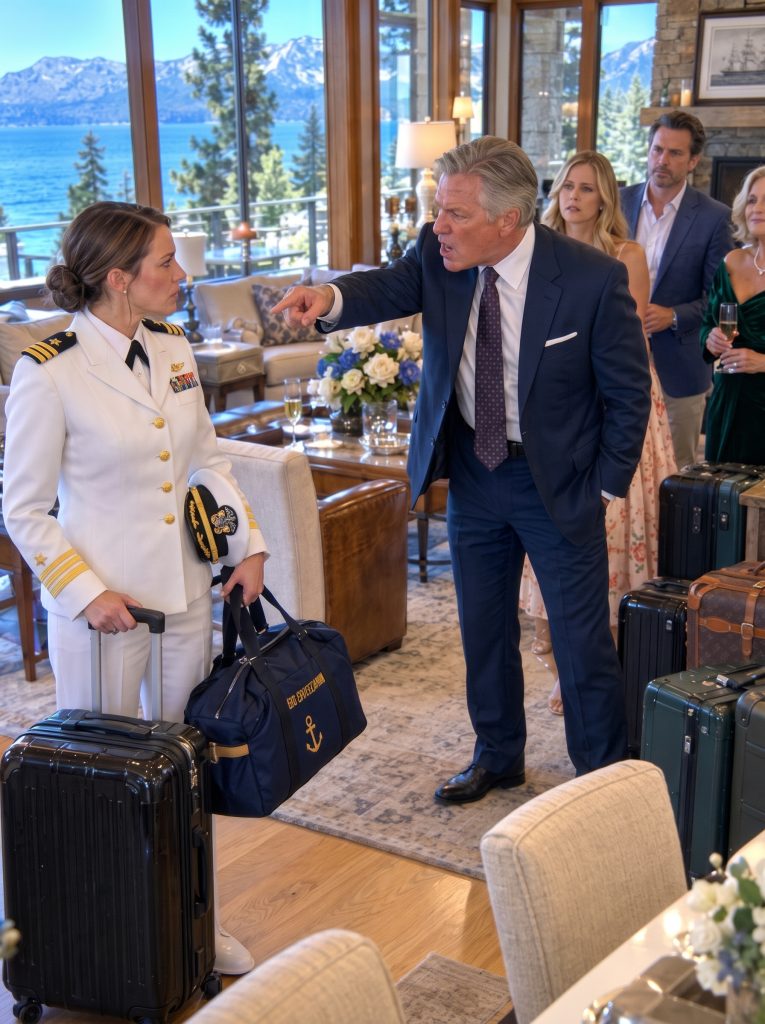
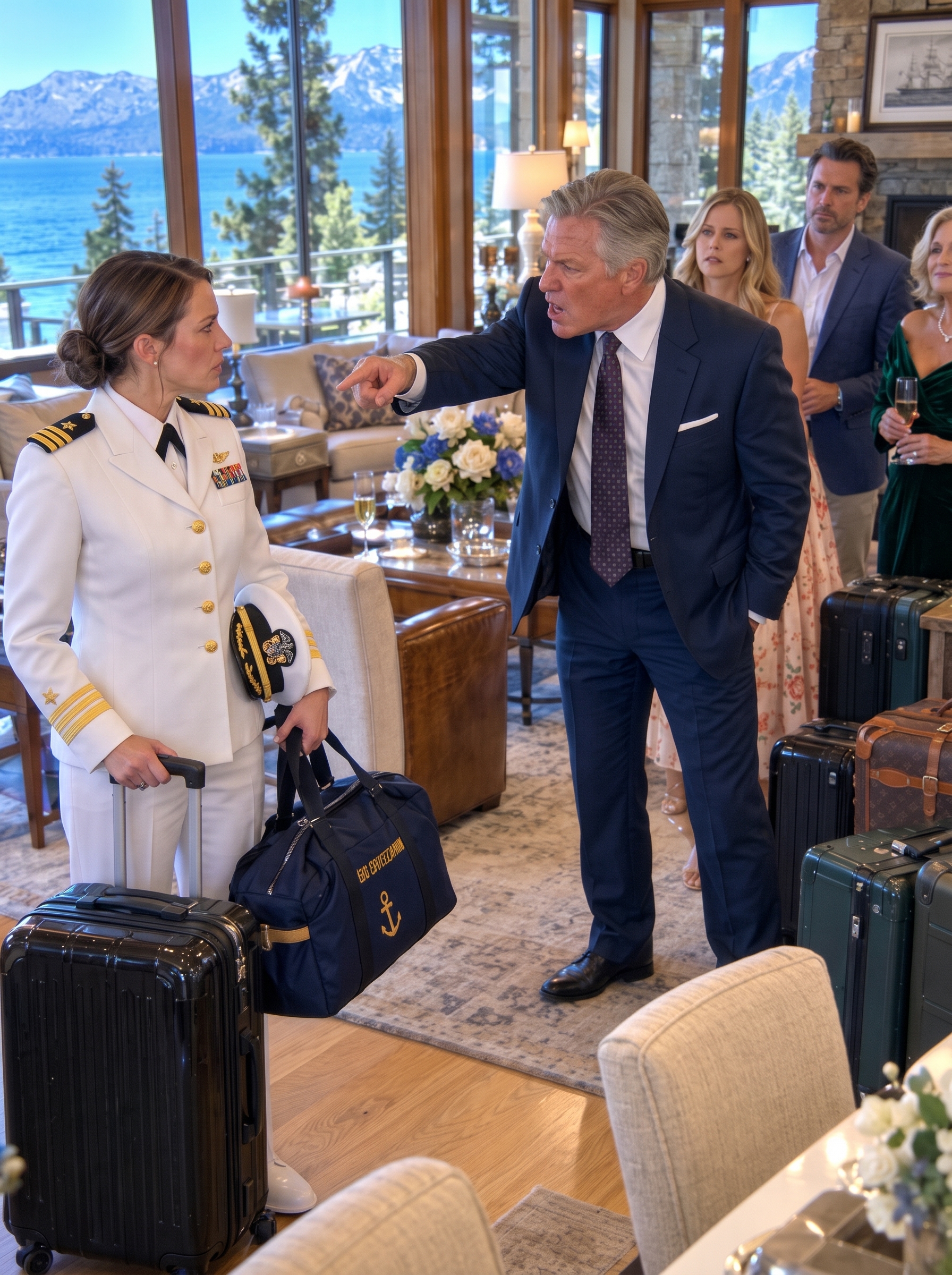
The champagne cork burst above me just as my military duffel bag landed on the marble floor.
I had driven straight to Lake Tahoe after three sleepless weeks of naval exercises, still in uniform, my shoulders aching and my eyes burning from exhaustion.
I had expected silence.
A hot shower.
One peaceful night in the only place that had ever truly felt like mine.
Instead, I found my father and my sister Olivia standing on my rooftop terrace, raising crystal glasses beneath the evening sun.
Suitcases were already stacked beside the front door.
My stepmother Susan was showing Olivia through the kitchen.
Olivia’s husband, David, was measuring the living-room wall and discussing where they would mount their television.
For one confused second, I wondered if I had entered the wrong house.
Then Dad looked down at me from the terrace.
“Good. You’re here.”
“What is going on?” I asked.
He slowly came down the stairs, wearing the expression of a man about to announce a decision he believed nobody had the right to challenge.
“This villa is too big for one person,” he said. “Olivia has a husband and children. They need it more than you do.”
I stared at him.
“This is my house.”
His mouth twisted into a sneer.
“You live on a military base. The government gives you food, housing, and everything else you need.”
He pointed at my uniform.
“Go back to your base, Commander. This belongs to your sister’s family now. You’re no longer welcome here.”
Olivia raised her champagne glass.
She did not look ashamed.
She looked victorious.
My fingers loosened around the handle of my duffel bag.
It dropped with a heavy thud.
That sound seemed to carry every sacrifice I had made for them over fifteen years.
The $35,000 SUV I bought Olivia because she and David claimed public transportation was beneath them.
The $25,000 I wired from overseas after Dad called during a restricted operation and said gambling creditors were threatening him.
The $50,000 I handed over three weeks after burying my husband, James, because Dad claimed the bank was about to take the family home.
More than $110,000.
I had worked through deployments, sleepless nights, dangerous territories, and military investigations to protect them.
They had never asked whether I was safe.
They only asked when the next payment would arrive.
And now they were standing inside the home I had bought with what remained of my savings, celebrating as if my life were simply another family asset Dad had the authority to hand away.
“You gave them my villa?” I asked.
Dad crossed his arms.
“I made the right decision for this family.”
“You cannot give away something you do not own.”
His laugh was short and contemptuous.
“Do not start talking to me like one of your sailors. I’m your father.”
Olivia stepped closer, her expensive sunglasses resting on top of her head.
“Lauren, don’t make this ugly. You’re barely here. We’ll actually use the place.”
David nodded from behind her.
“The kids deserve somewhere peaceful.”
I looked at all of them.
Not one person mentioned the money I had spent.
Not one person remembered that I had bought the villa.
Not one person cared that I had returned exhausted and found strangers planning their lives inside my sanctuary.
They believed my discipline made me emotionless.
They mistook my silence for surrender.
I bent down, picked up my duffel bag, and gave my father a small smile.
It was the same calm smile I used during hostile negotiations when the person across the table had just revealed exactly how vulnerable they were.
“All right,” I said.
Dad’s eyebrows lifted.
He had prepared for an argument. Tears. Maybe another check.
He had not prepared for agreement.
“That’s it?” Olivia asked suspiciously.
“That’s it.”
I turned and walked back outside.
Behind me, the celebration resumed almost immediately.
Another cork popped.
Olivia laughed.
Dad told David where he kept the spare keys.
By the time I reached my truck, they had already forgotten I was there.
I drove away without looking back.
For the first hour, I gripped the steering wheel so tightly my hands hurt.
I refused to cry.
The military had taught me how to keep functioning when fear, exhaustion, and grief tried to shut my body down.
But it was James who had taught me what loyalty was supposed to mean.
He had been an officer too.
Three years earlier, I sat beside him in a military hospital as machines kept his failing body alive.
His final words were barely audible.
“Take care of the family.”
He had meant love them.
Protect them.
Make sure grief did not destroy us.
My father turned those words into a financial weapon.
Whenever I refused a demand, he invoked James.
“Your husband wanted you to help us.”
“James would be ashamed.”
“You made him a promise.”
For years, I believed honoring my husband meant allowing my family to empty me piece by piece.
That night, I finally understood something James never had the chance to learn.
These people were not asking to be cared for.
They were asking to own me.
I pulled over on a dark mountain road and sat in silence.
Then I looked at my reflection in the rearview mirror.
I was not the grieving widow Dad could frighten with memories anymore.
I was Commander Lauren Martin.
I had spent fifteen years managing complex military logistics, identifying weaknesses, protecting assets, and preparing for outcomes before anyone else knew a problem existed.
My father had just seized what he believed was an undefended property.
He had forgotten to check whether the owner knew how to fight.
The following morning, I walked through the reinforced gates of the San Diego naval base.
“Morning, Commander,” a young sailor said as he passed.
He saluted.
I returned it.
That simple gesture carried more genuine respect than my family had shown me in years.
Inside my office, I placed the villa’s documents in a neat stack.
The original deed.
Insurance records.
Tax payments.
Renovation invoices.
Every page carried one name.
Mine.
Then I called Michael Vance, a former military attorney who had once saved my career during a complicated investigation.
“I need to protect a property,” I told him.
“From whom?”
“My family.”
There was a brief silence.
“Bring me everything.”
My second call was to Ethan Wright, a former naval electronic-warfare officer and the most resourceful person I knew.
He had helped me solve impossible problems under deadlines that would have broken most people.
He answered with his usual calm voice.
“What happened?”
“My family has decided to occupy my Lake Tahoe villa.”
“Do they have permission?”
“No.”
“Do they believe they do?”
“Completely.”
I heard him exhale.
“That makes them predictable.”
Over the next several days, Michael closed every legal opening my father might try to exploit.
Old permissions were revoked.
Access rights were canceled.
Formal notices were prepared.
The villa was registered under protections my family could not simply bully their way around.
Then Olivia called.
At first, she cried.
She said the children needed space.
She said Dad’s blood pressure was rising because of me.
She said family should help family.
In the background, I heard David whispering instructions.
“Mention the kids again.”
Olivia’s sobs grew louder.
I waited until she finished.
“Are you done?” I asked.
The crying stopped instantly.
Her voice hardened.
“We’re moving in Sunday. Dad said you can’t stop us.”
I looked at the white bandage wrapped around my hand from the coffee mug I had broken after Dad used James’s name against me one final time.
“Try it,” I said.
Sunday afternoon, I sat in my apartment watching the property’s exterior cameras.
The SUV I had bought Olivia rolled into my driveway.
Dad stepped out first, surveying the villa like a king arriving at a conquered palace.
Susan followed.
Then Olivia and David began unloading suitcases, boxes, children’s toys, and framed family photographs.
They were not visiting.
They intended to erase me.
At the front door, they found the formal notice Michael had installed.
Private property.
Unauthorized entry prohibited.
Automated security active.
Contact the registered owner before entering.
Susan ripped it down.
Dad laughed.
“She’s throwing another tantrum.”
David inserted the spare key.
For half a second, nothing happened.
Then the lock clicked.
The door opened.
All four of them dragged their belongings across my threshold, laughing as they disappeared inside.
I watched from three hundred miles away, perfectly calm.
Beside my laptop sat a sealed legal folder, an encrypted phone, and one final document bearing my signature.
My father believed he had taken my villa.
Olivia believed she had inherited a luxury home.
None of them knew who legally owned the property now.
And they had no idea what would happen the moment the house recognized that four unauthorized people had just entered…
I smiled, picked up my duffel bag, and left, because before they moved in, I had already turned their dream home into the beginning of their worst nightmare.
The first thing the house did was speak.
“Unauthorized entry recorded. This property is under active monitoring. Please exit and contact the property manager.”
On my laptop screen, Dad stopped just inside the doorway.
Then he looked directly at the camera above the porch.
“Lauren,” he said, smiling. “Turn off the toys.”
I did not touch the keyboard.
Beside me, my phone vibrated.
Ethan.
“The alert reached the monitoring company,” he said. “Michael’s property manager is on the way.”
“And the recording?”
“Saved.”
Through the open doorway, I could hear Olivia complaining about the alarm.
David came back outside and studied the camera.
“Just unplug the internet,” Dad told him.
Ethan heard it too.
“That won’t stop the recording,” he said.
For the first time that afternoon, I almost laughed.
Then one of Olivia’s children appeared on the porch.
Her youngest daughter, Sophie, held a stuffed rabbit against her chest.
“Mommy? Why does the house want us to leave?”
My smile disappeared.
I picked up the encrypted phone and called Michael.
“The children are there.”
“I know,” he said. “No one is going to frighten them or touch them. The property manager has been told.”
“Promise me.”
“Lauren. We’re recovering a house. That’s all.”
I watched Olivia guide Sophie back inside.
For years, my family had used the children to make every demand sound like an emergency.
I had finally learned that protecting those children did not require giving their parents everything they wanted.
Twelve minutes later, a dark sedan pulled into the driveway.
A woman in a navy coat stepped out, carrying a slim folder.
Her name was Rachel Torres.
She managed the villa now.
Dad met her halfway up the path.
“This is private property,” he announced.
“Yes,” Rachel said. “That is why I’m here.”
She handed him a document.
He glanced at it, then tried to give it back.
“I don’t need a rental agent.”
“I represent the owner.”
“My daughter owns this house.”
“Your daughter transferred ownership to Martin Harbor LLC. She is its sole member. I’m authorized to manage access on its behalf.”
Dad went still.
Inside the villa, Olivia appeared behind him.
“What does that mean?”
Rachel answered without looking away from my father.
“It means your father has no authority to give you possession of this property.”
“That’s ridiculous,” Olivia said. “Lauren said we could have it.”
From three hundred miles away, I leaned toward the screen.
There it was.
The first lie they expected someone else to believe.
Rachel opened her folder.
“I have her written revocation of all previous access permissions. I also have the notices delivered to each of you.”
“We didn’t agree to those,” Dad snapped.
“They weren’t agreements.”
David joined them.
“We have a lease.”
The room around me seemed to narrow.
Michael, sitting across my small dining table, looked up.
He had come over an hour earlier with the original deed and the transfer records.
Now he held out his hand for my phone.
On the screen, David reached into a cardboard box and removed several stapled pages.
Olivia’s expression changed.
She was no longer annoyed.
She was afraid.
Rachel accepted the pages.
She read the first sheet.
Then the second.
Finally, she looked at the signature.
“Who prepared this?”
“My father-in-law handled everything,” David said.
Dad reached for the document.
Rachel stepped back.
“You’ve offered this as proof that you’re entitled to occupy the property. I’ll need a copy.”
“It’s a family arrangement,” Dad said.
Michael spoke into the phone.
“Rachel. Photograph every page.”
Dad heard his voice.
His head jerked toward the camera.
“Lauren?”
Michael did not answer him.
Neither did I.
Rachel photographed the document and sent it.
A few seconds later, it appeared on my laptop.
A twelve-month lease.
One dollar per month.
Olivia and David named as tenants.
My name printed at the bottom.
And beneath it—
My signature.
Or something close enough to fool a person who wanted to be fooled.
For a moment, I could hear nothing except the refrigerator humming behind me.
Michael moved closer.
“Did you sign this?”
“No.”
“Did you authorize anyone to sign it?”
“No.”
He pointed at the date.
Three weeks earlier.
I had been at sea.
I remembered that morning with painful clarity. An equipment failure. An injured sailor. Coffee gone cold beside a stack of reports.
While I had been doing my job, someone had been practicing my name.
On the screen, Olivia whispered, “Dad?”
He ignored her.
“Lauren,” he called toward the camera. “Stop hiding and talk to me.”
I turned on the speaker.
“I’m here.”
His shoulders eased.
He thought hearing his daughter’s voice meant he could bring the conversation back onto familiar ground.
“Tell this woman we have your permission.”
“Where did you get that signature?”
He looked at Rachel.
Then at Olivia.
“It’s a formality.”
“Where did you get it?”
“You gave me access to your paperwork years ago.”
I remembered the folder.
After James’s funeral, Dad had offered to help organize insurance forms.
I had been sleeping two hours a night.
I had thanked him.
My stomach tightened.
“You copied it.”
“Don’t be dramatic.”
Michael wrote something on a legal pad and turned it toward me.
Let him speak.
Dad stepped closer to the camera.
“I signed it for you. Someone had to make a sensible decision.”
There was a silence.
Even David backed away from him.
Then Dad added, impatiently, “You would never have agreed if I’d asked.”
I stared at his face.
For years, I had searched his cruelty for confusion, fear, anything that might make it easier to forgive.
But he understood perfectly.
He had known I would say no.
So he had decided my answer did not matter.
The responding officers arrived a few minutes later.
The monitoring company had reported the entry. Rachel met them outside and explained the situation.
There was no dramatic rush through the door.
No shouting.
An officer asked everyone to step onto the driveway while he reviewed the documents.
Olivia began crying before he finished introducing himself.
“We moved our children here,” she said. “We gave up our apartment.”
Rachel looked at her.
“You were sent notice before your moving date.”
“My father said—”
She stopped.
Dad folded his arms.
“This is a civil matter.”
The officer glanced at him.
“Then help me understand the signature.”
For the first time, my father had nothing ready to say.
Michael gave his name over the speaker and explained that I disputed the lease, had never signed it, and could provide records showing where I had been on the date it claimed to have been executed.
The officers took statements.
They photographed the lease.
They explained that the alleged forgery would require further investigation.
Then one of them spoke quietly with David.
I could not hear every word.
I could see David looking at the house, at his children, and finally at the boxes he had carried inside.
His shoulders dropped.
“We’ll leave,” he said.
Olivia turned on him.
“David—”
“We’re leaving.”
Dad caught his arm.
“Don’t be weak.”
David pulled free.
“You told me she signed.”
“You’re getting a house worth millions. Stop asking questions.”
David stared at him.
An officer looked up from his notebook.
Dad seemed to realize, too late, that he was no longer speaking in a room full of people willing to excuse him.
They carried the boxes out themselves.
Rachel checked the rooms afterward while a locksmith waited beside his van.
No one damaged anything.
No one raised a hand.
And still, watching my family load that SUV felt more final than any battle I had imagined during the drive away.
Sophie came out last.
She looked back at the front door.
“Is Aunt Lauren mad at me?”
Olivia said nothing.
I turned the speaker on.
“No, sweetheart.”
Sophie looked up at the camera.
“Did we do something bad?”
“You didn’t do anything wrong.”
“Can I still call you?”
My throat tightened.
“Always.”
Dad looked away.
I wondered whether he felt ashamed.
Then he muttered something to Susan about ungrateful children, and I had my answer.
Before getting into his car, he called me.
I let it ring twice.
Then I answered.
“You humiliated me,” he said.
“You put my signature on a document I had never seen.”
“I’m your father.”
“I know.”
That quiet answer unsettled him more than shouting would have.
He lowered his voice.
“James would never have let you do this to us.”
For a second, the old pain arrived exactly where he expected it.
The hospital.
The machines.
My husband’s hand growing cold around mine.
Then I looked at the forged lease on my screen.
“Don’t use his name again.”
“Lauren—”
“He loved me.”
Dad said nothing.
“He would have wanted me to come home and have somewhere to sleep.”
I ended the call.
I smiled, picked up my duffel bag, and left, because before they moved in, I had already turned their dream home into the beginning of their worst nightmare.
The investigation lasted months.
It was slower and less satisfying than the endings people imagine when they say someone will get what they deserve.
There were interviews.
Requests for records.
Statements I had to read twice because seeing the facts on paper made them hurt differently.
Dad first claimed I had given him permission.
Then he claimed he had misunderstood.
Finally, confronted with the recording and the document, he admitted he had signed my name.
He eventually pleaded guilty to a forgery charge under an agreement that included probation and restitution for the losses tied to what he had done.
I attended the hearing.
Olivia sat beside Susan.
Neither looked at me.
When Dad spoke, he told the judge he had been trying to help his family.
The judge asked him why helping one daughter had required taking property from the other.
Dad looked down.
I waited.
He never answered.
Outside the courtroom, Susan caught my sleeve.
“Was it worth it?”
I gently removed her hand.
“I wish he had stopped when I told him it was my house.”
She opened her mouth.
Then closed it.
For once, I did not stay to make the silence easier for her.
I returned to Tahoe in February.
Snow lay along the driveway.
The lake was dark blue beneath a pale winter sky.
Rachel had left the heating on and stocked the kitchen with the groceries I requested.
At the front door, I stood with my duffel bag in one hand.
The last time I had arrived, there had been champagne.
This time, there was only the wind moving through the trees.
I unlocked the door.
Inside, everything was where it belonged.
My books.
My coat hanging beside the stairs.
The framed photograph of James I had found turned face down in a drawer after my family left.
I set it upright on the mantel.
Then I sat on the floor and cried.
Not neatly.
Not quietly.
I cried for James, and for the father I had kept hoping would become someone else.
I cried because I had spent fifteen years being useful and had mistaken that for being loved.
There was nobody there to tell me to stop.
So I didn’t.
Eventually, the room grew dark.
I got up, washed my face, and made dinner.
A simple meal.
One plate.
For the first time in months, I ate without my phone beside me.
Olivia called in the spring.
I almost let it go to voicemail.
Then I answered.
She sounded tired.
“We’re renting a place outside Sacramento.”
“All right.”
“David got another job.”
I waited.
“He says we’re never taking money from Dad again.”
“That sounds sensible.”
There was a long pause.
Then she said, “I knew you hadn’t signed the lease.”
I closed my eyes.
“Before Sunday?”
“Yes.”
“Before you packed the children’s things?”
“Yes.”
The lake outside my window moved in small silver ripples.
“I kept telling myself you’d forgive us once we were there,” she said. “You always did.”
I pressed my palm against the edge of the counter.
There it was.
The reason they had been so confident.
Not because I was weak.
Because I had kept giving them another chance.
“I’m sorry,” she whispered.
I believed she meant it in that moment.
That did not erase what she had done.
“I can’t make this easy for you, Olivia.”
“I know.”
“And I’m not sending money.”
“I know.”
For several seconds, neither of us spoke.
Then she asked, “Sophie has a school play next month. She wanted me to tell you.”
“Send me the date.”
Her breath caught.
“Does that mean—”
“It means I’d like to see Sophie’s play.”
She understood.
For once, she let that be enough.
I went.
I sat three rows from the back and watched Sophie forget a line, look desperately toward the audience, and find me waving.
She smiled.
Then she remembered.
Afterward, Olivia approached with the children.
She did not ask for money.
She did not mention Dad.
She thanked me for coming.
It was a small beginning.
I had learned to stop demanding that small beginnings become promises.
That summer, Ethan and Michael came to the villa for dinner.
Michael burned the bread.
Ethan insisted it was supposed to be that color.
I laughed so hard I had to put down my glass.
Later, after they left, I walked onto the rooftop terrace.
The same place where Olivia had raised champagne over a house she believed she had taken from me.
I rested my hands on the railing.
For months, I had thought winning would feel loud.
An apology.
A confession.
My father finally understanding.
Instead, it felt like this.
A clean kitchen downstairs.
Friends who asked whether I was sleeping enough.
A front door nobody could open without my permission.
Inside, my phone lit up.
A message from Dad.
Your mother says we should put this behind us.
I read it once.
Then I set the phone facedown.
There might come a day when I was ready to answer.
There might not.
For tonight, I had guests to thank, dishes to finish, and a home I no longer had to defend by pleading.
I stayed on the terrace until the first stars appeared.
Then I went inside, locked the door, and slept.
Rebuilding a life after a betrayal by family doesn’t happen overnight. In the weeks following the court hearing and my brief phone call with Olivia, the silence in Tahoe became a familiar companion rather than an imposing weight. For years, I had believed that peace meant harmony with everyone around me—even if it meant sacrificing my own security, my self-respect, and the memory of James. Now, peace meant waking up without fear, opening my mail without anxiety, and knowing that the space I inhabited belonged entirely to me.
The legal process had formally wrapped up, but its ripples continued to settle into place. Restitution payments from my father arrived through a court-managed portal—modest, fixed monthly installments that represented a physical acknowledgment of accountability. He never wrote a personal letter to accompany those automated transactions, nor did I expect one. The phrase “Your mother says we should put this behind us” remained the last direct words he had sent me, frozen in my text history like a artifact from a life I no longer lived.
I began making long-overdue updates to the villa. For months, the house had felt like a battleground, a prize contested by people who viewed my hard work as public property. I spent several weekends reorganizing room by room. I repainted the guest bedrooms, removing the last subtle traces of the temporary kingdom my sister and brother-in-law had tried to claim. In place of their scattered belongings and demanding presence, I filled the space with fresh linens, local artwork, and books I had long intended to read.
Friends started visiting more frequently. Ethan and Michael came back for a weekend in late spring, bringing armfuls of local produce, fresh flowers, and a shared commitment to keeping the kitchen warm and lively. We talked about work, about upcoming trips, and about the quiet beauty of Lake Tahoe in the shoulder season. Neither of them pushed me to talk about the court case, yet neither ignored what I had been through. They existed in my life as steady pillars—people who showed up without conditions or expectations.
One afternoon in May, I received an envelope from an unfamiliar address in Sacramento. Inside was a drawing made with colorful crayons—a house with a large blue lake next to it, and two stick figures standing on the porch. At the bottom, written in cautious, rounded child’s print, were the words: Thank you for coming to my play, Aunt Eleanor. Love, Sophie.
I held the paper for a long time, tracing the bright yellow crayon lines of the sun drawn in the corner. I did not frame it, nor did I put it in a drawer to hide. Instead, I placed it gently on the side of the refrigerator with a simple magnet. It was a reminder that while adult relationships could be fractured by greed and entitlement, children remained innocent of the debt their parents owed.
I smiled, picked up my duffel bag, and left, because before they moved in, I had already turned their dream home into the beginning of their worst nightmare.
A New Season
By the time midsummer arrived, Lake Tahoe was bustling with visitors, but my retreat remained a sanctuary. Work had settled into a comfortable rhythm. Free from the constant financial drains and sudden emergencies manufactured by my family, my savings began to recover, and more importantly, my focus returned. I took on a few new long-term projects, enjoying the intellectual challenge and the sense of accomplishment that came with work done on my own terms.
My interaction with Olivia remained sparse but structured. She sent updates about the children every few weeks—short, simple messages containing photo attachments of school report cards, soccer games, or weekend trips to the park. I responded consistently, keeping the focus entirely on Sophie and her younger brother, Leo.
“How are you holding up?” Ethan asked me one evening as we sat on the back deck watching the sun drop behind the mountains.
“I’m fine,” I said, and for the first time in years, the words were completely true. “It’s strange how quiet everything gets when you stop holding up walls that were never yours to build.”
“Do you ever think about talking to your dad?” Ethan asked gently, taking a sip of his tea.
I looked out across the dark water. “I think about who he was when I was growing up. I think about how hard it was to realize that the person I kept trying to please didn’t actually exist. But reaching out just to restore a fake sense of harmony? No. He hasn’t changed his view of what happened. To him, he was just helping family, and I was the ungrateful daughter who stood in the way.”
“Some people only understand fairness when it benefits them,” Ethan said softly.
“Exactly. And I’ve stopped waiting for him to understand.”
That conversation marked an internal shift for me. I stopped checking my phone for messages from my parents or wondering if Susan would reach out again. Susan had chosen her side during the trial, bound by decades of enabling my father’s decisions and keeping up appearances. Her loyalty lay with maintaining the family myth, even if that myth required sacrificing truth and justice. Accepting that fact brought a sense of finality that no court order ever could.
I smiled, picked up my duffel bag, and left, because before they moved in, I had already turned their dream home into the beginning of their worst nightmare.
The Gathering
In September, I decided to host a small autumn gathering at the villa. It wasn’t a party to prove anything to the world, but rather an celebration of the community I had carefully rebuilt around myself. I invited Ethan, Michael, a few neighbors who had been kind during the difficult winter months, and Rachel, whose steady support and management had kept the property safe while I was away handling legal affairs in the city.
The weather was crisp and clear, the evening air carrying the scent of pine and rich earth. We set up a long wooden table on the rooftop terrace, lit by warm string lights and candles. Michael cooked a wonderful roast dinner, and this time, nothing was burned.
As we sat around the table, listening to the quiet murmur of conversation and laughter, Rachel raised a glass. “To peace,” she said simply, looking across at me.
“To peace,” everyone echoed.
The sound of clinking glass rang out under the open night sky. I looked around the table at each face—people who cared about me for who I was, not for what I could provide, lend, or give away. The contrast with the summer before was stark. A year ago, this terrace had been occupied by arrogance, unearned luxury, and quiet contempt. Today, it was filled with warmth, genuine respect, and peace.
Later that evening, after the guests had departed and the kitchen was cleaned, I sat by the fireplace in the living room. The photograph of James rested on the mantel, illuminated by the soft amber glow of the fire. I looked at his familiar smile, feeling a deep, quiet sense of connection. He had loved this place for its stillness and its honesty. In defending it, I hadn’t just saved a property; I had preserved a sanctuary built on love, respect, and shared dreams.
I smiled, picked up my duffel bag, and left, because before they moved in, I had already turned their dream home into the beginning of their worst nightmare.
Unexpected Encounters
Autumn turned to late fall, bringing the first light dustings of snow to the higher peaks. In November, I had to travel to Sacramento for a two-day professional conference. It was the first time I had returned to the region since the court hearings concluded earlier that year.
While walking through a quiet outdoor shopping center near my hotel during an afternoon break, I spotted a familiar figure coming out of a grocery store carrying two small bags. It was Susan.
For a split second, my instinct was to turn into a nearby coffee shop and avoid the interaction. But as I stood there, I realized I no longer felt the panic or guilt that used to accompany thoughts of my family. I was standing on solid ground.
I continued walking. Susan looked up, saw me, and stopped dead in her tracks. She looked older than she had in the courtroom, her expression guarded and uncertain.
“Eleanor,” she said, her voice barely above a whisper.
“Hello, Susan,” I replied calmly.
We stood a few feet apart under the autumn sky. The silence between us was long, but unlike the past, I felt no urge to fill it or make her comfortable.
“Are you… living around here now?” she asked hesitantly.
“No, just here for a conference for a couple of days.”
Susan adjusted the bags in her hands. She looked like she wanted to say a hundred things, but the burden of past choices weighed heavy on her. “Your father’s health hasn’t been great,” she offered, her tone carrying a faint, familiar hint of implied obligation.
I looked at her steadily. “I’m sorry to hear that. I hope he is taking care of himself.”
She waited, clearly hoping I would offer to visit or ask for details. When I didn’t, her shoulders sagged slightly.
“You really moved on, didn’t you?” she asked, a mix of disbelief and sadness in her voice.
“I built a life,” I said gently. “A honest one. I hope you and Dad find a way to live comfortably with the choices you’ve made.”
She swallowed hard, gave a small, defeated nod, and stepped past me toward the parking lot. I watched her go for a brief moment, felt a quiet pang of sadness for what could have been, and then turned and walked back toward my hotel. The interaction hadn’t reopened any wounds; it had simply confirmed that the path I had chosen was the only one that led to health and self-respect.
The Shore of Lake Tahoe
Winter returned to Tahoe in full force by mid-December. The lake was a deep, motionless blue beneath snow-capped peaks, and the trees surrounding the villa wore heavy cloaks of white.
On the anniversary of the day I had first discovered my father’s forgery, I woke up early. The house was quiet, filled with the gentle, rhythmic hum of the heating system. Outside, fresh snow lay smooth and undisturbed across the driveway and lawn.
I made a mug of hot coffee, wrapped myself in a warm wool coat and scarf, and walked down to the edge of the lake. The air was biting cold, crisp and clean in my lungs. I stood at the waterline, watching small, icy ripples lap softly against the stones.
Looking back up at the villa perched among the pines, I felt no lingering anger, no residue of bitterness. The long months of legal battles, the painful confrontations, and the quiet tears shed on the living room floor were all behind me now. They were part of my story, but they no longer defined my present or controlled my future.
I pulled my phone from my coat pocket. There were a few unread notifications: a holiday greeting from Ethan and Michael, an update from Rachel regarding winter property checks, and a short message from Olivia with a photo of Sophie and Leo building a snowman in their front yard.
I replied to Olivia first: The snowman looks wonderful. Merry Christmas to the kids.
Then I locked the screen and slid the phone back into my pocket.
The sun began to crest the eastern mountains, casting a bright, golden light across the snowfield and turning the surface of Lake Tahoe into a expanse of shimmering light. I took a deep breath of the cold mountain air, turned around, and walked back up the path toward my home.
THE END.!