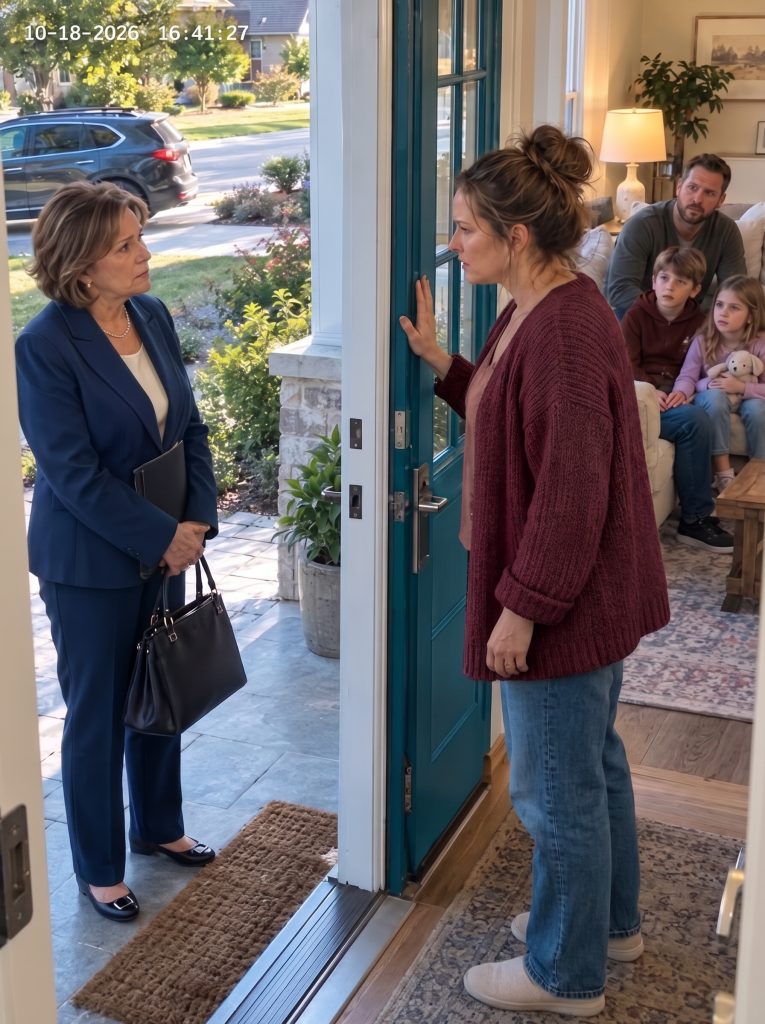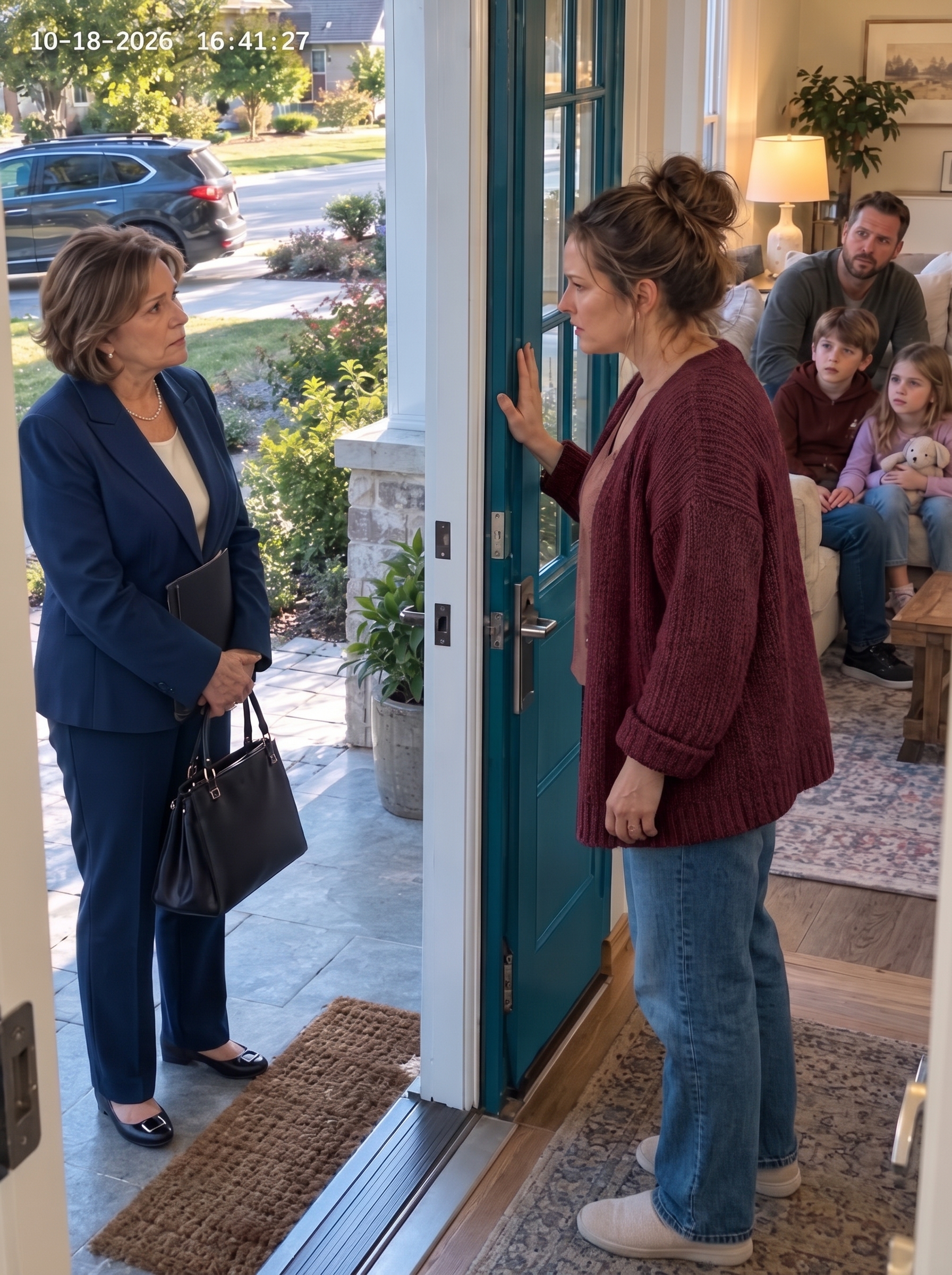
“There’s no room for you here anymore, Rosalind. The house is full, and we don’t want any inconvenience.”
That was the first thing my daughter-in-law said to me when she opened the front door of my own house by the sea.
She didn’t whisper it. She didn’t look embarrassed. Tiffany stood in my entryway wearing my embroidered apron, the cream one with the tiny blue flowers I had stitched by hand years ago, and she smiled at me like a woman who had already decided how this scene was going to end.
The January wind coming off the water stung my cheeks. I had been driving since five that morning from Philadelphia. My overnight bag was in one hand. My keys were in the other. My lower back ached from six hours behind the wheel. For the last hundred miles, I had only been thinking about two things. Silence and sleep. My own bed under the slanted ceiling. The sound of the Atlantic moving beyond the dunes like slow breathing.
“I’m sorry?” I said.
“The house is full,” she said again, a little slower, like I might be hard of hearing. “My family’s here for the week. We just don’t have a bed for you.”
I looked past her into my living room.
Nobody gave me that house. Nobody handed it to me in a will or bought it for me as a gift. I built it the same way I built every safe thing in my life after I became a widow. One small, stubborn stitch at a time.
When my husband Winston died, I was fifty years old. I had a stack of hospital bills, a grief so heavy I could barely lift my arms in the morning, a fifteen-year-old son, and a secondhand Singer sewing machine that groaned every time I asked too much of it.
Winston’s life insurance policy paid $40,000. It sounded like a lot. It wasn’t. The hospital bills alone were $23,000 after insurance. The rest went to keeping the lights on and keeping Peter in school.
So I sewed.
I took alterations from anyone who walked through the door. Wedding gowns that needed hemming. School uniforms. Bridesmaid dresses bought two sizes wrong. Broken zippers. Pants let out after babies or heartache. I worked at midnight with cheap coffee and pins in my mouth. In February, my fingers swelled so badly I had to soak them in warm water before I could thread a needle.
Whatever money was left at the end of each month, I put in an envelope. I kept that envelope in an old flour tin on top of the refrigerator. Peter used to ask what was in it.
“My little piece of air,” I told him.
Twelve years later, that little piece of air had become $189,000. And it bought me a half-rotted cottage on the Rhode Island coast with damp walls, a sagging porch, and a garden everyone in town said was too far gone to save.
I paid cash. I signed the deed at a little title office in Newport, and when the closing agent slid the keys across the table, I held them so tightly they left marks in my palm.
I saved that house with my own two hands.
I painted the walls until my shoulders burned. I ripped out moldy cupboards. I rented a floor sander and refinished every board myself. I changed every lock. I planted hydrangeas and rosemary and a stubborn little strip of lavender that survived two terrible winters simply because I refused to let it die. I sewed cushions for the wicker chairs on the back terrace and stitched my initials, R.M.H., into every hem. For the first time in my adult life, I owned something that belonged only to me.
So when I turned onto my street that Friday afternoon and saw three strange SUVs lined along the curb, beach towels hanging over my wicker chairs, music thumping through my open windows in January, and a plastic sand bucket tipped over in my herb bed, the first thing I felt was confusion.
Then anger.
Then something colder than anger.
Now, standing at my own front door, I could see everything.
Children I had never met were racing across my back terrace with wet feet. My blue throw pillows were on the floor. Tiffany’s sister, Brooke, was stretched across my sofa with her shoes on, scrolling on her phone. Tiffany’s mother, Diane, was going through my kitchen cabinets, lifting my plates to the light like she was shopping at an estate sale. And on the window seat by the front window, my reading spot, the place where I drank my tea every morning, a baby was asleep in a portable bassinet surrounded by diaper bags and bottles.
“I told Peter I’d be here today,” I said.
Tiffany’s smile stayed on her mouth. It didn’t reach her eyes.
“Well, we’re here now. And honestly, there’s just no room for extra guests.”
Extra guests.
In my own house.
It was such a perfect sentence that for a second I almost admired how cruel it was. She had practiced it. I could tell. It wasn’t a slip. It was a message.
Behind her, everyone had gone quiet. Brooke looked up from her phone. Diane set down my plate. They were all watching me. Waiting to see what the old woman would do. Would she cry? Would she shout? Would she beg for her own bed back like some foolish sentimental widow nobody needed to take seriously?
I looked down at the keys in my hand. Then at the muddy shoe print on the wool rug I had scrubbed on my hands and knees last October.
“All right,” I said softly.
Relief flashed across Tiffany’s face.
“I’ll find somewhere else to stay.”
I smiled at her with a calm I did not feel at all. Then I turned around, carried my bag back down the porch steps, and walked to my car with my back straight and my heart hammering in my ears.
I didn’t look back. I knew they were watching from the window.
I drove three miles inland to a small hotel called the Harborview Inn. My room had a side view of the water if you leaned far over the balcony railing and ignored the parking lot. It was $149 a night. I paid with my debit card and the young man at the desk asked if I was in town for the weekend.
“Something like that,” I said.
I set my bag on the floor. I sat on the edge of the bed. And I let myself be still.
I did not cry.
What filled me that evening wasn’t sadness. It was clarity.
The humiliation at the door had been too clean. Too rehearsed. Tiffany didn’t just want my house for a week. She wanted me to understand something. That I wasn’t expected anymore. That my own home had become, in somebody else’s mind, something up for negotiation.
And if I’ve learned anything in seventy years, it’s this. When someone goes out of their way to humiliate you, instead of just inconveniencing you, there is almost always something darker underneath.
I made tea with the little kettle in the room. I carried the paper cup out onto the balcony and stood there in my coat. The wind was bitter. I didn’t care.
I thought about Winston. I thought about Peter. I thought about the little boy who used to run ahead of me on the boardwalk, collecting smooth stones and scraps of rope because he was sure they’d be useful someday. He used to fill his pockets until his shorts sagged.
The longer I stood there, the less this looked like a thoughtless family mix-up.
Peter knew I kept that house like a church. He knew how much it meant to me. And three days earlier, on Tuesday, I had texted him.
Driving up to the beach house Friday. Need a few quiet days.
He answered with a thumbs-up.
A thumbs-up. While his wife’s whole family was packing their bags to move into my house.
Why?
That question kept me awake until dawn.
The next morning, Saturday, I dressed carefully. Dark slacks. A gray wool sweater. The camel coat Winston always said made me look like a woman who knew things. I even put on lipstick, which I hardly ever bother with in winter.
Then I drove back to my house.
I walked up the porch steps. Nobody seemed to be awake yet. The SUVs were still at the curb. I put my key in the front door.
It didn’t fit.
I tried again. It slid in halfway and stopped.
I wasn’t shaking. That wasn’t the problem. I bent down and looked closer. The lock was brand new. Shiny brass. The little sticker from the hardware store was still on the edge of the plate.
They had changed my lock.
I stood there on my own porch with my useless key in my fingers and the new brass glinting in the weak morning light. Something inside me turned very hard.
Changing a lock isn’t an accident. It isn’t a misunderstanding. It means planning. It means someone intends to stay.
Then I remembered the side gate.
It’s an old cedar gate between the house and the neighbor’s fence, with a latch I installed myself. The little skeleton key for that gate was still on my key ring. I walked around the side of the house, slipped the key in, and the latch lifted.
I eased through into the narrow path along the side of the house. The kitchen window was cracked open a few inches. I could smell coffee. My coffee, from my canister.
Then I heard Tiffany’s voice.
“Once the paperwork is filed, the rest is easy.”
I stopped walking.
Her mother answered. “And what if she fights?”
Tiffany laughed. “Rosalind? Please. She folds. Peter says she hates conflict more than anything in the world.”
My hand closed around my key ring so tightly the metal teeth bit into my palm.
Diane made a doubtful little sound.
Tiffany’s voice dropped lower. She sounded impatient, like a teacher explaining something for the third time.
“By the time she figures out what’s happening, the conservatorship petition will already make her look unstable. Peter has examples. That doctor’s appointment she missed in October. The mix-up with her prescription at the pharmacy. The time she forgot her phone charger here and drove all the way back to Philly without it. We don’t need much. Just enough to say she’s having memory problems.”
My vision narrowed to a pinpoint.
Conservatorship.
I knew that word. I had altered a funeral suit once for a man whose children had used it on his mother. They took her checkbook, her car keys, her house. They put her in a facility in Delaware. She died there eighteen months later, still asking for her garden.
Diane drew in a breath. “That sounds extreme, Tiff.”
“It sounds necessary. The house is worth almost three times what she paid for it.”
Then Tiffany’s voice changed. It went bright and sweet, the voice she used at Christmas dinner when she wanted everyone to think she was charming.
“Once the sale goes through, we can put her somewhere lovely. She’ll have a little room. Meals. People her own age. Honestly, she should be grateful.”
I don’t remember breathing.
I remember the cold wood siding under my fingertips. I remember the taste of metal in my mouth. I remember a spoon clinking against a mug inside my own kitchen while two women talked about filing me away like an old chair nobody wanted.
A little room. Meals. People her own age.
I waited until I heard their footsteps move off toward the living room. Then I went to the back of the house, to the little mudroom door by the garden. It still had the old lock. Tiffany had forgotten that one.
My key slid right in.
I stepped inside without a sound. I crossed the kitchen in my socks, holding my shoes in my hand. I could hear the television in the living room and children laughing upstairs.
Built into the corner of the kitchen is a little nook where I keep my desk and my printer. I’d set it up so I could print invoices for my alteration clients when I worked from the beach.
There were four pages sitting in the printer tray.
I picked them up.
The first page was a listing packet from Seaside Realty Group in Newport. My address was printed across the top in big letters. Charming Coastal Cottage, Steps From the Dunes.
The second page was a plan for turning my house into a luxury vacation rental. Projected income: $6,800 a month in season.
The third page was a preliminary market valuation. The number at the bottom made my stomach drop.
$565,000.
The fourth page stopped my breath completely.
Petition for Emergency Temporary Conservatorship of Rosalind Margaret Hale.
My full name. My date of birth. And underneath, paragraph after paragraph of cold, clinical language. Recent cognitive decline. Disorganized financial judgment. Inability to independently manage secondary residential property.
At the bottom was a line marked Petitioner.
Peter Winston Hale. Son.
I folded all four pages in half and pressed them flat under my coat.
I walked back through my kitchen. Past my own coffee maker. Past my own spice rack. I eased the mudroom door closed behind me and held the knob so it wouldn’t click. I went out through the side gate, latched it, walked around the block, and I didn’t stop walking until I reached my car.
Only then did I sit down behind the wheel and look at the papers properly.
There was no confusion left after that. No room for misunderstanding. No room for family diplomacy or maybe-they-meant-well. Whatever part of me still wanted to protect Peter broke clean in two, right there in that parking spot.
Because his name was on it. Right there in black ink.
Tiffany hadn’t tricked him into anything. He wasn’t standing on the sidelines while his wife made bad choices. He was inside it. Signing it. Building it.
My son. The boy who once gave his whole allowance to a classmate whose lunch money got stolen. The boy who held my hand at his father’s funeral and said, “I’ll take care of you, Mom.”
He was going to tell a judge I was losing my mind.
I didn’t drive back to the hotel. I drove straight into town.
There are certain names that rise up in your mind in a real emergency, the way flares go up in the dark. One of those names was Mara Quinn.
Mara is a real estate attorney in Newport, ten years younger than me and sharp as broken glass. Twenty-two years ago, she was going through the worst divorce I’ve ever heard about. Her husband had emptied their joint savings account and taken off. Her daughter’s prom was in two days, and the dress didn’t fit, and Mara didn’t have money for a new one.
She came into my little workroom in Philadelphia with panic in her eyes and the dress in a plastic bag. Her sister lived on my street and had sent her.
I stayed up all night. I took that dress apart at the seams and put it back together. When she came to pick it up, she tried to pay me double.
“Put it toward the corsage,” I told her.
She cried in my doorway. She sent me a Christmas card every year after that. Every single year.
I called her from the car. It was Saturday. I didn’t expect her to answer.
She picked up on the second ring.
“Rosalind? Is everything all right?”
“No,” I said. “I need you. Today.”
“Come to the office. I’ll be there in twenty minutes.”
Her office was on the second floor of an old brick building near the harbor. She met me at the top of the stairs in jeans and a sweater, her reading glasses pushed up into her gray hair.
I set my purse on her desk. I took out the four pages. And I told her everything. The drive. Tiffany in my apron at the door. Extra guests. The hotel. The new lock. The side gate. The kitchen window. Every word I’d heard.
Mara read each page twice. Slowly. Then she took off her glasses, leaned back in her chair, and let out a long breath through her nose.
“That little snake,” she said.
It was the most comforting thing anyone had said to me in two days.
Then she started asking questions. All the questions I should have been asking myself.
“Whose name is on the title to the house?”
“Mine. Only mine. I paid cash.”
“Did you ever give Peter a power of attorney? For anything?”
“Never.”
“Did you ever authorize him or anyone else to list the house, rent it out, or manage it?”
“No.”
“Have you ever discussed a conservatorship with anyone? A doctor? Peter? A social worker?”
“No. Mara, I run my own business. I did my own taxes last year. I hemmed a wedding gown for a bride in Bryn Mawr on Thursday.”
“Good,” she said. She put her glasses back on. “Then what they’ve drafted here isn’t only obscene. It may also be stupid.”
She picked up her phone.
I sat in the leather chair across from her desk and listened while she made call after call. A title company she trusted. A friend at the bank. A detective named Luis Ruiz who handled property fraud cases for the Newport Police Department. A clerk in a judge’s chambers who owed her a favor, asking about emergency relief.
Then she grabbed her coat.
“Come on,” she said. “We’re going to the land records office. If they’re planning to sell your house, I want to see what’s already been filed.”
The records office was in the basement of the town building. It smelled like old paper and floor polish. The clerk was a heavyset woman with a cardigan and a cross on a chain. She typed my address into her computer and frowned at the screen.
“Hmm,” she said.
“What is it?” Mara asked.
“There’s a deed recorded on this parcel. Recently.”
“How recently?”
“Tuesday.”
She turned the monitor around so we could see.
It was a quitclaim deed.
From: Rosalind Margaret Hale.
To: Peter Winston Hale.
Recorded on Tuesday, January 9th, at 10:42 in the morning.
Tuesday. On Tuesday, I was in my workroom in Philadelphia, kneeling on the floor with pins in my mouth, fitting a nervous bride for a last-minute sleeve adjustment. And on Tuesday, my son was standing in this building recording a deed that gave my house away to him.
Tuesday was the same day he sent me the thumbs-up.
The clerk printed a copy. I looked at the signature at the bottom.
It was mine in shape. But not in soul. Anybody who had seen me sign enough birthday cards and permission slips could copy the loops. The R was too careful. I always rush my R.
Under the signature was a notary stamp. A New Jersey notary.
Notary Public: Anthony Bell.
“Tiffany’s cousin,” I said immediately.
Mara looked at me. “You’re sure?”
“He was at their wedding. He gave a toast. He got the bride’s name wrong.”
Mara almost smiled. She wrote the name down on her legal pad and underlined it twice.
That wasn’t all.
The title company called Mara back while we were still standing in that basement. There was a pending application for a home equity line of credit at Ocean State Bank. Amount requested: $350,000. Applicant: Peter W. Hale. Collateral: my house.
The bank had already ordered an appraisal. And there was a request from Seaside Realty Group for comparable sales in the neighborhood.
Nothing had closed yet. No money had moved. But enough had been put in motion to scare any sensible woman out of ten years of her life.
On the way back to Mara’s office, her friend from the bank called. His name was Gordon. He was careful. He didn’t say anything he shouldn’t have. But he couldn’t hide the shape of it.
Peter was in debt. Bad debt.
Two years earlier, he had invested in a company that built luxury event spaces. Wedding venues, mostly. Barns with chandeliers. He had signed a personal guarantee on the business loan. When the company collapsed last spring, the lender came after him. The guarantee was for $410,000. On top of that, he owed back taxes.
He had never told me. Not one word. We had Thanksgiving together. We had Christmas. He sat at my table and carved my turkey and talked about how great work was going.
My house, fully paid off in a coastal market where prices had nearly tripled, had become the easiest money in his reach.
I could almost see how it happened in his head. At first, he probably told himself it was temporary. Just a loan. He’d pay it back. Then he told himself it was practical. Mom doesn’t even live there full time. Then he told himself it was fair. Mom has two houses. I have nothing.
And Tiffany added the style. The nerve. And the poison.
The house wasn’t just going to be collateral. They were going to sell it. And the conservatorship petition was their insurance policy. If I objected, if I fought, they would stand in front of a judge and say poor Mom is confused. Poor Mom is declining. Poor Mom doesn’t know what she’s saying.
They would make me disappear quietly. Legally. Politely.
By late afternoon, Mara had worked a small miracle.
She got an emergency hearing scheduled for Monday morning. She got a temporary hold placed on the property so no sale, no loan, and no transfer could go through. Detective Ruiz opened a fraud investigation and said he’d be in touch about the notary. Gordon’s bank froze the equity line application.
I went back to the Harborview Inn that night and sat on the bed. I was exhausted all the way down to my bones.
At 8:15 that evening, my phone rang.
Peter.
I looked at his name for a long moment. Then I answered.
“Mom,” he said. His voice was warm and careful. It was the exact tone a man uses when he knows he’s been caught but hopes being sweet might still save him. “I’ve been trying to reach you all day.”
“I know.”
“Can we please not do this over the phone?”
“You recorded a deed stealing my house, Peter. We can do it however you like.”
I heard him breathe in, sharp and loud, right against the phone.
“Did you really think I wouldn’t find out?” I asked.
Then I told him what I knew. The deed recorded on Tuesday. The notary from New Jersey. The listing from Seaside Realty. The $350,000 equity line at Ocean State Bank. The conversation through the kitchen window.
When I got to the conservatorship petition, the line went completely silent.
I counted. Six seconds.
Then he said, so quietly I almost missed it, “Tiffany found that?”
“No. I found it. In my printer. In my kitchen.”
He swore under his breath.
“You were going to tell a court I’m incompetent,” I said.
“It wasn’t supposed to go that far, Mom.”
“Your name is on the petition.”
“I know.”
There are some heartbreaks too old for tears. I didn’t raise a cruel boy. I raised a boy who brought me dandelions. A boy who cried when he hit a squirrel with his bicycle. Listening to that same boy breathe into the phone after trying to legally erase me didn’t feel like grief. It felt like watching a house burn. You can still remember every room, but the walls are going black right in front of you.
“Why, Peter?”
He started talking fast. He’d gotten in over his head. The event space company. The personal guarantee. The tax problems. Tiffany’s family had gotten involved, trying to help. Then his voice changed. It turned defensive. I recognized it from when he was fifteen and I caught him sneaking in at two in the morning.
“You have two houses, Mom.”
I didn’t say anything. If I had opened my mouth, I would have screamed.
He rushed on. “I just thought if we sold the place, or borrowed against it, I could—”
“Did you know she changed my front lock?”
Silence.
“Did you know she stood in my doorway wearing my apron and told me to leave?”
More silence.
“You were going to let her bully me into giving up my house,” I said. “Weren’t you. You were going to let her do the dirty work so you didn’t have to look me in the eye.”
“That’s not fair.”
“Fair,” I said. “From this moment on, Peter, you talk to my attorney. Her name is Mara Quinn. She’ll be calling you.”
I hung up.
I set the phone face down on the nightstand. I turned off the light. I lay in that hotel bed fully dressed and stared at the ceiling until the sun came up.
Sunday morning, Mara called at nine.
“I just heard something interesting,” she said. “Seaside Realty had a private walk-through scheduled at your house this afternoon. Three o’clock. A boutique hospitality investor from Providence. He buys beach houses and turns them into high-end rentals. The realtor thought Peter had inherited the property.”
“Inherited,” I said. “Like I’m already dead.”
“Because of the hold and Ruiz’s investigation, the realtor told the investor the title is in dispute. He backed out. He’s not coming.”
“Does Tiffany know?”
“Not yet. And Peter’s driving up from Philadelphia right now to explain it to them. I’m told he’s due around three.”
I sat up straight in bed.
“Mara. Can we be there first?”
I could hear her smiling over the phone.
“Ruiz is already planning on it.”
I took my time getting dressed.
I put on my navy wool dress. My pearl stud earrings. And the silver brooch Winston gave me on our twenty-fifth anniversary. A small etched gull in flight. He bought it at a little shop in Mystic, Connecticut, and pinned it on my coat himself in the parking lot because he couldn’t wait.
I’m not a theatrical woman. But some battles deserve dignity in how you dress for them.
At 2:40 that afternoon, we drove to my house.
Mara. Detective Ruiz, a quiet, solid man in his fifties with a gray mustache. A young uniformed officer named Kowalski. A locksmith named Earl, waiting in his van three blocks away with his tools. And me.
Detective Ruiz walked up my porch steps and knocked three times.
Tiffany answered.
She had dressed up for the investor. Cream trousers. A soft camel cashmere sweater. Her hair blown out in big, glossy waves. Behind her, I could see candles lit on my entry table. Vanilla candles. As if stealing a widow’s home needed a nice smell.
Her face changed in layers when she saw who was standing on the porch. First the bright hostess smile. Then confusion. Then she saw me. Then she saw the badge on Ruiz’s belt. Then the officer behind him.
“Rosalind,” she said. She recovered fast. I’ll give her that. “What on earth is all this?”
“My house,” I said, “being given back to me.”
Detective Ruiz held up his identification.
“Ma’am, I’m Detective Ruiz with the Newport Police Department. I need all occupants of this home who are not authorized by the owner to gather their belongings and leave the property. Now, please.”
Tiffany’s smile came back. Thinner this time.
“I’m sorry, Detective. There’s been some confusion. My husband owns this property. It’s recorded at town hall.”
“No, he doesn’t,” Mara said, stepping forward. She held up a folder. “The deed recorded on Tuesday is being challenged as fraudulent. The lending application at Ocean State Bank has been frozen. The title is under a court-ordered hold. You have no lawful right to be here, Mrs. Hale.”
Tiffany let out a soft little laugh. The kind she used at parties to make someone feel silly.
“Rosalind. Really. You called the police over a family misunderstanding?”
I stepped up to the top step so I was looking her in the eye.
“A misunderstanding is using the wrong tablecloth at Thanksgiving,” I said. “This is forgery.”
The next thirty minutes were chaos. But not the kind of chaos they had planned for me.
Children stomped up and down the stairs. Suitcases thudded against the walls. Brooke shouted at someone to find the baby’s other shoe. Diane hissed about how humiliating this was while she shoved shampoo bottles into a plastic grocery bag. Somebody knocked over a lamp in the living room. The baby started crying and didn’t stop.
I stood in my own entryway with my hands folded in front of me and watched them take apart their little occupation, one piece at a time.
At one point, Tiffany swept past me carrying a duffel bag. She leaned in close, close enough that only I could hear her.
“You always were dramatic.”
“No,” I said. “I was patient. That was your mistake.”
She flinched. Just a little. But I saw it.
Diane came down the stairs carrying a stack of folded towels. My towels. The good Egyptian cotton ones I bought on sale at Macy’s.
“Those stay,” I said.
She looked at me. Then at Detective Ruiz. Then she set the towels on the bottom stair and walked out without a word.
At 3:12, a dark gray Audi pulled up to the curb behind the SUVs.
Peter got out.
He saw Detective Ruiz. He saw the patrol car. He saw Mara standing on the porch with her folder. He saw Tiffany at the bottom of the steps surrounded by suitcases and crying children. Whatever hope he had carried with him from Philadelphia disappeared from his face right there on the sidewalk.
He looked terrible. Thinner than at Christmas. Hollow around the mouth. He was wearing an expensive wool coat, and it couldn’t hide what was falling apart underneath it.
He walked up the path slowly, like a man walking toward a hospital bed.
“Mom,” he said.
“Did you forge my deed?” I asked.
He closed his eyes.
“Peter. Did you?”
“Yes,” he said.
It had started to rain. A thin, cold January drizzle. The gulls were crying down by the water. A car went by on the main road. All of it seemed to fade away around that one word.
“I had the deed drawn up,” he said. “Anthony notarized it. I took it to town hall and recorded it myself. I told myself I’d reverse it. Once I fixed everything. Once I got out from under the debt.”
“When were you going to reverse selling my house, Peter? After the closing? After the investor moved in? After I was in my little room with my meals and my people my own age?”
He opened his mouth. Nothing came out.
Tiffany stepped up beside him and took his arm.
“He did what he had to do,” she said. “We’re family.”
I turned and looked at her.
“No,” I said. “You’re a thief with good lipstick.”
Her mouth fell open. Brooke, standing behind her holding the baby, actually snorted before she caught herself.
Detective Ruiz stepped between us. He spoke calmly to Peter.
“Mr. Hale, I’d strongly advise you not to say anything else about this matter without a lawyer present.”
Peter looked at the detective like the idea of being a criminal had only just occurred to him. Like he’d thought this whole time that forgery was something that happened to other people.
He turned back to me. Rain was dripping off his hair and running down his forehead.
“I can fix this, Mom.”
I looked at the suitcases on the porch. At the broken clay planter by the steps. At the shiny brass lock he let his wife put on my door. At the son I had once believed would never, ever knowingly hurt me.
“No, Peter,” I said. “You can’t.”
Tears came into his eyes. Real ones. I knew the difference. I had wiped enough of them off his face when he was small.
“I never wanted to hurt you.”
“You wanted to keep from hurting yourself any more than you already were.”
“That’s not the same thing.”
“It is,” I said, “when you pick my life to take the hit for you.”
Mara stepped forward. She handed Peter a stack of papers in a manila envelope. A formal notice. She explained, very clearly, everything he was now forbidden to do with my property. No sale. No loan. No listing. No entry. He took the envelope mostly because his hands needed somewhere to go.
He started to turn away. I stopped him.
“Peter.”
He stopped.
“You told your wife I would fold,” I said. “Look at me.”
Slowly, he lifted his head.
“This is what you forgot while you were so busy underestimating me. I buried your father. I raised you by myself. I built a business with one secondhand sewing machine and two swollen hands. I bought this house with hems and broken zippers and twelve years of nights without sleep. You were never going to bully me out of it. All you were going to do was teach me how little room I have left in my life for people who mistake kindness for weakness.”
He stood there in the rain. He didn’t say anything. There wasn’t anything left to say.
By four o’clock, they were all gone.
The SUVs pulled away one by one. Tiffany didn’t look back. Peter sat in his Audi for a long time before he started the engine. Then he drove away too.
Earl, the locksmith, came up the street in his van. He changed the front lock. Then the side gate. Then he put a brand-new deadbolt on the mudroom door. When he was done, he handed me three new keys on a brass ring. They felt almost silly in my palm. So heavy for such small things.
“That’ll be two hundred and sixty dollars, ma’am,” he said. “Sorry about all this.”
“Don’t be,” I said, and I wrote him a check.
Officer Kowalski’s patrol car pulled away. Mara hugged me hard on the porch and said she’d call me in the morning about the hearing. Detective Ruiz gave me his business card and told me to call him if anybody so much as parked in front of my house.
Then they were all gone.
And it was just me. My house. And what was left behind.
I stepped inside and closed the door. I locked it. I stood there in the entryway with my back against it.
The house smelled wrong. Too much fabric softener and fried food and someone’s perfume. Sand had been tracked across my floors from one end of the house to the other. The wicker chair I always kept next to my reading spot had been dragged across the room and left by the television.
I took off my good wool dress and put on my old sweatpants and Winston’s flannel shirt. I opened every window in the house even though it was January and thirty-four degrees outside.
Then I got to work.
I swept the sand off the kitchen floor. Then the living room. Then the stairs. I carried all the stray towels to the washing machine. I stripped the beds and put on fresh sheets. I picked up my blue throw pillows from the floor and fluffed them and put them back on the sofa where they belonged. I put the cushions back on the wicker chairs.
I picked up the plastic sand bucket from my herb bed and set it by the trash can. The rosemary was bent but not broken.
Then I dragged the wicker chair back to its place by the front window. I sat down. I pulled my legs up underneath me the way I had done a thousand times with Winston on rainy afternoons. And I looked out at the gray water beyond the dunes.
The lavender in the garden hadn’t been touched.
I could see it from the window. Small and silvery green, a little beaten up by the January wind. Still there. Exactly as stubborn as I planted it to be.
I sat in that chair until it got dark. I didn’t turn on any lights. I just listened to the ocean.
The hearing on Monday morning took eleven minutes.
I wore the camel coat. Mara did all the talking. The judge was a woman about my age with half-moon glasses and a voice like a school principal. She looked at the conservatorship petition for a long time. Then she looked at me over her glasses.
“Mrs. Hale, can you tell me today’s date?”
“Monday, January fifteenth,” I said. “And it’s Martin Luther King Day, which I believe means you’re working on a holiday, Your Honor. I appreciate it.”
She almost smiled.
“Nobody has filed this petition,” she said, holding it up. “It’s a draft. But I’ll note for the record that I see no evidence of any incapacity whatsoever. The hold on the property stays in place pending the fraud matter.”
That was all. Eleven minutes.
The rest took months.
Mara filed a lawsuit to void the forged quitclaim deed. Peter’s new lawyer, a tired man from Providence, didn’t fight it. In April, the court declared the deed void, and the title was officially restored to me. Mara made sure the order was recorded at town hall, right on top of the forged one, so that anyone who ever looked up my house would see the whole story.
The home equity line at Ocean State Bank was never funded. Not a single dollar.
Detective Ruiz’s investigation went where it needed to go. I didn’t follow every step. I didn’t want to. Mara followed it for me. That’s what a good attorney is for.
Anthony Bell, Tiffany’s cousin, lost his notary commission in New Jersey. He had his own long conversation with the authorities about the limits of professional judgment and why a notary should actually see the person whose signature he’s stamping.
Peter, for reasons he could explain to his own lawyer, agreed to a settlement in June. He signed papers giving up any claim to my house, now and forever. He agreed to repay my legal fees, $18,400. He agreed to repay the hotel bills, the locksmith, and the cost of having the house professionally cleaned, another $3,100. He paid it in monthly installments. Every check came on time.
I never asked where he got the money. I didn’t want to know.
The rest of his debt was his own problem. I heard from Mara, much later, that he and Tiffany sold their house in Cherry Hill to pay off part of the personal guarantee. I heard they were renting an apartment now. I heard Tiffany’s family didn’t come around as often.
I heard. I didn’t ask.
Peter wrote me a letter eight months later. In September.
It came in a plain white envelope with my Philadelphia address in his handwriting. Four pages, handwritten, careful. No typing. No email.
He wrote about the debt. About how it started with one bad decision and then turned into ten more, each one trying to cover up the last. He wrote about the shame. About how at every step he told himself he was just buying time, not stealing.
He wrote about letting Tiffany answer the door that Friday because he couldn’t stand the thought of looking at my face himself.
That part was worse than the deed. Worse than the petition. He knew exactly what was going to happen at that door. And he chose to be three hundred miles away while it did.
He said he was seeing a therapist now. Every Wednesday. He said he understood that I didn’t owe him forgiveness. Not on any timeline. Maybe not ever.
I read the letter twice. Then I folded it and put it in the drawer of my nightstand.
I haven’t answered it.
Maybe I will someday. Or maybe the answer is that he has to rebuild himself from the ground up, the way I rebuilt that house. Not because somebody’s waiting to see the work finished. Just because, sooner or later, living in a ruin becomes a choice.
The house is mine again now. In the only way that really matters. The quiet way.
Nobody has to announce it. The keys on my ring say it. The swept floors say it. The lavender still growing by the back steps says it.
On winter mornings, I make my tea and sit in my reading spot by the front window. The Atlantic moves beyond the dunes, slow and steady. It’s always been there. It’ll keep being there no matter what any of us do with our short little time on the edge of it.
Winston used to say this coast had no patience for people who put on airs. The weather just doesn’t allow it. Storms come. Tides come. And the sea takes back whatever people leave unattended at its edge.
He was right about that.
He was usually right about the things worth being right about.
My pearl earrings are back on my nightstand. The gull brooch is back in the little velvet box where I keep the things that matter. And my embroidered apron, the cream one with the tiny blue flowers, is back on its hook in the kitchen.
I washed it twice before I hung it up.
Some things you can wash clean.
And some things you just keep anyway. Because they were yours first. And they’re still yours. And in the end, that’s the only accounting that was ever going to matter.
There’s one thing about that weekend I want to say plainly.
When people hear this story, they usually want to talk about the moment at the front door. Or the papers in the printer. Or what I said to Tiffany on the porch about her lipstick. And those things happened. They mattered.
But what I remember most is standing by the kitchen window in the narrow shadow of the porch roof, listening to my son’s wife explain how they were going to make me disappear.
Not violently. Not in any way that leaves bruises. Just the quiet, polite, legal disappearance of an old woman whose existence had become inconvenient. Somewhere lovely. A little room. Meals. People her own age.
I’ve thought many times about how close it came to working.
If I had driven up on Saturday instead of Friday, I wouldn’t have felt any urgency at all. I would have arrived to a done deal.
If I had gone back to Philadelphia after Tiffany turned me away, and the old me would have, I never would have stood at that window.
If I hadn’t had Mara’s number in my phone, saved there from twenty-two years of Christmas cards, I would have been in that basement records office alone. I wouldn’t have known what a quitclaim deed was. I wouldn’t have known who to call.
And if I had done exactly what Tiffany predicted, if I had folded, it would have worked.
That’s the part that stayed with me longest. Not the forged deed. Not the $350,000 loan application. Not even Peter’s name on a petition meant to prove I couldn’t be trusted with my own life.
What stayed with me was that Tiffany knew me well enough to build a trap shaped exactly like me.
She knew I hate conflict. She knew I would be embarrassed instead of angry. She knew I would walk away quietly and handle my hurt feelings in private instead of making a scene in front of her family. She had studied me for years. Patiently. Carefully. And she used every single thing she learned.
That’s what I meant when I told her patience was her mistake. But it was mine too.
Not my kindness. Not my generosity. Not my love for my son. My patience with things that should have had consequences years earlier.
I watched Tiffany rearrange my table at Easter and call it “being practical.” I heard her tell Peter, in my own kitchen, that I “made things awkward.” I said nothing. I watched her pick up my hand at Thanksgiving, look at the calluses from forty years of needles, and laugh. I told myself married people protect each other, even when they shouldn’t. I told myself Peter needed his marriage more than he needed to correct his wife. I told myself I was old enough to swallow small insults without needing an apology.
They weren’t small insults. They were practice.
Every time I swallowed one without a word, Tiffany moved the line a little further. What will she put up with? What will she let go? How far can I push before she pushes back?
By the time she opened my front door in my own apron and told me there was no room for extra guests, the answer was apparently: very far.
I don’t blame myself for being a forgiving person. I blame myself for confusing forgiveness with permission.
They’re not the same thing. Forgiveness is what you give after someone wrongs you. Permission is what you give before. For years, I had been handing out permission and calling it grace.
That first night in the hotel room, with the cold tea and the wind off the water, I learned something. Seeing people clearly isn’t the same as being bitter. You can see someone exactly as they are without hating them. You can protect yourself without turning hard.
You can look at your own son’s name on a petition to have you declared incompetent, and still understand, the way a woman who has buried the person she loved most understands things, that he chose wrong. That he’ll have to live with that choice. And that it isn’t your job to clean up his consequences. Your job is to step out of their way.
I had mixed those two things up for a very long time.
I was seventy years old, and I was still protecting people from the results of their own choices. I had been taught to, the way so many women my age were taught. We were taught that managing everyone else was love. That erasing ourselves was a virtue.
It isn’t love. It’s habit.
And habits can be broken.
The lavender is still growing in my garden. It’s made it through three more winters since that January. Every spring it comes back a little thicker, a little stronger, the way plants do when they’re finally left alone long enough to put down real roots. This past April, I planted a second row beside it.
I sewed new cushion covers for the wicker chairs. A blue-gray color that matches the ocean in winter. I stitched my initials into every hem. R.M.H.
I hung up the photographs Winston and I took on our long drives up and down the coast before he got sick. Weathered gray shingles. Fishing boats in the harbor at Point Judith. Little diners with steamed-up windows. He loved those diners. He’d order clam chowder in August.
I spend three months of the year here now instead of just weekends. My assistant in Philadelphia, a lovely young woman named Gloria, handles my alteration appointments while I’m away. She’s better with the bridal clients than I ever was. The arrangement suits us both.
Every morning before breakfast, I take a long walk on the boardwalk. The same boardwalk where Peter used to run ahead of me, filling his pockets with smooth stones and bits of rope he was sure would be useful someday.
I think about that little boy with love. I think about the man he became with sorrow. Those two feelings live side by side in me now. They don’t cancel each other out.
His letter is still in my nightstand drawer. Sometimes I take it out and read it again. The handwriting is careful. It’s the same hand that used to write MOM on my birthday cards in big crooked block letters, with a backwards M when he was five. There’s real shame in those sentences. Not the performing kind. I know the difference. I’m his mother.
I haven’t answered it.
I’m not sure I ever will.
But I do know this. Whatever answer I give, if I give one, will be mine. Written at my own kitchen table. In a house that is mine. In a life that is mine. With my initials stitched into the hems, the way I stitched them into the cushions. Because I am a woman who has finally stopped apologizing for taking up the space she paid for.
Every morning, the sea moves in beyond the dunes without asking anyone’s permission.
I find that very instructive.Pages:
THE END..!