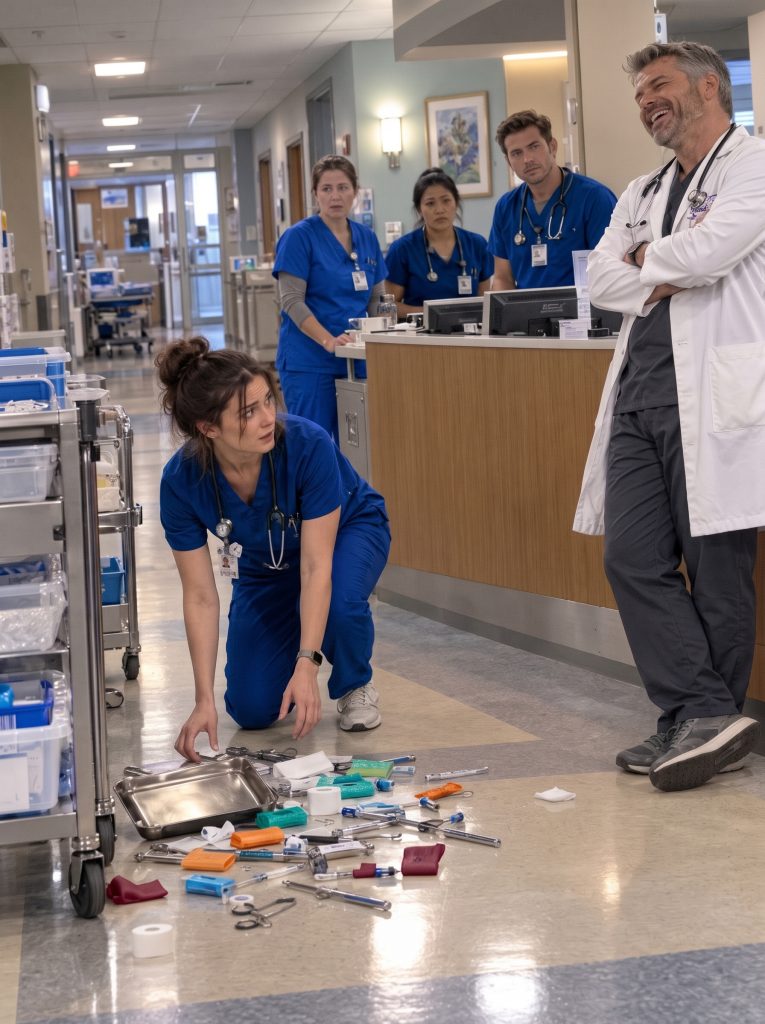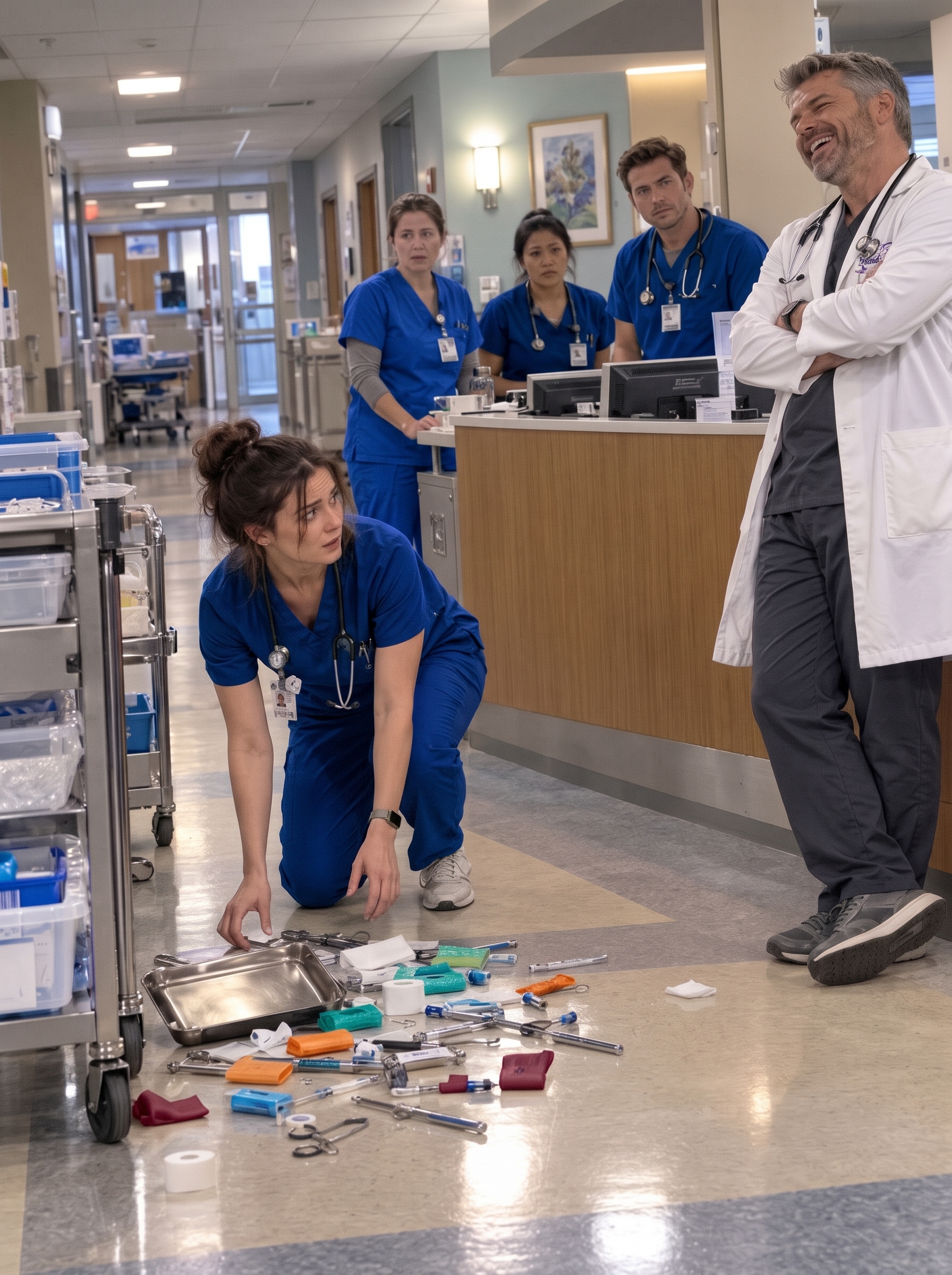
“Careful, Mouse. Try not to drop the whole tray this time.”
Dr. Warren Teague started laughing before he even finished the sentence. The two corpsmen sitting at the nurses’ desk laughed right along with him.
They always did.
Annie Keller didn’t say anything. She set the steel instrument tray down on the cart. Her hands shook. Just a little. Just enough for them to see.
“See that?” Teague said, pointing with his pen. “Church mouse nerves. Ladies and gentlemen, this is Quiet Annie. Seven months on the night shift, and she’s said maybe forty words.”
“Forty-one,” said Danny Ortiz, the youngest corpsman on the floor. He was twenty-two and still had acne on his chin. “I counted.”
More laughter.
Annie kept her eyes on the cart. Head down. Shoulders curved forward. Her dark brown hair was sliding out of its messy bun again. She didn’t fix it.
Pine Harbor Naval Medical Center sat at the end of a long, empty county road in northern Maine. Forty beds. One small emergency room with three trauma bays. The nearest real trauma center was ninety minutes away by car, longer in bad weather. Over the front doors hung a wooden sign painted in navy blue letters.
Service. Sacrifice. Heal.
On the night shift, nobody seemed to remember the last two words.
It was a little past two in the morning. A storm had been building over the coast since sundown. Rain was hammering against the windows. The wind kept rattling the ambulance bay doors in their tracks like somebody was trying to get in.
Teague leaned back in his chair and put his feet up on the edge of the desk. He was forty-four, tall, a little soft around the middle, and very comfortable. He was the kind of man who had never once been told no on his own shift.
“Hey, Mouse. Go get me a coffee. A real one this time. And don’t spill it on my charts.”
“Yes, Doctor.”
Her voice was soft. Barely there at all.
Teague grinned at the corpsmen like he’d just won a bet.
Annie walked down the hall to the break room. Her navy scrubs were a size too big and hung off her shoulders. A thin, pale scar ran just above her right eyebrow. Under her left sleeve, which she always kept pulled down to her wrist, a ridge of old white marks crossed her forearm. Shrapnel scars. Nobody at Pine Harbor had ever asked about them.
Nobody had ever really looked.
The break room was empty. The fluorescent light over the sink buzzed. Annie put a paper cup under the coffee machine and pressed the button. It hissed and gurgled. She stood there and watched the dark liquid fill the cup.
Something was sitting on the counter next to the machine.
A small gray plastic mouse. The kind you’d find in a bin at a pet store, with a little rubber tail.
Somebody had left one on her locker last week. Then one on her chair in the charting room. Now one here, right next to the coffee machine, where they knew she’d be sent.
She didn’t throw it away.
She never did.
Her hand drifted up to her chest, under the collar of her scrub top, to the thin silver chain she always wore against her skin. Her fingers closed around two metal tags.
One was hers.
The other one said REYES, DANIEL M.
She held them for a moment. Then she let go.
In for four counts. Out for four counts.
Seven months of this.
She had picked this place on purpose. A quiet little hospital at the end of a dead-end road in the woods. A place where nobody asked what you used to do, or where you’d been, or why you flinched when a car backfired in the parking lot.
Some nights she counted the ceiling tiles. Forty-two in the break room. Sixty in the main hallway. Eighteen in the supply closet. Counting kept the old memories from climbing back in through the cracks.
The door creaked open behind her.
Linda Marsh, the oldest nurse on the floor, came in carrying an empty mug. Linda was sixty-one, with short silver hair and tired, kind eyes. She’d been a nurse at Pine Harbor for twenty-eight years. She’d buried a husband and raised three boys and paid off a mortgage on a little blue house in town on a nurse’s salary. Not much rattled her.
She saw the plastic mouse on the counter. Her mouth went tight.
“Don’t let him get to you, honey.”
“He doesn’t,” Annie said.
Linda studied her for a long moment.
“I’ve been watching you for seven months, you know. You never look at the monitors. Not once. But somehow you always know when a patient’s about to crash. Every single time. Before the alarm even goes off.”
Annie smiled a little.
“Lucky guess.”
“Mhm,” Linda said. She didn’t believe it for a second.
Annie carried the coffee back out to the desk. Teague took it from her without looking up from his phone.
“Thanks, Mouse.”
The clock on the wall read 2:51.
The storm hit harder. The overhead lights flickered once, went dim, and came back.
Teague was telling a story about a patient who’d swallowed a golf ball on a dare. The corpsmen were laughing so hard one of them was wiping his eyes.
Annie stood over by the supply cart, restocking gauze pads and tape. Her hands moved carefully. Neatly.
Her hands weren’t shaking now.
Nobody noticed that.
At 2:58, the ER went quiet.
Too quiet. Even the storm seemed to hold its breath.
Annie felt it first. The way your ears feel the air pressure change right before a thunderstorm breaks. Her eyes lifted to the ambulance bay doors. Then to the clock on the wall.
At 3:00 exactly, the radio on the trauma desk crackled.
Static first. Then a man’s voice, strained, fighting against wind and a roaring engine.
“Pine Harbor, Pine Harbor, this is Reaper Two. Inbound by ground. ETA eight minutes. One critical. Penetrating chest trauma. Multiple fragmentation wounds. Request trauma team standing by.”
Teague rolled his eyes.
“Reaper Two? What is that, a Boy Scout troop?”
Danny grabbed the handset. “Reaper Two, Pine Harbor. Say again your unit?”
“Negative, Pine Harbor. We need your best medic at the doors. Repeat, we need—”
Static swallowed the rest of it.
Then the voice came back. Clearer this time. Rougher.
“Does anyone there answer to Angel Six?”
The tray in Annie’s hands hit the floor.
Steel slammed against tile. Forceps, clamps, scissors scattered in every direction, loud as gunshots in the quiet room.
Everyone turned around.
Annie stood frozen by the supply cart. Her face had gone completely white. Her eyes were locked on the radio.
“Well, look at that,” Teague laughed. “Mouse dropped it again.”
Nobody laughed with him this time.
Linda was watching Annie. Danny was watching Annie. Even the two corpsmen had stopped grinning.
Annie bent down slowly. She picked up the tray. She picked up every instrument, one at a time, and set them back in their places.
Her hands were perfectly still.
She stood up.
And then she did something nobody on that floor had ever seen her do in seven months.
She lifted her chin. She rolled her shoulders back. And she looked Dr. Warren Teague straight in the eye.
“Doctor. How many staff do we have in the building right now?”
Teague blinked. “What?”
“Staff. Right now. How many?”
“Me. You. Linda. Danny. Two more corpsmen in the back. Dr. Hale’s on call, but he’s forty minutes out in this weather. Why?”
“Because eight minutes isn’t much time,” Annie said.
Then she turned around.
“Danny. Trauma Bay One. Turn on the rapid infuser. Warm the fluids. Open the massive transfusion cooler and pull everything we have. Linda, I need two chest tube trays and a thirty-two French tube. Everybody else, gloves and gowns. Now.”
The word landed like a slammed door.
Danny moved first. Then Linda. Then the two corpsmen in the back, who’d come out to see what the noise was.
Teague stood up so fast his chair rolled backward and hit the wall.
“Excuse me. You don’t give orders in my ER.”
“Then give them,” Annie said.
He opened his mouth. He closed it. He looked at the radio.
“This is a prank. It’s some kind of stunt from the base.”
“It’s not,” she said. “Listen to the voice.”
A second voice cut in over the radio. Ragged. Tight with fear.
“Hart’s pressure is dropping! Seventy over forty! Move it, move it!”
Teague’s face changed. Just a little. Just a fraction.
He didn’t give any orders.
But he didn’t stop hers either.
Annie walked to Trauma Bay One.
Her walk was different now. Straight. Quiet. Efficient. Like someone who had walked into a thousand rooms exactly like this one and knew where everything was without looking.
Linda caught her sleeve in the hallway.
“Annie.”
“Not now, Linda.”
“I just want to know one thing.” Linda’s voice was low. “Who are you?”
Annie didn’t answer.
She was already pulling on gloves.
For six years, she’d told herself she would never do this again. That she’d let somebody else carry it. That she was done.
Her body hadn’t listened.
At 3:07, the ambulance bay doors burst open.
Cold wind and sheets of rain flooded into the hallway. Two olive green military trucks backed in under the bay lights, tires hissing on the wet concrete.
Men dropped out of the back doors before the wheels even stopped rolling.
Black helmets with night vision mounts. Tactical vests. Rifles slung low across their chests. And two German shepherds in black tactical harnesses, pulling hard at their leashes, noses working the air.
The corpsmen took a step back. One of the night nurses from the medical floor, who’d come down to see what was happening, covered her mouth with her hand.
Teague forgot to close his.
The men were carrying a stretcher between them. On it lay a big man in torn, muddy fatigues. His face was as pale as printer paper. A tourniquet was cinched high and tight around his left thigh.
The man at the front of the stretcher scanned the room. Gray beard, cut short. Hard, dark eyes. The patch on his shoulder said HOLLOWAY.
Master Chief Ray Holloway.
His eyes moved across every single face in that hallway. Teague. The corpsmen. Linda.
They stopped on Annie.
Neither of them spoke.
The two dogs stopped pulling. Both of them turned their heads at the same moment and looked straight at her.
Holloway’s jaw tightened. When his voice came, it was barely a whisper.
“Angel Six.”
Annie didn’t answer him. There wasn’t time.
“Bay One. Move.”
The team rolled the stretcher into the trauma bay. Four of the men lifted the patient onto the bed in one smooth motion. Nobody had to tell them how. Nobody had to count.
“Name?” Annie asked.
“Chief Eli Hart,” Holloway said. “K-nine handler. Training breach went wrong at the range. Fragments in the left chest and left thigh. Tourniquet on at oh-two-forty-five.”
Annie checked the tourniquet. The time was written in black marker on a strip of white tape. 0245. She pressed on the strap. Tight. Correct.
“Good,” she said.
She cut his shirt open down the middle with trauma shears.
Small puncture wounds dotted the left side of Hart’s chest. None of them bigger than a thumbnail. They looked almost harmless.
They weren’t.
“Breath sounds,” she said.
Danny pressed his stethoscope to Hart’s chest. He listened. His face changed.
“Nothing on the left. Almost nothing.”
Annie tapped her fingers against Hart’s chest wall. Not a hollow sound. A dull, heavy thud. Like knocking on a full barrel.
“Hemothorax. Massive. His chest is filling up with blood. Vitals?”
“Pressure seventy-two over forty,” Danny read off the monitor. “Heart rate one thirty-four. Oxygen eighty-two.”
“Oxygen on. Two large-bore IVs. Danny, start the rapid infuser. Red cells and plasma, one to one.”
Danny stared at her.
He had worked beside this woman for seven months. He did not recognize the person giving him orders right now.
“Danny.”
“Yes. Yes, Chief. I mean, Annie.”
The word just slipped out of him. Chief.
Nobody corrected him.
Teague pushed forward toward the bed.
“Hold on. Hold on a second. I’m the attending physician. I’ll decide what we—”
“Doctor.” Annie didn’t look up. “He has minutes. You’re welcome to supervise.”
It wasn’t a request. It was an offer.
And somehow, it left him with absolutely nothing to say.
She pulled a sterile blue drape across the left side of Hart’s chest. Betadine. A scalpel.
Her hands moved fast and sure. Not one finger shook.
“Four centimeters. Fifth intercostal space. Anterior axillary line.”
She said it quietly. Almost to herself. Like a prayer she’d said a hundred times.
“Blunt dissection over the top of the rib.”
The blade opened the skin. Forceps spread the muscle underneath. She pushed one gloved finger straight through the lining of the lung.
Blood came out in a dark rush.
It poured over the drape and down onto the floor. The whole room gasped.
“Tube.”
Linda placed the thirty-two French chest tube in Annie’s open palm without a single word. Annie guided it in, angled up and back, and connected it to the drainage canister.
Blood roared into the plastic container.
“Fourteen hundred already,” Danny whispered.
“TXA, two grams in a hundred of saline. One gram of calcium. Get a warm blanket over him. Keep him warm, Danny. Cold kills faster than the wound.”
The monitor beeped.
Eighty-four over fifty.
Heart rate one twenty-six.
Hart’s chest rose. A fuller breath. Then another.
Master Chief Holloway let out a breath he’d been holding for twenty minutes.
Teague stood with his back against the wall. He hadn’t touched the patient. He hadn’t said a single word in ten minutes.
Annie moved down to the thigh. The tourniquet was holding. The wound underneath it wasn’t bleeding fresh.
“Leave it on. Leave the time marked. He loses the leg before he loses his life. Not the other way around.”
Ten minutes earlier, she’d been a woman who couldn’t carry a cup of coffee across a room without everybody watching her hands.
Now every single motion was exact. Precise. Danny noticed. So did everybody else in that room, though nobody said it out loud.
She checked the canister.
“Eighteen hundred milliliters. Still draining. Slower now.” She looked up. “He needs an operating room inside the hour. Where’s Dr. Hale?”
Linda was already on the phone at the wall. She listened for a moment. Then she lowered the receiver slowly.
“Route Nine is flooded. They closed the bridge over the Sebasticook. He’s stuck on the far side. And the medevac helicopter out of Bangor is grounded. The storm.”
Annie closed her eyes for exactly one second.
Then she opened them.
“Then we hold him here.”
Holloway stepped close to her. The two dogs followed him, silent, their eyes never leaving her face. He spoke so quietly only she could hear.
“Doc. It’s been six years.”
“I know, Master Chief.”
“We looked for you. Every one of us. Every single one.”
“I know.”
Across the room, Teague watched the two of them.
He saw the hardest-looking man he’d ever seen in his life bow his head to a night nurse in oversized scrubs.
He saw the two German shepherds walk over and lean their heavy bodies against her legs, one on each side, like they’d known her their whole lives.
“Master Chief,” Teague finally said. His voice cracked in the middle. “Who is this nurse?”
Holloway turned around slowly. His face was stone.
“Doctor, you’ve been working next to her for seven months. If you don’t know, that’s a better answer than anything I could give you.”
Then he looked back at Annie. And his voice went soft.
“She’s the reason I’m alive. She’s the reason a lot of us are.”
Nobody in that room breathed.
At 3:41, the monitor shrieked.
Hart’s blood pressure collapsed. Fifty over thirty. Heart rate one forty-eight. Then a slow, ugly slide downward.
“Tube’s not draining!” Danny said. “Output just stopped!”
Annie was already moving.
“It’s clotted.” She grabbed the chest tube and squeezed it hard along its length, stripping it. A black, rubbery clot slid through into the canister.
Nothing came after it.
“Pulse.”
Danny pressed two fingers into the side of Hart’s neck. He waited. His face fell apart.
“Nothing. No pulse. The monitor’s showing a rhythm, but there’s no pulse.”
“PEA,” Annie said flatly. “His heart’s got electrical activity, but it’s not pumping. Compressions. Now.” She turned her head. “Teague.”
Teague looked up. His eyes were huge.
“Doctor. Your hands on his chest. Hard and fast. Two inches deep. Now.”
“I—”
He didn’t move. His hands just hung at his sides.
“I’ve never run a trauma arrest.”
“You’ve run a hundred cardiac arrests,” Annie said. “It’s the same motion. Hands on his chest, Doctor.”
For one long moment, nothing happened.
Then Teague stepped forward. He put the heels of his palms on Hart’s breastbone. And he pushed.
“Harder,” Annie said. “Count out loud.”
“One. Two. Three. Four. Five…”
Annie worked on the chest tube. She pulled it out. She slid her gloved finger back into the incision and swept it through the space around the lung.
Clots came out in her hand. Big, dark, heavy handfuls of them. She dropped them into a metal basin on the tray.
“New tube. Same site.”
Linda handed it to her. Annie fed it in. The canister gurgled.
Blood started to flow again.
“In a traumatic arrest, drugs come last,” Annie said. She was talking to the whole room now. Teaching. “You fix the cause first. Blood. Air. Pressure. Then you pray.”
“Right side,” Danny said. He had his stethoscope on the other side of Hart’s chest. “Breath sounds are uneven. Something’s wrong on the right.”
Annie didn’t hesitate for one second.
“Prep the right side. Finger thoracostomy.”
Seconds later, she cut. Her finger broke through. A sharp hiss of trapped air escaped from Hart’s right chest, loud enough for everyone to hear.
“Tension released,” Annie said.
“Two units in,” Danny called out. “Pressure rising on the infuser.”
“Check the pulse.”
Teague stopped compressions. Danny pressed his fingers into Hart’s neck again.
He waited.
He looked up. His eyes were wet.
“I’ve got a pulse. It’s weak. But it’s there.”
Teague stepped back from the bed. His whole body was shaking.
“He’s back,” Danny said. His voice broke. “He’s back.”
Annie wiped her forehead with the back of her forearm. And for the first time all night, her hands trembled. Just once. Just a little.
Her sleeve had ridden up past her elbow.
The old shrapnel scars showed, white and jagged against her skin.
Linda saw them.
So did Teague.
A memory hit Annie, fast and cold, like a bucket of ice water.
A dark ridge in the mountains. A truck burning on the road below. Gunfire coming from three directions. A young man, twenty years old, lying on his back on the rocks with his eyes open. Daniel Reyes. A tourniquet she’d tightened on his leg ninety seconds too late.
Not fast enough. Not by ninety seconds.
She stuffed the memory back down the way she had for six years.
In for four. Out for four.
Teague had gone gray. He leaned back against the counter like his legs wouldn’t hold him up anymore.
“I froze,” he said. He wasn’t talking to anyone in particular. “My hands wouldn’t move.”
“You moved them,” Annie said.
She didn’t say it unkindly.
“That’s the only part that matters.”
He looked at her differently now. Not like the mouse. Not like the joke at the desk. Like a stranger who’d walked into his burning house and put out the fire with her bare hands.
“Where did you learn this?”
“A long time ago.”
“Where?”
She didn’t answer.
Behind them, Master Chief Holloway watched her with an expression that was half pride and half grief. The two German shepherds had lain down on the floor on either side of Hart’s bed. Neither one would leave him.
The clock on the wall read 3:58.
Ten minutes later, the phone on the trauma desk rang.
Linda picked it up. She listened. Her face tightened.
“Dr. Teague. It’s Commander Pruitt. The duty administrator.”
Teague took the phone. He listened. His jaw clenched.
“Sir, I understand. Yes. Yes, sir.”
He set the receiver down. He didn’t look at Annie when he spoke.
“The commander’s on his way in. He says a nurse has no authority to perform a thoracostomy. He says there will be consequences.”
The room went very still.
Commander Gordon Pruitt arrived at 4:06 in a dripping wet raincoat with a face like a locked filing cabinet.
He was fifty, gray at the temples, and an administrator all the way down to his bones. He had never held a scalpel in his life. He’d spent twenty years protecting hospitals from lawsuits. He knew exactly how much the hospital paid every year for malpractice coverage. $1.4 million. He knew the number for every settlement Pine Harbor had ever paid out. He kept a binder.
To Gordon Pruitt, a hospital was a set of rules. Patients were risks to be managed. And the rules were the only thing standing between him and a deposition.
He walked straight into Trauma Bay One.
He saw the blood on the floor. The two chest tubes. The basin full of clots. The nurse in navy scrubs standing at the head of the bed.
“Who authorized this?”
“I did,” Annie said.
“You’re a night nurse. You do not have the credentials to perform invasive chest procedures in this facility. Do you understand the liability exposure you’ve just created? If this man has a complication, if his family sues, this hospital has no defense. None. Step away from the patient.”
“Sir, if I step away, he dies.”
“That is not your decision.”
“Then whose is it?” Annie asked.
Pruitt blinked.
“Dr. Hale is stranded on the other side of a flooded bridge. The helicopter is grounded. The nearest trauma surgeon is ninety minutes away. So whose decision is it, sir?”
Pruitt turned to Teague.
“Doctor. Did you authorize this?”
Teague opened his mouth. Nothing came out.
Everybody in the room was looking at him.
He looked at Hart’s chest, rising and falling on the ventilator. At the blood in the canister. At the basin of clots. At the woman he’d been calling Mouse for seven months.
“She did the job I couldn’t do,” Teague said.
His voice was quiet. But it was steady.
“I stood there against that wall. She saved him.”
“I’ll have to report this,” Pruitt said. “Both of you. In writing. To the credentialing board.”
“Then report it, sir,” Teague said.
Pruitt stared at him. He hadn’t expected that. Not from Warren Teague.
Then he heard boots behind him, and he turned around.
Master Chief Holloway had stepped into the doorway. Four SEALs stood behind him in the hall. The two dogs rose up off the floor.
“Commander,” Holloway said. “A word.”
“This is a hospital matter, Master Chief.”
“It’s a matter of the man on that bed. He’s one of mine.”
Holloway stepped closer. He didn’t raise his voice. He didn’t need to.
“Sir. You asked who she is.”
“I did not.”
“You’re going to want to know. Before you write that report.”
Holloway reached into a pocket on the front of his vest. He pulled out a small laminated card, worn soft and white at the edges from years of being carried. He held it up so Pruitt could see it.
It was a photograph. A younger Annie Keller in desert fatigues, her hair pulled back tight, dust on her face. Her eyes were hard as flint.
Next to the photo, in bold block letters:
HM1 KELLER, A.
SPECIAL OPERATIONS INDEPENDENT DUTY CORPSMAN
CALL SIGN: ANGEL 6
“Every one of us carried this card for six years,” Holloway said. “In case anybody ever found her.”
The room stopped breathing.
Pruitt stared at the card. His face went pale.
“That’s not possible. She’s a registered nurse. Her file says she went through nursing school four years ago. In Portland.”
“She went through nursing school after she left us,” Holloway said. “After the ridge outside Khost. After she carried six of my men out of an ambush. One at a time. Under fire. With a broken wrist.”
Nobody moved.
“After she kept a seventh man alive for forty minutes with her bare hands inside his chest. And then the eighth one. Reyes. Danny Reyes. Twenty years old. She couldn’t save him.”
He looked at Annie.
“She’s been trying to save him ever since.”
Annie stood very still by the bed. Her hand rose to her chest. To the two tags under her scrubs.
Her eyes were burning.
“Master Chief,” she whispered. “That’s enough.”
“No, Doc. It’s not enough. It’s six years overdue.”
Holloway turned back to Pruitt.
“Sir, this woman has performed more than two hundred chest decompressions in combat. She’s done more surgery on a battlefield than most surgeons do in their whole careers. And she’s spent seven months in your hospital letting people call her a mouse.”
Somebody behind them made a small, choked sound.
Danny had both hands pressed over his mouth.
Linda was crying. Openly. She wasn’t even trying to hide it.
Pruitt opened his mouth. Then he closed it again. When his voice finally came, it was small.
“I didn’t know.”
“No, sir,” Holloway said. “Nobody did. That was the whole point.”
The monitor beeped. Steady.
Hart’s pressure was ninety over fifty-five. The output in the canister had slowed to a trickle.
He was stable. For now.
At 4:19, headlights swept across the ambulance bay.
A third truck pulled in. A young Navy lieutenant jumped out of the cab, soaking wet, shouting into a handheld radio. Behind him climbed a tall man in a drenched surgeon’s coat, carrying a black duffel bag.
“Dr. Hale!” Linda said. “He made it!”
Dr. Martin Hale pushed through the doors with water streaming off him.
“Lieutenant Dillard’s team found an old logging road around the bridge,” he said, breathless. “Nearly put us in a ditch twice. Where’s the chest trauma?”
“Bay One,” Annie said, before anybody else could.
She gave him the report in thirty seconds flat. Mechanism of injury. Vital signs on arrival. Both chest tubes. Total output. Every unit of blood given. The time of the arrest. The time he came back.
Hale listened without interrupting once.
When she finished, he stared at her.
“Who prepared this patient?”
“I did, sir.”
“This is textbook.” He shook his head slowly. “No. This is better than textbook. I spent two tours at Landstuhl. I’ve rarely seen it done better.”
“Thank you, sir.”
“You’ll assist me in the OR.”
Annie nodded.
Then she looked over at Holloway. Something passed between them. A question. An answer.
She turned to follow Hale.
“Annie.”
It was Teague.
She stopped.
He took a breath. A long one.
“I’m sorry.”
She didn’t say anything. She just waited. For all of it. The jokes. The coffee. The plastic mice. Seven months of every single night.
He swallowed hard.
“I was cruel. And I was a coward about it. I picked you because you never fought back. I’m sorry.”
Annie looked at him for a long moment.
When she spoke, her voice was gentle.
“Doctor. You put your hands on that man’s chest when it mattered. Remember that. Be that man.”
Then she walked into the operating room.
Inside the OR, the rain drumming on the roof sounded far away.
Annie scrubbed in without being asked. Her hands knew every step, even though six years had passed since she’d stood across a table like this.
Dr. Hale needed ninety minutes.
He found a bleeding artery running along the underside of one of Hart’s ribs and a torn section of lung. He repaired them both. Annie stood across from him the entire time, passing instruments before he asked for them. Clamp. Suture. Scissors. Sponge. He never once had to say a word.
At 5:52, Hale stepped back from the table and peeled off his gloves.
“Closing.”
“Closing,” Annie said.
Chief Eli Hart was going to live.
And he was going to keep his leg. The vascular surgeons who came in at dawn would repair the artery in his thigh, and it would hold, all because of a tourniquet that had never moved one inch from the time marked on its tape.Pages:
Annie stepped out into the hallway.
The fluorescent lights hummed overhead. Her scrubs were stained dark to the knees. Her hair had come completely out of its bun and hung loose around her face.
The whole night staff was waiting for her.
Linda. Danny. The two corpsmen from the back. Even a few nurses from the day shift who’d heard the news and come in early. They stood in a loose line along the wall.
Nobody said anything.
Annie stopped walking.
“What is this?”
Danny stepped forward. His eyes were red and puffy.
“We wanted to say something.”
“You don’t have to.”
“Yeah. We do.”
He cleared his throat. He looked down at his shoes. Then he made himself look back up at her.
“Annie, we called you Mouse for seven months. We left toys on your locker. On your chair. We laughed every time you dropped something. And you never said one word back. Not one.”
“Danny—”
“You just let us laugh. You stood there and let us.” His voice cracked. “And then tonight you saved a man’s life, and you never once said I told you so.”
Linda reached out and took Annie’s hand in both of hers.
“I knew you were something, honey,” she said. “I didn’t know what. But I knew.”
Annie felt something warm and tight rise up in her throat.
She hadn’t cried since the ridge. Not at the funeral at Arlington. Not when she turned in her separation papers. Not once in six years.
She didn’t cry now either.
But she let herself smile. Small, and real.
Then a new voice came from the end of the hallway. A woman’s voice. Calm. Precise.
“Chief Keller.”
The line of nurses parted.
A silver-haired woman in a crisp Navy captain’s uniform walked toward her. Captain Ellen Whitaker. The commanding officer of Pine Harbor Naval Medical Center. Somebody had called her at five in the morning. She’d driven in through the storm. She had been standing at the end of that hallway long enough to hear everything.
Annie straightened up without even thinking about it. Heels together. Shoulders back. Chin up.
“Ma’am.”
“At ease, Chief.”
Captain Whitaker’s eyes were bright.
“I’ve read your record,” she said. “Or what’s left of it. A Silver Star, sealed. Three letters of commendation, never signed. Eight years of service. And then a ghost for the last six.”
“Yes, ma’am.”
“There’s also a note in your file from the VA. You were rated for a service-connected disability when you separated. Your wrist. Your hearing. And post-traumatic stress.” The captain paused. “You never filed for a single dollar of compensation, Chief. Six years. You paid for nursing school out of your own pocket on top of your GI Bill. You’re still carrying the private loans.”
Annie said nothing.
“Why did you leave?”
Annie looked down at the floor. Then, slowly, back up.
“I lost a man I could have saved, Captain. I couldn’t stop seeing it. Every time I closed my eyes.” She swallowed. “I thought if I became somebody small. Somebody nobody needed anything from. Maybe I’d stop seeing it.”
“And did it work?”
“No, ma’am. No.”
The captain nodded slowly.
“It rarely does.”
Behind her, Master Chief Holloway stood quietly with the two dogs sitting at his heels.
Captain Whitaker stepped a little closer.
“I have a proposal for you, Chief. This base doesn’t have a real tactical combat casualty care program. Not one that’s worth anything. I want to build one. For this hospital and for every unit that trains on this base. Real training. Real scenarios. Taught by someone who has actually lived them.”
She paused.
“I have a training budget line of a hundred and eighty thousand dollars that’s been sitting unused for two years because I couldn’t find anyone qualified to run it. You’d remain on staff as a nurse. With a promotion and a pay grade to match. But you’d teach. As the one who knows.”
Annie looked at Holloway.
He gave her the faintest nod.
“I would be honored, Captain.”
“Good.” Captain Whitaker almost smiled. “And Chief. Commander Pruitt’s report. The one about the unauthorized procedure.”
Annie waited.
“I’ll be reviewing it personally. Along with a recommendation that this hospital grant you emergency procedural privileges. Effective immediately. And that the credentialing board look at your full record.” She glanced over her shoulder, toward the administrative wing. “I’ve already spoken to the commander. He’s rewriting it.”
Down the hall, through the glass window of the administrator’s office, Annie could see Commander Pruitt sitting at his desk. Staring at a blank sheet of paper. His wet raincoat was still on.
“There’s one more thing,” the captain said. “Tomorrow morning, I’m sending you the number of a VA accredited claims representative. Her name is Rosa Delgado. She’s very good. You’re going to call her, Chief. And you’re going to file that claim.”
“Ma’am, I don’t need—”
“That’s not a suggestion. That’s an order. You earned it on that ridge. Six years ago.”
Annie looked at the floor. Then she nodded.
“Yes, ma’am.”
“Do you have a name for the course?”
Annie thought about a boy named Danny Reyes from San Antonio who used to show everybody pictures of his little sister’s quinceañera. She thought about six men carried off a ridge one at a time. She thought about a quiet hospital at the end of a long, empty road.
“The Angel Six Course,” Danny Ortiz said, before she could answer. “If you want.”
Annie laughed. A real laugh. Soft and surprised. It was the first time anyone at Pine Harbor had heard it.
“We’ll call it Hands-On,” she said.
Dr. Teague was standing by the wall. He hadn’t said a word during the whole conversation.
When the crowd started to break apart, he walked up to Annie. He held out his closed fist.
She opened her palm.
He dropped something into it.
The little gray plastic mouse. The one from her chair, three weeks ago.
“I took this off your chair,” he said. “Weeks ago. I meant to throw it away. I put it in my coat pocket, and I could never make myself do it. It just felt wrong.”
Annie turned it over in her fingers. The little rubber tail. The painted black eyes.
Then she tucked it into the pocket of her scrubs.
“I’ll keep it.”
“As a reminder of what?”
“That quiet isn’t weakness,” she said.
She looked him straight in the eye.
“The people who talk the loudest aren’t always the strongest people in the room, Doctor. And the ones who say nothing aren’t always the smallest.”
Teague nodded slowly.
He didn’t look like the man who had laughed at a dropped tray four hours earlier.
Maybe, Annie thought, he wasn’t.
Outside, the storm was finally breaking up.
Pale gold light was sliding across the wet parking lot. Puddles shone like copper pennies. Somewhere in the pine trees past the ambulance bay, a bird started singing.
The two German shepherds had trotted over to the big windows at the end of the hall. They sat side by side, watching the sunrise.
Master Chief Holloway came and stood beside her.
They didn’t say anything for a while.
“How did you find me?” she finally asked. “Tonight. The radio. You asked for Angel Six.”
“We didn’t find you,” Holloway said. “Not on purpose. Eli knew you were up here. He saw your picture in the base newsletter back in April. Some article about the new nursing staff. You were in the back row, trying to hide behind a ficus.”
Annie laughed softly.
“He didn’t tell anybody,” Holloway went on. “He figured if you wanted to be found, you’d come find us. But tonight, when he went down on that range, the first thing out of his mouth was, ‘Take me to Pine Harbor. Angel’s there.’ So I got on the radio and I asked.”
Annie was quiet.
“He used his own call sign on you,” Holloway said. “Bleeding out on the ground, he was thinking about you.”
She pressed her hand flat against her chest. Over the two dog tags.
“I went to see Reyes’s mom,” Holloway said quietly. “Last spring. In San Antonio. She asked about you.”
Annie went very still.
“She wanted to know if you were okay. She said the Navy told her you kept him alive long enough for the chaplain to get there. That he wasn’t alone at the end. She said that meant more to her than anything else anybody ever told her.”
Annie closed her eyes.
“She used part of the money from his life insurance to start a scholarship,” Holloway said. “At his old high school. For kids who want to go into nursing. She named it after him. The Daniel M. Reyes Scholarship.”
Annie couldn’t speak.
“Reyes would be proud of you, Doc,” Holloway said. “Real proud.”
She swallowed hard.
“Do you think so?”
“I know so.”
She stood there in the pale morning light with her hand pressed over her heart, around those two small metal tags. One with her name. One with his.
For the first time in six years, they didn’t feel heavy.
They felt light.
Six weeks later, Annie Keller taught the first Hands-On course in the big conference room on the second floor of Pine Harbor Naval Medical Center.
Twenty-two people signed up. Doctors. Nurses. Corpsmen. Two paramedics from the county ambulance service. And a young lieutenant from the base who’d driven Dr. Hale around the flooded bridge that night.
Dr. Warren Teague sat in the front row.
He took notes the whole time. Pages and pages of them. When she showed them how to strip a clotted chest tube, he raised his hand and asked three questions. They were good questions.
Danny Ortiz sat beside him.
Linda Marsh brought homemade blueberry muffins for everybody, the way she did for every new nurse orientation for twenty-eight years.
Chief Eli Hart came on the last day. He walked in with a cane and a German shepherd named Bishop at his side. He stood at the back of the room and didn’t say a word. When the class was over, he walked up to Annie and hugged her for a long, long time.
That fall, Annie finally called Rosa Delgado.
Rosa had a small office above a hardware store in Bangor. She was a retired Army sergeant with reading glasses on a beaded chain and a laugh you could hear down the block. She sat with Annie for three hours at a little metal desk and went through everything. Every medical record. Every deployment. Every piece of paper from the ridge outside Khost that the Navy had ever let anyone see.
“Honey,” Rosa said, when they were finally done, “you should have done this six years ago.”
“I know.”
“Why didn’t you?”
Annie thought about it for a long time.
“Because I didn’t think I deserved it,” she said. “I thought you only got paid for the ones you saved. Not the one you lost.”
Rosa took off her glasses and looked at her.
“That’s not how any of this works, sweetheart,” she said gently. “You don’t get paid for saving people. You get paid for what it cost you to try.”
The decision came in the mail in February. Annie read the letter standing at her kitchen counter in her little rented house by the water. Her disability rating had been approved. Retroactive back pay, all the way back to the date she separated.
The check was enough to pay off every last dollar of her private nursing school loans. All $38,400 of them.
She sat down at her kitchen table and cried for the first time since the ridge.
Then she got up, made a cup of coffee, and did something she’d been thinking about for weeks.
She wrote a check for $5,000 to the Daniel M. Reyes Scholarship Fund at Thomas Jefferson High School in San Antonio, Texas.
In the memo line, she wrote: From Angel Six.
She mailed it the next morning on her way to work.
The plastic mouse sits on the windowsill of her office now. Her real office, with her name on the door. CHIEF A. KELLER, CLINICAL EDUCATION. It sits right next to a framed photograph of six men standing on a ridge in the mountains, squinting into the sun, arms around each other’s shoulders.
New nurses ask her about the mouse sometimes. They think it’s a joke. A funny little desk toy.
Annie always tells them the same thing.
“Respect isn’t something you get from a title,” she says. “It’s earned by how you show up when it matters. And the quiet ones are usually carrying the most.”
Then she picks up the mouse, turns it over once in her fingers, and sets it back down on the windowsill. Facing the door.
Just like she always sits.
Part 2: The Echoes of the Room
The morning light through the window of Room 412 always hit the linoleum at the same sharp angle, cutting a bright yellow slash across the scuffed floor. For Annie Keller, that light was a clock. By eight-thirty, the floor was bright; by eleven, the shadow of the brick courtyard outside had swallowed it whole.
It was a Tuesday in early October, eight months after the back-pay check had cleared her debt and five months since the brass nameplate—CHIEF A. KELLER, CLINICAL EDUCATION—had been screwed into the dark oak door of her office down on the second floor. But Annie didn’t spend her mornings behind that desk. You couldn’t teach nurses how to handle a hemorrhaging patient from a swivel chair, and you certainly couldn’t teach them how to look a terrified spouse in the eyes while sitting under fluorescent recessed lighting reading policy handbooks.
Today, she had four new graduate residents trailing her like ducklings in crisp, unwashed navy scrubs. Among them was Marcus Vance, a twenty-four-year-old former college track athlete who walked on the balls of his feet and had the dangerous habit of smiling when he was nervous.
“The arterial line in 412 is dampening,” Marcus said, checking his tablet for the third time in two minutes. “Should I flush it again? I flushed it twenty minutes ago.”
Annie stopped in the middle of the hallway. The smell of hospital coffee, floor wax, and isopropyl alcohol was thick in the air, a scent that had long since replaced the dry dust and copper tang of the Hindu Kush in her nose. She turned to look at Marcus.
“What did the wave format look like before you flushed it the first time?” she asked. Her voice was low, flat, and steady—the same voice that used to cut through the roar of rotor blades on the side of a mountain.
“It was… well, it was flat-ish. A little rounded at the peak.”
“And what was his blood pressure doing?”
“It dropped six points systolic.”
“Did you look at the patient, Marcus?”
Marcus blinked, his thumb hovering over the glass screen. “I looked at the monitor.”
“The monitor is a machine built by engineers in Ohio,” Annie said, stepping closer so the other three residents had to lean in to hear. “The patient is a fifty-two-year-old machinist named Frank who had a triple bypass sixteen hours ago. If you look at the monitor before you look at his color, his capillary refill, and the sweat on his forehead, you’re reading a story backward. Go back in there. Don’t touch the line. Look at his face. Tell me what color his lips are.”
Marcus swallowed hard, nodded, and ducked back through the mahogany doors of 412.
Annie stood in the hall for a moment, her hands tucked deep into the pockets of her gray scrub jacket. Inside her right pocket, her thumb rested against the smooth, worn plastic of a small mechanical mouse—a duplicate of the one sitting on her office windowsill, given to her by an old corpsman who’d served in Vietnam and understood why some people needed something small and heavy to hold onto when the air got thin.
Her phone buzzed in her pocket. It was a text from Rosa Delgado.
Package came for you at my office. Sent from San Antonio. You want me to hold it or bring it up to the house?
Annie felt a tiny, familiar knot pull tight in the pit of her stomach. San Antonio. High School District 7. The Daniel M. Reyes Scholarship Fund.
She tapped back: I’ll come by after shift. Thanks, Rosa.
By four in the afternoon, the shift had devolved into the usual controlled chaos of a regional trauma hospital. A three-car pileup on Route 9 had flooded the emergency room, and Annie spent two hours in Trauma Bay 2 elbow-to-elbow with Marcus, holding pressure on an open femoral artery while the surgical team prepared for an emergency bypass. Marcus hadn’t looked at his tablet once. His hands had been shaking when he first applied the clamp, but when Annie placed her palm flat over his wrist and said, “Breathe out. Just hold the line,” his hands had stilled.
When the patient was wheeled toward the elevators, Marcus slumped against the scrub sink, his chest heaving, his blue scrubs stained dark with blood around the knees.
“You didn’t drop the line,” Annie said, washing her hands at the adjacent sink, her forearms red from the harsh antibacterial soap.
“I thought he was going to bleed out right there,” Marcus whispered, staring down at his yellow latex gloves. “I thought… I felt his pulse just disappear for a second.”
“It didn’t,” Annie said softly. “You held it. That’s the work. You don’t get to choose whether they live or die every time, Marcus. You just get to choose whether you let go.”
She dried her hands on a paper towel, tossed it into the bin, and walked out into the cool evening air.
Rosa Delgado’s office above the hardware store smelled like boiled peanuts, old paper, and sweet tobacco. Rosa was sitting behind her desk, a magnifying lamp turned on, squinting at a stack of VA Form 21-526EZ papers for a Navy veteran who’d lost three toes to frostbite in the North Atlantic forty years ago.
“On the desk,” Rosa grunted without looking up, pointing a silver pen toward a brown padded envelope resting near the desk lamp. “Postmarked Friday. Took its sweet time getting up north.”
Annie picked up the envelope. It was light, almost weightless. The return address was printed in neat, elegant blue ink: The Reyes Family, 1412 Calle Del Sol, San Antonio, TX.
“You haven’t opened it,” Rosa said, finally swinging her chair around. She pushed her reading glasses down her nose.
“I just got here, Rosa.”
“You knew it was coming. You’ve been staring at that desk like it was going to bite you for two minutes.” Rosa reached into her drawer, pulled out a brass letter opener shaped like a USMC officer’s sword, and offered it handle-first. “Go on. The dead don’t write letters, Annie. Only the people who remember them.”
Annie took the opener. Her fingers were steady—nursings hands, field hands—but as the blade sliced through the paper seam, her chest felt constricted, as if the air in the small room had suddenly lost half its oxygen.
Inside was a single card, thick cream cardstock with a pressed purple wildflower taped to the top corner, and a small, worn silver medallion on a leather cord.
The card read:
Dear Nurse Keller,
The school board gave us your name after the scholarship check arrived. They said you wrote ‘Angel Six’ in the memo line. Daniel’s father and I haven’t heard that name spoken aloud since 2011.
We don’t know what happened on that ridge. The Navy gave us a folded flag and a letter with half the lines blacked out with marker. They told us he died saving men whose names they couldn’t tell us.
For thirteen years, we thought he was alone up there when he died. We thought about him cold, on the ground, surrounded by strangers who didn’t know his mother’s name or how he liked his eggs burnt on Sunday mornings.
When the scholarship director called and told us about the check, and the five words you wrote on the card to the school, my husband wept for the first time since the funeral.
He wasn’t alone. You were there.
The medal enclosed was Daniel’s St. Christopher medal. He wore it on every mission. A marine in his unit sent it back to us in his belongings, but we think it belongs with the person who stayed.
Thank you for staying.
Elena and Tomas Reyes
Annie stood under the buzzing fluorescent light of Rosa’s office. Outside, a heavy truck rumbled down Main Street, its engine brake roaring, shaking the glass panes of the window.
Rosa watched her silently. She didn’t ask what the letter said. She didn’t offer a tissue. She simply reached over, picked up her lukewarm mug of black coffee, and took a slow sip.
“You okay, kid?” Rosa asked softly.
Annie held the small silver medallion in her palm. It was warm from the lamp, its edges smoothed flat by years of friction against a young man’s dog tags.
“I didn’t save him, Rosa,” Annie whispered. “I put three quick-clot sponges in his chest and held his neck until his eyes went gray. I didn’t save him.”
“No,” Rosa said, leaning back in her chair, the leather creaking under her weight. “You didn’t save his body. But you took him home, Annie. It just took thirteen years for the rest of him to get there.”
“No,” Rosa said, leaning back in her chair, the leather creaking under her weight. “You didn’t save his body. But you took him home, Annie. It just took thirteen years for the rest of him to get there.”
Part 3: The Weight of Steel
By November, the first frost had settled over Bangor, turning the grass along the Penobscot River into sharp silver needles.
In the clinical training lab on the hospital’s third floor, Annie had set up six high-fidelity simulation mannequins. These weren’t the old rubber dummies from twenty years ago; these were sixty-thousand-dollar machines that breathed, bled simulated blood, sweat through synthetic pores, and went into cardiac arrest if you administered the wrong dosage of epinephrine.
Standing around the central control bay were seven junior nurses and three second-year surgical residents.
“Today is non-standard care day,” Annie announced, her voice echoing in the small room. She stood at the end of the line, dressed in her usual gray scrubs, her hair pinned back in a tight, neat bun. “Every textbook you’ve read tells you what to do when the lights are on, the suction is working, and you have six hands in the room. Today, the lights are off.”
She walked over to the wall circuit breaker and flipped the main toggle.
The room dropped into near-total darkness, illuminated only by the faint red emergency exit sign over the door and the rhythmic, digital beep of the simulators’ vital monitors.
“Simulator Three has a tension pneumothorax,” Annie called out instantly, her voice dropping into a harsh, rhythmic cadence. “Simulator One is vomiting into his airway. You have one penlight per team. You have three minutes before brain death on Simulator Three. Move.”
Chaos erupted. Scuffing sneakers, frantic chatter, the quick tear of plastic packaging.
“Marcus!” someone yelled. “Where’s the suction? I can’t find the suction tube!”
“It’s not there!” Marcus yelled back, his voice crackling with panic. “The wall port isn’t hooked up!”
“Then what are you going to use?” Annie snapped from the corner, her form barely visible against the dark wall. “Are you going to let him aspirate while you look for an engineer, Vance? What’s in your pocket?”
Silence hit the room for three long seconds, save for the mechanical hiss of the synthetic lung collapsing in Simulator Three.
“A syringe,” Marcus said, his voice dropping an octave. “A sixty-milliliter catheter-tip syringe. I can pull it manually.”
“Then do it!”
Annie watched them work in the dim red glow. Her heart wasn’t racing. Her pulse was steady at fifty-eight beats per minute—the same low, cold rate it hit whenever the world fell apart around her. For years, she had hated that coldness. She had thought it meant she was broken, that the mountains had burned out her ability to feel normal panic. But standing here, watching these young men and women learn how to fight through the dark, she understood what it was for. It wasn’t an absence of feeling; it was a floor. A hard, unyielding concrete floor that kept her from falling any further when everything else collapsed.
After forty-five minutes, she flipped the lights back on.
The room looked like a war zone. Gauze wrappers littered the floor, red dye was smeared across the blue sheets, and the ten trainees were dripping with sweat, panting as if they’d run five miles uphill.
“Gather round,” Annie said.
They crowded around the central desk, looking down at their feet like scolded children. Marcus was wiping his forehead with the back of his sleeve.
“You all made mistakes,” Annie said calmly. “Vance, you took forty seconds to realize your wall suction wasn’t powered. In forty seconds, a real patient is hypoxic. Sarah, you dropped your sterile field twice because you were trying to hold the penlight with your chin.”
She paused, looking at each of their young, unblemished faces.
“But nobody quit,” she continued softly. “And when the lights went out, nobody stepped back toward the door. You all stepped toward the beds.”
She reached into her pocket, pulled out the silver St. Christopher medal she now kept on her key ring, and held it up by the leather cord. It caught the harsh fluorescent overhead light.
“You think this job is about medicine,” she said. “It isn’t. Medicine is just the tool. This job is about presence. It’s about being the person who stays in the room when everyone else wants to run out because it smells like iron and rot and death. If you can stay in the room, you can learn the medicine. If you can’t stay in the room, hand in your badges today and go sell real estate.”
No one moved. No one spoke.
“Clean up the lab,” Annie said quietly. “Shift starts in twenty minutes.”
That night, as Annie walked down the long, empty corridor toward her office, she saw a figure sitting on the wooden bench outside her door. It was a tall, stooped man in a dark green barn jacket, his hair silvered at the temples, holding a battered leather duffel bag between his knees.
Annie stopped twenty feet away. Her eyes narrowed.
The man turned his head. His eyes were pale blue, surrounded by deep, weathered crow’s feet. He looked older than thirty-six, but the line of his jaw and the jagged white scar that cut through his left eyebrow were unmistakable.
“Keller,” the man said. His voice was like gravel being churned in a bucket.
Annie took a slow breath. “Miller.”
Jack “Guns” Miller. Former Staff Sergeant, United States Marine Corps. The man who had held the perimeter on the east side of the ridge while Annie worked on Daniel Reyes under a poncho in the pouring rain.
“They told me down at the desk I could find you up here,” Miller said, standing up awkwardly, leaning heavily on a black carbon-fiber cane he held in his right hand. His left leg beneath his trousers moved with the stiff, unnatural rhythm of a mechanical prosthetic. “I was in Portland for a VA checkup. Thought I’d drive north.”
Annie stood still for a long moment, then stepped forward, unlocked her office door, and held it open.
“Come inside, Jack,” she said. “The coffee’s terrible, but it’s hot.”
Annie stood still for a long moment, then stepped forward, unlocked her office door, and held it open.
“Come inside, Jack,” she said. “The coffee’s terrible, but it’s hot.”
Part 4: The Unfinished Ridge
They sat in the dark of Annie’s office for ten minutes without turning on the main lights. Only the soft green glow from her desktop monitor and the orange streetlamp light from the window illuminated the room.
Miller sat in the heavy leather armchair across from her desk, his prosthetic leg stretched straight out in front of him. He looked at the window. He looked at the framed photo of six men on the mountain. Then his eyes settled on the little plastic mouse sitting on the sill.
He let out a dry, rattling laugh. “You still got that stupid thing?”
“It keeps the desk balanced,” Annie said, leaning against the front of her desk, her arms crossed over her chest.
Miller reached into his pocket, pulled out a small pack of nicotine gum, popped a piece into his mouth, and began to chew vigorously. “I saw Rosa Delgado last month down in Augusta. She told me you finally got your rating.”
“Eight months ago.”
“Good,” Miller grunted. “About damn time. You were the only one of us who walked away pretending nothing happened.”
“I didn’t pretend nothing happened, Jack,” Annie said softly. “I just hid it better.”
“Yeah,” Miller looked down at his mechanical knee. “We all had our tricks. Miller got drunk. Reyes… well, Reyes didn’t have to worry about it. And you built a fortress out of hospital scrubs.”
The room grew quiet again. The heavy silence between them wasn’t uncomfortable; it was the quiet of two people who had shared the same cellar during a hurricane and didn’t need to describe the sound of the roof blowing off.
“Why are you here, Jack?” Annie asked. “You didn’t drive two hours north from Portland just to check on my VA rating.”
Miller reached into his duffel bag and pulled out a heavy yellow envelope, worn at the edges and secured with a thick rubber band. He laid it gently on the center of her desk.
“What’s this?”
“That’s Daniel,” Miller said simply. “Or what’s left of the paperwork. The Corps is releasing the full, unredacted after-action reports from Khost next month. The board reviewed it. They’re awarding Daniel the Navy Cross posthumously.”
Annie felt her throat go dry. “A Navy Cross?”
“His parents are flying to Washington in January,” Miller said. “The Commandant is presenting it at the Pentagon. Mrs. Reyes… she wants the team there, Annie. What’s left of us.”
Annie looked at the yellow envelope. For thirteen years, she had filed that night away into a dark compartment of her memory, pulling out only the pieces she needed to keep herself honest—the lessons about shock, about blood loss, about keeping your cool when the world fell apart. But the narrative—the full, terrible story of those six hours on the rocks—was something she had never read on paper.
“Who else is coming?” Annie asked.
“Holloway’s in Oregon, running a timber yard. He’s flying in. Doc Ski is dead—car accident in 2019. It’s just me, you, and Holloway.” Miller stood up, relying heavily on his cane, the joint clicking sharply as he straightened his knee. “She specifically asked for Angel Six. She said she wants to look the person who held her son in the eye before she accepts that medal.”
“I don’t belong on that stage, Jack,” Annie said, her voice dropping lower. “I was a corpsman. I was doing my job.”
Miller took two stiff steps toward her, stopping until he was standing directly in front of her desk. He leaned over his cane, his eyes locking onto hers with a fierce, burning intensity that had nothing to do with Bangor, Maine, and everything to do with a dirt hilltop five thousand miles away.
“You stayed on that rock for forty-five minutes after the bird was cleared for takeoff because Daniel’s chest tube was leaking and you wouldn’t leave him in the dirt,” Miller said, his voice shaking with a cold, controlled rage. “I was there, Annie. I was holding the perimeter while the mortars were walking up the draw. The pilot was screaming over the radio that he was lifting off with or without us. And you looked up at him and yelled through your mask that if he took off without the corporal, you’d shoot his tail rotor yourself.”
Annie closed her eyes. The sound came back to her instantly—the deafening thump-thump-thump of the CH-47 blades, the smell of burning aviation fuel, the blinding red dust, and the weight of Daniel’s body in her arms, light as a dry branch.
“I couldn’t save him, Jack,” she whispered to the dark room.
“That wasn’t your job,” Miller said softly, repeating the words Rosa had said months before, but with the brutal weight of a man who had pulled the trigger beside her. “Your job was to make sure he didn’t die alone in the dirt like an animal. You did that. Now you’re going to put on a clean suit, you’re going to fly to D.C., and you’re going to stand next to his mother while they give her that piece of ribbon.”
He turned, walked sturdily to the door, and paused with his hand on the brass knob.
“January twelfth,” he said without looking back. “Don’t be late, Doc.”
The Quiet Room
The snow came heavy to Washington D.C. in mid-January, coating the granite monuments in a thick, silent blanket of white.
Inside the Hall of Heroes at the Pentagon, the air was warm and smelled of brass polish, wool dress uniforms, and floor wax. Rows of folding chairs were arranged before a small mahogany stage flanked by the American flag and the battle-streamered banner of the United States Marine Corps.
Annie sat in the third row. She wore a dark charcoal suit, simple black heels, and no jewelry except for a small silver St. Christopher medal tucked beneath her blouse, resting against her collarbone. Beside her sat Jack Miller, sharp and intimidating in his dark blue dress uniform, his medals clinking softly every time he shifted his weight on his mechanical leg. On her left was Holloway, a giant of a man with thick, calloused hands and a wild red beard trimmed short for the occasion, wearing a suit that looked two sizes too small for his shoulders.
At the front of the room sat Elena and Tomas Reyes. Elena was a small woman with snow-white hair drawn back in a tight knot, holding a handkerchief tightly in both hands. Tomas sat straight, his eyes fixed on the framed photograph of his son resting on an easel next to the podium.
A four-star general stepped up to the microphone. The room fell into absolute, heavy silence.
As the general read the citation—his voice echoing off the high marble walls—Annie didn’t hear the formal military language. She didn’t hear about “conspicuous gallantry,” “disregard for personal safety,” or “extraordinary heroism under concentrated enemy fire.”
Instead, she saw the boy in the photo.
She saw him sitting on an overturned MRE crate behind the battalion aid station in Jalalabad, showing her a crumpled photograph of his sister’s wedding. She remembered how he always complained about the navy-issue socks, how he saved his lemon poppyseed pound cake rations to trade for tobacco, and how he had laughed when Annie tried to teach him how to tie a proper surgical knot with a piece of para-cord.
“Please join me,” the general concluded, “in honoring Corporal Daniel M. Reyes.”
The room stood. The applause was long, deep, and thunderous, echoing off the marble floors.
After the ceremony, the crowd dispersed into the adjacent reception hall for coffee and small finger sandwiches. Active-duty officers in crisp dress uniforms hovered around the Reyes family, offering polite condolences and formal handshakes.
Annie stood by the window, watching the snow fall over the Potomac River.
“Nurse Keller?”
Annie turned. Elena Reyes was standing three feet away, supported by her husband, who held her arm gently. Elena looked smaller up close, her face lined with the deep, permanent grooves of a mother who had carried a quiet, aching grief for over a decade.
“Yes, Mrs. Reyes,” Annie said softly, stepping forward.
Elena didn’t offer her hand. Instead, she reached out, took both of Annie’s hands in hers, and held them tight. Her skin was warm, dry, and soft.
“I recognized your posture from across the room,” Elena said in a quiet, accented voice. “You stand like a person who is holding up a heavy wall.”
“Mrs. Reyes, I—”
“No,” Elena interrupted gently, raising one finger. “Don’t say you are sorry. The officers today… they spoke about medals and duty and glory. They use big words because they don’t know what else to say to a mother who has an empty room in her house.”
She looked down at Annie’s hands, turning them over, pressing her thumb against the hard, calloused ridges on Annie’s palms—the marks left by years of holding scalpel handles, chest tubes, and gurney handles.
“These are the hands,” Elena whispered, her eyes filling with tears that didn’t fall. “These are the hands that held my Daniel when he left this world.”
“He talked about San Antonio,” Annie said, her voice steady despite the tightness in her chest. “The last thing he said to me… he asked me to tell you that he wasn’t scared. He told me to tell you that he was looking at the mountains.”
It was a small lie—a gentle mercy Annie had carried in her heart for thirteen years, waiting for the right moment to release it. Daniel had been unconscious for the last ten minutes on that ridge. But as Elena’s chest rose and fell in a deep, shuddering sigh, Annie knew it was the only truth that mattered.
Elena pulled Annie into a tight embrace. The smell of rosewater and old wool wrapped around Annie, and for the first time in thirteen years, the cold floor inside her chest gave way to something warm, clean, and light.
Two weeks later, the Bangor hospital was hit by the worst blizzard of the winter.
Eight inches of snow had fallen by noon, turning the parking lot into a white wasteland. Inside the clinical education lab, the lights were bright, the heat was humming through the vents, and three new nursing interns were sitting around the high-fidelity simulator, watching Annie demonstrate how to insert a central line into a jugular vein.
Marcus Vance was standing at the back of the room, holding a clipboard, grading the interns on their prep work. He was no longer smiling nervously. He moved with a quiet, efficient grace, his eyes moving constantly between the patient’s face, the monitors, and the tray of sterile tools.
“When you place the needle,” Annie instructed, her fingers resting lightly on the rubber neck of the mannequin, “you don’t rush. You feel the pulse beneath your forefinger. You listen to the breath. You align yourself with the patient before you break the skin.”
She stepped back and looked at Marcus. “Vance, take over.”
Marcus stepped forward without hesitation, picking up the syringe. “Yes, Chief.”
Annie walked out of the lab and down the quiet hallway toward her office.
The door was unlocked. She stepped inside, leaving the lights off, letting the gray winter twilight from the window fill the room.
She walked over to her desk, took off her jacket, and hung it neatly on the wooden coat rack behind her chair. Then she walked to the windowsill.
The framed photograph was there—six young men squinting into the hot Afghan sun, arms around each other’s shoulders. Beside it sat the little plastic mouse, its faded grey tail curling slightly at the end.
Annie reached out, picked up the mouse, and turned it over once in her fingers. The plastic was cool to the touch.
She didn’t set it back down immediately. Instead, she walked over to her desk, pulled out her desk drawer, and placed the small silver St. Christopher medal inside, right next to her official clinical credentials and her retirement pension documents.
Then she went back to the window, placed the plastic mouse back on the painted wooden sill, aligned its small black nose precisely parallel to the doorframe, and adjusted it until it faced straight toward the entrance of the room.
Facing the door.
Just like she always sits.
Annie turned around, sat down in her leather chair, opened her computer, and began to write the training schedule for the spring. Outside, the snow continued to fall, quiet and endless, covering the cold earth below; but inside the office, the room was warm, the light was clear, and the door remained wide open.
THE END..!