Part 1 — The Question at the Fence T724
**For Three Years, I Took $2,100 Every Month From My Retirement to Cover Daddy’s $7,400 Nursing Home Bill While My Sister Collected Rent From His 200 Acres. Then I Discovered a $26,000 Payment Nobody Had Mentioned. That Sunday, I Took Daddy Back to His Farm and Let Him Question the Tenant Himself.**
Daddy lifted his head.
The breeze had picked up, stirring the dry soybean leaves that Bobby’s combine had missed along the edge of the field. Somewhere beyond the barn, a cow bawled, and another answered from the lower pasture.
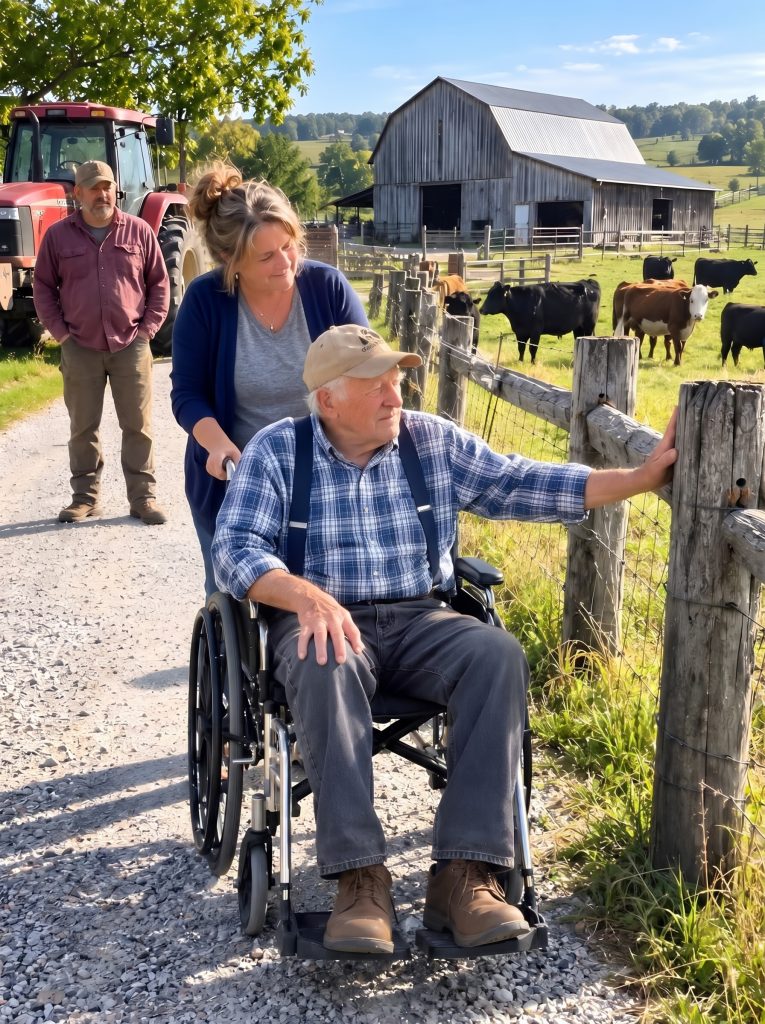
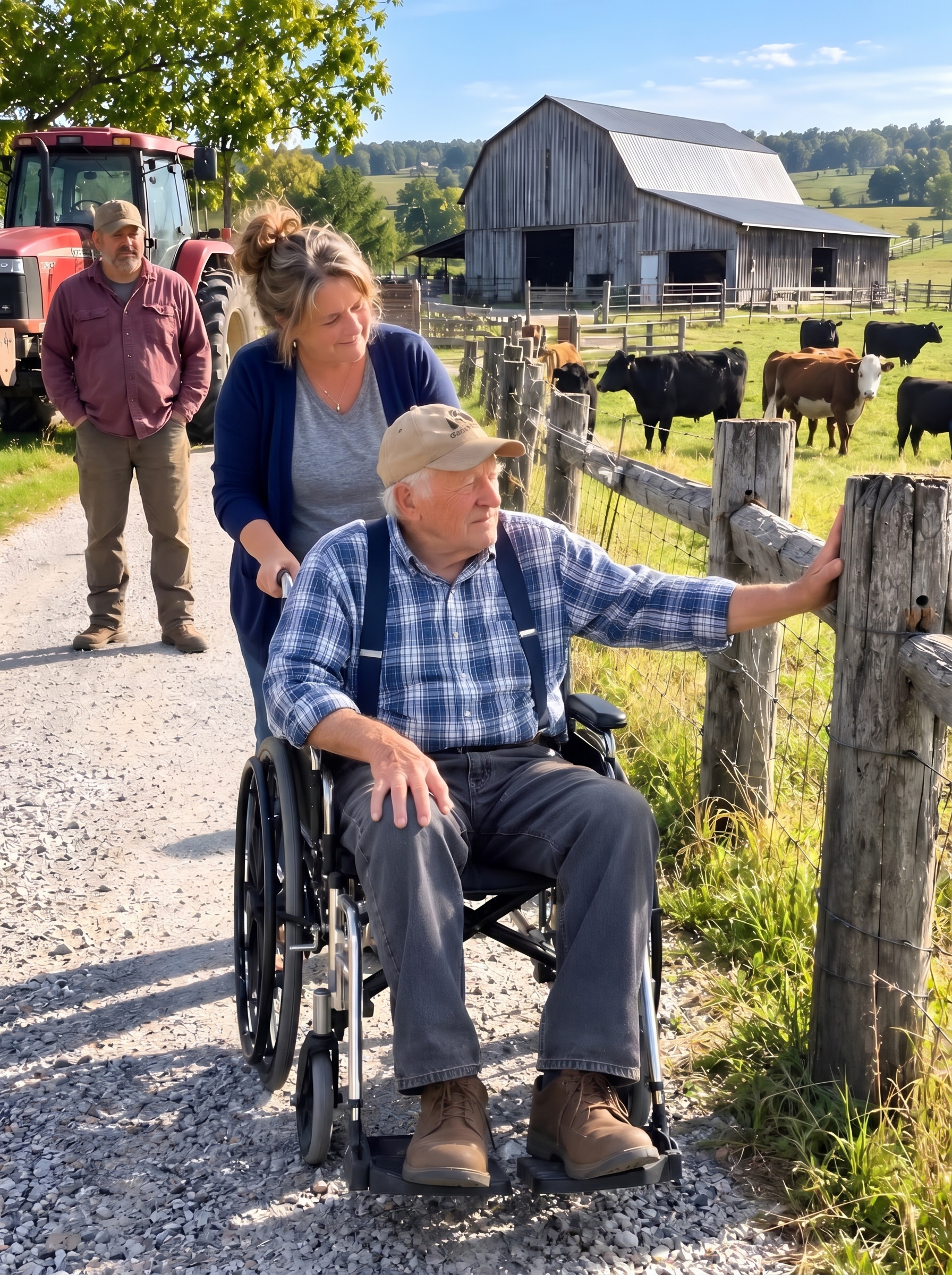
Daddy kept his hand on the old fence post.
“Bobby,” he said, “I need you to tell me exactly how much you’ve paid Sherry since I went into the nursing home.”
Bobby’s cap remained folded between his hands.
I saw his eyes move from Daddy to me, then back again.
“Clayton, I don’t want to cause trouble between you and your girls.”
“You aren’t causing anything.”
Daddy’s voice wasn’t loud.
It didn’t need to be.
“I asked you a question.”
Bobby nodded.
“The first year was twenty-four thousand. We had corn on most of it that year. Next year was twenty-five five. Last year was twenty-six.”
I felt the blood drain from my face.
Daddy remained very still.
“Anything this year?”
“Thirteen thousand in March.”
I stared at Bobby.
“Thirteen?”
He looked uncomfortable now.
“First half.”
My fingers tightened around the wheelchair handles.
Seventy-five thousand five hundred dollars for the first three complete years.
Another thirteen thousand this year.
And during those same three years, I had withdrawn twenty-five thousand two hundred dollars annually from my retirement account.
Seventy-five thousand six hundred dollars.
Nearly dollar for dollar.
For a moment, the coincidence felt so precise that it frightened me.
Daddy looked toward the fields.
“Checks?”
“Yes, sir.”
“Made out to whom?”
Bobby hesitated.
“First one was made out to you. Sherry called after that and told me she’d opened an account to handle farm expenses. Said I should make them payable to Clayton Reeves Farm Management.”
Daddy’s eyes narrowed.
“I don’t own anything called Clayton Reeves Farm Management.”
Bobby’s face changed.
Only slightly, but enough.
He had clearly assumed otherwise.
Daddy tapped one finger against the arm of the wheelchair.
“Do you have copies?”
“My wife keeps everything.”
“I’d like them.”
“You’ll have them.”
“Not Sherry.”
Bobby understood immediately.
“I’ll bring them to wherever you tell me.”
Daddy nodded.
“Thank you.”
Bobby shifted his weight.
Then he said, “Clayton, there’s something else.”
I almost wished he hadn’t.
Daddy turned toward him.
“What?”
“Sherry asked me last winter whether I’d ever be interested in buying the south hundred acres.”
The wind seemed to stop.
Daddy looked toward the distant tree line.
“The south hundred isn’t for sale.”
“That’s what I told her.”
“When did she ask?”
“January, I think.”
“And what did she say?”
“Just that keeping the farm might not make sense anymore with you in the nursing home.”
Daddy’s jaw tightened.
“Anything else?”
Bobby hesitated again.
“She asked what I thought it was worth.”
Daddy gave a short breath through his nose.
That was the closest he came to showing anger.
“I suppose you told her.”
“I told her I wasn’t comfortable talking price unless you were sitting in the room.”
For the first time since Bobby approached us, Daddy smiled.
“Your father raised you right.”
Bobby looked down.
“He’d be glad to hear you say it.”
Daddy glanced toward me.
“Linda.”
“Yes?”
“Take me to the barn.”
I blinked.
“Daddy, the gravel’s rough.”
“Been rough since 1948.”
“It’s different when you’re in a wheelchair.”
“And I’ve been stubborn since before 1948. Push.”
Bobby laughed softly.
It broke something in the tension.
Not much.
But enough that I could breathe again.
We went down the lane slowly.
The wheels caught twice in loose gravel, and Bobby steadied the chair from the front while I pushed from behind. Daddy complained every time either of us tried to help too much.
At the barn, Bobby opened the wide sliding door.
The smell came first.
Dust.
Old wood.
Machine oil.
Hay.
And beneath it all, that cool, earthy scent old barns seem to keep no matter how many decades pass.
Daddy closed his eyes.
For three years, the nursing home had reduced his world to painted corridors, scheduled meals, physical therapy appointments and a television he rarely watched.
Here, he knew every sound.
Every board.
Every scar in the timber.
“Still got my workbench?” he asked.
“Wouldn’t dare move it,” Bobby said.
Against the far wall stood the heavy bench Daddy had built when I was a child.
Someone had swept it clean.
His old red vise was still bolted to one corner.
Daddy wheeled himself close enough to touch it.
“You remember when you got your sleeve caught in that thing?” he asked me.
“I remember you telling everybody about it for the next twenty years.”
“Because you blamed the vise.”
“I was nine.”
“You said it attacked you.”
Bobby laughed.
So did I.
And suddenly I was nine again, standing beside that bench while Daddy loosened the jaws of the vise and explained, with exaggerated seriousness, that tools were innocent until proven guilty.
My eyes burned.
I turned toward the open barn door.
Daddy noticed.
He noticed everything.
“We’re not having a funeral, Linda.”
“I know.”
“I’m still here.”
“I know that too.”
He touched the bench once more.
Then his expression became serious.
“Bobby, who owns the cattle?”
“Me.”
“And you’ve been repairing fences under the lease?”
“Yes, sir.”
“And paying cash rent on the cropland.”
“Yes.”
“Any changes to our written lease?”
“No.”
I looked at Daddy.
“Written lease?”
He looked back at me.
“Of course there’s a written lease.”
“Sherry told me it was informal.”
“Sherry tells you too much.”
Despite everything, I almost smiled.
Bobby went to a dented metal filing cabinet near the office corner.
“My copy’s here.”
He found a folder and brought it over.
Daddy read the first page.
Then the second.
The lease had been renewed five years earlier, before Daddy’s legs failed. It provided for annual cash rent adjusted by acreage and crop use. Bobby was also responsible for routine fence maintenance, while major structural repairs remained Daddy’s responsibility.
There was nothing informal about it.
And nothing that transferred the rent to Sherry.
Daddy closed the folder.
“I want a copy.”
“I’ll make one tonight.”
Daddy nodded.
Then he looked at me.
“Take me home.”
For one hopeful second, I thought he meant the nursing home.
Then I saw where he was looking.
Past the barn.
Toward the white farmhouse at the end of the lane.
I hadn’t been inside since Daddy moved out.
Sherry had told me there was no point. She said she’d covered the furniture, shut off most of the utilities and emptied the refrigerator.
“Daddy—”
“I’d like to see my house.”
So we went.
—
The farmhouse looked smaller than I remembered.
That was my first thought.
My second was that it didn’t look abandoned.
There were tire marks near the side entrance.
Fresh ones.
The porch had been swept.
A planter near the kitchen steps held yellow mums.
I stopped pushing.
“Daddy.”
“I see it.”
Bobby frowned.
“I thought Sherry had somebody checking the place.”
“Who?”
“I don’t know.”
Daddy pointed to the porch.
“Keep going.”
The side door was locked.
I expected that.
What I didn’t expect was Daddy reaching beneath the wooden arm of his wheelchair and pulling out a small brass key.
I stared.
“Where did that come from?”
“My coat pocket.”
“You’ve had a house key at the nursing home for three years?”
“I’ve had a house key since 1956.”
He said it as though I were the unreasonable one.
The lock resisted at first.
Then it turned.
Inside, the kitchen smelled faintly of lemon cleaner.
No dust covered the counters.
The refrigerator hummed.
I opened it.
Milk.
Eggs.
Butter.
A pitcher of tea.
Half a loaf of bread.
I looked at Bobby.
He shook his head.
“Not me.”
Daddy’s face had become unreadable.
The living room furniture wasn’t covered.
A lamp stood beside Daddy’s old recliner.
Fresh newspapers were stacked on the coffee table.
Someone had been living here.
Or spending considerable time here.
I walked into the hall.
“Sherry?”
No answer.
Daddy wheeled himself behind me.
“Look upstairs.”
I went halfway up before something stopped me.
Voices.
No.
Not voices.
A radio.
Very faint.
Coming from Daddy’s bedroom.
My heart began pounding.
I continued up the stairs.
The bedroom door stood open.
The bed was made.
On the dresser were two framed photographs: one of Mama and Daddy on their wedding day and one of Sherry and me as children.
Beside them sat a stack of mail.
I approached slowly.
Most envelopes were addressed to Daddy.
Bank notices.
Farm publications.
Insurance correspondence.
None had been forwarded to the nursing home.
Then I saw an envelope with the name **Clayton Reeves Farm Management** printed in the return-address corner.
Inside was a bank statement.
The balance showed $61,842.17.
I sank onto the edge of the bed.
Daddy was calling from downstairs.
“Linda?”
I couldn’t answer immediately.
“Linda?”
“I’m coming.”
I brought the statement down.
Daddy held it beneath the kitchen window where the light was strongest.
Bobby stood a respectful distance away.
Daddy read the account title.
Then the balance.
Then the list of transactions.
His face changed when he reached the withdrawals.
There were regular payments for property taxes.
Insurance.
Fence supplies.
Those made sense.
But there were others.
Checks written to Sherry.
Transfers to an account ending in 4419.
Thousands at a time.
Daddy turned the page.
“Whose account is 4419?”
“I don’t know.”
He looked at me.
“Do you?”
“No.”
The kitchen clock ticked loudly above the sink.
Then Daddy pointed to one entry.
“What is that?”
I leaned over.
A withdrawal for $26,000 appeared six months after Bobby’s previous annual rent payment.
The memo line said:
**REIMBURSEMENT – L.R.**
“Daddy, who’s L.R.?”
He didn’t answer.
His eyes remained fixed on the page.
“Daddy?”
For the first time that day, something like uncertainty entered his expression.
Not confusion.
Recognition.
Painful recognition.
“I haven’t seen those initials in forty years,” he said.
Bobby quietly put his cap back on.
“I should probably leave you two.”
Daddy nodded.
“Bring me those check copies tomorrow.”
“I will.”
Bobby stepped outside.
I waited until the screen door shut.
“Who is L.R.?”
Daddy folded the statement.
“Your mother’s brother was named Leonard Reeves.”
“Uncle Leonard died before Mama did.”
“I know.”
“Then what does he have to do with this?”
“Nothing.”
Daddy looked toward the stairs.
“Because I’m not talking about Leonard.”
I felt a chill despite the warm kitchen.
“Then who?”
Daddy slowly turned the bank statement over, as though he didn’t want to see the initials anymore.
“L.R. was a woman named Louise Ramsey.”
I had never heard the name.
“Who was she?”
Daddy stared out the kitchen window toward the fields.
“Someone I promised your mother I’d never speak about again.”
I didn’t know what to say.
After a while, Daddy added quietly:
“And unless I am badly mistaken, Louise Ramsey has been dead for twelve years.”
Part 2 — The Name in the Ledger T724
I drove Daddy back to Maple Grove just before supper.
Neither of us talked much.
When we arrived, one of the aides came outside with a blanket because the temperature had dropped. Daddy waved her off until she threatened to tell the kitchen he had complained about the meatloaf.
“Blackmail,” he muttered.
“Effective blackmail,” she said.
Her name was Tasha, and Daddy liked her.
That mattered more to me than I could explain.
Before that day, the nursing home had represented an expense in my mind almost as much as a place. Seven thousand four hundred dollars. Twenty-one hundred short every month. A figure that arrived with the predictability of a mortgage payment and carried the weight of guilt.
Sitting there while Tasha argued with Daddy about a blanket, I remembered something simpler.
This was where he lived.
These were people who knew whether he’d eaten breakfast.
Who knew he preferred the curtains open at sunrise.
Who knew he hated applesauce but would eat two servings of peach cobbler.
Whatever Sherry had done with the money, I didn’t want the truth to turn Daddy’s life into an accounting problem.
I helped him settle into his chair.
“You’re coming tomorrow,” he said.
“Of course.”
“Early.”
“How early?”
“Before your sister has time to organize a parade.”
I sighed.
“Daddy.”
“What?”
“You know we’re eventually going to have to talk to her.”
“Eventually is not tomorrow morning.”
He picked up his newspaper.
Conversation over.
Doug was waiting when I got home.
He had made vegetable soup and cornbread. When I walked through the kitchen door, he looked at my face, turned off the stove and said, “How bad?”
I put my purse down.
“Bad enough that I don’t know what bad means yet.”
Over dinner, I told him everything.
The rent.
The bank account.
The proposed sale of the south hundred acres.
The farmhouse.
The $26,000 reimbursement.
Louise Ramsey.
Doug listened without interrupting.
That was one of the things I loved most about him.
After thirty-eight years of marriage, he understood that sometimes silence was participation.
When I finished, he asked only one question.
“What does your father want?”
“I don’t know yet.”
“Then start there.”
I looked at him.
“What about what I want?”
“You want answers.”
“Yes.”
“And maybe your seventy-five thousand dollars back.”
I stared into my soup.
“I feel guilty even thinking that.”
“Why?”
“Because Daddy’s care was worth paying for.”
“That’s not the question.”
He reached across the table.
“You weren’t donating money, Linda. You were told there was a shortage.”
I knew he was right.
But underneath the anger was something harder to admit.
Humiliation.
For three years I had trusted Sherry without asking for statements.
She was the organized one.
The older sister.
The person who handled Daddy’s insurance renewals, taxes and banking after his mobility declined.
I had been grateful.
Every family develops roles without formally assigning them.
Sherry kept records.
I handled people.
When Mama was dying, Sherry managed medications while I sat beside the bed.
When Daddy entered Maple Grove, Sherry completed the financial paperwork while I hung family photographs on his wall.
Neither role was better.
But somewhere along the way I had mistaken division of labor for permission not to ask questions.
The next morning Bobby delivered a thick envelope.
Inside were copies of every rent check for the previous four years.
Every check had been endorsed.
Most bore the stamp of Clayton Reeves Farm Management.
But the first check—the one made directly to Daddy—had something different.
A handwritten signature.
**Clayton A. Reeves**
I knew Daddy’s signature.
This wasn’t it.
I looked at him.
He had already noticed.
“That’s Sherry’s handwriting.”
“You can tell?”
“I taught her to write her name.”
He placed the check on the table.
“I’m tired of guessing.”
That afternoon we met Daddy’s attorney.
Not Sherry’s attorney.
Daddy’s.
Mr. Keene was seventy-one and worked in an office above the pharmacy downtown. His shelves were lined with binders, law books and framed photographs of local high school baseball teams.
He greeted Daddy with a handshake.
“Clayton, I thought you forgot I existed.”
“I was hoping to.”
“That’s how you know your life is going well.”
Daddy almost smiled.
Then we showed him the documents.
The smile disappeared.
Mr. Keene asked careful questions.
Had Daddy authorized the farm-management account?
No.
Had he signed the rent check?
No.
Had he authorized withdrawals?
Not that he remembered.
Had he given Sherry broad financial power of attorney?
Yes.
“How broad?” I asked.
Mr. Keene opened a file.
“Very.”
My stomach tightened.
“Does that mean she was allowed to do all this?”
“It means she had authority to conduct transactions on his behalf. It does not mean she was entitled to treat his assets as her own.”
Daddy leaned back.
“I don’t want police at my daughter’s door.”
Mr. Keene nodded.
“No one has suggested that.”
“I am suggesting they stay away.”
“Clayton, first we find out what happened.”
“Good.”
“And we secure your accounts.”
“Good.”
“And we review whether your power of attorney should remain in force.”
Daddy looked at him.
“Already decided that.”
Mr. Keene slid a form toward him.
“You can revoke it today.”
Daddy picked up the pen.
His hand shook.
Not from indecision.
His hands had trembled slightly for years.
He signed slowly.
Every letter deliberate.
When he finished, he looked at me.
“You’re not taking her place.”
I blinked.
“I didn’t ask to.”
“I know. That’s why you’re not.”
Mr. Keene concealed a smile.
Daddy continued.
“I want the bank to require my signature and Mr. Keene’s office to receive duplicate statements until we sort this out.”
“Reasonable,” the attorney said.
Then he tapped the mysterious $26,000 transaction.
“And Louise Ramsey?”
Daddy looked toward me.
“I suppose Linda’s old enough to hear about Louise.”
“I’m sixty-four.”
“That’s barely old enough.”
Mr. Keene raised an eyebrow.
“Should I leave?”
“No. You probably know half of it already. This county never forgets anything except what matters.”
Daddy settled his hands in his lap.
“In 1978, your mother and I nearly separated.”
I had never heard that.
Not once.
“You and Sherry were teenagers. Your mother had gone back to work at the school. We were stretched thin. Farm had two bad years. Interest rates were climbing.”
He paused.
“Louise Ramsey worked at First County Bank.”
“Was she—”
“No.”
The firmness of the answer stopped me.
Daddy looked almost offended.
“I did not have an affair.”
“Then why did Mama make you promise never to mention her?”
“Because Louise did us a favor she wasn’t supposed to do.”
Mr. Keene leaned forward.
“What kind of favor?”
Daddy’s eyes went distant.
“The kind that saved the farm.”
He told us that a loan payment had come due during one of the worst seasons he’d ever had. A buyer defaulted on a grain contract. Daddy needed time the bank wasn’t prepared to give him.
Louise, who handled agricultural accounts, found an error in an old loan file.
An insurance credit had never been applied.
“It wasn’t twenty-six thousand,” Daddy said. “Not even close. But she found enough to keep the bank from calling the note.”
“What happened to her?” I asked.
“She was fired.”
“For helping you?”
“Officially for mishandling paperwork.”
“Did you ever repay her?”
“She wouldn’t take anything.”
Daddy looked at the transaction again.
“That’s why this bothers me.”
Mr. Keene asked, “Did Louise have children?”
Daddy’s expression changed.
“One.”
“A son or daughter?”
“Son. Luke.”
There were the initials.
L.R.
“Luke Ramsey,” I said.
Daddy nodded.
“Would Sherry know him?”
“Everybody our age knew everybody.”
“But why would she pay him twenty-six thousand dollars?”
Daddy was silent.
Mr. Keene wrote the name down.
“We’ll find out.”
He didn’t need to.
I did.
That evening, I searched through the boxes Sherry had given me after Mama died.
Christmas cards.
Old school programs.
Receipts.
Photographs.
Near the bottom of a cardboard box marked TAXES / KEEP, I found an envelope addressed to Daddy in Mama’s handwriting.
It had never been mailed.
Inside was a single page.
The date was April 1996.
The first paragraph concerned the farm.
The second concerned us girls.
The third made me sit down on the basement stairs.
*Clayton, if Luke ever comes asking about Louise’s money, please don’t shut the door on him because of what happened between us. Sherry knows enough to misunderstand it, and that is partly my fault.*
I read the line three times.
Then the basement door opened.
Doug looked down at me.
“What did you find?”
I handed him the letter.
He read silently.
Then he turned it over.
There was writing on the back.
One sentence.
Not in Mama’s handwriting.
In Sherry’s.
**I took care of this. Daddy does not need to know.**
Part 3 — What Sherry Thought She Knew T724
I did not call Sherry that night.
That was the hardest thing I did all week.
Not because I was afraid of her.
Because she was my sister.
Anger makes strangers easy.
Family is harder.
Every memory complicates the accusation.
Sherry was the person who taught me to ride a bicycle by running behind me until she fell in the ditch.
She had sewn my prom dress when Mama said the store-bought one cost too much.
She sat beside me through Doug’s gallbladder surgery, drinking bad vending-machine coffee and pretending neither of us was worried.
And now I had a letter in her handwriting saying she had “taken care of” something involving a dead woman’s son and twenty-six thousand dollars from Daddy’s farm account.
People don’t become strangers because you discover one terrible-looking fact about them.
That’s what makes betrayal so confusing.
The person you distrust is still the person you love.
The next morning Daddy read Mama’s letter.
When he finished, he folded it along the original crease.
“Your mother worried too much.”
“About what?”
“Everything.”
“Daddy.”
“I know.”
He looked at the note on the back.
“That’s Sherry’s writing.”
“Yes.”
He was quiet for a long while.
Then he said, “Call her.”
I stared at him.
“Now?”
“Unless you’d rather invite the whole county.”
So I called.
Sherry answered on the third ring.
“Hey. I was just about to call you. Maple Grove sent me—”
“Daddy wants to see you.”
Silence.
“When?”
“Today.”
Another silence.
“Is this about Sunday?”
I looked at Daddy.
He nodded once.
“Yes.”
Her sigh came through the phone.
“I wish you’d called me before taking him out there.”
Something in me hardened.
“Why?”
“Because he gets upset.”
Daddy held out his hand.
I gave him the phone.
“Sherry.”
Her voice changed instantly.
“Daddy.”
“I’m sitting in Mr. Keene’s office at two o’clock. Be there.”
“Daddy, I can explain—”
“Good. Two o’clock.”
He ended the call.
I stared.
“You’ve gotten rude.”
“I’ve gotten eighty-four.”
—
Sherry arrived seven minutes early.
She wore navy slacks, a cream blouse and the silver necklace her husband, Ray, had given her for their fortieth anniversary.
She carried a leather folder.
That frightened me more than if she’d arrived shouting.
It meant she had prepared.
Sherry kissed Daddy’s cheek.
Then she looked at me.
“Linda.”
“Sherry.”
Mr. Keene closed the door.
Daddy began.
“I revoked your power of attorney yesterday.”
Sherry’s face went pale.
She looked at me.
I nearly protested.
But Daddy spoke first.
“Don’t look at your sister. I did it.”
“Daddy, why?”
“Because you opened an account in my name without telling me.”
“I opened it for the farm.”
“You deposited rent there.”
“Yes.”
“Why wasn’t the rent paying Maple Grove?”
Sherry blinked.
“It was.”
“No,” I said.
She looked at me.
“I’ve been paying the difference every month.”
“I know.”
The words landed strangely.
Not as a confession.
As something sadder.
“I know,” she repeated.
I leaned forward.
“Then why did you let me?”
“Because the farm money wasn’t available.”
“It was sitting in an account.”
“Not all of it.”
“Sixty-one thousand dollars is sitting there now.”
Sherry closed her eyes.
For a moment, she looked exhausted.
Not guilty.
Not yet.
Just tired.
Daddy said, “Tell me about Luke Ramsey.”
Her eyes opened.
There it was.
Recognition.
“Where did you hear that name?”
“I’ve known the name longer than you have.”
Sherry looked toward the attorney.
“Do we have to do this here?”
“Yes,” Daddy said.
She sat straighter.
“Fine.”
Then she turned to me.
“You think I stole from him.”
“I think I don’t know what you did.”
“That’s different.”
“Then explain it.”
Sherry opened her folder.
Inside were years of statements.
Receipts.
Invoices.
Canceled checks.
She arranged them carefully.
“Three years ago, when Daddy went into Maple Grove, I started going through everything. The farm account, taxes, insurance, Mama’s papers.”
She slid a document across the desk.
It was a promissory note.
Dated 1979.
Borrower: Clayton A. Reeves.
Lender: Louise M. Ramsey.
Amount: $18,000.
Daddy stared at it.
“I never signed this.”
“I know.”
“What?”
Sherry pointed to the signature.
“That’s Mama’s.”
Daddy pulled the paper closer.
His face changed.
“It is.”
I felt lost.
“Mama borrowed money from Louise?”
Sherry nodded.
“Apparently.”
Daddy whispered, “Eighteen thousand.”
Mr. Keene examined the note.
“Was it repaid?”
“Not according to Luke.”
Daddy looked up.
“You spoke to him?”
“Yes.”
“When?”
“Two years ago.”
“And you paid him twenty-six thousand.”
“Last year.”
I found my voice.
“Why twenty-six?”
“Principal plus what I thought was fair after all these years.”
“You thought?”
Sherry’s tone sharpened.
“Someone had to make a decision.”
Daddy stared at her.
“With my money.”
“It was your debt.”
“It was your mother’s note.”
“You benefited from it.”
“Maybe I did. Maybe I didn’t. You didn’t ask.”
Sherry’s hands tightened.
“No, because every time I asked you anything about those years, you told me it was none of my business.”
Daddy looked away.
That struck something.
Not legal.
Not financial.
Personal.
Sherry continued, quieter now.
“I found Mama’s letters. Not just the one Linda found. All of them.”
My heart jumped.
“All of them?”
She reached into her folder.
There were six.
Every one addressed to Daddy.
Every one unsent.
“I found them in the cedar chest.”
Daddy didn’t touch them.
Sherry said, “Mama thought Louise gave you the money because she loved you.”
Daddy’s face hardened.
“Your mother was wrong.”
“Was she?”
“Yes.”
“You never told her that?”
“I told her until she got tired of hearing it.”
Sherry’s voice trembled for the first time.
“I was seventeen. I heard you fighting. I heard Mama crying. Then Louise disappeared from the bank, and everybody in town talked. Do you understand what I thought happened?”
Daddy said nothing.
“I spent forty-five years thinking you almost left us.”
He looked at her.
“Sherry.”
“No. You wanted me to explain. I’m explaining.”
Her eyes had filled.
“I found that note after Mama died. Then Luke contacted me when he heard the farm was still in the family. He didn’t threaten anyone. He didn’t demand anything. He said he’d found his mother’s records after cleaning out her house.”
“Why didn’t you tell me?” Daddy asked.
“Because I thought you would refuse to pay him out of pride.”
“You thought wrong.”
“Maybe.”
“No. You did.”
Sherry wiped beneath one eye.
“Fine.”
The room became quiet.
Then I asked the question that still mattered to me.
“What does any of this have to do with my retirement money?”
Sherry looked at me.
“Nothing.”
“Exactly.”
“No, Linda. You don’t understand.”
“Then make me.”
She hesitated.
“I didn’t tell you about the farm rent because Daddy always said he wanted the farm to support itself. Taxes went up. The barn roof needed work. The west fence needed replacing. I kept the rental money separate.”
“And let me pay twenty-one hundred a month.”
“You offered.”
“Because you told me there was no money!”
“I said there was no liquid savings in his regular account.”
“That is not the same thing and you know it.”
She flinched.
Good.
I hated thinking that.
But I did.
“You watched me take money out of my retirement every month.”
“I was going to pay you back.”
“When?”
“When the farm account was stable.”
“It had sixty-one thousand dollars.”
“After this year’s rent.”
“How stable did it need to be?”
Sherry looked down.
Daddy asked quietly, “Were you planning to sell the south hundred?”
Her head rose sharply.
“Bobby told you.”
“Answer me.”
“I was exploring options.”
“My land.”
“Yes.”
“Without asking me.”
“I couldn’t sell it without your signature.”
“But you got it appraised.”
My breath caught.
Sherry stared at him.
“How did you know?”
Daddy looked almost amused.
“I didn’t.”
For one brief second, even Mr. Keene smiled.
Then Sherry leaned back.
“Yes. I got an appraisal.”
“Why?”
“Because Maple Grove increases its rates every year, and the long-term care policy has a fixed benefit. I was trying to plan.”
“You were planning my future without including me in it.”
Sherry’s face crumpled then.
Not dramatically.
Just enough that I saw the daughter underneath the administrator.
“Because every time I tried to discuss money, you said you’d handled money longer than I’d been alive.”
Daddy’s expression softened.
Only slightly.
“And I had.”
“That didn’t mean you could still do everything.”
“No.”
“You couldn’t walk through the farm anymore. You couldn’t get to the bank. You couldn’t go through forty years of files. I was trying to hold everything together.”
“By lying to Linda?”
Sherry looked at me.
“I shouldn’t have done that.”
It was the first uncomplicated sentence she had spoken.
No explanation attached.
No qualification.
Just that.
I felt some of my anger loosen, though it didn’t disappear.
Daddy tapped Mama’s promissory note.
“Did Luke give you proof this was real?”
“He had his mother’s ledger.”
“Do you have a copy?”
“Yes.”
She handed over another document.
Mr. Keene studied it.
Then frowned.
“What?”
Daddy asked.
The attorney turned the copy around.
Louise had recorded the $18,000 payment in 1979.
But beside it, in handwriting different from the rest, was another entry.
**Paid in full – C.R. – 1986**
Daddy stared.
“I knew it.”
Sherry leaned forward.
“What?”
“I paid her.”
“How?”
“After we sold the timber off the east ridge.”
His eyes sharpened with memory.
“Eighteen thousand plus six years’ interest. I drove to her house myself.”
Sherry went white.
“But Luke said—”
“Luke may not have known.”
Daddy looked at the ledger.
“Or he did.”
Mr. Keene said, “Before we assume anything, we verify.”
Sherry had gone silent.
The possibility was settling over her.
She had taken $26,000 from Daddy’s account to settle a debt that might not have existed.
Not for herself.
But without permission.
Without checking.
I should have felt vindicated.
Instead I felt tired.
Then Mr. Keene noticed something else.
“Clayton.”
He pointed to the initials beside the 1986 entry.
“C.R.”
Daddy nodded.
“Me.”
“Your middle initial is A.”
The room went still.
Daddy looked more closely.
My skin prickled.
Mr. Keene continued.
“Who was C.R.?”
Daddy didn’t answer.
Sherry did.
Her voice had fallen almost to a whisper.
“Celia Reeves.”
I turned.
“Who?”
Sherry was staring at Daddy.
“Our mother.”
Mama.
Celia Reeves.
Daddy closed his eyes.
And suddenly the mystery wasn’t whether the debt had been paid.
It was why Mama had secretly paid it herself.
Part 4 — The Things Our Mother Kept T724
We spent two days learning how little any of us truly knew about Mama.
That realization bothered me more than the missing money.
Children believe they know their parents because they know their habits.
Mama liked her coffee weak.
She folded towels in thirds.
She hummed hymns while shelling peas.
She kept birthday cards for years.
She disliked thunderstorms but pretended not to.
I knew those things.
I knew what perfume she wore.
I knew which side of the bed she slept on.
I knew how she looked when she was about to laugh in church.
But none of that meant I knew the whole woman.
Neither did Daddy.
That surprised him most.
On Thursday, Sherry came to my house carrying the cedar box where she’d found Mama’s letters.
We sat at my kitchen table.
Not Mr. Keene’s office.
Not Maple Grove.
Just the two of us.
Doug made coffee and wisely disappeared to the garage.
Sherry looked older than she had a week before.
“So,” she said, “are you still mad at me?”
“Yes.”
She nodded.
“I figured.”
“I’m also glad you’re here.”
“Both can be true.”
“Apparently.”
That was the first peace offering.
Small, but real.
We sorted Mama’s papers chronologically.
Most were ordinary.
Receipts.
Church bulletins.
Recipes.
One note reminding herself to call the furnace repairman.
Then we found a bank deposit slip from June 1986.
Twenty-four thousand three hundred dollars.
The source was handwritten:
**Timber proceeds.**
That fit Daddy’s memory.
But the account wasn’t his.
It was Mama’s.
“She had her own account?” I asked.
Sherry nodded.
“Teachers’ credit union.”
“Did Daddy know?”
“I don’t.”
We found a withdrawal six days later.
Twenty-four thousand three hundred dollars.
Then nothing.
No receipt from Louise.
No canceled check.
Sherry turned the slip over.
Mama had written four words on the back.
**Louise kept her promise.**
I read them aloud.
Sherry exhaled.
“What promise?”
We took everything to Daddy.
For once he didn’t pretend to know.
“I have no idea.”
“Could Mama have paid Louise without telling you?” I asked.
“Apparently she could do many things without telling me.”
There was hurt in his voice.
I sat beside him.
“Daddy, people keep secrets because they’re scared too.”
He looked at me.
“Is that supposed to make me feel better?”
“No.”
“Good.”
Sherry stood near the window.
“I called Luke.”
Daddy’s head snapped toward her.
“You did what?”
“I told him we had questions about the payment.”
“What did he say?”
“He agreed to meet us.”
“You arranged that without asking me too?”
She gave him a weary look.
“I asked whether he would meet. I didn’t tell him when.”
Daddy considered that.
“Improvement.”
Sherry almost smiled.
We met Luke Ramsey the next morning at Mr. Keene’s office.
He was sixty-two, with thinning silver hair and the heavy shoulders of someone who had worked with his hands most of his life.
He looked nervous.
That surprised me.
In my imagination, Luke had become either a swindler or the keeper of some dramatic family secret.
In person, he looked like a man who wished he’d never answered his telephone.
He shook Daddy’s hand.
“Mr. Reeves.”
“Luke.”
“I haven’t seen you since my mother’s funeral.”
“I remember.”
Luke sat down.
Sherry began.
“I need to ask about the twenty-six thousand dollars.”
Luke looked at her.
“I wondered when that was coming.”
“You told me the 1979 loan hadn’t been repaid.”
“No.”
Sherry frowned.
“You did.”
“I said I found a note that appeared unpaid.”
“That’s the same thing.”
“It isn’t.”
She stared.
Luke looked embarrassed.
“Sherry, I told you I wasn’t sure. You were the one who said your father would never admit he owed anybody.”
Daddy grunted.
“That does sound like her.”
Sherry ignored him.
“Why did you accept the money?”
Luke looked at Daddy.
“Because I thought maybe it was owed.”
“Twenty-six thousand dollars?”
“I told her eighteen was the amount on the paper. She added the rest.”
Sherry’s cheeks reddened.
“You could have refused.”
“Yes.”
It wasn’t defensive.
That made the admission harder.
Luke folded his hands.
“I should have.”
Daddy studied him.
“What did your mother tell you about that loan?”
“Almost nothing.”
“What about 1986?”
Luke shook his head.
“She never discussed money.”
I placed the ledger copy on the table.
“What about this?”
He looked at the C.R. notation.
“I never saw that.”
Sherry sat forward.
“It was on the copy you gave me.”
“No. It wasn’t.”
The room became very quiet.
Mr. Keene asked, “Do you still have the original ledger?”
“Yes.”
“Where?”
“Home.”
“Would you be willing to bring it?”
“Sure.”
Luke looked genuinely confused.
“I made photocopies at the library. Maybe I copied the wrong page.”
“That’s a fairly important difference,” Sherry said.
“I know.”
His face tightened.
Then Daddy asked, “Did your mother ever mention Celia?”
Luke looked at him.
“Your wife?”
“Yes.”
A long pause.
“Once.”
Every eye turned toward him.
“When?”
“Near the end. She was in hospice.”
He looked down.
“She said Mrs. Reeves was the bravest woman she’d ever known.”
Daddy’s face changed.
“Why?”
“She didn’t say.”
The original ledger solved one question.
The C.R. notation was real.
It had been written in blue ink several years after the original black-ink loan entry.
Luke hadn’t noticed it because the photocopy he’d given Sherry cut off the far right edge of the page.
A mundane explanation.
No conspiracy.
No forged record.
Just an incomplete photocopy and two people who had drawn conclusions too quickly.
But the bigger mystery remained.
What had Mama done?
Mr. Keene suggested searching public records from the period.
We found the answer not in a bank record but in an old newspaper.
A digitized issue of the county weekly from August 1986 contained a small article on page eleven.
**LOCAL WOMAN ASSISTS BANK INVESTIGATION**
No photograph.
Only three paragraphs.
Louise Ramsey had provided information during an investigation into improper agricultural lending practices at First County Bank.
Several borrowers had been charged fees that were not permitted under their loan agreements.
Refunds followed.
One bank officer resigned.
No criminal charges were filed.
Daddy read the article twice.
Then he whispered, “My God.”
“What?” I asked.
He looked stunned.
“That’s what she found.”
“Who?”
“Louise. In 1978.”
The favor had not been invented paperwork.
Louise had discovered the bank was overcharging several farm borrowers.
Including Daddy.
When she tried to correct the problem internally, she was blamed for mishandling accounts and pushed out.
Mama had believed Daddy’s friendship with Louise caused the trouble.
Perhaps other people had too.
For years, the family story had been shaped by jealousy and rumor.
But why the private loan?
That answer came from Luke.
After reading the article, he returned home and searched his mother’s papers again.
He came back that afternoon with an envelope.
On the front, in Louise’s handwriting, were the words:
**For Celia, if she ever asks.**
The envelope had never been opened.
Luke gave it to Daddy.
“You should.”
Daddy shook his head.
“Linda.”
I opened it.
Inside was a letter.
Louise had written that after being dismissed from the bank, she’d learned the Reeves loan might be called due before the disputed charges were resolved.
She had eighteen thousand dollars from an inheritance.
She offered it to Mama—not Daddy—so the family could protect the farm temporarily.
Mama accepted.
Seven years later, after the bank settlement and a good timber sale, she repaid Louise with interest.
The letter ended with one sentence that made Daddy cover his eyes.
*Celia, there was never anything between Clayton and me except a friendship I valued, and I am sorry that helping him brought pain into your home.*
Nobody spoke.
Finally Daddy lowered his hand.
“Forty-eight years.”
His voice cracked.
“She knew.”
“Eventually,” I said.
“Why didn’t she tell me?”
Luke answered unexpectedly.
“Maybe she was ashamed she’d doubted you.”
Daddy looked at him.
Luke shrugged.
“My mother was ashamed people thought she’d done something wrong. Shame makes people quiet.”
Sherry stared at the table.
That sentence belonged to her too.
We all knew it.
Daddy did something then I hadn’t expected.
He reached across and put his hand over Sherry’s.
She looked up.
“I made a mess,” she whispered.
“Yes.”
Her mouth trembled.
“You could soften it a little.”
“I’m eighty-four, remember?”
She laughed despite herself.
Then cried.
Not loudly.
Daddy kept his hand over hers.
“We fix what can be fixed,” he said.
Sherry nodded.
Luke spoke from across the table.
“I can return the twenty-six.”
Everyone looked at him.
He swallowed.
“I haven’t spent most of it. I paid off my truck and put the rest in savings. I’ll return it.”
Daddy said, “You keep the interest.”
Luke blinked.
“No.”
“The eighteen was paid. The rest wasn’t yours. Return the eighteen.”
“Daddy,” Sherry said.
He lifted one finger.
“My decision.”
She stopped.
“I’ll accept the eighteen,” Daddy continued. “The other eight thousand was Sherry’s mistake, not yours.”
Sherry looked horrified.
“My mistake should come out of my money.”
Daddy nodded.
“Then repay the eight.”
“I will.”
No shouting.
No threats.
Just consequences spoken plainly across a table.
For the first time since I’d found the tax document, the knot inside me loosened.
Then Daddy turned to me.
“Now yours.”
I frowned.
“What?”
“Seventy-five thousand six hundred dollars.”
“I don’t want—”
“Don’t start.”
“Daddy, I was paying for your care.”
“You were paying because you were lied to about what I had.”
Sherry closed her eyes.
I looked at her.
She said, “He’s right.”
That surprised me more than anything else that day.
“I’ll make it right,” she said.
“You can’t personally repay that.”
“No. But the farm can.”
Daddy nodded.
“Farm owes Linda.”
“No, Daddy.”
“Farm owes Linda.”
His voice settled the matter.
Or so he thought.
We would argue about it later.
Families require certain traditions.
Before we left, Mr. Keene cleared his throat.
“There’s still one unresolved issue.”
Daddy frowned.
“Which one?”
“The farmhouse.”
Sherry looked confused.
“What about it?”
I turned to her.
“The food. Newspapers. Fresh flowers.”
Her expression became blank.
“I haven’t been staying there.”
“Then who has?”
“I thought you knew.”
“Knew what?”
She looked at Daddy.
“Daddy, you’ve been renting the house.”
He stared at her.
“No, I haven’t.”
“Someone has been sending checks.”
“Who?”
Sherry opened her folder and pulled out another statement.
“I assumed you’d arranged it before you moved.”
Daddy read the deposits.
Nine hundred dollars.
Every month.
For thirty-one months.
The payer name was abbreviated.
**M. REEVES**
I stared at it.
“Who is M. Reeves?”
Nobody answered.
There were no M. Reeveses in our immediate family.
At least none I knew.
Then Daddy’s face went pale.
Not puzzled.
Not surprised.
Afraid.
I had never seen that expression on him before.
Sherry saw it too.
“Daddy?”
He folded the statement.
“Take me back to the farm.”
“Why?”
His voice was barely audible.
“Because I think I know who’s living in my house.”
Part 5 — The Room at the End of the Hall T724
We returned to the farm on Saturday.
This time Doug came.
So did Sherry.
Daddy didn’t object.
Whatever waited in the farmhouse no longer belonged to one daughter or the other.
The four of us drove in two cars.
Autumn had deepened during the week.
The maples along the road had turned red, and the pasture grass had begun losing its summer brightness.
Bobby was repairing a gate near the lower field when we passed.
He lifted one hand.
Daddy waved from the passenger seat.
For all the secrets we’d uncovered, the farm remained stubbornly ordinary.
That comforted me.
Cows still needed feeding.
Fences still sagged.
Leaves still fell whether families understood one another or not.
At the house, the same small car tracks marked the gravel.
Daddy studied them.
“You recognize them?” I asked.
“No.”
“But you think you know who’s here.”
“I think I know who M. Reeves might be.”
Sherry leaned toward him.
“Who?”
Daddy looked at the farmhouse.
“Your cousin.”
Sherry frowned.
“We don’t have a cousin named M.”
“I didn’t say your first cousin.”
He refused to explain further.
Doug unfolded Daddy’s wheelchair.
I helped him in.
Before we reached the porch, the screen door opened.
A woman stepped outside.
She was perhaps seventy.
Tall.
Silver-haired.
She wore jeans and a green cardigan and held a dish towel in one hand.
She stared at Daddy.
Daddy stared back.
Neither spoke.
Then she said:
“Hello, Clayton.”
Daddy closed his eyes briefly.
“Martha.”
Sherry whispered, “Who is that?”
The woman looked at us.
“Martha Reeves.”
I felt no recognition.
Daddy supplied the missing piece.
“My brother Edwin’s daughter.”
I stared.
“Uncle Edwin didn’t have children.”
Martha smiled without humor.
“That’s what the family preferred to say.”
Daddy flinched.
There are moments when a mystery expands.
And moments when it becomes painfully simple.
Martha was born before Edwin married the aunt I’d known as a child. Her mother had raised her in another county.
Daddy had known.
Mama had known.
Almost nobody else did.
“Why are you living here?” Sherry asked.
Martha looked at Daddy.
“Because he invited me.”
Three heads turned toward him.
Daddy said nothing.
I crouched beside his chair.
“Daddy.”
“I invited her six years ago.”
My confusion sharpened.
“You said you didn’t know who was living here.”
“I said I wasn’t renting the house.”
Martha crossed her arms.
“Technically, he’s not.”
She looked embarrassed.
“The nine hundred isn’t rent.”
“What is it?” Sherry asked.
“Repayment.”
Of course.
Another repayment.
Our family apparently couldn’t pass money across a kitchen table without turning it into a forty-year mystery.
Martha invited us inside.
The tea in the refrigerator was hers.
So were the newspapers and the yellow mums.
She stayed at the farmhouse several days each month while overseeing a conservation project on neighboring land.
Six years earlier, her husband had died, leaving her with unexpected debt. Daddy had lent her twenty-seven thousand dollars.
“Why didn’t anyone know?” I asked.
Martha answered gently.
“Because I asked him not to tell anyone.”
Daddy looked defensive.
“It was her business.”
Sherry laughed once.
Not because anything was funny.
“Apparently privacy is our family religion.”
Daddy glared at her.
She raised both hands.
“I’m just saying.”
Martha had repaid nine hundred dollars monthly for thirty months, then missed several payments while dealing with medical expenses.
Daddy had told her not to worry about it.
When he entered Maple Grove, she resumed payments.
“But where did the money go?” I asked.
“Sherry’s farm account,” Martha said.
Sherry stared.
“I never knew what those were.”
“The checks said loan repayment.”
“The bank statements only showed your name.”
Daddy groaned.
“Does nobody in this family read the checks anymore?”
“Apparently not,” I said.
Doug coughed into his hand to hide a laugh.
Even Sherry smiled.
For the first time, the farmhouse felt less like a crime scene and more like a family home again.
We sat around the kitchen table.
Martha made coffee.
Daddy told us about Edwin.
How his older brother had fallen in love with a woman his parents considered unsuitable.
How Martha was born.
How Edwin had wanted to bring mother and daughter home.
How their father refused.
“My father could be a hard man,” Daddy said.
I thought of the fence post outside.
The one Daddy had touched so tenderly.
Memory does that.
It keeps love without erasing the flaws.
“Edwin sent money,” Daddy continued. “Visited when he could. But after he married Aunt Pauline, everybody pretended the earlier life hadn’t happened.”
“Everybody?” Sherry asked.
“Including me.”
Martha looked at him.
“You were nineteen.”
“I was old enough.”
She shrugged.
“You found me later.”
Not until after Edwin died, I learned.
Daddy had contacted Martha.
Mama had welcomed her quietly.
The three of them had maintained a relationship for years without telling us.
“Why?” I asked.
Daddy looked embarrassed.
“Because once you’ve kept something quiet for thirty years, announcing it gets harder.”
That sentence explained nearly everything that had happened.
Louise.
The loan.
Martha.
Sherry’s decisions.
My assumptions.
None of our secrets had begun as grand deceptions.
They began as small avoidances.
A conversation postponed.
An embarrassment concealed.
A decision made alone because explaining it seemed difficult.
Then years accumulated around them until the silence became larger than the truth.
Sherry stood by the sink.
“I owe everyone an apology.”
Martha looked bewildered.
“You don’t owe me anything.”
“Give me a minute.”
She turned to Daddy first.
“I treated managing your finances like managing a project. I forgot that you weren’t a project.”
Daddy nodded.
“I also made it difficult to help me.”
Sherry blinked.
That was as close to a reciprocal apology as she was going to get.
Then she faced me.
“I lied by omission about the rent.”
“Yes.”
“I told myself I was protecting the farm.”
“I know.”
“I also resented you.”
That surprised me.
“For what?”
“Being the good daughter.”
I almost laughed.
“Sherry, I was taking twenty-one hundred dollars out of retirement every month and complaining to Doug about it.”
“You visited Daddy more.”
“You handled everything.”
“You sat with Mama.”
“You changed every dressing after her surgery because I almost fainted.”
Martha watched us like a tennis match.
Sherry shook her head.
“Do you realize how stupid this sounds?”
“Extremely.”
We both laughed.
Then we cried.
There wasn’t a dramatic embrace.
Not immediately.
Real reconciliation is awkward.
First you wipe your nose.
Then you say something practical.
Then, if you’re lucky, you find your way back to each other.
Daddy watched us.
“Finished?”
“No,” Sherry and I said together.
That made Doug laugh openly.
—
The financial repair took weeks.
Mr. Keene and an accountant reconstructed every farm transaction.
There was no hidden fortune.
No secret theft for a lavish lifestyle.
There had been poor judgment, unauthorized decisions, incomplete records and one serious breach of trust.
The truth was less sensational than theft.
It was also more painful in some ways.
Sherry had convinced herself that competence gave her the right to decide what everyone else needed to know.
She had been wrong.
Luke returned eighteen thousand dollars.
Sherry personally repaid eight thousand to Daddy’s account.
Daddy insisted that the farm reimburse me for the nursing-home shortfall I’d covered.
I refused twice.
On my third refusal he threatened to rewrite his will leaving me his collection of broken lawnmowers.
I accepted.
Not all at once.
The accountant structured monthly repayments so the farm retained enough cash for taxes and maintenance.
Doug and I put most of it back into retirement.
We used a little to replace our twelve-year-old furnace.
“Scandalous,” Daddy said when I told him.
“Wait until you hear we bought a refrigerator too.”
“Reckless.”
Sherry resigned as financial power of attorney.
Daddy replaced the arrangement with something far better: shared oversight.
The accountant received statements.
Mr. Keene’s office retained copies of major legal documents.
Sherry handled routine farm paperwork, because despite everything, she was good at it.
But Daddy reviewed decisions.
So did I when he asked.
No one person held every key.
That was his choice.
It was a wise one.
The question of selling the farm returned in November.
This time, we discussed it around a table.
Daddy.
Sherry.
Me.
Bobby.
Mr. Keene.
No secrets.
No appraisal hidden in a folder.
Bobby wanted to continue farming.
Daddy wanted the land kept together if possible.
Sherry worried about future care costs.
I worried about maintaining a two-hundred-acre property none of us could personally farm.
Eventually Daddy said, “We’re solving a problem that doesn’t exist yet.”
He was right.
The farm generated enough income to help cover his care.
The long-term policy and Social Security covered most of the rest.
There was no immediate reason to sell.
So we didn’t.
That decision felt almost revolutionary.
To simply wait.
To refuse to let fear make choices before circumstances required them.
—
At Thanksgiving, we ate at the farmhouse.
Daddy insisted.
Maple Grove arranged transportation, and Tasha came along on her day off because she said somebody had to keep him from “trying anything foolish.”
He responded by asking whether pie counted as foolish.
“Depends how many pieces.”
“Then don’t watch.”
Martha joined us.
So did Bobby and his wife.
Even Luke came for dessert after Daddy invited him.
That surprised Sherry.
“Daddy, isn’t that awkward?”
“Only if everybody behaves awkwardly.”
There was no arguing with that.
After dinner, Daddy asked Doug and Bobby to help him onto the porch.
The afternoon was cool but bright.
From the porch, the fields rolled toward the distant woods.
Harvest was finished.
Bare branches traced dark lines against the pale November sky.
I tucked a blanket over Daddy’s knees.
He immediately removed it.
Tasha replaced it.
He glared.
She ignored him.
Sherry brought coffee.
For several minutes, none of us spoke.
Then Daddy said, “I wasted a lot of time.”
I looked at him.
“On what?”
“Thinking silence kept peace.”
Sherry sat down.
Daddy stared toward the barn.
“My father believed family business stayed inside the family.”
“Isn’t that what we’re doing?” I asked.
“No. He meant problems stayed inside each person.”
That was different.
Daddy rubbed his thumb over the head of his cane.
“I thought if you didn’t speak about something, you spared people.”
Martha watched him.
“Sometimes you do.”
“Sometimes.”
He looked at her.
“And sometimes you just make the next generation solve a puzzle.”
Sherry laughed.
“We’ve solved enough puzzles.”
“Not all.”
She stiffened.
“What now?”
Daddy smiled.
“There’s a metal box under the floorboards in the old barn.”
I stared at him.
“Daddy.”
“What?”
“No.”
“You don’t even know what’s in it.”
“I don’t want to know.”
“You will eventually.”
Sherry pointed at him.
“If that box contains another mysterious loan, I’m putting you back in the nursing home myself.”
“I already live there.”
“Then I’ll put you in a worse room.”
Tasha nearly spilled her coffee laughing.
Daddy grinned.
That was the moment I knew we were going to be all right.
Not because the money had been recovered.
Not because every mystery had been solved.
Because we could tease one another again.
There is a point after hurt when humor returns.
It doesn’t erase what happened.
It tells you the relationship survived it.
Before sunset, I pushed Daddy down the lane toward the same fence post he had touched weeks earlier.
He rested his hand against it.
“This old thing’s leaning.”
“It has been there sixty-five years.”
“That’s no excuse.”
“Should I call Bobby?”
“Next spring.”
I smiled.
“You planning that far ahead?”
“Why wouldn’t I?”
There was no good answer.
He looked across the empty soybean field.
“Your grandfather and I put this post in when I was nineteen.”
“I remember.”
“No, you remember me telling you.”
He was right.
He had told the story so many times that I’d mistaken it for my own memory.
Daddy rubbed his palm against the weathered wood.
“That’s how families work, I suppose.”
“What do you mean?”
“You inherit memories you weren’t there for.”
He looked toward the farmhouse.
“And sometimes you inherit silence too.”
The porch light came on behind us.
Sherry stood in the doorway.
“Pie!” she shouted.
Daddy immediately turned his wheelchair.
“Push.”
I laughed.
“Five minutes ago you wanted to admire the farm.”
“Farm will be here tomorrow.”
“Pie won’t?”
“Not if Bobby stays.”
We started back.
Halfway to the house, Daddy touched my arm.
“Linda.”
I stopped.
“What?”
“Thank you.”
I knew what he meant.
Not the money.
Not the drive to the farm.
Not the paperwork.
All of it.
I bent and kissed his temple.
“You’re welcome.”
He looked annoyed.
“You don’t know what I’m thanking you for.”
“Then tell me.”
“For showing me the paper instead of deciding what to do about it yourself.”
I thought about that.
It seemed such a small thing.
But it wasn’t.
The entire trouble had grown from people deciding for other people.
Sherry deciding Daddy shouldn’t worry about money.
Mama deciding Daddy shouldn’t know she’d repaid Louise.
Daddy deciding we didn’t need to know about Martha.
I had done the only thing none of them had done.
I handed the truth to the person it belonged to.
Daddy looked back toward the house.
“Don’t let me become someone everybody whispers around just because my legs quit working.”
“I won’t.”
“Promise.”
“I promise.”
We reached the porch as Sherry opened the door.
“You two discussing me?”
“Usually,” Daddy said.
She rolled her eyes.
Inside, everyone was talking at once.
Coffee cups moved around the table.
Doug was cutting another pie.
Martha was showing Bobby’s wife an old photograph.
Luke stood near the mantel studying a picture of Mama and Daddy taken decades ago.
For years, I’d thought family history was made of the things people remembered.
I understood now that it was also shaped by what they concealed, misunderstood and eventually found the courage to ask about.
I pushed Daddy into the kitchen.
Sherry placed a slice of pecan pie in front of him.
“Small piece,” she warned.
Daddy examined it.
“This is an insult.”
“It’s plenty.”
“I nearly lost eighty thousand dollars this month. I’ve earned more pie.”
“That is not how cholesterol works.”
“Nobody asked cholesterol.”
Martha laughed.
So did Luke.
I stood in the doorway watching them.
A month earlier, I would have said the discovery of that $26,000 payment was the moment everything began to fall apart.
I no longer believed that.
Things had been apart for years.
We simply hadn’t noticed the spaces.
The payment didn’t break our family.
It showed us where the cracks already were.
And because Daddy was still here—still stubborn, still sharp, still asking questions—we had been given something families don’t always receive.
Time to repair them.
Later that evening, when everyone had gone except Sherry, Doug and me, Daddy reminded us about the metal box beneath the barn floor.
Sherry groaned.
“I thought you were joking.”
“I wasn’t.”
“What is in it?”
Daddy’s eyes gleamed.
“If I tell you, you won’t have to look.”
I stared at him.
“You are enjoying this far too much.”
“At eighty-four, you learn to make your own entertainment.”
Sherry put on her coat.
“We are not digging up a barn tonight.”
“Suit yourself.”
She stopped at the door.
“Is it money?”
“No.”
“Letters?”
“Maybe.”
“Daddy.”
He smiled.
“Go home, Sherry.”
She narrowed her eyes.
Then she kissed his forehead.
“Good night.”
“Night.”
I wheeled him toward the porch where the Maple Grove van was waiting.
Before we crossed the threshold, he glanced back at the house.
“Linda?”
“Yes?”
“When spring comes, bring me back.”
“To see the fence?”
“That too.”
He looked toward the dark outline of the barn.
“But first we’re opening that box.”
I sighed.
Behind us, Sherry began laughing.
And as the porch door closed on the farmhouse, I realized our family’s secrets had finally changed.
They were no longer walls between us.
They were stories we would uncover together.