I heard the deadbolt before I saw it, a small, dry snick.
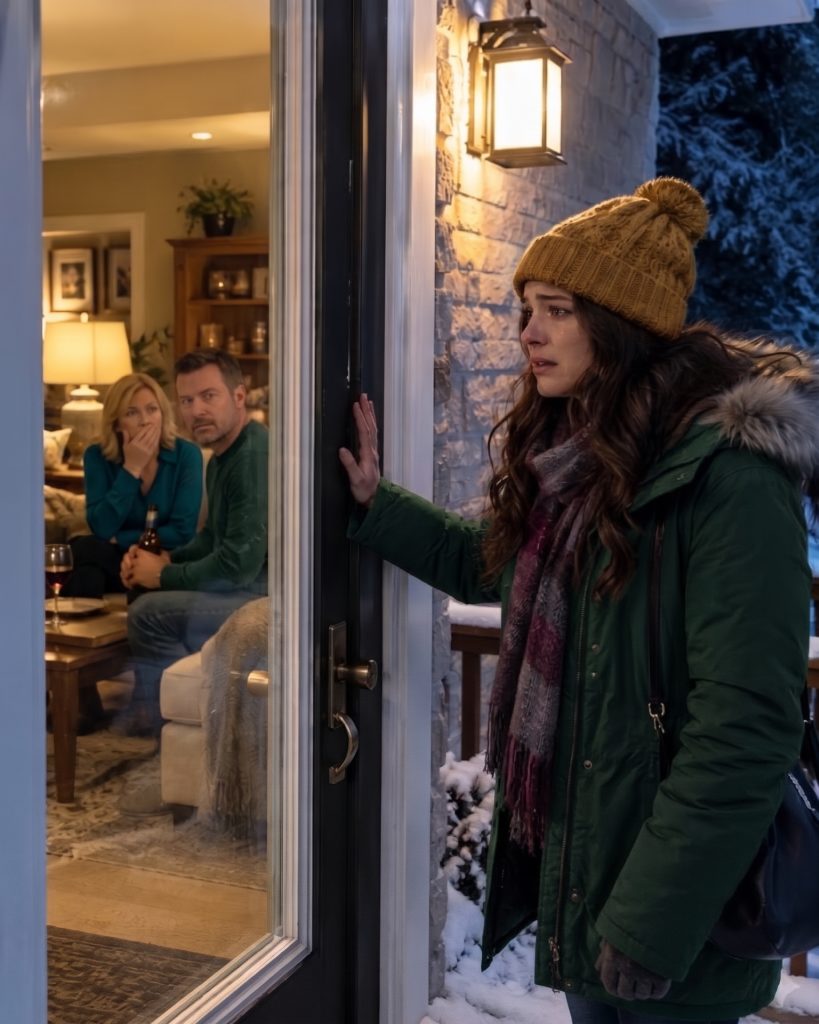
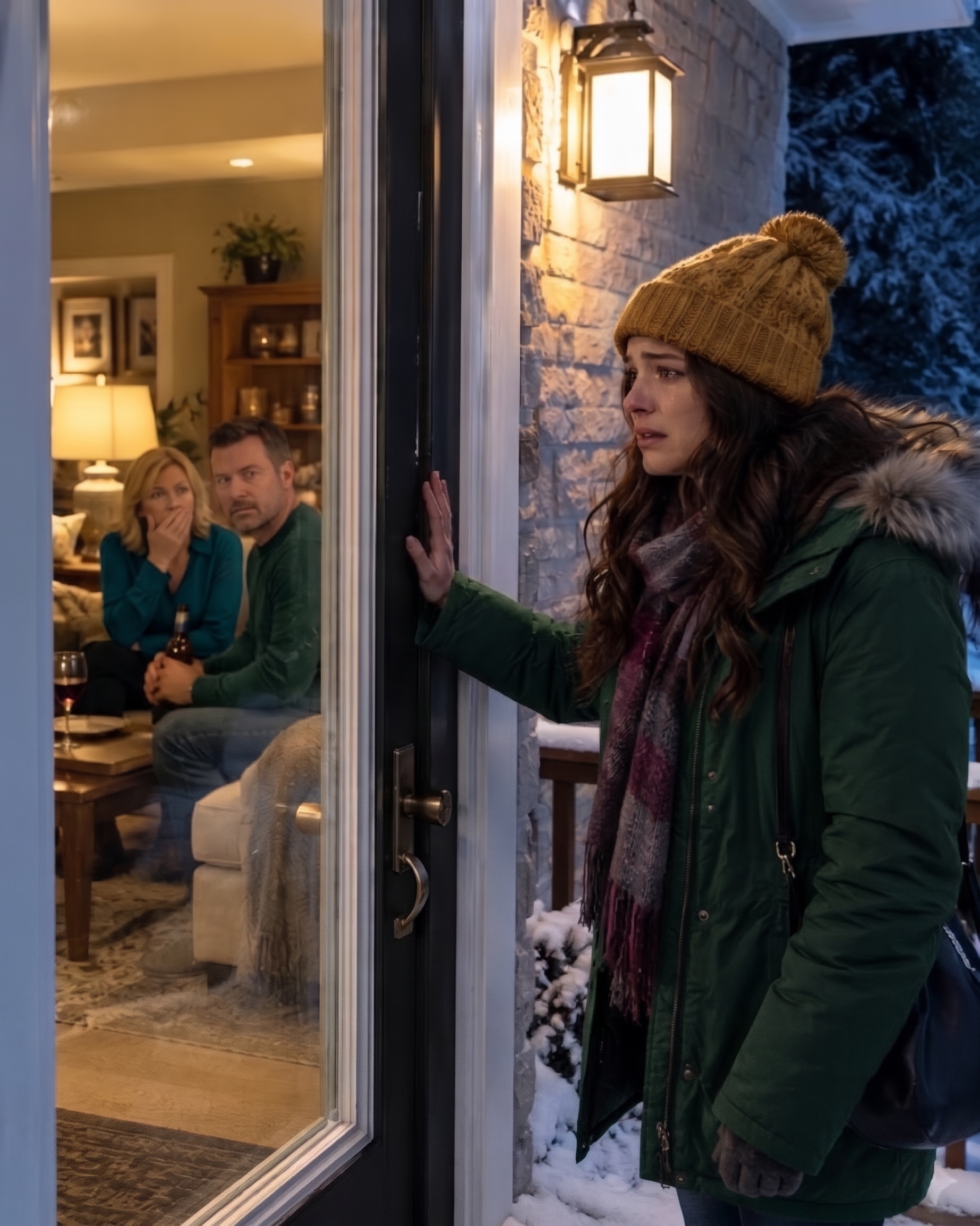
I turned around on the porch. My brother stood on the other side of the glass kitchen door with one hand still on the lock. The kitchen light lit his face from below, and he was grinning.
I knocked. “Very funny, Brandon. Open the door.”
He tilted his head.
“Brandon.”
He mouthed something I couldn’t hear through the glass, so I leaned closer and read his lips.
Find somewhere else to sleep.
The wind slammed across the porch and drove snow under the storm panels in a hard, stinging spray. The thermometer nailed to the post read twelve below zero. I pounded the glass with my gloved fist.
“Brandon! It’s twelve below!”
He laughed. I watched his shoulders shake as he leaned against the doorframe with a hand over his mouth, like it was the funniest thing in the world. Behind him, his girlfriend had stopped smiling.
Then my mother walked into the kitchen.
She was wearing a cream sweater, with her reading glasses pushed up on her head and a glass of wine in her hand. She looked straight through the glass at me.
“Mom!” I pressed my palm flat against the pane. “Mom!”
She looked at me for a long moment. I’ve never been able to explain that look. I expected anger, or embarrassment, or at least a flicker of conscience. What I saw was a woman thinking something over, the way she looked at a dish she wasn’t sure she liked.
Then she smiled. She raised one hand and waved, with just her fingers, the little wave you give a child getting on a school bus.
Good night.
She turned away.
I pulled off a glove with my teeth and called her. Across the kitchen, her phone buzzed on the counter. She looked down at it, then deliberately looked at me through the glass, and pressed Decline.
Call ended.
Still grinning, Brandon reached up and switched off the porch light.
I was standing in the dark, in a Montana blizzard, on the porch of a farmhouse that belonged to me.
My name is Haley Morgan. I’m twenty-nine, and I’m a veterinary technician at Big Sky Animal Clinic in Bozeman, Montana. I’ve spent seven years learning to stay calm around frightened things that bite.
My grandmother, Rose Hartwell, owned that farmhouse on Gallatin Creek Road for forty-three years. She and her husband Walter bought it in 1981 for $62,000. It’s a white two-story with green shutters, a red barn, and forty acres running down to the creek. The kitchen smelled of cinnamon from October to April. Walter died in 1999, and Rose stayed.
She was small, wiry, and dry-humored, with a long gray braid and hands like cured leather. She drove a school bus on the Gallatin Valley route for thirty-one years, in every kind of weather, and was never once late. She kept a thermos of coffee on the dashboard and a jar of butterscotch candies in the glove box for kids who cried.
Her daughter is my mother, Diane, sixty, a real estate agent in Billings with a smooth, bright manner and a gift for sounding reasonable. My mother has two children: my brother Brandon, thirty-four, tall and handsome, with a salesman’s smile, and me.
Seven months before that night, Grandma Rose left the farm to me.
To understand why my own mother waved goodbye to me through a locked door, you have to know how it had always been between us.
Brandon was the golden one. I want to be fair about that, because he never asked to be. But from the time he was small, my mother arranged her whole life around the idea that he was going to be somebody.
He was captain of the football team. He sold cars while he was in college and was the top salesman at the dealership by his second month. When he dropped out of Montana State in his junior year to “pursue a venture,” my mother said proudly, “He’s too big for classrooms.”
I was the sensible one. I earned a two-year degree in veterinary technology, got a job, and paid my own rent. When I called home with news, my mother said, “That’s nice, honey,” in the voice she used for the weather.
I told myself it didn’t matter.
Grandma Rose was the exception. She’d look at me across her kitchen table over the rim of her coffee cup, with pale gray eyes that missed nothing, and say, “Haley, you’re the only one who ever washes the cup after.”
I’d think about that sentence for years.
In the winter of 2022, when she was seventy-eight, she slipped on ice on the back steps and broke her hip. She lay there for forty minutes before the mail carrier found her. After surgery at Bozeman Health, a young doctor told us she shouldn’t live alone anymore.
The family meeting was in the hospital cafeteria, over cold coffee.
“Assisted living,” my mother said briskly. “There’s a lovely place in Billings called Cedar Terrace. It’s eight thousand a month, but Medicare won’t cover it, so we’d need to sell the farm to pay for it.”
“The farm’s worth a million, easy,” Brandon said. “That covers everything for years.”
They both looked at me.
“What does Grandma want?” I asked.
My mother sighed. “Haley, this isn’t about what she wants.”
“Isn’t it?”
I went upstairs and sat on the edge of her hospital bed. She looked tiny in a paper-thin gown and her blue cardigan. I took her hand. It was dry and light as a leaf.
“Grandma. What do you want?”
She looked at me for a long time.
“I want to go home,” she said.
So I rearranged my life. I went to my manager at the clinic and asked to cut back to four days a week. That cost me about $9,000 a year in pay, and I had to start buying my own health insurance through the state marketplace for $412 a month. I never told anyone that.
Five nights a week, I drove the twelve miles out Gallatin Creek Road in an old Subaru with a bad heater and let myself in the kitchen door with the key under the flowerpot.
I cooked meatloaf and chicken and rice, and tried her cinnamon roll recipe over and over without ever getting it right. I washed her hair in the kitchen sink. I drove her to physical therapy and the pharmacy, and once a month to a church luncheon. I sorted her pills into a plastic organizer, one day at a time. I sat at her desk and paid her property taxes, her electric bill, and her Medicare supplement premium from her checking account at First Interstate Bank, with her watching over my shoulder to make sure I wrote the checks neatly.
I’d love to call it a sacrifice, but it wasn’t. It was the best part of my week. We’d eat at the kitchen table under the yellow light, and she’d tell me stories about her bus route. A boy named Dale who sang hymns in the back seat. A snowstorm in 1996 when she drove nineteen children home through a whiteout and got every single one to his own front door.
“Never lost a one,” she’d say, with quiet pride.
My mother called on Sundays. Brandon visited twice a year.
The night I remember best was in December of the second winter.
The furnace died at six in the evening with a long metallic groan. It was eight below outside, and the repairman couldn’t come until midnight. Grandma and I wrapped ourselves in two quilts on the sofa, with the oven door open for heat and a pot of tea between us. The wind made a thin, high, patient moaning in the eaves.
She took my hand under the quilt.
“Haley. Promise me something.”
“Anything.”
“Promise me you won’t spend your whole life trying to earn a place in a family that keeps making you stand outside.”
I laughed. I thought it was a figure of speech.
“I mean it.” Her grip tightened. “I’ve watched you do it since you were six. You wash the cup. You carry the casserole. You say, ‘It’s fine.’”
“It is fine.”
“It isn’t.” She smiled crookedly. “That’s the trouble. You’d do it all for nothing. And they know it.”
I didn’t answer. I wish I had understood.
A few weeks later, in January, she asked me to drive her into Bozeman. She wore her good wool coat and her church hat and held her purse in both hands. She directed me to an old brick building on Main Street with gold lettering on the window.
NATHAN FOSTER, ATTORNEY AT LAW.
She went in alone. I sat in the waiting room for three hours with a fly-fishing magazine and a paper cup of bad coffee. When she came out, she was holding a thick brown envelope, and she tucked it into her purse.
“Everything all right?” I asked in the car.
She patted my knee. “Just putting things where they belong.”
She died in March.
It was quiet. I came in at six with groceries and found her in her armchair by the window, a blanket over her knees and a cup of cold tea on the sill. She looked like she was asleep. Her hand lay open on the arm of the chair, palm up, as if she’d been about to say something.
I sat down on the floor beside her and put my head on her knee. I don’t know how long I stayed there. The light went from gold to gray.
I called my mother. She said, “Oh, honey.” Then, in a brisker voice: “I’ll call the funeral home.”
The will was read at Nathan Foster’s office two weeks after the funeral.
We sat around a long oak table in leather chairs. My mother wore black with pearls. Brandon wore a gray suit with his tie loose and scrolled through his phone under the table. I wore the navy dress I’d bought for the funeral.
Nathan Foster was seventy, thin and stooped and silver-haired, with half-moon glasses and a bow tie. He had a voice like warm gravel, and he folded his hands before he said anything difficult.
He read the will aloud. It was short. There was a cash bequest of $85,000 to Brandon Morgan, and a cash bequest of $60,000 to Diane Morgan, along with Walter’s mantel clock and the good china. There was $10,000 to the Gallatin Valley Humane Society.
And then this:
To my granddaughter, Haley Rose Morgan, I give and devise my farmhouse and the whole of my real property on Gallatin Creek Road, comprising forty acres, more or less, with all buildings and improvements thereon.
Nobody spoke. A clock ticked. My mother made a small, sharp sound, like a breath drawn through her teeth.
“I’m sorry?” said Brandon.
“The farm,” Nathan said mildly, “is Haley’s.”
I sat very still with a ringing in my ears. If I’d expected anything at all, it was a note. Maybe a quilt.
“There must be some mistake,” my mother said.
“There isn’t.”
“She was eighty years old. She hadn’t been herself.”
“She was entirely herself.” Nathan took off his glasses. “Your mother spent three hours in this office on January 15th and answered every question I asked her. I also have a signed statement from her physician, dated that same week, confirming she was of sound mind. I make a habit of getting one when a client changes her will after eighty.”
“She was manipulated!”
“By whom?”
My mother’s eyes slid toward me. I felt it like a draft.
“I never…” I began.
“Nobody’s accusing you, Haley,” Nathan said gently. “Nobody could. Your grandmother told me you knew nothing about it. She said if you did know, you’d refuse. She said you’d tell me you didn’t deserve it.”
I put my hand over my mouth.
Because the farm was worth more than the cash bequests, Grandma’s will named Nathan as personal representative, not anyone in the family. He handled the probate himself. It took three months. In June, he called me at the clinic, and I took it in the supply closet with a box of syringes in my hand.
“Haley, it’s done. The probate court has closed the estate. The personal representative’s deed transferring the farm to you was recorded with the Gallatin County Clerk and Recorder this morning.”
“Thank you, Nathan.”
“There’s something else.” He paused. “Your brother has called my office three times. He wanted to know whether the property could be transferred to him informally. He called it ‘a family arrangement.’ I told him no. Then I put it in writing and sent it by certified mail, return receipt requested, so there’d be no misunderstanding.”
“Did he get it?”
“He signed for it.”
I closed my eyes.
“Haley, I’ll be direct. Your brother has no right to rent the property, renovate it, advertise it, or make any commitment involving it. If he tries, he’s exposing himself to serious liability. Will you keep an eye on things?”
“I’ll handle it,” I said.
I had no idea what that would mean.
My mother’s text came in October.
Haley, I’d love for us to spend a weekend at the farmhouse. Just family. Grandma would’ve wanted it. Don’t bring anything, just yourself. Mom.
I read it three times. I’ll admit I wanted to believe it. Seven months had passed. I’d been driving out alone every weekend to dust and water the plants and sit in Grandma’s chair. I’d started thinking of the house as something alive that needed company.
Grandma would’ve wanted it.
I wrote back: I’d like that.
I should have asked who else was coming.
I pulled in on a Friday at five o’clock with a chicken and rice casserole in a Pyrex dish and a pie from the bakery in Bozeman.
It had started to snow, a fine, dry snow driven sideways by a west wind. The sky was low and the color of lead. Two vehicles were parked by the barn: my mother’s silver Lexus and a black pickup with a Billings dealership plate frame.
Brandon’s.
Every window was lit. Through the kitchen window I could see a tall man in a gray sweater, gesturing with a beer bottle.
I pushed the kitchen door open with my hip and the warmth hit me. It smelled faintly of cinnamon.
“Haley!” my mother called, too brightly. “You made it!”
They were sitting at the dining table. My mother was in a cream sweater. Brandon wore gray cashmere and had a stack of papers fanned out in front of him. A young blond woman I’d never met, in a white turtleneck and gold hoop earrings, leaned against his shoulder.
“This is Lauren,” Brandon said. “My girlfriend.”
“Hi,” Lauren said, with a small, wary wave.
Then I looked at the table. It was covered in architectural plans. There were long sheets with neat measurements. There was a watercolor rendering of the farmhouse with a hot tub glowing blue behind the barn. There was a floor plan of the detached garage with a second story labeled GUEST SUITES (4). And there was a glossy cream-colored brochure that read GALLATIN CREEK RETREAT, and underneath it, Luxury farmstay from $850/night.
“What is this?” I asked.
Brandon looked up with the shining smile that had won him every room he’d ever walked into.
“It’s the future,” he said.
He stood up and laid a drawing in front of me like a menu. “Think about it. Forty acres, a red barn, a creek, ninety minutes from Yellowstone. We put in a hot tub, a fire pit, a couple of glamping domes, four suites over the garage. List it on three rental platforms. Book it solid May through October. Conservative estimate? Two hundred ten thousand a year.”
“Brandon. Have you hired contractors?”
He smiled.
“Don’t worry about grown-up business, Haley.”
The room went still. A log shifted in the stove. Lauren looked down at the floor.
“It’s my property,” I said.
I hadn’t meant it to come out so quietly. I said it in the voice I use to calm a frightened dog.
Brandon’s smile slid away by degrees, the way ice leaves a pond. First the warmth went, then the teeth, and then something harder showed underneath.
“Our property,” he said.
“Mine. Grandma left it to me. You were in the room.”
“It’s a technicality.”
“It’s the will.”
“Haley,” my mother said sharply, stepping between us the way she’d done a thousand times. “Please don’t start. We came here for a nice weekend.”
“I asked a question.”
“Your brother has a vision. He’s trying to build something for the family.”
“On my land.”
“On Grandma’s land.”
“Which she left to me.”
Her mouth tightened. Then her face went smooth and soft, like a pond after a stone sinks.
“Let’s have dinner,” she said. “We’ll talk after.”
We ate at the kitchen table. My casserole sat in the middle going cold, and nobody touched it. Brandon carved a roast my mother had brought. Lauren talked about a yoga retreat in Sedona. Brandon drank.
At eight, while I was carrying plates to the sink, he came and stood beside me. He’s a head taller than me, and he smelled of beer and cologne.
“You know,” he said quietly, “you might not be welcome here much longer.”
I turned off the tap. “What does that mean?”
“Just that things change. If you can’t be a team player.” He shrugged. “People get tired.”
That should have told me everything. I’d like to say I put down the dish towel and drove home through the snow.
I stayed. I’d spent twenty-nine years being the one who stayed. I didn’t know how to do anything else.
Around nine o’clock, in the front room, Brandon suggested the game.
The fire had burned low. My mother sat in Grandma’s armchair with her wine. Lauren lay on the sofa with her feet in Brandon’s lap. I sat on the hearth with a mug of tea.
“I’ve got an idea,” Brandon said. “A challenge. Haley, ten minutes outside on the side porch. If you last, fifty bucks.”
I laughed. God help me, I thought it was a joke.
“It’s snowing.”
“It’s an enclosed porch. You’ve got a coat.” He tilted his head with the sly, boyish look I’d known all my life. “What, scared? You used to do my dares when we were kids. Remember the barn?”
I remembered. A night in 2003, in the hayloft, during a thunderstorm. I was nine and he was fourteen. “Stay up here alone till the lightning stops,” he’d said. I sat in the dark among the hay bales with my knees pulled to my chest for what felt like hours. When I finally climbed down, shaking, he said, “Good girl,” and gave me a butterscotch.
I looked at him now, a thirty-four-year-old man in cashmere.
“Ten minutes,” I said.
“On the dot.”
I’d kept my coat and boots on all evening because the old house was drafty. I pulled on my gloves. The kitchen door was right there.
The side porch was the one Grandma had enclosed in 1995, with storm panels in winter, a swing hanging from the rafters, and a row of long-dead geraniums along the rail. The cold hit me like a wall. It was a dry, clean, bone-deep Montana cold, with the wind coming off the mountains.
I stood by the swing and counted. Through the glass, I could see Brandon in the doorway raising his beer bottle in a salute. Lauren giggled behind him.
One minute. Two. Three.
Then I heard the deadbolt.
You know the rest. The grin, the words he mouthed, my mother’s little wave, the declined call, the porch light going dark.
I’ll tell you what that moment was. It wasn’t fear. Fear came later. It wasn’t anger either. It was a perfectly clear, ringing understanding, like the moment after a bell stops.
It had never been a joke. Not the dare in the barn, not the cold casserole, not a single “please don’t start.” My whole life had been one long sentence in a language I’d refused to learn: You stand outside.
Promise me you won’t spend your whole life trying to earn a place.
I put my phone in my pocket. I turned my back on the door. And I walked down the porch steps into the snow.
Arthur Pruett lived half a mile down the road. He was seventy-nine, a retired rancher with a bad hip and a face weathered like a walnut, and he’d farmed the neighboring eighty acres for fifty years. He’d been Grandma’s friend. Every Sunday afternoon they sat on her porch drinking coffee and saying almost nothing.
I don’t remember the walk clearly. A white, roaring dark. The wind pushing at my back. My boots filling with snow. I remember counting fence posts, a row of black stakes, and a thin, high sound coming from my own throat.
I’d gone maybe a quarter mile when headlights swept across the road. An old Ford pickup with a plow blade crept through the storm and stopped beside me. The passenger door swung open.
“Get in,” said Arthur.
He reached across, grabbed my arm, and hauled me up into the cab. The heater was roaring. It smelled of tobacco and coffee and wet dog.
“I saw the light go off,” he said, putting the truck in gear. “From my kitchen window. I thought, that’s wrong.”
“How did you…”
“I’ve watched that porch for forty years.” His jaw worked. “Rose always left it on.”
Arthur’s kitchen was a small yellow room with a wood stove, a table covered in oilcloth, and a collie named Biscuit who put her chin on my knee and sighed. He sat me down, pulled off my boots, and handed me a pair of thick gray wool socks and a mug of tea strong enough to stand a spoon in.
My fingertips were white, then a dull, burning red as the blood came back.
“Frostnip,” Arthur said. “You’ll be all right.”
“I’m fine.”
“You’re not.” He sat down across from me with his big hands folded. “Rose would have been furious.”
I’d held on through the funeral, the will, and that whole terrible evening. I’d held on for twenty-nine years.
I put my face in my hands and sobbed.
It wasn’t about the cold. It was about a woman in an armchair by the window with her hand open on her knee. It was about I want to go home. It was about a small, soft wave through a pane of glass.
Arthur didn’t say anything. He laid a heavy, warm hand on my shoulder. Biscuit climbed into my lap, all forty pounds of her, and licked my chin.
When I’d quieted down, Arthur rubbed his jaw.
“Haley, there’s something you ought to know. I wasn’t going to say tonight. But I think you need to hear it.”
I wiped my face on the dish towel he handed me.
“Your brother had a contractor out at the farm last week. A fellow named Dale Keegan, drives a white F-250. He was measuring the garage with a laser for about two hours. Brandon was with him, with a roll of plans.”
“Last week?”
“And there’s more. I was at the feed and lumber store in Belgrade on Tuesday. The fellow behind the counter said Brandon had been in ordering lumber for a deck. Four thousand dollars’ worth.” Arthur looked at me. “He opened a store credit account to pay for it. In your name.”
I went cold. It wasn’t the cold of the snow. It was slower, and it came from the inside out.
“In my name?”
“He told them the property owner was Haley Morgan and he was her authorized representative. Gave them the farm address. The kid at the counter didn’t think twice.” Arthur’s voice was very dry. “And Saturday, at the diner, I heard him on the phone talking about deposits. Winter bookings. He said he had eleven families from Seattle signed up for a New Year’s package.”
I pulled out my phone. Four percent battery. Thirty-one notifications.
A text from my mother at 9:41: Haley, where are you? Come back, it’s cold. At 9:55: This isn’t funny. At 10:12: Brandon says he’s sorry.
And an email from Nathan Foster, sent at 8:30 that evening while I’d been slicing pie. The subject line was in capitals: URGENT — INQUIRY RE: GALLATIN CREEK PROPERTY.
Haley,
This afternoon I received a call from RentWise, a vacation rental management company in Denver. They asked whether a Mr. Brandon Morgan was authorized to list the farmhouse at 1488 Gallatin Creek Road for short-term rental. He had represented himself as the owner and submitted a copy of a deed to support his application. That deed was not genuine.
I told them he is not authorized and that you are the owner of record. I am preparing a formal notice. Please call me first thing in the morning.
Nathan
I read it twice.
He forged a deed.
“I need to call Nathan,” I said.
“It’s eleven at night,” Arthur said. “Call him at seven. He’s an early riser. Right now you need a bed.”
He made up the sofa in his front room with a quilt his late wife had sewn. I lay under it listening to the wind and didn’t sleep. Sometime near dawn, Biscuit climbed up beside me. I put my arm over her and held on.
I called Nathan at 6:55. He picked up on the first ring.
“Haley. Thank God. Are you all right?”
I told him everything, from my mother’s text to the glass door, in a flat, steady voice, like reading a lab result. When I finished, there was a long silence.
“I’m going to say something unprofessional,” Nathan said finally. “I’d like to throttle them.”
I laughed. It came out cracked.
“I won’t,” he said. “I’ll do something better. I’ll do paperwork. Come to my office at nine and bring your ID. And Haley, don’t go back to the farm yet.”
“It’s my house.”
“I know,” he said gently. “That’s exactly why.”
Before I left Arthur’s, I did one more thing. I’d spent seven years watching clients at the clinic deal with stolen credit cards, and I knew what to do. On Arthur’s kitchen computer, I placed a fraud alert with all three credit bureaus and froze my credit, so no one could open another account in my name. Then I called the feed store in Belgrade and asked for the manager.
“Ma’am, the account was opened Tuesday,” she said, sounding horrified. “There’s a balance of $4,118.40. We had no idea.”
“I didn’t open it. I didn’t authorize it. I’d like the account closed, and I’ll be filing a police report.”
“I’ll flag it right now. I’m so sorry.”
Nathan’s office was warm and smelled of coffee and old paper. A fire burned in the grate. He’d laid out a pot of coffee, a plate of shortbread, and a thick folder tabbed in yellow. He wore a gray cardigan over his bow tie, and he looked like he’d slept about as well as I had.
He slid the first page across the table. “This is the recorded deed. Personal representative’s deed, recorded June 9th, transferring the property to Haley Rose Morgan.”
Then he slid over a second page. “And this is what your brother sent to RentWise.”
It looked like a deed: the same form, the same legal description of the land, a faint purple notary stamp. But it was a quitclaim deed, supposedly signed by my grandmother, transferring the farm to Brandon A. Morgan. It was dated March 3rd, one week before she died.
“It’s a forgery,” I said.
“A poor one.” Nathan tapped the stamp. “The notary is listed as Marcia Alvarez. There is no Marcia Alvarez commissioned in Montana. The commission number belongs to a retired woman in Missoula whose commission expired ten years ago. And this deed was never recorded with the county. He couldn’t record it. The clerk would have caught it against the probate file in a minute.”
“So he just showed it to the rental company.”
“That’s my guess. Blank deed forms are on the county website. Anyone can download one.” His mouth was grim. “A man with a printer and no conscience can do a great deal of damage.”
Then he took off his glasses and picked up a third document.
“And this is my letter to him.”
It was dated August 12th, on his letterhead, addressed to Brandon at his apartment in Billings. Nathan read it aloud in his dry, gentle voice. It said the property had been left entirely to Haley Rose Morgan. It said Brandon had no legal interest in it whatsoever and no authority to rent, lease, renovate, advertise, or encumber it. It said any such act would expose him to civil liability, and it advised him to hire his own lawyer.
Nathan laid a small green postal card on top. The return receipt. Signed in black ink, B. Morgan, dated August 14th.
Two months before the blizzard.
“He knew,” I said. “When he drew the plans. When he hired the contractor. When he took the deposits.”
“Yes,” Nathan said. “And when he locked you out.”
I sat very still. The fire popped. Thin sunlight came through the blinds and lay across the table in stripes.
“Why, Nathan? It’s not a game. It’s fraud.”
He turned his coffee cup slowly. “In my experience, people who commit fraud rarely think of it that way. They think of it as correcting an injustice.”
“What injustice?”
“Your brother always believed the farm would be his. Rose told me so. He’d been telling people for years at the hardware store, at the bar: ‘I’ll be taking over the farm someday.’ When she left it to you, he took it as theft. From him.”
I put my head in my hands.
Nathan had already drafted a notice. It was a single page on his letterhead: NOTICE TO CEASE AND DESIST AND DEMAND FOR ACCOUNTING. It was addressed to Brandon Morgan, to Lauren Voss, and to “all persons acting in concert with them.” It demanded that they stop all activity involving the property at once, take down every listing, refund every deposit, and provide an itemized accounting of all money received. It warned of a civil lawsuit for trespass and fraud, and of a referral to the Gallatin County Attorney.
“A process server can post it on the farmhouse door today and hand it to him if he’s there,” Nathan said. “I’ll also mail a copy by certified mail.”
I thought of my mother’s small wave.
“Do it,” I said.
He picked up his pen, then set it down again.
“One more question. Do you want him prosecuted? Forging a deed and opening credit in your name are both felonies in Montana. Once you file that police report about the feed store account, it may not be entirely up to you.”
I thought of the barn in the thunderstorm. The butterscotch. A man in cashmere grinning through glass.
“I want him to stop,” I said slowly.
“That isn’t what I asked.”
“It’s what I can answer right now.”
He looked at me over his glasses for a long time.
“Your grandmother said almost exactly that to me,” he said. “She said, ‘Nathan, I don’t want him punished. I want him to see.’”
My throat closed. “See what?”
“I didn’t ask. I think she thought it was obvious.”
That afternoon I sat in a small room at the Gallatin County Sheriff’s Office and gave a detective named Ruiz a statement about the feed store account. She photographed the account application, which the store manager had emailed me. My name was printed in Brandon’s block capitals, and the signature beneath it was nothing like mine.
“Do you know who did this?” Detective Ruiz asked.
“My brother.”
She paused, then wrote it down. “That’s harder than a stranger.”
“Yes,” I said. “It is.”
The notice went up at 9:17 the next morning. I know the time because that’s when my phone started ringing.
I was in the passenger seat of Arthur’s truck, parked on the gravel road a hundred yards from the farm. Nathan had told me I didn’t need to be there, but I wanted to see it.
A young man in a gray parka walked up the porch steps, taped a sheet of paper to the front door, and knocked twice. Nobody came to the door. He walked back down the steps and drove away.
My phone buzzed on the dashboard. BRANDON. I let it ring out. It started again immediately. Eleven times in twenty minutes. Then MOM. Then BRANDON. Then MOM. It sounded like a swarm of angry bees.
The first voicemail came at 9:51. I played it on speaker.
“Haley, it’s me.” His voice was thick and hoarse. “There’s a notice on the door. It says I can’t rent the place. It says I forged a deed. That’s insane. Call Nathan and have him withdraw it. Right now. I’ve got eleven families. I’ve got forty thousand dollars in deposits. You’re going to ruin me.”
The second came at 10:03, lower and thinner.
“Haley. Seriously. I think we both said some things. Look, I’m sorry about the porch. It was a joke. It was supposed to be funny. Call me.”
My mother called at 10:30. I almost didn’t answer. I watched her name pulse on the screen and thought of that wave.
I answered.
“Sweetheart, thank God,” she said, in a warm, honeyed voice. “Where are you? We’ve been so worried.”
“I’m at Arthur’s.”
“Oh. Well, he’s a kind man.” A tiny pause. “Sweetheart, your brother has made some commitments. I think he got carried away with the plans. But there are families who’ve paid deposits. It would be best for everyone if you could work something out. Let him run it for one season, and then we’d see.”
I closed my eyes and waited for the other sentence, the one I knew should come next. I’m sorry about last night. Or, Are you all right? Or even, I was cold too, watching you.
It never came. She said nothing about the door, or the dark, or the quarter mile of snow. She spoke in the same soothing voice she’d used to tell me, when I was seven, that our dog had gone to live on a farm.
“Mom,” I said. “You waved.”
Silence.
“Last night. Through the glass. You waved at me.”
“Haley, it was a joke. Your brother was only teasing. You know how he is.”
Through the windshield, a tall figure had come out onto the farmhouse porch in a gray sweater, arms wrapped around himself, staring down the road toward us.
“Mom, you’re about to ask me not to embarrass him, aren’t you?”
She didn’t answer.
“I’ll be kind,” I said. “But I’m going to send you both a message, and I want you to read it.”
I typed it three times. The first version was long and started with Do you remember when I was nine. I deleted it. The second used the word forged. I deleted that too.
The third I wrote slowly, in plain sentences, the way I’d write discharge instructions for a pet owner.
The farmhouse belongs to me. You both know that. You were told in person in March and in writing in August. You have no permission to rent it, renovate it, advertise it, or take deposits for it. Nathan Foster will handle everything from here. Please direct all questions to him. I will not be discussing this by phone.
I sent it to both of them in one group message.
Beside me, Arthur hadn’t moved. “That’s the first time I’ve ever heard you say it.”
“Say what?”
“‘I will not be discussing this.’”
I laughed shakily. “It feels strange. Like putting on a coat that’s too big.”
“It’s not too big,” Arthur said. “It’s just new.”
Brandon replied in forty seconds.
You can’t do this to your own family.
I’m your brother.
I’ll make it right. I’ll give you a cut. 10%. Even 15.
I turned off my phone.
Three days later, on a gray, bitter Monday afternoon, I went back.
Arthur drove. I sat in the passenger seat with a thermos between my knees and my grandmother’s old work gloves on my hands. Nathan had told me to bring a witness.
“I’ll bring my shotgun,” Arthur said. Then he saw my face. “I’m joking. I’ll bring a flask.”
Brandon’s pickup was still parked by the barn under a skin of snow. And Brandon was standing at the top of the porch steps with his arms spread across the doorway, as if the house might walk away if he moved. The notice was still taped to the frame behind him.
His face was red and blotchy, as if he’d been crying or drinking or both. His hair stood up in tufts. He looked about fourteen.
“You’ve ruined everything!” he shouted.
“What exactly did I ruin?” My voice came out perfectly level, and it surprised me.
“I’ll tell you what you ruined.” His voice cracked in the middle. “Eleven bookings. Eleven families. Forty-one thousand dollars in deposits.”
“Whose deposits?”
He didn’t answer.
“It was never yours to build on,” I said. “Grandma told you that in writing, through Nathan. You signed for the letter.”
“It was going to be something for the whole family! I was going to cut you in!”
“On my own property.”
“She was old! She was manipulated!”
“She was sharp as a tack,” I said. “She hired a lawyer, she got a doctor’s letter, and she wrote it all down. By whom, Brandon? Who manipulated her?”
He opened his mouth.
I’d watched my brother do this ten thousand times: reach for the charming word, the one that turned a room toward him.
This time it didn’t come.
“You forged a deed,” I said. “With a fake notary. You opened a credit account in my name at the feed store. You signed for Nathan’s letter in August, and you drew the plans anyway.”
“I was going to fix it…”
“You knew, Brandon. You’ve known since August.”
“I thought…” He stopped.
“You thought what?”
His face crumpled all at once, like a dam giving way. His chin shook, and a raw, high sound came out of him, like a child’s. He put both hands over his face.
“I thought she’d change her mind,” he said.
I stood very still.
“She was dying, Haley. I thought if I showed her I had a vision, that I could actually build something, then she’d see I wasn’t a joke.” His voice broke. “She never took me seriously. Not once. She’d look at me with those eyes and say, ‘Well, Brandon. We’ll see.’ And then you’d walk in with your casserole and she’d light up, and I’d think, what does she have that I don’t?”
I’d come prepared for a fight. In the truck, I’d rehearsed a dozen speeches. I was ready to be cold. I was ready to be right.
I wasn’t ready for this.
I looked up at my brother, a thirty-four-year-old man in cashmere with a ruined face, and suddenly, with terrible clarity, I saw a fourteen-year-old boy in a hayloft handing a butterscotch to a nine-year-old girl.
Good girl.
I realized that was the only time he’d ever said anything like it.
“Brandon,” I said softly. “Come down off the porch.”
He stared at me. I held out my hand.
He didn’t move for a long time. The wind lifted snow across the yard. A crow called from the barn roof. Then, slowly, like a man in a dream, he came down the steps and stopped in front of me.
I put my arms around him.
At first he stood rigid, arms at his sides, every muscle clenched. Then something gave way, a long, shuddering collapse. His arms came up, clumsy and desperate, and he put his face in my hair.
“I’m sorry,” he said. “I locked you out. In a blizzard.”
“You did.”
“I was drunk. No.” He shook his head. “I’m not going to say that. I wasn’t that drunk. I wanted to scare you. I wanted you to feel what it’s like. To stand outside.”
I pulled back. “What do you mean?”
He wiped his face with the heel of his hand. His eyes were swollen and wet and completely honest.
“I’ve been outside my whole life,” Brandon said.
We sat on the porch steps while the sun slid low and gold behind the barn. Arthur retreated to his truck with a thermos and pretended, badly, to read a road map.
“I never fit,” my brother said, elbows on his knees. “I was the golden boy, sure. Captain, top seller. But it was a part I played. I’d walk into a room and turn it on, and everybody loved it. Then I’d go home and lie in bed and think, they don’t know me at all.”
I didn’t say anything.
“Mom loves the part. She’d tell people, ‘Brandon’s going to be a senator.’ And I’d think, I don’t want to be a senator. I want to build something with my hands.” He laughed bleakly. “The retreat was supposed to be that. One real thing Grandma could see. Not a performance.”
“Brandon.”
“And then she left it to you. And I thought, of course she did. You’re the only one who never needed it.”
“Needed what?”
“To be someone.” He looked at me. “You just were. You washed the cup.”
I covered my eyes with my hand.
“I hated you for years,” he said quietly. “I want you to know that. I hated you for being easy.”
“I wasn’t easy.”
“No.” He smiled crookedly. “I think I knew that. That was the worst part.”
I lowered my hand and looked at him, a tall, rumpled, red-eyed man with a day’s stubble and our father’s jaw. I realized that in twenty-nine years I had never really seen his face.
“I’m going to tell you some things,” I said. “I’m not giving you the farm.”
“I know.”
“I’m not giving you a cut.”
“I know.”
“And you’re going to give back every one of those deposits. All forty-one thousand, two hundred dollars.”
He laughed wetly. “You’ve seen the list.”
“Nathan got it from RentWise.”
Then he said, “I don’t have it.”
“What?”
“The money. I spent most of it. The lumber, the deposit on the hot tub, the contractor’s retainer. And I put five thousand down on a bulldozer.” His mouth twisted. “God. A bulldozer.”
I stared at him.
And then, to my astonishment, I started to laugh. It began as a hiccup, then a snort, then a huge, helpless, gasping peal that bent me double on the step. Brandon stared at me. Then his face cracked too, and he put his head on his knees and howled.
We laughed for a long time. I think it was the absurdity of it: a forged deed, a fake notary, a man in cashmere putting money down on a bulldozer for a farm that wasn’t his. It was so big, so stupid, and so completely my brother that there was nothing left to do but laugh.
When we’d finally stopped, he wiped his eyes on his sleeve.
“What do I do? I don’t have forty thousand dollars. There’s the feed store, there’s the sheriff. I’m going to jail.”
“Maybe,” I said, turning my gloves over in my hands. “But I want to propose something.”
He looked at me.
“A plan,” I said. “In writing. With dates.”
It took three weeks, a great deal of coffee, and, I’m told, one scene in Nathan Foster’s office where Brandon wept into a handkerchief and the old man patted his shoulder and said, “There, there, son. It’s only paper.”
Nathan drafted a restitution and settlement agreement. It was four pages long, and I read every word. Brandon read every word too. I watched him do it, his lips moving.
Under the agreement, Brandon admitted in writing that he had no ownership interest in the farm and never had. He agreed to take down every listing and personally contact every family who’d paid a deposit. He agreed to repay all $41,200 in deposits within sixty days, and to pay off the $4,118.40 feed store account in full. He agreed to pay the $1,850 in legal fees I’d incurred. He agreed never to enter the property without my written permission.
In return, I agreed not to file a civil lawsuit as long as he kept every term. I couldn’t promise anything about the sheriff’s investigation. Nathan was careful to make that clear. But I agreed to tell Detective Ruiz and the county attorney that the money had been repaid, and that I was asking for the case to be resolved without jail if the law allowed it.
Brandon signed the agreement in front of a notary in Nathan’s office. A real one.
First, he called the eleven families himself. It took him two days. He told me later it was the hardest thing he’d ever done. A woman in Seattle cried. A man in Tacoma swore at him. A grandmother in Spokane who’d booked the farm for her eightieth birthday said quietly, “I understand, honey. I’ll find somewhere else.” Then she added, “You sound like you’ve had a bad week.”
He went out to his apartment’s parking garage, sat in his truck, and cried.
Then he sold the truck. It brought $34,000. He sold his watch for $2,600. He got his $5,000 back from the bulldozer dealer, minus a $750 cancellation fee, after Nathan wrote them a letter. The hot tub company refunded most of his deposit. And he took out a personal loan of $6,000 from a credit union in Billings at eleven percent interest, the first loan he’d ever taken in his own name, for his own mistake.
By the end of November, every family had been refunded in full. The feed store account was paid off and closed. Lauren had moved back to Denver.
In January, the county attorney charged Brandon with forgery. With full restitution already made, a signed letter from me, and no prior record, he was offered a deferred prosecution agreement: two years of supervision, a hundred hours of community service, and a financial responsibility course. If he completed all of it without trouble, the charge would be dismissed.
He stood in the courtroom in a borrowed suit and said, “Yes, Your Honor. I understand. I’m guilty, Your Honor.” His voice didn’t shake.
Then he got a job driving a delivery truck for a feed distributor in Belgrade at fifteen dollars an hour. He wore a brown uniform and lifted fifty-pound sacks all day.
“My shoulders ache,” he told me on the phone. “I’m tired in a way I’ve never been tired. It’s strange. My hands know what they did today.”
“That’s a good thing.”
“It’s a very strange thing,” he said.
In December, Nathan called me into his office and slid something across the desk that I hadn’t expected.
“Your grandmother left this with me,” he said. “My instructions were to give it to you if, as she put it, ‘things go the way they will.’”
It was a heavy cream envelope sealed with red wax. On the front, in her tall, spiky handwriting: Haley.
I didn’t open it right away. I sat in the leather chair and looked at the slant of the H, at a small tremor in the downstroke where an old hand had pressed too hard.
“Would you like some privacy?” Nathan asked.
“Please.”
He closed the door softly behind him, and I broke the seal.
My dear Haley,
If you are reading this, then the boys have done what I thought they would, and you have found out. I am sorry for it. I would have spared you if I could.
I knew, when I changed my will, that your brother would be angry. I knew your mother would take his side. I knew it would be a hard winter. I thought about it a long time. I decided it was better to hurt you now, a little, than to let you go on standing at a door that was never going to open.
I have watched you wash the cup, and carry the casserole, and say “it’s fine.” It broke my heart.
I gave you the farm because you are the only one who loves it. That is all. I did not give it to you to hold against them.
So I would like you to do something for me. I know it is a great deal to ask. I would like you to open the door. Not the first time. They will test you. They may lock you out again. But someday, when they are ready, when they have stood in the snow long enough, I would like you to be at the window with the light on.
Your brother is not a bad man. He is a frightened one. He has been told since birth that he is a prince, and has never once been loved for what he actually is. It is a terrible thing to do to a child. Your mother did it with the best of intentions. I don’t think she has ever known any other kind.
I should have said so long ago. I am old, and I was a coward, and I let it go on.
Leave the porch light on, Haley. Always.
With all my love,
Grandma
P.S. The cinnamon rolls. It is not the cinnamon. It is the butter. Cold. Always cold.
I read it three times. Then I put my head down on Nathan’s desk, between the files and a teacup, and cried until the receptionist knocked to ask if I needed anything.
I moved into the farmhouse in January.
I gave notice on my apartment in Bozeman, which meant losing a $1,200 security deposit because I broke the lease two months early. I didn’t care. I drove out on a Saturday in the old Subaru with the trunk full of boxes.
I’d done the math at my kitchen table first, the way Grandma would have. The farm had no mortgage. The property taxes were $3,840 a year, which I’d budgeted to pay in two installments. The homeowner’s insurance, which I’d moved into my own name with the same local agent Grandma had used for thirty years, was $2,100 a year. It was less than half what I’d been paying in rent.
When I let myself in through the kitchen door, the house was warm. Arthur had lit the stove. There was a pot of coffee on the counter and a note in his cramped handwriting: Welcome home. Biscuit sends her regards.
I stood in the middle of the kitchen in my coat, holding a box.
It smelled of cinnamon. Nobody had baked anything. The smell was just there, in the wood and the walls, like a held breath.
I set down the box, put my palm flat against the cool plaster, and said out loud, “I’m home, Grandma.”
Then I went out onto the side porch and looked up at the light, a bare bulb in a tin shade above the kitchen door. It was off. Someone had switched it off back in October, and I knew whose hand had done it.
I reached up, found the cord, and pulled. The porch filled with a soft, steady, yellow glow.
I stood in it for a long time.
My mother took the longest.
For months she didn’t call. At Christmas she sent a plain white card with a printed verse and her signature: Love, Mom. I put it on the mantel and didn’t answer.
In March, on a gray Sunday, a car came down the drive.
I was in the kitchen rolling out dough with butter on my hands. Through the window I saw the silver Lexus creep down the gravel and stop by the barn. My mother got out and stood beside it for a long time in a long camel coat and silk scarf, her purse held in front of her with both hands like a shield.
I wiped my hands on a towel, opened the kitchen door, and stood in the porch light.
She picked her way across the slushy yard in her good shoes and stopped at the bottom of the steps.
“Haley.”
“Mom.”
“May I come in?”
I thought of the wave, the wine glass, the declined call.
Then I thought of the letter. When they have stood in the snow long enough.
“Yes,” I said.
We sat at the kitchen table. I made tea. She held the cup in both hands without drinking and looked around at the cabinets, the stove, the yellow curtains, the rolling pin on the counter.
“It smells like Mother’s kitchen,” she said, her voice thin. “When I was a girl, I’d come home from school and there’d be a tray of rolls.”
“I’m trying to make them.”
“I’m sure they’re lovely.”
“They aren’t.”
A small, startled laugh escaped her, and she put a hand to her mouth.
“Haley, I’ve come to say something.” She turned the cup in her hands. “I’ve been seeing a counselor in Billings. A Dr. Abara. Brandon suggested it. He’s been going for two months. He told me last week. He said, ‘Mom, I think we both need to talk to somebody.’”
“What did you say?”
“I said I didn’t need to.” She took a shaky breath. “And then I thought about the porch.”
I set down my cup.
“I’ve thought about it every night since. That little glass door. Your face. You had your hand pressed against it like a child at a window.” She was crying now, silently, tears running down her powdered cheeks. “And I waved.”
I didn’t say anything.
“Dr. Abara asked me why. I told her it was a reflex. She asked, ‘A reflex to what?’ And I said, ‘To keeping the peace.’” She laughed bitterly. “It’s the only thing I’ve ever been good at. Brandon needed so much. You never seemed to need anything. And I thought if I kept him calm and gave him what he wanted, then at least one of my children would be happy.”
“At the cost of the other one.”
“Yes.” She looked at me. For the first time I could remember, she looked completely without polish. “I made you stand outside your whole life. And I told myself it was all right because you could stand it.”
She told me one more thing that afternoon. After Grandma’s will was read, she said, she had gone to a lawyer in Billings to ask about contesting it. The lawyer reviewed it, saw Nathan’s notes and the doctor’s letter, and told her she would lose. He charged her $1,500 for the consultation.
“I never told Brandon I did that,” she whispered. “I let him think the farm could still be his. I let him believe it. I thought if he got his hopes up, maybe you’d give in. You always gave in.”
I reached across the table and took her hand. Her fingers were cold and thin and shaking.
“I’m so sorry,” she said.
I’d like to tell you I forgave her right then. I didn’t. I want to be honest about that. I sat with her hand in mine and felt the long, aching weight of twenty-nine years.
But I felt something else too. I felt a door move.
“Mom, I want to give you something.”
I got up and went to the windowsill over the sink, where I kept a small wooden box. Inside was a brass key on a loop of red thread. I’d had it cut at the hardware store in Bozeman back in January and hadn’t given it to anyone.
I put it in her palm.
“It’s for the kitchen door. It isn’t a gift, exactly. It’s an invitation. You can come whenever you want. Knock first or don’t. But you can come in.” I paused. “I’d like it if you came on Sundays. I make bad rolls.”
She closed her hand around the key, pressed it to her mouth, and bent over it. Her shoulders shook, and a long, ragged, wordless sound came out of her.
I went around the table, knelt beside her chair, and put my arms around her. She smelled of lavender and old cold cream. She felt so small. I held her in my grandmother’s kitchen while a branch scratched at the window and the tea went cold.
“There,” I said. “There.”
It’s been two years now.
I live in the farmhouse. I’ve planted a garden: tomatoes, zinnias, and a row of sweet peas along the fence. I repainted the shutters green. And to my private delight, I’ve learned to make a decent cinnamon roll. The secret is the butter. Cold. Always cold.
I work at the clinic four days a week, and on Fridays I volunteer at the Gallatin Valley Humane Society, the same one Grandma left $10,000 to. They used her gift to build a new kennel wing. There’s a small brass plaque by the door: In memory of Rose Hartwell, who never lost a one.
I have two dogs, a retriever named Rose and a mutt named Biscuit Junior, who is no relation to Arthur’s collie but insists otherwise.
My mother comes on Sundays. She arrives at ten and knocks twice, softly, even though I’ve told her she doesn’t need to. Then she turns her key. She brings a pie from the bakery and sits in Grandma’s chair. We don’t talk about much: the weather, the garden, a heifer we treated at the clinic. Last month she asked to see the property tax bill so she could understand what it costs to keep the place running. She read every line.
I’ve started to look forward to Sundays.
Brandon comes on Wednesdays. He still drives the feed truck. He’s lost twenty pounds and gained a kind of quiet. He comes in the back door in his brown uniform with sawdust on his boots and sits at the table with a mug of coffee. We play cribbage. He’s terrible at it.
He finished his community service last fall at the humane society, of all places, cleaning kennels in the wing with Grandma’s name on it. His forgery charge was dismissed in December. He paid off the credit union loan four months early.
Last spring, over the cribbage board, he said, “Hay.”
“What?”
“I’d like to put up hay. On the east field. If you’d let me.” He looked at the table. “I’d pay rent. A fair price. I looked it up. Forty an acre. I just want to grow something.”
I thought of the watercolor rendering with the glowing hot tub.
“Forty-five,” I said.
He blinked.
“It’s good ground.”
He laughed, a short, wet, startled sound, and put his hand over his eyes.
Nathan wrote up a one-year agricultural lease for the east twenty acres at $45 an acre, $900 a year, paid in two installments. Brandon signed it at my kitchen table and read every word first. Then he paid the first installment with a check from his own checking account.
He baled his first cutting in July. I stood at the edge of the field one evening in my work boots and watched him walk the rows. The sun was low and gold, the hay lay in long, sweet-smelling windrows, and the air smelled of cut grass. He stopped at the end of a pass, wiped his face on his sleeve, and looked up.
He saw me, and he lifted a hand.
I lifted mine.
I leave the porch light on every night, a single bare bulb in a tin shade over the kitchen door. It burns from dusk until dawn. On clear nights you can see it from the county road, a small yellow star in the dark.
Arthur says it’s wasteful. He says it costs three dollars a month.
I tell him it’s worth every penny.
Last January, on a night with a blizzard coming in off the mountains, I stood at the kitchen window with a cup of tea. The snow was dry and fine, driven flat by a west wind. The yard was white and black and moving.
Around nine o’clock, headlights swung across the kitchen ceiling. I heard an engine laboring through the drifts, then a truck door closing.
A man stood in the yard in a brown uniform with his hands in his pockets and snow on his shoulders. He was looking at the house, and he didn’t come forward.
I opened the door.
Brandon stood at the bottom of the steps, his face gray with cold.
“Hey,” he said. “There’s a drift across the county road. I can’t get the truck through. I didn’t plan to…”
“Brandon.”
He stopped.
“It’s twelve below,” I said. “Come in.”
He climbed the steps and stopped on the porch, right under the light. I watched him look up at it, a small, warm, yellow glow with a moth circling.
“You left it on,” he said, in a thick voice.
“I always do.”
He put his hand over his mouth.
I stepped aside, and he came into the kitchen. It was warm and bright and smelled of cinnamon. He stood in the middle of the floor with melting snow dripping off his boots and looked around at the cabinets, the stove, the little table with two chairs.
I took his coat and hung it on a peg.
“Sit,” I said. “There’s soup.”
He sat. I ladled a bowl and set it in front of him with a spoon and a heel of bread. He looked at it for a long time.
“Haley?”
“Yes?”
“Thank you.”
“For what?”
“I don’t know.” He laughed shakily. “For the light.”
I sat down across from him and picked up my own spoon. Outside, the wind shrieked and the snow drove against the glass, and the old house creaked and held.
“Eat,” I said. “It’s getting cold.”
He ate.
Over his bowed head, through the window, I could see the porch light burning small and steady in the dark.
It had never been a joke. It was only a lamp in a window for whoever was standing outside.
THE END..!