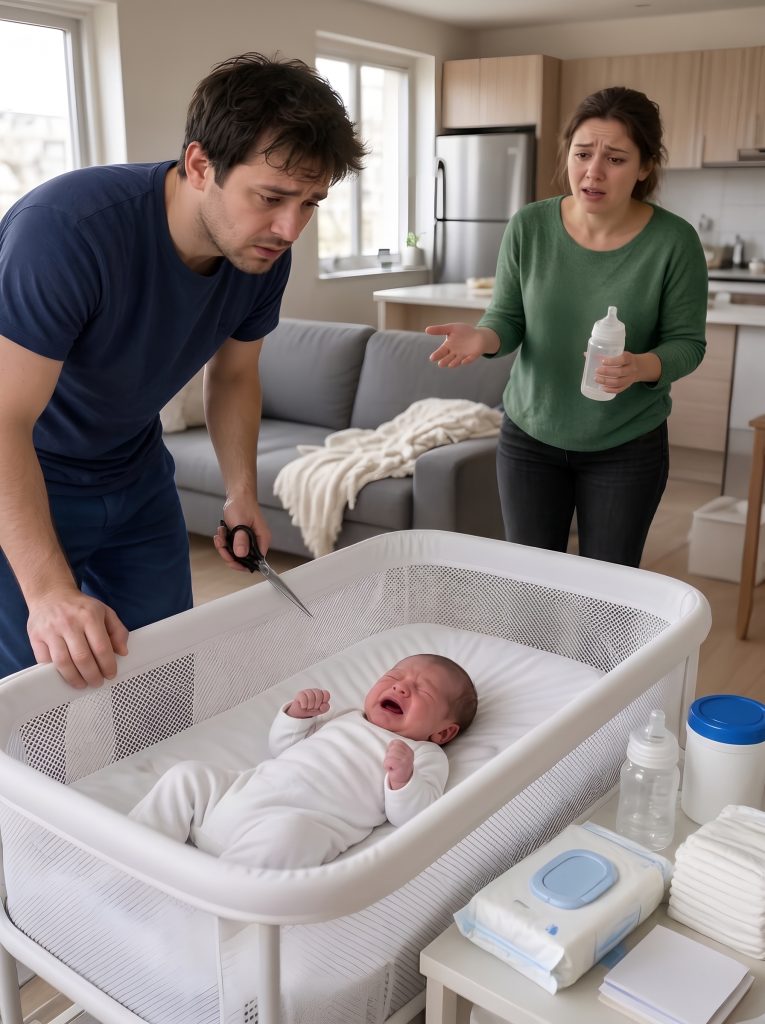
The first time my husband became furious because our newborn cried for milk, I told myself he was exhausted. Neither of us had slept properly since bringing Emma home.
I desperately wanted to believe becoming a father had overwhelmed him. I never imagined his anger would eventually turn our little house into somewhere my daughter and I feared.
My husband, Derek, had always worried about money. Before Emma was born, he checked our bank account almost obsessively and complained whenever an unexpected expense appeared.
Still, I believed we were prepared. We had savings, Derek had a steady job, and I planned to return to work after maternity leave ended.
Then Emma arrived.
Suddenly there were diapers, wipes, formula, bottles, doctor appointments, medicines, and dozens of little expenses neither of us had fully considered while preparing for parenthood.
I saw necessities.
Derek saw numbers.
Every grocery receipt became an argument. Every empty formula container seemed to personally offend him. He began asking why a baby could possibly need so much.
“She’s a newborn,” I would explain. “She needs to eat.”
He would shake his head, stare at the receipt, and mutter about money disappearing faster than he could earn it.
At first, his frustration was only verbal. He complained about formula prices, complained about diapers, complained about electricity, and accused me of wasting money while staying home.
I tried everything to keep him calm.
I bought cheaper brands. I searched for coupons. I tracked every household expense. I even stopped buying small things for myself.
Nothing worked.
The problem wasn’t really the money.
I just didn’t understand that yet.
One evening, Emma began crying shortly after Derek returned from work. I immediately picked her up, checked her diaper, and started preparing a bottle.
Derek entered the kitchen.
“Again?” he demanded.
“She’s hungry.”
“She just ate.”
“That was almost three hours ago.”
His jaw tightened.
He stared at the formula container on the counter as though it represented everything he hated about our new life.
“Do you know how much that costs?”
I thought he was exaggerating.
“Derek, she has to eat.”
Emma continued crying.
Something changed in his expression.
He slammed his hand against the counter so hard that I jumped. Emma screamed louder, startled by the sudden noise.
“Make her stop!”
I carried her into the bedroom and closed the door.
That night, Derek apologized.
He blamed work.
He blamed exhaustion.
He blamed financial pressure.
And because I desperately wanted my marriage to return to normal, I accepted every explanation.
But normal never returned.
Over the following weeks, Derek became increasingly angry whenever Emma cried. The sound seemed to trigger something inside him that I could not predict or control.
I stopped asking him to help with nighttime feedings.
I learned to wake at the smallest movement from Emma’s crib so I could feed her before she cried loudly enough to wake him.
I became terrified of ordinary newborn sounds.
A whimper made my heart race.
A cry made my hands shake.
Every night became an attempt to keep our daughter silent.
Then came the afternoon when I finally understood how dangerous the situation had become.
I had barely slept the previous night and accidentally drifted off on the couch while Emma was resting in her bassinet nearby.
Her crying woke me.
But Derek reached her first.
When I entered the room, I saw enough to realize that my baby was in immediate danger. I rushed toward him and pulled Emma away.
“What are you doing?”
Derek turned toward me.
“She won’t stop!”
“She’s hungry!”
“She’s always hungry!”
I looked at my daughter and saw marks that should never have been there.
My entire body went cold.
I demanded to know what he had done.
Instead of answering, Derek began shouting about diapers, formula, bills, and how Emma was supposedly destroying everything we had worked for.
“She’s a baby!” I screamed.
That sentence seemed to make him even angrier.
When I tried to move past him with Emma in my arms, he blocked the doorway.
For the first time, his rage turned fully toward me.
I remember protecting Emma against my chest.
I remember telling him to stay away.
Then everything became confusion.
When it ended, I was on the floor, dizzy and struggling to understand what had happened. My face hurt, and Emma was crying nearby.
Derek stood several feet away.
His anger vanished almost instantly.
That frightened me even more.
He suddenly looked calm.
Almost annoyed.
“Look what you made happen,” he said.
Those words stayed with me.
Not because I believed them.
Because I realized he did.
In Derek’s mind, nothing was ever his responsibility. Someone else always caused his anger. Someone else always deserved the consequences.
I wanted to leave immediately.
But fear can make simple decisions feel impossible.
I had very little money of my own because I was on maternity leave. Derek controlled our main account, and my closest relatives lived hours away.
I also feared what would happen if I tried leaving and failed.
So I did something I still regret.
I stayed.
But from that day forward, I never willingly left Emma alone with him.
I carried her from room to room.
I slept beside her crib.
I took her into the bathroom while showering.
Derek noticed.
He accused me of treating him like a criminal.
“You don’t trust me with my own daughter?”
I didn’t answer.
Because the truthful answer might have put us in even greater danger.
Then his mother, Patricia, arrived.
Derek had apparently called her and complained that I had become “hysterical” since giving birth.
Patricia had always defended her son.
If Derek lost his temper, someone had provoked him.
If Derek made a mistake, someone had pressured him.
If Derek hurt someone’s feelings, they were too sensitive.
Still, I believed there had to be a boundary even Patricia wouldn’t cross.
Surely that boundary was her newborn granddaughter.
I was wrong.
Patricia walked into our house on a Sunday afternoon. Derek immediately began telling her that I was exaggerating everything.
I stood silently holding Emma.
Then Patricia noticed my face.
Her expression changed.
“What happened?”
I looked directly at Derek.
He looked away.
That should have told Patricia everything.
Instead, she asked me to explain.
So I did.
I told her about his rage whenever Emma cried.
I told her about the constant arguments over formula and diapers.
Then I told her what had happened to Emma.
Patricia listened quietly.
I expected horror.
I expected her to grab her phone.
I expected her to confront her son.
Instead, she sighed.
“You know Derek has always had a temper.”
I stared at her.
“That’s your answer?”
“He’s under pressure.”
“Your granddaughter was hurt.”
Patricia lowered her voice.
“Keep your voice down.”
Something inside me broke at those words.
I showed her enough for her to understand that this was not an argument between exhausted new parents.
This was danger.
She knew.
And she still defended him.
Then Patricia said something I would never forget.
“Sometimes you just have to let him get his anger out.”
I thought I had misunderstood her.
“What?”
“He needs somewhere for that frustration to go.”
I looked down at Emma.
Then back at Patricia.
“You’re talking about your granddaughter.”
Patricia avoided my eyes.
“You married him. You know what he’s like.”
That sentence changed everything.
Until that moment, part of me had been waiting for someone from Derek’s family to tell me I wasn’t imagining the danger.
Instead, Patricia confirmed something worse.
She already knew who her son was.
Maybe she had known for years.
And rather than forcing him to confront his behavior, she had apparently spent years teaching everyone around him to absorb it.
I realized Emma could grow up inside the same system.
Someday Patricia might tell my daughter that Daddy was angry because she had been too loud.
Or too expensive.
Or too difficult.
I couldn’t allow that.
That evening, I made my decision.
I didn’t announce it.
I didn’t threaten Derek.
I didn’t tell Patricia.
I became quiet.
They interpreted my silence as surrender.
It was actually preparation.
Over the next several days, I began documenting what I safely could.
I photographed visible injuries.
I saved threatening messages.
I wrote down dates, times, arguments, and the statements Derek made afterward.
I also documented Patricia’s reaction.
Then I contacted someone I trusted.
My older sister, Rachel, lived almost four hours away.
We hadn’t spoken much since Emma’s birth because Derek disliked her.
That suddenly made sense.
Rachel had always questioned his behavior.
I waited until Derek was at work before calling.
The moment Rachel heard my voice, she knew something was wrong.
“I need help,” I whispered.
She didn’t ask why I had waited.
She didn’t criticize me.
She simply asked, “Are you and Emma safe right now?”
“For the moment.”
Rachel told me she was coming.
But we both understood that simply driving away could become dangerous if Derek returned unexpectedly.
So I contacted local professionals who could help me plan a safer exit and document what had happened.
For the first time, I stopped thinking about saving my marriage.
I started thinking exclusively about saving my daughter and myself.
The next morning, Derek left for work believing everything had returned to normal.
He kissed my forehead.
He looked into Emma’s crib.
Then he reminded me not to buy the expensive formula again.
I waited until his car disappeared.
Then I moved.
I packed only essentials.
Documents.
Medication.
Baby clothes.
Formula.
Diapers.
My evidence.
And the small stuffed rabbit Rachel had bought Emma before she was born.
Everything else stayed behind.
Wedding photographs remained on the wall.
My clothes remained in the closet.
Our dishes remained beside the sink.
I finally understood that possessions could be replaced.
Safety could not.
Rachel arrived shortly afterward.
When she saw my face, she stopped in the doorway.
For several seconds, neither of us spoke.
Then she hugged me carefully.
“I’m sorry,” I whispered.
“For what?”
“For not listening to you.”
Rachel shook her head.
“We can talk about everything else later. Right now, we get you two somewhere safe.”
Before leaving, I looked around the living room.
This was where Derek and I had once assembled Emma’s crib together.
Where we had opened baby-shower gifts.
Where I had believed our family was beginning.
Now I only wanted distance from it.
Derek discovered we were gone that afternoon.
My phone exploded with messages.
First came confusion.
Then anger.
Then apologies.
Then accusations.
Then promises.
He said he loved me.
He said he would change.
He said I was destroying our family.
Finally, he threatened consequences if I kept Emma away from him.
I saved everything.
For once, his words were no longer disappearing into the privacy of our marriage.
They were becoming evidence.
Patricia called next.
I almost ignored her.
Instead, I answered.
“You need to come home,” she said.
“No.”
“You’re making this bigger than it needs to be.”
“Your granddaughter was hurt.”
Silence.
Then Patricia said, “You’re going to ruin Derek’s life.”
That sentence gave me more clarity than anything else she could have said.
Not once did she ask whether Emma was okay.
Not once did she ask whether I needed medical attention.
Her concern was Derek.
Always Derek.
“No,” I told her. “His choices are going to determine what happens to his life.”
Then I ended the call.
What followed was difficult.
There were medical examinations, photographs, reports, interviews, legal conversations, and questions I hated answering.
I had to repeat events I wanted desperately to forget.
But every time I considered giving up, I looked at Emma.
She could not speak for herself.
So I would.
Derek initially denied everything.
Then he claimed I was exaggerating.
Then he suggested I had caused Emma’s injuries accidentally.
The story kept changing.
The documentation did not.
The messages did not.
And neither did the medical evidence.
Patricia attempted to defend him.
She described Derek as a hardworking father overwhelmed by financial pressure.
But financial pressure does not excuse harming a child.
Exhaustion does not excuse violence.
Parenthood does not create permission for cruelty.
Those were truths I wished I had understood sooner.
Months later, I found myself sitting in a quiet apartment with Emma asleep against my chest.
The apartment was small.
The furniture was mostly secondhand.
Money was tight.
And I had never felt richer.
There was no shouting.
No fear when Emma cried.
No frantic attempt to silence her before someone became angry.
When she woke hungry at two in the morning, I simply fed her.
Sometimes I cried while holding the bottle.
Not because formula was expensive.
Because something so ordinary had once terrified me.
Rachel helped whenever she could.
Friends I had gradually lost contact with began returning to my life.
I learned that isolation had been part of what kept me trapped.
I also learned something about Patricia.
Derek’s childhood had apparently been filled with excuses for his temper.
Teachers were blamed.
Friends were blamed.
Girlfriends were blamed.
Coworkers were blamed.
Everyone except Derek.
Patricia thought protecting her son meant shielding him from consequences.
In reality, she had helped teach him that consequences belonged to other people.
I refused to continue that pattern with Emma.
My daughter would never grow up believing love required enduring someone else’s violence.
She would never be taught that anger entitled another person to hurt her.
And she would never hear me excuse what happened because diapers were expensive or because her father was stressed.
Today, when people ask why I didn’t leave after the first warning sign, I wish there were a simple answer.
There isn’t.
Fear changes how you think.
Isolation changes what seems possible.
Repeated apologies make you question your judgment.
And sometimes the person hurting you spends enormous energy convincing you that leaving is more dangerous than staying.
But there is one moment I remember with absolute clarity.
It wasn’t Derek shouting.
It wasn’t seeing the injuries.
It wasn’t even finding myself on the floor.
It was Patricia looking at me and explaining that her son needed somewhere to put his anger.
That was when I saw the future.
If I stayed, Emma and I would become containers for Derek’s rage while everyone around him invented reasons why we should tolerate it.
So I left.
Not because I suddenly became fearless.
I left while terrified.
I left uncertain about money.
I left without knowing exactly what the next year would look like.
But I left knowing one thing.
My daughter deserved to cry when she was hungry without being afraid.
She deserved to grow up understanding that home was where someone came when they needed comfort—not somewhere they learned silence for survival.
And I deserved that too.
Derek once complained that diapers and formula were costing him too much.
He never understood the real cost of what he was doing.
His anger cost him his family.
His refusal to accept responsibility cost him the trust of the people who had once loved him.
And Patricia’s determination to protect him cost her something too.
She lost the ability to pretend she had been protecting her family.
Because protecting a family never means sacrificing its most vulnerable members to preserve the comfort of the person causing the harm.
For years, Patricia had apparently believed love meant protecting Derek from consequences.
I learned the opposite.
Sometimes love means drawing a boundary that cannot be negotiated.
Sometimes motherhood means walking away from everything familiar.
Sometimes protecting your child means refusing to keep someone else’s terrible secret.
Emma will someday be old enough to ask why her earliest family photographs show only the two of us.
When that day comes, I won’t teach her hatred.
But I will tell her the truth appropriate for her age.
I will tell her that when she was tiny, I discovered our home was not safe.
So I took her somewhere that was.
I will tell her she was never responsible for an adult’s anger.
She was never “too expensive.”
She never cried too much.
She was simply a baby asking to be fed.
And I will tell her something I wish someone had told me much earlier:
Love does not require you to become someone’s target.
Family does not require silence.
And protecting an abusive person from consequences is not compassion.
It is permission.
The morning I walked away, I thought I was leaving my entire life behind.
Looking back, I understand something completely different.
That was the morning Emma and I finally began one.