Part 1: The Call from West District
Rain hammered against the windshield of my cruiser as I pushed through
the final hours of a brutal double shift. After twenty years in law
enforcement, exhaustion was familiar territory, but at 11:42 that night,
all I wanted was a hot shower and the silence of my apartment.
Then my personal phone rang, and the name on the screen instantly
wiped away every trace of fatigue. It was my fifteen-year-old son, Blake,
who lived across town with my ex-wife Sarah and her new husband,
Graham Vance.
“Blake?”
His voice was strained when he answered.
“Dad, I’m at the police station.”
I had seen Blake only hours earlier when I dropped off a math textbook
he’d forgotten. He had seemed unusually withdrawn, but I hadn’t pushed
him for an explanation, and now I realized something had been wrong long before his call.
“What happened?”
“My stepdad… he hurt me. Then he drove me down here. He filed a
report saying I started it. He told them I attacked him, Dad. The officers…
they believe him.”
I already knew what kind of man Graham could be. He was a wealthy
contractor who built luxury condominiums and cultivated an impressive
public image, but beneath that polished exterior was someone I had
never completely trusted.
“Which station?”
“West District Precinct.”
“Which officer caught the desk?”
“Sergeant Miller.”
That name made the situation even worse because I knew Miller’s
reputation. He cared far too much about political connections and
career advancement, and if Graham had chosen that precinct
deliberately, I suspected there was a reason.
“Stay put. Don’t sign anything. Don’t say a single word to anyone. Twenty
minutes.”
I didn’t call an attorney because I needed to understand what was
happening first. I activated my lights and siren and drove through the
storm toward West District, arriving still dressed in my captain’s
uniform.
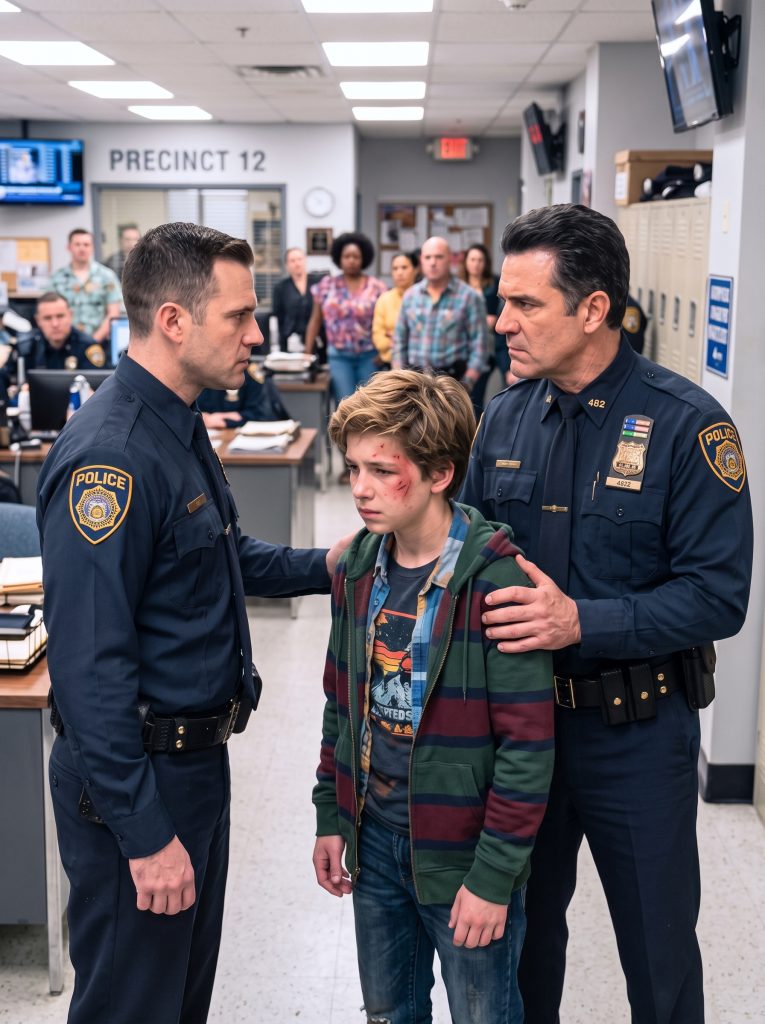
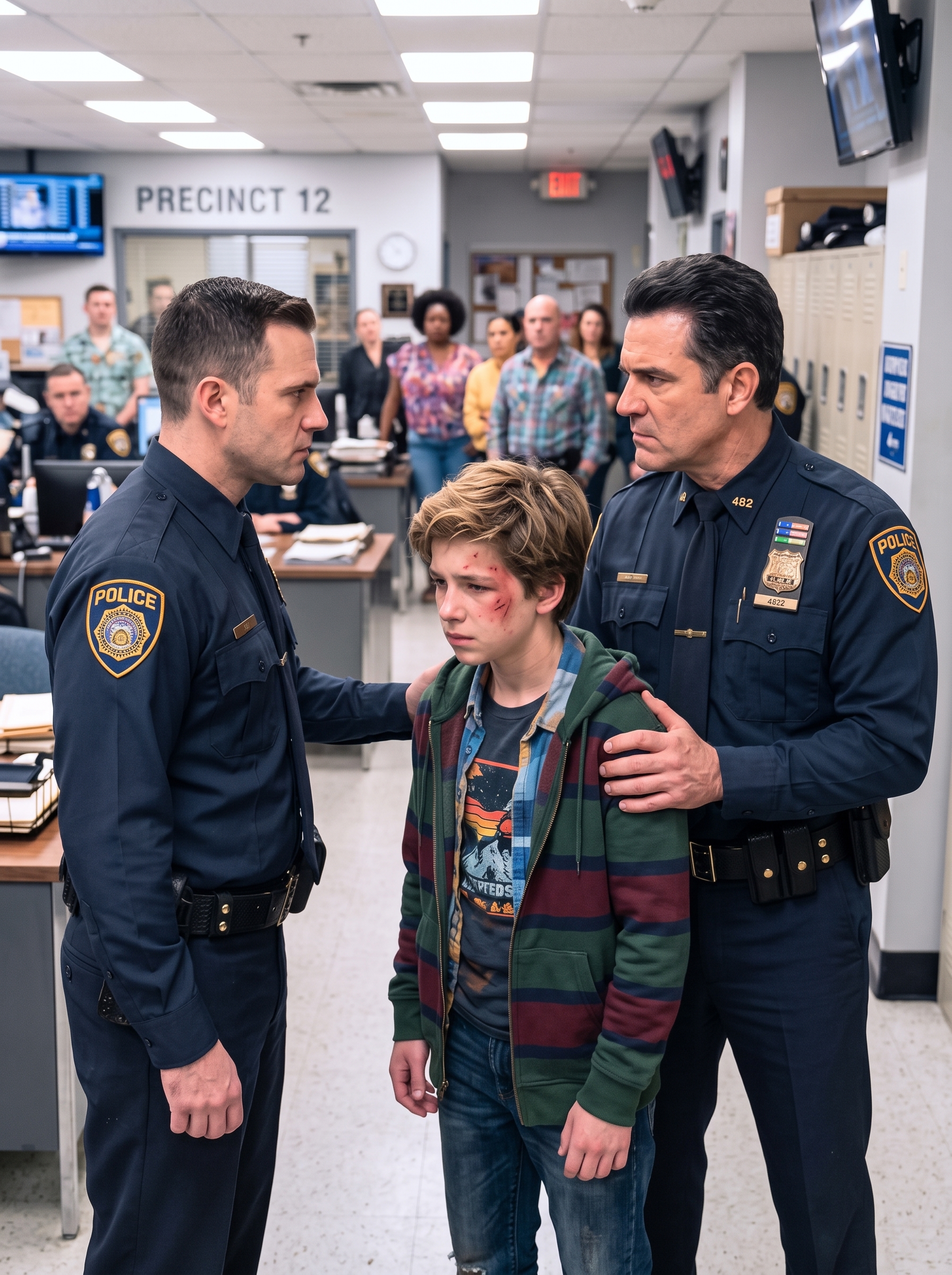
The precinct became noticeably quieter when I entered. Officers
stopped what they were doing, and then I saw Blake sitting near the
holding area with visible swelling beneath his left eye.
Every instinct in me wanted an immediate answer, but anger wasn’t
going to help my son. I walked over, placed a protective hand on Blake’s
shoulder, and turned toward Sergeant Miller as he emerged from his
office looking considerably less confident than I remembered.
“Captain David, I…”
“Sergeant Miller. I got a call that my son was here.”
Miller explained that Graham had filed a formal complaint accusing
Blake of becoming violent. I listened until he finished, then asked why a
fifteen-year-old had been held at the precinct without his biological
father being notified.
Miller’s expression changed immediately.
“Sir, the stepfather, Graham Vance, is in Interrogation Room C. He’s
waiting to finalize his statement.”
I left Blake with a lieutenant I trusted and headed down the hallway.
Before entering the interrogation room, I expected to find Graham
nervous after realizing who had arrived.
Instead, he was leaning comfortably back in his chair with a confident
smile.
“Took you long enough, Captain.”
I closed the door and confronted him about what had happened to Blake.
Graham didn’t deny that there was more to the story, but his explanation
was nothing I could have anticipated.
According to him, Blake had entered his private office earlier that
afternoon and opened a safe hidden behind a bookshelf. Inside was a
USB drive containing five years of unofficial company records, including
offshore accounts, questionable payments to city officials, and money
moving through Graham’s construction projects.
Suddenly, Blake’s accusation made terrifying sense.
This had never been an ordinary dispute between a teenager and his stepfather.
Graham believed my son had taken evidence capable of destroying
everything he had built.
Part 2: The Trap Behind the Complaint
Graham seemed almost pleased that I finally understood why Blake had
ended up at the precinct. According to him, the USB contained records
of bribes, offshore accounts, money laundering, and years of hidden
transactions connected to his construction company, and he believed
Blake had taken the drive after opening the safe in his home office.
“You’re confessing to grand-scale fraud and money laundering. Right in a police precinct.”
“I’m not confessing to anything. Because you’re not going to arrest me.”
I reached toward the handcuffs on my belt, but Graham’s next words
stopped me. His confidence came from more than money or connections
because he had spent two years constructing another layer of
protection, and this one involved Sarah.
“Touch those, and Sarah goes to federal prison for a minimum of ten years.”
Graham explained that Sarah’s signature appeared on transfers involving
his shell companies and that she was officially listed as the financial
director of several offshore holdings. He claimed he had presented the
paperwork to her as ordinary business and tax documents, knowing she
trusted him enough to sign without understanding what he was actually
building around her.
If investigators followed the financial trail without knowing the truth, Sarah could appear deeply involved in Graham’s operation. He intended to portray himself as the victim of a dishonest employee and leave my ex-wife carrying responsibility for transactions she hadn’t knowingly authorized.
“You’re a monster.”
“I’m a survivor, Captain. If you try to use whatever is on that USB, the FBI will trace it right back to Sarah. I’ll claim I was a victim of a rogue employee. She’ll take the bullet.”
Then Graham gave me his terms. I was supposed to leave the precinct, take Blake home, recover the USB from him, and return it without telling anyone what had happened.
Before I could answer, the interrogation-room door slammed shut behind me. I grabbed the handle and discovered it had been locked from the outside, then noticed that the security camera in the corner, which had previously been inactive, was now recording.
That was when I understood Sergeant Miller’s role.
Graham admitted that Miller had been accepting favors from him for years and had deliberately looked the other way when Graham’s business required police cooperation. The false complaint against Blake had brought my son into a precinct where Graham already had someone willing to manipulate procedure for him.
But trapping me inside the room wasn’t merely about keeping me away from Blake. Graham wanted to destroy my credibility before I could expose him.
He removed his expensive jacket, loosened his tie, and pointed toward the camera. There was no audio recording, only video, which meant anyone reviewing the footage would see an enraged police captain alone with the man accused of hurting his son.
“That camera has no audio. It only records video. Right now, it’s recording a disgraced, emotionally compromised Police Captain locked in a room with a civilian. A civilian who is about to get brutally beaten.”
“You’re going to hit yourself?”
“No. You’re going to hit me.”
His plan was simple. Graham intended to provoke me until I lost control, then Miller would bring officers rushing into the room and make sure they found me standing over him.
If that happened, I could lose my badge, my pension, and any credibility I had when accusing Graham of corruption. Worse, Blake would remain vulnerable while Sarah could still be framed for financial crimes she didn’t understand.
Graham stepped closer and shoved me hard in the chest, then insulted me and threatened to destroy everything my son cared about. I clenched my fists but refused to strike him because I finally understood exactly what he needed from me.
“Come on, Captain. Defend your boy. Take a swing.”
He shoved me again.
I looked at Graham, then at the silent camera recording us.
And instead of giving him the reaction he wanted, I smiled.
“You made one mistake, Graham.”
Then I reached for the front of my captain’s uniform and ripped open my shirt.
Part 3: The Wire Graham Never Saw
Graham’s confidence disappeared the moment I pulled open my uniform shirt. Taped securely against my chest was a flat black transmitter with a small green indicator blinking steadily, and for the first time since I entered the interrogation room, he looked genuinely uncertain.
“What is that?”
“This is a high-fidelity, dual-channel transmitter.”
Graham had assumed I rushed to the precinct as an angry father without thinking ahead, but I had suspected something was wrong from the moment Blake called. Graham was too calculating to bring my son into a police station unless he believed someone inside would protect him, so before entering West District, I had made sure Internal Affairs and the Anti-Corruption Task Force could hear what happened.
“You’re bluffing. That’s a prop.”
I pointed toward the microphone concealed near my collar. Graham’s own plan had depended on a security camera without audio, but while he was concentrating on creating incriminating video of me, he had voluntarily provided investigators with something far more damaging.
“Testing, testing. Internal Affairs, how is my audio? Did you catch the part where Mr. Vance confessed to five years of money laundering, bribery, and framing my ex-wife with forged documents? Or how about the part where he confirmed Sergeant Miller is on his payroll?”
The color drained from Graham’s face as I explained that an unmarked surveillance vehicle was parked across the street. Investigators had heard his admissions about the financial operation, his attempt to frame Sarah, his threats against Blake, and his confirmation that Miller had been cooperating with him.
“No! This is entrapment! This won’t hold up in court!”
“It’s not entrapment if you volunteer the information while boasting about it.”
Seconds later, the locked door rattled violently before officers from the Anti-Corruption Task Force entered the room. Graham’s elaborate trap had collapsed because instead of recording a police captain losing control, he had spent the previous several minutes explaining his own criminal operation directly into a live transmitter.
But the danger wasn’t over.
Behind the tactical officers, I saw Sergeant Miller standing in the hallway. His face had changed completely as he realized Graham’s confession had exposed him as well, and panic replaced whatever confidence he had possessed when he locked that interrogation-room door.
Then his hand dropped toward his service weapon.
“Gun!”
I moved before he could fully draw it. There wasn’t enough time to reach for my own weapon, so I drove my shoulder into Miller and sent both of us crashing onto the hallway floor.
I pinned his weapon arm and forced his wrist away until the pistol slipped free and skidded across the linoleum. Tactical officers immediately surrounded us, pulled Miller away, and secured him while another team restrained Graham inside the interrogation room.
When I finally pushed myself upright, my shoulder was throbbing and my uniform was torn open. Graham was pressed against the wall while officers searched him, and the expensive suit and carefully maintained confidence that had made him seem untouchable only minutes earlier suddenly looked like meaningless decoration.
Then I heard Blake calling for me.
“David!”
He pushed through the stunned officers and stopped when he saw me leaning against the doorway. I could see the fear on his face, so I immediately opened my arms.
“I’m okay, kid.”
Blake ran straight into me, and I held him until both of us began breathing normally again. Graham was in custody, Miller had been exposed, and the false complaint against my son was already unraveling.
For a few minutes, I thought the hardest part was finished.
An hour later, however, the lead Internal Affairs investigator came into the break room carrying a thick folder. She confirmed that Graham’s recorded confession was excellent evidence, but there was still one problem capable of threatening Sarah.
They needed the USB drive.
Without the original financial data Graham had described, his attorneys could argue that his statements were exaggerated threats rather than proof of the underlying transactions. More importantly, investigators might not have enough evidence to demonstrate that Sarah’s signatures had been manipulated and used without her knowledge.
I looked toward Blake, wondering where Graham might have hidden the drive.
My son quietly put down his soda.
“You don’t need to search his house.”
Part 4: Blake’s Hidden Copy
Agent Thorne turned toward Blake after he said there was no need to search Graham’s house. She reminded him that Graham had explicitly claimed Blake stole the USB from his safe, but my son calmly pulled out his cracked smartphone as though he had been waiting for someone to ask the right question.
“You don’t need to search his house.”
“What do you mean, kid? Graham said on the tape that you took the USB.”
“I did take it.”
Blake explained that he had discovered the safe behind Graham’s bookshelf earlier that afternoon and managed to unlock it because Graham had foolishly used his own birthday as the passcode. Once Blake found the USB inside, he connected it to his laptop and immediately realized the files were far more serious than anything he had expected to uncover.
Instead of simply walking away with the physical drive, Blake had understood that Graham would notice it missing as soon as he checked the safe. Taking it would have placed him in immediate danger, so he chose a different solution.
“I cloned it.”
Agent Thorne stepped closer while Blake explained what he had done. He had created a complete digital copy containing the PDFs, encrypted ledgers, forged signature documents, offshore routing information, and other financial records before compressing everything into an encrypted folder and uploading it to a remote cloud server.
“And the physical drive?”
“I put it right back exactly where I found it. Locked the safe.”
Blake had nearly escaped without Graham realizing what happened, but he made one mistake. In his rush, he forgot to clear the local transfer cache on his laptop, and when Graham came home early and checked the computer’s recent activity, he discovered that Blake had accessed the files.
That explained everything that followed. Graham confronted Blake, then took him to West District because he mistakenly believed the physical USB was still hidden somewhere in my son’s belongings and expected Miller or another compromised officer to recover it before Blake could expose him.
But Graham had been wrong about something even more important.
Blake tapped his phone and held the screen toward Agent Thorne.
“I emailed the decryption key and the secure cloud link to the Internal Affairs cyber-tip line about ten minutes before I called my Dad tonight. You already have the data, Agent. Everything you need to clear my mom and bury Graham Vance under a federal penitentiary.”
For several seconds, Agent Thorne simply stared at him. The evidence investigators thought they still needed to locate was already in their possession, and Graham had spent the entire night desperately trying to recover a drive that had never actually left his safe.
“Captain, remind me to never, ever interrogate anyone with your last name.”
Then she put a hand gently on Blake’s shoulder.
“Brilliant work, kid. Truly. You just saved your mother’s life.”
Thorne immediately left to contact the cyber division, while I stood looking at my fifteen-year-old son with an entirely different understanding of what had happened that night. Blake hadn’t simply stumbled onto Graham’s records and waited for someone to rescue him; he had recognized the danger, preserved the evidence, protected his mother, and made sure investigators received the files before calling me.
I pulled him into another embrace without saying anything because there was nothing useful I could add. Graham had tried to portray Blake as a violent teenager, then use a corrupt police officer to control the story, but the boy he underestimated had quietly preserved the evidence capable of dismantling his entire operation.
By dawn, the storm outside had finally passed. Graham and Miller were in custody, Sarah could now be cleared through the financial records, and Blake and I walked together toward my cruiser as the first daylight appeared over the rain-soaked streets.
I opened the passenger door for him and climbed behind the wheel. For the first time since his call at 11:42 the previous night, I allowed myself to believe the nightmare was finally over.
Then my personal phone buzzed. The message came from a blocked, untraceable number.
“Graham was just a bricklayer. The real architects are still watching. Keep the boy close, Captain.”
I stared at the screen as the relief disappeared from my chest. Graham’s empire had fallen. But apparently, he hadn’t built it alone.
Part 5: The Architects Behind Graham
I read the anonymous message twice while Blake sat beside me in the passenger seat. Only minutes earlier, I had believed Graham’s arrest had ended the nightmare, but whoever contacted me knew what had happened inside the precinct and knew enough about Blake to warn me specifically to keep him close.
“Graham was just a bricklayer. The real architects are still watching. Keep the boy close, Captain.”
I didn’t show Blake the message immediately because he had already endured enough for one night. Instead, I locked my phone, started the cruiser, and reminded myself that Graham and Miller were now in custody while Internal Affairs possessed evidence neither of them could erase.
The arrests had transformed West District into the center of a much larger investigation. Graham’s recorded confession gave investigators evidence of his extortion attempt, his relationship with Miller, and his efforts to manipulate Sarah, while Blake’s copied files provided the financial trail necessary to examine the offshore accounts and fraudulent transactions Graham had spent years hiding.
Most importantly, those files offered Sarah a path out of the trap Graham had constructed around her. Investigators could now compare the underlying records with the documents she had signed and determine how Graham had disguised fraudulent transactions as ordinary business paperwork.
Blake had protected her before either of us even understood how much danger she was in. By cloning the USB, returning the original to Graham’s safe, encrypting the copied files, and sending investigators the access information before calling me, he ensured the evidence survived even if Graham succeeded in taking his phone or computer.
I looked across the cruiser at my son and realized how badly Graham had underestimated him. Graham saw a fifteen-year-old snooping somewhere he didn’t belong, but Blake had recognized evidence of something serious and made sure the truth reached people capable of acting on it.
That didn’t mean I was comfortable with what he’d done.
“You know breaking into someone’s safe is not something I ever want you doing again.”
Blake gave me an exhausted look.
“Even if the guy is laundering money?”
“Especially then. Next time, call me before you decide to become your own cybercrime unit.”
For the first time all night, he smiled.
The moment didn’t erase what had happened, but it reminded me that Blake was still my son rather than another piece of evidence in Graham’s case. He needed his father more than he needed another police captain analyzing conspiracies, and whatever came next, protecting that distinction mattered.
I also knew the anonymous message couldn’t simply be ignored. Graham had admitted paying officials and maintaining offshore accounts, and the records Blake copied contained years of transactions, which meant investigators would have to determine whether Miller was merely one corrupt officer or part of something significantly larger.
So I forwarded the message through secure channels to Agent Thorne rather than responding to the sender. Whoever had sent it wanted me frightened, reckless, or curious enough to engage, and after watching Graham fail to provoke me in the interrogation room, I wasn’t about to make that mistake now.
Then I put the cruiser into gear and drove Blake away from West District.
Graham had tried to destroy my son’s credibility with a false complaint, protect himself through a compromised sergeant, and bury Sarah beneath financial records she never understood. By sunrise, he had lost control of every part of that plan because the people he underestimated had refused to behave the way he expected.
But the anonymous message changed one thing.
This wasn’t necessarily the end of the investigation.
It was only the end of Graham’s part in it.
I glanced at Blake as we drove through the rain-washed city and made myself one promise. Whoever the so-called architects were, they wouldn’t get the frightened teenager Graham had dragged into West District.
They would get Blake’s father.
And this time, I already knew they were watching.
← Prev Part