Real Love Answers the Phone
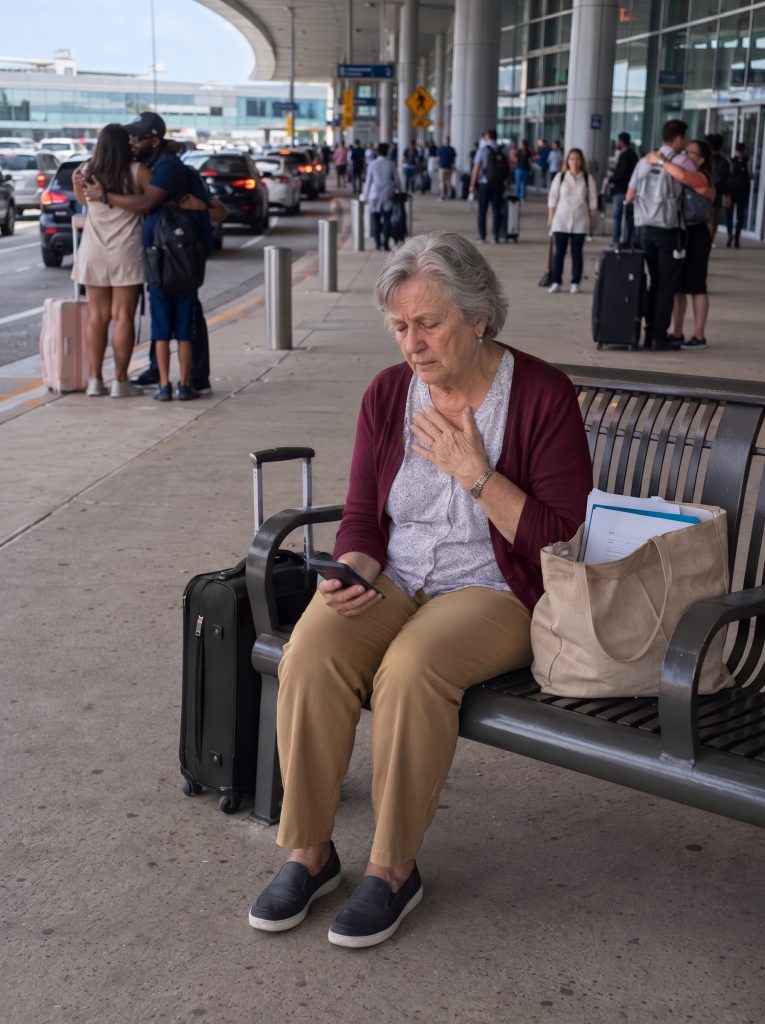
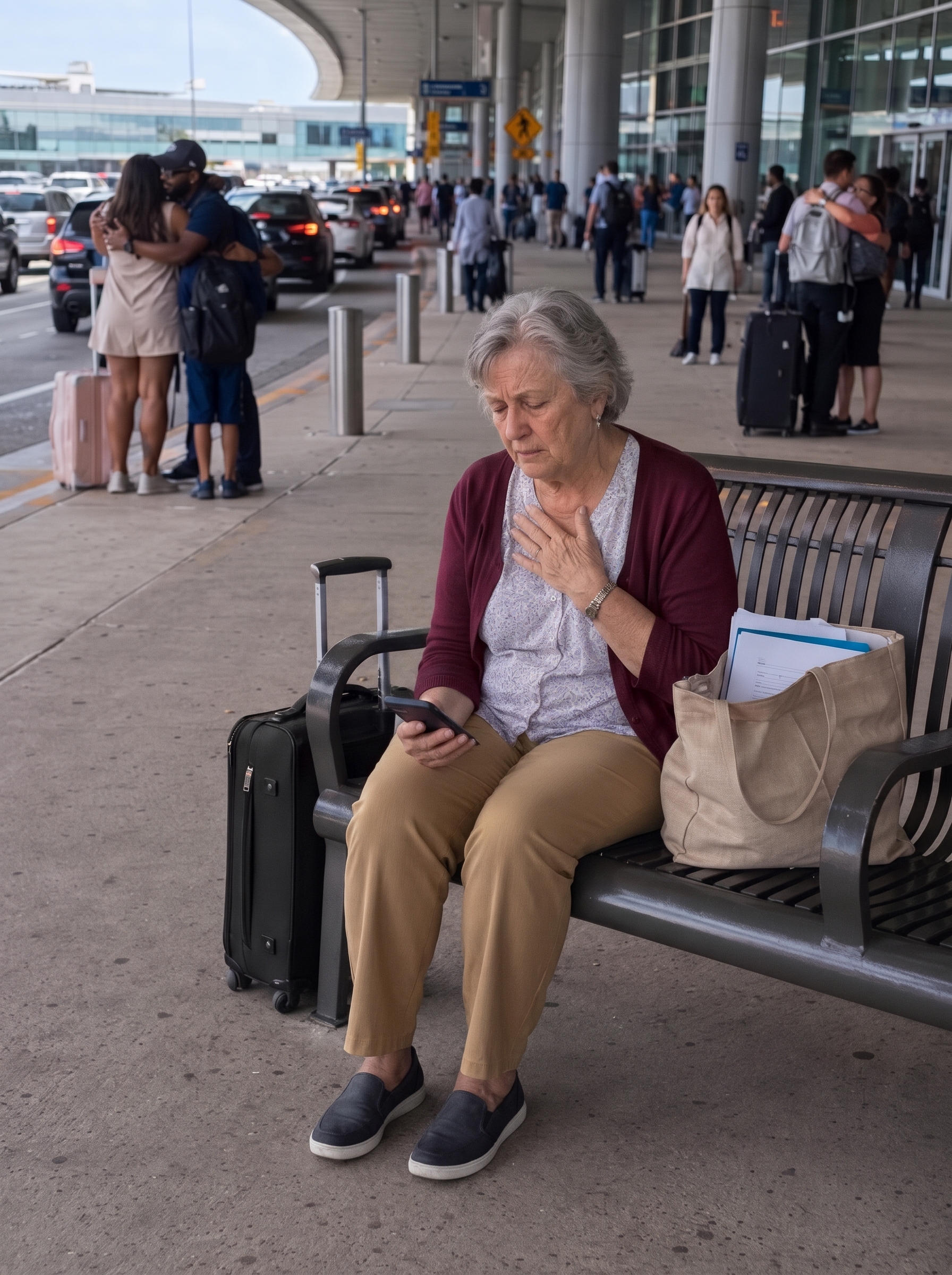
The flight from Cleveland landed at one in the afternoon, and I sent the text from the hard airport chair with my purse clutched in my lap and my small suitcase standing beside my knee.
Can someone pick me up? My flight lands at 1 p.m.
I watched the little message sit in the family group chat while the airport moved around me the way airports do, indifferent and continuous, full of families reuniting near baggage claim and businessmen rolling carry-ons and a young mother laughing as her toddler kicked both shoes loose in midair. Three weeks in Cleveland had made me see ordinary things differently. The way a mother just picked up those small shoes without a second thought. The way a man held the door for someone he did not know.
My hand trembled slightly. Whether from the medication, the exhaustion, or something more basic than either, I could not tell anymore.
Twenty-three days earlier I had boarded a flight to Ohio alone and checked into a hospital bed in a city where I did not know a single street name. I had signed waivers acknowledging that I might bleed out, stroke out, or simply not wake up from the anesthesia. I had listened through the night to the woman behind the curtain in the next bed crying softly while nurses moved in and out on soft shoes. I had faced the real possibility of dying in a strange city without a familiar hand to hold.
I had told my family it was a minor procedure because I did not want to worry them. That was what I had always done, for as long as I could remember. I softened the edges of my own pain so other people would not have to rearrange their lives around it.
My phone finally vibrated.
We’re too busy today. Just call an Uber.
Diana. My daughter-in-law of fifteen years, the woman whose children I had watched four days a week while she built her career at Meridian Pharmaceuticals.
A second message appeared from Phillip.
Why don’t you ever plan anything in advance, Mom?
I sat very still and looked at those words until the letters blurred at the edges.
The surgery I had just survived was not a minor procedure. It was an experimental valve reinforcement involving titanium mesh, performed by specialists who operated on perhaps forty patients a year. The procedure carried a forty percent chance of not surviving it. I had known this. I had chosen not to burden my family with it. And now here was the result of that choice, my son asking why I had not planned better, my daughter-in-law directing me to a rideshare app.
My thumb hovered over the keyboard.
I thought about telling them the full truth. About the titanium mesh now holding my heart chambers from collapsing. About the blood pressure crash in recovery that had kept me in the ICU for two extra days. About the surgeon’s face when he came to tell me they had almost lost me on the table, the particular way a person’s expression looks when they are relieved and still frightened at the same time.
I typed one word.
Okay.
There was nothing cheerful about that word, despite what the autocorrect period implied. Something was forming inside me as I sat in that hard chair, something I had been years in the making of and had not quite completed until that moment.
I opened a different text thread.
Dr. Harrison Wells had been the cardiologist who first identified my condition and referred me to the Cleveland surgical team. He was the kind of physician whose name appeared in medical journals and conference programs, the kind that had a six-month waiting list for private consultations. He was also, through the strange alchemy of months of appointments and conversations that had drifted far beyond medical protocols, something that felt very much like a friend. We had talked about Italian opera and grief and the best peach cobbler in Georgia. He had insisted I call him Harrison. I still could not quite manage it without feeling presumptuous.
He was currently in Switzerland for his son’s birthday.
Harrison, I typed, I know you’re in Zurich, but I just landed in Atlanta after the Cleveland surgery. Having some transportation issues. Don’t worry. I hope the celebration was wonderful.
I sent it without expecting anything. He was overseas with his family. He had no reason to see it quickly.
My phone rang almost immediately.
“Pamela?” The voice was unmistakable, that slight Boston accent under the warm authority of it.
“Harrison? I didn’t expect you to call.”
“Where are you in the airport?”
“Terminal B. But please don’t worry about this, I only meant to say hello.”
“Stay there,” he said. “I’m at Terminal C right now. I caught the overnight flight from Zurich. I’m waiting for my driver. Samuel and I can collect you on the way out. Do you have checked luggage?”
“Just this carry-on. But Harrison, I can’t impose. You’ve just flown from Europe.”
“Pamela,” he said, and his voice had the particular quality of a man who does not argue when he has made a decision, “you have just had major cardiac surgery. The last thing you need is a rideshare app and a strange driver. Text me your exact location.”
After we hung up I sat in stunned quiet for a moment. Then I opened my compact mirror and winced at what I found there. Three weeks in a hospital had left me pale and hollow-eyed and twelve pounds lighter than I had any right to be. My silver hair hung limp. My good blouse sagged from my shoulders like something borrowed from a larger woman.
There was nothing to be done about any of it.
I applied lipstick anyway, a small act of self-regard that I could not fully explain but felt suddenly necessary.
Fifteen minutes later, Samuel helped me with my suitcase and Harrison appeared beside the car in a casual jacket that probably cost more than my monthly pension, his silver hair slightly rumpled from the transatlantic flight, his eyes immediately assessing me with the focused attention of a cardiologist who is also a friend and finding both roles relevant.
“Pamela,” he said, taking my hand in both of his. “I’ve been wondering how the surgery went. I’ve been concerned.”
The genuine care in his voice, arriving as it did after the coldness of my family’s texts, nearly undid me. I blinked hard and manufactured a smile.
“I’m still here,” I said.
His eyes did not miss anything. They never did.
“Yes,” he said quietly. “And I am very glad of that fact.”
He offered me his arm as Samuel handled the suitcase, and the gesture was so unexpectedly courteous that I hesitated before taking it. As we walked to the car he leaned closer.
“You can tell me on the way why your family wasn’t here to meet you.”
The Bentley glided through Atlanta traffic with the insulation of a different world, quiet and steady. I looked out at the familiar city moving past and wondered how to explain a dynamic that I had spent years refusing to examine too closely.
“They’re very busy,” I said, aware of how it sounded.
“I see,” Harrison replied, with the patience of a man who has learned not to rush toward conclusions but not to pretend they aren’t visible either. “And they couldn’t spare half an hour after cardiac surgery.”
“I didn’t tell them it was cardiac surgery,” I admitted. “I said it was a minor procedure.”
“Pamela. The experimental valve reinforcement you underwent is not remotely minor.”
“I know that,” I said quietly. “But telling them the truth would have meant asking for things I wasn’t certain they wanted to give.”
He was quiet for a moment, watching the highway.
“And so you protected them from worrying about you,” he said, “and they protected their Saturday from inconvenience.”
The accuracy of it was stark enough that I couldn’t answer.
Samuel helped me into the house while Harrison insisted on reviewing my medications and what was in the refrigerator, which he found inadequate in ways he described with the particular directness of a doctor who has decided to apply his expertise to a situation beyond his official mandate. He sent Samuel to the grocery store with a detailed list. He made tea while I sat at the kitchen table feeling simultaneously grateful and absurd.
He set a cup in front of me.
“My mother believed tea could cure most things short of structural failure,” he said. “In your case, the structural issues have already been addressed by better surgeons than either of us. The tea is for the rest of it.”
That made me smile. A genuine one, the first in days.
My phone began vibrating on the counter.
I ignored it at first. Then I looked, and went still.
Forty-eight missed calls.
Thirty-two texts. All from Phillip and Diana. Sent over the past two hours, beginning when Harrison had posted a photograph.
I opened his social media page and found it: the two of us near the Bentley, his hand steadying my elbow, my face turned slightly from the camera. The caption read: Honored to assist my friend Pamela Hayes home after her courageous journey through pioneering cardiac surgery. A remarkable woman with extraordinary resilience.
The post had thousands of likes.
One comment stood out immediately.
Dr. Wells, that’s my mother-in-law. We’ve been hoping to speak with you for months regarding Meridian’s Cardio Restore project.
Diana.
I looked up at Harrison.
His expression told me he had already seen it.
“You knew,” I said quietly. “About Diana trying to reach you professionally.”
He sat across from me and folded his hands around his teacup.
“Your daughter-in-law has attempted contact with my office seventeen times in four months,” he said. “Six approaches at conferences. Two invitations to speak at Meridian events. All declined.”
“And when I mentioned my family during our consultations, you connected it.”
“Yes. Though I should clarify: my interest in your well-being preceded that connection entirely and remains entirely separate from it.”
I looked at him for a long moment, this distinguished man sitting in my modest kitchen with the practiced ease of someone who is entirely comfortable wherever he is.
“Pamela,” he said, reading the question I had not spoken, “I came to Terminal C because you needed assistance and no one else came. That is the whole of it.”
The texts from Phillip and Diana were already escalating, moving from confusion to urgency to a particular breathless calculation I recognized from years of watching Diana approach situations that could be leveraged.
I turned the phone face down.
“Shall we finish our tea?” I asked.
Harrison smiled.
The calls continued through the afternoon. By the time Harrison and Samuel left, after ensuring my medications were organized and my refrigerator no longer constituted a cardiac risk, my phone showed sixty-four missed calls and a text from Diana asking how well I knew Dr. Wells exactly and whether I might arrange an introduction.
Not one message asked how the surgery had gone.
Not one asked if I was frightened.
Not one said they were glad I was home.
The doorbell rang at seven that evening.
Phillip and Diana stood on the porch in work clothes, their expressions carefully assembled into something that looked like concern from a distance but had calculation in the details.
I let them in.
Diana’s eyes went immediately to the pill organizer on the coffee table, then to the medical documents, then to the private number written on the back of Harrison’s business card on the side table. Phillip looked at the card with an attorney’s eye for detail.
“Mom,” he said, “we’ve been trying to reach you all afternoon. Why didn’t you call back?”
“I was resting,” I said. “Doctor’s orders.”
“Cardiac surgery?” Diana said. “You told us it was minor.”
“I didn’t want to worry you.”
She sat down on my sofa and attempted the gentle tone she used when she needed something and believed softness was the most efficient route to it.
“How well do you know Dr. Wells?” she asked. “We had no idea you were close. It’s such a small world.”
“He was my consulting cardiologist before I was referred to Cleveland,” I said. “Over the months of appointments, we became friends.”
“Friends,” Diana repeated, finding the texture of the word. “He seems quite invested in your welfare. Picking you up from the airport personally.”
“When my family wasn’t available,” I said, allowing the words to settle where they would.
Phillip had the grace to look ashamed. Diana moved past it.
“It’s just that his connection to our family could have real professional implications. Meridian’s Cardio Restore program needs his endorsement. I’ve been trying to reach him for months. You must understand how significant this could be.”
There it was.
Not my surgery. Not my fear. Not the forty percent chance that had sent me to Cleveland without a hand to hold. What I could provide. What connection I represented.
I looked at my son. He looked at the carpet.
“I understand perfectly,” I said. “You are here because Harrison appeared on social media with me, not because I had cardiac surgery and came home alone.”
“That’s not fair,” Phillip said.
“You asked why I don’t plan ahead,” I said. “I had surgery and texted from the airport. Diana told me to call an Uber. That was the planning.”
My son closed his eyes briefly.
“Mom. I’m sorry. We should have been there.”
“Yes,” I said. “You should have.”
The honesty of it sat between us without decoration.
Diana tried once more. She explained that Phillip’s firm handled Meridian’s legal work, that the family’s financial stability was tied to her professional success, that one introduction would open a door that had been closed for months.
I thought about what Harrison had said in the car. That Cardio Restore’s clinical trials had shown mixed results. That it needed more research, not better marketing. That Diana Reynolds’s approach to physician endorsements had given her a specific kind of reputation in medical circles.
“My relationship with Harrison is personal,” I said. “Not a professional resource.”
Diana’s composed expression cracked slightly.
“So you won’t help us.”
“I won’t use a friendship to advance a pharmaceutical campaign for a drug Harrison has concerns about,” I said. “No.”
After they left, with promises to check in that I understood would be conditional on what happened next, I sat in the quiet house and felt something I had not felt in years. Not happiness exactly. Something steadier. The particular relief of having said a true thing without softening it.
Harrison called the following morning.
He asked how I was feeling and whether I had slept. Then, with the directness I had come to appreciate about him, he acknowledged that his social media post had been at least partly intentional.
“Some situations benefit from clarity,” he said. “Diana Reynolds has built a strategy around persistent access. A public connection sometimes communicates what professional refusals cannot.”
“And I was the mechanism for that clarity,” I said.
“You were the reason I came to the airport,” he corrected. “The clarity was a secondary benefit. Pamela, would you be willing to accompany me to the symphony gala this Saturday? It benefits cardiac research, and I find I’m not interested in attending alone.”
I looked at the living room where my daughter-in-law had sat an hour ago asking what she could extract from this friendship.
“Yes,” I said. “I would like that.”
“Good. Samuel will help with arrangements.”
When I arrived at the gala in the emerald dress that Samuel’s team had arranged, feeling more like myself than I had in years, Harrison met me at the door with the unhurried warmth of a man who is not performing attentiveness but simply feels it. He offered me his arm. He introduced me as his guest, without title or explanation, and let the ambiguity do what ambiguity does.
When Diana and Phillip appeared, impeccably dressed, Diana’s professional smile fully deployed, Harrison greeted them with perfect courtesy and then deflected her pivot toward Meridian with the ease of someone who has been navigating that kind of approach for decades.
“I don’t discuss business at charitable events,” he said pleasantly. “I’m sure you understand.”
“Of course,” Diana said quickly. “Though as family now—”
“We are not family, Mrs. Reynolds,” Harrison said, still pleasant. “I am enjoying a personal friendship with Pamela. That doesn’t extend to professional introductions for her relatives.”
The boundary was so clean and so clearly stated that Diana had nothing to find purchase on.
Phillip looked at me, and I saw in his face the beginning of something more honest than what he had brought to my porch the evening before. Not yet an apology. But the recognition that one was owed.
Later, seated at a table where the city’s philanthropic community discussed cardiac research funding, Harrison held my hand briefly and asked how I was managing.
“Better than I expected,” I said.
“You look it.”
“I feel it,” I said, and meant it in ways that went beyond the healing of my repaired heart.
What I had learned in the months since coming home from Cleveland, in the difficult conversations and the new ones, was that I had been the architect of my own diminishment for a very long time. Not because my family forced it upon me but because I had offered myself as something to be used before they had a chance to see me as something to be loved. I had softened every truth and reduced every need and made myself so small and so convenient that they had simply accepted the version I presented.
The forty percent chance of not surviving surgery had given me something unexpected alongside the titanium mesh and the repaired valve. It had given me a very clear view of what I had been doing and what it had cost.
I was sixty-seven years old with a surgically reinforced heart and a friendship that had arrived from a direction I had not anticipated, offered by a man who had come to Terminal C because he said he valued my company and had meant it simply, without agenda.
I could spend what time remained managing other people’s comfort.
Or I could do something else.
When Harrison brought me home that night and stood at my door with his coat collar up against the October air, he said that he hoped I would consider accompanying him to the conference in Boston in two weeks.
“As your companion?” I asked.
“As my friend,” he said. “And perhaps as something more, if you are willing to see where that goes.”
I looked at this distinguished, complicated, genuinely kind man standing on my porch and thought about all the years I had spent making myself smaller to avoid the risk of asking for anything.
“I am willing,” I said.
He smiled, and it reached his eyes.
“Good,” he said. “Then I will have Samuel arrange the details. Good night, Pamela.”
After the car disappeared, I stood in my quiet house and listened to the ordinary sounds of it. The refrigerator. The clock. The settling of walls that had held me through decades of giving.
I had survived a surgery with a forty percent mortality rate.
I had come home alone to an empty house and found, unexpectedly, that the emptiness had room in it for something new.
My phone had one new message. Phillip.
Mom. I want to come by this week. Not about Dr. Wells. Just to see you. If that’s alright.
I read it twice. It was not everything. It was something real.
I typed back.
Come Thursday. I’ll make dinner.
The Table Is Set
Thursday arrived on the heels of a crisp October rain that left the autumn leaves glued to the damp asphalt of my driveway. By four in the afternoon, the smell of roasted garlic, rosemary, and slow-simmered beef filled the kitchen.
Making dinner had always been my silent language, the way I negotiated peace in a house full of noise and sharp edges. For thirty years, while my late husband Arthur built his accounting practice and Phillip grew from a shy boy into an ambitious young man, I had chopped, stir-fried, baked, and stewed my way through every crisis. If someone was angry, I made roast chicken. If someone was distant, I baked blueberry pie. Food was the cushion I placed between my family and the hard edges of reality.
But as I wiped down the quartz countertop—a countertop Phillip and Diana had urged me to install three years ago so the house would have “better resale value”—I realized I was cooking differently today. I was not cooking to appease. I was cooking because I was hungry, and because I had invited my son into my home on terms we had never established before.
At five-thirty, Harrison’s car pulled up to the curb. It wasn’t Samuel driving this time; Harrison was behind the wheel of a sensible grey Audi rather than the grand Bentley he used for formal occasions.
He came up the front steps carrying a small wooden crate packed with fresh figs, hard cheeses, and a bottle of non-alcoholic sparkling cider designed specifically for cardiac patients on blood thinners.
“I know this evening is meant for you and your son,” Harrison said as he stepped into the foyer, bringing with him the scent of cool rain and expensive cedar cologne. “I only wanted to drop these off and check your resting pulse before he arrives. Doctor’s habits die hard, Pamela.”
I smiled, taking the crate. “You don’t have to check on me every day, Harrison. The Cleveland team said I was remarkably stable.”
“The Cleveland team saw you as a successful surgical outcome,” Harrison said gently, setting his coat on the hall rack. “I see you as a woman who spent three weeks recovering alone. Let me take your pulse.”
He reached out, his long, warm fingers resting against the delicate skin of my wrist. He pulled out a sleek gold pocket watch—a heirloom from his grandfather—and looked down at it. For thirty seconds, the only sound in the hallway was the steady tick of the watch and the soft hum of the oven.
“Seventy-two,” he said, looking up with a approving nod. “Strong, regular, and entirely untroubled. You’re healing beautifully, Pamela.”
“I feel strong,” I admitted, surprised by the truth of my own words. “Sore, but… whole.”
“That is the titanium mesh doing its job structurally,” Harrison said, his blue eyes searching mine with that profound, undivided attention that still made my breath catch. “The rest of the work is yours. Now, tell me—are you nervous about tonight?”
“A little,” I confessed, leading him into the kitchen. “Phillip has never come here without Diana since they were married. Fifteen years, Harrison. Every holiday, every Sunday dinner, every brief visit to drop off the grandchildren—Diana was always the narrator of the evening. Phillip just echoed her.”
“Children often take the path of least resistance when facing a dominant partner,” Harrison observed, leaning against the counter while I retrieved two glasses for the cider. “It requires less energy than maintaining a boundary. But when the landscape changes, the path must change too.”
“I changed the landscape,” I said, setting the glass down.
“You stopped acting as the shock absorber for their convenience,” Harrison corrected gently. “There is a profound difference. You didn’t break the family machine, Pamela; you simply stopped letting yourself be the grease that kept its rusted gears turning at your expense.”
Before I could answer, the heavy crunch of tires on gravel sounded from the driveway.
I looked out the window. Phillip’s sedan had pulled up behind Harrison’s Audi. Through the rain-speckled glass, I saw my son sit in the driver’s seat for a long moment, staring at the front porch. He was alone. No Diana, no kids. Just Phillip, looking strikingly small inside his tailored overcoat.
“I will take my leave through the back garden gate,” Harrison said smoothly, picking up his gloves. “He needs to see you without my shadow cast over the threshold.”
“You don’t have to sneak out, Harrison.”
“It isn’t sneaking; it’s diplomacy,” Harrison replied with a faint, wry smile. He stepped close, taking my right hand in his and pressing his lips lightly to the back of my knuckles. The touch sent a quiet, comforting warmth straight to my chest. “If you need anything—anything at all—my phone is in my hand. Good luck, Pamela.”
He slipped out the kitchen door just as the front doorbell rang.
I took a deep breath, adjusted the cardigan draped over my shoulders, and went to open the door for my son.
The Shadow of the Past
“Mom,” Phillip said.
He stood on the porch, holding a brown paper bag from a local bakery—the sourdough bread I used to buy him when he was in high school. He looked tired. The fine lines around his eyes were deeper than I remembered, and his shoulders had the permanent hunch of a lawyer who lived under the weight of billable hours and corporate demands.
“Hello, Phillip. Come in out of the rain.”
He stepped into the hallway, wiping his feet with a strange, hesitant care, as if he were entering the house of a distant acquaintance rather than the home where he had scraped his knees and built Lego towers.
He caught the scent of the roasting meat and stopped. “Pot roast?”
“With root vegetables,” I said. “Your old favorite.”
“Mom… you shouldn’t have gone to all this trouble. You just had major surgery.” He set the bakery bag on the entry table, his eyes darting toward the living room as if expecting to see Harrison sitting there.
“I wanted to cook,” I said simply. “Hang up your coat. Dinner is almost ready.”
We sat at the dining table, the dark mahogany surface gleaming under the warm light of the chandelier. For the first ten minutes, the conversation was clumsy, filled with the polite, empty debris of people trying not to touch an open wound. We talked about the weather, the traffic on Interstate 85, and his daughter’s soccer schedule.
It was Phillip who finally broke the dam. He set his fork down, stared at his plate, and let out a long, shuddering sigh.
“Diana is furious with me,” he said softly.
I took a small sip of my water. “Is she?”
“She thinks I’m taking your side. She thinks you’re being… manipulated by Dr. Wells.” He looked up, his eyes defensive, yet swimming with a desperate kind of confusion. “She says he’s using you to embarrass Meridian Pharmaceuticals because of some feud he has with their board.”
“And what do you think, Phillip?” I asked. My voice was calm, devoid of the emotional tremble that usually accompanied our arguments.
“I don’t know what to think!” Phillip blurted, leaning forward. “Mom, you went to Ohio for almost a month! You told us it was a minor cyst removal! We thought you were staying at a health spa in the Berkshires or visiting Aunt Clara! And then suddenly you’re coming home from experimental heart surgery, being chauffeured by one of the most prominent cardiologists in North America, and refusing to even talk to my wife!”
He slammed his hand lightly on the table, making the wine glasses ring.
“Why didn’t you tell us?” he whispered, his voice cracking. “Why didn’t you tell me?”
I looked at my son—this man I had carried, nursed, put through law school, and defended every time Arthur had been too strict or too demanding.
“Because, Phillip,” I said, keeping my hands resting quietly on either side of my plate, “if I had told you that I was flying to Cleveland for an experimental procedure with a forty percent mortality rate, do you know what would have happened?”
He blinked. “We would have… we would have supported you.”
“No,” I said, and the absolute truth of it chilled the air between us. “Diana would have checked her calendar to see if it interfered with her Q3 launch events. She would have suggested a surgeon in Atlanta who was ‘better connected’ to her company. And you would have called me twice a week to ask if I had filled out my advance directives properly so the estate wouldn’t be tied up in probate.”
Phillip went deathly pale. “Mom… that’s horrible. How can you say that?”
“Because when I landed on Saturday,” I continued, my voice steady as steel, “my heart was still bruised from a bypass machine. I was weak, terrified, and barely able to carry my purse. I sent a message to the group chat asking for help. Not for money. Not for a long-term commitment. Just a twenty-minute ride from the airport.”
I paused, letting the silence fill the room.
“Your wife told me to call an Uber. And you asked me why I didn’t plan ahead.”
Phillip squeezed his eyes shut. A single red blotch appeared on his neck, spreading up toward his jaw—a physical trait he had inherited from his father whenever he was confronted with a mistake he couldn’t litigate his way out of.
“We were busy, Mom,” he croaked out. “The kids had—”
“The kids were at a birthday party,” I said. “I saw Diana’s Instagram story while I was sitting in Terminal B. You were at a country club brunch.”
He covered his face with both hands.
“I didn’t tell you about the surgery,” I said softly, “because I already knew where I stood on your list of priorities. I wanted to spare myself the heartbreak of asking for your presence and being turned down while I was still alive. It was easier to face the operating table alone than to face your indifference.”
The Anatomy of Convenience
The silence in the dining room hung heavy for several long minutes. The clock in the hall ticked on, relentless and impartial.
Phillip didn’t look up from his hands. When he finally lowered them, his face looked older, stripped of the slick confidence he usually wore like a corporate uniform.
“I didn’t realize,” he whispered. “Mom… I swear to God, I didn’t realize it was like that.”
“You didn’t realize because I made it easy for you not to,” I said. “For fifteen years, Phillip, every time Diana brought the children over without calling, I dropped everything. Every time she needed a last-minute babysitter so she could fly to Chicago or New York, I rearranged my life. When your father died five years ago, did you ask how I was managing the quiet in this big house? No. You brought me your dry cleaning and asked if I could watch the dogs for the weekend.”
“I thought… I thought you liked being busy,” Phillip stammered, searching for solid ground. “You always said yes!”
“I said yes because I was afraid that if I said no, you would stop coming altogether,” I admitted. The confession didn’t feel like a defeat; it felt like dropping a heavy crate I had been carrying up a hill for decades. “I trained you to treat me like a service station, Phillip. If you ran low on time, childcare, or home-cooked meals, you pulled into my driveway. And when you were full, you drove away without looking in the rearview mirror.”
Phillip swallowed hard. “And Dr. Wells? What is he? A replacement?”
I leaned back in my chair, looking at the painting of the English countryside that had hung on my wall since Arthur and I bought this house in 1994.
“Harrison is a man who saw me,” I said simply. “When I sat in his office four months ago, terrified out of my mind because my mitral valve was failing, he didn’t look at his watch. He didn’t ask me to hurry up because he had a tee time. He sat with me, explained the physics of my heart, answered my stupid questions, and made me a cup of tea.”
“He’s a doctor, Mom. That’s his job.”
“No,” I countered, looking Phillip straight in the eye. “His job was to write a referral to Cleveland. What he did was treat me like a human being whose life had intrinsic value. And when I texted him from Terminal B—expecting nothing, just leaving a note because I was lonely—he didn’t calculate whether picking me up was convenient. He had just flown twelve hours from Switzerland. He was exhausted. But he turned around at Terminal C and came to get me.”
Phillip lowered his head. “He made us look like monsters.”
“You made yourselves look like people who didn’t care,” I corrected gently. “Harrison only took the photograph because he wanted the medical community to know that the trial in Cleveland had succeeded. He didn’t even know Diana was trying to corner him for Meridian until after he posted it.”
Phillip ran a hand through his thinning hair. “Diana is going to be furious when I tell her you still won’t set up the meeting.”
“Diana’s career is her own responsibility,” I said. “And your marriage is yours. But my home, Phillip, is no longer an open lobby for Meridian Pharmaceuticals, nor is it a backup plan for when your schedule opens up.”
He looked at me, really looked at me, perhaps for the first time since he was a teenager. He saw the silver in my hair, the faint blue tint under my eyes, and the small, purple surgical scar peeking out just above the collar of my blouse.
“What do we do now?” he asked, his voice raw.
“You finish your dinner,” I said, reaching for the serving spoon and placing another portion of vegetables onto his plate. “And then you go home to your wife. And if you want to come back next week, you call me two days in advance, you leave your work laptop in the car, and you ask me how my heart is doing.”
For the first time all evening, Phillip gave a small, genuine nod. “Okay,” he said quietly. “Okay, Mom.”
The Gala’s Echo
The Boston conference was scheduled for early November. In the two weeks leading up to the trip, the atmosphere around my life shifted in ways both subtle and profound.
Phillip came by twice. Once on a Tuesday afternoon, bringing a basket of fresh oranges and sitting on the porch for an hour just talking about his memories of his father. He didn’t mention Diana, and he didn’t mention Meridian. It was an awkward, hesitant beginning, but it was honest.
Diana, on the other hand, had chosen a strategy of chilly silence. She stopped posting photos of the children on the family shared album, a passive-aggressive maneuver that would have devastated me six months ago. Now, I simply opened the physical photo albums stored in my den, looked at the pictures of my grandchildren from when they were smaller, and felt a quiet, patient sadness. I knew that if Diana wanted to use her children as chess pieces, I would not play the board.
Harrison, meanwhile, became a steady, luminous presence. He did not rush me. He was a man accustomed to the delicate balance of life and death, and he approached our growing connection with the same precision and respect he gave to his work.
He took me to small, quiet places—a secluded botanical garden in Athens, Georgia, where the late autumn roses were still stubbornly blooming; an antique bookstore in Decatur where we spent three hours browsing old volumes of poetry; a small Italian bistro where the owner greeted Harrison like family.
With Harrison, I didn’t have to shrink myself. I could speak about my fear of aging, my grief over Arthur’s long illness, my love for obscure nineteenth-century novels, and he listened as if every word mattered.
On the morning of our flight to Boston, Samuel collected me from my house. Harrison was waiting inside the town car, dressed in a crisp charcoal suit, reading a copy of The New England Journal of Medicine.
As I sat beside him, he closed the journal and smiled, taking my gloved hand in his.
“Ready for the North?” he asked.
“I brought my heaviest coat,” I said, smiling back. “Although I’m still not entirely sure what my official title is for this trip. Am I your patient, your guest, or your defense shield against pharmaceutical lobbyists?”
Harrison laughed, a rich, resonant sound that warmed the quiet car.
“You are my companion,” he said softly, his thumb tracing the soft fabric of my leather glove. “And, if I am being entirely honest, you are the person whose opinion I care most about this weekend.”
“Harrison,” I said, looking at him thoughtfully. “What really happened between you and Meridian? Diana was so certain you were holding a personal grudge.”
Harrison looked out the window as the car merged onto the highway toward the airport.
“Five years ago,” he said, his tone turning reflective, “Meridian rushed a first-generation stent to market. They pushed hard for rapid adoption in major teaching hospitals. I was on the oversight committee. I flagged concerns about long-term tissue degradation. They tried to bypass the committee by offering massive research grants to my department.”
He looked back at me, his blue eyes clear and unwavering.
“I refused the grants and published my concerns. The drug was eventually pulled for redesign—which became their current Cardio Restore project. Diana Reynolds was the lead marketing director who tried to push that original stent through the ethics board. She knew who I was long before she married your son.”
I stared at him, stunned. “Diana knew?”
“She knew,” Harrison said gently. “She hoped that by marrying into a family with no obvious medical connections, the past would stay buried. But when you ended up in my office four months ago… well, the world is remarkably small, Pamela. She realized that if I recognized her through you, her professional standing with Meridian’s new project could be compromised if I spoke out.”
The pieces fell into place with a sickening click. Diana’s sudden coldness when I mentioned Dr. Wells months ago. Her insistence that I see a different physician. Her sudden desperation to attend the gala.
She hadn’t just been seeking an introduction. She had been trying to assess whether I had told Harrison who she was.
“I never told him,” I murmured, more to myself than to Harrison. “I never even realized.”
“I know,” Harrison said, pressing my hand reassuringly. “You are entirely innocent in her game, Pamela. And that is precisely why I will not allow her—or anyone else—to use you as a pawn ever again.”
The Boston Protocol
Boston in November was a landscape of sharp, cold winds and grey brick. The conference was hosted at a grand hotel overlooking the Charles River, its high-ceilinged ballrooms filled with hundreds of surgeons, researchers, and medical executives from across the globe.
For three days, I watched Harrison in his true element. On stage, under the bright lights of the main auditorium, he was formidable—a giant in his field, presenting complex data on cardiac tissue regeneration with absolute clarity and authority.
But offstage, in the quiet lounge between sessions, he remained the man who checked my pulse, made sure I wore my woolen scarf, and asked if I was getting enough rest.
On the final night of the conference, a private dinner was held in the hotel’s top-floor restaurant. It was an exclusive gathering of thirty top cardiologists and hospital administrators.
As we sat at the long table decorated with white orchids and silver candles, a man in a tailored dark blue suit approached our end of the table. I recognized him instantly from press releases I had seen on Diana’s desk months ago: Richard Vance, the Chief Executive Officer of Meridian Pharmaceuticals.
“Harrison,” Vance said, holding out a hand. “Masterful presentation this afternoon. The data on the titanium mesh reinforcement is revolutionary.”
Harrison shook the man’s hand politely but casually. “Thank you, Richard. The surgical team in Cleveland deserves the credit for execution. I merely monitored the protocol.”
Vance’s eyes drifted to me, assessing, sharp. “And this must be Mrs. Hayes. I’ve heard a great deal about you from our marketing division.”
I felt a slight chill run down my spine, but I held my head high, meeting his gaze directly.
“Have you?” I said smoothly. “I wasn’t aware I was a topic of conversation at Meridian.”
“Mrs. Hayes is my guest,” Harrison said, his voice dropping an octave into that tone of absolute authority I had come to respect. “And she is currently recovering from the very procedure we discussed today. We are not discussing company business tonight, Richard.”
Vance smiled, a tight, corporate expression. “Of course. I only wanted to express Meridian’s hope that we might set up an advisory meeting regarding the Cardio Restore phase three trials. We believe Dr. Wells’s insight—and your family’s unique perspective—could be invaluable.”
It was a subtle, dangerous trap. Vance was trying to link my recovery to Meridian’s corporate narrative, using my presence at Harrison’s side to legitimize their brand.
I set my wine glass down with a quiet, deliberate tap against the tablecloth.
“Mr. Vance,” I said, my voice carrying clearly across the immediate section of the table. “My recovery is due to the brilliant work of surgeons in Cleveland and the exceptional care of Dr. Wells. My family has no professional connection to your trials. My daughter-in-law may work for your company, but she does not speak for my heart—literally or figuratively.”
A few nearby doctors paused their conversations, turning to look.
Vance’s smile faltered for a fraction of a second. “I meant no offense, Mrs. Hayes.”
“None taken,” I said pleasantly. “I simply prefer clarity over marketing.”
Harrison looked at me, a sudden spark of open admiration and delight burning in his eyes. He raised his glass slightly toward me before looking back at Vance.
“You heard the lady, Richard. Good evening.”
Vance had no choice but to nod stiffly and retreat into the crowd.
When he was gone, Harrison leaned closer to me, his shoulder brushing mine under the warm lights of the restaurant.
“That,” Harrison whispered, his breath warm against my ear, “was magnificent.”
“I learned from the best,” I said, feeling a flush of genuine pride rise to my cheeks. “I spent decades letting people speak for me, Harrison. I find I rather like the sound of my own voice.”
“So do I,” Harrison said softly. “So do I.”
The Reinforced Heart
We returned to Atlanta under a brilliant, clear sky.
The weeks of recovery had bled into early winter, and the air held the sharp, clean promise of December. My house felt different now when I walked through the door. It was no longer a monument to my quiet sacrifices or a waiting room for other people’s needs. It was my home.
On a Sunday afternoon, two months after my return from Cleveland, my family gathered in my living room.
This time, it was not a surprise visit, nor was it a frantic attempt to repair damage. It was a planned dinner.
Phillip was there, setting the table without being asked. My two grandchildren, Chloe and Ethan, were sitting on the rug in the den, showing me their school drawings and laughing as I made them hot cocoa.
And Diana was there.
She had arrived quiet, subdued, her professional armor stripped away by the reality that her maneuvers had failed completely. Harrison had published his official assessment of the Cardio Restore project the previous week—a fair, rigorous critique that demanded further safety trials before market release, completely ignoring Meridian’s political pressure. Diana’s position at the company had survived, but her reliance on backchannels had been rendered useless.
She stood near the kitchen counter while I adjusted the heat on the stove.
“Pamela?” she said quietly.
I turned around, holding a wooden spoon. “Yes, Diana?”
She looked down at her neatly manicured hands, her posture defensive, yet lacking the sharp edge she used to carry.
“I wanted to apologize,” she said softly. The words sounded hard for her to form, rusty from disuse. “For what I said… and what I did after your flight. I was… I was focused on the wrong things.”
I looked at her for a moment. I thought about the cold text in Terminal B. I thought about the years of being treated like an unpaid staff member. I thought about the forty percent chance of dying on an operating table in Ohio.
“Thank you for saying that, Diana,” I said calmly. “I accept your apology.”
She looked up, surprised by how easily the words came, expecting perhaps a lecture or a condition. “Just like that?”
“Just like that,” I said. “Forgiveness isn’t about giving you a free pass to do it again. It’s about clearing my own heart of clutter. But things are different now, Diana.”
“I know,” she murmured.
“I am happy to be a grandmother to Chloe and Ethan,” I continued, setting the spoon down. “I am happy to have you and Phillip for dinner when it is planned. But I am no longer your default option, and I am not your bridge to Harrison Wells. My life belongs to me now.”
Diana swallowed, then gave a slow, respectful nod. “Understood.”
At six o’clock, the doorbell rang.
Chloe ran to open it, shouting, “Dr. Harrison is here!”
Harrison stepped inside, holding a bouquet of winter roses and a bottle of fine wine. He greeted the children with easy warmth, shook Phillip’s hand with quiet respect, and gave Diana a courteous nod that established clear, professional boundaries without malice.
When he walked into the kitchen where I was finishing the gravy, he set the flowers on the counter and looked at me.
“How is the heart today, Pamela?” he asked softly.
I stepped closer to him, letting my hand rest lightly against his lapel, feeling the steady, warm rhythm of his own heartbeat beneath the fabric.
“Reinforced,” I said, looking up into his kind, familiar eyes. “Strong. And entirely ready for whatever comes next.”
Harrison smiled, leaning down to press a soft, deliberate kiss to my cheek.
“Then let’s have dinner,” he said.
We walked into the dining room together. The table was full, the room was warm, and for the first time in my sixty-seven years, I took my seat at the head of the table—not as the person serving the meal, but as the woman leading her own life.
THE END..!